GENERAL
ELECTRICAL SAFETY
AWARENESS
By: Mandeep Kumar
IOSH, NEBOSH
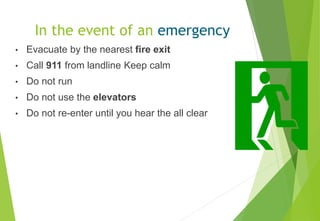
In the event of an emergency
• Evacuate by the nearest fire exit
• Call 911 from landline Keep calm
• Do not run
• Do not use the elevators
• Do not re-enter until you hear the all clear
Training Outcomes
3
 Basic Concepts of Electricity
 Hazard Recognition
 Effects of Electricity on the Human Body
 Electrical Hazard Protection
 Safe work Practices
 What to do in the event an electrical accident.
Purpose
• Raise your awareness to potential electrical hazards.
• Instruct you on how to recognize electrical hazards.
• Provide ways to eliminate, remove, and prevent electrical
hazards in the workplace.
• Emphasizing the extreme importance of observing all
electrical safety requirements and practices.
• what to do in the event an electrical accident.
4
Basic Concept of Electricity
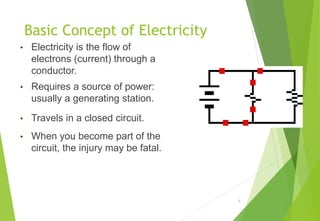
• Electricity is the flow of
electrons (current) through a
conductor.
• Requires a source of power:
usually a generating station.
• Travels in a closed circuit.
• When you become part of the
circuit, the injury may be fatal.
5
Hazard Recognition
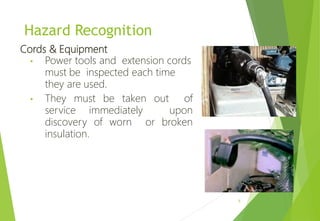
Cords & Equipment
• Power tools and extension cords
must be inspected each time
they are used.
• They must be taken out of
service immediately upon
discovery of worn or broken
insulation.
6
Hazard Recognition
Electrical Panels
• Electric panels must be kept
clear of any obstructions at all
times.
• Storage is not allowed in
electrical vault or service
panel rooms.
• Find another place for
storage of materials,
products, etc.
7
Hazard Recognition
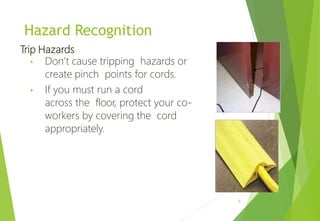
Trip Hazards
• Don’t cause tripping hazards or
create pinch points for cords.
• If you must run a cord
across the floor, protect your co-
workers by covering the cord
appropriately.
8
Hazard Recognition
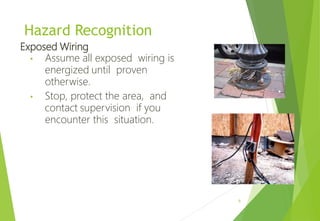
Exposed Wiring
• Assume all exposed wiring is
energized until proven
otherwise.
• Stop, protect the area, and
contact supervision if you
encounter this situation.
9
Hazard Recognition
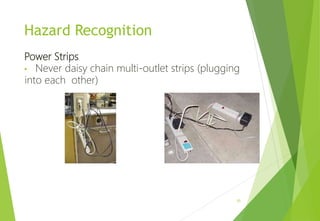
Power Strips
• Never daisy chain multi-outlet strips (plugging
into each other)
10
Electrical Injuries
11
There are four main types of electrical injuries:
• Electrocution (death due to electrical shock)
• Electrical Shock
• Burns
• Falls
What Causes Shock?
Shocks occur when a person’s body completes the current path
with:
• both wires of an electric circuit;
• one wire of an energized circuit and the ground;
• a metal part that accidentally becomes energized due, for
example, to a break in its insulation; or
• another “conductor” that is carrying a current.
12
Electric shock
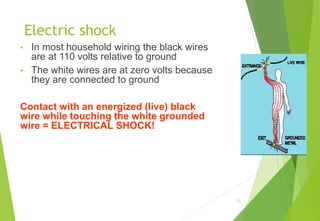
• In most household wiring the black wires
are at 110 volts relative to ground
• The white wires are at zero volts because
they are connected to ground
Contact with an energized (live) black
wire while touching the white grounded
wire = ELECTRICAL SHOCK!
13
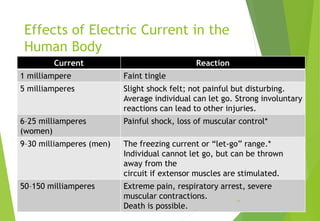
Effects of Electric Current in the
Human Body
Current Reaction
1 milliampere Faint tingle
5 milliamperes Slight shock felt; not painful but disturbing.
Average individual can let go. Strong involuntary
reactions can lead to other injuries.
6–25 milliamperes
(women)
Painful shock, loss of muscular control*
9–30 milliamperes (men) The freezing current or “let-go” range.*
Individual cannot let go, but can be thrown
away from the
circuit if extensor muscles are stimulated.
50–150 milliamperes Extreme pain, respiratory arrest, severe
muscular contractions.
Death is possible.
14
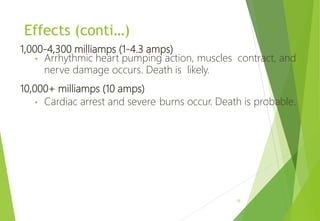
Effects (conti…)
1,000-4,300 milliamps (1-4.3 amps)
• Arrhythmic heart pumping action, muscles contract, and
nerve damage occurs. Death is likely.
10,000+ milliamps (10 amps)
• Cardiac arrest and severe burns occur. Death is probable.
15
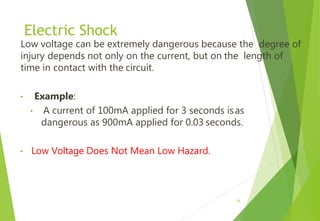
Electric Shock
Low voltage can be extremely dangerous because the degree of
injury depends not only on the current, but on the length of
time in contact with the circuit.
• Example:
• A current of 100mA applied for 3 seconds isas
dangerous as 900mA applied for 0.03 seconds.
• Low Voltage Does Not Mean Low Hazard.
16
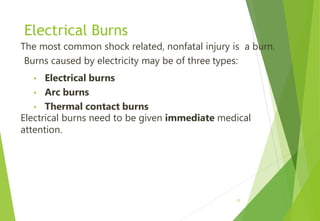
Electrical Burns
The most common shock related, nonfatal injury is a burn.
Burns caused by electricity may be of three types:
• Electrical burns
• Arc burns
• Thermal contact burns
Electrical burns need to be given immediate medical
attention.
17
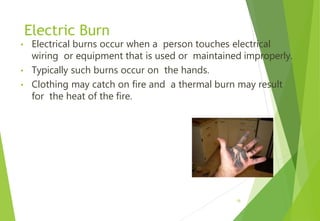
Electric Burn
• Electrical burns occur when a person touches electrical
wiring or equipment that is used or maintained improperly.
• Typically such burns occur on the hands.
• Clothing may catch on fire and a thermal burn may result
for the heat of the fire.
18
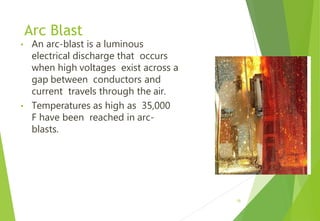
Arc Blast
• An arc-blast is a luminous
electrical discharge that occurs
when high voltages exist across a
gap between conductors and
current travels through the air.
• Temperatures as high as 35,000
F have been reached in arc-
blasts.
19
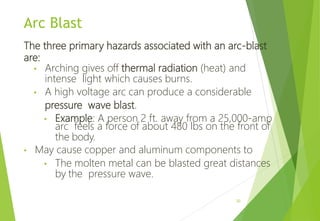
Arc Blast
The three primary hazards associated with an arc-blast
are:
• Arching gives off thermal radiation (heat) and
intense light which causes burns.
• A high voltage arc can produce a considerable
pressure wave blast.
• Example: A person 2 ft. away from a 25,000-amp
arc feels a force of about 480 lbs on the front of
the body.
• May cause copper and aluminum components to
• The molten metal can be blasted great distances
by the pressure wave.
20
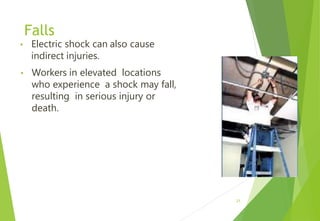
Falls
• Electric shock can also cause
indirect injuries.
• Workers in elevated locations
who experience a shock may fall,
resulting in serious injury or
death.
21
Electrical Hazard Protection
• Insulation
• Grounding
• Guarding
• Electrical protective devices
• Personal Protective Equipment
• Safe work practices
22
Insulation
• Plastic or rubber coverings that does not conduct electricity.
• Insulation prevents live wires from coming in contact with
people thus protecting them form electrical shock.
23
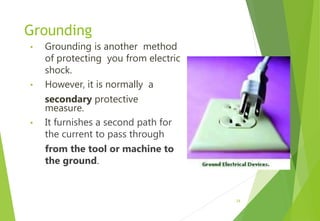
Grounding
• Grounding is another method
of protecting you from electric
shock.
• However, it is normally a
secondary protective
measure.
• It furnishes a second path for
the current to pass through
from the tool or machine to
the ground.
24
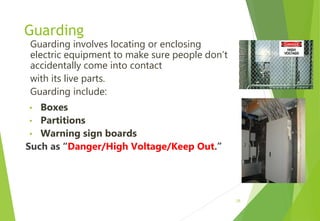
Guarding
Guarding involves locating or enclosing
electric equipment to make sure people don’t
accidentally come into contact
with its live parts.
Guarding include:
• Boxes
• Partitions
• Warning sign boards
Such as “Danger/High Voltage/Keep Out.”
25
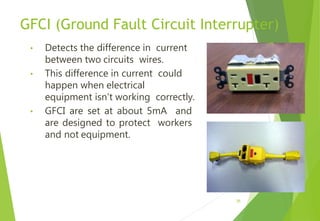
GFCI (Ground Fault Circuit Interrupter)
• Detects the difference in current
between two circuits wires.
• This difference in current could
happen when electrical
equipment isn’t working correctly.
• GFCI are set at about 5mA and
are designed to protect workers
and not equipment.
26
Fuses and Circuit Breakers
• Fuses and circuit breakers are intended primarily for the
protection of conductors and equipment.
• They prevent over-heating of wires and components
that might otherwise create hazards for operators.
• They also open the circuit under certain hazardous
ground-fault conditions.
27
Safe Work Practices
Electrical accidents are largely preventable through safe work
practices.
• De-energizing electric equipment before inspection or repair,
• keeping electric tools properly maintained,
• exercising caution when working near energized lines
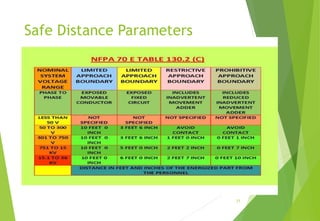
• maintain a safe distance from energized part
• Follow SSOW
28
Safe Work Practices
Employees and others working with electric equipment need
to use safe work practices.
• Plan your work by yourself and with others.
• Lock out Tag out circuits and equipment.
• Do not work in wet conditions.
• Avoid overhead power lines.
• You should be at least 10 feet away from high-voltage
transmission lines.
• Use proper wiring and connectors
• Avoid overloading circuits.
• Never use a three prong plug with the third prong broken off.
29
Safe Work Practices
• Use and maintain tools properly.
• Inspect tools before using them.
• Damaged tools must be removed from service.
• Using appropriate personal protective equipment
• Wear safety glasses to avoid eye injury.
• Wear proper foot protection.
• Wear a hard hat.
30
Safe Distance Parameters
31
How to respond a problem
In the event of an electrical fire:
• Activate the fire alarm system
• If you know how to use an extinguisher, use a CO2 or dry
chemical fire extinguisher
• Alert everyone in the area to evacuate
• Call EMERGENCY SERVICES or HSE TEAM
• If you are not sure about using a fire extinguisher, leave the
area and close any doors behind you
32
Summary
• Electricity will try to reach ground even if it means going
through a person
• Even the “small” voltage from your home can cause serious
injury
• Always inspect power tools and cords before each use and
do not use them if damaged
• Do not attempt to repair electrical equipment
• unless you are trained and qualified
• Always use lockout/tagout procedures to de- energize
electrical systems
33
Summary
• Use electrical tools and equipment that are protected by a
GFCI
• Review your assignments with your supervisors
• Utilize correct PPE
• Report all problems to your supervisors
• If at all in doubt, ask questions
34

Electrical safety

  • 1.
  • 2.
    In the eventof an emergency • Evacuate by the nearest fire exit • Call 911 from landline Keep calm • Do not run • Do not use the elevators • Do not re-enter until you hear the all clear
  • 3.
    Training Outcomes 3  BasicConcepts of Electricity  Hazard Recognition  Effects of Electricity on the Human Body  Electrical Hazard Protection  Safe work Practices  What to do in the event an electrical accident.
  • 4.
    Purpose • Raise yourawareness to potential electrical hazards. • Instruct you on how to recognize electrical hazards. • Provide ways to eliminate, remove, and prevent electrical hazards in the workplace. • Emphasizing the extreme importance of observing all electrical safety requirements and practices. • what to do in the event an electrical accident. 4
  • 5.
    Basic Concept ofElectricity • Electricity is the flow of electrons (current) through a conductor. • Requires a source of power: usually a generating station. • Travels in a closed circuit. • When you become part of the circuit, the injury may be fatal. 5
  • 6.
    Hazard Recognition Cords &Equipment • Power tools and extension cords must be inspected each time they are used. • They must be taken out of service immediately upon discovery of worn or broken insulation. 6
  • 7.
    Hazard Recognition Electrical Panels •Electric panels must be kept clear of any obstructions at all times. • Storage is not allowed in electrical vault or service panel rooms. • Find another place for storage of materials, products, etc. 7
  • 8.
    Hazard Recognition Trip Hazards •Don’t cause tripping hazards or create pinch points for cords. • If you must run a cord across the floor, protect your co- workers by covering the cord appropriately. 8
  • 9.
    Hazard Recognition Exposed Wiring •Assume all exposed wiring is energized until proven otherwise. • Stop, protect the area, and contact supervision if you encounter this situation. 9
  • 10.
    Hazard Recognition Power Strips •Never daisy chain multi-outlet strips (plugging into each other) 10
  • 11.
    Electrical Injuries 11 There arefour main types of electrical injuries: • Electrocution (death due to electrical shock) • Electrical Shock • Burns • Falls
  • 12.
    What Causes Shock? Shocksoccur when a person’s body completes the current path with: • both wires of an electric circuit; • one wire of an energized circuit and the ground; • a metal part that accidentally becomes energized due, for example, to a break in its insulation; or • another “conductor” that is carrying a current. 12
  • 13.
    Electric shock • Inmost household wiring the black wires are at 110 volts relative to ground • The white wires are at zero volts because they are connected to ground Contact with an energized (live) black wire while touching the white grounded wire = ELECTRICAL SHOCK! 13
  • 14.
    Effects of ElectricCurrent in the Human Body Current Reaction 1 milliampere Faint tingle 5 milliamperes Slight shock felt; not painful but disturbing. Average individual can let go. Strong involuntary reactions can lead to other injuries. 6–25 milliamperes (women) Painful shock, loss of muscular control* 9–30 milliamperes (men) The freezing current or “let-go” range.* Individual cannot let go, but can be thrown away from the circuit if extensor muscles are stimulated. 50–150 milliamperes Extreme pain, respiratory arrest, severe muscular contractions. Death is possible. 14
  • 15.
    Effects (conti…) 1,000-4,300 milliamps(1-4.3 amps) • Arrhythmic heart pumping action, muscles contract, and nerve damage occurs. Death is likely. 10,000+ milliamps (10 amps) • Cardiac arrest and severe burns occur. Death is probable. 15
  • 16.
    Electric Shock Low voltagecan be extremely dangerous because the degree of injury depends not only on the current, but on the length of time in contact with the circuit. • Example: • A current of 100mA applied for 3 seconds isas dangerous as 900mA applied for 0.03 seconds. • Low Voltage Does Not Mean Low Hazard. 16
  • 17.
    Electrical Burns The mostcommon shock related, nonfatal injury is a burn. Burns caused by electricity may be of three types: • Electrical burns • Arc burns • Thermal contact burns Electrical burns need to be given immediate medical attention. 17
  • 18.
    Electric Burn • Electricalburns occur when a person touches electrical wiring or equipment that is used or maintained improperly. • Typically such burns occur on the hands. • Clothing may catch on fire and a thermal burn may result for the heat of the fire. 18
  • 19.
    Arc Blast • Anarc-blast is a luminous electrical discharge that occurs when high voltages exist across a gap between conductors and current travels through the air. • Temperatures as high as 35,000 F have been reached in arc- blasts. 19
  • 20.
    Arc Blast The threeprimary hazards associated with an arc-blast are: • Arching gives off thermal radiation (heat) and intense light which causes burns. • A high voltage arc can produce a considerable pressure wave blast. • Example: A person 2 ft. away from a 25,000-amp arc feels a force of about 480 lbs on the front of the body. • May cause copper and aluminum components to • The molten metal can be blasted great distances by the pressure wave. 20
  • 21.
    Falls • Electric shockcan also cause indirect injuries. • Workers in elevated locations who experience a shock may fall, resulting in serious injury or death. 21
  • 22.
    Electrical Hazard Protection •Insulation • Grounding • Guarding • Electrical protective devices • Personal Protective Equipment • Safe work practices 22
  • 23.
    Insulation • Plastic orrubber coverings that does not conduct electricity. • Insulation prevents live wires from coming in contact with people thus protecting them form electrical shock. 23
  • 24.
    Grounding • Grounding isanother method of protecting you from electric shock. • However, it is normally a secondary protective measure. • It furnishes a second path for the current to pass through from the tool or machine to the ground. 24
  • 25.
    Guarding Guarding involves locatingor enclosing electric equipment to make sure people don’t accidentally come into contact with its live parts. Guarding include: • Boxes • Partitions • Warning sign boards Such as “Danger/High Voltage/Keep Out.” 25
  • 26.
    GFCI (Ground FaultCircuit Interrupter) • Detects the difference in current between two circuits wires. • This difference in current could happen when electrical equipment isn’t working correctly. • GFCI are set at about 5mA and are designed to protect workers and not equipment. 26
  • 27.
    Fuses and CircuitBreakers • Fuses and circuit breakers are intended primarily for the protection of conductors and equipment. • They prevent over-heating of wires and components that might otherwise create hazards for operators. • They also open the circuit under certain hazardous ground-fault conditions. 27
  • 28.
    Safe Work Practices Electricalaccidents are largely preventable through safe work practices. • De-energizing electric equipment before inspection or repair, • keeping electric tools properly maintained, • exercising caution when working near energized lines • maintain a safe distance from energized part • Follow SSOW 28
  • 29.
    Safe Work Practices Employeesand others working with electric equipment need to use safe work practices. • Plan your work by yourself and with others. • Lock out Tag out circuits and equipment. • Do not work in wet conditions. • Avoid overhead power lines. • You should be at least 10 feet away from high-voltage transmission lines. • Use proper wiring and connectors • Avoid overloading circuits. • Never use a three prong plug with the third prong broken off. 29
  • 30.
    Safe Work Practices •Use and maintain tools properly. • Inspect tools before using them. • Damaged tools must be removed from service. • Using appropriate personal protective equipment • Wear safety glasses to avoid eye injury. • Wear proper foot protection. • Wear a hard hat. 30
  • 31.
  • 32.
    How to responda problem In the event of an electrical fire: • Activate the fire alarm system • If you know how to use an extinguisher, use a CO2 or dry chemical fire extinguisher • Alert everyone in the area to evacuate • Call EMERGENCY SERVICES or HSE TEAM • If you are not sure about using a fire extinguisher, leave the area and close any doors behind you 32
  • 33.
    Summary • Electricity willtry to reach ground even if it means going through a person • Even the “small” voltage from your home can cause serious injury • Always inspect power tools and cords before each use and do not use them if damaged • Do not attempt to repair electrical equipment • unless you are trained and qualified • Always use lockout/tagout procedures to de- energize electrical systems 33
  • 34.
    Summary • Use electricaltools and equipment that are protected by a GFCI • Review your assignments with your supervisors • Utilize correct PPE • Report all problems to your supervisors • If at all in doubt, ask questions 34

Editor's Notes

  • #13 Electricity travels in closed circuits, normally through a conductor. But sometimes a person’s body — an efficient conductor of electricity — mistakenly becomes part of the electric circuit. This can cause an electrical shock. Shocks occur when a person’s body completes the current path with: • both wires of an electric circuit; • one wire of an energized circuit and the ground; • a metal part that accidentally becomes energized due, for example, to a break in its insulation; or • another “conductor” that is carrying a current. When a person receives a shock, electricity flows between parts of the body or through the body to a ground or the earth.