Electrical
Safety
2022
Sana’a
UST
Presented by:
Shaima Mohammed
Malak Ayman
Under supervision of:
Dr.Mahmoud Al-Rumaima
Table of contents
Sources &
Causes
Effect &
Risks
Codes &
Standards
First Aid &
Precaution
Classes &
types
05 06
02 03
04
01
Introduction
& Definitions
1.1 Introduction
Electricity is essential to modern life, both at home
and on jobs. Some employees - engineers,
electricians, electronic technicians, and power line
workers, among them - work with electricity directly.
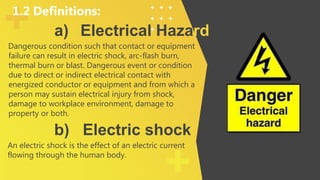
a) Electrical Hazard
Dangerous condition such that contact or equipment
failure can result in electric shock, arc-flash burn,
thermal burn or blast. Dangerous event or condition
due to direct or indirect electrical contact with
energized conductor or equipment and from which a
person may sustain electrical injury from shock,
damage to workplace environment, damage to
property or both.
1.2 Definitions:
b) Electric shock
An electric shock is the effect of an electric current
flowing through the human body.
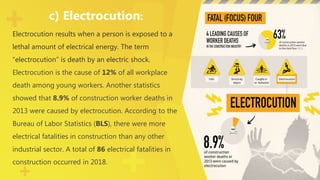
Electrocution results when a person is exposed to a
lethal amount of electrical energy. The term
“electrocution” is death by an electric shock.
Electrocution is the cause of 12% of all workplace
death among young workers. Another statistics
showed that 8.9% of construction worker deaths in
2013 were caused by electrocution. According to the
Bureau of Labor Statistics (BLS), there were more
electrical fatalities in construction than any other
industrial sector. A total of 86 electrical fatalities in
construction occurred in 2018.
c) Electrocution:
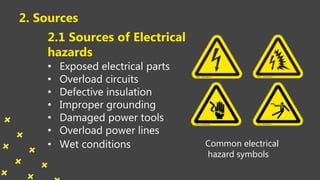
Common electrical
hazard symbols
2.1 Sources of Electrical
hazards
• Exposed electrical parts
• Overload circuits
• Defective insulation
• Improper grounding
• Damaged power tools
• Overload power lines
• Wet conditions
2. Sources
How the electrical shock happen ?
2.2 Causes
An electrical shock, arc flash or arc blast can
occur and a current can go through the body,
due to the following situations:
• Direct contact with live parts of the
installation (exposure to live parts).
• Contact with parts that normally are not live,
but as a consequence of a fault become live
accidentally (indirect contact).
• Existence of potential difference between
different points in the ground.
• The current takes the path of lowest
resistance .
The current takes the path
of lowest resistance
2.2
Causes
Electricity takes the
path of least resistance
Live wire contact in one hand
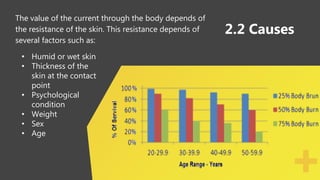
The value of the current through the body depends of
the resistance of the skin. This resistance depends of
several factors such as:
2.2 Causes
• Humid or wet skin
• Thickness of the
skin at the contact
point
• Psychological
condition
• Weight
• Sex
• Age
The pathway of the current
through the human body is
unpredictable, and pathways
through the heart are the most
dangerous. The figure below
shows possible pathways. Two
points of contact are required on
the body to complete the circuit
for shock current to flow.
2.2 Causes
The effects of electrical current through the
human body vary according to:
• The voltage
• The time the current flows
• The value of the current
• The frequency of the network
• The pathway of the current
• The ability of the person to react
3. Effect & Risks
3.1Physiological effect of electricity
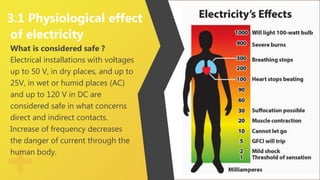
What is considered safe ?
Electrical installations with voltages
up to 50 V, in dry places, and up to
25V, in wet or humid places (AC)
and up to 120 V in DC are
considered safe in what concerns
direct and indirect contacts.
Increase of frequency decreases
the danger of current through the
human body.
3.1 Physiological effect
of electricity
video
3.1 Physiological effect of electricity
What is considered dangerous ?
The called “industrial frequencies” (50 Hz
or 60 Hz) are the more dangerous.
AC or DC, Which one is dangerous ?
Both the AC and DC voltages and
Currents are dangerous & hazardous. But
AC with 50 or 60Hz frequency is more
dangerous than the same voltage of level
for DC.
Effects AC DC
Perception 0.5-1.5 0-4
surprise 1-3 4-15
Reflex Action 3-21 15-88
Muscular Inhibition 21-40 88-160
Respiratory Block 40-100 160-300
Usually Fatal More
than
100
More
than
300
Volt or current, Which one is
dangerous ?
Current kills but some amount of voltage
is required to flow current in the body
breaking the human body resistance.
Therefore enough voltage of hundredth
with enough current make electric shock.
Overall, it is mainly the eclectic power (a
mixture of current and voltage) where
voltage (as a pressure) pushes electric
current (as a flow of charge) is
responsible for electric shock.
3.1 Physiological effect of electricity
video
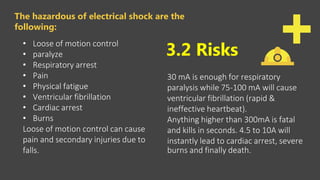
30 mA is enough for respiratory
paralysis while 75-100 mA will cause
ventricular fibrillation (rapid &
ineffective heartbeat).
Anything higher than 300mA is fatal
and kills in seconds. 4.5 to 10A will
instantly lead to cardiac arrest, severe
burns and finally death.
The hazardous of electrical shock are the
following:
3.2 Risks
• Loose of motion control
• paralyze
• Respiratory arrest
• Pain
• Physical fatigue
• Ventricular fibrillation
• Cardiac arrest
• Burns
Loose of motion control can cause
pain and secondary injuries due to
falls.
Risks of wet
conditions
The average resistance of a human body in dry
condition is almost ≈ 100,000Ω while the
resistance of a human body in wet condition is
1000Ω.
Also, the voltage above 50V (in dry condition)
and 25V (in wet condition) is enough to shock
a person.
Electricity and water make a dangerous
combination, as the water’s ions are extremely
conductive.
3.2
Risks
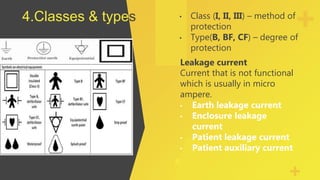
4.Classes & types • Class (I, II, III) – method of
protection
• Type(B, BF, CF) – degree of
protection
Leakage current
Current that is not functional
which is usually in micro
ampere.
• Earth leakage current
• Enclosure leakage
current
• Patient leakage current
• Patient auxiliary current
Leakage
current
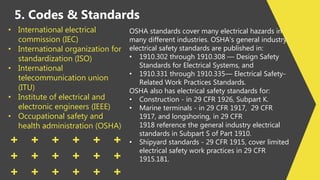
5. Codes & Standards
• International electrical
commission (IEC)
• International organization for
standardization (ISO)
• International
telecommunication union
(ITU)
• Institute of electrical and
electronic engineers (IEEE)
• Occupational safety and
health administration (OSHA)
OSHA standards cover many electrical hazards in
many different industries. OSHA's general industry
electrical safety standards are published in:
• 1910.302 through 1910.308 — Design Safety
Standards for Electrical Systems, and
• 1910.331 through 1910.335— Electrical Safety-
Related Work Practices Standards.
OSHA also has electrical safety standards for:
• Construction - in 29 CFR 1926, Subpart K.
• Marine terminals - in 29 CFR 1917, 29 CFR
1917, and longshoring, in 29 CFR
1918 reference the general industry electrical
standards in Subpart S of Part 1910.
• Shipyard standards - 29 CFR 1915, cover limited
electrical safety work practices in 29 CFR
1915.181.
Electrical
Safety
Analyzer
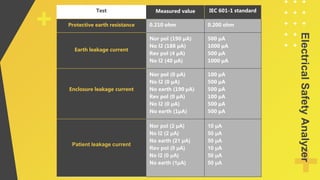
Test Measured value IEC 601-1 standard
Protective earth resistance 0.210 ohm 0.200 ohm
Earth leakage current
Nor pol (190 µA)
No l2 (188 µA)
Rev pol (4 µA)
No l2 (40 µA)
500 µA
1000 µA
500 µA
1000 µA
Enclosure leakage current
Nor pol (0 µA)
No l2 (0 µA)
No earth (190 µA)
Rev pol (0 µA)
No l2 (0 µA)
No earth (1µA)
100 µA
500 µA
500 µA
100 µA
500 µA
500 µA
Patient leakage current
Nor pol (2 µA)
No l2 (2 µA)
No earth (21 µA)
Rev pol (0 µA)
No l2 (0 µA)
No earth (1µA)
10 µA
50 µA
50 µA
10 µA
50 µA
50 µA
Test Measured value IEC 601-1 standard
Patient auxiliary current
Normal pol, earth, l2
RA-A (0 µA)
RL-A (0 µA)
LA-A (0 µA)
10 µA
10 µA
10 µA
Patient auxiliary current
Normal pol, earth, no l2
RA-A (0 µA)
RL-A (0 µA)
LA-A (0 µA)
50 µA
50 µA
50 µA
Patient auxiliary current
Normal pol, no earth, l2
RA-A (1 µA)
RL-A (1 µA)
LA-A (4 µA)
RA-A (1 µA)
RL-A (1 µA)
LA-A (4 µA)
Electrical
Safety
Analyzer
video
6.First Aid &
Precaution
Caution
• Don't touch an injured person who
is still in contact with an electrical
current.
• Call your local emergency number if
the source of the burn is a high-
voltage wire or lightning. Don't get
near high-voltage wires until the
power is turned off. Overhead
power lines usually aren't insulated.
Stay at least 20 feet (about 6
meters) away — farther if wires are
jumping and sparking.
• Don't move a person with an
electrical injury unless there is
immediate danger
6.First Aid & Precaution
Take these actions immediately while waiting for
medical help:
• Turn off the source of electricity, if possible. If not,
use a dry, non-conducting object made of
cardboard, plastic or wood to move the source
away from you and the injured person.
• Begin CPR if the person shows no signs of
circulation, such as breathing, coughing or
movement.
• Try to prevent the injured person from becoming
chilled.
• Apply a bandage. Cover any burned areas with a
sterile gauze bandage, if available, or a clean
cloth. Don't use a blanket or towel, because loose
fibers can stick to the burns.
video
● Electrocutions & Shock Injuries: the Basics of Human Electrical
Exposures | Robson Forensic
● Electrical Shock Hazards & Its Effects on Human Body
(electricaltechnology.org)
● Is Voltage or Amperage (Current) More Dangerous?
(oneprojectcloser.com)
● Focus Four - What is an electrocution hazard? - OSHAcademy free
online training (oshatrain.org)
● Electrical shock: First aid - Mayo Clinic
Resources
electrical-safety.pptx

electrical-safety.pptx

  • 1.
    Electrical Safety 2022 Sana’a UST Presented by: Shaima Mohammed MalakAyman Under supervision of: Dr.Mahmoud Al-Rumaima
  • 2.
    Table of contents Sources& Causes Effect & Risks Codes & Standards First Aid & Precaution Classes & types 05 06 02 03 04 01 Introduction & Definitions
  • 3.
    1.1 Introduction Electricity isessential to modern life, both at home and on jobs. Some employees - engineers, electricians, electronic technicians, and power line workers, among them - work with electricity directly.
  • 4.
    a) Electrical Hazard Dangerouscondition such that contact or equipment failure can result in electric shock, arc-flash burn, thermal burn or blast. Dangerous event or condition due to direct or indirect electrical contact with energized conductor or equipment and from which a person may sustain electrical injury from shock, damage to workplace environment, damage to property or both. 1.2 Definitions: b) Electric shock An electric shock is the effect of an electric current flowing through the human body.
  • 5.
    Electrocution results whena person is exposed to a lethal amount of electrical energy. The term “electrocution” is death by an electric shock. Electrocution is the cause of 12% of all workplace death among young workers. Another statistics showed that 8.9% of construction worker deaths in 2013 were caused by electrocution. According to the Bureau of Labor Statistics (BLS), there were more electrical fatalities in construction than any other industrial sector. A total of 86 electrical fatalities in construction occurred in 2018. c) Electrocution:
  • 6.
    Common electrical hazard symbols 2.1Sources of Electrical hazards • Exposed electrical parts • Overload circuits • Defective insulation • Improper grounding • Damaged power tools • Overload power lines • Wet conditions 2. Sources
  • 7.
    How the electricalshock happen ? 2.2 Causes An electrical shock, arc flash or arc blast can occur and a current can go through the body, due to the following situations: • Direct contact with live parts of the installation (exposure to live parts). • Contact with parts that normally are not live, but as a consequence of a fault become live accidentally (indirect contact). • Existence of potential difference between different points in the ground. • The current takes the path of lowest resistance .
  • 8.
    The current takesthe path of lowest resistance 2.2 Causes Electricity takes the path of least resistance Live wire contact in one hand
  • 9.
    The value ofthe current through the body depends of the resistance of the skin. This resistance depends of several factors such as: 2.2 Causes • Humid or wet skin • Thickness of the skin at the contact point • Psychological condition • Weight • Sex • Age
  • 10.
    The pathway ofthe current through the human body is unpredictable, and pathways through the heart are the most dangerous. The figure below shows possible pathways. Two points of contact are required on the body to complete the circuit for shock current to flow. 2.2 Causes
  • 11.
    The effects ofelectrical current through the human body vary according to: • The voltage • The time the current flows • The value of the current • The frequency of the network • The pathway of the current • The ability of the person to react 3. Effect & Risks 3.1Physiological effect of electricity
  • 12.
    What is consideredsafe ? Electrical installations with voltages up to 50 V, in dry places, and up to 25V, in wet or humid places (AC) and up to 120 V in DC are considered safe in what concerns direct and indirect contacts. Increase of frequency decreases the danger of current through the human body. 3.1 Physiological effect of electricity
  • 13.
  • 14.
    3.1 Physiological effectof electricity What is considered dangerous ? The called “industrial frequencies” (50 Hz or 60 Hz) are the more dangerous. AC or DC, Which one is dangerous ? Both the AC and DC voltages and Currents are dangerous & hazardous. But AC with 50 or 60Hz frequency is more dangerous than the same voltage of level for DC. Effects AC DC Perception 0.5-1.5 0-4 surprise 1-3 4-15 Reflex Action 3-21 15-88 Muscular Inhibition 21-40 88-160 Respiratory Block 40-100 160-300 Usually Fatal More than 100 More than 300
  • 15.
    Volt or current,Which one is dangerous ? Current kills but some amount of voltage is required to flow current in the body breaking the human body resistance. Therefore enough voltage of hundredth with enough current make electric shock. Overall, it is mainly the eclectic power (a mixture of current and voltage) where voltage (as a pressure) pushes electric current (as a flow of charge) is responsible for electric shock. 3.1 Physiological effect of electricity
  • 16.
  • 17.
    30 mA isenough for respiratory paralysis while 75-100 mA will cause ventricular fibrillation (rapid & ineffective heartbeat). Anything higher than 300mA is fatal and kills in seconds. 4.5 to 10A will instantly lead to cardiac arrest, severe burns and finally death. The hazardous of electrical shock are the following: 3.2 Risks • Loose of motion control • paralyze • Respiratory arrest • Pain • Physical fatigue • Ventricular fibrillation • Cardiac arrest • Burns Loose of motion control can cause pain and secondary injuries due to falls.
  • 18.
    Risks of wet conditions Theaverage resistance of a human body in dry condition is almost ≈ 100,000Ω while the resistance of a human body in wet condition is 1000Ω. Also, the voltage above 50V (in dry condition) and 25V (in wet condition) is enough to shock a person. Electricity and water make a dangerous combination, as the water’s ions are extremely conductive. 3.2 Risks
  • 19.
    4.Classes & types• Class (I, II, III) – method of protection • Type(B, BF, CF) – degree of protection Leakage current Current that is not functional which is usually in micro ampere. • Earth leakage current • Enclosure leakage current • Patient leakage current • Patient auxiliary current
  • 20.
  • 21.
    5. Codes &Standards • International electrical commission (IEC) • International organization for standardization (ISO) • International telecommunication union (ITU) • Institute of electrical and electronic engineers (IEEE) • Occupational safety and health administration (OSHA) OSHA standards cover many electrical hazards in many different industries. OSHA's general industry electrical safety standards are published in: • 1910.302 through 1910.308 — Design Safety Standards for Electrical Systems, and • 1910.331 through 1910.335— Electrical Safety- Related Work Practices Standards. OSHA also has electrical safety standards for: • Construction - in 29 CFR 1926, Subpart K. • Marine terminals - in 29 CFR 1917, 29 CFR 1917, and longshoring, in 29 CFR 1918 reference the general industry electrical standards in Subpart S of Part 1910. • Shipyard standards - 29 CFR 1915, cover limited electrical safety work practices in 29 CFR 1915.181.
  • 22.
    Electrical Safety Analyzer Test Measured valueIEC 601-1 standard Protective earth resistance 0.210 ohm 0.200 ohm Earth leakage current Nor pol (190 µA) No l2 (188 µA) Rev pol (4 µA) No l2 (40 µA) 500 µA 1000 µA 500 µA 1000 µA Enclosure leakage current Nor pol (0 µA) No l2 (0 µA) No earth (190 µA) Rev pol (0 µA) No l2 (0 µA) No earth (1µA) 100 µA 500 µA 500 µA 100 µA 500 µA 500 µA Patient leakage current Nor pol (2 µA) No l2 (2 µA) No earth (21 µA) Rev pol (0 µA) No l2 (0 µA) No earth (1µA) 10 µA 50 µA 50 µA 10 µA 50 µA 50 µA
  • 23.
    Test Measured valueIEC 601-1 standard Patient auxiliary current Normal pol, earth, l2 RA-A (0 µA) RL-A (0 µA) LA-A (0 µA) 10 µA 10 µA 10 µA Patient auxiliary current Normal pol, earth, no l2 RA-A (0 µA) RL-A (0 µA) LA-A (0 µA) 50 µA 50 µA 50 µA Patient auxiliary current Normal pol, no earth, l2 RA-A (1 µA) RL-A (1 µA) LA-A (4 µA) RA-A (1 µA) RL-A (1 µA) LA-A (4 µA) Electrical Safety Analyzer
  • 24.
  • 25.
    6.First Aid & Precaution Caution •Don't touch an injured person who is still in contact with an electrical current. • Call your local emergency number if the source of the burn is a high- voltage wire or lightning. Don't get near high-voltage wires until the power is turned off. Overhead power lines usually aren't insulated. Stay at least 20 feet (about 6 meters) away — farther if wires are jumping and sparking. • Don't move a person with an electrical injury unless there is immediate danger
  • 26.
    6.First Aid &Precaution Take these actions immediately while waiting for medical help: • Turn off the source of electricity, if possible. If not, use a dry, non-conducting object made of cardboard, plastic or wood to move the source away from you and the injured person. • Begin CPR if the person shows no signs of circulation, such as breathing, coughing or movement. • Try to prevent the injured person from becoming chilled. • Apply a bandage. Cover any burned areas with a sterile gauze bandage, if available, or a clean cloth. Don't use a blanket or towel, because loose fibers can stick to the burns.
  • 27.
  • 28.
    ● Electrocutions &Shock Injuries: the Basics of Human Electrical Exposures | Robson Forensic ● Electrical Shock Hazards & Its Effects on Human Body (electricaltechnology.org) ● Is Voltage or Amperage (Current) More Dangerous? (oneprojectcloser.com) ● Focus Four - What is an electrocution hazard? - OSHAcademy free online training (oshatrain.org) ● Electrical shock: First aid - Mayo Clinic Resources