SCCT ACS 2006
Quality Assurance of Precast
Concrete Product
by
Ir Richard Sumners MHKIE (Materials)
Program for Today:
Introduction to QA of Precast Product
Some new and innovative ways to assist in QA of precast
Definition.
“ The manufacture of off-site, moulded, or
formed product using a hydraulic
cementitious material as a binder to
construct a useful product or shape.”
SCCT ACS 2006
Examples of Precast Products
SCCT ACS 2006
SCCT ACS 2006
SCCT ACS 2006
SCCT ACS 2006
SCCT ACS 2006
What are the different precast products requiring QA.
Simple Answer :- All
Plant certification Classified into 4 main groups
Architectural
Bridges
Commercial
GRC
Refer to www.pci.org for further details
Quality System
Production Practices
Raw Materials and Accessories
Concrete
Reinforcement and Stressing,
Quality Control/ Acceptability
SCCT ACS 2006
SCCT ACS 2006
Quality System
Extract from cl.4.1.1 of Code of Practice
For Precast Concrete Construction 2003 issued by BD
“A factory selected for the casting of units must
ensure that the precast units are manufactured
under a Quality Assurance Scheme certified under
ISO 9000 covering the following items:
• quality control tests of materials;
• calibration of laboratory equipment for quality
control tests; and
• production process and control of equipment at
the casting yard”
SCCT ACS 2006
Production Practices
•Safety
•Production and Curing Facilities
•Moulds
•‘Hardware’ installation
(e.g. anchor bolts,
plates, windows, tiles,etc)
•Handling
•Surface Finishes
•Repairs
•Acceptability of Appearance
•Sealers/coatings
•Etc, etc.
SCCT ACS 2006
Safety
•With nearly precast plants for supply to HK
in Guangdong Province safety of all
personnel is obviously a high concern.
•Safety is difficult to achieve given the lack of
education/understanding of the labourers.
But precasters do try there best with the
available resources and it is an uphill battle
that they are continually facing.
•To date levels of reported incidents of
serious safety issues at precast facilites is
low.
SCCT ACS 2006
Production and Curing Practices
• Suitable to ensure samples/moulds are
protected against detrimental environment
conditions.
• Adequate lighting for all operations
• Ideally ‘maintain suitable ambient
temperature within production area’
• Mould Fabrication facilities (some local
precasters make there own !)
a. capable of providing moulds of the
required accuracy
b. Moulds stored appropriately to avoid
damage/change of dimensions e.g. due to
execessive temperature
c. Use qualified Design Engineers /
Specialists
SCCT ACS 2006
Production and Curing Practices
• Suitable Storage of Materials
• Hardware Fabrication and Storage (to
avoid distortion and other affects) –
External records for outside suppliers.
• Casting Area and Equipment
• Sufficient and suitable equipment.
• Flexibility in planning spacing of moulds
and movability of workers, materials
and product.
• When stressing activities performed –
separate distinct/secure area.
• Sufficient Ventilation for certain
applications.
SCCT ACS 2006
Curing Areas
• Most curing is by using ambient (covered in
polyethylene or wet hessian) curing conditions
(Normally cured for at least 4 days)
• Sometimes Steam curing used to ensure one-
day production cycle (or more frequent) –
common practice is to control temperature
(~55+/-5oC) of steam at suitable ‘agreed’
locations near the surface of the element by use
of thermocouples. The steam is applied 4 hours
after pouring at a rate of 10oC per hour ensuring
concrete temperature does not exceed 70oC (e.g.
Segments). When cooling same rate applies.
• Power regulated Heat Lamps are occasionally
used for certain applications instead of steam
(e.g. curing of LVT Blocks).
SCCT ACS 2006
Materials and Construction
• Moulds maybe made of a variety of materials.
• Stable to produce required finish and tolerance
• Some may be reused many times others maybe
one-off. For reusable moulds checking of
moulds before reuse is required
• Appropriate selection of mould type and quality.
The appearance of finish is directly related to
the choice of mould material and quality of the
mould.
• Selection of Mould Release agent will be
dependent on type of mould and possible
affects on finish (e.g. discolouration/staining)
SCCT ACS 2006
Moulds from Different Materials (Timber, GRP, GRC, Steel or
Rubber)
Split, Single
or Multiple Moulds
Moulds
SCCT ACS 2006
Moulds
Verification and Maintenance
• Mould Surfaces and dimensions checked in detail
against design drawings before casting. (normally
dimensional/ flatness / squareness / twist/
straightness / visual checks)
• Moulds have to be cleaned and inspected before each
use. Inspection to look for defects/contaminations
that may affect appearance/performance and correct
assembly with design drawings.
• Templates
(used for flatness checking etc)
and other equipment used to
verify moulds also have to
be inspected and maintained
regularly.
• Mould Release agent applied
evenly without ponding.
SCCT ACS 2006
Finishing Areas
Depends on the type of product, some products no
finishing treatment required prior to storage and
delivery others may require extensive treatment.
For the latter case good lighting is essential at
the point where final inspection takes place.
Lighting should be as close possible to the actual
lighting conditions of the product when in service.
Also the area shall contain all the elements
necessary for the appropriate finish to be applied
(more detail later)
SCCT ACS 2006
Handling Equipment
The type, capacity of equipment for handling finished
products depends on the product and its operating
conditions
Equipment maintained in good working order to be
Capable of stripping, moving , stacking, retrieving ,
loading units without damage.
Storage Area for Finished Products
Adequate size for safe (damage free) storage , easy
access (required for inspection) and handling of
products.
Area should be clean, well drained and stabilized.
Storage conditions will be dependent upon product.
SCCT ACS 2006
Handling
The handling method depends on the type of
product
• Susceptibility to damage.
• Size / Weight of the product
Suitable procedures required for each
product type to allow for demoulding, lifting ,
storage and preparation for transport.
The handling has to ensure that structural
damage, detrimental cracking, architectural
impairment or permanent distortion are
avoided.
SCCT ACS 2006
Yard Storage/Loading.
• Careful Planning,
• Units generally supported with 2-point supports
spaced at about 1/5th point.
• Stored on firm and level ground.
• Stored & Loaded in a way to protect from damage,
discolouration or staining of finished product.
• Stored and loaded in a suitable manner to allow
for moving at later stage.
• Stored and loaded using even loading to prevent
domino effect.
Cleaning
• All exposed surfaces of units cleaned as
necessary prior to shipping to remove dirt, stains
etc.
SCCT ACS 2006
Storage
SCCT ACS 2006
Sealers or Clear Surface Coatings
• When Specified Precasters use sealers/clear
surface coatings after surface finish
accepted.
• Architectural Concrete normally do not use
sealers for waterproofing.
• Sealers used have to be checked before use
to ensure that they do not cause stains ,
darken , discolour the finish or cause similar
effects to any joint sealants that maybe
present.
SCCT ACS 2006
Hardware Installation
All Hardware checked prior to casting to verify
• Correct size and Type
• Sufficient Quantity
• Coating
• Accuracy.
• Strength.
• Correct Alignment/positioning.
During casting hardware also checked to
Ensure that they have not moved and
concrete around them consolidated correctly
SCCT ACS 2006
Stripping, Lifting
• Tests performed to confirm that concrete
strength achieves requirement for
stripping, detensioning and lifting. (Precast
Code of Practice PNAP 286)
SCCT ACS 2006
Stripping
• Tests performed to confirm that concrete
strength achieves requirement for stripping,
detensioning and lifting. (Precast Code of
Practice PNAP 286)
• All removable inserts, fastenings, mould
parts released and/or removed prior to
stripping.
• Units uniquely identified in appropriate
place to include cast date or serial
number.
• Surface of Unit checked for damage
Surface Finishes
How to ensuring quality of finish !.
First all parties agree on the acceptable
type of finish
This is achieved by using by various
ways
SCCT ACS 2006
SCCT ACS 2006
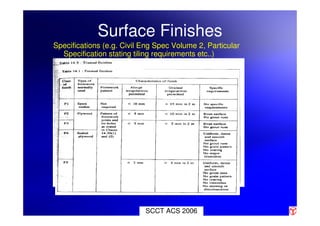
Surface Finishes
Specifications (e.g. Civil Eng Spec Volume 2, Particular
Specification stating tiling requirements etc..)
Initial standard points of reference.
SCCT ACS 2006
Refer to PCI –Color Texture Guide at
http://www.pci.org
Surface Finish
SCCT ACS 2006
Surface Finishes
Mock-up/Control samples
with varying levels of colour/
acid etching/ tooling etc
Do Not use one sample as
control use a series or range !.
SCCT ACS 2006
Painted Finishes
SCCT ACS 2006
Acceptability of Appearance
• Agreement on how to accept finish (lighting
requirements / colour (range) requirement/ intensity of
shade requirements / depth of etching etc…)
• Generally Subjective individual judgment. Standard
Rules therefore difficult.
• “Finish face surface shall have no obvious
imperfections other than minimal colour and texture
variations from the approved samples or evidence of
repair when viewed in good typical daylight illumination
with the unaided naked eye at 6m viewing distance.”
• Colour variation will vary greatly with different colours ,
e.g. white will have minimal variation whereas
something such as dark blue is difficult to control.
• Also Note ensure persons assessing and / or accepting
do not suffer from colour deficiency
SCCT ACS 2006
Repairs
• A certain amount of Repair Should Always
be expected.
• Repair normally requires a lot of care and
should always be performed by experts.
• Selection of the appropriate repair material
to ensure that the end-product may be
structurally sound , durable or visually
acceptable and all of these not impaired by
the repair.
• Excessive variation in colour or texture of
repairs from the surrounding surfaces may
result in the panels being not approved
until the variation is minimized.
Repairs
• Repairs should be done prior to being
placed in the storage area.
• Colour variations between new and old
samples will always be evident. Repairs
differences will blend in time (several
weeks). Earlier repair made normally the
better.
• If Substantial variation in colour and texture
of repairs from the surrounding area occur,
the repair may be required to be removed
and new repair material installed.
• Small cracks (< 0.25mm) may not need
repair unless failure to do can cause
corrosion of reinforcement.
SCCT ACS 2006
Repairs
How are common repairs normally performed.
• Filling Cracks with epoxy
• Filling imperfections (blow holes, water holes,
exposed aggregate , bleed scarring etc) with
cement sand (or CRF) mortar / brush or rub into
place with latex or similar material as gauging
medium. Care required as may cause colour
variations
• More Acid Etching/sandblasting (make it lighter)
• Removal of stains (removal depends on type of
stain)
• Blending pigment slurry into the repair area.
• Breaking out and Reinstatement.
• Many others
SCCT ACS 2006
Raw Materials and Accessories
SCCT ACS 2006
* Concrete Materials
(Concrete Materials Comply to the requirements of HKQAA QSPSC
(or equivalent) plus any other additional Specification requirements)
* Reinforcement and Hardware
(Comply to the requirements of CS2 / BS 5896 / BS4482/ BS4483
and/or other additional Specification requirements)
* Others
(Window frames, Tiles, Insulations, Conduits for E & M Fixings,
lighting, TV ..., Waterproofing, Welding for Hardware Etc..)
•Precasters arrange testing to be performed of the materials
at HOKLAS accredited labs (or equivalent) if available prior
to use and acceptance.
Raw Materials Others
– Window frames
– Tiles
– Insulations
– Conduits for E & M Fixings, lighting,
TV ...
– Waterproofing
– Welding for Hardware
– Etc..
SCCT ACS 2006
Concrete
• Concrete Comply to HKQAA QSPSC (or equivalent)
• Coloured Concrete comply to QSPSC (or equivalent)
• Glass Fibre Reinforced Concrete
comply to ISO 9001 & BS EN1169
Reinforcement and Stressing,
SCCT ACS 2006
• Storage
• Installation
• Tensioning
• Pre-tensioning
• Post tensioning
SCCT ACS 2006
Quality Control/ Acceptability
• Inspection
• Testing
• Records
• Laboratory
• Analysis
Inspection (Internal and/or External)
• External Inspections
• HKIAS
• HKHA Q-Plus
• PCI
• Internal Pre and Post pour Inspections.
• Inspections have to managed in an efficient manner
so as not to cause downtime for production/delivery
and yet ensure that the product meets all set
requirements.
• Number/Qualification of persons performing
inspection directly related to complexity of product and
number of samples
• Scope of Inspection
SCCT ACS 2006
Scope of Inspection
• Plant testing of materials for acceptance prior to initial
placement and daily check testing for maintenance
• Mix Design and routine concrete testing.
• Inspection of Moulds (moulds for tightness, flatness,
squareness, dimensions , condition etc) and new set-up
changes prior to pouring.
• Checking of quantity/location/positioning of cast-in items,
reinforcement and other critical items.
•Inspection of batching, mixing , placement, compaction,
curing and finishing
•Inspection of demoulding, product identification (cast
number/cast date/job number), condition, etc.
SCCT ACS 2006
Scope of Inspection
• General observations of plant, equipment, working
conditions and other items that may affect production.
• Preparation of specimens for lab tests
• Inspection of finish
• Check finished product against drawings/approved
samples
• Inspection of storage, checking method of storage ,
contamination , conditions etc.
•Final Inspection of product during loading for proper
blocking, detection of stains, cracks and other defects.
•Inspection of product following repair.
SCCT ACS 2006
SCCT ACS 2006
Quality Control/ Acceptability
Testing
• Internal Plant Quality Control Monitoring.
• Product Approval (normally HOKLAS
endorsable report)
• Ideally Testing performed at the precast
facility
a) eliminate delays in production,
b) provide adequate product assessment,
c) ensure proper curing of samples.
SCCT ACS 2006
Quality Control/ Acceptability
Testing
Internal Plant Quality Control Monitoring.
• Daily (or more frequent)
Material Evaluations (moisture
contents/grading of aggregates)
• Routine Fresh Concrete (e.g. slump,
temperature etc) and Hardened
Concrete Tests (cube strength for
demoulding strengths, lifting strengths
etc) to CS1
• Routing GRC Tests (BSEN1170).
SCCT ACS 2006
Quality Control/ Acceptability
Testing
Product Approval.
•Material Testing
Cement , aggregate, fibre , pigments etc.
•Routine Product Testing
Slump , Cubes , Flexural Samples,
Production Samples etc.
positive and
•Special Testing negative
bending moment test
for blocks
SCCT ACS 2006
Quality Control/ Acceptability
Records
Many records are required for precast
concrete.
• Standards and Specifications
• Design Approval Records
•Testing of materials
• Concrete Mixing and Inspection Records
• Production Records
(Testing / Pour/ Stressing etc).
• Maintenance Records
• Repair Records
• Supplier Records
• Other Quality (ISO 9001) records.
SCCT ACS 2006
Quality Control/ Acceptability
Laboratory
Laboratory should be recognised by a
accredited body such as HOKLAS to ensure
it is competent to perform tests.
• Sufficient Equipment for performing
tests including curing.
• Calibrated/Maintained Equipment.
• Properly Trained Staff.
SCCT ACS 2006
Quality Control/ Acceptability
Analysis and Acceptance
Data (Product) obtained throughout the process
is normally analysed using various techniques,
these include;
• Individual Material/Product Compliance
evaluations
• Statistical Evaluations
• Once all data has been accepted internally by
precaster then data (product) is inspected for
client approval prior to shipment.
SCCT ACS 2006
SCCT ACS 2006
SCCT ACS 2006
Product Certification
Use of RFID
Example of how the established
precasters are working with
International Institutions
Product Certification
HKAS Offers via The Hong Kong Certification
Body Accreditation Scheme (HKCAS) the
service of accrediting organisations for
product certification for precast concrete.
Details are referred in the document
HKCAS Supplementary Criteria No. 2
Accreditation of Construction Product
Certification
Download from http://www.itc.gov.hk/
SCCT ACS 2006
Product Certification
With Individual Product Certification /
Marking, confidence in products
acceptability will be enhanced.
Furthermore the Quality of the precast
operation will hopefully be improved.
SCCT ACS 2006
How Tracking works ?
The process is similar to the Current Cube
System except:
1. The type of tags used are normally active
rather passive.
2. The tags are cast into the concrete element
3. The information is uploaded throughout the
Precast construction process onto the tag,
hence the amount of data on the tag is far
greater.
SCCT ACS 2006
How Tracking works ?
RRFFIIDD TTrraacckkiinngg ffoorr PPrreeccaasstt
The process is similar to the Current Cube
System except:
1. The type of tags used are normally active
rather passive.
2. The tags are cast into the concrete element
3. The information is uploaded throughout the
Precast construction process onto the tag,
hence the amount of data on the tag is far
greater.
What information is Tracked ?
• Element Design Plans
• Reinforcement Details
• Test Data (Materials and End-Product)
• Casting/Handling /Erection Procedures
• Records:- Inventory , Maintenance, Safety,
Delivery , Audits
• Security Access
SCCT ACS 2006
What information is Tracked ?
TTrraacckkiinngg CCoonnccrreettee PPrroodduuccttss
• Element Design Plans
• Reinforcement Details
• Test Data (Materials and End-Product)
• Casting/Handling /Erection Procedures
• Records:- Inventory , Maintenance, Safety,
Delivery , Audits
• Security Access
Other ways RFID can be used for precast concrete
(System for Making Test Measurements)
How System works ?
•Tags Used are Active so that they can
‘chirp -out’ test data at regular intervals
•Tags are of a different design as they
incorporate two items – namely The
measurement sensor and the RFID
transponder
SCCT ACS 2006
Other ways RFID can be used for precast concrete
(System for Making Test Measurements)
How System works ?
•Tags Used are Active so that they can
‘chirp -out’ test data at regular intervals
•Tags are of a different design as they
incorporate two items – namely The
measurement sensor and the RFID
transponder
Potential Applications of RFID for Precast
In the Medium - Long Term
1. Fire and Heat Warnings.
2. Thermal Losses of Buildings through wall
panels
3. Moisture / Relative Humidity monitoring of
panels.
4. Monitoring gas penetration through panels
5. Monitoring movement of installed Wall panels
6. Monitoring acoustic properties of products.
SCCT ACS 2006
Potential Applications of RFID for PrecastPotential Applications of RFID for Precast
In the Medium - Long Term
1. Fire and Heat Warnings.
2. Thermal Losses of Buildings through wall
panels
3. Moisture / Relative Humidity monitoring of
panels.
4. Monitoring gas penetration through panels
5. Monitoring movement of installed Wall panels
6. Monitoring acoustic properties of products.
Precasters working together with
institutions/associations
PCI - Precast Prestressed Concrete Institute of USA;
ACI - American Concrete Institute;
GRCA- Glassfibre Reinforced Concrete Association /
Concrete Society;
(HKCA) Hong Kong Construction Association
And many more …
SCCT ACS 2006
Research & Development
» New Mix Designs
» New Manufacturing Techniques
» Use of New Materials
» Development of Software
» Laboratory Testing
SCCT ACS 2006
Summary
• Precast QA depends entirely on the end-product, it
can sometimes be very complex but on other
occasions very simple.
• It is essential that the inspectors and end-users fully
understand how the precast products are
manufactured and how they are intended to be used
including limitations
• Realistic agreement on what is truly acceptable.
• Nearly all ‘local’ Precast Contractors factories are in
Guangdong and this limitation is a very important
consideration when specifications are devised and
implemented.
SCCT ACS 2006
Many Thanks to the following for their kind
co-operation with this presentation
1. Quality Control Consultants Ltd.
2. Redland Precast Concrete Products Ltd (Precast Photos)
Contact : E-mail : RSumners@netvigator.com or
Richard2@QCCHK.com
SCCT ACS 2006

QA_OF_PRECAST_CONCRETE_PRODUCT.PDF

  • 1.
    SCCT ACS 2006 QualityAssurance of Precast Concrete Product by Ir Richard Sumners MHKIE (Materials) Program for Today: Introduction to QA of Precast Product Some new and innovative ways to assist in QA of precast
  • 2.
    Definition. “ The manufactureof off-site, moulded, or formed product using a hydraulic cementitious material as a binder to construct a useful product or shape.” SCCT ACS 2006
  • 3.
    Examples of PrecastProducts SCCT ACS 2006
  • 4.
  • 5.
  • 6.
  • 7.
    SCCT ACS 2006 Whatare the different precast products requiring QA. Simple Answer :- All Plant certification Classified into 4 main groups Architectural Bridges Commercial GRC Refer to www.pci.org for further details
  • 8.
    Quality System Production Practices RawMaterials and Accessories Concrete Reinforcement and Stressing, Quality Control/ Acceptability SCCT ACS 2006
  • 9.
    SCCT ACS 2006 QualitySystem Extract from cl.4.1.1 of Code of Practice For Precast Concrete Construction 2003 issued by BD “A factory selected for the casting of units must ensure that the precast units are manufactured under a Quality Assurance Scheme certified under ISO 9000 covering the following items: • quality control tests of materials; • calibration of laboratory equipment for quality control tests; and • production process and control of equipment at the casting yard”
  • 10.
    SCCT ACS 2006 ProductionPractices •Safety •Production and Curing Facilities •Moulds •‘Hardware’ installation (e.g. anchor bolts, plates, windows, tiles,etc) •Handling •Surface Finishes •Repairs •Acceptability of Appearance •Sealers/coatings •Etc, etc.
  • 11.
    SCCT ACS 2006 Safety •Withnearly precast plants for supply to HK in Guangdong Province safety of all personnel is obviously a high concern. •Safety is difficult to achieve given the lack of education/understanding of the labourers. But precasters do try there best with the available resources and it is an uphill battle that they are continually facing. •To date levels of reported incidents of serious safety issues at precast facilites is low.
  • 12.
    SCCT ACS 2006 Productionand Curing Practices • Suitable to ensure samples/moulds are protected against detrimental environment conditions. • Adequate lighting for all operations • Ideally ‘maintain suitable ambient temperature within production area’ • Mould Fabrication facilities (some local precasters make there own !) a. capable of providing moulds of the required accuracy b. Moulds stored appropriately to avoid damage/change of dimensions e.g. due to execessive temperature c. Use qualified Design Engineers / Specialists
  • 13.
    SCCT ACS 2006 Productionand Curing Practices • Suitable Storage of Materials • Hardware Fabrication and Storage (to avoid distortion and other affects) – External records for outside suppliers. • Casting Area and Equipment • Sufficient and suitable equipment. • Flexibility in planning spacing of moulds and movability of workers, materials and product. • When stressing activities performed – separate distinct/secure area. • Sufficient Ventilation for certain applications.
  • 14.
    SCCT ACS 2006 CuringAreas • Most curing is by using ambient (covered in polyethylene or wet hessian) curing conditions (Normally cured for at least 4 days) • Sometimes Steam curing used to ensure one- day production cycle (or more frequent) – common practice is to control temperature (~55+/-5oC) of steam at suitable ‘agreed’ locations near the surface of the element by use of thermocouples. The steam is applied 4 hours after pouring at a rate of 10oC per hour ensuring concrete temperature does not exceed 70oC (e.g. Segments). When cooling same rate applies. • Power regulated Heat Lamps are occasionally used for certain applications instead of steam (e.g. curing of LVT Blocks).
  • 15.
    SCCT ACS 2006 Materialsand Construction • Moulds maybe made of a variety of materials. • Stable to produce required finish and tolerance • Some may be reused many times others maybe one-off. For reusable moulds checking of moulds before reuse is required • Appropriate selection of mould type and quality. The appearance of finish is directly related to the choice of mould material and quality of the mould. • Selection of Mould Release agent will be dependent on type of mould and possible affects on finish (e.g. discolouration/staining)
  • 16.
    SCCT ACS 2006 Mouldsfrom Different Materials (Timber, GRP, GRC, Steel or Rubber) Split, Single or Multiple Moulds Moulds
  • 17.
    SCCT ACS 2006 Moulds Verificationand Maintenance • Mould Surfaces and dimensions checked in detail against design drawings before casting. (normally dimensional/ flatness / squareness / twist/ straightness / visual checks) • Moulds have to be cleaned and inspected before each use. Inspection to look for defects/contaminations that may affect appearance/performance and correct assembly with design drawings. • Templates (used for flatness checking etc) and other equipment used to verify moulds also have to be inspected and maintained regularly. • Mould Release agent applied evenly without ponding.
  • 18.
    SCCT ACS 2006 FinishingAreas Depends on the type of product, some products no finishing treatment required prior to storage and delivery others may require extensive treatment. For the latter case good lighting is essential at the point where final inspection takes place. Lighting should be as close possible to the actual lighting conditions of the product when in service. Also the area shall contain all the elements necessary for the appropriate finish to be applied (more detail later)
  • 19.
    SCCT ACS 2006 HandlingEquipment The type, capacity of equipment for handling finished products depends on the product and its operating conditions Equipment maintained in good working order to be Capable of stripping, moving , stacking, retrieving , loading units without damage. Storage Area for Finished Products Adequate size for safe (damage free) storage , easy access (required for inspection) and handling of products. Area should be clean, well drained and stabilized. Storage conditions will be dependent upon product.
  • 20.
    SCCT ACS 2006 Handling Thehandling method depends on the type of product • Susceptibility to damage. • Size / Weight of the product Suitable procedures required for each product type to allow for demoulding, lifting , storage and preparation for transport. The handling has to ensure that structural damage, detrimental cracking, architectural impairment or permanent distortion are avoided.
  • 21.
    SCCT ACS 2006 YardStorage/Loading. • Careful Planning, • Units generally supported with 2-point supports spaced at about 1/5th point. • Stored on firm and level ground. • Stored & Loaded in a way to protect from damage, discolouration or staining of finished product. • Stored and loaded in a suitable manner to allow for moving at later stage. • Stored and loaded using even loading to prevent domino effect. Cleaning • All exposed surfaces of units cleaned as necessary prior to shipping to remove dirt, stains etc.
  • 22.
  • 23.
    SCCT ACS 2006 Sealersor Clear Surface Coatings • When Specified Precasters use sealers/clear surface coatings after surface finish accepted. • Architectural Concrete normally do not use sealers for waterproofing. • Sealers used have to be checked before use to ensure that they do not cause stains , darken , discolour the finish or cause similar effects to any joint sealants that maybe present.
  • 24.
    SCCT ACS 2006 HardwareInstallation All Hardware checked prior to casting to verify • Correct size and Type • Sufficient Quantity • Coating • Accuracy. • Strength. • Correct Alignment/positioning. During casting hardware also checked to Ensure that they have not moved and concrete around them consolidated correctly
  • 25.
    SCCT ACS 2006 Stripping,Lifting • Tests performed to confirm that concrete strength achieves requirement for stripping, detensioning and lifting. (Precast Code of Practice PNAP 286)
  • 26.
    SCCT ACS 2006 Stripping •Tests performed to confirm that concrete strength achieves requirement for stripping, detensioning and lifting. (Precast Code of Practice PNAP 286) • All removable inserts, fastenings, mould parts released and/or removed prior to stripping. • Units uniquely identified in appropriate place to include cast date or serial number. • Surface of Unit checked for damage
  • 27.
    Surface Finishes How toensuring quality of finish !. First all parties agree on the acceptable type of finish This is achieved by using by various ways SCCT ACS 2006
  • 28.
    SCCT ACS 2006 SurfaceFinishes Specifications (e.g. Civil Eng Spec Volume 2, Particular Specification stating tiling requirements etc..)
  • 29.
    Initial standard pointsof reference. SCCT ACS 2006 Refer to PCI –Color Texture Guide at http://www.pci.org Surface Finish
  • 30.
    SCCT ACS 2006 SurfaceFinishes Mock-up/Control samples with varying levels of colour/ acid etching/ tooling etc Do Not use one sample as control use a series or range !.
  • 31.
  • 32.
    SCCT ACS 2006 Acceptabilityof Appearance • Agreement on how to accept finish (lighting requirements / colour (range) requirement/ intensity of shade requirements / depth of etching etc…) • Generally Subjective individual judgment. Standard Rules therefore difficult. • “Finish face surface shall have no obvious imperfections other than minimal colour and texture variations from the approved samples or evidence of repair when viewed in good typical daylight illumination with the unaided naked eye at 6m viewing distance.” • Colour variation will vary greatly with different colours , e.g. white will have minimal variation whereas something such as dark blue is difficult to control. • Also Note ensure persons assessing and / or accepting do not suffer from colour deficiency
  • 33.
    SCCT ACS 2006 Repairs •A certain amount of Repair Should Always be expected. • Repair normally requires a lot of care and should always be performed by experts. • Selection of the appropriate repair material to ensure that the end-product may be structurally sound , durable or visually acceptable and all of these not impaired by the repair. • Excessive variation in colour or texture of repairs from the surrounding surfaces may result in the panels being not approved until the variation is minimized.
  • 34.
    Repairs • Repairs shouldbe done prior to being placed in the storage area. • Colour variations between new and old samples will always be evident. Repairs differences will blend in time (several weeks). Earlier repair made normally the better. • If Substantial variation in colour and texture of repairs from the surrounding area occur, the repair may be required to be removed and new repair material installed. • Small cracks (< 0.25mm) may not need repair unless failure to do can cause corrosion of reinforcement. SCCT ACS 2006
  • 35.
    Repairs How are commonrepairs normally performed. • Filling Cracks with epoxy • Filling imperfections (blow holes, water holes, exposed aggregate , bleed scarring etc) with cement sand (or CRF) mortar / brush or rub into place with latex or similar material as gauging medium. Care required as may cause colour variations • More Acid Etching/sandblasting (make it lighter) • Removal of stains (removal depends on type of stain) • Blending pigment slurry into the repair area. • Breaking out and Reinstatement. • Many others SCCT ACS 2006
  • 36.
    Raw Materials andAccessories SCCT ACS 2006 * Concrete Materials (Concrete Materials Comply to the requirements of HKQAA QSPSC (or equivalent) plus any other additional Specification requirements) * Reinforcement and Hardware (Comply to the requirements of CS2 / BS 5896 / BS4482/ BS4483 and/or other additional Specification requirements) * Others (Window frames, Tiles, Insulations, Conduits for E & M Fixings, lighting, TV ..., Waterproofing, Welding for Hardware Etc..) •Precasters arrange testing to be performed of the materials at HOKLAS accredited labs (or equivalent) if available prior to use and acceptance.
  • 37.
    Raw Materials Others –Window frames – Tiles – Insulations – Conduits for E & M Fixings, lighting, TV ... – Waterproofing – Welding for Hardware – Etc.. SCCT ACS 2006
  • 38.
    Concrete • Concrete Complyto HKQAA QSPSC (or equivalent) • Coloured Concrete comply to QSPSC (or equivalent) • Glass Fibre Reinforced Concrete comply to ISO 9001 & BS EN1169 Reinforcement and Stressing, SCCT ACS 2006 • Storage • Installation • Tensioning • Pre-tensioning • Post tensioning
  • 39.
    SCCT ACS 2006 QualityControl/ Acceptability • Inspection • Testing • Records • Laboratory • Analysis
  • 40.
    Inspection (Internal and/orExternal) • External Inspections • HKIAS • HKHA Q-Plus • PCI • Internal Pre and Post pour Inspections. • Inspections have to managed in an efficient manner so as not to cause downtime for production/delivery and yet ensure that the product meets all set requirements. • Number/Qualification of persons performing inspection directly related to complexity of product and number of samples • Scope of Inspection SCCT ACS 2006
  • 41.
    Scope of Inspection •Plant testing of materials for acceptance prior to initial placement and daily check testing for maintenance • Mix Design and routine concrete testing. • Inspection of Moulds (moulds for tightness, flatness, squareness, dimensions , condition etc) and new set-up changes prior to pouring. • Checking of quantity/location/positioning of cast-in items, reinforcement and other critical items. •Inspection of batching, mixing , placement, compaction, curing and finishing •Inspection of demoulding, product identification (cast number/cast date/job number), condition, etc. SCCT ACS 2006
  • 42.
    Scope of Inspection •General observations of plant, equipment, working conditions and other items that may affect production. • Preparation of specimens for lab tests • Inspection of finish • Check finished product against drawings/approved samples • Inspection of storage, checking method of storage , contamination , conditions etc. •Final Inspection of product during loading for proper blocking, detection of stains, cracks and other defects. •Inspection of product following repair. SCCT ACS 2006
  • 43.
  • 44.
    Quality Control/ Acceptability Testing •Internal Plant Quality Control Monitoring. • Product Approval (normally HOKLAS endorsable report) • Ideally Testing performed at the precast facility a) eliminate delays in production, b) provide adequate product assessment, c) ensure proper curing of samples. SCCT ACS 2006
  • 45.
    Quality Control/ Acceptability Testing InternalPlant Quality Control Monitoring. • Daily (or more frequent) Material Evaluations (moisture contents/grading of aggregates) • Routine Fresh Concrete (e.g. slump, temperature etc) and Hardened Concrete Tests (cube strength for demoulding strengths, lifting strengths etc) to CS1 • Routing GRC Tests (BSEN1170). SCCT ACS 2006
  • 46.
    Quality Control/ Acceptability Testing ProductApproval. •Material Testing Cement , aggregate, fibre , pigments etc. •Routine Product Testing Slump , Cubes , Flexural Samples, Production Samples etc. positive and •Special Testing negative bending moment test for blocks SCCT ACS 2006
  • 47.
    Quality Control/ Acceptability Records Manyrecords are required for precast concrete. • Standards and Specifications • Design Approval Records •Testing of materials • Concrete Mixing and Inspection Records • Production Records (Testing / Pour/ Stressing etc). • Maintenance Records • Repair Records • Supplier Records • Other Quality (ISO 9001) records. SCCT ACS 2006
  • 48.
    Quality Control/ Acceptability Laboratory Laboratoryshould be recognised by a accredited body such as HOKLAS to ensure it is competent to perform tests. • Sufficient Equipment for performing tests including curing. • Calibrated/Maintained Equipment. • Properly Trained Staff. SCCT ACS 2006
  • 49.
    Quality Control/ Acceptability Analysisand Acceptance Data (Product) obtained throughout the process is normally analysed using various techniques, these include; • Individual Material/Product Compliance evaluations • Statistical Evaluations • Once all data has been accepted internally by precaster then data (product) is inspected for client approval prior to shipment. SCCT ACS 2006
  • 50.
  • 51.
    SCCT ACS 2006 ProductCertification Use of RFID Example of how the established precasters are working with International Institutions
  • 52.
    Product Certification HKAS Offersvia The Hong Kong Certification Body Accreditation Scheme (HKCAS) the service of accrediting organisations for product certification for precast concrete. Details are referred in the document HKCAS Supplementary Criteria No. 2 Accreditation of Construction Product Certification Download from http://www.itc.gov.hk/ SCCT ACS 2006
  • 53.
    Product Certification With IndividualProduct Certification / Marking, confidence in products acceptability will be enhanced. Furthermore the Quality of the precast operation will hopefully be improved. SCCT ACS 2006
  • 54.
    How Tracking works? The process is similar to the Current Cube System except: 1. The type of tags used are normally active rather passive. 2. The tags are cast into the concrete element 3. The information is uploaded throughout the Precast construction process onto the tag, hence the amount of data on the tag is far greater. SCCT ACS 2006 How Tracking works ? RRFFIIDD TTrraacckkiinngg ffoorr PPrreeccaasstt The process is similar to the Current Cube System except: 1. The type of tags used are normally active rather passive. 2. The tags are cast into the concrete element 3. The information is uploaded throughout the Precast construction process onto the tag, hence the amount of data on the tag is far greater.
  • 55.
    What information isTracked ? • Element Design Plans • Reinforcement Details • Test Data (Materials and End-Product) • Casting/Handling /Erection Procedures • Records:- Inventory , Maintenance, Safety, Delivery , Audits • Security Access SCCT ACS 2006 What information is Tracked ? TTrraacckkiinngg CCoonnccrreettee PPrroodduuccttss • Element Design Plans • Reinforcement Details • Test Data (Materials and End-Product) • Casting/Handling /Erection Procedures • Records:- Inventory , Maintenance, Safety, Delivery , Audits • Security Access
  • 56.
    Other ways RFIDcan be used for precast concrete (System for Making Test Measurements) How System works ? •Tags Used are Active so that they can ‘chirp -out’ test data at regular intervals •Tags are of a different design as they incorporate two items – namely The measurement sensor and the RFID transponder SCCT ACS 2006 Other ways RFID can be used for precast concrete (System for Making Test Measurements) How System works ? •Tags Used are Active so that they can ‘chirp -out’ test data at regular intervals •Tags are of a different design as they incorporate two items – namely The measurement sensor and the RFID transponder
  • 57.
    Potential Applications ofRFID for Precast In the Medium - Long Term 1. Fire and Heat Warnings. 2. Thermal Losses of Buildings through wall panels 3. Moisture / Relative Humidity monitoring of panels. 4. Monitoring gas penetration through panels 5. Monitoring movement of installed Wall panels 6. Monitoring acoustic properties of products. SCCT ACS 2006 Potential Applications of RFID for PrecastPotential Applications of RFID for Precast In the Medium - Long Term 1. Fire and Heat Warnings. 2. Thermal Losses of Buildings through wall panels 3. Moisture / Relative Humidity monitoring of panels. 4. Monitoring gas penetration through panels 5. Monitoring movement of installed Wall panels 6. Monitoring acoustic properties of products.
  • 58.
    Precasters working togetherwith institutions/associations PCI - Precast Prestressed Concrete Institute of USA; ACI - American Concrete Institute; GRCA- Glassfibre Reinforced Concrete Association / Concrete Society; (HKCA) Hong Kong Construction Association And many more … SCCT ACS 2006
  • 59.
    Research & Development »New Mix Designs » New Manufacturing Techniques » Use of New Materials » Development of Software » Laboratory Testing SCCT ACS 2006
  • 60.
    Summary • Precast QAdepends entirely on the end-product, it can sometimes be very complex but on other occasions very simple. • It is essential that the inspectors and end-users fully understand how the precast products are manufactured and how they are intended to be used including limitations • Realistic agreement on what is truly acceptable. • Nearly all ‘local’ Precast Contractors factories are in Guangdong and this limitation is a very important consideration when specifications are devised and implemented. SCCT ACS 2006
  • 61.
    Many Thanks tothe following for their kind co-operation with this presentation 1. Quality Control Consultants Ltd. 2. Redland Precast Concrete Products Ltd (Precast Photos) Contact : E-mail : RSumners@netvigator.com or Richard2@QCCHK.com SCCT ACS 2006