ELECTRICAL
ENGINEERING
Development till the Present
Chapter 14
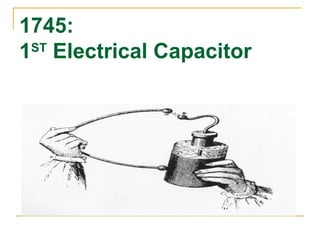
1745:
1ST
Electrical Capacitor
1837:
1st
Electric Telegraph
1861: 1st
Electric Oven
 WOOD
COMBINATION
ELECTRIC
1874:
1st
Electric Light Bulb
1887:
1ST
Alternating Current
Network
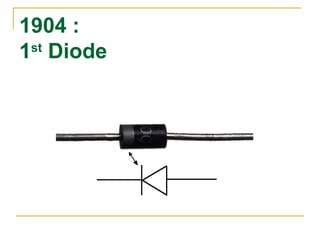
1904 :
1st
Diode
1929:
1ST
Theory of
Semi-Conductors
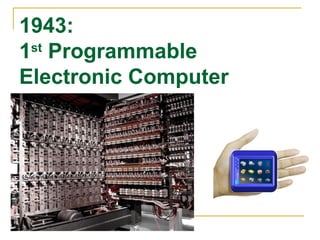
1943:
1st
Programmable
Electronic Computer
1947:
1st
Transistor
a semiconductor device is used to:
amplify
switch electronic signals
switch electrical power
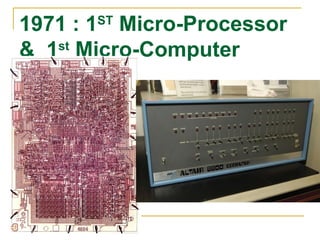
1971 : 1ST
Micro-Processor
& 1st
Micro-Computer
1975: Pong console
1977: Atari 2600 Console
1978: Electronic QB
banned from high schools
1980: 1st
Handheld Video
Games & Cell Phones
1980s: 1st
Personal Computer
1980s: The Walkman
1998:
1st
Hard Drive MP3 Player
Electrical
Engineering
relates both electronics and
electricity
Electronic vs Electrical
 Electronic
 Made with
semiconductor material
 Usually silicon
 Examples
 Capacitors
 Diodes
 Transistors
 Relays
 Electrical
 Made with conductor
material
 Metals and alloys
 Examples
 Wires
 Switches
 Fuses
Alloy
 A homogeneous mixture made by
fusing two or more metals, or a metal
and a nonmetal.
 To obtain desirable qualities such as
hardness, lightness, and strength.
 Brass: Copper & Zinc
 Bronze:Copper & Tin
Electrical Current
 Electron flow current
occurs from the
negative terminal
(where there is an
excess of negative
electrons) to the
positive terminal
(where there is a lack of
electrons)
 Conventional current
Direct Current
 Electrons move continuously in the one
direction
Alternating
Current
 Electrons vibrate back and forth in a regular
pattern at 60 cycles per second or 60 Hz
Electrical function:
 the role that a component plays in the
control or transformation of electric current
Power Supply
 Provides the energy that causes
the current to flow through the
circuit
Advantages
Portable/Compact
Replaceable
Rechargeable
Cheap
Advantages
Continuous equal
flow
Recharges others
Good for big
items
Advantages
Renewable
Environment
friendly
Good for remote
places
Disadvantages
Drains fast
Limited Power
Polluting
Disadvantages
Stationary
Fire
Disadvantages
Expensive
Fragile
Good only when
sunny
Conduction
 Energy transfer from one material to
another by direct contact.
 Conductors are materials that allow
transfer to happen.
 E.g. copper, aluminum, silver and optical
fibres.
 A printed circuit is an electrical circuit
printed on a solid support called a circuit
board.
Insulation
 The electrical function performed
by a component to prevent the
flow of an electric current
 Prevent injury and short circuits
 E.g. Ceramic and plastic
Protection
 Protection is a component that
stops the flow of current in the
event of a power surge
 E.g. Fuses and circuit breakers
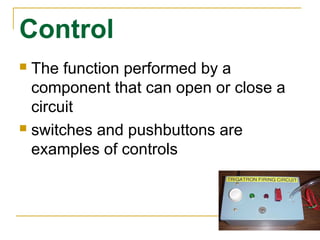
Control
 The function performed by a
component that can open or close a
circuit
 switches and pushbuttons are
examples of controls
Switches
 Rocker
 Toggle
 Push button
 Magnetic contact – Reed Switch
 Throw Switch
Throw Switches(love his voice)
 Single pole switches open/close 1
contact at a time
 Double pole switches open/close 2
contacts
 Single throw switches allow
electrons to follow 1 path.
 Double throw switches allow
electrons to follow 1 of 2 paths
Energy
Transformation
 Change of one form of energy (electricity)
to another form of energy
 Light energy
 Thermal (heat) energy
 Mechanical
 Sound
 Magnetic Induction
Components with
other Functions
 Capacitors
 Diodes
 Transistors
 Relays
Capacitors
 Can store electrical charge
 Composed of two electrical surfaces
separated by an insulator
 Charge builds up on one plate,
when the insulator is removed,
the charge is released
E.g. Camera flash
Diode
 Allows electric current to flow in one
direction
 Made of semi-conductors
 Protects electronic parts from
having electrons flow in the wrong
direction
 Used to convert AC to DC
 LEDs are Light Emitting Diodes
Transistors
 Block or amplify an
electric current
 Base acts like a valve that
controls current
Relays
 A relay opens or closes
a circuit using an
electrical signal from
another circuit
 Used in lighting in a
theatre, high voltage
appliances
Resistors
 Resistors limit the flow of electrons through an
electrical circuit
 E.g. A 10 Ω resistor has more conductance than
a 100 Ω resistor.
Coding on 4 band resistors:
 A resistor is banded with Red, Blue, Red, Gold;
 Thus the code gives 2, 6, 2, 5
 The 1st two bands gives the first two digits of
resistance; 2,6 = 26
 The 3rd band tells you the multiplier;
(2 102
=100)
 The last band is the tolerance (Gold= ±5%)
 26x 100 = 2600 Ω ±5% or 2600 ±5% 130 Ω
 Minimum R = 2570 Ω; Maximum R = 2730 Ω
Activity
 Page 479, Q. 1-15

Electrical engineering