Prepared by Kantoli S.B BMP Solapur.By—Mr. Kantoli S.B. Solapur.
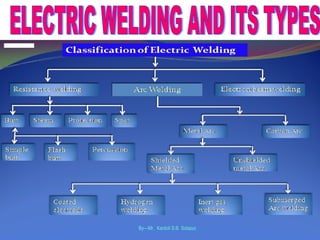
ELECTRIC WELDING AND ITS TYPESELECTRIC WELDING AND ITS TYPES
Defination of Electrical Welding
It is that branch of welding in which Electric current is
used to produce the large heat required for joining
together into firm two pieces of metals.
Electrical welding process fall into two main
categories
 RESISTANCE WELDING.
 ARC WELDING.
Prepared by Kantoli S.B BMP Solapur.
Resistance Welding (RW)
Heat generated by electrical
resistance to current flow at junction
to be welded.
Principal RW process is resistance spot
welding (RSW).
Prepared by Kantoli S.B BMP Solapur.
Components in Resistance Spot Welding
Parts to be welded(usually sheet metal)
Two opposing electrodes
Means of applying pressure to squeeze
parts between electrodes.
Power supply from which a controlled
current can be applied for a specified
time duration.
Prepared by Kantoli S.B BMP Solapur.
Advantages / Drawbacks of RW
Advantages:
 No filler metal required
 High production rates possible
 Lends itself to mechanization and
automation
 Lower operator skill level than for arc
welding
 Good repeatability and reliability
Disadvantages:
 High initial equipment cost
 Limited to lap joints for most RW
processes
Prepared by Kantoli S.B BMP Solapur.
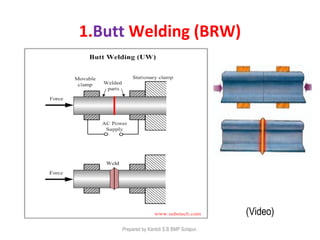
1.Butt Welding (BRW)
(Video)
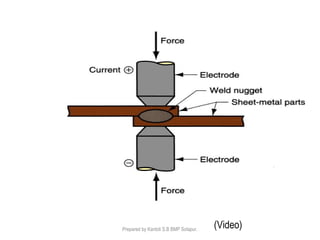
2. Spot Welding (SW)
Resistance welding process in which fusion of faying
surfaces of a lap joint is achieved at one location
by opposing electrodes
 Used to join sheet metal parts using a series of
spot welds
 Widely used in mass production of automobiles,
appliances, metal furniture, and other products
made of sheet metal
Typical car body has ~ 10,000
spot welds
Annual production of automobiles
in the world is measured in tens
of millions of units
Prepared by Kantoli S.B BMP Solapur.
(Video)Prepared by Kantoli S.B BMP Solapur.
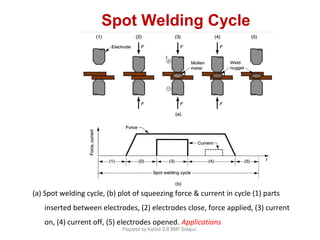
(a) Spot welding cycle, (b) plot of squeezing force & current in cycle (1) parts
inserted between electrodes, (2) electrodes close, force applied, (3) current
on, (4) current off, (5) electrodes opened. Applications
Spot Welding Cycle
Prepared by Kantoli S.B BMP Solapur.
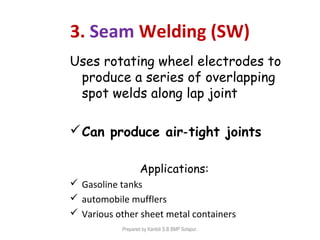
3. Seam Welding (SW)
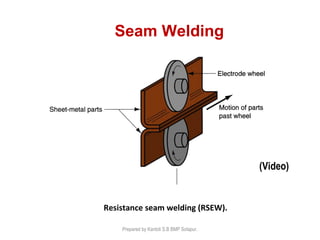
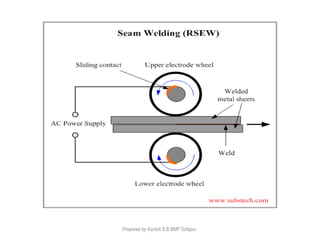
Uses rotating wheel electrodes to
produce a series of overlapping
spot welds along lap joint
Can produce air tight joints‑
Applications:
 Gasoline tanks
 automobile mufflers
 Various other sheet metal containers
Prepared by Kantoli S.B BMP Solapur.
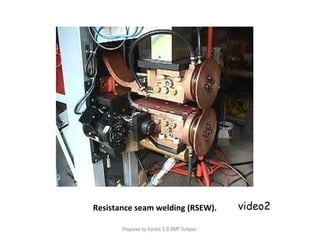
Resistance seam welding (RSEW).
Seam Welding
(Video)
Prepared by Kantoli S.B BMP Solapur.
Resistance seam welding (RSEW). video2
Prepared by Kantoli S.B BMP Solapur.
4. Projection Welding (PW)
A resistance welding process in which
coalescence occurs at one or more
small contact points on parts
Contact points determined by
design of parts to be joined
 May consist of projections,
embossments, or localized intersections
of parts
Prepared by Kantoli S.B BMP Solapur.
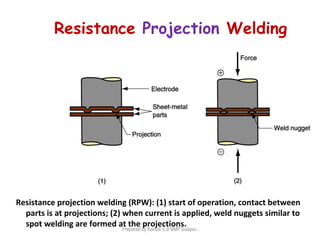
Resistance projection welding (RPW): (1) start of operation, contact between
parts is at projections; (2) when current is applied, weld nuggets similar to
spot welding are formed at the projections.
Resistance Projection Welding
Prepared by Kantoli S.B BMP Solapur.
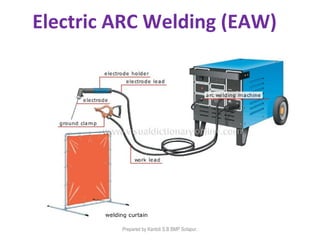
Electric ARC Welding (EAW)
Prepared by Kantoli S.B BMP Solapur.
What is an Electric Arc?
An electric arc is a discharge of
electric current across a gap in a circuit.
It is sustained by an ionized column of
gas (plasma) through which the current
flows.
To initiate the arc in AW, electrode is
brought into contact with work and then
quickly separated from it by a short
distance.
Prepared by Kantoli S.B BMP Solapur.
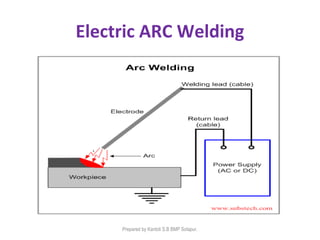
What is an Arc Welding (AW)
A fusion welding process in which coalescence
of
the metals is achieved by the heat from an
electric arc between an electrode and the
work
 Electric energy from the arc produces
temperatures ~ 10,000 F (55000
C), hot
enough to melt any metal.
 Most AW processes add filler metal to
increase volume and strength of weld joint.
Prepared by Kantoli S.B BMP Solapur.
Electric ARC Welding
Prepared by Kantoli S.B BMP Solapur.
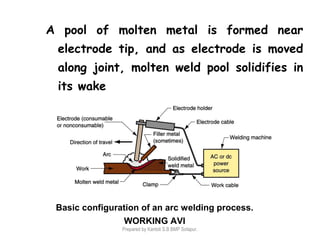
A pool of molten metal is formed near
electrode tip, and as electrode is moved
along joint, molten weld pool solidifies in
its wake
Basic configuration of an arc welding process.
WORKING AVI
Prepared by Kantoli S.B BMP Solapur.
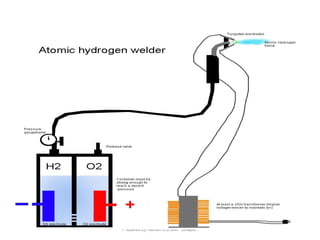
Atomic hydrogen welding (AHW) is an arc welding
process that uses an arc between two metal tungsten
electrodes in a shielding atmosphere of hydrogen.
The electric arc efficiently breaks up the hydrogen
molecules, which later recombine with tremendous
release of heat, reaching temperatures from 3400 to
4000 °C.
Prepared by Kantoli S.B BMP Solapur.
Power Source in Arc Welding
Direct current (DC) vs. Alternating
current (AC)
AC machines less expensive to
purchase and operate, but generally
restricted to ferrous metals.
DC equipment can be used on all
metals and is generally noted for
better arc control.
Prepared by Kantoli S.B BMP Solapur.
Polarity (positive & negative) is present in all electrical
circuits.
Electricity flows from negative to positive.
Controlling the polarity allows the welder to influence
the location of the heat.
When the electrode is positive (+) it will be slightly
hotter than the base metal.
When the base metal is positive (+) the base metal will
be slightly hotter than the electrode.
Polarity in DC welding
Prepared by Kantoli S.B BMP Solapur.
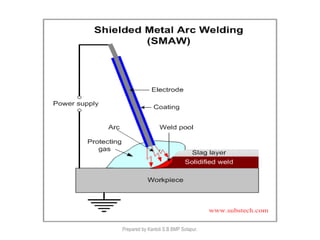
Shielded Metal Arc Welding (SMAW)
Advantages
• Versatility - readily applied to a variety of applications and
a wide choice of electrodes.
• Relative simplicity and portability of equipment.
• Low cost.
• Adaptable to confined spaces and remote locations.
• Suitable for out-of-position welding.
Disadvantages
• Not as productive as continuous wire processes.
• Likely to be more costly to deposit a given quantity of metal.
• Frequent stop/starts to change electrode.
• Relatively high metal wastage (electrode stubs).
• Current limits are lower than for continuous or automatic processes.
Prepared by Kantoli S.B BMP Solapur.
Thank You!!!

Electric welding

  • 1.
    Prepared by KantoliS.B BMP Solapur.By—Mr. Kantoli S.B. Solapur.
  • 2.
    ELECTRIC WELDING ANDITS TYPESELECTRIC WELDING AND ITS TYPES Defination of Electrical Welding It is that branch of welding in which Electric current is used to produce the large heat required for joining together into firm two pieces of metals. Electrical welding process fall into two main categories  RESISTANCE WELDING.  ARC WELDING. Prepared by Kantoli S.B BMP Solapur.
  • 3.
    Resistance Welding (RW) Heatgenerated by electrical resistance to current flow at junction to be welded. Principal RW process is resistance spot welding (RSW). Prepared by Kantoli S.B BMP Solapur.
  • 4.
    Components in ResistanceSpot Welding Parts to be welded(usually sheet metal) Two opposing electrodes Means of applying pressure to squeeze parts between electrodes. Power supply from which a controlled current can be applied for a specified time duration. Prepared by Kantoli S.B BMP Solapur.
  • 5.
    Advantages / Drawbacksof RW Advantages:  No filler metal required  High production rates possible  Lends itself to mechanization and automation  Lower operator skill level than for arc welding  Good repeatability and reliability Disadvantages:  High initial equipment cost  Limited to lap joints for most RW processes Prepared by Kantoli S.B BMP Solapur.
  • 6.
    Prepared by KantoliS.B BMP Solapur. 1.Butt Welding (BRW) (Video)
  • 7.
    2. Spot Welding(SW) Resistance welding process in which fusion of faying surfaces of a lap joint is achieved at one location by opposing electrodes  Used to join sheet metal parts using a series of spot welds  Widely used in mass production of automobiles, appliances, metal furniture, and other products made of sheet metal Typical car body has ~ 10,000 spot welds Annual production of automobiles in the world is measured in tens of millions of units Prepared by Kantoli S.B BMP Solapur.
  • 8.
  • 9.
    (a) Spot weldingcycle, (b) plot of squeezing force & current in cycle (1) parts inserted between electrodes, (2) electrodes close, force applied, (3) current on, (4) current off, (5) electrodes opened. Applications Spot Welding Cycle Prepared by Kantoli S.B BMP Solapur.
  • 10.
    3. Seam Welding(SW) Uses rotating wheel electrodes to produce a series of overlapping spot welds along lap joint Can produce air tight joints‑ Applications:  Gasoline tanks  automobile mufflers  Various other sheet metal containers Prepared by Kantoli S.B BMP Solapur.
  • 11.
    Resistance seam welding(RSEW). Seam Welding (Video) Prepared by Kantoli S.B BMP Solapur.
  • 12.
    Prepared by KantoliS.B BMP Solapur.
  • 13.
    Resistance seam welding(RSEW). video2 Prepared by Kantoli S.B BMP Solapur.
  • 14.
    4. Projection Welding(PW) A resistance welding process in which coalescence occurs at one or more small contact points on parts Contact points determined by design of parts to be joined  May consist of projections, embossments, or localized intersections of parts Prepared by Kantoli S.B BMP Solapur.
  • 15.
    Resistance projection welding(RPW): (1) start of operation, contact between parts is at projections; (2) when current is applied, weld nuggets similar to spot welding are formed at the projections. Resistance Projection Welding Prepared by Kantoli S.B BMP Solapur.
  • 16.
    Electric ARC Welding(EAW) Prepared by Kantoli S.B BMP Solapur.
  • 17.
    What is anElectric Arc? An electric arc is a discharge of electric current across a gap in a circuit. It is sustained by an ionized column of gas (plasma) through which the current flows. To initiate the arc in AW, electrode is brought into contact with work and then quickly separated from it by a short distance. Prepared by Kantoli S.B BMP Solapur.
  • 18.
    What is anArc Welding (AW) A fusion welding process in which coalescence of the metals is achieved by the heat from an electric arc between an electrode and the work  Electric energy from the arc produces temperatures ~ 10,000 F (55000 C), hot enough to melt any metal.  Most AW processes add filler metal to increase volume and strength of weld joint. Prepared by Kantoli S.B BMP Solapur.
  • 19.
    Electric ARC Welding Preparedby Kantoli S.B BMP Solapur.
  • 20.
    A pool ofmolten metal is formed near electrode tip, and as electrode is moved along joint, molten weld pool solidifies in its wake Basic configuration of an arc welding process. WORKING AVI Prepared by Kantoli S.B BMP Solapur.
  • 21.
    Prepared by KantoliS.B BMP Solapur.
  • 22.
    Prepared by KantoliS.B BMP Solapur. Atomic hydrogen welding (AHW) is an arc welding process that uses an arc between two metal tungsten electrodes in a shielding atmosphere of hydrogen. The electric arc efficiently breaks up the hydrogen molecules, which later recombine with tremendous release of heat, reaching temperatures from 3400 to 4000 °C.
  • 23.
    Prepared by KantoliS.B BMP Solapur.
  • 24.
    Power Source inArc Welding Direct current (DC) vs. Alternating current (AC) AC machines less expensive to purchase and operate, but generally restricted to ferrous metals. DC equipment can be used on all metals and is generally noted for better arc control. Prepared by Kantoli S.B BMP Solapur.
  • 25.
    Polarity (positive &negative) is present in all electrical circuits. Electricity flows from negative to positive. Controlling the polarity allows the welder to influence the location of the heat. When the electrode is positive (+) it will be slightly hotter than the base metal. When the base metal is positive (+) the base metal will be slightly hotter than the electrode. Polarity in DC welding Prepared by Kantoli S.B BMP Solapur.
  • 26.
    Shielded Metal ArcWelding (SMAW) Advantages • Versatility - readily applied to a variety of applications and a wide choice of electrodes. • Relative simplicity and portability of equipment. • Low cost. • Adaptable to confined spaces and remote locations. • Suitable for out-of-position welding. Disadvantages • Not as productive as continuous wire processes. • Likely to be more costly to deposit a given quantity of metal. • Frequent stop/starts to change electrode. • Relatively high metal wastage (electrode stubs). • Current limits are lower than for continuous or automatic processes. Prepared by Kantoli S.B BMP Solapur.
  • 27.
    Prepared by KantoliS.B BMP Solapur. Thank You!!!