SPOT WELDING SIMULATION
WELDING SYSTEM COMPARISON
DC VSAC SPOT WELDING
SPOT WELDING SYSTEM COMPARISON
WELDING SYSTEM COMPARISON
ITEMS DC INVERTER – TRANS GUN AC – TRANS GUN AC – PORTABLE GUN
1. Spot Weld
Quality
Stable on weld quality
1. Wide Lobe Curve (weldability) range 1. Narrow Lobe Curve (weldability) range Same as AC – Trans Gun
2. Keep nugget growth with lower current 2. Keep nugget growth with higher current Same as AC – Trans Gun
3. Better voltage fluctuation – Freq 1000 Hz 3. High voltage fluctuation – Freq 50 Hz Same as AC – Trans Gun
2. Power /
utilities saving
Power factor, PF PF : 95% PF : 50% PF : 65%
Electric Power 5.0kWh 5.0kWh 13kWh
Energy Efficiency *37% *26% **24.1%
3. Size of welding
transformer
Approx. weight 23kg 45kg -
Rated capacity 105 kVA 70 kVa -
Size, mm 130 x 172 x 314 125 x 200 x 335 -
4. Welding control method
Open loop / Close loop (Adaptive Control) -
Optional
Open loop Open Loop
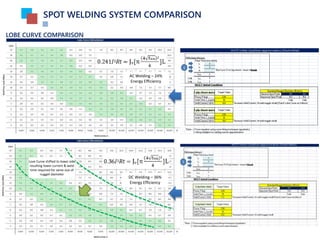
LOBE CURVE COMPARISON
AC Welding – 24%
Energy Efficiency
DC Welding – 36%
Energy Efficiency
Love Curve shifted to lower side
resulting lower current & weld
time required for same size of
nugget diameter
SPOT WELDING SYSTEM COMPARISON
MATHEMATICAL MODELLING
SPOT WELDING SYSTEM COMPARISON
Spot Welding Parameters Basic Calculation
𝐸 = 0.241𝑃𝑡w .........................(1) where E : Energy (J)
*Calculation for AC spot welding P : Power (W)
tw : Weld time (sec)
= 0.241𝐼2 𝑅𝑡w .........................(2) where I : Welding Current (A)
R : Panel Contact Resistance (Ω)
= JvSL .........................(3) where Jv : Melting energy (J/mm3
)
S : Surface contact (mm2
)
L : Total plate thickness combination (mm)
= Jv[π
𝑑2
4
]L ........................(4) where d : Required nugget diameter (mm)
Since 𝑑 = 4 𝑡min for general spot point
= 5 𝑡min for important spot point
Where 𝑡min : Min thickness of panel combinations
So, 0.241𝐼2 𝑅𝑡 = Jv[π
(4 𝑡min)2
4
]L .......(5) Combination eqn (2) & eqn (4)
= Jv[π4𝑡min]]L .............(6)
Final equation;
𝐼 =
Jv[π4𝑡min]]L
0.241𝑅𝑡w
2
..............(7) *Used for minimum nugget diameter requirement (general)
=
Jv[π
𝑑2
4
]L
0.241𝑅𝑡w
2
....................(8) *Used for specific required nugget diameter
Note :
Steel type Melting Energy Contact Resistance
Low Carbon Steel 9.7 J/mm3
100 μΩ
Aluminum 2.9 J/mm3
75 μΩ
 Replace 𝐸 = 0.241𝑃𝑡w to 𝐸 = 0.37𝑃𝑡w for MFDC / DC spot welding calculation
𝐹w = 250𝑡min .............................(9) where 𝐹w = Welding Force (kg) - target
*Go to Quadratic approximation for best data fitting (refer reference) – No 11
𝑡w = 10𝑡min .............................(10) where 𝑡w = Weld time (cycle) – 50 hz
𝑡hold = 3 ~ 5 𝑐𝑦𝑐𝑙𝑒𝑠.................... where 𝑡hold = Hold time (cycle) – 50 hz
*𝑡squeeze - Pneumatic Gun : Min 17 cycle – Min time require for applied force to stable at 80%
- Servo Gun (robot) : 0 cycles – Using integrated robot function (robot will send
signal once applied force is stable to welding
controller)
Servo Gun : 4 cycle – Min time require for applied force to stable

DC vs AC spot welding - A comparison

  • 1.
    SPOT WELDING SIMULATION WELDINGSYSTEM COMPARISON DC VSAC SPOT WELDING
  • 2.
    SPOT WELDING SYSTEMCOMPARISON WELDING SYSTEM COMPARISON ITEMS DC INVERTER – TRANS GUN AC – TRANS GUN AC – PORTABLE GUN 1. Spot Weld Quality Stable on weld quality 1. Wide Lobe Curve (weldability) range 1. Narrow Lobe Curve (weldability) range Same as AC – Trans Gun 2. Keep nugget growth with lower current 2. Keep nugget growth with higher current Same as AC – Trans Gun 3. Better voltage fluctuation – Freq 1000 Hz 3. High voltage fluctuation – Freq 50 Hz Same as AC – Trans Gun 2. Power / utilities saving Power factor, PF PF : 95% PF : 50% PF : 65% Electric Power 5.0kWh 5.0kWh 13kWh Energy Efficiency *37% *26% **24.1% 3. Size of welding transformer Approx. weight 23kg 45kg - Rated capacity 105 kVA 70 kVa - Size, mm 130 x 172 x 314 125 x 200 x 335 - 4. Welding control method Open loop / Close loop (Adaptive Control) - Optional Open loop Open Loop
  • 3.
    LOBE CURVE COMPARISON ACWelding – 24% Energy Efficiency DC Welding – 36% Energy Efficiency Love Curve shifted to lower side resulting lower current & weld time required for same size of nugget diameter SPOT WELDING SYSTEM COMPARISON
  • 4.
    MATHEMATICAL MODELLING SPOT WELDINGSYSTEM COMPARISON Spot Welding Parameters Basic Calculation 𝐸 = 0.241𝑃𝑡w .........................(1) where E : Energy (J) *Calculation for AC spot welding P : Power (W) tw : Weld time (sec) = 0.241𝐼2 𝑅𝑡w .........................(2) where I : Welding Current (A) R : Panel Contact Resistance (Ω) = JvSL .........................(3) where Jv : Melting energy (J/mm3 ) S : Surface contact (mm2 ) L : Total plate thickness combination (mm) = Jv[π 𝑑2 4 ]L ........................(4) where d : Required nugget diameter (mm) Since 𝑑 = 4 𝑡min for general spot point = 5 𝑡min for important spot point Where 𝑡min : Min thickness of panel combinations So, 0.241𝐼2 𝑅𝑡 = Jv[π (4 𝑡min)2 4 ]L .......(5) Combination eqn (2) & eqn (4) = Jv[π4𝑡min]]L .............(6) Final equation; 𝐼 = Jv[π4𝑡min]]L 0.241𝑅𝑡w 2 ..............(7) *Used for minimum nugget diameter requirement (general) = Jv[π 𝑑2 4 ]L 0.241𝑅𝑡w 2 ....................(8) *Used for specific required nugget diameter Note : Steel type Melting Energy Contact Resistance Low Carbon Steel 9.7 J/mm3 100 μΩ Aluminum 2.9 J/mm3 75 μΩ  Replace 𝐸 = 0.241𝑃𝑡w to 𝐸 = 0.37𝑃𝑡w for MFDC / DC spot welding calculation 𝐹w = 250𝑡min .............................(9) where 𝐹w = Welding Force (kg) - target *Go to Quadratic approximation for best data fitting (refer reference) – No 11 𝑡w = 10𝑡min .............................(10) where 𝑡w = Weld time (cycle) – 50 hz 𝑡hold = 3 ~ 5 𝑐𝑦𝑐𝑙𝑒𝑠.................... where 𝑡hold = Hold time (cycle) – 50 hz *𝑡squeeze - Pneumatic Gun : Min 17 cycle – Min time require for applied force to stable at 80% - Servo Gun (robot) : 0 cycles – Using integrated robot function (robot will send signal once applied force is stable to welding controller) Servo Gun : 4 cycle – Min time require for applied force to stable