ELBOW FRACTURES/
DISLOCATIONS
TRINITY ANGONI
ELBOW FRACTURES
Intercondyler fractures
Condyler fractures
Capitulum fractures
Head of radius fractures
Radial neck fractures
Olecranon process
fractures
Coronoid process
fractures
Intercondyler fractures of the
humerus
Riseborough and Radin Classification
 Type I: Nondisplaced
 Type II: Slight displacement with no rotation
between the condylar fragments in the frontal
plane
 Type III: Displacement with rotation
 Type IV: Severe comminution of the articular
surface
Riseborough and Radin
classification
Condylar Fractures
 Milch Classification
 Two types for medial and lateral; the key is the
lateral trochlear ridge.
 Type I: Lateral trochlear ridge is left intact.
 Type II: Lateral trochlear ridge is part of the
condylar fragment (medial or lateral).
Humeral epihpyses anatomy
Milch classification
Capitulum fractures
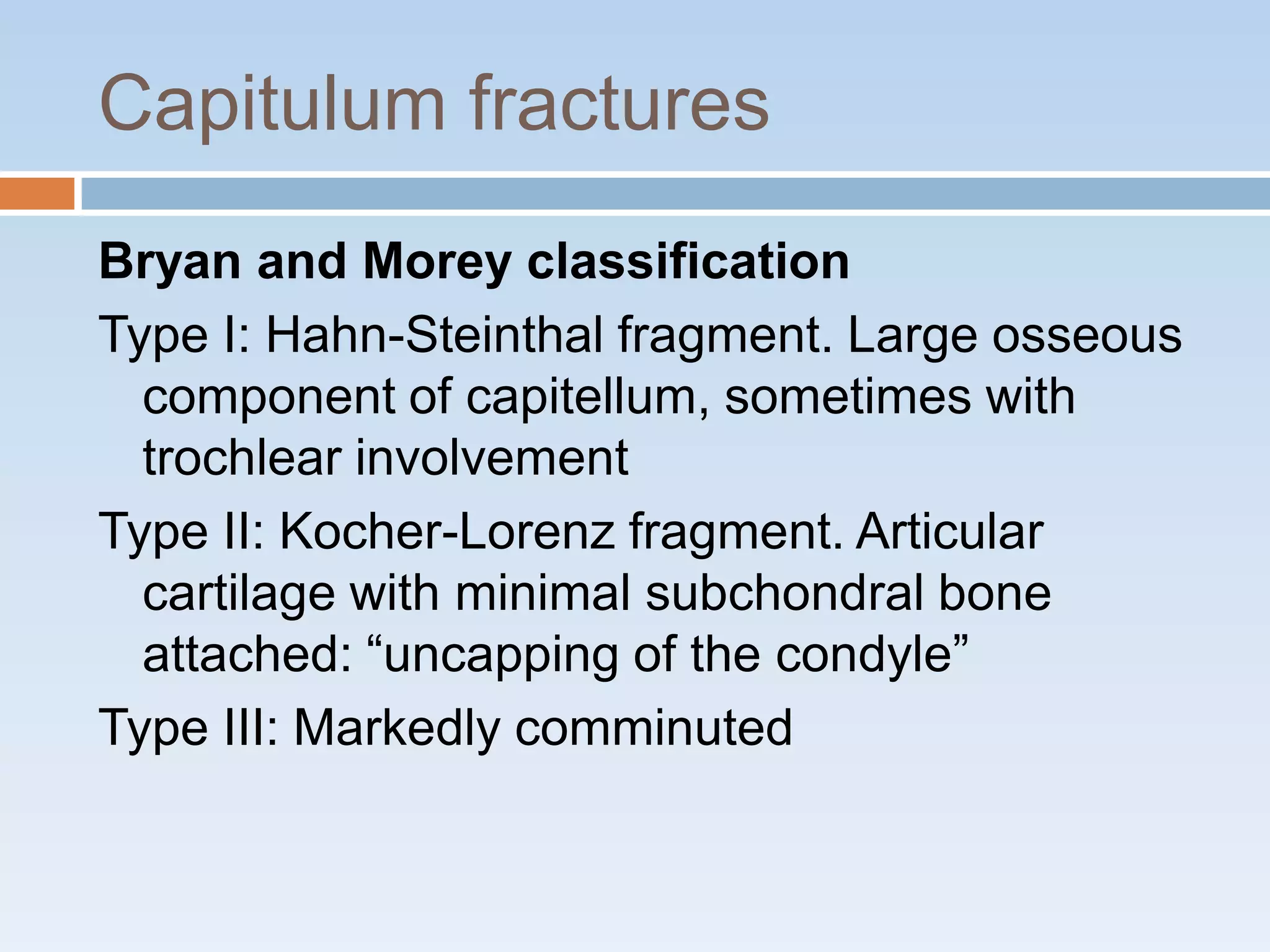
Bryan and Morey classification
Type I: Hahn-Steinthal fragment. Large osseous
component of capitellum, sometimes with
trochlear involvement
Type II: Kocher-Lorenz fragment. Articular
cartilage with minimal subchondral bone
attached: “uncapping of the condyle”
Type III: Markedly comminuted
Hahn-Steinthal fragment
Kocher-Lorenz fragment
Radial head fractures
 A fall on the outstretched hand forces the
elbow into valgus and pushes the radial head
against the capitulum.
Head of radius fractures
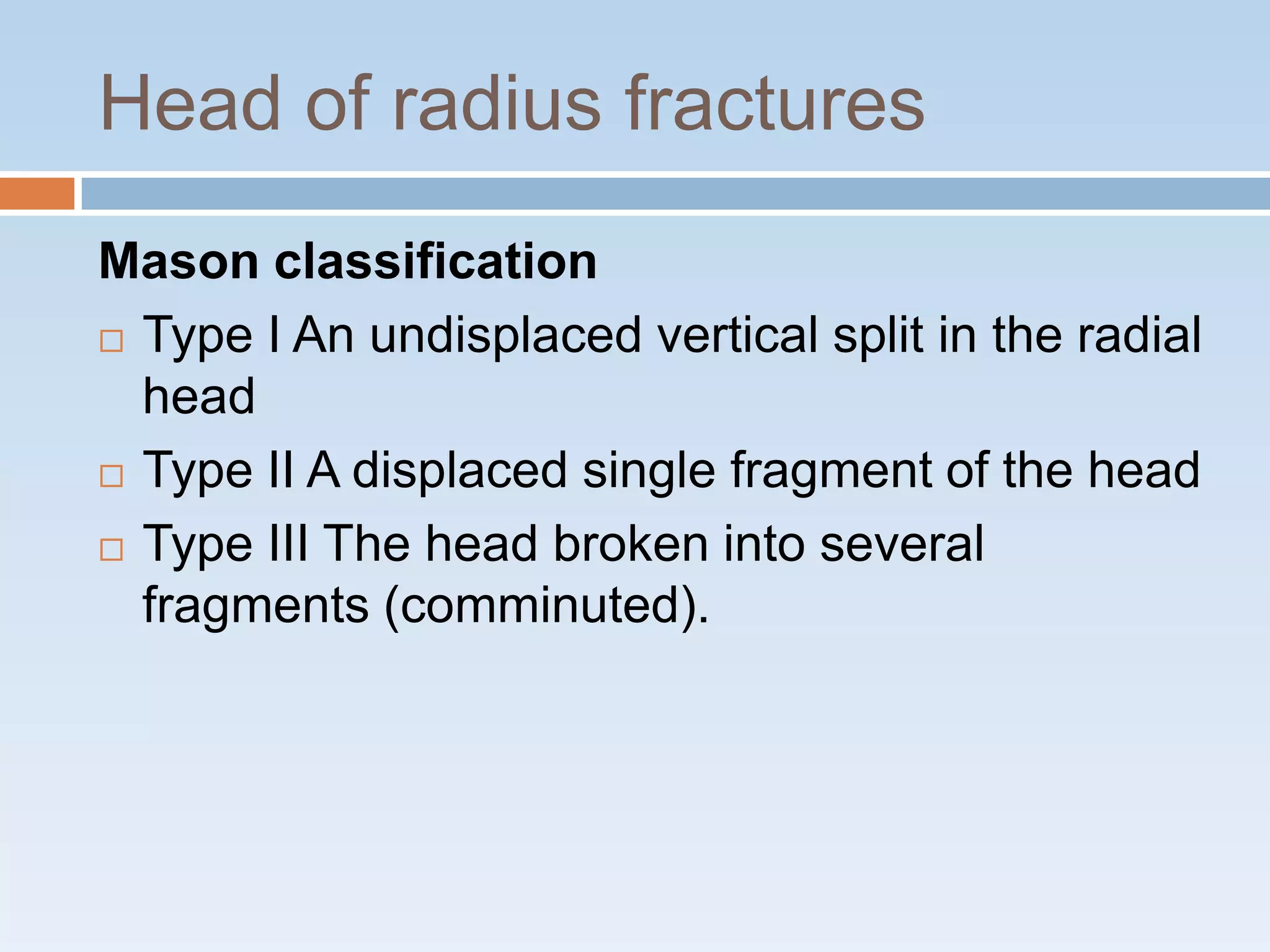
Mason classification
 Type I An undisplaced vertical split in the radial
head
 Type II A displaced single fragment of the head
 Type III The head broken into several
fragments (comminuted).
Mason’s Classification
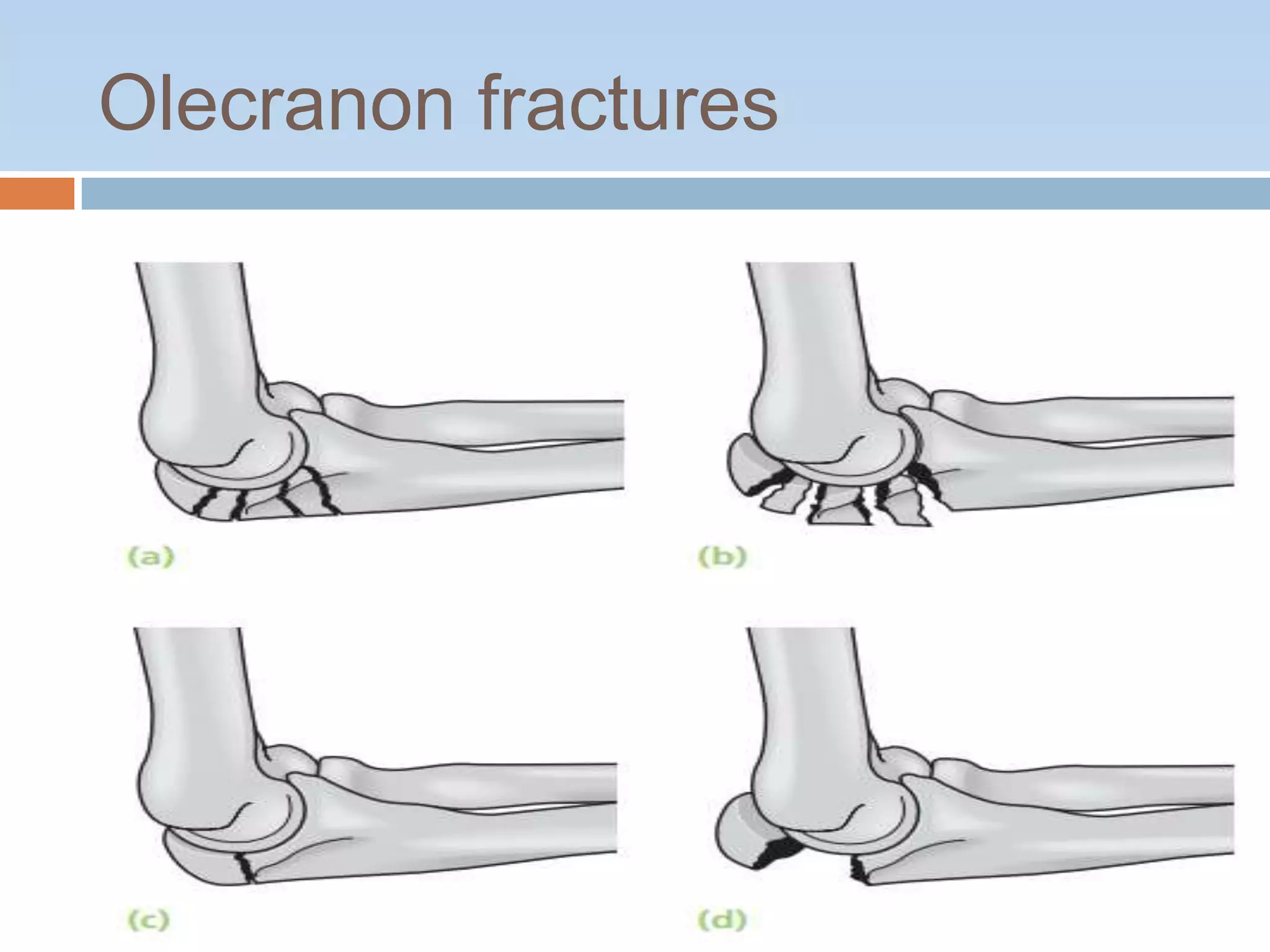
Olecranon process fractures
Two broad types of injury are seen:
(1) a comminuted fracture which is due to a direct blow
or a fall on the elbow
(2) a transverse break, due to traction when the patient
falls onto the hand while the triceps muscle is
contracted.
These two types can be further sub-classified into
(a) Displaced
(b) Undisplaced fractures.
More severe injuries may be associated also
with subluxation or dislocation of the ulno-humeral
joint.
Olecranon process fractures
Morrey Classification
 Type I: Undisplaced, stable fractures
 Type II: Displaced, stable
 Type III: Displaced, unstable fractures
Olecranon fractures
Radial neck fractures
 A fall on the outstretched hand forces the
elbow into valgus and pushes the radial head
against the capitulum.
 In children the bone fractures through the neck
of the radius.
Coronoid process fractures
Regan and Morrey classification
Type I: Fracture avulsion just the tip of the
coronoid
Type II: Those that involve less than 50% of
coronoid either as single fracture or multiple
fragments
Type III: Those involve >50% of coronoid
Subdivided into those
(A)without elbow dislocation
(B)with elbow dislocation
Regan and Morey classification
Treatment
 Surgical treatment is given as appropriate
 Plates and screws for comminuted fractures
 Headless or lag screws for uncomminuted
fractures
 Collar and cuff for splinting or other splints in
non surgical intervention.
Physiotherapy mx
Problems
 Stiffness of the elbow
 Loss of extension and flexion and sometimes
pronation and supination
 Pain
 Myositis ossificans
 Vascular insufficiency
 Nerve damage (ulnar and median nerve)
 Mul union
Physio mx
Problems
 Delayed union
 Non union
 Elbow instability
 Muscle spasm
 Muscle weakness
 Muscle atrophy
 Joint deformity
 Bone infection (osteomyelitis)
 Osteoporosis loss of bone density as a result of reduced
functionality
 Thrombus formation
Physio mx
 Ultrasound to loosen adhesions/ myositis
ossificans
 Massage (hacking) and muscle stretch to
realese contractures
 Range of motion exercizes to increase
extension, flexion, supination and pronation.
 Tens/ift for pain medication and muscle spasm.
Physio mx
 Circulatory exercizes for vascular insufficiency
 Nerve glides for nerve damage if neuropraxic
 Nerve stretching
 Immobilisation in cast in cases of mal
union, delayed union and non union then
refere for re assesment.
 Immobilising in armsling for elbow instability.
Untill healing takes place.
Physio mx…..
 Muscle strengthening exercizes for muscle
weakness, muscle atrophy and immobility
osteoporosis.
 Order for a check x-ray if there is joint
deformity for appropriate progression of
therapy.
 with chronic uhealing wounds discharging pus
suspect osteomyelitis, and recommend biopsy
for microbiology examination.
 tubi grip will be appropriate for dvt (paget von
schruetter disease).
ELBOW DISLOCATION
Elbow dislocation
General
• The most common type of dislocation in
children and the second most common type in
adults, second only to shoulder dislocation
• Young adults between the ages of 25–30 years
are most affected and sports activities account
for almost 50% of these injuries
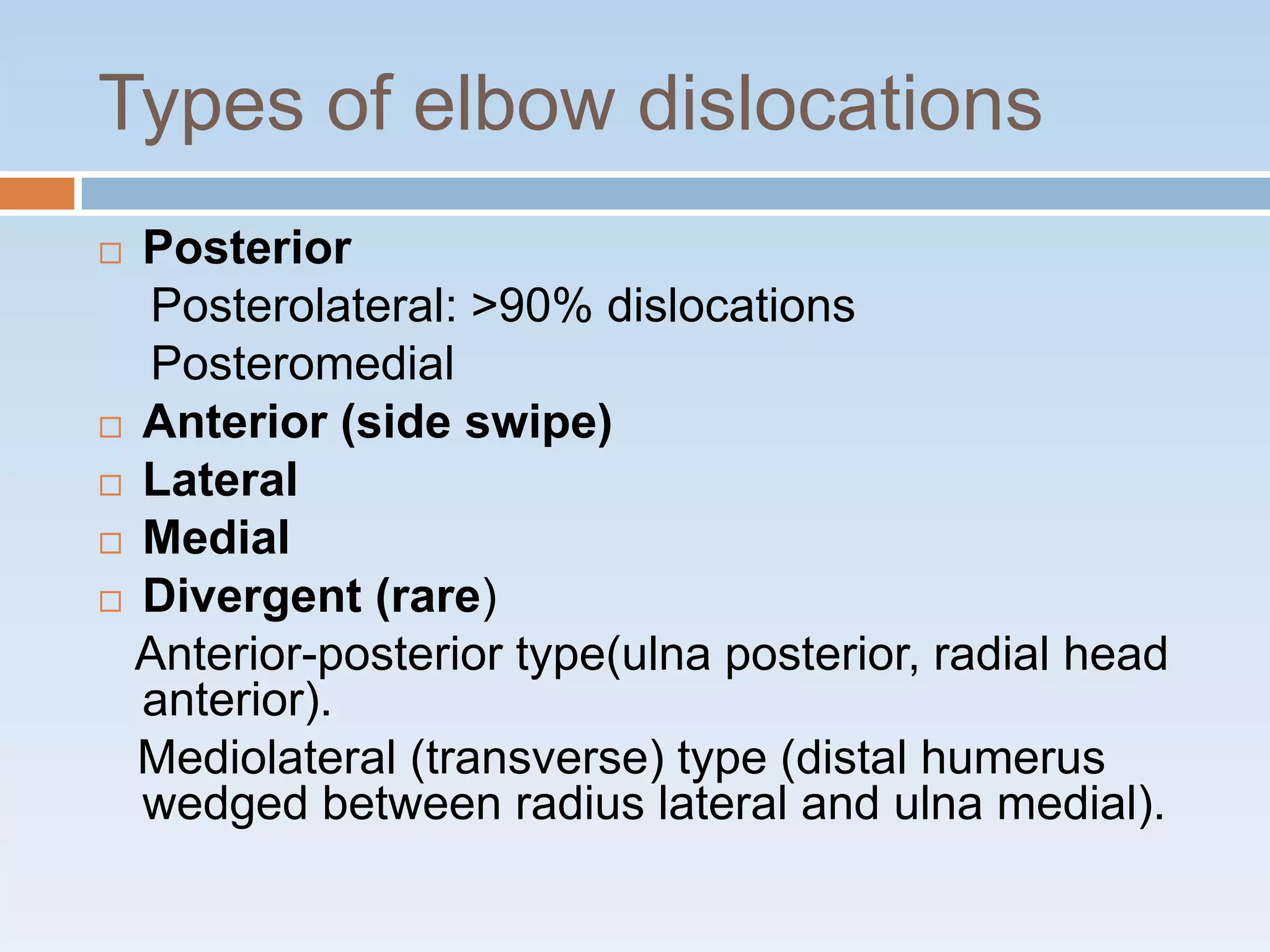
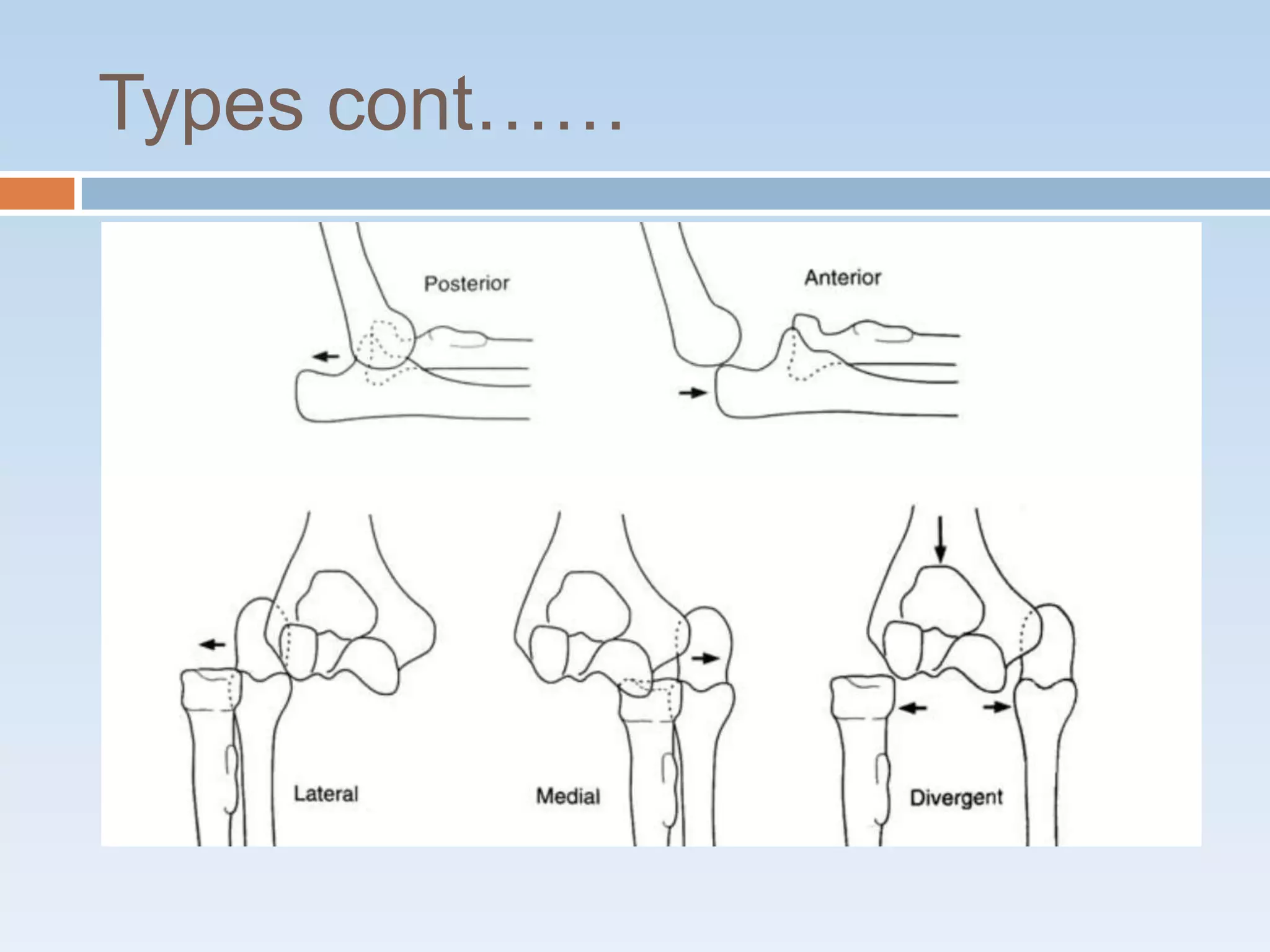
Types of elbow dislocations
 Posterior
Posterolateral: >90% dislocations
Posteromedial
 Anterior (side swipe)
 Lateral
 Medial
 Divergent (rare)
Anterior-posterior type(ulna posterior, radial head
anterior).
Mediolateral (transverse) type (distal humerus
wedged between radius lateral and ulna medial).
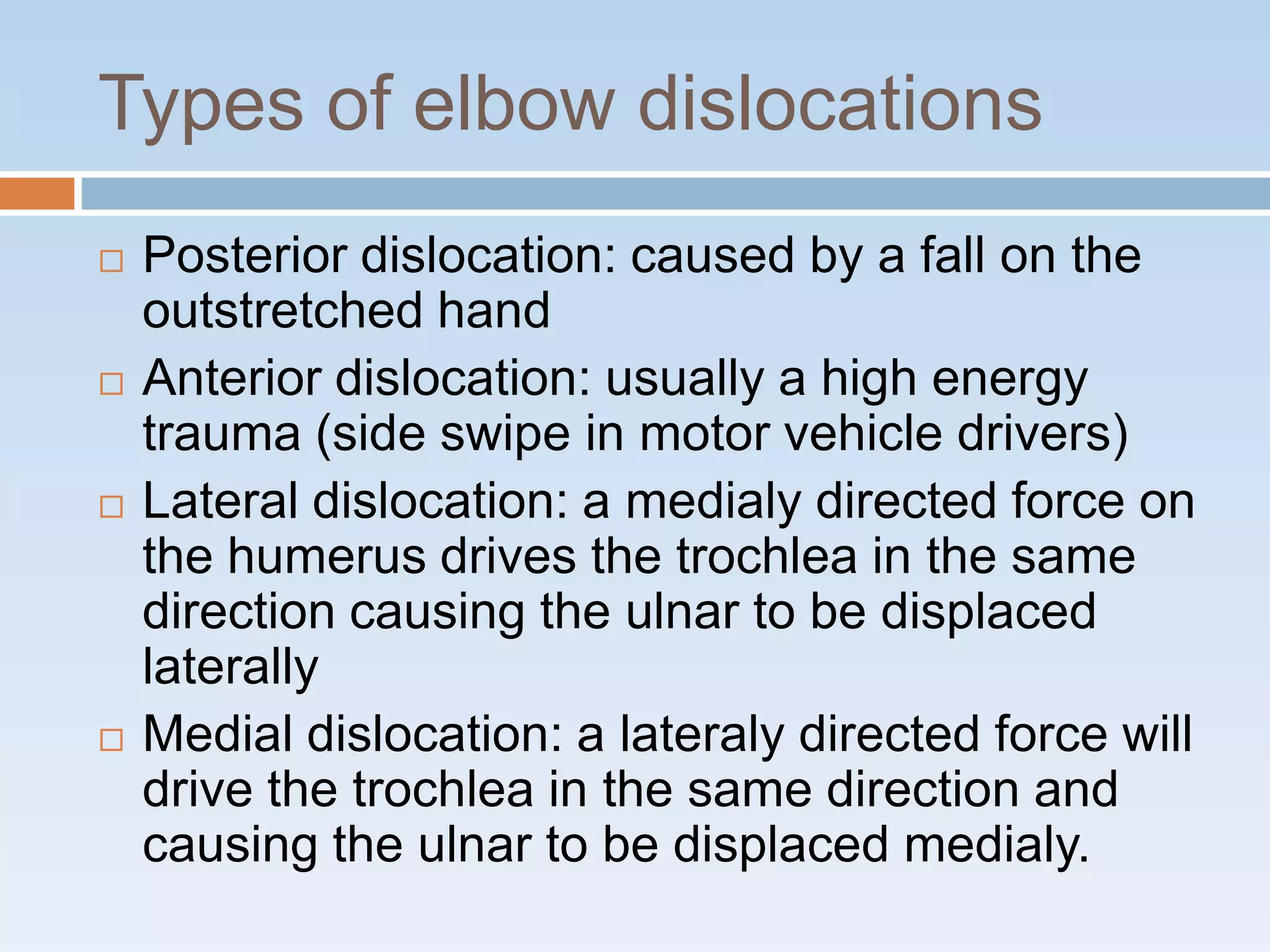
Types of elbow dislocations
 Posterior dislocation: caused by a fall on the
outstretched hand
 Anterior dislocation: usually a high energy
trauma (side swipe in motor vehicle drivers)
 Lateral dislocation: a medialy directed force on
the humerus drives the trochlea in the same
direction causing the ulnar to be displaced
laterally
 Medial dislocation: a lateraly directed force will
drive the trochlea in the same direction and
causing the ulnar to be displaced medialy.
Types cont…..
 Divergent: a dislocation which wedges the
humerus between the ulnar and radius. Either
antero-posterior or mediolateral.
Types cont……
Clinical
• Associated injuries include fracture of the radial
head, injury to the brachial artery and median
nerve
 Symptoms
• Inability to bend the elbow following a fall on
the outstretched hand
• Pain in the shoulder and wrist
• On physical exam: The most important part of
the exam is the neurovascular evaluation of
 the radial artery, and median, ulnar and radial
nerves
 Imaging
• Plain AP and lateral radiographs
• CT and MRI scans are seldom necessary
 Treatment
• Reduce dislocation as soon as possible after
injury
• Splint for 10 days
• Initiate ROM exercises, NSAIDs
Complications
• Loss of ROM of elbow especially extension
• Ectopic bone formation
• Neurovascular injury
• Arthritis of the elbow
References
 Apley orthopaedic textbook
 Upper limb fractures
 Physical medicine and rahabilitation

Elbow fractures and dislocations

  • 1.
  • 2.
    ELBOW FRACTURES Intercondyler fractures Condylerfractures Capitulum fractures Head of radius fractures Radial neck fractures Olecranon process fractures Coronoid process fractures
  • 3.
    Intercondyler fractures ofthe humerus Riseborough and Radin Classification  Type I: Nondisplaced  Type II: Slight displacement with no rotation between the condylar fragments in the frontal plane  Type III: Displacement with rotation  Type IV: Severe comminution of the articular surface
  • 4.
  • 5.
    Condylar Fractures  MilchClassification  Two types for medial and lateral; the key is the lateral trochlear ridge.  Type I: Lateral trochlear ridge is left intact.  Type II: Lateral trochlear ridge is part of the condylar fragment (medial or lateral).
  • 6.
  • 7.
  • 8.
  • 9.
    Capitulum fractures Bryan andMorey classification Type I: Hahn-Steinthal fragment. Large osseous component of capitellum, sometimes with trochlear involvement Type II: Kocher-Lorenz fragment. Articular cartilage with minimal subchondral bone attached: “uncapping of the condyle” Type III: Markedly comminuted
  • 10.
  • 11.
  • 12.
    Radial head fractures A fall on the outstretched hand forces the elbow into valgus and pushes the radial head against the capitulum.
  • 13.
    Head of radiusfractures Mason classification  Type I An undisplaced vertical split in the radial head  Type II A displaced single fragment of the head  Type III The head broken into several fragments (comminuted).
  • 14.
  • 15.
    Olecranon process fractures Twobroad types of injury are seen: (1) a comminuted fracture which is due to a direct blow or a fall on the elbow (2) a transverse break, due to traction when the patient falls onto the hand while the triceps muscle is contracted. These two types can be further sub-classified into (a) Displaced (b) Undisplaced fractures. More severe injuries may be associated also with subluxation or dislocation of the ulno-humeral joint.
  • 16.
    Olecranon process fractures MorreyClassification  Type I: Undisplaced, stable fractures  Type II: Displaced, stable  Type III: Displaced, unstable fractures
  • 17.
  • 18.
    Radial neck fractures A fall on the outstretched hand forces the elbow into valgus and pushes the radial head against the capitulum.  In children the bone fractures through the neck of the radius.
  • 19.
    Coronoid process fractures Reganand Morrey classification Type I: Fracture avulsion just the tip of the coronoid Type II: Those that involve less than 50% of coronoid either as single fracture or multiple fragments Type III: Those involve >50% of coronoid Subdivided into those (A)without elbow dislocation (B)with elbow dislocation
  • 20.
    Regan and Moreyclassification
  • 21.
    Treatment  Surgical treatmentis given as appropriate  Plates and screws for comminuted fractures  Headless or lag screws for uncomminuted fractures  Collar and cuff for splinting or other splints in non surgical intervention.
  • 22.
    Physiotherapy mx Problems  Stiffnessof the elbow  Loss of extension and flexion and sometimes pronation and supination  Pain  Myositis ossificans  Vascular insufficiency  Nerve damage (ulnar and median nerve)  Mul union
  • 23.
    Physio mx Problems  Delayedunion  Non union  Elbow instability  Muscle spasm  Muscle weakness  Muscle atrophy  Joint deformity  Bone infection (osteomyelitis)  Osteoporosis loss of bone density as a result of reduced functionality  Thrombus formation
  • 24.
    Physio mx  Ultrasoundto loosen adhesions/ myositis ossificans  Massage (hacking) and muscle stretch to realese contractures  Range of motion exercizes to increase extension, flexion, supination and pronation.  Tens/ift for pain medication and muscle spasm.
  • 25.
    Physio mx  Circulatoryexercizes for vascular insufficiency  Nerve glides for nerve damage if neuropraxic  Nerve stretching  Immobilisation in cast in cases of mal union, delayed union and non union then refere for re assesment.  Immobilising in armsling for elbow instability. Untill healing takes place.
  • 26.
    Physio mx…..  Musclestrengthening exercizes for muscle weakness, muscle atrophy and immobility osteoporosis.  Order for a check x-ray if there is joint deformity for appropriate progression of therapy.  with chronic uhealing wounds discharging pus suspect osteomyelitis, and recommend biopsy for microbiology examination.  tubi grip will be appropriate for dvt (paget von schruetter disease).
  • 27.
  • 28.
    Elbow dislocation General • Themost common type of dislocation in children and the second most common type in adults, second only to shoulder dislocation • Young adults between the ages of 25–30 years are most affected and sports activities account for almost 50% of these injuries
  • 29.
    Types of elbowdislocations  Posterior Posterolateral: >90% dislocations Posteromedial  Anterior (side swipe)  Lateral  Medial  Divergent (rare) Anterior-posterior type(ulna posterior, radial head anterior). Mediolateral (transverse) type (distal humerus wedged between radius lateral and ulna medial).
  • 30.
    Types of elbowdislocations  Posterior dislocation: caused by a fall on the outstretched hand  Anterior dislocation: usually a high energy trauma (side swipe in motor vehicle drivers)  Lateral dislocation: a medialy directed force on the humerus drives the trochlea in the same direction causing the ulnar to be displaced laterally  Medial dislocation: a lateraly directed force will drive the trochlea in the same direction and causing the ulnar to be displaced medialy.
  • 31.
    Types cont…..  Divergent:a dislocation which wedges the humerus between the ulnar and radius. Either antero-posterior or mediolateral.
  • 32.
  • 33.
    Clinical • Associated injuriesinclude fracture of the radial head, injury to the brachial artery and median nerve
  • 34.
     Symptoms • Inabilityto bend the elbow following a fall on the outstretched hand • Pain in the shoulder and wrist • On physical exam: The most important part of the exam is the neurovascular evaluation of  the radial artery, and median, ulnar and radial nerves
  • 35.
     Imaging • PlainAP and lateral radiographs • CT and MRI scans are seldom necessary
  • 36.
     Treatment • Reducedislocation as soon as possible after injury • Splint for 10 days • Initiate ROM exercises, NSAIDs
  • 37.
    Complications • Loss ofROM of elbow especially extension • Ectopic bone formation • Neurovascular injury • Arthritis of the elbow
  • 38.
    References  Apley orthopaedictextbook  Upper limb fractures  Physical medicine and rahabilitation