BY:- Dr. RATISH
MISHRA,
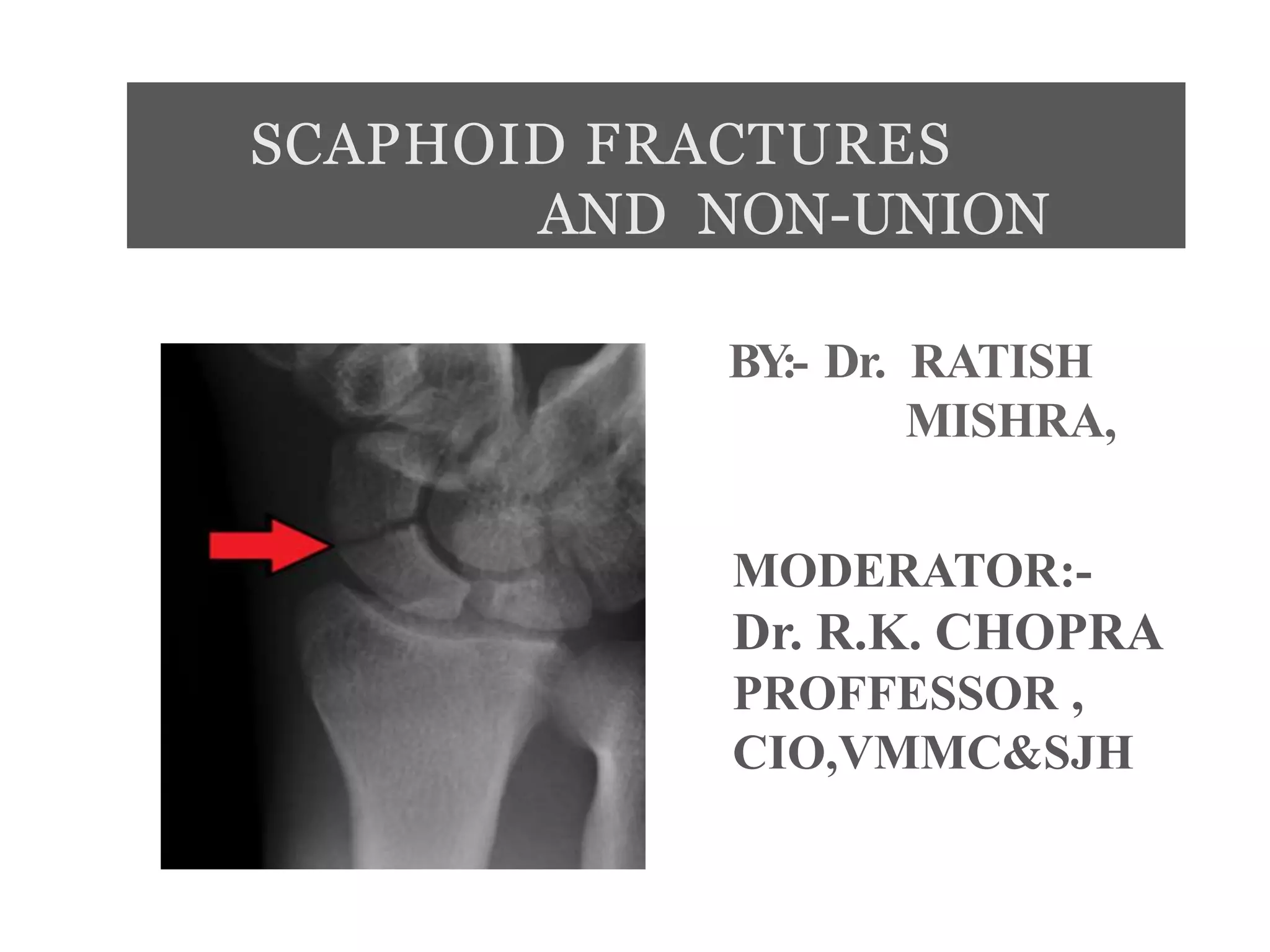
SCAPHOID FRACTURES
AND NON-UNION
MODERATOR:-
Dr. R.K. CHOPRA
PROFFESSOR ,
CIO,VMMC&SJH
 ANATOMY
 MECHANISM OF INJURY
 PATHOPHYSIOLOGY
 DIAGNOSIS AND CLINICAL EXAMINATION
 CLASSIFICATIONS
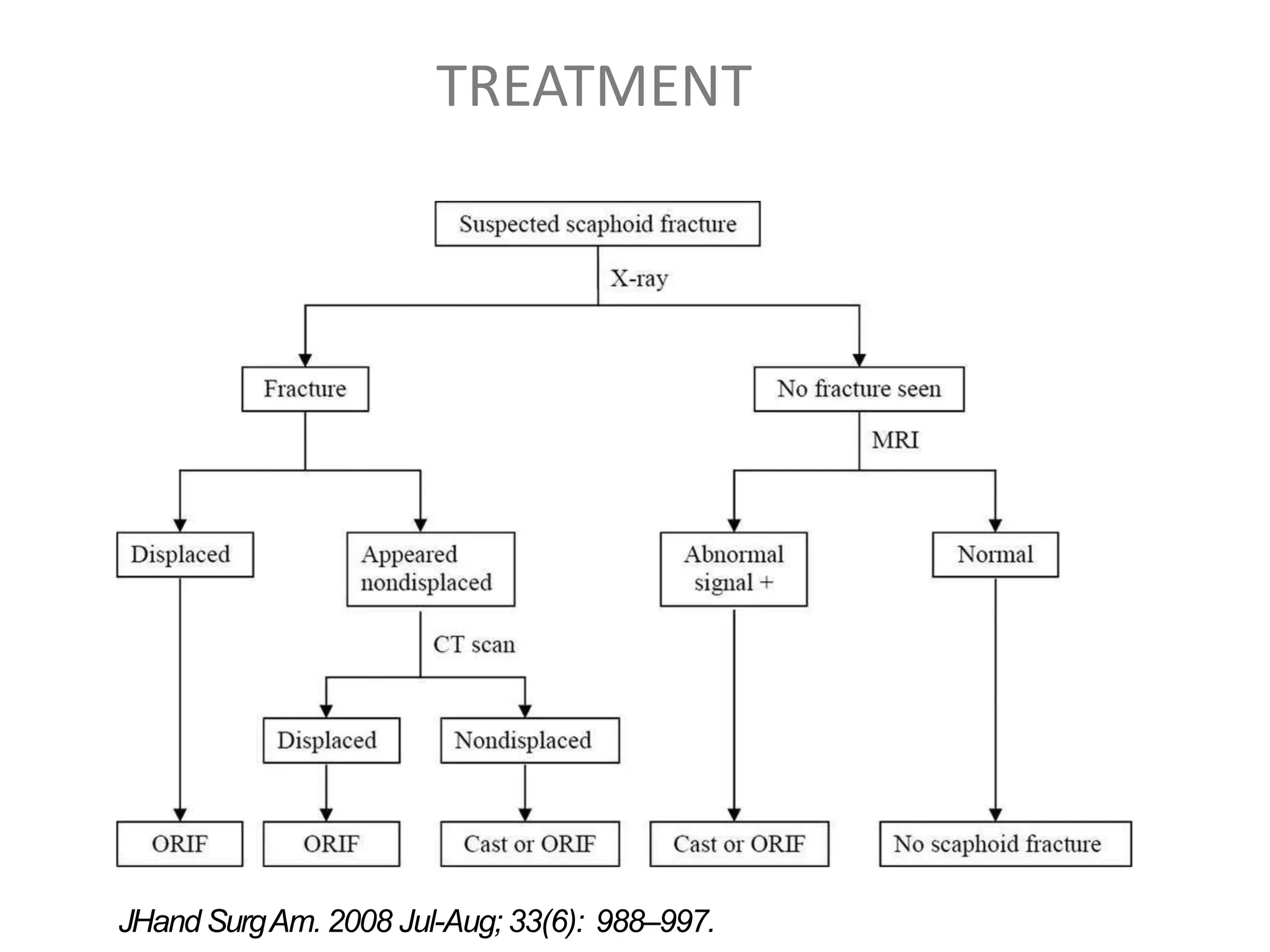
 TREATMENT
 COMPLICATIONS
 NONUNION OF SCAPHOID AND ITS
MANAGEMENT
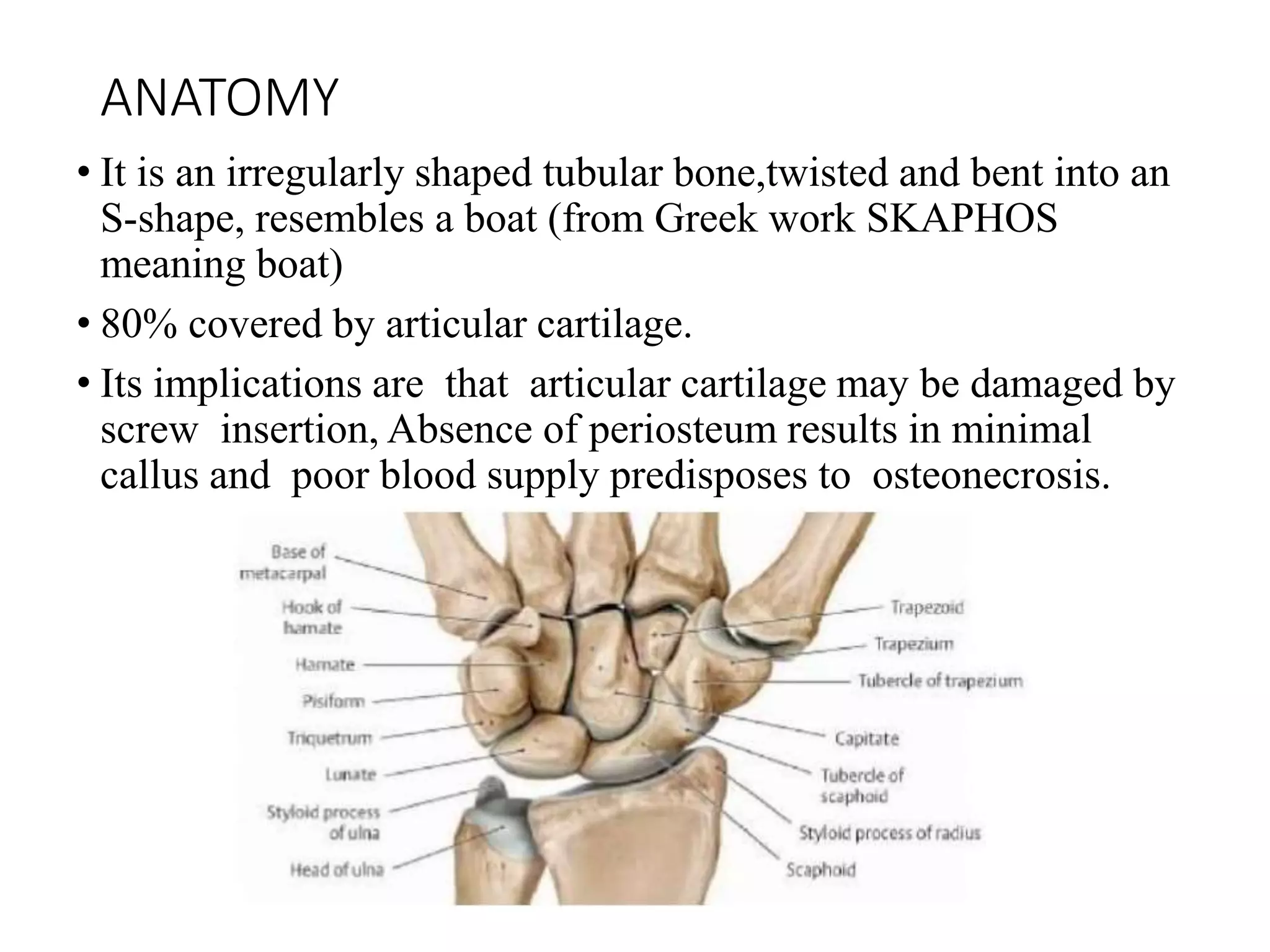
ANATOMY
• It is an irregularly shaped tubular bone,twisted and bent into an
S-shape, resembles a boat (from Greek work SKAPHOS
meaning boat)
• 80% covered by articular cartilage.
• Its implications are that articular cartilage may be damaged by
screw insertion, Absence of periosteum results in minimal
callus and poor blood supply predisposes to osteonecrosis.
ANATOMY
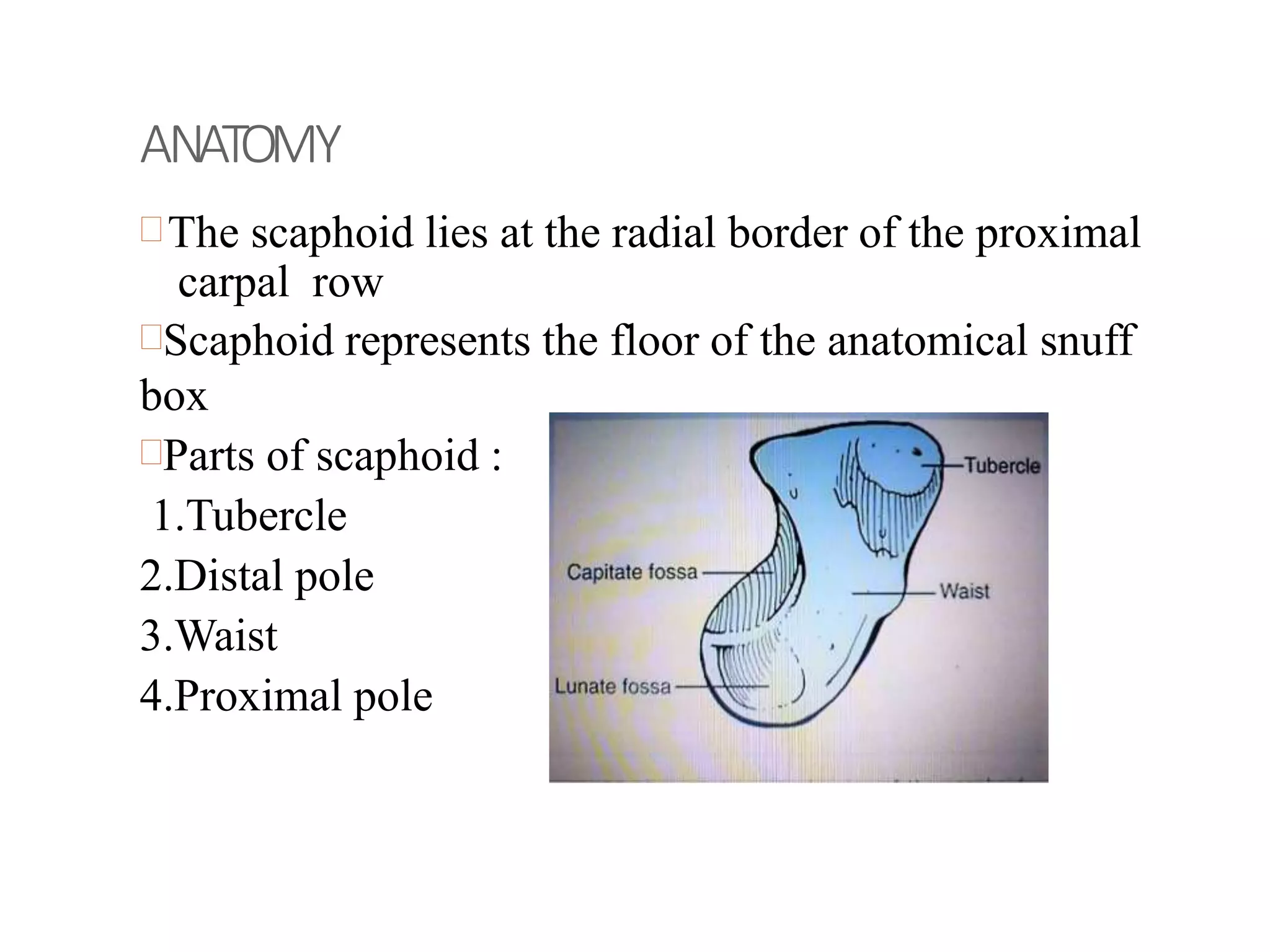
The scaphoid lies at the radial border of the proximal
carpal row
Scaphoid represents the floor of the anatomical snuff
box
Parts of scaphoid :
1.Tubercle
2.Distal pole
3.Waist
4.Proximal pole
ARTICULATIONS
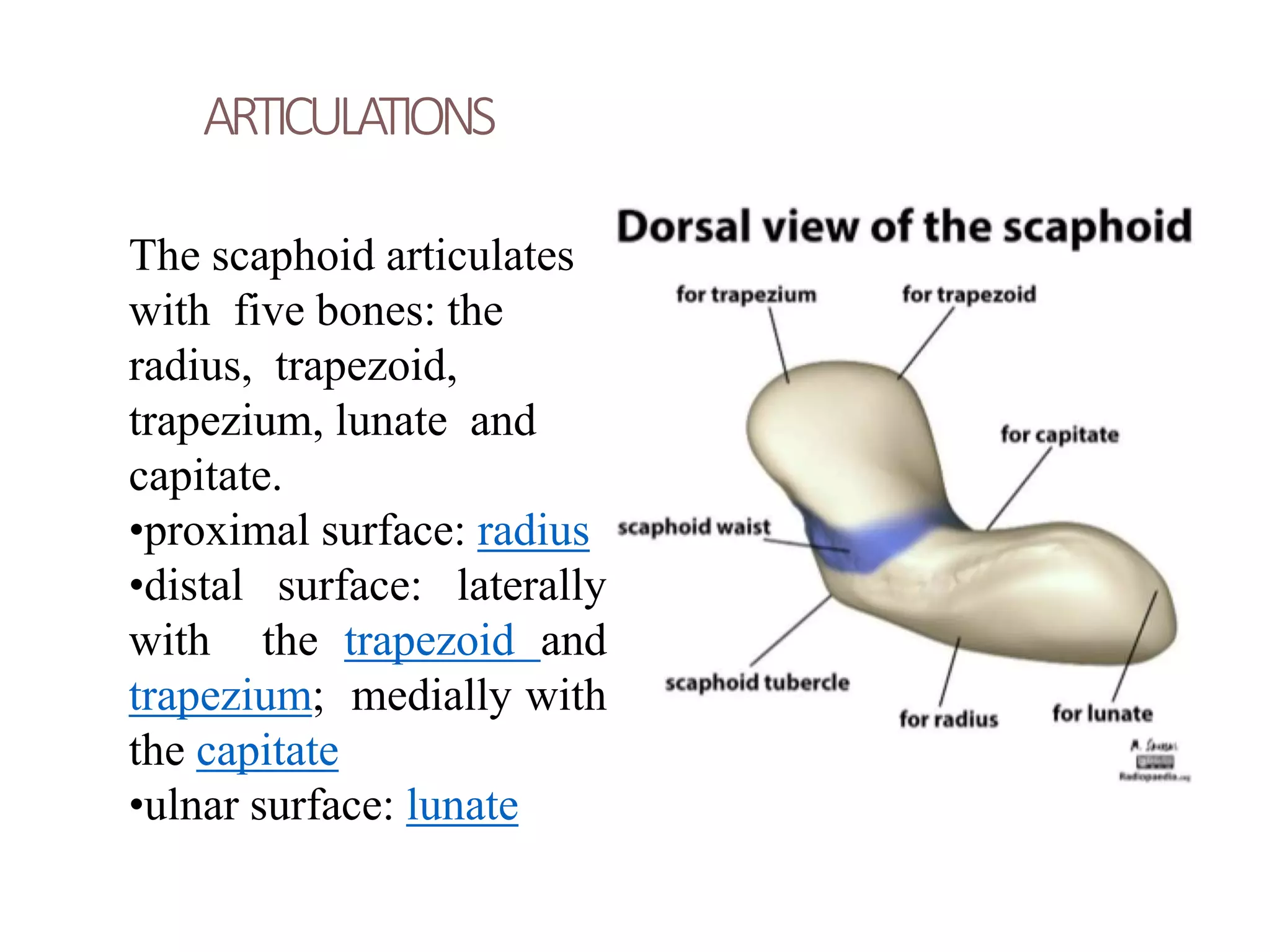
The scaphoid articulates
with five bones: the
radius, trapezoid,
trapezium, lunate and
capitate.
•proximal surface: radius
•distal surface: laterally
with the trapezoid and
trapezium; medially with
the capitate
•ulnar surface: lunate
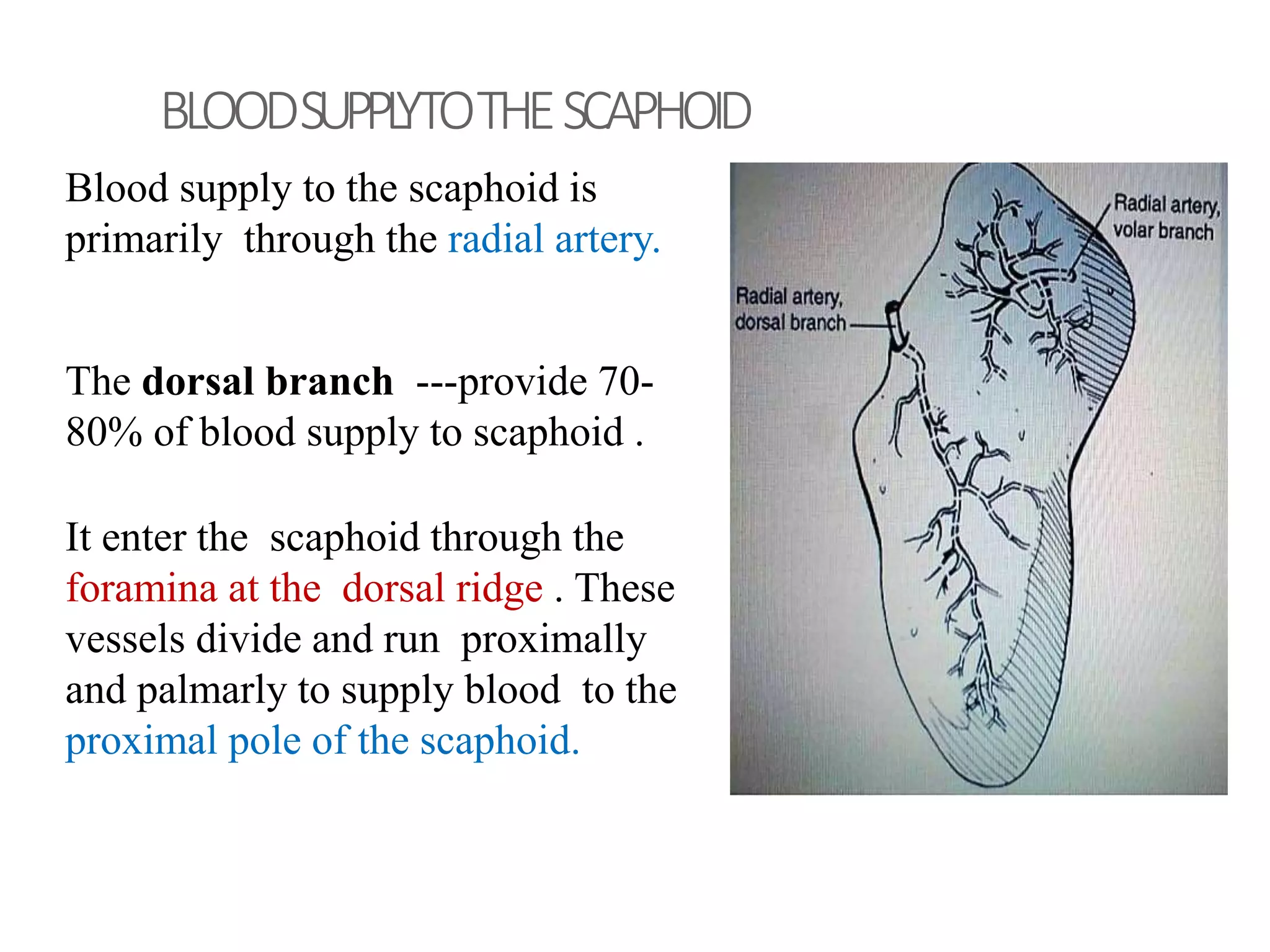
The dorsal branch ---provide 70-
80% of blood supply to scaphoid .
It enter the scaphoid through the
foramina at the dorsal ridge . These
vessels divide and run proximally
and palmarly to supply blood to the
proximal pole of the scaphoid.
BLOODSUPPLYTOTHESCAPHOID
Blood supply to the scaphoid is
primarily through the radial artery.
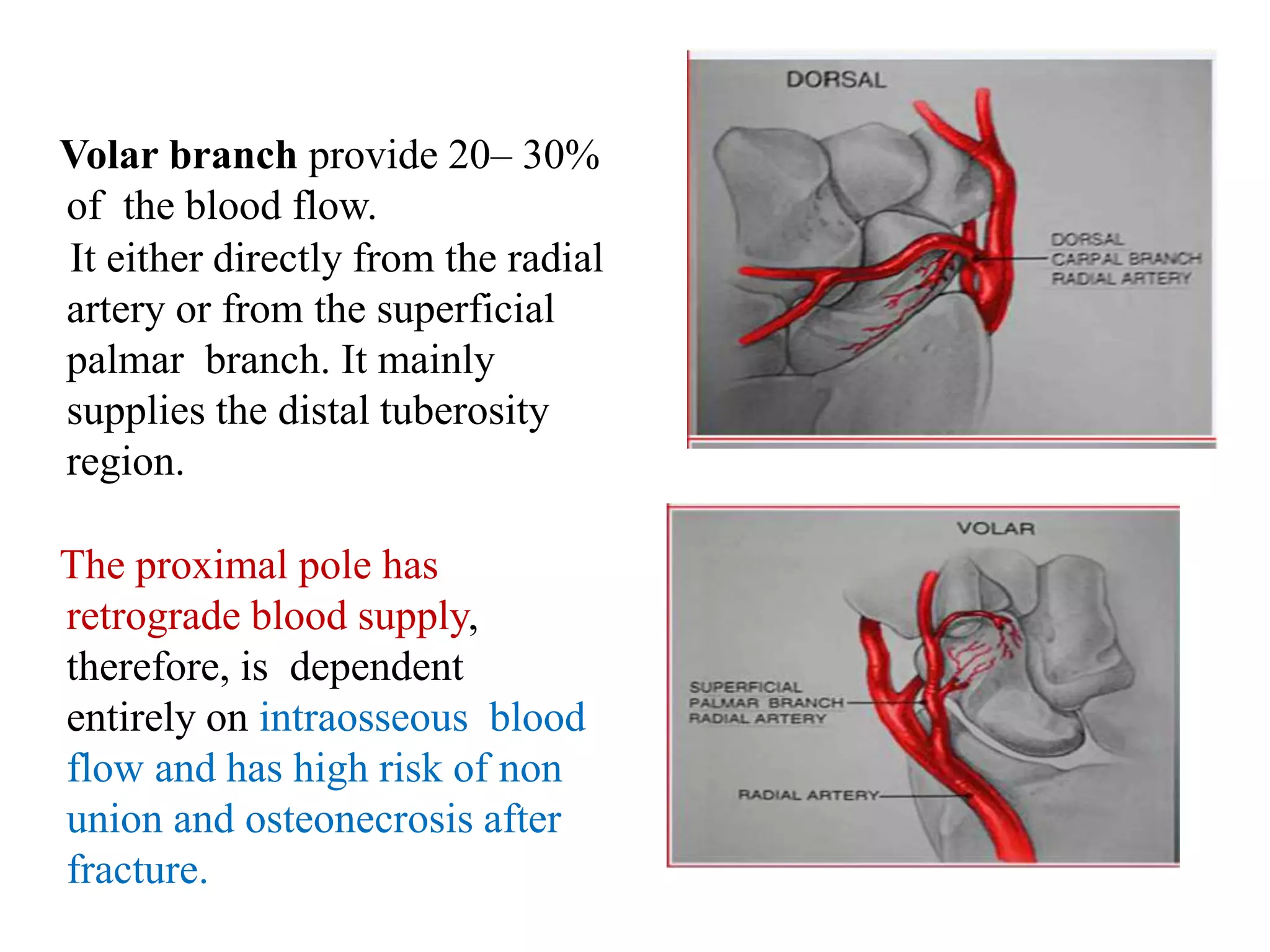
Volar branch provide 20– 30%
of the blood flow.
It either directly from the radial
artery or from the superficial
palmar branch. It mainly
supplies the distal tuberosity
region.
The proximal pole has
retrograde blood supply,
therefore, is dependent
entirely on intraosseous blood
flow and has high risk of non
union and osteonecrosis after
fracture.
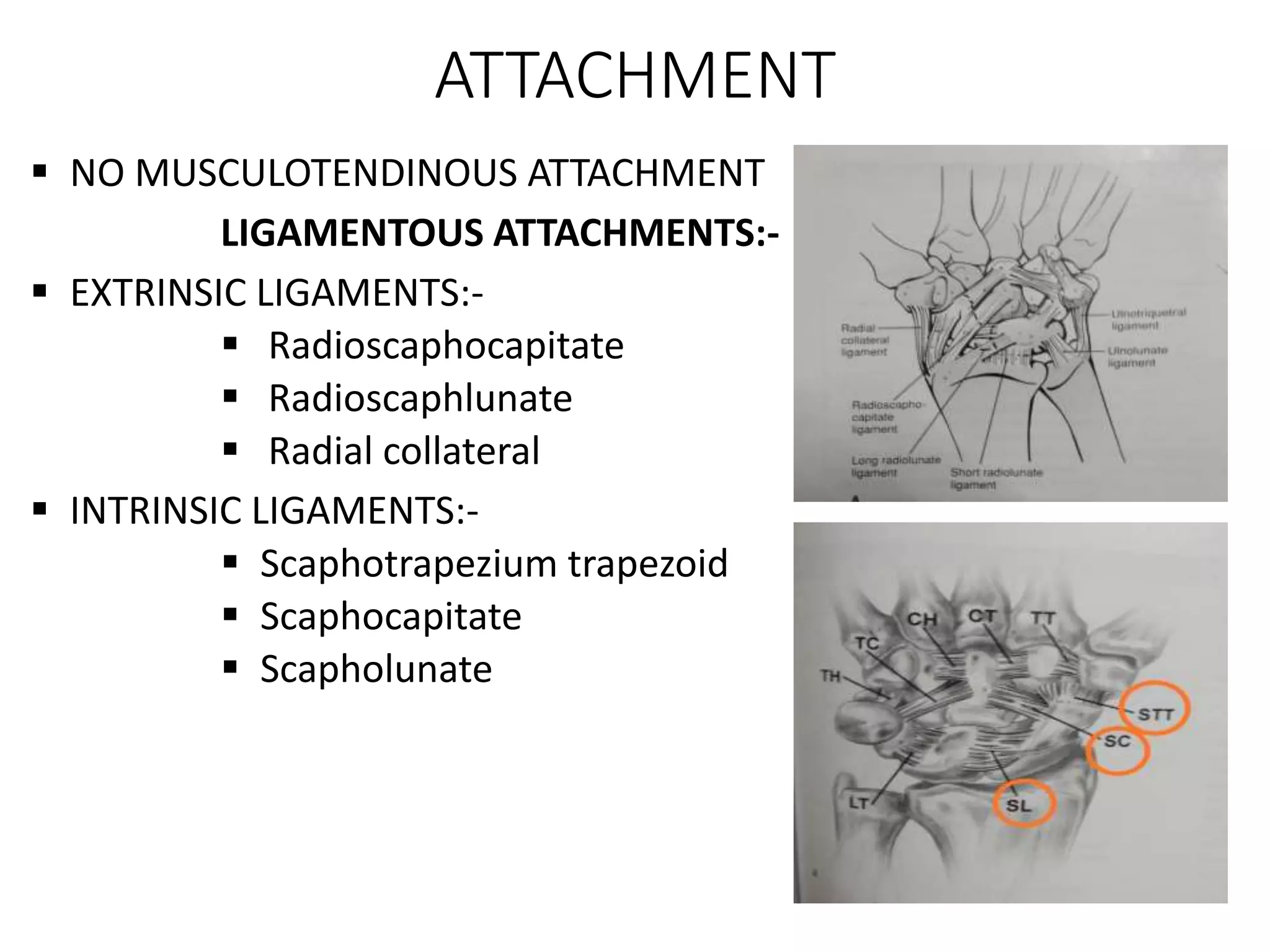
ATTACHMENT
 NO MUSCULOTENDINOUS ATTACHMENT
LIGAMENTOUS ATTACHMENTS:-
 EXTRINSIC LIGAMENTS:-
 Radioscaphocapitate
 Radioscaphlunate
 Radial collateral
 INTRINSIC LIGAMENTS:-
 Scaphotrapezium trapezoid
 Scaphocapitate
 Scapholunate
INTRODUCTION
The scaphoid is the most commonly fractured
carpal bone(60-80% ). 2nd M.C. in upper limb
after fracture distal radius.
Most commonly missed fracture.
AGE: 10-70 yrs. Max incidence in young (20-30
yrs.)
Scaphoid fractures are uncommon in children
because the physis of distal radius fails first and there
is thick peripheral cartilage around scaphoid. If
fracture occurs, distal pole is more common due to
ossification sequence.
M:F- 2.5:1
About 5-12% of scaphoid fractures are associated
with other fractures and carpal instability due to
ligamentous disruption.
70-80% occur at the waist, 20% occurs at
proximal pole,10% at distal pole
RULE OF 70’S FOR SCAPHOID
- 70% of all carpal bone fractures.
- 70% of blood supply is by the dorsal branch
of the radial artery.
- 70% of fractures occur at the waist of scaphoid.
- 70% of the scaphoid fractures unite .
MECHANISM OF INJURY
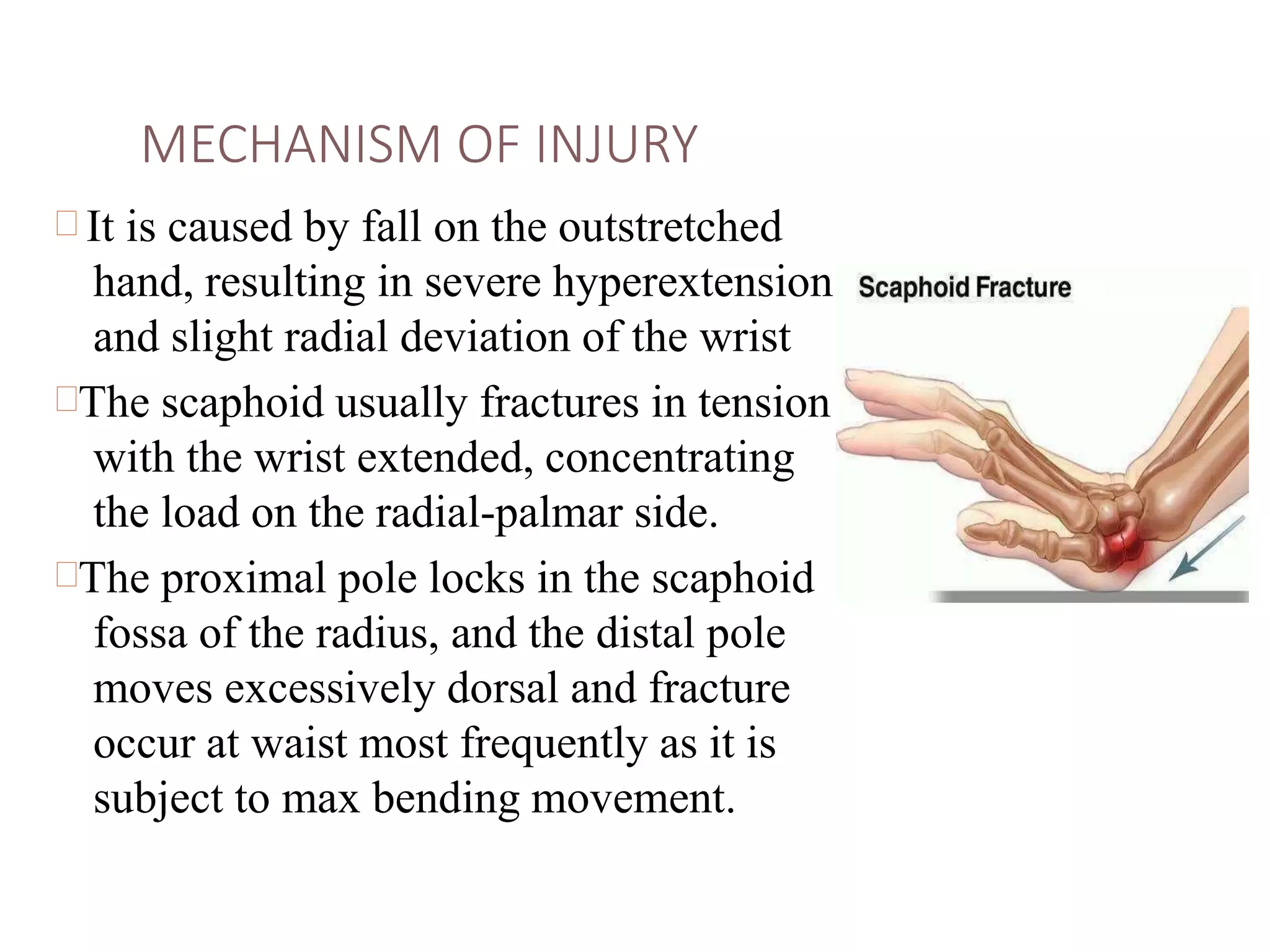
 It is caused by fall on the outstretched
hand, resulting in severe hyperextension
and slight radial deviation of the wrist
The scaphoid usually fractures in tension
with the wrist extended, concentrating
the load on the radial-palmar side.
The proximal pole locks in the scaphoid
fossa of the radius, and the distal pole
moves excessively dorsal and fracture
occur at waist most frequently as it is
subject to max bending movement.
PATHOPHYSIOLOGY
 Frykman subjected cadaver wrists to loading and observed that:
• extension of 40 degrees or less resulted in
proximal forearm fractures
• 40-90 degree resulted in distal radius fracture
• >90 degrees hyperextension resulted in carpal
fractures
 Fracture scaphoid occur when wrist is dorsiflexed > 95 degree
and radially deviated to >10 degree.
 Fracture at waist occur due to shear forces across schaphoid.
 Distal pole fracture occur due to compression or avulsion of
tubercle.
 Position of radial and ulnar deviation thought to determine
where it breaks as midcarpal joint line crosses proximal
pole in radial deviation and distal pole in ulnar deviation.
DIAGNOSIS AND CLINICAL EXAMINATION
 Astrong index of suspicion is the key to early
diagnosis
Diagnosis should be based on
1.history
2.clinical examination
3. radiographic evaluation
CLINICAL EXAMINATION
SYMPTOMS:
1.Pain along the radial side
of wrist 2.Inability or
difficulty to move the wrist
SIGNS:
1.Swelling present in
anatomical snuff box
2.Anatomical snuffbox
tenderness
3.Tenderness with axial compression of
thumb towards the snuff box (longitudinal
thumb compression test)
4.Radial & ulnar deviation results in
pain on radial side of wrist
TESTS
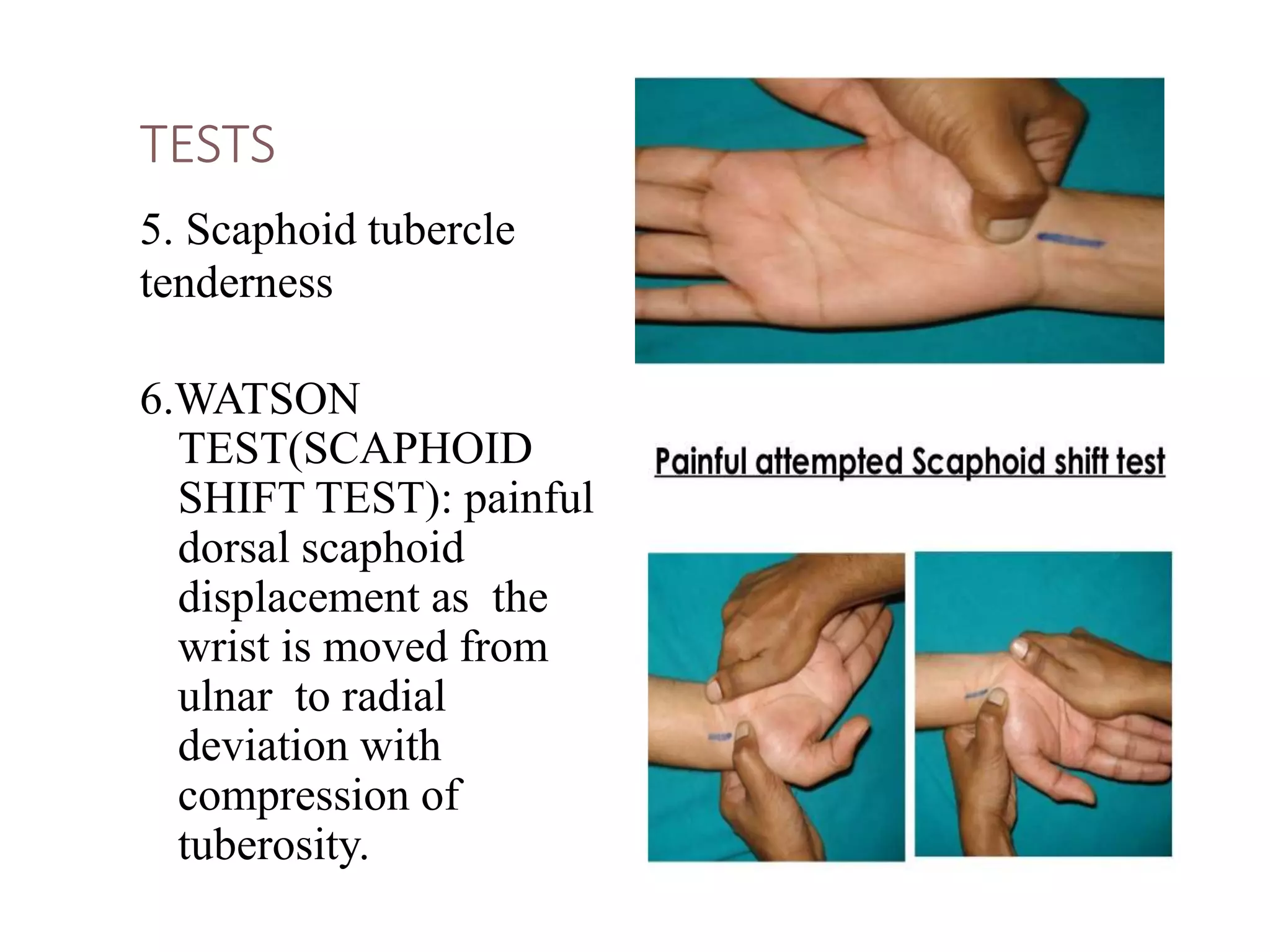
5. Scaphoid tubercle
tenderness
6.WATSON
TEST(SCAPHOID
SHIFT TEST): painful
dorsal scaphoid
displacement as the
wrist is moved from
ulnar to radial
deviation with
compression of
tuberosity.
IMAGING
XRAYS: 4 essentialviews
PAview
Lateralview
45ºradialoblique(semisupinated)
45ºulnaroblique(semipronated)
 ULNAR DEVIATION PA VIEW
 ZITER VIEW/ BANANA VIEW
 REPEAT RADIOGRAPH AFTER 10-14 DAY- WHEN
CLINICAL SUSPICION IS PRESENT BUT
RADIOGRAPH ARE NEGATIVE
 30-40% SCAPHOID FRACTURE NOT IDENTIFIED
INITIALLY( occult fractures)
NEUTRAL PA VIEW
 Assess carpal alignment- GILULA
LINES.
ARC 1-proximal articular
surface of proximal carpal row.
ARC 2-distal articular
surface of proximal carpal row
ARC 3-proximal cortical
margin of capitate and hamate
Broken arc is diagnostic of fracture
or instability particularly perilunate
dislocation.
 Assessment of intercarpal,
carpometacarpal, radiocarpal
joint spaces( normally< 2 mm)
 But poor view for scaphoid
fracture detection as tubercle
overhang on PA view
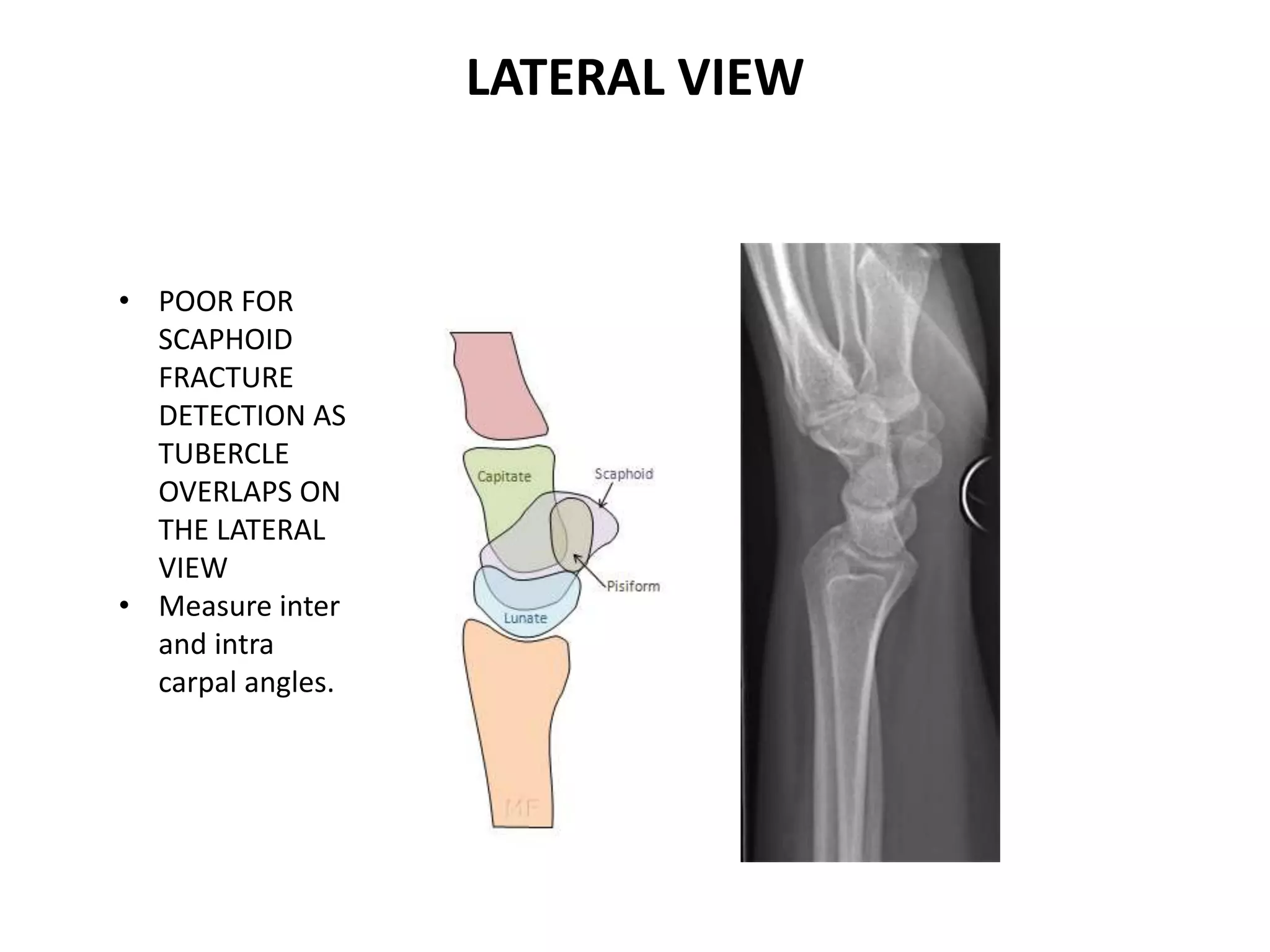
LATERAL VIEW
• POOR FOR
SCAPHOID
FRACTURE
DETECTION AS
TUBERCLE
OVERLAPS ON
THE LATERAL
VIEW
• Measure inter
and intra
carpal angles.
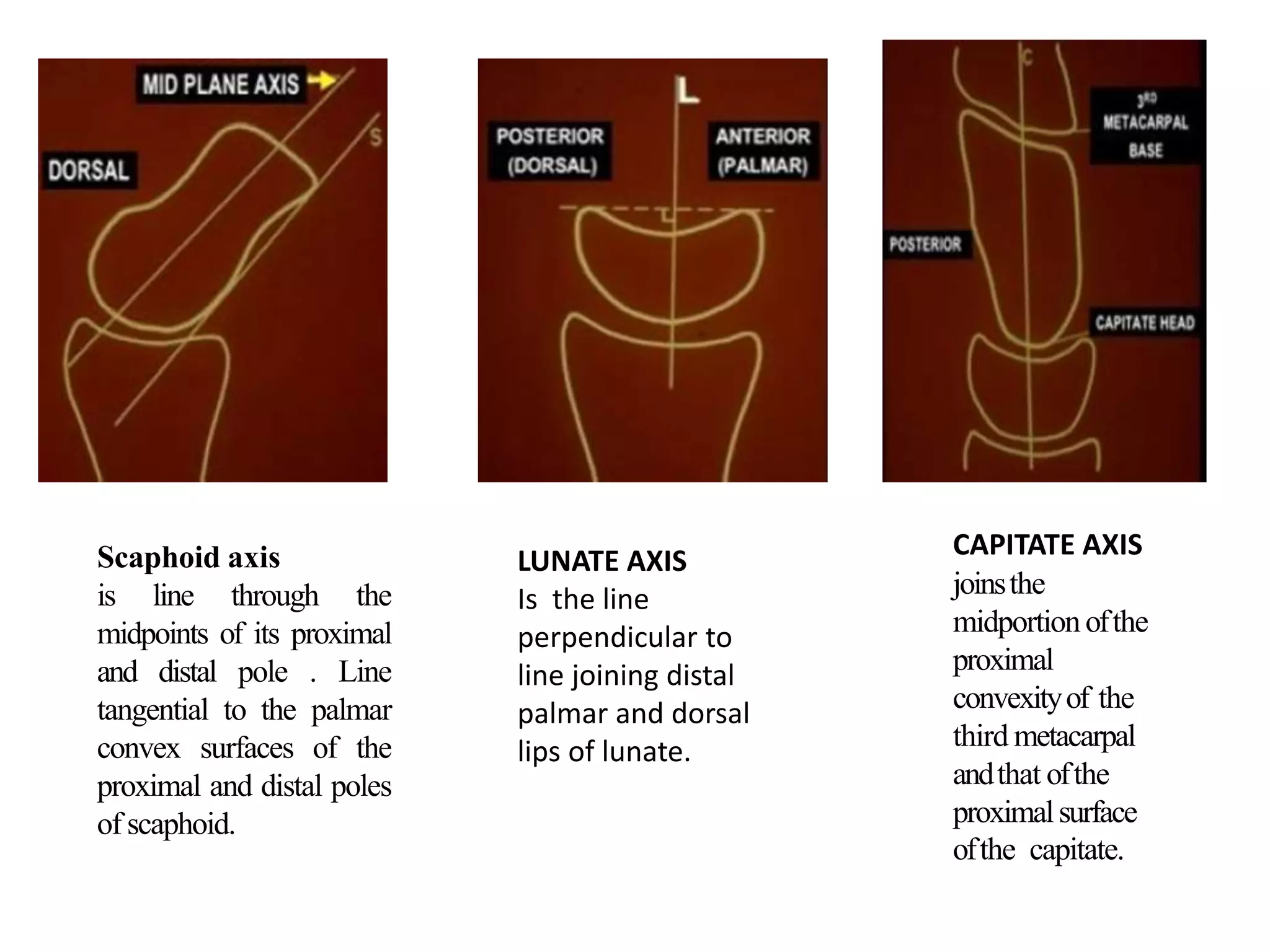
Scaphoid axis
is line through the
midpoints of its proximal
and distal pole . Line
tangential to the palmar
convex surfaces of the
proximal and distal poles
of scaphoid.
LUNATE AXIS
Is the line
perpendicular to
line joining distal
palmar and dorsal
lips of lunate.
CAPITATE AXIS
joinsthe
midportionofthe
proximal
convexityof the
third metacarpal
andthat ofthe
proximalsurface
ofthe capitate.
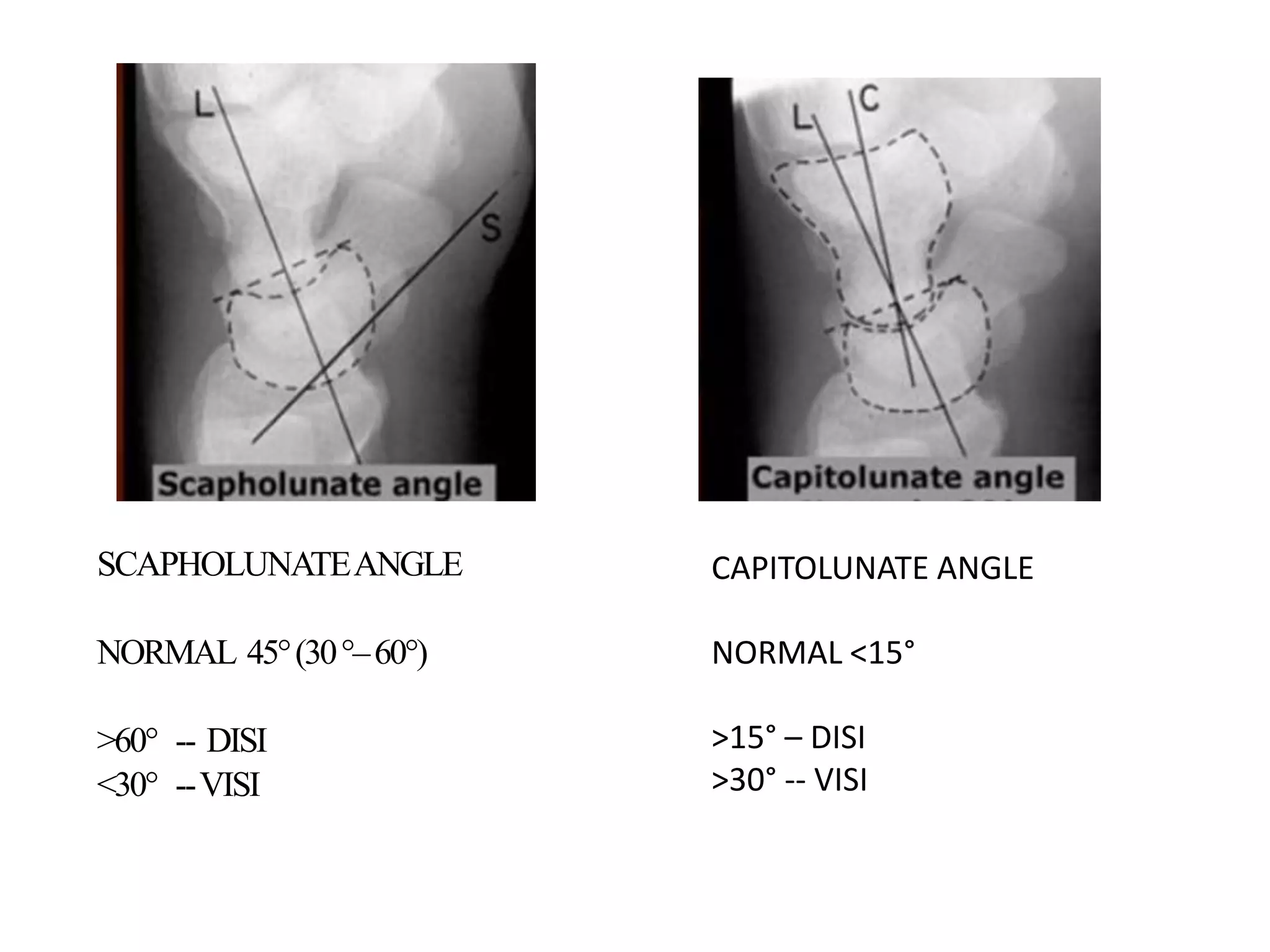
SCAPHOLUNATEANGLE
NORMAL 45°(30°–60°)
>60° -- DISI
<30° --VISI
CAPITOLUNATE ANGLE
NORMAL <15°
>15° – DISI
>30° -- VISI
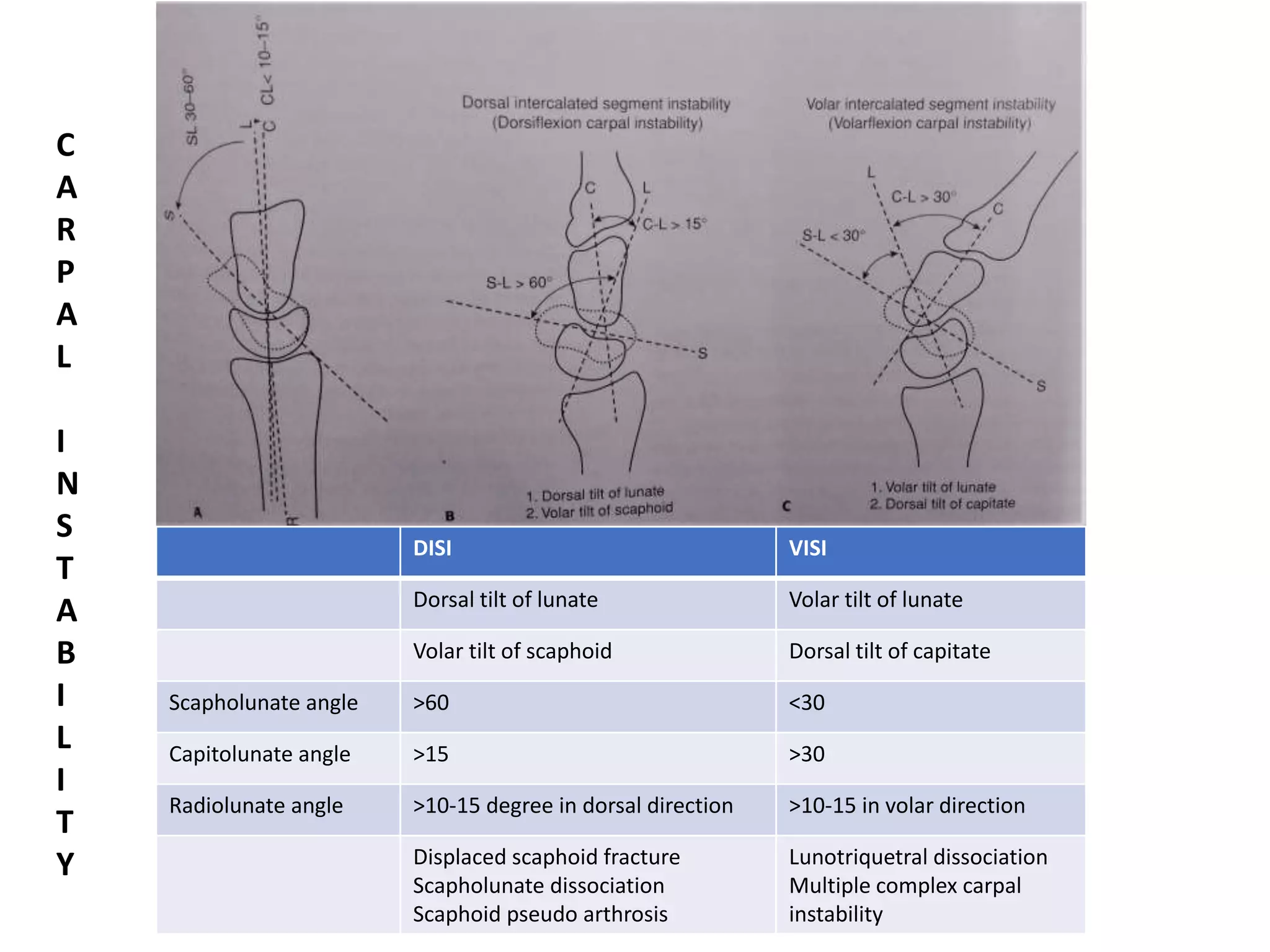
DISI VISI
Dorsal tilt of lunate Volar tilt of lunate
Volar tilt of scaphoid Dorsal tilt of capitate
Scapholunate angle >60 <30
Capitolunate angle >15 >30
Radiolunate angle >10-15 degree in dorsal direction >10-15 in volar direction
Displaced scaphoid fracture
Scapholunate dissociation
Scaphoid pseudo arthrosis
Lunotriquetral dissociation
Multiple complex carpal
instability
C
A
R
P
A
L
I
N
S
T
A
B
I
L
I
T
Y
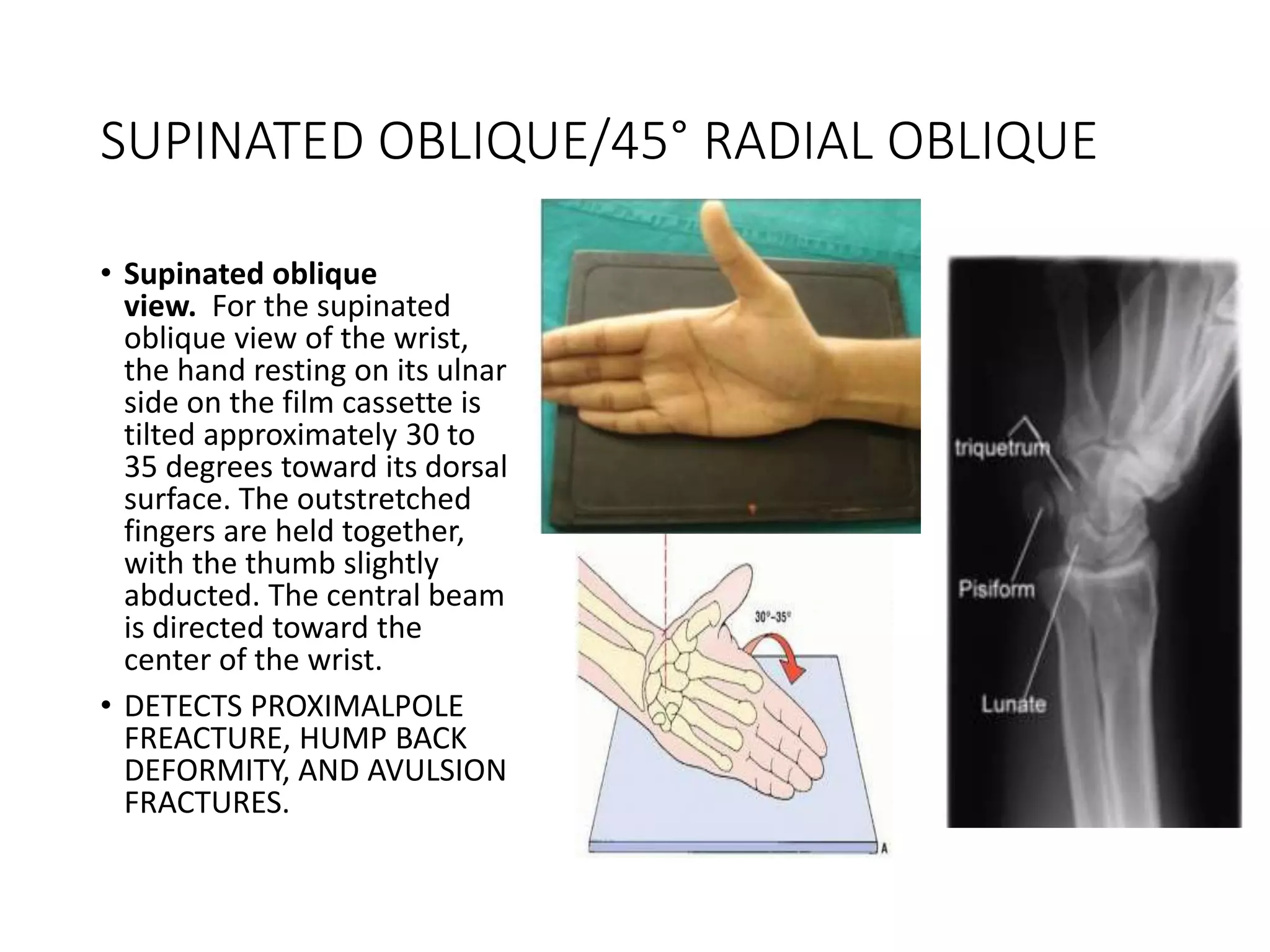
SUPINATED OBLIQUE/45° RADIAL OBLIQUE
• Supinated oblique
view. For the supinated
oblique view of the wrist,
the hand resting on its ulnar
side on the film cassette is
tilted approximately 30 to
35 degrees toward its dorsal
surface. The outstretched
fingers are held together,
with the thumb slightly
abducted. The central beam
is directed toward the
center of the wrist.
• DETECTS PROXIMALPOLE
FREACTURE, HUMP BACK
DEFORMITY, AND AVULSION
FRACTURES.
SEMIPRONATED VIEW/45°ULNAR OBLIQUE
Pronated oblique view. For the
pronated oblique view of the wrist, the
hand resting on its ulnar side on the
film cassette is tilted approximately 40
to 45 degrees toward its palmar
surface. The slightly flexed fingers are
held together, with the thumb in front
of them.
DETECT OBLIQUE SULCAL , WAIST AND
TUBERCLE FRACTURE.
PA VIEW WITH ULNAR DEVIATION
Ulnar deviation view:-
IT ROTATES SCAPHOID PARALLEL
TO LONG AXIS OF FOREARM.
DETECTS PROXIMAL POLE
FRACTURES.
Scaphoid fat pad sign is best
visualised
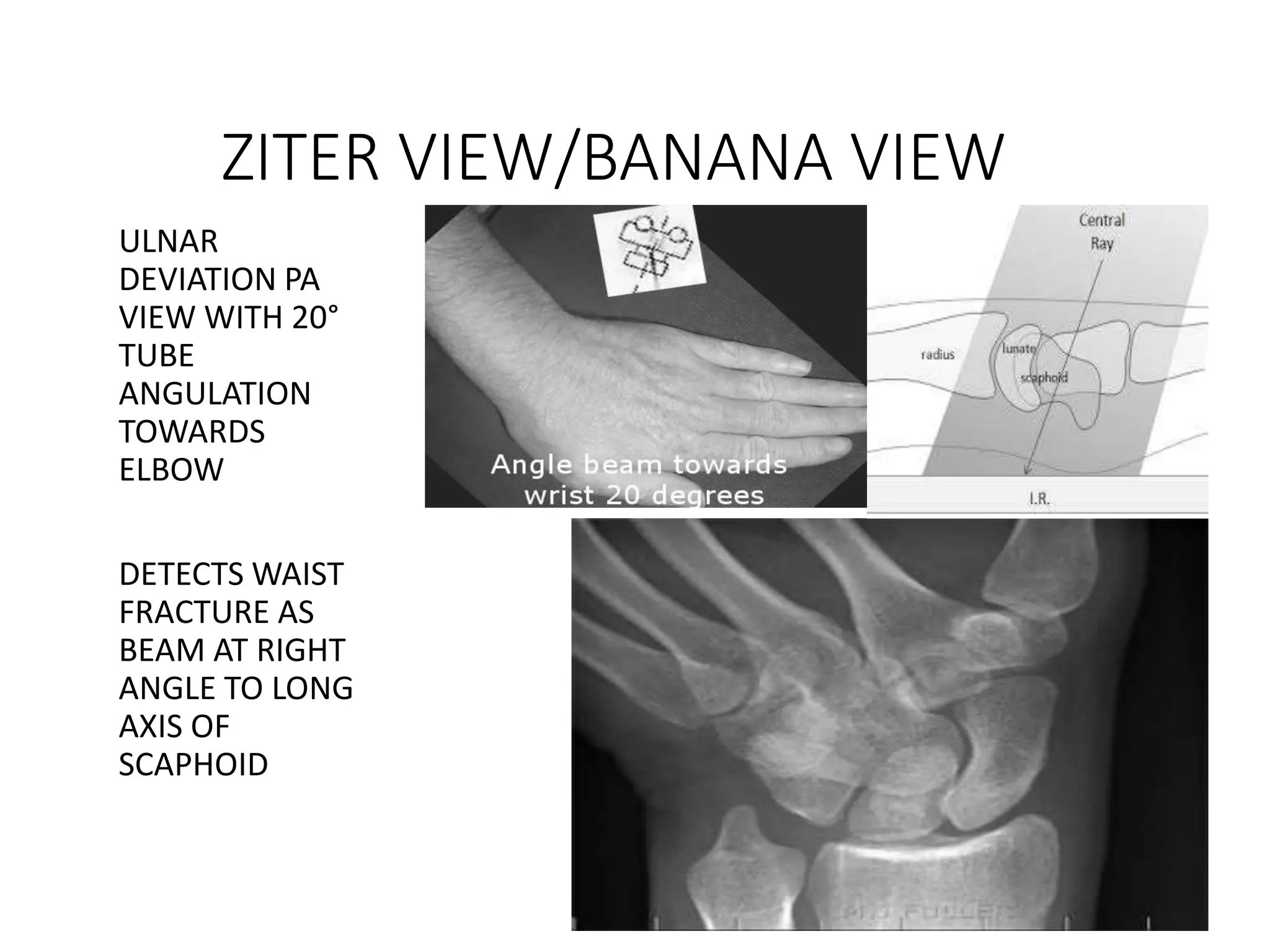
ZITER VIEW/BANANA VIEW
ULNAR
DEVIATION PA
VIEW WITH 20°
TUBE
ANGULATION
TOWARDS
ELBOW
DETECTS WAIST
FRACTURE AS
BEAM AT RIGHT
ANGLE TO LONG
AXIS OF
SCAPHOID
CT SCAN
 CT permits accurate anatomic assessment of the
fracture.
 Bone contusions are not evaluated with CT, but true
fractures can be excluded
 Most sensitive and specific
 Multiplanar and 3D-reconstructions are possible.
 Also assess displacement of fracture, malunion ,non
union and bone loss
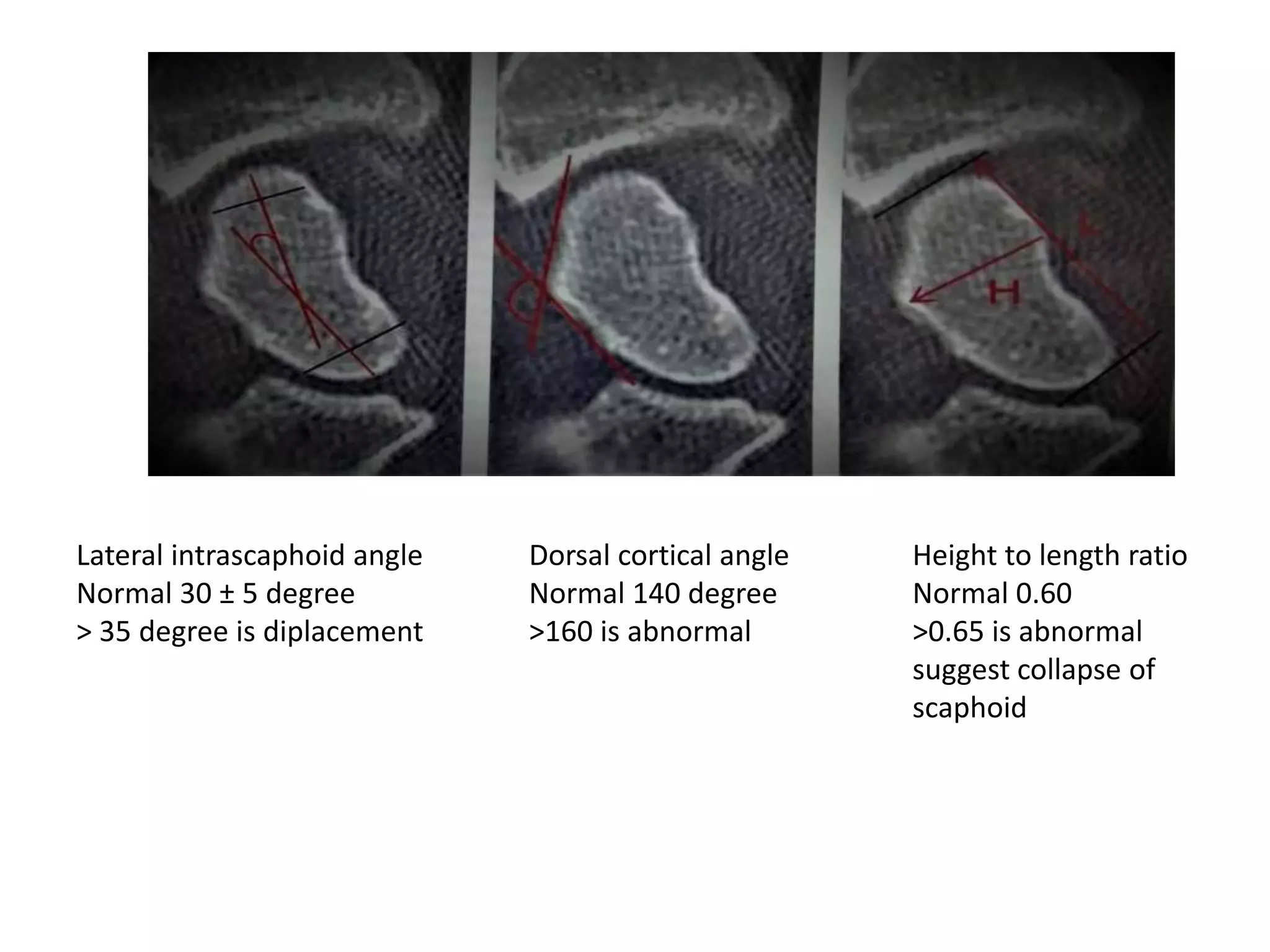
Lateral intrascaphoid angle
Normal 30 ± 5 degree
> 35 degree is diplacement
Dorsal cortical angle
Normal 140 degree
>160 is abnormal
Height to length ratio
Normal 0.60
>0.65 is abnormal
suggest collapse of
scaphoid
MRI
 T1-weighted images obtained in a single plane
(coronal) are typically sufficient to determine the
presence of a scaphoid fracture.
 Gaebler et al prospectively performed MRI on 32
patients, at average of 2.8 days post injury with
100% sensitivity and specificity
 In recent study Dorsay has shown that immediate
MRI provides cost benefit when compared to
splintage and repeat x-ray
 Detects suspected/occult fracture and AVN of
scaphoid
 Gadolinium enhanced MRI assess vascularity of
fracture scaphoid.
• Determine preop vascularityin adiagnosedscaphoid
fracture.
• Acutefractures- Normal or decreasedT1 intensity or
increasedT2 intensity.
• LowT1 andT2 marrow signalintensity indicatespoor
vascularity.
BONESCAN
Sensitive, but less specific
Increased osteocyte activity due to
trauma will show as a focal hot spot.
Fractures are seen in around 95% of non-
osteoporotic patients within 24 hrs.
Negative bone scan excludes any scaphoid fracture.
Teil-van studied cost effectiveness and concluded that
initial x-ray followed by bone scan at 2 weeks if
patient is still symptomatic is most effective
management option
CLASSIFICATIONS
There are several classification systems available for
fractures of scaphoid. These include the following
RUSSE’S classification
AO classification
HERBERT’S classification
MAYO classification
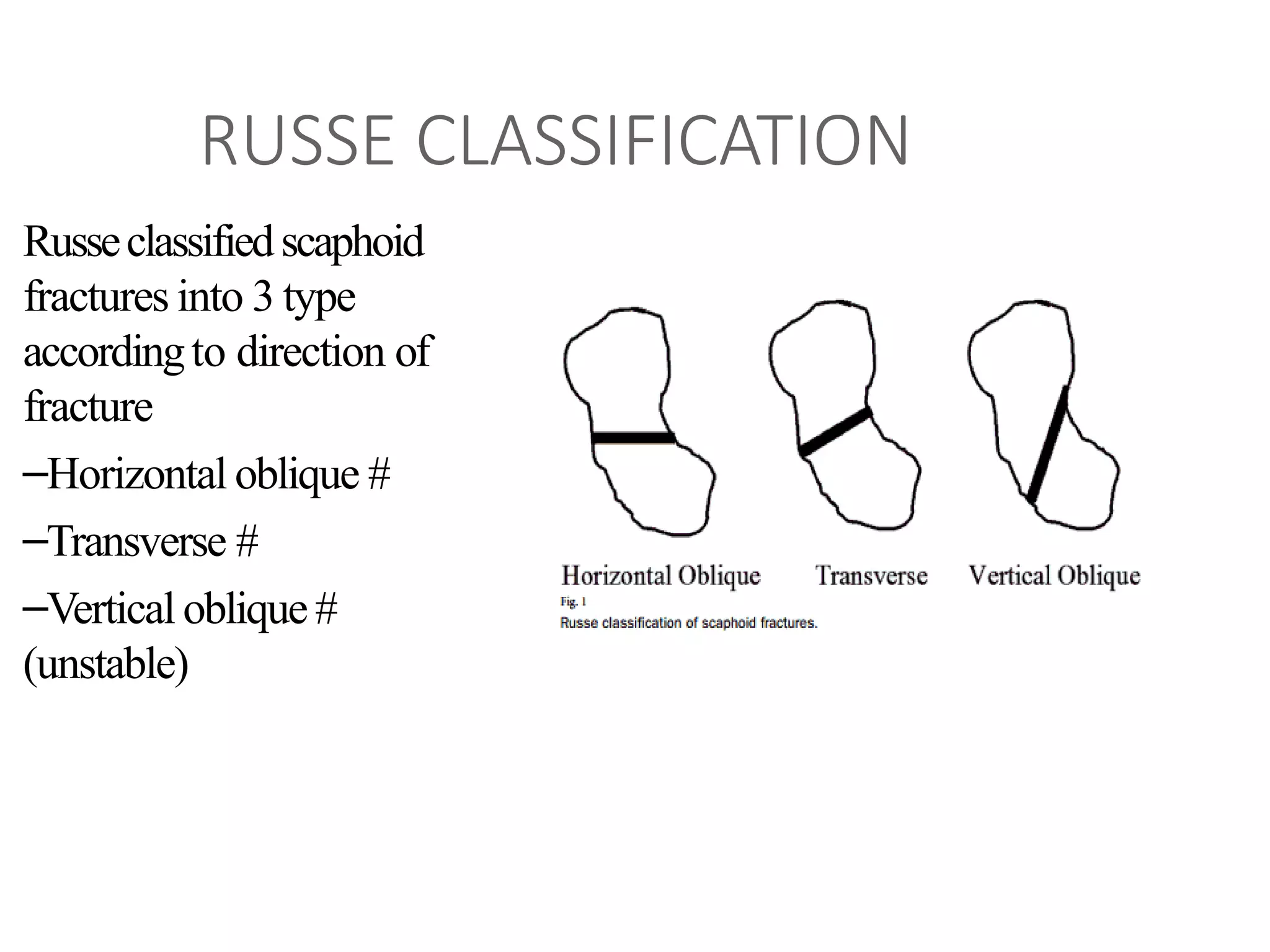
RUSSE CLASSIFICATION
Russeclassifiedscaphoid
fractures into 3 type
accordingto direction of
fracture
–Horizontal oblique #
–Transverse #
–Vertical oblique#
(unstable)
MAYO’ S CLASSIFICATION
 It divides scaphoid fractures
into three basic types
according to anatomic
location of the fracture line.
1.proximal third (10%)
2.middle third (70%)
3.distal third (20%)
Fracture of the distal third are
further divided according to
involvement of the distal
articular surface or the distal
tubercle.
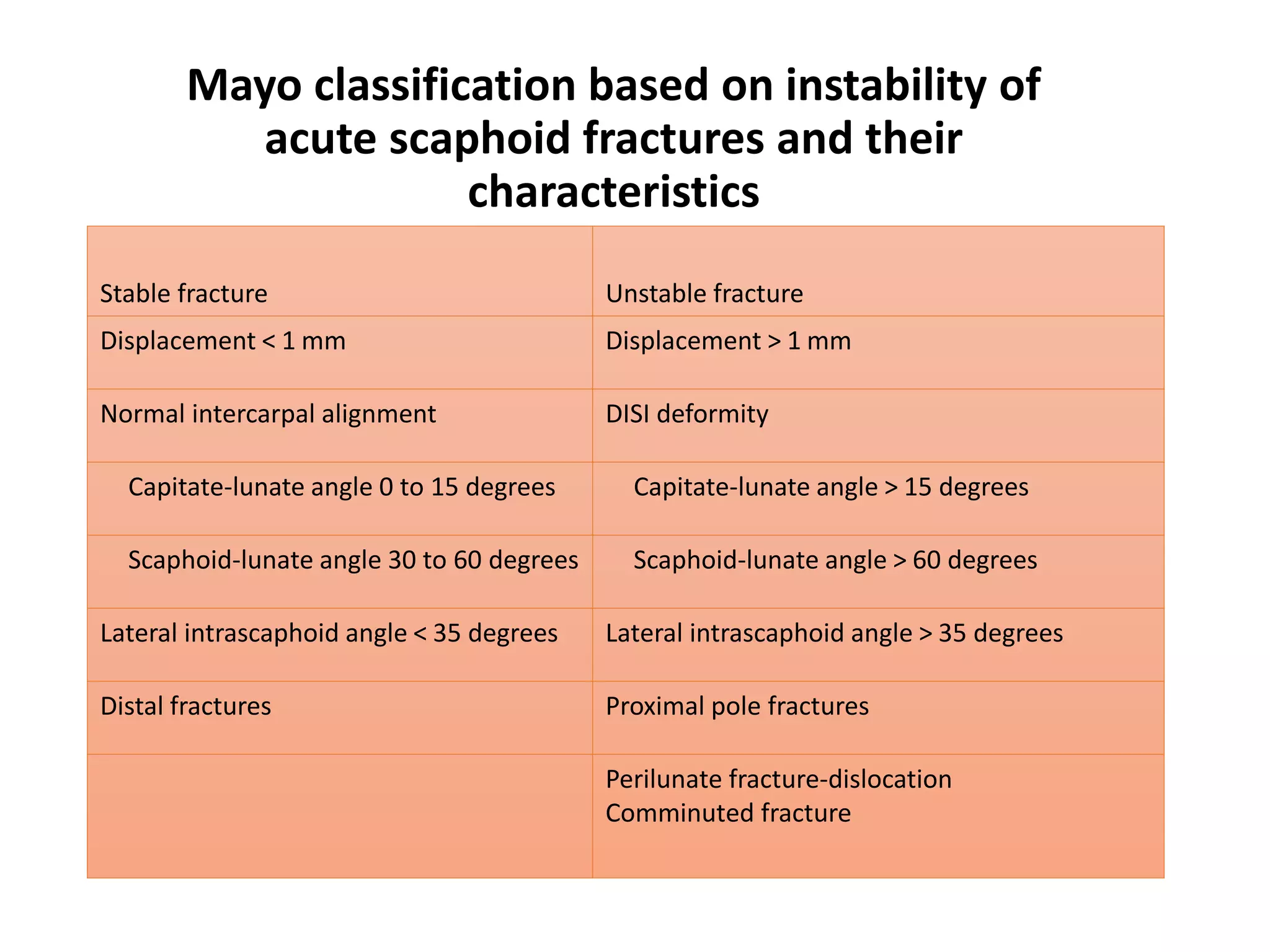
Mayo classification based on instability of
acute scaphoid fractures and their
characteristics
Stable fracture Unstable fracture
Displacement < 1 mm Displacement > 1 mm
Normal intercarpal alignment DISI deformity
Capitate-lunate angle 0 to 15 degrees Capitate-lunate angle > 15 degrees
Scaphoid-lunate angle 30 to 60 degrees Scaphoid-lunate angle > 60 degrees
Lateral intrascaphoid angle < 35 degrees Lateral intrascaphoid angle > 35 degrees
Distal fractures Proximal pole fractures
Perilunate fracture-dislocation
Comminuted fracture
HERBERT’SANDFISHERCLASSIFICATION
• combinedfracture anatomy, stability andchronicity of injury.
 Type A(stable acute fractures)- 31%
–
–
A1:fracture oftubercle
A2:incomplete fracture of waist
 Type B(unstable acute fractures)-69%
–
–
–
–
_
B1:distaloblique
B2:complete waist
B3:proximal pole fracture
B4:trans-scaphoidperilunate fracture
dislocationof carpus
B5: Comminuted
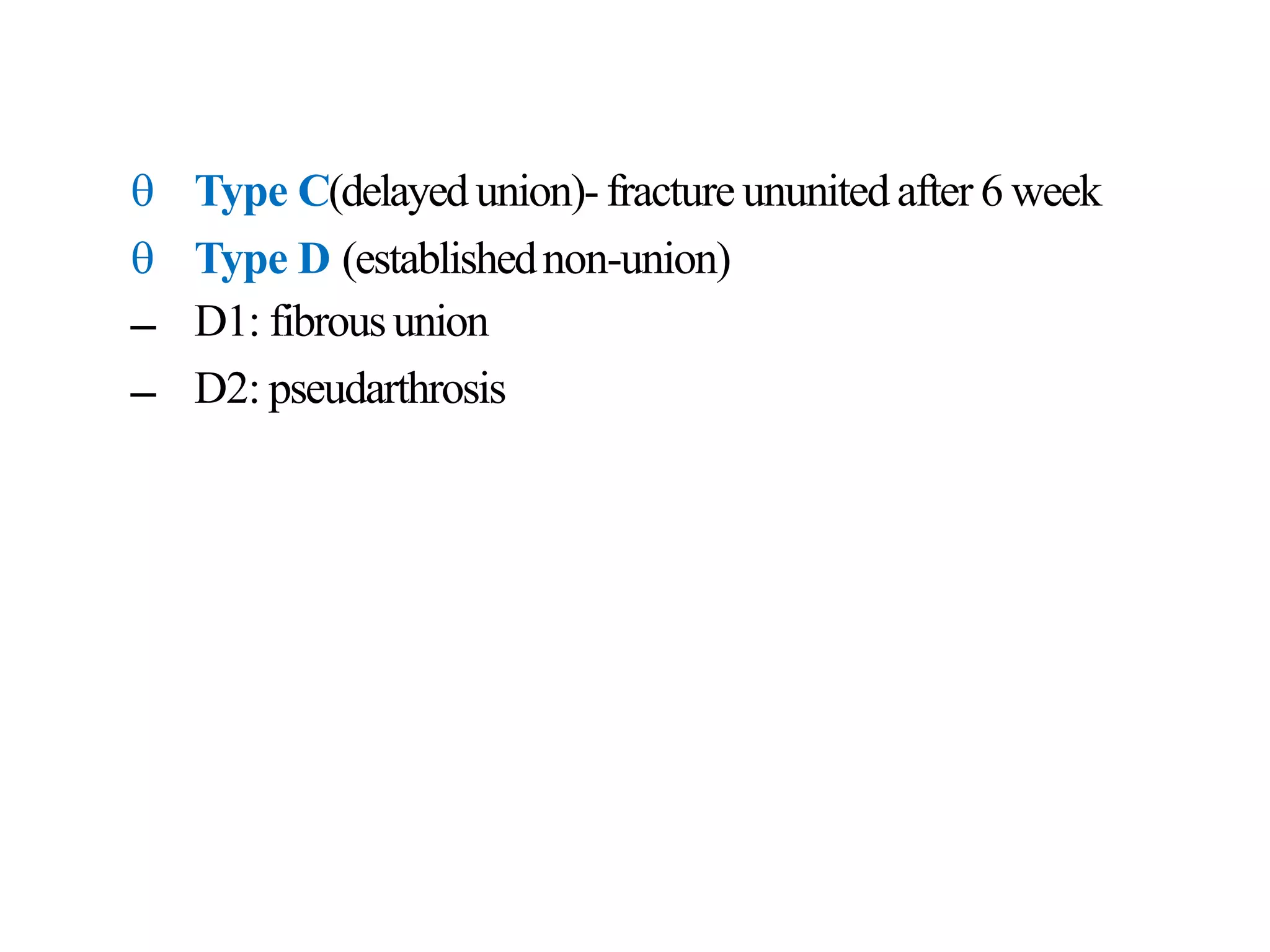
 Type C(delayed union)- fracture ununited after 6 week
 Type D (establishednon-union)
–
–
D1: fibrousunion
D2: pseudarthrosis
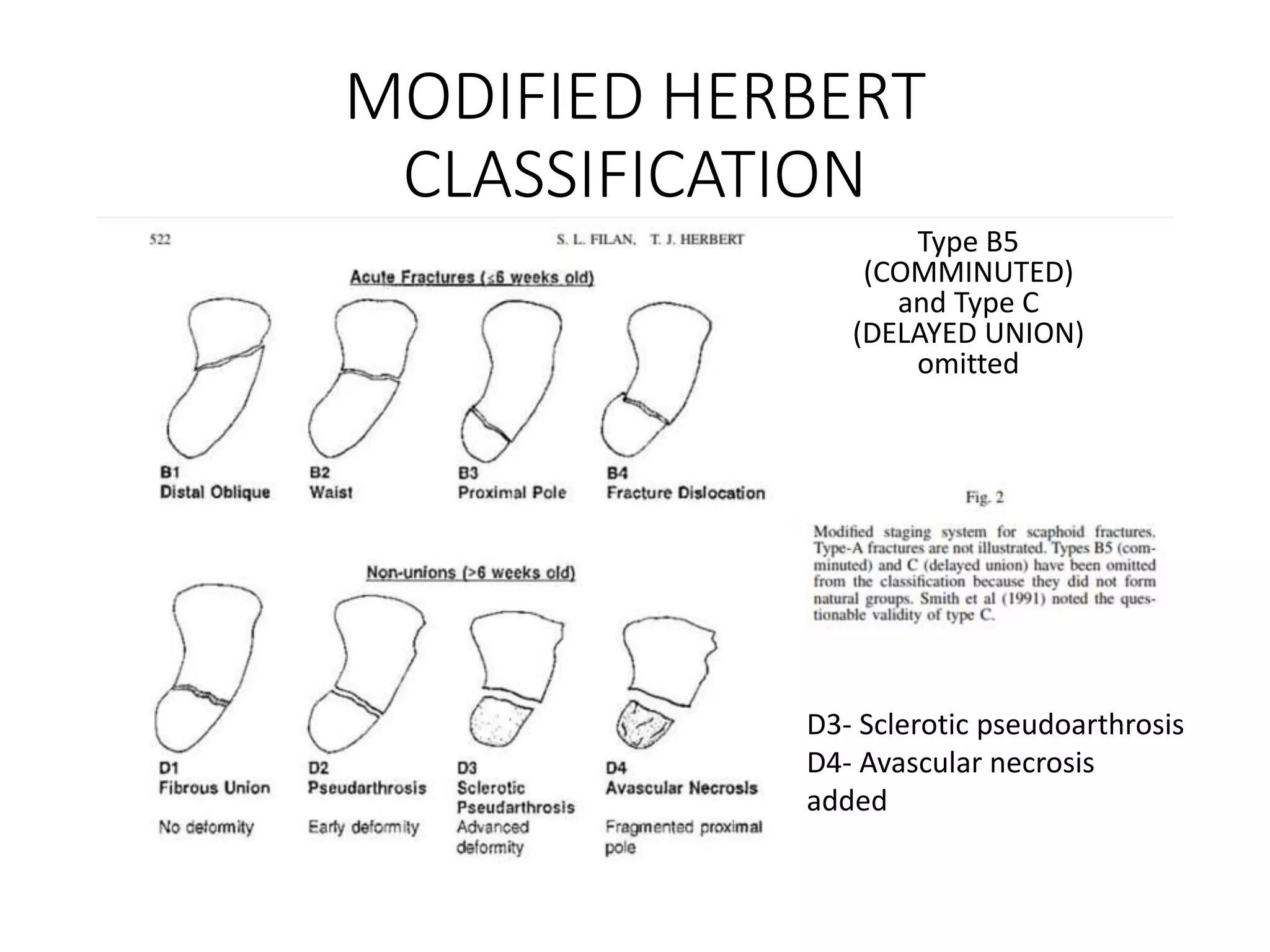
MODIFIED HERBERT
CLASSIFICATION
Type B5
(COMMINUTED)
and Type C
(DELAYED UNION)
omitted
D3- Sclerotic pseudoarthrosis
D4- Avascular necrosis
added
AO CLASSIFICATION( SCAPHOID-72)
JHand SurgAm. 2008 Jul-Aug; 33(6): 988–997.
TREATMENT
TREATMENT
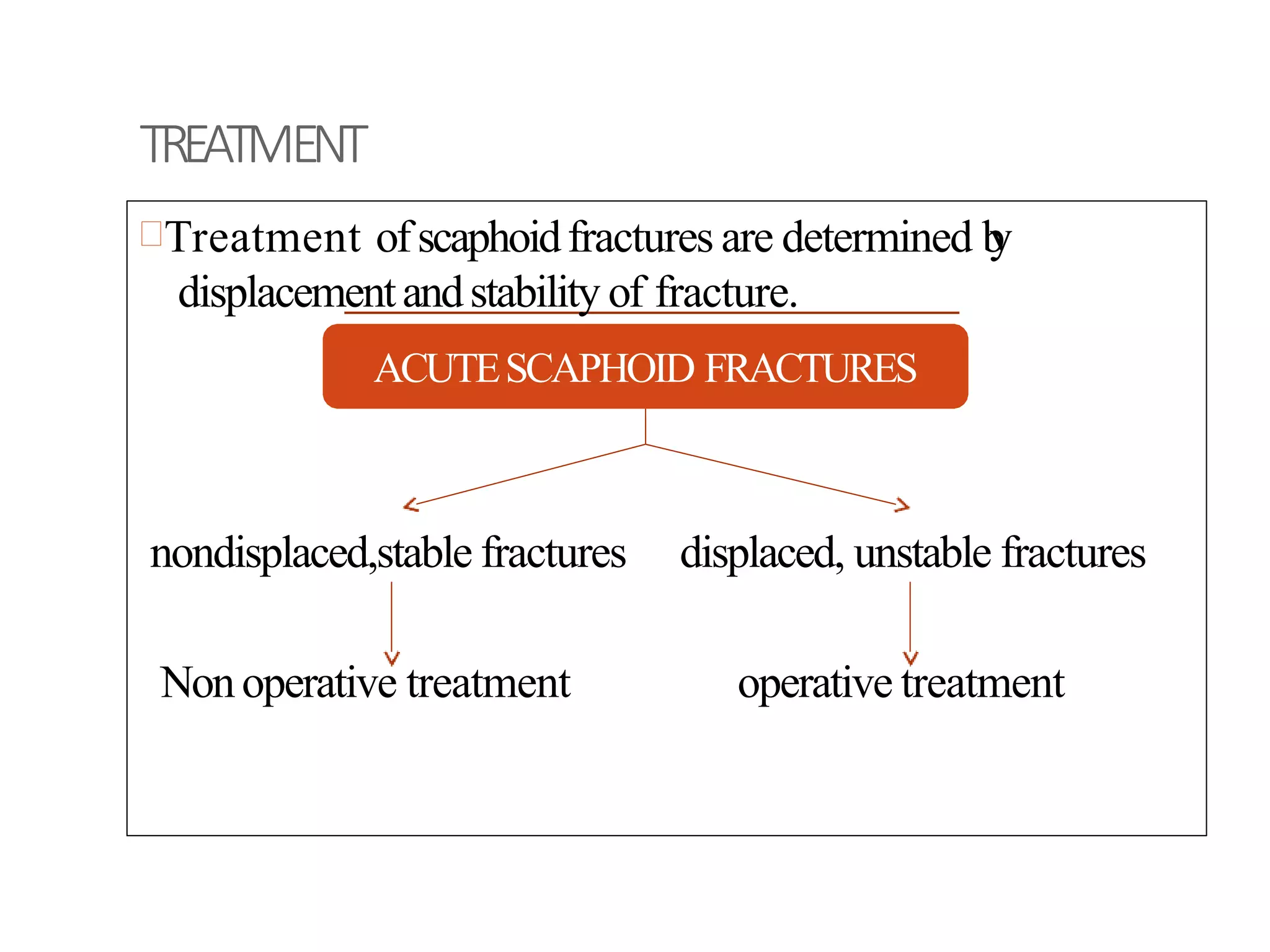
Treatment ofscaphoidfractures are determined by
displacementandstability of fracture.
nondisplaced,stable fractures displaced, unstable fractures
Nonoperative treatment operative treatment
ACUTESCAPHOID FRACTURES
SACPHOID TUBERCLE
FRACTURES/ DISTAL POLE
 Are infrequent
 Usuallyextra- articular with good blood supply
 Besttreated with BELOW ELBOW CAST
IMMOBILISATION for 4 week.
 Aftertreatmenttuberclemayshowpersistentdisplacement
orfibrousunionbutcausesnodisability
UNDISPLACED/ MINIMALLY
DISPLACED WAIST FRACTURE
 Mostcommontype of fracture
 Operative vs non-operative:Controversial
 Below elbow cast immobilization is treatment of choice
for 6-8 week
 Repeat x-ray after 2 week to look for displacement….if
present surgery may be required
 Bone consolidation take 12 to 16 week. So return to
sports and use of hand with force is delayed for 4-6
months
CAST immobilisation
SCAPHOID CASTVS COLLE’S CAST
SCAPHOID CAST/ LONG THUMB SPICACAST-below
elbow forearm cast with thumb immobilisation include
proximal phalanx of thumb with wrist in 10 degree flexion
and radial deviation(glass holding position).
Thumbismaintainedin functionalposition andthe fingersare
free to movefrom MCPjoints distally.
COLLE’S CAST-below elbow cast without thumb
immobilisation.
There is no advantage to either method. Both methods of
casting have similar union rate ,wrist flexion and grip
strength.
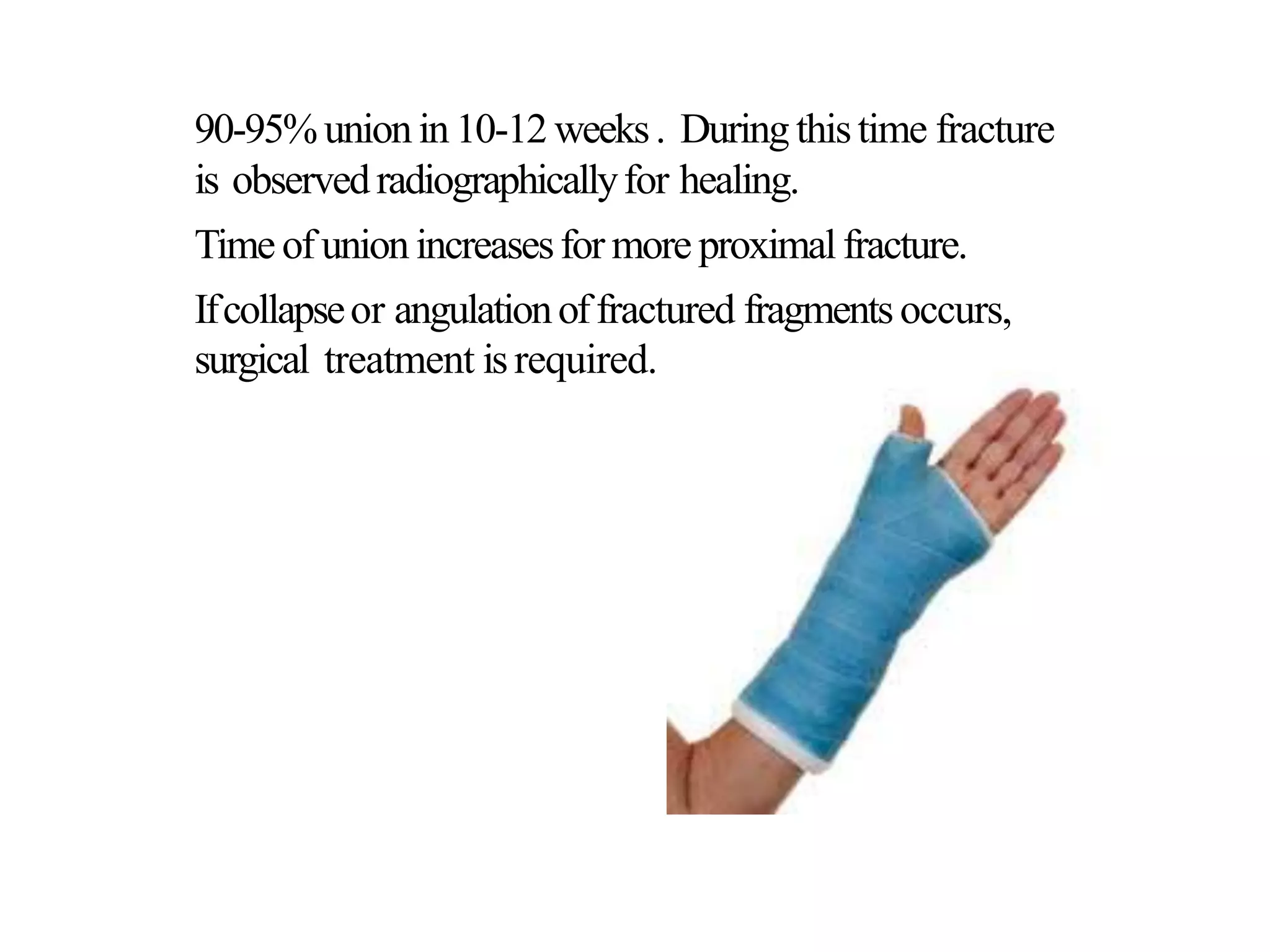
90-95%union in10-12 weeks. During thistime fracture
is observedradiographicallyfor healing.
Time ofunion increasesfor more proximalfracture.
Ifcollapseor angulationoffractured fragmentsoccurs,
surgical treatment isrequired.
Operative Management of minimally
displaced waist fractures
 Operative vs non-operative: Controversial
 High rate of delayed and non-union after conservative
management( Herbert and fisher).
 More recently several studies advocate use of early
fixation- decreased time of union , superior union rate
and early return to function
PERCUTANEOUS FIXATION is superior to ORIF.
 With advent of percutaneous techniques of cannulated
screws under fluoroscopic control trend towards
operative management
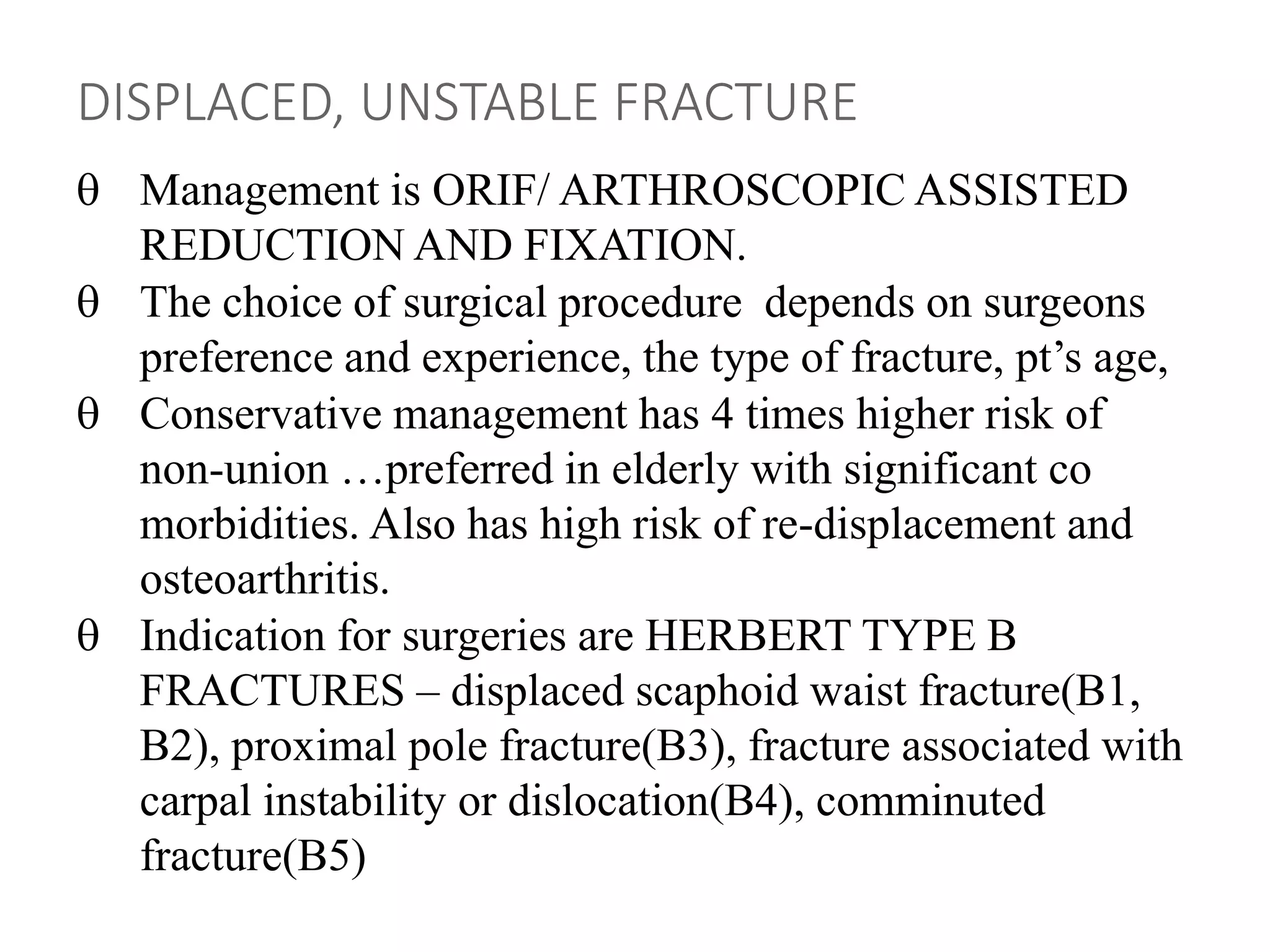
DISPLACED, UNSTABLE FRACTURE
 Management is ORIF/ ARTHROSCOPIC ASSISTED
REDUCTION AND FIXATION.
 The choice of surgical procedure depends on surgeons
preference and experience, the type of fracture, pt’s age,
 Conservative management has 4 times higher risk of
non-union …preferred in elderly with significant co
morbidities. Also has high risk of re-displacement and
osteoarthritis.
 Indication for surgeries are HERBERT TYPE B
FRACTURES – displaced scaphoid waist fracture(B1,
B2), proximal pole fracture(B3), fracture associated with
carpal instability or dislocation(B4), comminuted
fracture(B5)
Mayo’s criteria for unstable
scaphoid fracture
Displacement > 1 mm (B1,B2)
DISI deformity( B4)
Capitate-lunate angle > 15 degrees
Scaphoid-lunate angle > 60 degrees
Lateral intrascaphoid angle > 35 degrees
Proximal pole fractures(B3)
Perilunate fracture-dislocation(B4)
Comminuted fracture(B5)
• Uncommon
• On fracture there is temporary interruption of blood supply.
• If stabilised proximal pole revascularize and heal.
• However risk of non-union is 7.5 times higher in case of
conservative management . It also require longer duration
of cast
• Preferredtreatment----ORIF
Management of proximal pole fractures
METHODS OF FIXATION
K WIRE
AO CANNULATED SCREWS
HERBERT SCREWS
HERBERT WHIPPLE SCREW
ACUMED ACUTRAK
SYNTHES HCS LONG THREAD
KOMPRESSOR MINI
STRYKER TWIN FIX
HEADLESS SCREWS
Advantages :
Reduces the time of external immobilization
Provides relatively strong internal fixation
Produces compression at the fracture by pitch differential
between leading and traling threads.
Headless screw remains below the bone surface,
removal usually is unnecessary.
Can be used with a bone graft to correct scaphoid
angulation.
Disadvantages :
Cannot be used in immature bone
Cannot be used if fracture fragment is too small
Use of jig for insertion and demanding surgical technique
Contra indications :
o Avascular crumbling of the proximal pole of the scaphoid
o Extensive trauma or osteoarthritis involving the adjacent
carpals or articular surface of the radius
o Gross carpal collapse
o Severe osteoporosis
SURGICAL APPROACHES
PERCUTANEOUS APPROACH:-
1. DORSAL APPROACH
• Flex wrist at 45 degree ;
• Guide wire is inserted into the proximal pole
• Guide wire is inserted in central third of scaphoid;
• Aim straight for scaphoid tubercle;
• Structures at risk: posterior interosseous nerve, to
extensor digitorum communis to the index, and to
extensor indicis proprius;
• The dorsal entry site over the guide wire can be
enlarged with a small longitudinal skin incision and
blunt dissection down to the capsule to avoid injury to
the extensor tendons.
• The scaphoid is prepared with a drilling and tapping,
reaming no more than 2 mm from the distal cortex.
• A headless, cannulated screw 4-6 mm shorter than the
length of the scaphoid is advanced over the guide wire
from proximal to distal and countersunk by 2mm.
• The wire is removed and the reduction and screw
position is confirmed with fluoroscopy.
SURGICAL APPROACHES
PERCUTANEOUS APPROACH:-
2. VOLAR APPROACH
• Hyperextension and ulnar deviation of the wrist.
Hyperextension brings the trapezium dorsal to the insertion
point of the guide wire, at the scaphoid tubercle. Trapezium
tends to block the path of the guide wire away from the ideal
path.
• A stab incision of 5 -10 mm is made distal to the
scaphotrapezial joint.
• The insertion point of guide wire is on the distal surface of the
scaphoid tubercle, at the edge of the scaphotrapezial joint.
• The guide wire is inserted angled 45 degrees dorsally, and 45
degrees medially, along the mid-axis of the scaphoid from
distal to proximal pole
• The scaphoid is prepared with a drilling and tapping, reaming
no more than 2 mm from the distal cortex.
• A headless, cannulated screw 4-6 mm shorter than the length
of the scaphoid is advanced over the guide wire from proximal
to distal and countersunk by 2mm.
• The wire is removed and the reduction and screw position is
confirmed with fluoroscopy.
• Drawback- scaphotrapezial osteoarthrosis
SURGICAL APPROACHES
OPEN REDUCTION INTERNAL
FIXATION:-
1. VOLAR APPROACH-
INDICATIONS- DISPLACED SCAPHOID FRACTURE,
COMINUTED SCAPHOID FRACTURE
• Incision line can be marked on the skin in line
with the FCR tendon, starting at the scaphoid
tubercle, and running proximally for about 2
cm. Distal of the scaphoid tubercle, the
incision angles towards the base of the
thumb, over the scaphotrapezial joint.
• Ligate or retract superficial palmar branch of
radial artery running close to the scaphoid
tubercle
• The FCR sheath is opened as far distally as
possible, and the tendon retracted towards
the ulnar side.
ORIF WITH VOLAR APPROACH contd
• Wrist capsule is isolated and divided in line with scaphoid
• Retract the divided radioscaphocapitate ligament to expose
the scaphoid.
• If it is necessary to expose the proximal part of the
scaphoid, divide the long radiolunate ligament, proximally
as far as the palmar rim of the radius.
• Scaphotrapezial joint exposed to allow optimal positioning
of a screw. The incision is deepened distally, dividing the
origin of the thenar muscles in line with their fibres.
• Use small pointed reduction forceps to reduce the
fracture.
• Temporary K-wire fixation
• The entry point for the guide wire is located at the palmar
edge of the scaphotrapezial joint, which can be visualized
better with a hyperextended and ulnar-deviated wrist.
• volar screw is inserted as described in percutaneous volar
approach by passing guide wire and headless cannulate
screw fixation
WOUND CLOSURE:
• The divided palmar ligaments
(radioscaphocapitate/long radiolunate)
must be repaired with fine interrupted
sutures in order to prevent secondary
carpal instability.
• Approximate the soft tissues over the
scaphotrapezial joint.
• Test the integrity of the soft- tissue repair
bypassivewrist motion.
• Finally, the FCR tendon sheath is repaired
andcovered with subcutaneous tissue.
Indications
•ORIFofProximal pole fractures
•Excisionofthe proximal fragment ofanonunion
scaphoid
•Scapholunateligamentrupture
•Makeastraightdorsalskinincisionstarting over
Lister’stubercle andextending for about 4 cm distally.
•Identifyandpreserve the dorsal superficialbranchof
the radial nerve, whichruns inthe radialskin flapof
the wound.
•Incisethe extensor retinaculum over the extensor
pollicislongus(EPL)tendon openingthe distalpart of
the third extensor compartment.
2.ORIF WITH DORSAL APPROACH
• The EPLtendon isthen retracted radiallytogether
with the tendons of the second extensor
compartment.
• The fourth extensor compartment, containing the
extensor digitorum and extensor indicis, is located
on the ulnar side.
• Makealongitudinal, or inverted T-shaped, incision,
starting at the dorsal rim of the distal radius,
extendingto the dorsalintercarpal ligament.
• Take care to preserve the vessels to the dorsal ridge
of the scaphoid. The capsule is not stripped from
this area.
• To expose the proximal pole of the scaphoid, it is
necessaryto flex the wrist.
• The scaphoid now comes into view. Identify the SL
ligament.
• Reduce the scaphoid fracture
• The guide wire entry point is at the proximal pole,
directly adjacent to the scapholunate ligament
insertion.
The guide wire is inserted in the axis of the shaft of the
first metacarpal, in radial abduction.
• Fix with screw as in dorsal approach
Wound closure
• Closethe capsulewith interrupted sutures.
• Closethe third extensor compartment, avoidinganytension
over the EPLtendon, whichmust glidesmoothly. Ifthisisnot
possible, the EPLtendon isbest left superficialto the
retinaculum, in the subcutaneous tissue.
COMPLICATIONS
 NONUNION
 AVASCULAR NECROSIS
 MAL UNION
 OA OF RADIOCARPALAND INTERCARPAL
JOINTS
NON UNION OF SCAPHOID
 A non union of scaphoid fractures are influenced by
1.Delayed diagnosis
2.Gross displacement
3.Associated injuries of carpus and
4.Impaired blood supply
 40% of scaphoid fractures are undiagnosed at the time of
injury
 Displaced scaphoid # - nonunion rate is 92%
 The incidence of osteonecrosis is 30%- 40%, occurring most
frequently in proximal third fractures.
Non union of proximal pole fractures depends on
1.blood supply to proximal pole
2. size of the fragments
Non union of proximal pole fractures
Goodblood supply poor blood supply
Nonvascularizedbone grafts vascularizedbone grafts
Blood supply is determined preoperatively by
gadolinum enhanced MRI and by intraoperative
assessment of bone bleeding.
If small, avascular, ununited fragments, excision of
proximal pole is done
Electrical and ultrasound stimulations found to be of
variable effectiveness.
Bone grafting should be considered a better option
than PEMF( PULSE ELECTROMAGNETIC
FIELD) for scaphoid nonunions.
 Degenerative arthritis is seen after many years in
scaphoid nonunions
 Radiographic features of arthritis are:
1. Radioscaphoid narrowing
2. Capitolunate narrowing
3. Cyst formation
4. Pronounced dorsal intercalated segment
instability .
This is so called scaphoid nonunion advanced
collapse pattern(SNAC) seen in chronic scaphoid non
union.
STAGES OF SCAPHOID NONUNION
ADVANCECD COLLAPSE ARE:
STAGEI: arthritis at radialstyloid
STAGEII: scaphoidfossaarthritis
STAGEIII:capitolunate arthritis
STAGEIV:diffusearthritis ofcarpus
SLADE AND GIESSLER
CLASSIFICATIONFORSCAPHOID
NONUNION
Type Iinjury : are the result ofadelayedpresentation (4 to 12
weeksafter injury).
 TypeIIinjuries: afibrousunion is present.
 TypeIIIinjuries: minimalsclerosisisseenat the fracture site.
Sclerosis< 1mm.
 Type IVinjuries: cysticformation is present.
 Type Vinjuries: cysticchanges> 5 mmin diameter, rotation of
the lunate hasoccurred, resulting in ahumpbackdeformityas
seenwith plainradiographyor CT.
 TypeVIinjuries: secondarydegenerative changesare present,
(i.e., scaphoidnonunion advancedcollapse [SNAC]).
IMAGING
Radiographic diagnosis of
non union- after 6-12
months
X-ray Findings : –
widening of fracture gap,
cystic changes
fracture line sclerosis
CT SCAN- best to assess
non-union, alignment(
lateral intra scaphoid angle,
height to length ratio.)
MRI- best for diagnosis AVN
Definitive test for
AVN:- Absence of
bleeding from bone
observed during
surgery
GOALS OF MANAGEMENT
1. relieve symptoms,
2. correct the carpal deformity,
3. achieve union,
4.delay the onset of wrist arthrosis
The major principles to follow are the following:
1. Make an early diagnosis
2. Perform a complete resection of the nonunion
3. Correct the deformity secondary to carpal collapse
and carpal instability
4. Preserve the blood supply throughout
5. Achieve bone apposition by inlay graft
6. Achieve stability with screw fixation
Jupiter et al observed that ununited fractures of the
scaphoid fall into 3 groups depending upon the extent
of arthrosis
1. Established nonunions without arthrosis
2. Nonunions with radiocarpal arthrosis
3. Nonunions with advanced
radiocarpal and intercarpal arthrosis
Bone healing is needed for nonunions without
arthrosis, additional salvage procedures may be
required in patients with extensive arthrosis.
KNOLL AND TRUMBLE ALGORITHM FOR MANAGEMENT OF
SCAPHOID NON UNION
(Adapted from Knoll VD, TrumbleTE:
Scaphoid fractures and nonunions, in Trumble TE [ed]: Hand Surgery
Update 3.Rosemont, IL:American Academy of OrthopaedicSurgeons,
2003, pp161-173.)
Following operations can be useful for
nonunions of scaphoid.
1. Traditional bone grafting
2. Vascularized bone grafting
3. Excision of proximal
fragment,distal Fragment or
entire scaphoid.
salvage
procedures in
cases of
arthrosis
4. Radial styloidectomy
5. Proximal row carpectomy
6. Partial or total arthrodesis of
wrist.
BONE GRAFTING OPERATIONS
• Cancellous bone grafting for scaphoid nonunion,
as first described by matti and modified by
russe.
• Produces bony union in 80-97%
• This technique is most useful for ununited fractures
that do not have associated shortening or
angulation.
• Screw fixation is superior than k wire fixation after
bone grafting
• Graft site- iliac crest or anterolateral corner of
radial metaphysis.
• Disadvantage:- increased rate of non union in
presence of AVN.
MATTI-RUSSE TECHNIQUE( inlay graft)
VOLAR APPROACH
Volar incision over FCR tendon ending distally over the
scaphoid tuberosity.
Identify the scaphoid bone and expose the
nonunion by dorsiflexion and ulnar deviation of
wrist.
Freshen the sclerotic ends and form a cavity that
extends well into each adjacent fragments.
From the iliac crest obtain a piece of cancellous bone
and fit into the cavity and stabilize the two fragments
with k-wires.
Malpositioned nonunion of scaphoid
fractures ( Humpbackdeformity)
•
•
•
Resorption/communition at fracture site.
Thedeformity includesextension ofthe proximal pole ofthe scaphoid,
resulting extension ofthe lunate, andaform ofdorsalintercalated
instabilitypattern seenon lateral plain radiographs
Both poles of scaphoid appear flexed or humpback position on
x-ray with intra scaphoid angle >35 on CT SCAN
OperativeTechniques-Correctbyinterpositionalwedgegraft
– Fernandezet al
– Tomainoet al
FERNANDEZ TECHNIQUE
• Pre operatively calculate the scaphoid length and
Scapholunate angle from normal wrist xray
• Also calculate the amount of resection, measure width and
depth of defect, and deformity on tracing paper by x-rays.
• Volar approach is used and care must be taken to preserve
the vascularity of fragments
Resect the sclerosed part of scaphoid as planned
• Distract the osteotomy site to correct flexion deformity
and shortening along with dorsal rotation of lunate
• Shape the graft from iliac crest according to the size of
defect. cortical part of the graft should be palmar
• Interpositional grafting
• Scaphoid fixed with 1.2mm k-wires (one or two)
TOMAINO ET AL:
Approach between FCR and radial artery
Incise the capsule and RSC ligament longitudinally
and expose the proximal trapezium and
scaphotrapezial joint
Correct lunate extension, by flexing wrist fix it to the
radius with k-wire
Open up nonunion site of scaphoid and resect it
Obtain a tricorticocancellous graft from the iliac crest
and shape it ti fit in the defect
Fit the graft into nonunion site stabilize with k-wire
Using c-arm insert herbert whipple screw
Assess wrist flexion, extension, radial and ulnar
deviation. if impinges perform radial styloidectomy
Repair the capsule; RSC ligament and sheath of FCR.
TOMAINOETAL:
VASCULARIZED BONE GRAFTS
INDICATION:
Nonunion and avascular necrosis and if previous iliac
grafting has failed.
SOURCES:
pronator quadratus pedicle graft from the distal radius
iliac crest free flap
a vascularized bone graft from the distal dorsolateral
radius
pedicle bone grafts based on the 1,2
intercompartmental supraretinacular artery.
TECHNIQUES:
• KAWAI AND YAMAMOTO
• ZAIDEMBERG ET AL.
PEDICLE BONE GRAFT BY KAWAI AND
YAMAMOTO
Volar approach bone exposed, sclerotic ends excised.
Large oval cavity 10-20mm long created in long axis of
scaphoid,
pronator quadratus identified and block of bone graft 11-
20mm outlined at its distal insertion on the distal radius
close to the abductor pollicis longus tendon
Outline margin of the graft with k-wire holes separate
with fine osteotomy, dissect the muscle towards ulna to
secure a pedicle 20mm thick.
Align the fracture fragments and insert into the cavity
and introduce 2 k-wires from the tuberosity.
PEDICLE BONEGRAFTBYKAWAI
AND YAMAMOTO
Non union scaphoid fracture
Pronator quadratus
ZAIDEMBERG ET AL:
•
•
Oblique Incision on the dorsoradial side of the wrist-
centered on the radiocarpal joint.
On distal radius identify the longitudinal course
of ascending irrigating branch of the radial artery
in 1st or 2nd extensor compartment
Design a bone graft with longitudinal vessel at its
center and use a small gauge to harvest a graft beneath
the periosteal vessel and transpose it in the long
trough created in the scaphoid and stabilize it with k-
wires
RADIAL STYLOIDECTOMY
 It is a kind of early salvage procedure which aims to
reduce pain arising from radial styloid impingement
that may occur in scaphoid nonunion or
scapholunate instability.
Indicated along with grafting of scaphoid or excision
of its ulnar fragment when arthritic changes involve
the scaphoid fossa.
Technique : Stewart
He recommended resecting enough of the styloid to
remove entire articulation with the scaphoid
To avoid ulnar translocation of the carpus, it is
important to preserve palmar radiocarpal ligaments
EXCISION OF THE PROXIMAL FRAGMENT
•Excising both fragments of the scaphoid as the only procedure is
unwise; although the immediate result may be satisfactory,
eventual derangement of the wrist is likely.
•Soto-Hall and Haldeman reported gradual migration of the
capitate into the space previously occupied by the scaphoid.
•If excision of both fragments is considered, it is preferable to add
some other procedure to stabilize the capitolunate joint (e.g.,
capitolunate or capital-lunate-triquetral-hamate fusions).
•Excising the proximal scaphoid fragment usually is satisfactory;
the loss of one fourth or less of the scaphoid usually causes
minimal impairment of wrist motion. Because postoperative
immobilization is brief, function usually returns rapidly.
INDICATIONS FOR EXCISING THE
PROXIMAL FRAGMENT
1.The fragment is one fourth or less of the scaphoid.
2.The fragment is one fourth or less of the scaphoid
and is sclerotic, comminuted, or severely
displaced.
3.The fragment is one fourth or less of the
scaphoid, and grafting has failed.
4.Arthritic changes are present in the region of the
radial styloid.
EXCISIONOFDISTAL
SCAPHOID
 Satisfactory results havebeen reported with distalscaphoid
resection for the treatment ofscaphoidnonunionswith
radioscaphoidarthritis treated with distal scaphoid resection.
 If capitolunate arthritis is present, an additional procedure (e.g.,
limited intercarpal arthrodesis) should be added to distal scaphoid
excision.
•
PROXIMAL ROW CARPECTOMY
Proximal row carpectomy isusedasareconstructive procedure for
posttraumatic degenerative conditions in the wrist, especially
conditions involvingthe scaphoidand lunate.
• alternative to arthrodesis.
• is considered to be a satisfactory procedure in patients who have
limited requirements, desire some wrist mobility, and accept the
possibilityofminimalpersistent pain
• When proximal row carpectomyisdone for degenerative changes,
healthyarticular surfacesshouldbe present in the lunate fossaofthe
radiusandthe proximal articular surfaceofthe capitate to allowfor
satisfactoryarticulation between these surfaces.
Excision of the triquetrum, lunate, and entire
scaphoid usually is recommended.
The distal pole of the scaphoid at its articulation with
the trapezium can be left, however, to provide a more
stable base for the thumb.( in addition, radial
styloidectomy should be done to avoid impingement
of the distal scaphoid pole and trapezium on the radial
styloid)
After proximal carpectomy
ARTHROSCOPIC PROXIMAL
ROW CARPECTOMY by WEISS et.al
ARTHRODESIS
 If patient wants painless wrist
or in cases of nonunion or
Malunion A/W radiolunate
traumatic arthritis with
fracture of distal end of
radius.
1.LIMITED
INTERCARPAL
ARTHRODESIS: when
degenerative changes involve
the midcarpal joint.
Four corner fusion : if
radiolunate joint is not
involved
2. TOTALARTHROSESIS:
Involvement ofradiolunate joint
The wrist isfusedin 10-20 degofextension with the long
axisofthird metacarpalshaftalignedwith longaxisofthe radial
shaft.
AVN OF SCAPHOID(PREISER DISEASE)
• Late complication
• Manifest as chronic wrist pain and stiffness
• MRI help in diagnosis & assessing
circulation
• TREAMENT----vascularised graft
• Scaphoid collapse radioscaphoid arthrosis–
scaphoid excision with capitate-lunate-
triquetrum-hamate fusion/ proximal row
carpectomy
REFERENCES
1. CAMPBELL’S ORTHOPAEDICS-13TH EDT
2. ROCKWOOD AND GREEN’S FRACTURE IN
ADULT- 8th EDT
THANKYOU

Scaphoid fracture and non union

  • 1.
    BY:- Dr. RATISH MISHRA, SCAPHOIDFRACTURES AND NON-UNION MODERATOR:- Dr. R.K. CHOPRA PROFFESSOR , CIO,VMMC&SJH
  • 2.
     ANATOMY  MECHANISMOF INJURY  PATHOPHYSIOLOGY  DIAGNOSIS AND CLINICAL EXAMINATION  CLASSIFICATIONS  TREATMENT  COMPLICATIONS  NONUNION OF SCAPHOID AND ITS MANAGEMENT
  • 3.
    ANATOMY • It isan irregularly shaped tubular bone,twisted and bent into an S-shape, resembles a boat (from Greek work SKAPHOS meaning boat) • 80% covered by articular cartilage. • Its implications are that articular cartilage may be damaged by screw insertion, Absence of periosteum results in minimal callus and poor blood supply predisposes to osteonecrosis.
  • 4.
    ANATOMY The scaphoid liesat the radial border of the proximal carpal row Scaphoid represents the floor of the anatomical snuff box Parts of scaphoid : 1.Tubercle 2.Distal pole 3.Waist 4.Proximal pole
  • 5.
    ARTICULATIONS The scaphoid articulates withfive bones: the radius, trapezoid, trapezium, lunate and capitate. •proximal surface: radius •distal surface: laterally with the trapezoid and trapezium; medially with the capitate •ulnar surface: lunate
  • 6.
    The dorsal branch---provide 70- 80% of blood supply to scaphoid . It enter the scaphoid through the foramina at the dorsal ridge . These vessels divide and run proximally and palmarly to supply blood to the proximal pole of the scaphoid. BLOODSUPPLYTOTHESCAPHOID Blood supply to the scaphoid is primarily through the radial artery.
  • 7.
    Volar branch provide20– 30% of the blood flow. It either directly from the radial artery or from the superficial palmar branch. It mainly supplies the distal tuberosity region. The proximal pole has retrograde blood supply, therefore, is dependent entirely on intraosseous blood flow and has high risk of non union and osteonecrosis after fracture.
  • 8.
    ATTACHMENT  NO MUSCULOTENDINOUSATTACHMENT LIGAMENTOUS ATTACHMENTS:-  EXTRINSIC LIGAMENTS:-  Radioscaphocapitate  Radioscaphlunate  Radial collateral  INTRINSIC LIGAMENTS:-  Scaphotrapezium trapezoid  Scaphocapitate  Scapholunate
  • 9.
    INTRODUCTION The scaphoid isthe most commonly fractured carpal bone(60-80% ). 2nd M.C. in upper limb after fracture distal radius. Most commonly missed fracture. AGE: 10-70 yrs. Max incidence in young (20-30 yrs.) Scaphoid fractures are uncommon in children because the physis of distal radius fails first and there is thick peripheral cartilage around scaphoid. If fracture occurs, distal pole is more common due to ossification sequence. M:F- 2.5:1
  • 10.
    About 5-12% ofscaphoid fractures are associated with other fractures and carpal instability due to ligamentous disruption. 70-80% occur at the waist, 20% occurs at proximal pole,10% at distal pole RULE OF 70’S FOR SCAPHOID - 70% of all carpal bone fractures. - 70% of blood supply is by the dorsal branch of the radial artery. - 70% of fractures occur at the waist of scaphoid. - 70% of the scaphoid fractures unite .
  • 11.
    MECHANISM OF INJURY It is caused by fall on the outstretched hand, resulting in severe hyperextension and slight radial deviation of the wrist The scaphoid usually fractures in tension with the wrist extended, concentrating the load on the radial-palmar side. The proximal pole locks in the scaphoid fossa of the radius, and the distal pole moves excessively dorsal and fracture occur at waist most frequently as it is subject to max bending movement.
  • 12.
    PATHOPHYSIOLOGY  Frykman subjectedcadaver wrists to loading and observed that: • extension of 40 degrees or less resulted in proximal forearm fractures • 40-90 degree resulted in distal radius fracture • >90 degrees hyperextension resulted in carpal fractures  Fracture scaphoid occur when wrist is dorsiflexed > 95 degree and radially deviated to >10 degree.  Fracture at waist occur due to shear forces across schaphoid.  Distal pole fracture occur due to compression or avulsion of tubercle.  Position of radial and ulnar deviation thought to determine where it breaks as midcarpal joint line crosses proximal pole in radial deviation and distal pole in ulnar deviation.
  • 13.
    DIAGNOSIS AND CLINICALEXAMINATION  Astrong index of suspicion is the key to early diagnosis Diagnosis should be based on 1.history 2.clinical examination 3. radiographic evaluation
  • 14.
    CLINICAL EXAMINATION SYMPTOMS: 1.Pain alongthe radial side of wrist 2.Inability or difficulty to move the wrist SIGNS: 1.Swelling present in anatomical snuff box 2.Anatomical snuffbox tenderness 3.Tenderness with axial compression of thumb towards the snuff box (longitudinal thumb compression test) 4.Radial & ulnar deviation results in pain on radial side of wrist
  • 15.
    TESTS 5. Scaphoid tubercle tenderness 6.WATSON TEST(SCAPHOID SHIFTTEST): painful dorsal scaphoid displacement as the wrist is moved from ulnar to radial deviation with compression of tuberosity.
  • 16.
    IMAGING XRAYS: 4 essentialviews PAview Lateralview 45ºradialoblique(semisupinated) 45ºulnaroblique(semipronated) ULNAR DEVIATION PA VIEW  ZITER VIEW/ BANANA VIEW  REPEAT RADIOGRAPH AFTER 10-14 DAY- WHEN CLINICAL SUSPICION IS PRESENT BUT RADIOGRAPH ARE NEGATIVE  30-40% SCAPHOID FRACTURE NOT IDENTIFIED INITIALLY( occult fractures)
  • 17.
    NEUTRAL PA VIEW Assess carpal alignment- GILULA LINES. ARC 1-proximal articular surface of proximal carpal row. ARC 2-distal articular surface of proximal carpal row ARC 3-proximal cortical margin of capitate and hamate Broken arc is diagnostic of fracture or instability particularly perilunate dislocation.  Assessment of intercarpal, carpometacarpal, radiocarpal joint spaces( normally< 2 mm)  But poor view for scaphoid fracture detection as tubercle overhang on PA view
  • 18.
    LATERAL VIEW • POORFOR SCAPHOID FRACTURE DETECTION AS TUBERCLE OVERLAPS ON THE LATERAL VIEW • Measure inter and intra carpal angles.
  • 19.
    Scaphoid axis is linethrough the midpoints of its proximal and distal pole . Line tangential to the palmar convex surfaces of the proximal and distal poles of scaphoid. LUNATE AXIS Is the line perpendicular to line joining distal palmar and dorsal lips of lunate. CAPITATE AXIS joinsthe midportionofthe proximal convexityof the third metacarpal andthat ofthe proximalsurface ofthe capitate.
  • 20.
    SCAPHOLUNATEANGLE NORMAL 45°(30°–60°) >60° --DISI <30° --VISI CAPITOLUNATE ANGLE NORMAL <15° >15° – DISI >30° -- VISI
  • 21.
    DISI VISI Dorsal tiltof lunate Volar tilt of lunate Volar tilt of scaphoid Dorsal tilt of capitate Scapholunate angle >60 <30 Capitolunate angle >15 >30 Radiolunate angle >10-15 degree in dorsal direction >10-15 in volar direction Displaced scaphoid fracture Scapholunate dissociation Scaphoid pseudo arthrosis Lunotriquetral dissociation Multiple complex carpal instability C A R P A L I N S T A B I L I T Y
  • 22.
    SUPINATED OBLIQUE/45° RADIALOBLIQUE • Supinated oblique view. For the supinated oblique view of the wrist, the hand resting on its ulnar side on the film cassette is tilted approximately 30 to 35 degrees toward its dorsal surface. The outstretched fingers are held together, with the thumb slightly abducted. The central beam is directed toward the center of the wrist. • DETECTS PROXIMALPOLE FREACTURE, HUMP BACK DEFORMITY, AND AVULSION FRACTURES.
  • 23.
    SEMIPRONATED VIEW/45°ULNAR OBLIQUE Pronatedoblique view. For the pronated oblique view of the wrist, the hand resting on its ulnar side on the film cassette is tilted approximately 40 to 45 degrees toward its palmar surface. The slightly flexed fingers are held together, with the thumb in front of them. DETECT OBLIQUE SULCAL , WAIST AND TUBERCLE FRACTURE.
  • 24.
    PA VIEW WITHULNAR DEVIATION Ulnar deviation view:- IT ROTATES SCAPHOID PARALLEL TO LONG AXIS OF FOREARM. DETECTS PROXIMAL POLE FRACTURES. Scaphoid fat pad sign is best visualised
  • 25.
    ZITER VIEW/BANANA VIEW ULNAR DEVIATIONPA VIEW WITH 20° TUBE ANGULATION TOWARDS ELBOW DETECTS WAIST FRACTURE AS BEAM AT RIGHT ANGLE TO LONG AXIS OF SCAPHOID
  • 27.
    CT SCAN  CTpermits accurate anatomic assessment of the fracture.  Bone contusions are not evaluated with CT, but true fractures can be excluded  Most sensitive and specific  Multiplanar and 3D-reconstructions are possible.  Also assess displacement of fracture, malunion ,non union and bone loss
  • 28.
    Lateral intrascaphoid angle Normal30 ± 5 degree > 35 degree is diplacement Dorsal cortical angle Normal 140 degree >160 is abnormal Height to length ratio Normal 0.60 >0.65 is abnormal suggest collapse of scaphoid
  • 29.
    MRI  T1-weighted imagesobtained in a single plane (coronal) are typically sufficient to determine the presence of a scaphoid fracture.  Gaebler et al prospectively performed MRI on 32 patients, at average of 2.8 days post injury with 100% sensitivity and specificity  In recent study Dorsay has shown that immediate MRI provides cost benefit when compared to splintage and repeat x-ray  Detects suspected/occult fracture and AVN of scaphoid  Gadolinium enhanced MRI assess vascularity of fracture scaphoid.
  • 30.
    • Determine preopvascularityin adiagnosedscaphoid fracture. • Acutefractures- Normal or decreasedT1 intensity or increasedT2 intensity. • LowT1 andT2 marrow signalintensity indicatespoor vascularity.
  • 32.
    BONESCAN Sensitive, but lessspecific Increased osteocyte activity due to trauma will show as a focal hot spot. Fractures are seen in around 95% of non- osteoporotic patients within 24 hrs. Negative bone scan excludes any scaphoid fracture. Teil-van studied cost effectiveness and concluded that initial x-ray followed by bone scan at 2 weeks if patient is still symptomatic is most effective management option
  • 33.
    CLASSIFICATIONS There are severalclassification systems available for fractures of scaphoid. These include the following RUSSE’S classification AO classification HERBERT’S classification MAYO classification
  • 34.
    RUSSE CLASSIFICATION Russeclassifiedscaphoid fractures into3 type accordingto direction of fracture –Horizontal oblique # –Transverse # –Vertical oblique# (unstable)
  • 35.
    MAYO’ S CLASSIFICATION It divides scaphoid fractures into three basic types according to anatomic location of the fracture line. 1.proximal third (10%) 2.middle third (70%) 3.distal third (20%) Fracture of the distal third are further divided according to involvement of the distal articular surface or the distal tubercle.
  • 36.
    Mayo classification basedon instability of acute scaphoid fractures and their characteristics Stable fracture Unstable fracture Displacement < 1 mm Displacement > 1 mm Normal intercarpal alignment DISI deformity Capitate-lunate angle 0 to 15 degrees Capitate-lunate angle > 15 degrees Scaphoid-lunate angle 30 to 60 degrees Scaphoid-lunate angle > 60 degrees Lateral intrascaphoid angle < 35 degrees Lateral intrascaphoid angle > 35 degrees Distal fractures Proximal pole fractures Perilunate fracture-dislocation Comminuted fracture
  • 37.
    HERBERT’SANDFISHERCLASSIFICATION • combinedfracture anatomy,stability andchronicity of injury.  Type A(stable acute fractures)- 31% – – A1:fracture oftubercle A2:incomplete fracture of waist  Type B(unstable acute fractures)-69% – – – – _ B1:distaloblique B2:complete waist B3:proximal pole fracture B4:trans-scaphoidperilunate fracture dislocationof carpus B5: Comminuted
  • 38.
     Type C(delayedunion)- fracture ununited after 6 week  Type D (establishednon-union) – – D1: fibrousunion D2: pseudarthrosis
  • 40.
    MODIFIED HERBERT CLASSIFICATION Type B5 (COMMINUTED) andType C (DELAYED UNION) omitted D3- Sclerotic pseudoarthrosis D4- Avascular necrosis added
  • 41.
  • 42.
    JHand SurgAm. 2008Jul-Aug; 33(6): 988–997. TREATMENT
  • 43.
    TREATMENT Treatment ofscaphoidfractures aredetermined by displacementandstability of fracture. nondisplaced,stable fractures displaced, unstable fractures Nonoperative treatment operative treatment ACUTESCAPHOID FRACTURES
  • 44.
    SACPHOID TUBERCLE FRACTURES/ DISTALPOLE  Are infrequent  Usuallyextra- articular with good blood supply  Besttreated with BELOW ELBOW CAST IMMOBILISATION for 4 week.  Aftertreatmenttuberclemayshowpersistentdisplacement orfibrousunionbutcausesnodisability
  • 45.
    UNDISPLACED/ MINIMALLY DISPLACED WAISTFRACTURE  Mostcommontype of fracture  Operative vs non-operative:Controversial  Below elbow cast immobilization is treatment of choice for 6-8 week  Repeat x-ray after 2 week to look for displacement….if present surgery may be required  Bone consolidation take 12 to 16 week. So return to sports and use of hand with force is delayed for 4-6 months
  • 46.
    CAST immobilisation SCAPHOID CASTVSCOLLE’S CAST SCAPHOID CAST/ LONG THUMB SPICACAST-below elbow forearm cast with thumb immobilisation include proximal phalanx of thumb with wrist in 10 degree flexion and radial deviation(glass holding position). Thumbismaintainedin functionalposition andthe fingersare free to movefrom MCPjoints distally. COLLE’S CAST-below elbow cast without thumb immobilisation. There is no advantage to either method. Both methods of casting have similar union rate ,wrist flexion and grip strength.
  • 47.
    90-95%union in10-12 weeks.During thistime fracture is observedradiographicallyfor healing. Time ofunion increasesfor more proximalfracture. Ifcollapseor angulationoffractured fragmentsoccurs, surgical treatment isrequired.
  • 48.
    Operative Management ofminimally displaced waist fractures  Operative vs non-operative: Controversial  High rate of delayed and non-union after conservative management( Herbert and fisher).  More recently several studies advocate use of early fixation- decreased time of union , superior union rate and early return to function PERCUTANEOUS FIXATION is superior to ORIF.  With advent of percutaneous techniques of cannulated screws under fluoroscopic control trend towards operative management
  • 49.
    DISPLACED, UNSTABLE FRACTURE Management is ORIF/ ARTHROSCOPIC ASSISTED REDUCTION AND FIXATION.  The choice of surgical procedure depends on surgeons preference and experience, the type of fracture, pt’s age,  Conservative management has 4 times higher risk of non-union …preferred in elderly with significant co morbidities. Also has high risk of re-displacement and osteoarthritis.  Indication for surgeries are HERBERT TYPE B FRACTURES – displaced scaphoid waist fracture(B1, B2), proximal pole fracture(B3), fracture associated with carpal instability or dislocation(B4), comminuted fracture(B5)
  • 50.
    Mayo’s criteria forunstable scaphoid fracture Displacement > 1 mm (B1,B2) DISI deformity( B4) Capitate-lunate angle > 15 degrees Scaphoid-lunate angle > 60 degrees Lateral intrascaphoid angle > 35 degrees Proximal pole fractures(B3) Perilunate fracture-dislocation(B4) Comminuted fracture(B5)
  • 52.
    • Uncommon • Onfracture there is temporary interruption of blood supply. • If stabilised proximal pole revascularize and heal. • However risk of non-union is 7.5 times higher in case of conservative management . It also require longer duration of cast • Preferredtreatment----ORIF Management of proximal pole fractures
  • 53.
    METHODS OF FIXATION KWIRE AO CANNULATED SCREWS HERBERT SCREWS HERBERT WHIPPLE SCREW ACUMED ACUTRAK SYNTHES HCS LONG THREAD KOMPRESSOR MINI STRYKER TWIN FIX
  • 54.
    HEADLESS SCREWS Advantages : Reducesthe time of external immobilization Provides relatively strong internal fixation Produces compression at the fracture by pitch differential between leading and traling threads. Headless screw remains below the bone surface, removal usually is unnecessary. Can be used with a bone graft to correct scaphoid angulation. Disadvantages : Cannot be used in immature bone Cannot be used if fracture fragment is too small Use of jig for insertion and demanding surgical technique Contra indications : o Avascular crumbling of the proximal pole of the scaphoid o Extensive trauma or osteoarthritis involving the adjacent carpals or articular surface of the radius o Gross carpal collapse o Severe osteoporosis
  • 55.
    SURGICAL APPROACHES PERCUTANEOUS APPROACH:- 1.DORSAL APPROACH • Flex wrist at 45 degree ; • Guide wire is inserted into the proximal pole • Guide wire is inserted in central third of scaphoid; • Aim straight for scaphoid tubercle; • Structures at risk: posterior interosseous nerve, to extensor digitorum communis to the index, and to extensor indicis proprius; • The dorsal entry site over the guide wire can be enlarged with a small longitudinal skin incision and blunt dissection down to the capsule to avoid injury to the extensor tendons. • The scaphoid is prepared with a drilling and tapping, reaming no more than 2 mm from the distal cortex. • A headless, cannulated screw 4-6 mm shorter than the length of the scaphoid is advanced over the guide wire from proximal to distal and countersunk by 2mm. • The wire is removed and the reduction and screw position is confirmed with fluoroscopy.
  • 56.
    SURGICAL APPROACHES PERCUTANEOUS APPROACH:- 2.VOLAR APPROACH • Hyperextension and ulnar deviation of the wrist. Hyperextension brings the trapezium dorsal to the insertion point of the guide wire, at the scaphoid tubercle. Trapezium tends to block the path of the guide wire away from the ideal path. • A stab incision of 5 -10 mm is made distal to the scaphotrapezial joint. • The insertion point of guide wire is on the distal surface of the scaphoid tubercle, at the edge of the scaphotrapezial joint. • The guide wire is inserted angled 45 degrees dorsally, and 45 degrees medially, along the mid-axis of the scaphoid from distal to proximal pole • The scaphoid is prepared with a drilling and tapping, reaming no more than 2 mm from the distal cortex. • A headless, cannulated screw 4-6 mm shorter than the length of the scaphoid is advanced over the guide wire from proximal to distal and countersunk by 2mm. • The wire is removed and the reduction and screw position is confirmed with fluoroscopy. • Drawback- scaphotrapezial osteoarthrosis
  • 57.
    SURGICAL APPROACHES OPEN REDUCTIONINTERNAL FIXATION:- 1. VOLAR APPROACH- INDICATIONS- DISPLACED SCAPHOID FRACTURE, COMINUTED SCAPHOID FRACTURE • Incision line can be marked on the skin in line with the FCR tendon, starting at the scaphoid tubercle, and running proximally for about 2 cm. Distal of the scaphoid tubercle, the incision angles towards the base of the thumb, over the scaphotrapezial joint. • Ligate or retract superficial palmar branch of radial artery running close to the scaphoid tubercle • The FCR sheath is opened as far distally as possible, and the tendon retracted towards the ulnar side.
  • 58.
    ORIF WITH VOLARAPPROACH contd • Wrist capsule is isolated and divided in line with scaphoid • Retract the divided radioscaphocapitate ligament to expose the scaphoid. • If it is necessary to expose the proximal part of the scaphoid, divide the long radiolunate ligament, proximally as far as the palmar rim of the radius. • Scaphotrapezial joint exposed to allow optimal positioning of a screw. The incision is deepened distally, dividing the origin of the thenar muscles in line with their fibres. • Use small pointed reduction forceps to reduce the fracture. • Temporary K-wire fixation • The entry point for the guide wire is located at the palmar edge of the scaphotrapezial joint, which can be visualized better with a hyperextended and ulnar-deviated wrist. • volar screw is inserted as described in percutaneous volar approach by passing guide wire and headless cannulate screw fixation
  • 59.
    WOUND CLOSURE: • Thedivided palmar ligaments (radioscaphocapitate/long radiolunate) must be repaired with fine interrupted sutures in order to prevent secondary carpal instability. • Approximate the soft tissues over the scaphotrapezial joint. • Test the integrity of the soft- tissue repair bypassivewrist motion. • Finally, the FCR tendon sheath is repaired andcovered with subcutaneous tissue.
  • 60.
    Indications •ORIFofProximal pole fractures •Excisionoftheproximal fragment ofanonunion scaphoid •Scapholunateligamentrupture •Makeastraightdorsalskinincisionstarting over Lister’stubercle andextending for about 4 cm distally. •Identifyandpreserve the dorsal superficialbranchof the radial nerve, whichruns inthe radialskin flapof the wound. •Incisethe extensor retinaculum over the extensor pollicislongus(EPL)tendon openingthe distalpart of the third extensor compartment. 2.ORIF WITH DORSAL APPROACH
  • 61.
    • The EPLtendonisthen retracted radiallytogether with the tendons of the second extensor compartment. • The fourth extensor compartment, containing the extensor digitorum and extensor indicis, is located on the ulnar side. • Makealongitudinal, or inverted T-shaped, incision, starting at the dorsal rim of the distal radius, extendingto the dorsalintercarpal ligament. • Take care to preserve the vessels to the dorsal ridge of the scaphoid. The capsule is not stripped from this area. • To expose the proximal pole of the scaphoid, it is necessaryto flex the wrist. • The scaphoid now comes into view. Identify the SL ligament.
  • 62.
    • Reduce thescaphoid fracture • The guide wire entry point is at the proximal pole, directly adjacent to the scapholunate ligament insertion. The guide wire is inserted in the axis of the shaft of the first metacarpal, in radial abduction. • Fix with screw as in dorsal approach Wound closure • Closethe capsulewith interrupted sutures. • Closethe third extensor compartment, avoidinganytension over the EPLtendon, whichmust glidesmoothly. Ifthisisnot possible, the EPLtendon isbest left superficialto the retinaculum, in the subcutaneous tissue.
  • 63.
    COMPLICATIONS  NONUNION  AVASCULARNECROSIS  MAL UNION  OA OF RADIOCARPALAND INTERCARPAL JOINTS
  • 65.
    NON UNION OFSCAPHOID  A non union of scaphoid fractures are influenced by 1.Delayed diagnosis 2.Gross displacement 3.Associated injuries of carpus and 4.Impaired blood supply  40% of scaphoid fractures are undiagnosed at the time of injury  Displaced scaphoid # - nonunion rate is 92%  The incidence of osteonecrosis is 30%- 40%, occurring most frequently in proximal third fractures.
  • 66.
    Non union ofproximal pole fractures depends on 1.blood supply to proximal pole 2. size of the fragments Non union of proximal pole fractures Goodblood supply poor blood supply Nonvascularizedbone grafts vascularizedbone grafts
  • 67.
    Blood supply isdetermined preoperatively by gadolinum enhanced MRI and by intraoperative assessment of bone bleeding. If small, avascular, ununited fragments, excision of proximal pole is done Electrical and ultrasound stimulations found to be of variable effectiveness. Bone grafting should be considered a better option than PEMF( PULSE ELECTROMAGNETIC FIELD) for scaphoid nonunions.
  • 68.
     Degenerative arthritisis seen after many years in scaphoid nonunions  Radiographic features of arthritis are: 1. Radioscaphoid narrowing 2. Capitolunate narrowing 3. Cyst formation 4. Pronounced dorsal intercalated segment instability . This is so called scaphoid nonunion advanced collapse pattern(SNAC) seen in chronic scaphoid non union.
  • 69.
    STAGES OF SCAPHOIDNONUNION ADVANCECD COLLAPSE ARE: STAGEI: arthritis at radialstyloid STAGEII: scaphoidfossaarthritis STAGEIII:capitolunate arthritis STAGEIV:diffusearthritis ofcarpus
  • 70.
    SLADE AND GIESSLER CLASSIFICATIONFORSCAPHOID NONUNION TypeIinjury : are the result ofadelayedpresentation (4 to 12 weeksafter injury).  TypeIIinjuries: afibrousunion is present.  TypeIIIinjuries: minimalsclerosisisseenat the fracture site. Sclerosis< 1mm.  Type IVinjuries: cysticformation is present.  Type Vinjuries: cysticchanges> 5 mmin diameter, rotation of the lunate hasoccurred, resulting in ahumpbackdeformityas seenwith plainradiographyor CT.  TypeVIinjuries: secondarydegenerative changesare present, (i.e., scaphoidnonunion advancedcollapse [SNAC]).
  • 71.
    IMAGING Radiographic diagnosis of nonunion- after 6-12 months X-ray Findings : – widening of fracture gap, cystic changes fracture line sclerosis CT SCAN- best to assess non-union, alignment( lateral intra scaphoid angle, height to length ratio.) MRI- best for diagnosis AVN Definitive test for AVN:- Absence of bleeding from bone observed during surgery
  • 72.
    GOALS OF MANAGEMENT 1.relieve symptoms, 2. correct the carpal deformity, 3. achieve union, 4.delay the onset of wrist arthrosis The major principles to follow are the following: 1. Make an early diagnosis 2. Perform a complete resection of the nonunion 3. Correct the deformity secondary to carpal collapse and carpal instability 4. Preserve the blood supply throughout 5. Achieve bone apposition by inlay graft 6. Achieve stability with screw fixation
  • 73.
    Jupiter et alobserved that ununited fractures of the scaphoid fall into 3 groups depending upon the extent of arthrosis 1. Established nonunions without arthrosis 2. Nonunions with radiocarpal arthrosis 3. Nonunions with advanced radiocarpal and intercarpal arthrosis Bone healing is needed for nonunions without arthrosis, additional salvage procedures may be required in patients with extensive arthrosis.
  • 74.
    KNOLL AND TRUMBLEALGORITHM FOR MANAGEMENT OF SCAPHOID NON UNION (Adapted from Knoll VD, TrumbleTE: Scaphoid fractures and nonunions, in Trumble TE [ed]: Hand Surgery Update 3.Rosemont, IL:American Academy of OrthopaedicSurgeons, 2003, pp161-173.)
  • 75.
    Following operations canbe useful for nonunions of scaphoid. 1. Traditional bone grafting 2. Vascularized bone grafting 3. Excision of proximal fragment,distal Fragment or entire scaphoid. salvage procedures in cases of arthrosis 4. Radial styloidectomy 5. Proximal row carpectomy 6. Partial or total arthrodesis of wrist.
  • 76.
    BONE GRAFTING OPERATIONS •Cancellous bone grafting for scaphoid nonunion, as first described by matti and modified by russe. • Produces bony union in 80-97% • This technique is most useful for ununited fractures that do not have associated shortening or angulation. • Screw fixation is superior than k wire fixation after bone grafting • Graft site- iliac crest or anterolateral corner of radial metaphysis. • Disadvantage:- increased rate of non union in presence of AVN.
  • 77.
    MATTI-RUSSE TECHNIQUE( inlaygraft) VOLAR APPROACH Volar incision over FCR tendon ending distally over the scaphoid tuberosity. Identify the scaphoid bone and expose the nonunion by dorsiflexion and ulnar deviation of wrist. Freshen the sclerotic ends and form a cavity that extends well into each adjacent fragments. From the iliac crest obtain a piece of cancellous bone and fit into the cavity and stabilize the two fragments with k-wires.
  • 79.
    Malpositioned nonunion ofscaphoid fractures ( Humpbackdeformity) • • • Resorption/communition at fracture site. Thedeformity includesextension ofthe proximal pole ofthe scaphoid, resulting extension ofthe lunate, andaform ofdorsalintercalated instabilitypattern seenon lateral plain radiographs Both poles of scaphoid appear flexed or humpback position on x-ray with intra scaphoid angle >35 on CT SCAN OperativeTechniques-Correctbyinterpositionalwedgegraft – Fernandezet al – Tomainoet al
  • 80.
    FERNANDEZ TECHNIQUE • Preoperatively calculate the scaphoid length and Scapholunate angle from normal wrist xray • Also calculate the amount of resection, measure width and depth of defect, and deformity on tracing paper by x-rays. • Volar approach is used and care must be taken to preserve the vascularity of fragments Resect the sclerosed part of scaphoid as planned • Distract the osteotomy site to correct flexion deformity and shortening along with dorsal rotation of lunate • Shape the graft from iliac crest according to the size of defect. cortical part of the graft should be palmar • Interpositional grafting • Scaphoid fixed with 1.2mm k-wires (one or two)
  • 82.
    TOMAINO ET AL: Approachbetween FCR and radial artery Incise the capsule and RSC ligament longitudinally and expose the proximal trapezium and scaphotrapezial joint Correct lunate extension, by flexing wrist fix it to the radius with k-wire Open up nonunion site of scaphoid and resect it Obtain a tricorticocancellous graft from the iliac crest and shape it ti fit in the defect Fit the graft into nonunion site stabilize with k-wire Using c-arm insert herbert whipple screw Assess wrist flexion, extension, radial and ulnar deviation. if impinges perform radial styloidectomy Repair the capsule; RSC ligament and sheath of FCR.
  • 83.
  • 84.
    VASCULARIZED BONE GRAFTS INDICATION: Nonunionand avascular necrosis and if previous iliac grafting has failed. SOURCES: pronator quadratus pedicle graft from the distal radius iliac crest free flap a vascularized bone graft from the distal dorsolateral radius pedicle bone grafts based on the 1,2 intercompartmental supraretinacular artery. TECHNIQUES: • KAWAI AND YAMAMOTO • ZAIDEMBERG ET AL.
  • 85.
    PEDICLE BONE GRAFTBY KAWAI AND YAMAMOTO Volar approach bone exposed, sclerotic ends excised. Large oval cavity 10-20mm long created in long axis of scaphoid, pronator quadratus identified and block of bone graft 11- 20mm outlined at its distal insertion on the distal radius close to the abductor pollicis longus tendon Outline margin of the graft with k-wire holes separate with fine osteotomy, dissect the muscle towards ulna to secure a pedicle 20mm thick. Align the fracture fragments and insert into the cavity and introduce 2 k-wires from the tuberosity.
  • 86.
    PEDICLE BONEGRAFTBYKAWAI AND YAMAMOTO Nonunion scaphoid fracture Pronator quadratus
  • 87.
    ZAIDEMBERG ET AL: • • ObliqueIncision on the dorsoradial side of the wrist- centered on the radiocarpal joint. On distal radius identify the longitudinal course of ascending irrigating branch of the radial artery in 1st or 2nd extensor compartment Design a bone graft with longitudinal vessel at its center and use a small gauge to harvest a graft beneath the periosteal vessel and transpose it in the long trough created in the scaphoid and stabilize it with k- wires
  • 89.
    RADIAL STYLOIDECTOMY  Itis a kind of early salvage procedure which aims to reduce pain arising from radial styloid impingement that may occur in scaphoid nonunion or scapholunate instability. Indicated along with grafting of scaphoid or excision of its ulnar fragment when arthritic changes involve the scaphoid fossa. Technique : Stewart He recommended resecting enough of the styloid to remove entire articulation with the scaphoid To avoid ulnar translocation of the carpus, it is important to preserve palmar radiocarpal ligaments
  • 91.
    EXCISION OF THEPROXIMAL FRAGMENT •Excising both fragments of the scaphoid as the only procedure is unwise; although the immediate result may be satisfactory, eventual derangement of the wrist is likely. •Soto-Hall and Haldeman reported gradual migration of the capitate into the space previously occupied by the scaphoid. •If excision of both fragments is considered, it is preferable to add some other procedure to stabilize the capitolunate joint (e.g., capitolunate or capital-lunate-triquetral-hamate fusions). •Excising the proximal scaphoid fragment usually is satisfactory; the loss of one fourth or less of the scaphoid usually causes minimal impairment of wrist motion. Because postoperative immobilization is brief, function usually returns rapidly.
  • 92.
    INDICATIONS FOR EXCISINGTHE PROXIMAL FRAGMENT 1.The fragment is one fourth or less of the scaphoid. 2.The fragment is one fourth or less of the scaphoid and is sclerotic, comminuted, or severely displaced. 3.The fragment is one fourth or less of the scaphoid, and grafting has failed. 4.Arthritic changes are present in the region of the radial styloid.
  • 93.
    EXCISIONOFDISTAL SCAPHOID  Satisfactory resultshavebeen reported with distalscaphoid resection for the treatment ofscaphoidnonunionswith radioscaphoidarthritis treated with distal scaphoid resection.  If capitolunate arthritis is present, an additional procedure (e.g., limited intercarpal arthrodesis) should be added to distal scaphoid excision.
  • 94.
    • PROXIMAL ROW CARPECTOMY Proximalrow carpectomy isusedasareconstructive procedure for posttraumatic degenerative conditions in the wrist, especially conditions involvingthe scaphoidand lunate. • alternative to arthrodesis. • is considered to be a satisfactory procedure in patients who have limited requirements, desire some wrist mobility, and accept the possibilityofminimalpersistent pain • When proximal row carpectomyisdone for degenerative changes, healthyarticular surfacesshouldbe present in the lunate fossaofthe radiusandthe proximal articular surfaceofthe capitate to allowfor satisfactoryarticulation between these surfaces.
  • 95.
    Excision of thetriquetrum, lunate, and entire scaphoid usually is recommended. The distal pole of the scaphoid at its articulation with the trapezium can be left, however, to provide a more stable base for the thumb.( in addition, radial styloidectomy should be done to avoid impingement of the distal scaphoid pole and trapezium on the radial styloid)
  • 96.
  • 97.
  • 98.
    ARTHRODESIS  If patientwants painless wrist or in cases of nonunion or Malunion A/W radiolunate traumatic arthritis with fracture of distal end of radius. 1.LIMITED INTERCARPAL ARTHRODESIS: when degenerative changes involve the midcarpal joint. Four corner fusion : if radiolunate joint is not involved
  • 99.
    2. TOTALARTHROSESIS: Involvement ofradiolunatejoint The wrist isfusedin 10-20 degofextension with the long axisofthird metacarpalshaftalignedwith longaxisofthe radial shaft.
  • 100.
    AVN OF SCAPHOID(PREISERDISEASE) • Late complication • Manifest as chronic wrist pain and stiffness • MRI help in diagnosis & assessing circulation • TREAMENT----vascularised graft • Scaphoid collapse radioscaphoid arthrosis– scaphoid excision with capitate-lunate- triquetrum-hamate fusion/ proximal row carpectomy
  • 101.
    REFERENCES 1. CAMPBELL’S ORTHOPAEDICS-13THEDT 2. ROCKWOOD AND GREEN’S FRACTURE IN ADULT- 8th EDT THANKYOU