O lecranon Fracture By :  Shalini Devani
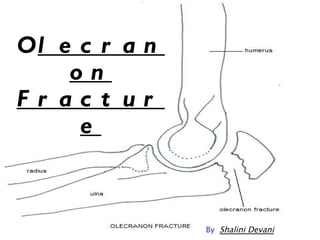
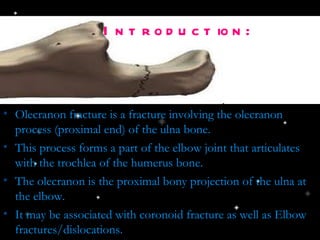
Introduction: Olecranon fracture is a fracture involving the olecranon process (proximal end) of the ulna bone.  This process forms a part of the elbow joint that articulates with the trochlea of the humerus bone. The olecranon is the proximal bony projection of the ulna at the elbow.  It may be associated with coronoid fracture as well as Elbow fractures/dislocations.
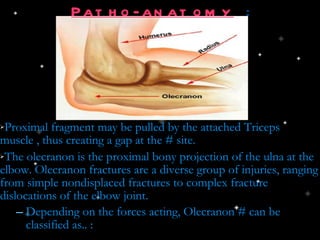
Patho-anatomy  : Proximal fragment may be pulled by the attached Triceps muscle , thus creating a gap at the # site. The olecranon is the proximal bony projection of the ulna at the elbow. Olecranon fractures are a diverse group of injuries, ranging from simple nondisplaced fractures to complex fracture dislocations of the elbow joint. Depending on the forces acting, Olecranon # can be classified as.. :
Types : Intra or Extra-articular Intra: associated with joint effusions & hematoma Extra: mostly avulsion type; common in adults.  Displaced or Undisplaced Displaced: >2 mm distance between fracture fragment Transverse/Oblique/ Comminuted/ Stable/Unstable Stable: fragments are not separate or if separation degree does not increase with flexion to 90 °
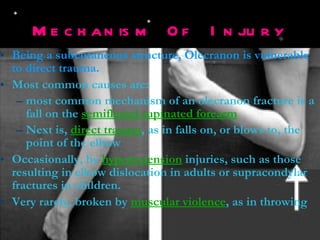
Mechanism Of Injury Being a subcutaneous structure, Olecranon is vulnerable to direct trauma. Most common causes are: most common mechanism of an olecranon fracture is a fall on the  semiflexed supinated forearm Next is,  direct trauma , as in falls on, or blows to, the point of the elbow Occasionally, by  hyperextension  injuries, such as those resulting in elbow dislocation in adults or supracondylar fractures in children. Very rarely, broken by  muscular violence , as in throwing
Diagnosis: Symptoms   include history of trauma is present  pain and swelling in and around the elbow joint  tenderness is present at the fracture site Crepitus or a gap may be present between the fragments TESTS : to check... disruption of extensor mechanism , patient should be asked to attempt extension against gravity. Unstable fracture  is confirmed by inability to extend the elbow. Stability of elbow (+MCL)  after operative fixation: varus+valgus stree in full extension & moderate flexion.
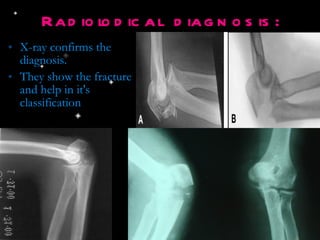
Radiolodical diagnosis: X-ray confirms the diagnosis. They show the fracture and help in it's classification
Treatment GOALS: In young active individuals, restoration of the articular surface, preservation of motor power, restoration of stability,  prevention of joint stiffness In older patients, minimization of morbidity
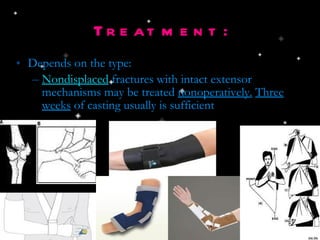
Treatment: Depends on the type: Nondisplaced  fractures with intact extensor mechanisms may be treated  nonoperatively.   Three weeks  of casting usually is sufficient
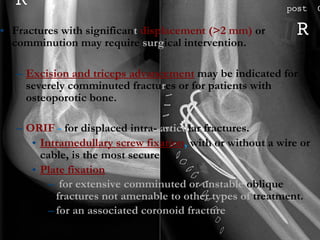
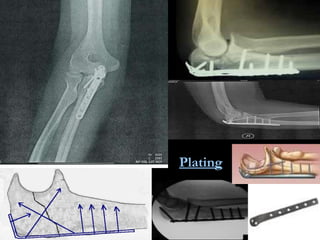
Fractures with significan t  displacement (>2 mm)  or comminution may require  surg ical intervention. Excision and triceps advancement   may be indicated for severely comminuted fractu r es or for patients with osteoporotic bone.  ORIF  -  for displaced intra-  articu lar fractures.  Intramedullary screw fixation ,  with or without a wire or cable, is the most secure. Plate fixation for extensive comminuted or unstable  oblique  fractures not amenable to other types of  treatment. for an associated coronoid fracture
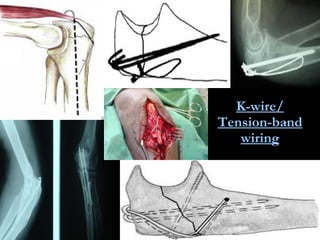
K-wire/ Tension-band wiring
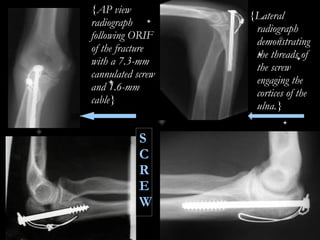
{AP view radiograph following ORIF of the fracture with a 7.3-mm cannulated screw and 1.6-mm cable} {Lateral radiograph demonstrating the threads of the screw engaging the cortices of the ulna.} S C R E W
Plating
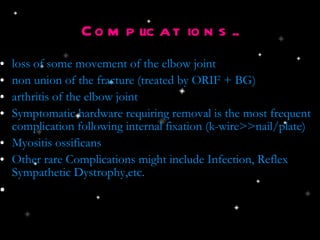
Complications.. loss of some movement of the elbow joint  non union of the fracture (treated by ORIF + BG) ‏ arthritis of the elbow joint Symptomatic hardware requiring removal is the most frequent complication following internal fixation (k-wire>>nail/plate) ‏ Myositis ossificans Other rare Complications might include Infection, Reflex Sympathetic Dystrophy,etc.
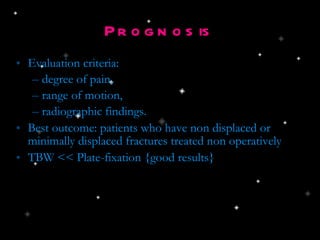
Prognosis Evaluation criteria: degree of pain, range of motion, radiographic findings. Best outcome: patients who have non displaced or minimally displaced fractures treated non operatively TBW << Plate-fixation {good results}
Thank-You

Olecranon fracture

  • 1.
    O lecranon FractureBy : Shalini Devani
  • 2.
    Introduction: Olecranon fractureis a fracture involving the olecranon process (proximal end) of the ulna bone. This process forms a part of the elbow joint that articulates with the trochlea of the humerus bone. The olecranon is the proximal bony projection of the ulna at the elbow. It may be associated with coronoid fracture as well as Elbow fractures/dislocations.
  • 3.
    Patho-anatomy :Proximal fragment may be pulled by the attached Triceps muscle , thus creating a gap at the # site. The olecranon is the proximal bony projection of the ulna at the elbow. Olecranon fractures are a diverse group of injuries, ranging from simple nondisplaced fractures to complex fracture dislocations of the elbow joint. Depending on the forces acting, Olecranon # can be classified as.. :
  • 4.
    Types : Intraor Extra-articular Intra: associated with joint effusions & hematoma Extra: mostly avulsion type; common in adults. Displaced or Undisplaced Displaced: >2 mm distance between fracture fragment Transverse/Oblique/ Comminuted/ Stable/Unstable Stable: fragments are not separate or if separation degree does not increase with flexion to 90 °
  • 5.
    Mechanism Of InjuryBeing a subcutaneous structure, Olecranon is vulnerable to direct trauma. Most common causes are: most common mechanism of an olecranon fracture is a fall on the semiflexed supinated forearm Next is, direct trauma , as in falls on, or blows to, the point of the elbow Occasionally, by hyperextension injuries, such as those resulting in elbow dislocation in adults or supracondylar fractures in children. Very rarely, broken by muscular violence , as in throwing
  • 6.
    Diagnosis: Symptoms include history of trauma is present pain and swelling in and around the elbow joint tenderness is present at the fracture site Crepitus or a gap may be present between the fragments TESTS : to check... disruption of extensor mechanism , patient should be asked to attempt extension against gravity. Unstable fracture is confirmed by inability to extend the elbow. Stability of elbow (+MCL) after operative fixation: varus+valgus stree in full extension & moderate flexion.
  • 7.
    Radiolodical diagnosis: X-rayconfirms the diagnosis. They show the fracture and help in it's classification
  • 8.
    Treatment GOALS: Inyoung active individuals, restoration of the articular surface, preservation of motor power, restoration of stability, prevention of joint stiffness In older patients, minimization of morbidity
  • 9.
    Treatment: Depends onthe type: Nondisplaced fractures with intact extensor mechanisms may be treated nonoperatively. Three weeks of casting usually is sufficient
  • 10.
    Fractures with significant displacement (>2 mm) or comminution may require surg ical intervention. Excision and triceps advancement may be indicated for severely comminuted fractu r es or for patients with osteoporotic bone. ORIF - for displaced intra- articu lar fractures. Intramedullary screw fixation , with or without a wire or cable, is the most secure. Plate fixation for extensive comminuted or unstable oblique fractures not amenable to other types of treatment. for an associated coronoid fracture
  • 11.
  • 12.
    {AP view radiographfollowing ORIF of the fracture with a 7.3-mm cannulated screw and 1.6-mm cable} {Lateral radiograph demonstrating the threads of the screw engaging the cortices of the ulna.} S C R E W
  • 13.
  • 14.
    Complications.. loss ofsome movement of the elbow joint non union of the fracture (treated by ORIF + BG) ‏ arthritis of the elbow joint Symptomatic hardware requiring removal is the most frequent complication following internal fixation (k-wire>>nail/plate) ‏ Myositis ossificans Other rare Complications might include Infection, Reflex Sympathetic Dystrophy,etc.
  • 15.
    Prognosis Evaluation criteria:degree of pain, range of motion, radiographic findings. Best outcome: patients who have non displaced or minimally displaced fractures treated non operatively TBW << Plate-fixation {good results}
  • 16.