

Presented by-
Bhupendra kumar singh
 These are important device for the measurement
of both static and dynamic forces.
 The force applied to the elastic member result in
a displacement or strain in the elastic member,
which is sensed by mechanical or electro-
mechanical mean.
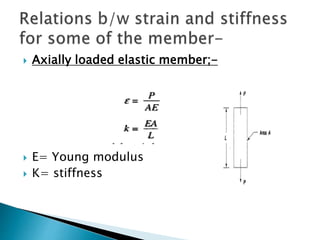
 Axially loaded elastic member;-
 E= Young modulus
 K= stiffness
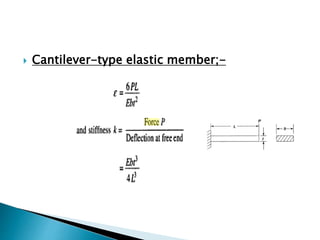
 Cantilever-type elastic member;-
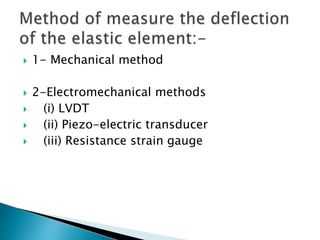
 1- Mechanical method
 2-Electromechanical methods
 (i) LVDT
 (ii) Piezo-electric transducer
 (iii) Resistance strain gauge
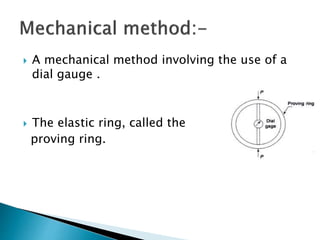
 A mechanical method involving the use of a
dial gauge .
 The elastic ring, called the
proving ring.
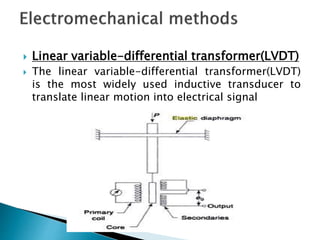
 Linear variable-differential transformer(LVDT)
 The linear variable-differential transformer(LVDT)
is the most widely used inductive transducer to
translate linear motion into electrical signal
 Any physical displacement of the core causes
the voltage of one secondary winding to
increase while simultaneously, reducing the
voltage in the other secondary winding.
 The difference of the two voltages appears
across the output terminals of the
transducers and gives a measure of the
physical position of the core and hence the
displacement.
 The transducers possess a high sensitivity.
 The transducers have low hysteresis and
hence repeatability is excellent under all
conditions.
 They have infinite resolution.
 They are simple,light in weight and easy to
maintain.
 They are sensitive to stray magnetic fields but
shielding is possible.
 They are inherently low in power output.
 Temperature affects the performance of
transducer.
 The LVDT can be used in all applications
where displacements ranging from fraction of
a mm to a few cm have to be measured.
 Acting as a secondary transducer it can be
used as a device to measure force, weight
and pressure.
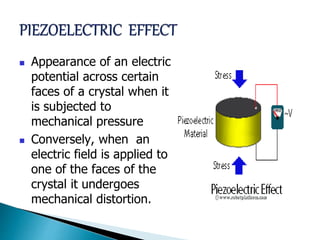
 Appearance of an electric
potential across certain
faces of a crystal when it
is subjected to
mechanical pressure
 Conversely, when an
electric field is applied to
one of the faces of the
crystal it undergoes
mechanical distortion.
 The material that show significant and
useful piezoelectric effect fall under three
main groups:
1. Natural, Eg: Quartz, Rochelle salt
2. Synthetic, Eg: Lithium Sulphate, Ammonium
Dihydrogen Phosphate
3. Polarized Ferroelectric Crystals, Eg: Barium
Titanate, Lead Zirconate-Titanate
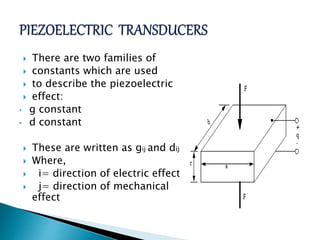
 There are two families of
 constants which are used
 to describe the piezoelectric
 effect:
• g constant
• d constant
 These are written as gij and dij
 Where,
 i= direction of electric effect
 j= direction of mechanical
effect
 Applied Piezo: Applications
 Piezoelectric materials are used in
numerous applications.
 The direct piezoelectric effect is used in e.g.
 generators (e.g. gas igniters)
 sensors (e.g. accelerometers, pressure
sensors)
 switches (e.g. in control panels)
 ultrasonic transducers (e.g. in medical
imaging)
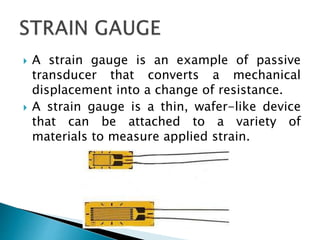
 A strain gauge is an example of passive
transducer that converts a mechanical
displacement into a change of resistance.
 A strain gauge is a thin, wafer-like device
that can be attached to a variety of
materials to measure applied strain.
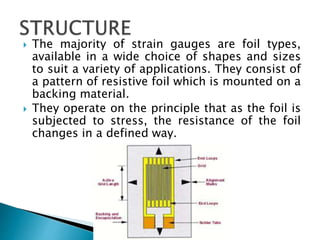
 The majority of strain gauges are foil types,
available in a wide choice of shapes and sizes
to suit a variety of applications. They consist of
a pattern of resistive foil which is mounted on a
backing material.
 They operate on the principle that as the foil is
subjected to stress, the resistance of the foil
changes in a defined way.
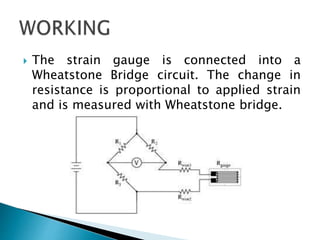
 The strain gauge is connected into a
Wheatstone Bridge circuit. The change in
resistance is proportional to applied strain
and is measured with Wheatstone bridge.
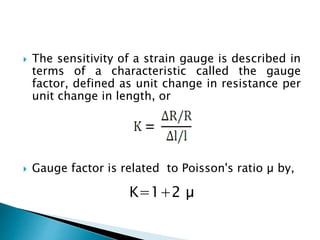
 The sensitivity of a strain gauge is described in
terms of a characteristic called the gauge
factor, defined as unit change in resistance per
unit change in length, or
 Gauge factor is related to Poisson's ratio µ by,
K=1+2 µ
Based on principle of working :
• Mechanical
• Electrical
• Piezoelectric
Based on mounting :
• Bonded strain gauge
• Unbonded strain gauge
Based on construction :
• Foil strain gauge
• Semiconductor strain gauge
• Photoelectric Strain gauge
Advantages
 There is no moving part.
 It is small and inexpensive.
Disadvantages
 It is non-linear.
 It needs to be calibrated.
 Residual stress
 Vibration measurement
 Torque measurement
 Bending and deflection measurement
 Compression and tension measurement
 Strain measurement
THANK YOU

Elastic force device

  • 1.
  • 2.
     These areimportant device for the measurement of both static and dynamic forces.  The force applied to the elastic member result in a displacement or strain in the elastic member, which is sensed by mechanical or electro- mechanical mean.
  • 3.
     Axially loadedelastic member;-  E= Young modulus  K= stiffness
  • 4.
  • 5.
     1- Mechanicalmethod  2-Electromechanical methods  (i) LVDT  (ii) Piezo-electric transducer  (iii) Resistance strain gauge
  • 6.
     A mechanicalmethod involving the use of a dial gauge .  The elastic ring, called the proving ring.
  • 7.
     Linear variable-differentialtransformer(LVDT)  The linear variable-differential transformer(LVDT) is the most widely used inductive transducer to translate linear motion into electrical signal
  • 8.
     Any physicaldisplacement of the core causes the voltage of one secondary winding to increase while simultaneously, reducing the voltage in the other secondary winding.  The difference of the two voltages appears across the output terminals of the transducers and gives a measure of the physical position of the core and hence the displacement.
  • 9.
     The transducerspossess a high sensitivity.  The transducers have low hysteresis and hence repeatability is excellent under all conditions.  They have infinite resolution.  They are simple,light in weight and easy to maintain.
  • 10.
     They aresensitive to stray magnetic fields but shielding is possible.  They are inherently low in power output.  Temperature affects the performance of transducer.
  • 11.
     The LVDTcan be used in all applications where displacements ranging from fraction of a mm to a few cm have to be measured.  Acting as a secondary transducer it can be used as a device to measure force, weight and pressure.
  • 12.
     Appearance ofan electric potential across certain faces of a crystal when it is subjected to mechanical pressure  Conversely, when an electric field is applied to one of the faces of the crystal it undergoes mechanical distortion.
  • 13.
     The materialthat show significant and useful piezoelectric effect fall under three main groups: 1. Natural, Eg: Quartz, Rochelle salt 2. Synthetic, Eg: Lithium Sulphate, Ammonium Dihydrogen Phosphate 3. Polarized Ferroelectric Crystals, Eg: Barium Titanate, Lead Zirconate-Titanate
  • 15.
     There aretwo families of  constants which are used  to describe the piezoelectric  effect: • g constant • d constant  These are written as gij and dij  Where,  i= direction of electric effect  j= direction of mechanical effect
  • 16.
     Applied Piezo:Applications  Piezoelectric materials are used in numerous applications.  The direct piezoelectric effect is used in e.g.  generators (e.g. gas igniters)  sensors (e.g. accelerometers, pressure sensors)  switches (e.g. in control panels)  ultrasonic transducers (e.g. in medical imaging)
  • 17.
     A straingauge is an example of passive transducer that converts a mechanical displacement into a change of resistance.  A strain gauge is a thin, wafer-like device that can be attached to a variety of materials to measure applied strain.
  • 18.
     The majorityof strain gauges are foil types, available in a wide choice of shapes and sizes to suit a variety of applications. They consist of a pattern of resistive foil which is mounted on a backing material.  They operate on the principle that as the foil is subjected to stress, the resistance of the foil changes in a defined way.
  • 19.
     The straingauge is connected into a Wheatstone Bridge circuit. The change in resistance is proportional to applied strain and is measured with Wheatstone bridge.
  • 20.
     The sensitivityof a strain gauge is described in terms of a characteristic called the gauge factor, defined as unit change in resistance per unit change in length, or  Gauge factor is related to Poisson's ratio µ by, K=1+2 µ
  • 21.
    Based on principleof working : • Mechanical • Electrical • Piezoelectric Based on mounting : • Bonded strain gauge • Unbonded strain gauge Based on construction : • Foil strain gauge • Semiconductor strain gauge • Photoelectric Strain gauge
  • 22.
    Advantages  There isno moving part.  It is small and inexpensive. Disadvantages  It is non-linear.  It needs to be calibrated.
  • 23.
     Residual stress Vibration measurement  Torque measurement  Bending and deflection measurement  Compression and tension measurement  Strain measurement
  • 24.