Contested Authority
  Professionalization and Popularization
     in Nineteenth Century Science
Geology

Development of stratigraphy and mapping
Discovery of “deep time” and primeval fauna
Naturalistic explanation tied with deism
Scientist
  Coined in William Whewell's 1834
  review of Mary Somerville's On the
  Connexion of the Physical Sciences
  “We need very much a name to
  describe a cultivator of science in
  general. I should incline to call him
  a Scientist. Thus we might say, that
  as an Artist is a Musician, Painter, or
  Poet, a Scientist is a Mathematician,
  Physicist, or Naturalist.” (1840)
Two Episodes

   The rejection of biblical literalism
   by the emerging geological
   community
   The controversy over the 1844
   publication of Vestiges of the
   Natural History of Creation.
Allegorically
                True

Literally                   “Simply A
  True                       Story”


             Revealed
               Text
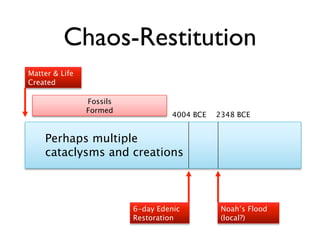
Chaos-Restitution
Matter & Life
Created

                Fossils
                Formed
                                    4004 BCE   2348 BCE


    Perhaps multiple
    cataclysms and creations


                          6-day Edenic          Noah’s Flood
                          Restoration           (local?)
Thomas Chalmers
      “There is a prejudice against
      the speculations of the
      geologists, which I am anxious
      to remove. It is said that they
      nurture infidel propensities …
      This is a false alarm. The
      writings of Moses do not fix
      the antiquity of the globe.”
                                1804
Gap
Matter
Created


                             4004 BCE   2348 BCE


Gap of undetermined length


                   Life                  Noah’s Flood
                   created               (local?)
Day-Age
Matter        Life      Fossils
Created       Created   Formed


 1        2   3     4     5        6


     Six “Days” of Creation

                  Humans Created       Noah’s Flood
                                       (local)
Scriptural Geologists
       “Mosaic geology”
       Amateurs who felt that they
       were competent to comment
       on the emerging body of
       professional geological work.
       Writing for popular audiences
       They themselves interpreted
       and modified scripture
Hugh Miller
on the “anti-geologists”


      “It need not surprise us that a
      writer who takes such strange
      liberties with a book which he
      professes to respect, and which he
      must have had many opportunities
      of knowing, should take still
      greater liberties with a science for
      which he entertains no respect
      whatever, and of whose first
      principles he is palpably ignorant.”
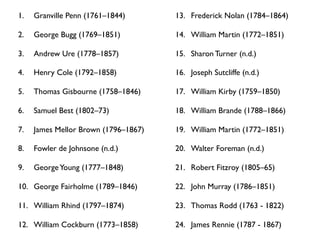
1.   Granville Penn (1761–1844)       13. Frederick Nolan (1784–1864)

2.   George Bugg (1769–1851)          14. William Martin (1772–1851)

3.   Andrew Ure (1778–1857)           15. Sharon Turner (n.d.)

4.   Henry Cole (1792–1858)           16. Joseph Sutcliffe (n.d.)

5.   Thomas Gisbourne (1758–1846)     17. William Kirby (1759–1850)

6.   Samuel Best (1802–73)            18. William Brande (1788–1866)

7.   James Mellor Brown (1796–1867)   19. William Martin (1772–1851)

8.   Fowler de Johnsone (n.d.)        20. Walter Foreman (n.d.)

9.   George Young (1777–1848)         21. Robert Fitzroy (1805–65)

10. George Fairholme (1789–1846)      22. John Murray (1786–1851)

11. William Rhind (1797–1874)         23. Thomas Rodd (1763 - 1822)

12. William Cockburn (1773–1858)      24. James Rennie (1787 - 1867)
George Bugg
“Geology cannot possibly exist consistently with
a fair and literal construction of the Word of
God” and so contradicts “the plainest dictates of
common sense”
“I ardently hope, however, that we shall .. value
more our Bible and its plain and obvious
instruction ... and ‘meddle not with them that are
given to change’.”
Major Objections

Evidence for “catastrophic” change
Problems with accurately dating strata
Presence of human remains in “old” strata
Geology was prone to “over-theorizing”
Hugh Miller
on the “anti-geologists”

      “The follies of the present day are
      transcripts, unwittingly produced,
      and with of course a few
      variations, of follies which existed
      centuries ago; and it seems to be
      … that scarce an explanation of
      geologic phenomena has been given
      by the anti-geologists of our own
      times, that was not anticipated by
      writers of the sixteenth and
      seventeenth centuries.”
Concern
 If the earth was populated
 prior to the Edenic creation,
 then there must have been
 death.
 If there was death, then
 biblical themes of original sin
 and redemption through the
 sacrifice of Christ were called
 into question.
James Mellor-Brown
Denial of the global flood by Buckland “affords
another illustration of men who pull down the
bulwark, but disclaim any intention of
endangering the citadel. The Trojan Horse,
drawn within the walls of the devoted city by
friendly hands, is a standing emblem of men
acting under the unsuspecting guidance of the
Evil One.”
Gideon Mantell

      Need to “silence the idle
      clamours that have been
      raised against geological
      speculations, from their
      supposed tendency to
      skepticism.”
Lyell
 “We cannot sufficiently depreciate the interference of a
certain class of writers … While they denounce as
heterodox the current opinions of geologists, with respect
to the high antiquity of the earth and of certain class of
organic beings, they do no scruple to promulgate theories
concerning the creation and the deluge, derived from their
own expositions of the sacred text, in which they endeavour
to point out the accordance of the Mosaic history with
phenomena which they have never studied, and to judge of
which every page of their writings proves their consummate
incompetence.” (1827)
Geological Society

        Formed in 1807
        A hierarchical
        metropolitan group that
        relied on the expertise
        of provincial workers.
Adam Sedgwick
“[T]he goodly pile, gentlemen, which many of
you have helped to rear, after years of labour, has
been pulled down and reconstructed; but with
such unskilful [sic] hands that its inscriptions are
turned upside down; its sculptured figures have
their heads to the ground, and their heels to the
heavens; and the whole fabric, amid the fantastic
ornaments by which it is degraded, has lost the
beauty and the harmony of its old proportions.”
Discourse on the Studies of the
            University
Science was the decipherment of the records of creation
All parts of the universe are “knit together by the
operation of a common law” which offers proof of
“beauty, and harmony, and order”
This in turn yields to the argument from design and the
Designer - a proof “so strong that it never has been and
never can be gainsaid”
Transmutation was “a theory no better than a phrenzied
dream”
Sedgwick on Literalism
Conflicts between science and religion were not to be
solved by “shifting and shuffling the solid strata of the
earth, or dealing them out in such as way as to play the
game of an ignorant and dishonest hypothesis - not by
shutting our eyes to the facts, or denying the evidence
of our senses; but by patient investigation carried out
in the sincere love of truth and by learning to reject
every consequence not warranted by direct physical
evidence.”
Against Scriptural Geologists

            “Who is the greatest
            unbeliever? Is it not the man
            who, professing to hold that
            this book [the Bible] contains
            the Word of God, is afraid to
            look into the other volume,
            lest it should contradict it?'
Against Scriptural Geologists


            “[T]o confound the ground-
            works of philosophy and
            religion is to ruin the
            superstructure of both
British Association for
the Advancement of Science
         Founded in 1831
         Formed against elitism of Royal
         Society of London
         Bringing science to the people
         outside London
         Attacked by William Cockburn
         and others as theologically
         unsound.
Scriptural Geologists

The reaction of the scriptural geologists was “in
part a cultural [one] to the social and cognitive
exclusion of all but self-styled experts from an
area of speculation that, in the heyday of
theories of the earth, had been open to all.”
                                Martin Rudwick
Scriptural Geologists
“[L]argely pre-professionals or members of the
older professions – classically educated and
genteel laymen, versed in polite literature;
clergymen, linguists, and antiquaries – those, in
general, with vested interests in mediating the
meaning of books, rather than rocks, in
churches and classrooms.”
                                    James Moore
Geology
‘When I need to know what a rock is, I go to
it. I hammer it; I dissect it. I then know what it
really is’ (Robert Dick)
‘A man, to be a true geologist, must have a body
as well as a soul. No mincing town-dandy or
sickly bookworm is likely to thrive in the
profession.’ (Edward Forbes)
Robert Bakewell
“Geology discovers to us proofs of the awful
revolutions which have in former ages changed
the surface of the globe, and overwhelmed all
its inhabitants: it reveals to us the forms of
strange and unknown animals and unfolds the
might and skill of creative energy, displayed in
the ancient world: indeed, there is no science
which presents objects that so powerfully
excite our admiration and astonishment.”
By1850, geology was being
  characterized as a practical,
 specialized, active, ‘masculine’
endeavor that was amenable to
          Christianity.

Contested Authority in 19th Century Science

  • 1.
    Contested Authority Professionalization and Popularization in Nineteenth Century Science
  • 2.
    Geology Development of stratigraphyand mapping Discovery of “deep time” and primeval fauna Naturalistic explanation tied with deism
  • 3.
    Scientist Coinedin William Whewell's 1834 review of Mary Somerville's On the Connexion of the Physical Sciences “We need very much a name to describe a cultivator of science in general. I should incline to call him a Scientist. Thus we might say, that as an Artist is a Musician, Painter, or Poet, a Scientist is a Mathematician, Physicist, or Naturalist.” (1840)
  • 4.
    Two Episodes The rejection of biblical literalism by the emerging geological community The controversy over the 1844 publication of Vestiges of the Natural History of Creation.
  • 5.
    Allegorically True Literally “Simply A True Story” Revealed Text
  • 6.
    Chaos-Restitution Matter & Life Created Fossils Formed 4004 BCE 2348 BCE Perhaps multiple cataclysms and creations 6-day Edenic Noah’s Flood Restoration (local?)
  • 7.
    Thomas Chalmers “There is a prejudice against the speculations of the geologists, which I am anxious to remove. It is said that they nurture infidel propensities … This is a false alarm. The writings of Moses do not fix the antiquity of the globe.” 1804
  • 8.
    Gap Matter Created 4004 BCE 2348 BCE Gap of undetermined length Life Noah’s Flood created (local?)
  • 9.
    Day-Age Matter Life Fossils Created Created Formed 1 2 3 4 5 6 Six “Days” of Creation Humans Created Noah’s Flood (local)
  • 10.
    Scriptural Geologists “Mosaic geology” Amateurs who felt that they were competent to comment on the emerging body of professional geological work. Writing for popular audiences They themselves interpreted and modified scripture
  • 11.
    Hugh Miller on the“anti-geologists” “It need not surprise us that a writer who takes such strange liberties with a book which he professes to respect, and which he must have had many opportunities of knowing, should take still greater liberties with a science for which he entertains no respect whatever, and of whose first principles he is palpably ignorant.”
  • 12.
    1. Granville Penn (1761–1844) 13. Frederick Nolan (1784–1864) 2. George Bugg (1769–1851) 14. William Martin (1772–1851) 3. Andrew Ure (1778–1857) 15. Sharon Turner (n.d.) 4. Henry Cole (1792–1858) 16. Joseph Sutcliffe (n.d.) 5. Thomas Gisbourne (1758–1846) 17. William Kirby (1759–1850) 6. Samuel Best (1802–73) 18. William Brande (1788–1866) 7. James Mellor Brown (1796–1867) 19. William Martin (1772–1851) 8. Fowler de Johnsone (n.d.) 20. Walter Foreman (n.d.) 9. George Young (1777–1848) 21. Robert Fitzroy (1805–65) 10. George Fairholme (1789–1846) 22. John Murray (1786–1851) 11. William Rhind (1797–1874) 23. Thomas Rodd (1763 - 1822) 12. William Cockburn (1773–1858) 24. James Rennie (1787 - 1867)
  • 13.
    George Bugg “Geology cannotpossibly exist consistently with a fair and literal construction of the Word of God” and so contradicts “the plainest dictates of common sense” “I ardently hope, however, that we shall .. value more our Bible and its plain and obvious instruction ... and ‘meddle not with them that are given to change’.”
  • 14.
    Major Objections Evidence for“catastrophic” change Problems with accurately dating strata Presence of human remains in “old” strata Geology was prone to “over-theorizing”
  • 15.
    Hugh Miller on the“anti-geologists” “The follies of the present day are transcripts, unwittingly produced, and with of course a few variations, of follies which existed centuries ago; and it seems to be … that scarce an explanation of geologic phenomena has been given by the anti-geologists of our own times, that was not anticipated by writers of the sixteenth and seventeenth centuries.”
  • 16.
    Concern If theearth was populated prior to the Edenic creation, then there must have been death. If there was death, then biblical themes of original sin and redemption through the sacrifice of Christ were called into question.
  • 17.
    James Mellor-Brown Denial ofthe global flood by Buckland “affords another illustration of men who pull down the bulwark, but disclaim any intention of endangering the citadel. The Trojan Horse, drawn within the walls of the devoted city by friendly hands, is a standing emblem of men acting under the unsuspecting guidance of the Evil One.”
  • 18.
    Gideon Mantell Need to “silence the idle clamours that have been raised against geological speculations, from their supposed tendency to skepticism.”
  • 19.
    Lyell “We cannotsufficiently depreciate the interference of a certain class of writers … While they denounce as heterodox the current opinions of geologists, with respect to the high antiquity of the earth and of certain class of organic beings, they do no scruple to promulgate theories concerning the creation and the deluge, derived from their own expositions of the sacred text, in which they endeavour to point out the accordance of the Mosaic history with phenomena which they have never studied, and to judge of which every page of their writings proves their consummate incompetence.” (1827)
  • 20.
    Geological Society Formed in 1807 A hierarchical metropolitan group that relied on the expertise of provincial workers.
  • 21.
    Adam Sedgwick “[T]he goodlypile, gentlemen, which many of you have helped to rear, after years of labour, has been pulled down and reconstructed; but with such unskilful [sic] hands that its inscriptions are turned upside down; its sculptured figures have their heads to the ground, and their heels to the heavens; and the whole fabric, amid the fantastic ornaments by which it is degraded, has lost the beauty and the harmony of its old proportions.”
  • 22.
    Discourse on theStudies of the University Science was the decipherment of the records of creation All parts of the universe are “knit together by the operation of a common law” which offers proof of “beauty, and harmony, and order” This in turn yields to the argument from design and the Designer - a proof “so strong that it never has been and never can be gainsaid” Transmutation was “a theory no better than a phrenzied dream”
  • 23.
    Sedgwick on Literalism Conflictsbetween science and religion were not to be solved by “shifting and shuffling the solid strata of the earth, or dealing them out in such as way as to play the game of an ignorant and dishonest hypothesis - not by shutting our eyes to the facts, or denying the evidence of our senses; but by patient investigation carried out in the sincere love of truth and by learning to reject every consequence not warranted by direct physical evidence.”
  • 24.
    Against Scriptural Geologists “Who is the greatest unbeliever? Is it not the man who, professing to hold that this book [the Bible] contains the Word of God, is afraid to look into the other volume, lest it should contradict it?'
  • 25.
    Against Scriptural Geologists “[T]o confound the ground- works of philosophy and religion is to ruin the superstructure of both
  • 33.
    British Association for theAdvancement of Science Founded in 1831 Formed against elitism of Royal Society of London Bringing science to the people outside London Attacked by William Cockburn and others as theologically unsound.
  • 34.
    Scriptural Geologists The reactionof the scriptural geologists was “in part a cultural [one] to the social and cognitive exclusion of all but self-styled experts from an area of speculation that, in the heyday of theories of the earth, had been open to all.” Martin Rudwick
  • 35.
    Scriptural Geologists “[L]argely pre-professionalsor members of the older professions – classically educated and genteel laymen, versed in polite literature; clergymen, linguists, and antiquaries – those, in general, with vested interests in mediating the meaning of books, rather than rocks, in churches and classrooms.” James Moore
  • 40.
    Geology ‘When I needto know what a rock is, I go to it. I hammer it; I dissect it. I then know what it really is’ (Robert Dick) ‘A man, to be a true geologist, must have a body as well as a soul. No mincing town-dandy or sickly bookworm is likely to thrive in the profession.’ (Edward Forbes)
  • 41.
    Robert Bakewell “Geology discoversto us proofs of the awful revolutions which have in former ages changed the surface of the globe, and overwhelmed all its inhabitants: it reveals to us the forms of strange and unknown animals and unfolds the might and skill of creative energy, displayed in the ancient world: indeed, there is no science which presents objects that so powerfully excite our admiration and astonishment.”
  • 42.
    By1850, geology wasbeing characterized as a practical, specialized, active, ‘masculine’ endeavor that was amenable to Christianity.

Editor's Notes

  • #4 c.f. Natural Philosopher / HIM - what about Somerville? Mary Anning? / Metropolitan v Provincial
  • #7 In the 1600’s: Accepted by John Ray, Edmund Halley, William Whiston, etc
  • #8 Later founder of Free Church of Scotland. Scripture allows for a gap which allowed for geological formation before six-day creation
  • #9 Supported by William Buckland (who renounced global flood), Adam Sedgwick, William Whewell, John Herschel
  • #11 (e.g. addition of extra day of creation after Deluge or claiming some verses were additions)
  • #12 Testimony of the Rocks, 1857
  • #13 Penn coined Mosaic G;Bugg coined SG; not an homogenous group.
  • #14 Scriptural Geology, 1826 -> cf modern opponents
  • #15 Similar to contemporary - some allowed for “appearance of age”
  • #16 1845
  • #17 Geology was thus seen to undermine Christianity.
  • #18 1838, Reflections on Geology, Suggested by the Perusal of Dr Buckland’s Bridgewater Treatise
  • #19 1822
  • #20 Lyell was no evolutionist – opposed Lamarck in PRINCIPALS. - he was an “insider” though
  • #21 No expertise necessary. Only two SGs were members.
  • #22 No evolutionist! 1831 GSL Presidential Address. In 1832 would recant his belief in a global flood.
  • #23 1831
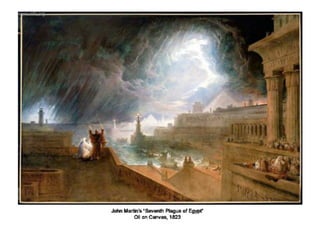
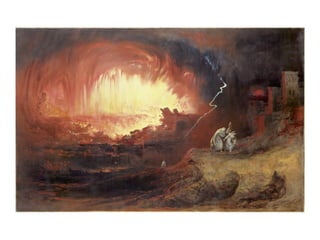
  • #27 John Martin - Attempts to use contemporary science - Fall of Babylon - Seventh Plague of Egypt - The Deluge - Sodom & Gomorrah - - The Great Day of His Wrath - And Iguanadon
  • #28 John Martin - Attempts to use contemporary science - Fall of Babylon - Seventh Plague of Egypt - The Deluge - Sodom & Gomorrah - - The Great Day of His Wrath - And Iguanadon
  • #29 John Martin - Attempts to use contemporary science - Fall of Babylon - Seventh Plague of Egypt - The Deluge - Sodom & Gomorrah - - The Great Day of His Wrath - And Iguanadon
  • #30 John Martin - Attempts to use contemporary science - Fall of Babylon - Seventh Plague of Egypt - The Deluge - Sodom & Gomorrah - - The Great Day of His Wrath - And Iguanadon
  • #31 John Martin - Attempts to use contemporary science - Fall of Babylon - Seventh Plague of Egypt - The Deluge - Sodom & Gomorrah - - The Great Day of His Wrath - And Iguanadon
  • #32 John Martin - Attempts to use contemporary science - Fall of Babylon - Seventh Plague of Egypt - The Deluge - Sodom & Gomorrah - - The Great Day of His Wrath - And Iguanadon
  • #33 BAAS as battleground - Importance of science being seen as not anti-Christian - Sedgwick in 1844, hammered Cockburn (Dean of Yk) for 90 minutes in BAAS meeting at York – marked end of SG
  • #34 1844 - that same year ....
  • #35 A hugely evolutionary theory – constant change from the very beginning – lawful process – opposed to the literal dogmatism of the likes of the SGs
  • #36 Difference Engine
  • #41 Inventor of kaleidoscope
  • #42 1845 - Edinburgh Review - “a filthy abortion”
  • #43 1846 - Clearly worried bout ideas being put infront of the public before being examined by scientists
  • #44 Problem both with public gullibility & inability of scientists to communicate.
  • #45 10th edn 1853 - A radically different beast – corrected by known scientists
  • #50 Secondary information
  • #51 elite THH & pious Miller / ‘Natural philosopher’ (generalist) versus ‘scientist’ / Natural Theology
  • #52 Tied to natural history tradition
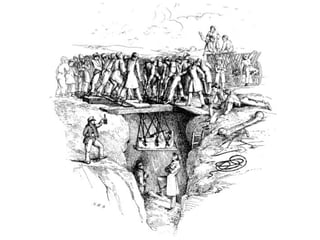
  • #54 Geology as active pursuit
  • #55 Geology as active pursuit
  • #56 Geology as active pursuit
  • #58 1828, Introduction to Geology. This “admiration and astonishment” had a religious dimension