Wave Function
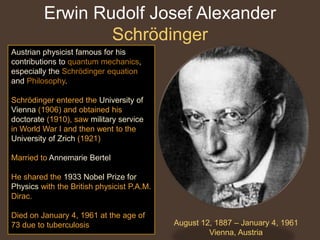
Erwin Rudolf Josef Alexander
                 Schrödinger
Austrian physicist famous for his
contributions to quantum mechanics,
especially the Schrödinger equation
and Philosophy.

Schrödinger entered the University of
Vienna (1906) and obtained his
doctorate (1910), saw military service
in World War I and then went to the
University of Zrich (1921)

Married to Annemarie Bertel

He shared the 1933 Nobel Prize for
Physics with the British physicist P.A.M.
Dirac.

Died on January 4, 1961 at the age of
73 due to tuberculosis                      August 12, 1887 – January 4, 1961
                                                     Vienna, Austria
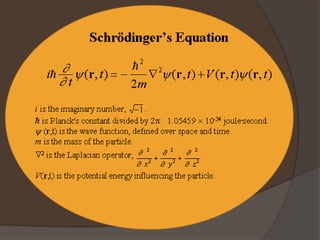
The Schrodinger equation was formulated in 1926


   It describes how the quantum state of a physical
               system changes in time.


 The most complete description that can be given to a
 physical system. Solutions to Schrödinger's equation
         describe not only molecular, atomic,
and subatomic systems, but also macroscopic systems,
          possibly even the whole universe.


        It is usually impossible to find an exact
           solution to the equation, so certain
        assumptions are used in order to obtain
          an approximate answer for a particular
                         problem.
WAVE FUNCTION (Ψ)
A probability amplitude describing the quantum state of a
               particle and how it behaves.


                Its values are complex numbers and, for
                a single particle, it is a function of space
                                  and time

                            The wave function is absolutely central to
                           quantum mechanics: it makes the subject
                              what it is. Also; it is the source of the
                           mysterious consequences and philosophical
                             difficulties in what quantum mechanics
                           means in nature, and even how nature itself
                            behaves at the atomic scale and beyond -
                              which continue in debate to this day.
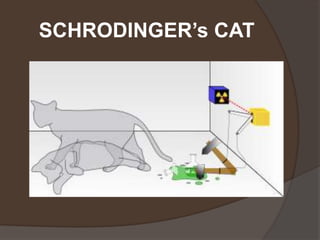
SCHRODINGER’s CAT
A cat, along with a flask containing a poison
and a radioactive source, is placed in a sealed
box. If an internal Geiger counter detects
radiation, the flask is shattered, releasing the
poison that kills the cat. The Copenhagen
interpretation of quantum mechanics implies
that after a while, the cat is simultaneously
alive and dead. Yet, when we look in the box,
we see the cat either alive or dead, not both
alive and dead.
Uncertainty Principle
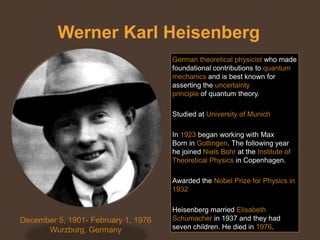
Werner Karl Heisenberg
                                     German theoretical physicist who made
                                     foundational contributions to quantum
                                     mechanics and is best known for
                                     asserting the uncertainty
                                     principle of quantum theory.

                                     Studied at University of Munich

                                     In 1923 began working with Max
                                     Born in Gottingen. The following year
                                     he joined Niels Bohr at the Institute of
                                     Theoretical Physics in Copenhagen.

                                     Awarded the Nobel Prize for Physics in
                                     1932

                                     Heisenberg married Elisabeth
December 5, 1901- February 1, 1976   Schumacher in 1937 and they had
      Wurzburg, Germany              seven children. He died in 1976.
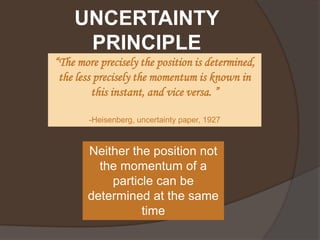
UNCERTAINTY
     PRINCIPLE
“The more precisely the position is determined,
 the less precisely the momentum is known in
         this instant, and vice versa. ”

        -Heisenberg, uncertainty paper, 1927


       Neither the position not
         the momentum of a
           particle can be
       determined at the same
                 time
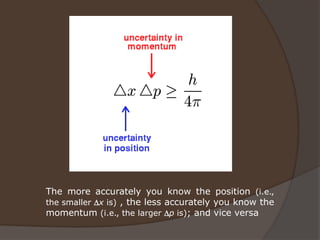
The more accurately you know the position (i.e.,
the smaller Dx is) , the less accurately you know the
momentum (i.e., the larger Dp is); and vice versa
Role of an Observer in
Quantum Mechanics
   The observer is not objective and passive

   The act of observation changes the
    physical system irrevocably

   This is known as subjective reality
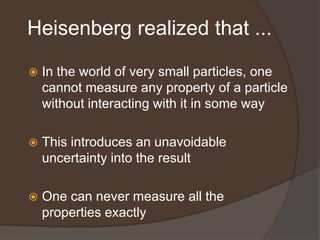
Heisenberg realized that ...

   In the world of very small particles, one
    cannot measure any property of a particle
    without interacting with it in some way

   This introduces an unavoidable
    uncertainty into the result

   One can never measure all the
    properties exactly
Nuclear Pairing; Nuclear shell structure
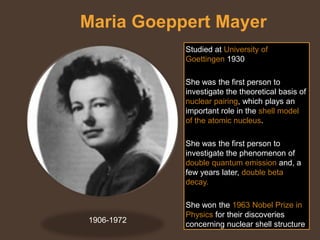
Maria Goeppert Mayer
            Studied at University of
            Goettingen 1930

            She was the first person to
            investigate the theoretical basis of
            nuclear pairing, which plays an
            important role in the shell model
            of the atomic nucleus.

            She was the first person to
            investigate the phenomenon of
            double quantum emission and, a
            few years later, double beta
            decay.

            She won the 1963 Nobel Prize in
            Physics for their discoveries
1906-1972
            concerning nuclear shell structure
REFERENCES:

•Freedman, R. et al. (2002). University Physics.
           Singapore: Pearson Education Asia Pte.
           Ltd.
•http://amods.kaeri.re.kr/mcdf/lectnote.pdf
•http://en.wikipedia.org/wiki/Schrodinger_equation
•http://www.youtube.com/watch?v=7GTCus7KTb0
•http://abyss.uoregon.edu/~js/21st_century_scienc
e/lectures/lec14.html
• http://en.wikipedia.org/wiki/Schodinger_equation
•http://en.wikipedia.org/wiki/Wavefunction
http://wiki.answers.com/Q/How_did_Heisenberg_u
ncertainty_principle_contribute_to_the_idea_that_e
lectrons_occupy_clouds_or_orbitals
•http://www.physlink.com/education/askexperts/ae6
89.cfm
•www.spaceandmotion.com/ Physics-Erwin-
Schrodinger.htm
•http://en.wikipedia.org/wiki/Schrödinger's_cat

SCHRODINGER; HEISENBERG; MAYER (Female Physicist)

  • 1.
  • 2.
    Erwin Rudolf JosefAlexander Schrödinger Austrian physicist famous for his contributions to quantum mechanics, especially the Schrödinger equation and Philosophy. Schrödinger entered the University of Vienna (1906) and obtained his doctorate (1910), saw military service in World War I and then went to the University of Zrich (1921) Married to Annemarie Bertel He shared the 1933 Nobel Prize for Physics with the British physicist P.A.M. Dirac. Died on January 4, 1961 at the age of 73 due to tuberculosis August 12, 1887 – January 4, 1961 Vienna, Austria
  • 4.
    The Schrodinger equationwas formulated in 1926 It describes how the quantum state of a physical system changes in time. The most complete description that can be given to a physical system. Solutions to Schrödinger's equation describe not only molecular, atomic, and subatomic systems, but also macroscopic systems, possibly even the whole universe. It is usually impossible to find an exact solution to the equation, so certain assumptions are used in order to obtain an approximate answer for a particular problem.
  • 5.
    WAVE FUNCTION (Ψ) Aprobability amplitude describing the quantum state of a particle and how it behaves. Its values are complex numbers and, for a single particle, it is a function of space and time The wave function is absolutely central to quantum mechanics: it makes the subject what it is. Also; it is the source of the mysterious consequences and philosophical difficulties in what quantum mechanics means in nature, and even how nature itself behaves at the atomic scale and beyond - which continue in debate to this day.
  • 6.
  • 7.
    A cat, alongwith a flask containing a poison and a radioactive source, is placed in a sealed box. If an internal Geiger counter detects radiation, the flask is shattered, releasing the poison that kills the cat. The Copenhagen interpretation of quantum mechanics implies that after a while, the cat is simultaneously alive and dead. Yet, when we look in the box, we see the cat either alive or dead, not both alive and dead.
  • 8.
  • 9.
    Werner Karl Heisenberg German theoretical physicist who made foundational contributions to quantum mechanics and is best known for asserting the uncertainty principle of quantum theory. Studied at University of Munich In 1923 began working with Max Born in Gottingen. The following year he joined Niels Bohr at the Institute of Theoretical Physics in Copenhagen. Awarded the Nobel Prize for Physics in 1932 Heisenberg married Elisabeth December 5, 1901- February 1, 1976 Schumacher in 1937 and they had Wurzburg, Germany seven children. He died in 1976.
  • 10.
    UNCERTAINTY PRINCIPLE “The more precisely the position is determined, the less precisely the momentum is known in this instant, and vice versa. ” -Heisenberg, uncertainty paper, 1927 Neither the position not the momentum of a particle can be determined at the same time
  • 11.
    The more accuratelyyou know the position (i.e., the smaller Dx is) , the less accurately you know the momentum (i.e., the larger Dp is); and vice versa
  • 12.
    Role of anObserver in Quantum Mechanics  The observer is not objective and passive  The act of observation changes the physical system irrevocably  This is known as subjective reality
  • 13.
    Heisenberg realized that...  In the world of very small particles, one cannot measure any property of a particle without interacting with it in some way  This introduces an unavoidable uncertainty into the result  One can never measure all the properties exactly
  • 14.
    Nuclear Pairing; Nuclearshell structure
  • 15.
    Maria Goeppert Mayer Studied at University of Goettingen 1930 She was the first person to investigate the theoretical basis of nuclear pairing, which plays an important role in the shell model of the atomic nucleus. She was the first person to investigate the phenomenon of double quantum emission and, a few years later, double beta decay. She won the 1963 Nobel Prize in Physics for their discoveries 1906-1972 concerning nuclear shell structure
  • 16.
    REFERENCES: •Freedman, R. etal. (2002). University Physics. Singapore: Pearson Education Asia Pte. Ltd. •http://amods.kaeri.re.kr/mcdf/lectnote.pdf •http://en.wikipedia.org/wiki/Schrodinger_equation •http://www.youtube.com/watch?v=7GTCus7KTb0 •http://abyss.uoregon.edu/~js/21st_century_scienc e/lectures/lec14.html • http://en.wikipedia.org/wiki/Schodinger_equation •http://en.wikipedia.org/wiki/Wavefunction http://wiki.answers.com/Q/How_did_Heisenberg_u ncertainty_principle_contribute_to_the_idea_that_e lectrons_occupy_clouds_or_orbitals •http://www.physlink.com/education/askexperts/ae6 89.cfm •www.spaceandmotion.com/ Physics-Erwin- Schrodinger.htm •http://en.wikipedia.org/wiki/Schrödinger's_cat