METABOLISM OF EICOSANOIDS
By S. PRISCILLA, M.Sc.CN, I yr
WHAT ARE EICOSANOIDS?
★ The term Eicosanoid is derived from the greek term ‘Eicosa’ means ‘twenty’.
★ They are oxygenated derivatives of 3 different 20-Carbon fatty acids:
○ Eicosapentaenoic acid(EPA), ω-3 fatty acid with 5 double bonds
○ Arachidonic acid(AA), ω-6 fatty acid with 4 double bonds
○ Di - homo gamma- linolenic acid(DHGLA), ω-6 fatty acid with 3 double bonds
★ Eicosanoids are derived from either omega 3 or omega 6 fatty acids.
★ Signalling molecules made by oxidation - Paracrine hormones.
★ They act locally by diffusing from its source to target cells in the
neighborhood.
○ Reproductive functions
○ Inflammatory responses, fever and pain associated with injury or diseases
○ Formation of blood clots and regulation of blood pressure.
○ Gastric acid secretion.
.
CLASSIFICATION
★ Prostanoids
○ Prostaglandins (PG)
○ Prostacyclins (PGI)
○ Thromboxanes (TX)
★ Leukotrienes and lipoxins
PROSTAGLANDINS(PG)
★ The first eicosanoid to be discovered, in
the seminal fluid
★ They have impact over the reproductive,
cardiovascular systems, CNS,
gastrointestinal tract etc.,
★ They structurally resemble prostanoic
acid, a 20-Carbon fatty acid, has a 5-C
ring and 2 side chains attached to the
chain.
THROMBOXANES(TX)
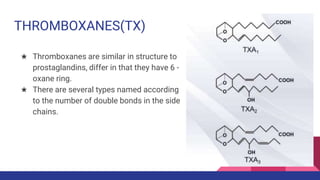
★ Thromboxanes are similar in structure to
prostaglandins, differ in that they have 6 -
oxane ring.
★ There are several types named according
to the number of double bonds in the side
chains.
LEUKOTRIENES (LT)
★ They are 20 carbon polyenoic fatty acids having a number of substituents,
depending on which they are divided into LTA, LTB, LTC, LTD, LTE
★ Each type is subdivided upon the number of double bonds which vary from 3 -
5
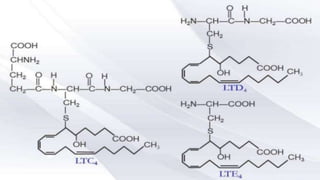
★ The most important leukotrienes are LTC4(Glutathione),
LTD4(Cysteinylglycine), LTE4(Cysteine).
ANABOLISM OF EICOSANOIDS
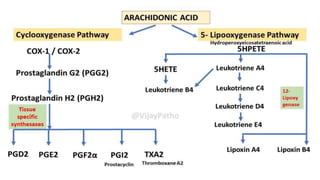
cyclooxygenase pathway and lipoxygenase pathway
CATABOLISM OF EICOSANOIDS
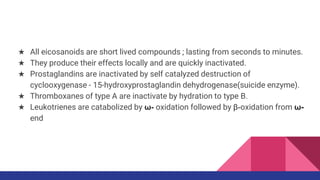
★ All eicosanoids are short lived compounds ; lasting from seconds to minutes.
★ They produce their effects locally and are quickly inactivated.
★ Prostaglandins are inactivated by self catalyzed destruction of
cyclooxygenase - 15-hydroxyprostaglandin dehydrogenase(suicide enzyme).
★ Thromboxanes of type A are inactivate by hydration to type B.
★ Leukotrienes are catabolized by ω- oxidation followed by β-oxidation from ω-
end
ACTIONS OF EICOSANOIDS
PROSTAGLANDINS
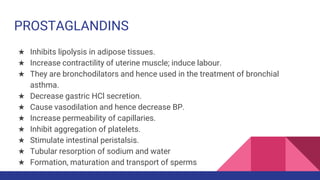
★ Inhibits lipolysis in adipose tissues.
★ Increase contractility of uterine muscle; induce labour.
★ They are bronchodilators and hence used in the treatment of bronchial
asthma.
★ Decrease gastric HCl secretion.
★ Cause vasodilation and hence decrease BP.
★ Increase permeability of capillaries.
★ Inhibit aggregation of platelets.
★ Stimulate intestinal peristalsis.
★ Tubular resorption of sodium and water
★ Formation, maturation and transport of sperms
THROMBOXANES
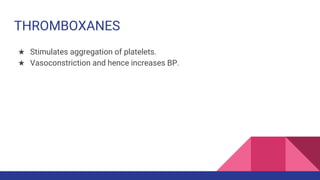
★ Stimulates aggregation of platelets.
★ Vasoconstriction and hence increases BP.
LEUKOTRIENES
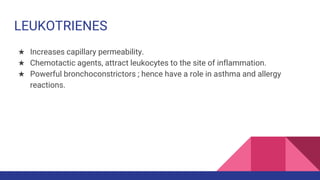
★ Increases capillary permeability.
★ Chemotactic agents, attract leukocytes to the site of inflammation.
★ Powerful bronchoconstrictors ; hence have a role in asthma and allergy
reactions.
References:
Harpers “Textbook of Biochemistry”
U.Sathyanaryana “Textbook of Biochemistry”
Images from Google

Eicosanoid metabolism

  • 1.
    METABOLISM OF EICOSANOIDS ByS. PRISCILLA, M.Sc.CN, I yr
  • 2.
    WHAT ARE EICOSANOIDS? ★The term Eicosanoid is derived from the greek term ‘Eicosa’ means ‘twenty’. ★ They are oxygenated derivatives of 3 different 20-Carbon fatty acids: ○ Eicosapentaenoic acid(EPA), ω-3 fatty acid with 5 double bonds ○ Arachidonic acid(AA), ω-6 fatty acid with 4 double bonds ○ Di - homo gamma- linolenic acid(DHGLA), ω-6 fatty acid with 3 double bonds ★ Eicosanoids are derived from either omega 3 or omega 6 fatty acids.
  • 3.
    ★ Signalling moleculesmade by oxidation - Paracrine hormones. ★ They act locally by diffusing from its source to target cells in the neighborhood. ○ Reproductive functions ○ Inflammatory responses, fever and pain associated with injury or diseases ○ Formation of blood clots and regulation of blood pressure. ○ Gastric acid secretion. .
  • 4.
    CLASSIFICATION ★ Prostanoids ○ Prostaglandins(PG) ○ Prostacyclins (PGI) ○ Thromboxanes (TX) ★ Leukotrienes and lipoxins
  • 5.
    PROSTAGLANDINS(PG) ★ The firsteicosanoid to be discovered, in the seminal fluid ★ They have impact over the reproductive, cardiovascular systems, CNS, gastrointestinal tract etc., ★ They structurally resemble prostanoic acid, a 20-Carbon fatty acid, has a 5-C ring and 2 side chains attached to the chain.
  • 6.
    THROMBOXANES(TX) ★ Thromboxanes aresimilar in structure to prostaglandins, differ in that they have 6 - oxane ring. ★ There are several types named according to the number of double bonds in the side chains.
  • 7.
    LEUKOTRIENES (LT) ★ Theyare 20 carbon polyenoic fatty acids having a number of substituents, depending on which they are divided into LTA, LTB, LTC, LTD, LTE ★ Each type is subdivided upon the number of double bonds which vary from 3 - 5 ★ The most important leukotrienes are LTC4(Glutathione), LTD4(Cysteinylglycine), LTE4(Cysteine).
  • 9.
    ANABOLISM OF EICOSANOIDS cyclooxygenasepathway and lipoxygenase pathway
  • 11.
  • 12.
    ★ All eicosanoidsare short lived compounds ; lasting from seconds to minutes. ★ They produce their effects locally and are quickly inactivated. ★ Prostaglandins are inactivated by self catalyzed destruction of cyclooxygenase - 15-hydroxyprostaglandin dehydrogenase(suicide enzyme). ★ Thromboxanes of type A are inactivate by hydration to type B. ★ Leukotrienes are catabolized by ω- oxidation followed by β-oxidation from ω- end
  • 13.
  • 14.
    PROSTAGLANDINS ★ Inhibits lipolysisin adipose tissues. ★ Increase contractility of uterine muscle; induce labour. ★ They are bronchodilators and hence used in the treatment of bronchial asthma. ★ Decrease gastric HCl secretion. ★ Cause vasodilation and hence decrease BP. ★ Increase permeability of capillaries. ★ Inhibit aggregation of platelets. ★ Stimulate intestinal peristalsis. ★ Tubular resorption of sodium and water ★ Formation, maturation and transport of sperms
  • 15.
    THROMBOXANES ★ Stimulates aggregationof platelets. ★ Vasoconstriction and hence increases BP.
  • 16.
    LEUKOTRIENES ★ Increases capillarypermeability. ★ Chemotactic agents, attract leukocytes to the site of inflammation. ★ Powerful bronchoconstrictors ; hence have a role in asthma and allergy reactions.
  • 17.
    References: Harpers “Textbook ofBiochemistry” U.Sathyanaryana “Textbook of Biochemistry” Images from Google