Evaporators 
G.P MANDI ADAMPUR , HISAR 
Copyright © 2014 Given to Diploma in food Technology
What is Evaporators ? 
 EVAPORATION PROCESS:-Evaporation is a heating 
process in which water is removed from the liquid 
substance. The goal of evaporation is 
to vaporize most of the water from a solution which 
contains the desired product. Evaporators are widely 
used in the food processing industry to remove a 
portion of the water from food products. This reduces 
bulk and weight for subsequent processing, increases 
solids content (as for jams and molasses), helps in 
preservation of the product, provides convenience to 
the end consumer and concentrates color or flavor.
EXAMPLE OF EVAPORATION PROCESS
What is evaporators 
Evaporators: - An evaporator is a device used 
to turn the liquid form of a chemical into its 
gaseous form. The liquid is evaporated, or 
vaporized, into a gas. Many types of 
evaporators and many variations in processing 
techniques have been developed to various 
products.
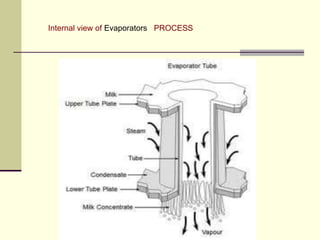
Internal view of Evaporators PROCESS
Types Of Evaporators 
The more common types of evaporators 
include:- 
1. Batch pan Evaporators. 
2. Forced circulation. 
3. Natural circulation. 
4. Rising film tubular. 
5. Falling film tubular. 
6. Rising/falling film tubular.
Batch pan Evaporators 
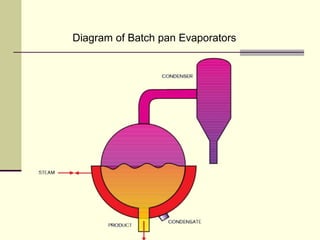
The batch pan evaporator is one of the simplest and oldest 
types of evaporators used in food industry. Now-a-days it is 
outdated technology, but it still used in a few limited applications, 
such as the concentration of jams and jellies where whole fruit is 
present and in processing some pharmaceutical products. Up 
until the early 1960's, batch pan also enjoyed wide use in the 
concentration of corn syrups. In batch pan evaporator the 
product is heated in a steam jacketed spherical vessel. The 
heating vessel may be open to the atmosphere or connected to 
the condenser and vacuum. The heat transfer area per unit 
volume is in batch pan evaporator is small. Thus, the residence 
time normally is many hours. Therefore, it is essential to boil at 
low temperatures and high vacuum when a heat sensitive or 
thermo degradable product is involved.
Diagram of Batch pan Evaporators
Natural Circulation evaporators 
 In Natural Circulation evaporators, short 
vertical tubes, typically 1-2 m long and 50- 
100 mm in diameter, are arranged inside the 
tubes, and the product is concentrated. The 
concentrated liquid falls back to the base of 
the vessel through a central annular section. 
A shell-and-tube heat exchanger can be 
provided outside the main evaporation vessel 
to preheat the liquid feed. The most common 
application for this type of unit is as a reboiler 
at the base of a distillation column.
Example of Natural Circulation Evaporators
Forced Circulation Evaporator 
The forced circulation evaporator was developed 
for processing liquors which are susceptible to 
scaling or crystallizing. Liquid is circulated at a 
high rate through the heat exchanger, boiling 
being prevented within the unit by virtue of a 
hydrostatic head maintained above the top tube 
plate. As the liquid enters the separator where 
the absolute pressure is slightly less than in the 
tube bundle, the liquid flashes to form a vapor
Example of Forced Circulation Evaporator
Rising-film Evaporators 
These are considered to be the first 'modern' 
evaporator used in the industry, the rising film unit 
dates back to the early 1900's. The rising film 
principle was developed commercially by using a 
vertical tube heated from the outside with steam. 
Liquid on the inside of the tube is brought to a boil, 
with the vapor generated forming a core in the 
center of the tube. As the fluid moves up the tube, 
more vapors are formed resulting in a higher 
central core velocity those forces the remaining 
liquid to the tube wall.
Example of Rising-film Evaporators
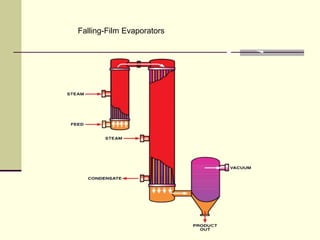
Falling-Film Evaporators 
The falling-film evaporators has a thin liquid film moving 
downward under gravity on the inside of the vertical tubes. 
The design of such evaporators is complicated by the fact 
that distribution of liquid in a uniform film flowing downward in 
a tube is more difficult to obtain than an upward-flow system 
such as in a rising- film evaporator. This is accomplished by 
the use of specially designed distribution or spray nozzles. 
The falling-film evaporators allow a greater number of effects 
then the rising-film evaporator. The falling-film evaporator can 
handle more viscous liquids than the rising film type. This 
type of evaporators is best suited for highly heat sensitive 
products such as orange juice
Falling-Film Evaporators
Rising/Falling Evaporator 
In the rising/falling evaporator, the product is 
concentrated by circulation through a rising-film 
section followed by a falling-film section of the 
evaporator. The product is first concentrated as it 
ascends through a rising tube section, followed by 
preconcentrated product descending through a 
falling-film section, there it attains its final 
concentration.
Example of Rising/Falling Evaporator
Evaporation and types of evaporators used in processing industries.

Evaporation and types of evaporators used in processing industries.

  • 2.
    Evaporators G.P MANDIADAMPUR , HISAR Copyright © 2014 Given to Diploma in food Technology
  • 3.
    What is Evaporators?  EVAPORATION PROCESS:-Evaporation is a heating process in which water is removed from the liquid substance. The goal of evaporation is to vaporize most of the water from a solution which contains the desired product. Evaporators are widely used in the food processing industry to remove a portion of the water from food products. This reduces bulk and weight for subsequent processing, increases solids content (as for jams and molasses), helps in preservation of the product, provides convenience to the end consumer and concentrates color or flavor.
  • 4.
  • 5.
    What is evaporators Evaporators: - An evaporator is a device used to turn the liquid form of a chemical into its gaseous form. The liquid is evaporated, or vaporized, into a gas. Many types of evaporators and many variations in processing techniques have been developed to various products.
  • 6.
    Internal view ofEvaporators PROCESS
  • 7.
    Types Of Evaporators The more common types of evaporators include:- 1. Batch pan Evaporators. 2. Forced circulation. 3. Natural circulation. 4. Rising film tubular. 5. Falling film tubular. 6. Rising/falling film tubular.
  • 8.
    Batch pan Evaporators The batch pan evaporator is one of the simplest and oldest types of evaporators used in food industry. Now-a-days it is outdated technology, but it still used in a few limited applications, such as the concentration of jams and jellies where whole fruit is present and in processing some pharmaceutical products. Up until the early 1960's, batch pan also enjoyed wide use in the concentration of corn syrups. In batch pan evaporator the product is heated in a steam jacketed spherical vessel. The heating vessel may be open to the atmosphere or connected to the condenser and vacuum. The heat transfer area per unit volume is in batch pan evaporator is small. Thus, the residence time normally is many hours. Therefore, it is essential to boil at low temperatures and high vacuum when a heat sensitive or thermo degradable product is involved.
  • 9.
    Diagram of Batchpan Evaporators
  • 10.
    Natural Circulation evaporators  In Natural Circulation evaporators, short vertical tubes, typically 1-2 m long and 50- 100 mm in diameter, are arranged inside the tubes, and the product is concentrated. The concentrated liquid falls back to the base of the vessel through a central annular section. A shell-and-tube heat exchanger can be provided outside the main evaporation vessel to preheat the liquid feed. The most common application for this type of unit is as a reboiler at the base of a distillation column.
  • 11.
    Example of NaturalCirculation Evaporators
  • 12.
    Forced Circulation Evaporator The forced circulation evaporator was developed for processing liquors which are susceptible to scaling or crystallizing. Liquid is circulated at a high rate through the heat exchanger, boiling being prevented within the unit by virtue of a hydrostatic head maintained above the top tube plate. As the liquid enters the separator where the absolute pressure is slightly less than in the tube bundle, the liquid flashes to form a vapor
  • 13.
    Example of ForcedCirculation Evaporator
  • 14.
    Rising-film Evaporators Theseare considered to be the first 'modern' evaporator used in the industry, the rising film unit dates back to the early 1900's. The rising film principle was developed commercially by using a vertical tube heated from the outside with steam. Liquid on the inside of the tube is brought to a boil, with the vapor generated forming a core in the center of the tube. As the fluid moves up the tube, more vapors are formed resulting in a higher central core velocity those forces the remaining liquid to the tube wall.
  • 15.
  • 16.
    Falling-Film Evaporators Thefalling-film evaporators has a thin liquid film moving downward under gravity on the inside of the vertical tubes. The design of such evaporators is complicated by the fact that distribution of liquid in a uniform film flowing downward in a tube is more difficult to obtain than an upward-flow system such as in a rising- film evaporator. This is accomplished by the use of specially designed distribution or spray nozzles. The falling-film evaporators allow a greater number of effects then the rising-film evaporator. The falling-film evaporator can handle more viscous liquids than the rising film type. This type of evaporators is best suited for highly heat sensitive products such as orange juice
  • 17.
  • 18.
    Rising/Falling Evaporator Inthe rising/falling evaporator, the product is concentrated by circulation through a rising-film section followed by a falling-film section of the evaporator. The product is first concentrated as it ascends through a rising tube section, followed by preconcentrated product descending through a falling-film section, there it attains its final concentration.
  • 19.