DEODORIZATION
      TECHNIQUES
             BY

GURUPRASAD VENKATKRISHNA RAO
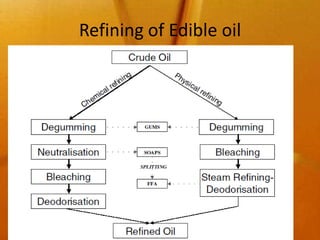
Refining of Edible oil
Deodourization
• Deodourization is a vaccum stripping process
  in which neutral oil is treated to remove
  malodorous compound ( volatile compound in
  general) to obtain fully refined oil.
• This process is similar to steam refining of
  neutral oil where along with malodorous
  compound even fatty acids are also
  removed.The above process is then known as
  steam deodourization.
Deodorization Process
• Deodorization is actually a combination of
  Two different effects on oil
  1) Stripping
  2) Temperature effect
Deodorization Technology

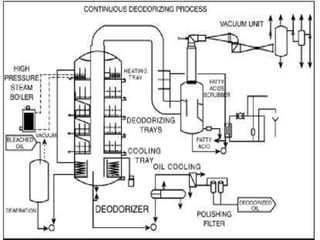
• Deodorization is a multi-step process
  comprising de-
  aeration, heating, deodorization-
  deacidification, and cooling of the oil.
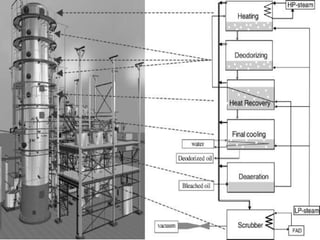
• General overview of Deodorization plant can
  be shown as
Deaeration
• Carried out in order to avoid oxidation and
  hence avoid risk of polymerization.
• Oil is heated to 800c and sprayed in a
  tank, which is kept at a pressure below 50
  mbar.
• Lower the pressure lower is residual air left in
  the oil.
Heating and Cooling
• The subsequent heating of the oil is usually
  accomplished in two stages.
• In the first stage, the incoming oil is heated
  counter currently in an oil-oil heat exchanger
  (economizer), with the finished oil leaving the
  deodorizer.
• Finally, the oil is heated under reduced
  pressure to the final deodorization
  temperature with a high-temperature source.
Heating and Cooling
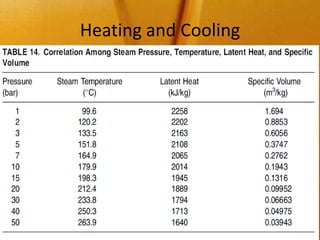
• Source of Heating in the final stages are
1) High-pressure steam boilers
2) Thermal Oil Heaters
3) Downtherm A (diphenyl/diphenyloxide)

• The net heating energy required for a
  deodorization system can be calculated as:
  H= [ O.c.(T2-T1).fL.fR ]
Heating and Cooling
Heating and Cooling
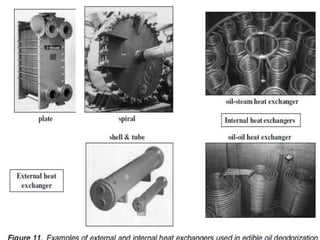
• In industrial practice, heat recovery has
  become an important factor because it
  minimizes the cost of additional heating of the
  oil to the deodorization temperature.
• For above purpose Heat exchangers have been
  evolved and they are classified as follows
 1) External Heat Exchanger
 2) Internal Heat Exchanger
Heating and Cooling
• Heat recovery can be done directly by
  exchange of heat between the two oil stream
  at different stream ( e.g.. Bleached oil Vs
  Deodorized oil)flowing in counter current
  direction through the exchangers or indirectly
  by steam production.
Heating and Cooling
• Final cooling of the oil is usually conducted under
  reduced pressure to prevent the possible
  production of degradation by products.
• As a result of the technological complexity and
  for cost reasons, cooling under vacuum is usually
  applied only in a large capacity deodorizer. Small
  capacity plants often make use of external oil–oil
  heat-exchanging devices.
Steam Stripping
• Amount of stripping agent is proportional to its
  molecular weight.
• Hence steam is being used for stripping.
• But N2 is being experimented to be used as stripping
  agent.
• studies have indicated that color, residual
  FFA, oxidative stability, as well as the formation of
  trans-fatty acids and the stripping of tocopherols are
  not affected by the nature of the stripping agent.
• Stripping agent must be dry and free from oxygen.
Steam Stripping
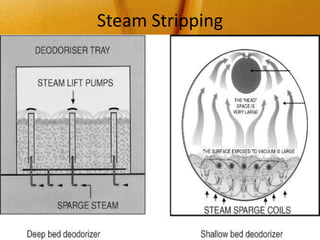
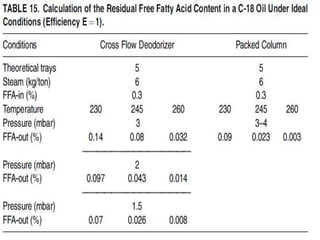
• Deodorization only occurs at the vapor-liquid
  contact zone where the lowest operating
  pressure exists.
• Hence there are different Deodorizer design
  which attempt to provide the best contact
  between the gas phase and the oil phase by
  creating a large contact surface, together with
  an optimal sparge steam distribution.
Steam Stripping
Vapor scrubbing system
• Composition of vapor phase
- Volatile components (FFA, odor components)
- Stripping steam
- Non condensable gases (air,…).
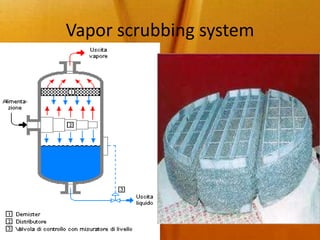
• The volatile substances are condensed by
   creating an intimate contact between the
   vapor and the fatty acid distillate circulating in
   the scrubber.
Vapor scrubbing system
• Condensation of vapour phase is achieved by
 series of sprayers or packed bed in vacuum
  duct.
 Installation of demister at the top.
 improved scrubbers operating at two
  different temperatures (so-called dual
  condensation principle) have been introduced.
Vapor scrubbing system
Vacuum systems
• Combination of steam jet ejectors (boosters),
  vapor condensers and mechanical (liquid-ring)
  vacuum pump
• High motive steam consumption (60-85% of
  total steam).
COMMERCIAL DEODORIZER SYSTEMS
•   Batch Deodorization
•   Semicontinuous Deodorization
•   Continuous Deodorization
•   dual-temperature Deodourization
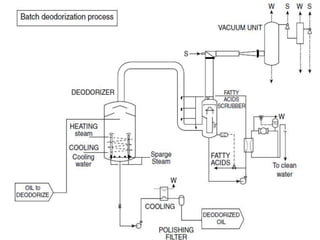
Batch Deodorization

• Batch deodorization is especially suitable for
  small capacities (<50 ton/day), irregular
  production, or in processing small batches of
  different oils that demand minimum cross-
  contamination.
• Batch deodorizers mainly consist of a single-
  shell welded vertical cylindrical vessel
Batch Deodorization
• Advantages :
 very simple
 construction and low capital cost


• Disadvantage:
 Low capacities
 high operating costs (high steam consumption, very
  low heat recovery),
 relatively long processing times (sometimes up to 8 h)
Semi Continous Deoderisation
• Suitable for Large capacity.
• Used when frequent feedstock changes of oil
  sensitive to cross contamination.
• Allows efficient Heat Recovery
• Steam produced in the bottom deodorized oil-
  cooling section is sent in a closed
  thermosiphon loop to the top bleached oil-
  heating section to heat the incoming oil.
• Main advantage is shorter hold up time.
Continuous Deodorization
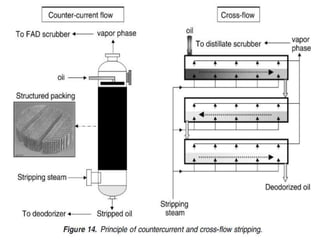
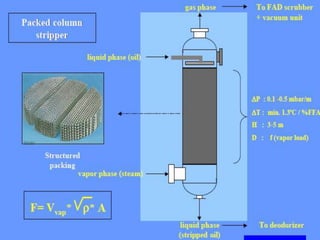
• Several configuration of continous
  Deoderisation are

horizontal vessels
vertical tray-type deodorizers
 packed columns
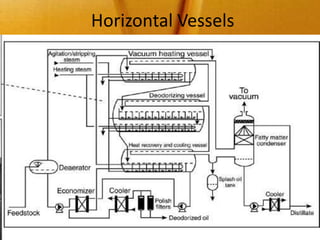
Horizontal Vessels
Continuous Deodorization
• Advantages :
Low utilities cost (high heat recovery)
Short residence time
Excellent control of all parameters

• Disadvantage: Contamination during
  feedstock change
Improved Deodorization Technology
• Dual temperature deodorization
- Deodorization at two different temperatures
• Integration of packed columns
- for specific application only
- efficient stripping - lower steam consumption
• Dual condensation
- Condensation at two different temperatures
- Higher added value of deodorizer distillate (physical refining)
• Dry-Ice condensing
- Lower deodorizing pressure (1 mbar)
- Allows milder refining (lower temp)
REFERENCE

• Various Search results on www.google.com
• Lipid Library
• Oils and Fats by Alton Bailey
• Chemistry and Technology of Oils and Fats by
  M.M Chakrabarthy.
• Dr A V JOSHI (ICT) & Dr AMIT PRATAP (ICT) for
  giving advise.
Deodorization

Deodorization

  • 1.
    DEODORIZATION TECHNIQUES BY GURUPRASAD VENKATKRISHNA RAO
  • 2.
  • 3.
    Deodourization • Deodourization isa vaccum stripping process in which neutral oil is treated to remove malodorous compound ( volatile compound in general) to obtain fully refined oil. • This process is similar to steam refining of neutral oil where along with malodorous compound even fatty acids are also removed.The above process is then known as steam deodourization.
  • 4.
    Deodorization Process • Deodorizationis actually a combination of Two different effects on oil 1) Stripping 2) Temperature effect
  • 5.
    Deodorization Technology • Deodorizationis a multi-step process comprising de- aeration, heating, deodorization- deacidification, and cooling of the oil. • General overview of Deodorization plant can be shown as
  • 7.
    Deaeration • Carried outin order to avoid oxidation and hence avoid risk of polymerization. • Oil is heated to 800c and sprayed in a tank, which is kept at a pressure below 50 mbar. • Lower the pressure lower is residual air left in the oil.
  • 8.
    Heating and Cooling •The subsequent heating of the oil is usually accomplished in two stages. • In the first stage, the incoming oil is heated counter currently in an oil-oil heat exchanger (economizer), with the finished oil leaving the deodorizer. • Finally, the oil is heated under reduced pressure to the final deodorization temperature with a high-temperature source.
  • 9.
    Heating and Cooling •Source of Heating in the final stages are 1) High-pressure steam boilers 2) Thermal Oil Heaters 3) Downtherm A (diphenyl/diphenyloxide) • The net heating energy required for a deodorization system can be calculated as: H= [ O.c.(T2-T1).fL.fR ]
  • 10.
  • 11.
    Heating and Cooling •In industrial practice, heat recovery has become an important factor because it minimizes the cost of additional heating of the oil to the deodorization temperature. • For above purpose Heat exchangers have been evolved and they are classified as follows 1) External Heat Exchanger 2) Internal Heat Exchanger
  • 13.
    Heating and Cooling •Heat recovery can be done directly by exchange of heat between the two oil stream at different stream ( e.g.. Bleached oil Vs Deodorized oil)flowing in counter current direction through the exchangers or indirectly by steam production.
  • 14.
    Heating and Cooling •Final cooling of the oil is usually conducted under reduced pressure to prevent the possible production of degradation by products. • As a result of the technological complexity and for cost reasons, cooling under vacuum is usually applied only in a large capacity deodorizer. Small capacity plants often make use of external oil–oil heat-exchanging devices.
  • 15.
    Steam Stripping • Amountof stripping agent is proportional to its molecular weight. • Hence steam is being used for stripping. • But N2 is being experimented to be used as stripping agent. • studies have indicated that color, residual FFA, oxidative stability, as well as the formation of trans-fatty acids and the stripping of tocopherols are not affected by the nature of the stripping agent. • Stripping agent must be dry and free from oxygen.
  • 16.
    Steam Stripping • Deodorizationonly occurs at the vapor-liquid contact zone where the lowest operating pressure exists. • Hence there are different Deodorizer design which attempt to provide the best contact between the gas phase and the oil phase by creating a large contact surface, together with an optimal sparge steam distribution.
  • 17.
  • 20.
    Vapor scrubbing system •Composition of vapor phase - Volatile components (FFA, odor components) - Stripping steam - Non condensable gases (air,…). • The volatile substances are condensed by creating an intimate contact between the vapor and the fatty acid distillate circulating in the scrubber.
  • 21.
    Vapor scrubbing system •Condensation of vapour phase is achieved by  series of sprayers or packed bed in vacuum duct.  Installation of demister at the top.  improved scrubbers operating at two different temperatures (so-called dual condensation principle) have been introduced.
  • 22.
  • 23.
    Vacuum systems • Combinationof steam jet ejectors (boosters), vapor condensers and mechanical (liquid-ring) vacuum pump • High motive steam consumption (60-85% of total steam).
  • 24.
    COMMERCIAL DEODORIZER SYSTEMS • Batch Deodorization • Semicontinuous Deodorization • Continuous Deodorization • dual-temperature Deodourization
  • 25.
    Batch Deodorization • Batchdeodorization is especially suitable for small capacities (<50 ton/day), irregular production, or in processing small batches of different oils that demand minimum cross- contamination. • Batch deodorizers mainly consist of a single- shell welded vertical cylindrical vessel
  • 26.
    Batch Deodorization • Advantages:  very simple  construction and low capital cost • Disadvantage:  Low capacities  high operating costs (high steam consumption, very low heat recovery),  relatively long processing times (sometimes up to 8 h)
  • 28.
    Semi Continous Deoderisation •Suitable for Large capacity. • Used when frequent feedstock changes of oil sensitive to cross contamination. • Allows efficient Heat Recovery • Steam produced in the bottom deodorized oil- cooling section is sent in a closed thermosiphon loop to the top bleached oil- heating section to heat the incoming oil. • Main advantage is shorter hold up time.
  • 29.
    Continuous Deodorization • Severalconfiguration of continous Deoderisation are horizontal vessels vertical tray-type deodorizers  packed columns
  • 30.
  • 33.
    Continuous Deodorization • Advantages: Low utilities cost (high heat recovery) Short residence time Excellent control of all parameters • Disadvantage: Contamination during feedstock change
  • 34.
    Improved Deodorization Technology •Dual temperature deodorization - Deodorization at two different temperatures • Integration of packed columns - for specific application only - efficient stripping - lower steam consumption • Dual condensation - Condensation at two different temperatures - Higher added value of deodorizer distillate (physical refining) • Dry-Ice condensing - Lower deodorizing pressure (1 mbar) - Allows milder refining (lower temp)
  • 35.
    REFERENCE • Various Searchresults on www.google.com • Lipid Library • Oils and Fats by Alton Bailey • Chemistry and Technology of Oils and Fats by M.M Chakrabarthy. • Dr A V JOSHI (ICT) & Dr AMIT PRATAP (ICT) for giving advise.

Editor's Notes

  • #10 where O is the amount of oil (kg), T1/T2 is the incoming and final temperature of the oil (C), c is the average specific heat capacity of vegetable oils (typically 2.2– 2.4 kJ/kgC), fL is the heat loss factor from radiation (typically 1.05–1.15), and fR is the heat recovery factor [1-(%heat recovery/100)].
  • #16 Nitrogen has the advantage of being an inert andnoncondensable gas. Theoretically, its use will result in lower loss (no hydrolysis)and a more pure deodorizer distillate. Although it is possible to work with nitrogen under the commonly applied process conditions, experiments have shown that the profitability is very uncertain, depending on the existing installations in the factory and the nitrogen supply
  • #22 The distillate is usually circulated at the lowest possible temperature (just above the melting point) to obtain the best possible condensation of thefatty matter present in the vapor phase that leaves the deodorizer.