Prepared By:- Nisarg Amin
Topic:- Improving Boiler Availability
Improving Boiler
Availability
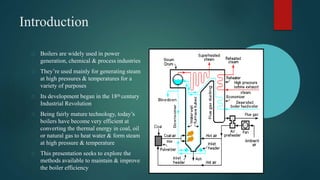
Boilers are widely used in power
generation, chemical & process industries
They’re used mainly for generating steam
at high pressures & temperatures for a
variety of purposes
Its development began in the 18th century
Industrial Revolution
Being fairly mature technology, today’s
boilers have become very efficient at
converting the thermal energy in coal, oil
or natural gas to heat water & form steam
at high pressure & temperature
This presentation seeks to explore the
methods available to maintain & improve
the boiler efficiency
Introduction
Main Areas for Improvement
Combustion Management
Feedwater Management
Steam Distribution Management
Combustion Efficiency Management
Boiler burns fuel efficiently if following 3 conditions aremet:
It burns fuelcompletely
It uses as little excess air as possible to do it
It extracts as much heat as possible from the combustiongases
The first 2 conditions are met by careful control of excess air in theboiler
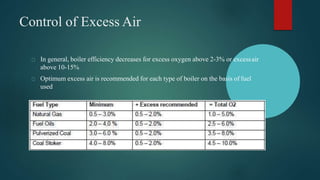
Control of Excess Air
In general, boiler efficiency decreases for excess oxygen above 2-3% or excessair
above 10-15%
Optimum excess air is recommended for each type of boiler on the basis of fuel
used
Combustion Control
Usual causes of deficient combustion:
Improper Draft: Remedied by DraftControl
Improper Air-Fuel Mixture
Draft Control
Pitfalls of Improper Draft:
Insufficient Draft: Prevents adequate air supply for combustion; Results insmoky,
incomplete combustion
Excessive Draft: Larger volume of air & flue gas moves quickly through the furnace;
Less time for heat transfer, High flue gas exit temperature; Contributes to maximum
heat loss
Ideal Draft: Controlled such that boiler operates at 2-4% excessoxygen
Close Draft Regulation difficult due to burners’ requirement of properair-fuel
mixture
Air-Fuel Mix Control
Stoichiometric air-fuel mix depends on masses
Fact to be considered: Density of air & gaseous fuels changes withambient
temperatures
Control challenging due to:
Inadequate tolerance of burner controls
Faultyburners
Improper Fuel Deliverysystem
Reclaiming Boiler Heat Losses
Residual heat in flue gas is the main heat loss
Residual heat used in following ways:
Economisers: Feedwaterpreheated
Flue gas condensing by water: Water absorbs flue gasheat
Combustion Air Preheat: Combustion air preheated for better combustion
Flue Gas Recirculation: Recirculated with incoming air-fuel mix; decreases NOx
emissions
Heat Cascading: Exhaust heat used in lower temperature applications
Feedwater Management
Boiler feedwater consists of:
Returnedcondensate
Make-upwater
Make-up water is the main source of contaminants, making condensate recovery
important
Condensate recovery important due to the following:
Losing hot condensate results in heat loss of fuel
More the condensate recovery, lesser will be the make-up water, lesser the need for
water treatment
More condensate recovery implies lower blowdown & associated losses
Steam Distribution Management
Steam distribution equipment must supply high quality steam at requiredpressure
& flow rate with minimum heat loss
Key Components of Steam Distribution System:
Steam distributionpiping
Valves &Flanges
Insulation
Steam Traps
AirVents
DripLegs
Strainers
Important Concerns of Steam Distribution Management
Optimum PipeSizing
ProperInsulation
PluggingLeaks
Steam Traps & Associated Pipelines
Steam Use inHeating
Steam Distribution Management
Optimum Pipe Sizing
Affected by Steam Velocities:
Superheated: 50-70 m/s
Saturated: 30-40 m/s
Wet/Exhaust: 20-30m/s
Velocities lesser than 15 m/s at shorter pipebends
Standard data tables available to help selection of appropriate pipesizes
Steam piping size based on ‘permissible velocity’ & ‘available pressuredrop’
considerations
Condensate piping size designed based on the assumption of only water flow at
starting conditions, despite mostly carrying two-phase flow in practice
Proper Piping Design & Maintenance
Ensure right sizing of pipes
Oversized Pipes: Increase capital, maintenance & insulation costs; Increase surface
heat losses
Undersized Pipes: Require higher pressure & pumping energy; Have higher rates of
leakage
Get rid of redundant & obsolete pipework
Fix Steam Leaks
Keep track of facility-wide & individual process-unit steambalances
Piping at equipment connections should accommodate thermal responses during
system start-ups & shutdowns
Steam separators should be installed to ensure dry steam throughout theprocess
equipment & branch lines
Done to avoid excessive heat loss to atmosphere
Important Insulation Properties: Thermal conductivity, Strength,Abrasion
resistance, Workability, and Resistance to water absorption
Common Insulating Materials:
Steam Piping: Calcium Silicate, Fiberglass, Perlite, Cellular Glass
Steam Distribution Components/Attachments: Fiberglass, Fabric InsulationBlankets
Smaller the pipe diameter, thinner the insulation
Higher the temperature of the insulated pipe, higher the return on investment
Running pipes in groups reduces heat losses
Air movement & Draft increase heat losses of un-insulatedpipes
Proper Insulation of Steam Piping
Steam Traps & Associated Pipelines
Steam traps distinguish condensate from steam & remove thecondensate
Types of steam traps, classified based on:
Density difference: Known as mechanical traps; Include float traps & bucket traps
Temperature difference: Known as thermostatic traps; Include Balanced-pressure traps,
Bimetal traps & Liquid expansion traps
Flow characteristics: Known as thermodynamic traps
Steam Traps Maintenance:
Periodic Cleaning & Checking for wear
Fixing strainers ahead of the steam traps to avoid damage by scale & dirt
Steam traps handling more air require more frequent inspection & proper venting
Steam Use in Heating
Steam can be used in various ways as follows:
Providing Dry steam forProcess
Using steam at lowest pressures required by end-user
Heating by DirectInjection
Proper Air Venting: Done to avoid reduced heat transfer performance due toair
films
Summary
The three important phases of operation to be managed for high boiler efficiency
are:
Combustion
Feedwater
SteamPiping
Good draft control, air-fuel mixture control results in high boilerefficiency
Maintaining low amount of dissolved solids & acids helps in maintaining high
efficiency & prolonging equipment life
Proper piping design & maintenance helps in increasing boilerefficiency
THANK YOU!

Improving boiler availability

  • 1.
    Prepared By:- NisargAmin Topic:- Improving Boiler Availability
  • 2.
  • 3.
    Boilers are widelyused in power generation, chemical & process industries They’re used mainly for generating steam at high pressures & temperatures for a variety of purposes Its development began in the 18th century Industrial Revolution Being fairly mature technology, today’s boilers have become very efficient at converting the thermal energy in coal, oil or natural gas to heat water & form steam at high pressure & temperature This presentation seeks to explore the methods available to maintain & improve the boiler efficiency Introduction
  • 4.
    Main Areas forImprovement Combustion Management Feedwater Management Steam Distribution Management
  • 5.
    Combustion Efficiency Management Boilerburns fuel efficiently if following 3 conditions aremet: It burns fuelcompletely It uses as little excess air as possible to do it It extracts as much heat as possible from the combustiongases The first 2 conditions are met by careful control of excess air in theboiler
  • 6.
    Control of ExcessAir In general, boiler efficiency decreases for excess oxygen above 2-3% or excessair above 10-15% Optimum excess air is recommended for each type of boiler on the basis of fuel used
  • 7.
    Combustion Control Usual causesof deficient combustion: Improper Draft: Remedied by DraftControl Improper Air-Fuel Mixture
  • 8.
    Draft Control Pitfalls ofImproper Draft: Insufficient Draft: Prevents adequate air supply for combustion; Results insmoky, incomplete combustion Excessive Draft: Larger volume of air & flue gas moves quickly through the furnace; Less time for heat transfer, High flue gas exit temperature; Contributes to maximum heat loss Ideal Draft: Controlled such that boiler operates at 2-4% excessoxygen Close Draft Regulation difficult due to burners’ requirement of properair-fuel mixture
  • 9.
    Air-Fuel Mix Control Stoichiometricair-fuel mix depends on masses Fact to be considered: Density of air & gaseous fuels changes withambient temperatures Control challenging due to: Inadequate tolerance of burner controls Faultyburners Improper Fuel Deliverysystem
  • 10.
    Reclaiming Boiler HeatLosses Residual heat in flue gas is the main heat loss Residual heat used in following ways: Economisers: Feedwaterpreheated Flue gas condensing by water: Water absorbs flue gasheat Combustion Air Preheat: Combustion air preheated for better combustion Flue Gas Recirculation: Recirculated with incoming air-fuel mix; decreases NOx emissions Heat Cascading: Exhaust heat used in lower temperature applications
  • 11.
    Feedwater Management Boiler feedwaterconsists of: Returnedcondensate Make-upwater Make-up water is the main source of contaminants, making condensate recovery important Condensate recovery important due to the following: Losing hot condensate results in heat loss of fuel More the condensate recovery, lesser will be the make-up water, lesser the need for water treatment More condensate recovery implies lower blowdown & associated losses
  • 12.
    Steam Distribution Management Steamdistribution equipment must supply high quality steam at requiredpressure & flow rate with minimum heat loss Key Components of Steam Distribution System: Steam distributionpiping Valves &Flanges Insulation Steam Traps AirVents DripLegs Strainers
  • 13.
    Important Concerns ofSteam Distribution Management Optimum PipeSizing ProperInsulation PluggingLeaks Steam Traps & Associated Pipelines Steam Use inHeating Steam Distribution Management
  • 14.
    Optimum Pipe Sizing Affectedby Steam Velocities: Superheated: 50-70 m/s Saturated: 30-40 m/s Wet/Exhaust: 20-30m/s Velocities lesser than 15 m/s at shorter pipebends Standard data tables available to help selection of appropriate pipesizes Steam piping size based on ‘permissible velocity’ & ‘available pressuredrop’ considerations Condensate piping size designed based on the assumption of only water flow at starting conditions, despite mostly carrying two-phase flow in practice
  • 15.
    Proper Piping Design& Maintenance Ensure right sizing of pipes Oversized Pipes: Increase capital, maintenance & insulation costs; Increase surface heat losses Undersized Pipes: Require higher pressure & pumping energy; Have higher rates of leakage Get rid of redundant & obsolete pipework Fix Steam Leaks Keep track of facility-wide & individual process-unit steambalances Piping at equipment connections should accommodate thermal responses during system start-ups & shutdowns Steam separators should be installed to ensure dry steam throughout theprocess equipment & branch lines
  • 16.
    Done to avoidexcessive heat loss to atmosphere Important Insulation Properties: Thermal conductivity, Strength,Abrasion resistance, Workability, and Resistance to water absorption Common Insulating Materials: Steam Piping: Calcium Silicate, Fiberglass, Perlite, Cellular Glass Steam Distribution Components/Attachments: Fiberglass, Fabric InsulationBlankets Smaller the pipe diameter, thinner the insulation Higher the temperature of the insulated pipe, higher the return on investment Running pipes in groups reduces heat losses Air movement & Draft increase heat losses of un-insulatedpipes Proper Insulation of Steam Piping
  • 17.
    Steam Traps &Associated Pipelines Steam traps distinguish condensate from steam & remove thecondensate Types of steam traps, classified based on: Density difference: Known as mechanical traps; Include float traps & bucket traps Temperature difference: Known as thermostatic traps; Include Balanced-pressure traps, Bimetal traps & Liquid expansion traps Flow characteristics: Known as thermodynamic traps Steam Traps Maintenance: Periodic Cleaning & Checking for wear Fixing strainers ahead of the steam traps to avoid damage by scale & dirt Steam traps handling more air require more frequent inspection & proper venting
  • 18.
    Steam Use inHeating Steam can be used in various ways as follows: Providing Dry steam forProcess Using steam at lowest pressures required by end-user Heating by DirectInjection Proper Air Venting: Done to avoid reduced heat transfer performance due toair films
  • 19.
    Summary The three importantphases of operation to be managed for high boiler efficiency are: Combustion Feedwater SteamPiping Good draft control, air-fuel mixture control results in high boilerefficiency Maintaining low amount of dissolved solids & acids helps in maintaining high efficiency & prolonging equipment life Proper piping design & maintenance helps in increasing boilerefficiency
  • 20.