
How to make an Effective
Presentation?
What is a Presentation?
A structured, prepared and speech based
means of communicating
information, or ideas to a group of
interested people, in order to inform or
persuade them.
Why Presentation Skills
Training?
To properly structure your presentation.
To overcome nervousness.
To develop powerful Body Language.
To deliver effective presentation.
To learn what not to do during presentation
To design and use visual aids effectively
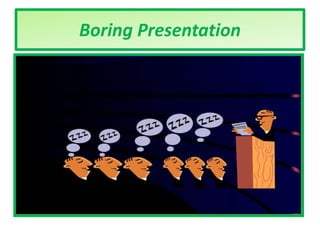
Boring Presentation
Common cause of Ineffective
Presentation
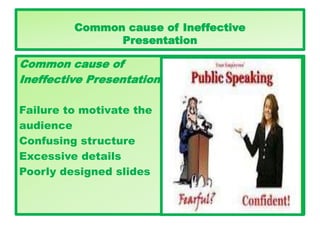
Common cause of
Ineffective Presentation
Failure to motivate the
audience
Confusing structure
Excessive details
Poorly designed slides
Steps needed to make an
Effective Presentation
For delivering an
effective presentation
we need to take the
following steps:
1. Planning
2. Preparation
3. Delivery
Planning
What is the purpose of your presentation?
Who will be your audience?
What are you trying to achieve
through this presentation?
Planning (cont)
Design your message
Organize your
material
Design the look of
your presentation
Create the slides.
Step -1: List your objectives
Why are you making this presentation?
What do you expect to accomplish?
Step -2: Focus on the
audience
Who are they?
Focus on what your audience needs to know,
NOT- what you know.
Consider audience’s level & interest
Decide what you want the audience to do, as a
result of your presentation
Step -3: Determine the message
Tailor the points to the audience’s technical
level: information needs and interest.
Modify the presentation for each new audience
Preparation
Fundamental rules for presentation are:
1. Subject of presentation:
a) Decide your message in advance
b) Have a strong conviction on what you want
to talk.
Preparation
2. Organize your points logically:
a) What to say at the beginning?
b) What you deal in the middle?
c) How to close?
( May be by summarizing entire presentation.)
Preparation
2. Organize your points logically:
a) What to say at the beginning?
b) What you deal in the middle?
c) How to close?
( May be by summarizing entire presentation.)
Preparation
Preparation
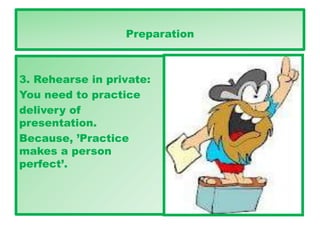
3. Rehearse in private:
You need to practice
delivery of
presentation.
Because, ’Practice
makes a person
perfect’.
Preparation
4. Keep notes to a minimum:
--If necessary, use Index Cards.
-- Jot down the main points
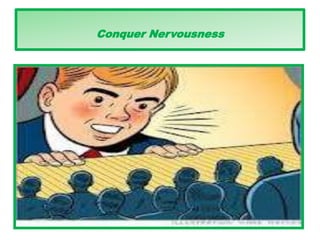
Conquer Nervousness
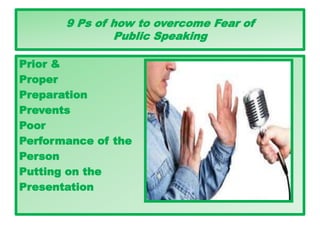
9 Ps of how to overcome Fear of
Public Speaking
Prior &
Proper
Preparation
Prevents
Poor
Performance of the
Person
Putting on the
Presentation
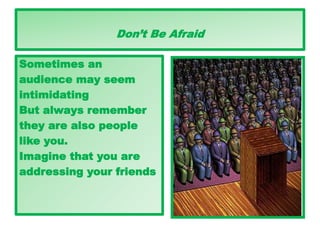
Don’t Be Afraid
Sometimes an
audience may seem
intimidating
But always remember
they are also people
like you.
Imagine that you are
addressing your friends
Preparation
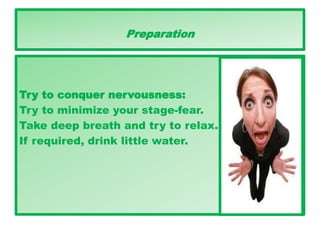
Try to conquer nervousness:
Try to minimize your stage-fear.
Take deep breath and try to relax.
If required, drink little water.
Preparation
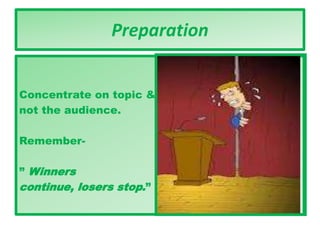
Concentrate on topic &
not the audience.
Remember-
” Winners
continue, losers stop.”
Organizing your Delivery-
General Tips
• Announce your topic clearly
• Give an outline of your presentation in your
introduction
• State your objective upfront
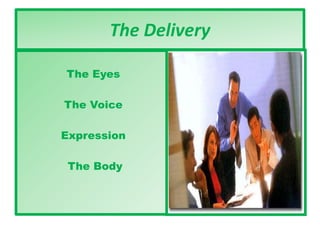
The Delivery
The Eyes
The Voice
Expression
The Body
Organizing your Delivery-
The Opener
”Tell them what you are
going to tell them”
- Set the tone
- Capture your
audience’s attention
- Build rapport
- Tailor your opener to
Your audience
The Opener
1. Introduction:
a) Start with a bang to get attention.
Start with an ice-breaker such as a story, joke
or a quotation.
The Opener
Be warm and friendly
Provide facts & figures
Throw out a question
Organizing The Delivery
(Middle)
”Say it”
- Organize the
presentation around
main aspects of the
subject.
Body of Presentation
1. Cover the subject in logical order
2. Repeat important points
3. Use visuals wherever possible
4. The voice should not be too fast , too high or
too slow.
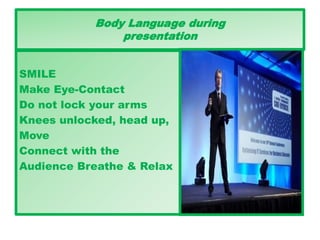
Body Language during
presentation
SMILE
Make Eye-Contact
Do not lock your arms
Knees unlocked, head up,
Move
Connect with the
Audience Breathe & Relax
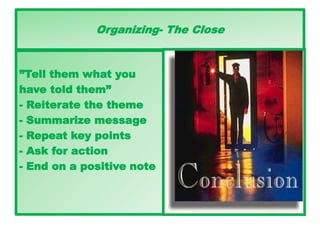
Organizing- The Close
”Tell them what you
have told them”
- Reiterate the theme
- Summarize message
- Repeat key points
- Ask for action
- End on a positive note
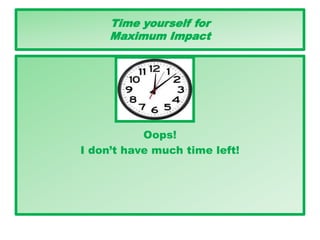
Time yourself for
Maximum Impact
Oops!
I don’t have much time left!
The Three Presentation
Essentials
1.Use Visual Aids, wherever you can
2. Rehearse, Rehearse, & Rehearse
”If you fail to prepare, you are
prepared to fail”
Rehearse against clock
3. Memorize your script
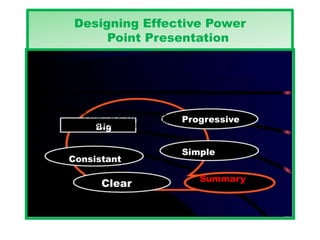
Designing Effective Power
Point Presentation
• Big
•Big
CConsistantent
Clear
Progressive
Simple
Summary
Designing Effective Power
Point Presentation
Design the ”Look” of your
Presentation
Follow the ‘KISS” rule—keep it short and simple
• Use Short words and short phrases
• The 6*7 rules
• N
• Not more than 7 rules per line
• Not more than 6 lines per slide
Why Visuals?
Visuals are powerful tools because they:
- increase understanding
- Save time
- Enhance attention
- Help control nervousness
Make it clear
SIZE IMPLIES IMPORTANCE
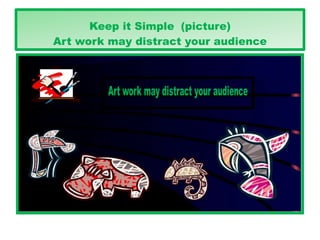
Keep it Simple (picture)
Art work may distract your audience
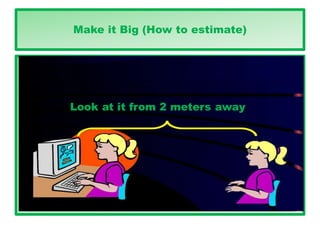
Make it Big (How to estimate)
Tips & Techniques for
Effective Presentation
Maintain good eye contact
Vary your speaking volume
Use pauses
Do not read your presentation
Don’t stand between the audience and
the slides
Use stories, questions, clips, examples etc
Tips & Techniques for
delivery
Do not put both hands in your pockets forlong
time
Speak to the audience. Not to the visualSpeak
clearly and loudly enough
Circulate around the room as you speak
Discuss your objectives at the begining of
the presentation
Tips on Visual Aids
Are the Visual Aids
easy to read and easy
to understand?
Can they be easily seen
from all areas of the
room?
Some Final Words
Communication is the key
Text to support the communication
Pictures to simplify complex concepts
Visuals to support, not to distract
Signs to detect that Audience is
not Listening
Start to look down
Touch or rub the face, hand or hair
Yawn Fidget
Sigh heavily Whisper
Tap their feet
Make sure you have finished
speaking before your audience
has finished listening
-Dorothy Sarnoff
Effective presentation

Effective presentation

  • 1.
    How to makean Effective Presentation?
  • 2.
    What is aPresentation? A structured, prepared and speech based means of communicating information, or ideas to a group of interested people, in order to inform or persuade them.
  • 3.
    Why Presentation Skills Training? Toproperly structure your presentation. To overcome nervousness. To develop powerful Body Language. To deliver effective presentation. To learn what not to do during presentation To design and use visual aids effectively
  • 4.
  • 5.
    Common cause ofIneffective Presentation Common cause of Ineffective Presentation Failure to motivate the audience Confusing structure Excessive details Poorly designed slides
  • 6.
    Steps needed tomake an Effective Presentation For delivering an effective presentation we need to take the following steps: 1. Planning 2. Preparation 3. Delivery
  • 8.
    Planning What is thepurpose of your presentation? Who will be your audience? What are you trying to achieve through this presentation?
  • 9.
    Planning (cont) Design yourmessage Organize your material Design the look of your presentation Create the slides.
  • 10.
    Step -1: Listyour objectives Why are you making this presentation? What do you expect to accomplish?
  • 11.
    Step -2: Focuson the audience Who are they? Focus on what your audience needs to know, NOT- what you know. Consider audience’s level & interest Decide what you want the audience to do, as a result of your presentation
  • 12.
    Step -3: Determinethe message Tailor the points to the audience’s technical level: information needs and interest. Modify the presentation for each new audience
  • 13.
    Preparation Fundamental rules forpresentation are: 1. Subject of presentation: a) Decide your message in advance b) Have a strong conviction on what you want to talk.
  • 14.
    Preparation 2. Organize yourpoints logically: a) What to say at the beginning? b) What you deal in the middle? c) How to close? ( May be by summarizing entire presentation.) Preparation 2. Organize your points logically: a) What to say at the beginning? b) What you deal in the middle? c) How to close? ( May be by summarizing entire presentation.) Preparation
  • 15.
    Preparation 3. Rehearse inprivate: You need to practice delivery of presentation. Because, ’Practice makes a person perfect’.
  • 16.
    Preparation 4. Keep notesto a minimum: --If necessary, use Index Cards. -- Jot down the main points
  • 17.
  • 18.
    9 Ps ofhow to overcome Fear of Public Speaking Prior & Proper Preparation Prevents Poor Performance of the Person Putting on the Presentation
  • 19.
    Don’t Be Afraid Sometimesan audience may seem intimidating But always remember they are also people like you. Imagine that you are addressing your friends
  • 20.
    Preparation Try to conquernervousness: Try to minimize your stage-fear. Take deep breath and try to relax. If required, drink little water.
  • 21.
    Preparation Concentrate on topic& not the audience. Remember- ” Winners continue, losers stop.”
  • 22.
    Organizing your Delivery- GeneralTips • Announce your topic clearly • Give an outline of your presentation in your introduction • State your objective upfront
  • 23.
    The Delivery The Eyes TheVoice Expression The Body
  • 24.
    Organizing your Delivery- TheOpener ”Tell them what you are going to tell them” - Set the tone - Capture your audience’s attention - Build rapport - Tailor your opener to Your audience
  • 25.
    The Opener 1. Introduction: a)Start with a bang to get attention. Start with an ice-breaker such as a story, joke or a quotation.
  • 26.
    The Opener Be warmand friendly Provide facts & figures Throw out a question
  • 27.
    Organizing The Delivery (Middle) ”Sayit” - Organize the presentation around main aspects of the subject.
  • 28.
    Body of Presentation 1.Cover the subject in logical order 2. Repeat important points 3. Use visuals wherever possible 4. The voice should not be too fast , too high or too slow.
  • 29.
    Body Language during presentation SMILE MakeEye-Contact Do not lock your arms Knees unlocked, head up, Move Connect with the Audience Breathe & Relax
  • 30.
    Organizing- The Close ”Tellthem what you have told them” - Reiterate the theme - Summarize message - Repeat key points - Ask for action - End on a positive note
  • 31.
    Time yourself for MaximumImpact Oops! I don’t have much time left!
  • 32.
    The Three Presentation Essentials 1.UseVisual Aids, wherever you can 2. Rehearse, Rehearse, & Rehearse ”If you fail to prepare, you are prepared to fail” Rehearse against clock 3. Memorize your script
  • 33.
    Designing Effective Power PointPresentation • Big •Big CConsistantent Clear Progressive Simple Summary Designing Effective Power Point Presentation
  • 34.
    Design the ”Look”of your Presentation Follow the ‘KISS” rule—keep it short and simple • Use Short words and short phrases • The 6*7 rules • N • Not more than 7 rules per line • Not more than 6 lines per slide
  • 35.
    Why Visuals? Visuals arepowerful tools because they: - increase understanding - Save time - Enhance attention - Help control nervousness
  • 36.
    Make it clear SIZEIMPLIES IMPORTANCE
  • 37.
    Keep it Simple(picture) Art work may distract your audience
  • 38.
    Make it Big(How to estimate)
  • 39.
    Tips & Techniquesfor Effective Presentation Maintain good eye contact Vary your speaking volume Use pauses Do not read your presentation Don’t stand between the audience and the slides Use stories, questions, clips, examples etc
  • 40.
    Tips & Techniquesfor delivery Do not put both hands in your pockets forlong time Speak to the audience. Not to the visualSpeak clearly and loudly enough Circulate around the room as you speak Discuss your objectives at the begining of the presentation
  • 41.
    Tips on VisualAids Are the Visual Aids easy to read and easy to understand? Can they be easily seen from all areas of the room?
  • 42.
    Some Final Words Communicationis the key Text to support the communication Pictures to simplify complex concepts Visuals to support, not to distract
  • 43.
    Signs to detectthat Audience is not Listening Start to look down Touch or rub the face, hand or hair Yawn Fidget Sigh heavily Whisper Tap their feet
  • 44.
    Make sure youhave finished speaking before your audience has finished listening -Dorothy Sarnoff