Effective
Communication
Overview

Functions of Communication
 The Communication Process
 Communication Fundamentals
 Key Communication Skills

Functions of Communication

Control
 Motivation
 Emotional Expression
 Information

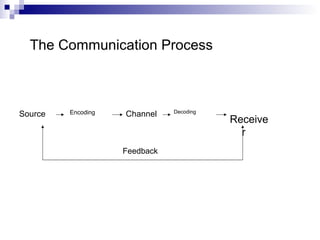
The Communication Process

Source

Encoding

Channel

Feedback

Decoding

Receive
r
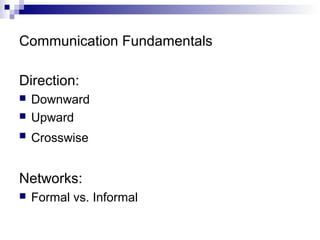
Communication Fundamentals
Direction:


Downward
Upward



Crosswise



Networks:


Formal vs. Informal
Communication Networks

Chain

Wheel

All Channels
Barriers to Effective Communication

Filtering
 Selective Perception
 Emotions
 Language

Key Communication Skills
Listening Skills
 Feedback Skills
 Presentation skills

Basic Communication Skills
Profile
________________________________________________
Communication Order Learned Extent Used Extent Taught

____________________________________________
Listening
Speaking
Reading
Writing

First
Second
Third
Fourth

First
Second
Third
Fourth

Fourth
Third
Second
First
Meaning







Listening Is With The Mind
Hearing With The Senses
Listening Is Conscious.
An Active Process Of Eliciting Information
Ideas, Attitudes And Emotions
Interpersonal, Oral Exchange
Fallacies about Listening






Listening is not my problem!
Listening and hearing are the same
Good readers are good listeners
Smarter people are better listeners
Listening improves with age



Learning not to listen
Thinking about what we are going to say rather than listening to a
speaker
Talking when we should be listening
Hearing what we expect to hear rather than what is actually said
Not paying attention
( preoccupation, prejudice, self-centeredness, stero-type)









Listening skills are difficult to learn
Stages of the Listening Process








Hearing
Focusing on the message
Comprehending and interpreting
Analyzing and Evaluating
Responding
Remembering
Barriers to Active Listening









Environmental barriers
Physiological barriers
Psychological barriers
Selective Listening
Negative Listening Attitudes
Personal Reactions
Poor Motivation
How to Be an Effective Listener


What You Think about Listening ?



Understand the complexities of listening
Prepare to listen
Adjust to the situation
Focus on ideas or key points
Capitalize on the speed differential







Organize material for learning
How to Be an Effective Listener
(cont.)


What You Feel about Listening ?



Want to listen
Delay judgment
Admit your biases
Don’t tune out “dry” subjects
Accept responsibility for understanding
Encourage others to talk






How to Be an Effective Listener
(cont.)


What You Do about Listening ?



Establish eye contact with the speaker
Take notes effectively
Be a physically involved listener
Avoid negative mannerisms
Exercise your listening muscles
Follow the Golden Rule






Feedback Skills






Positive vs. Negative Feedback
Positive feedback is more readily and accurately
perceived than negative feedback
Positive feedback fits what most people wish to hear and
already believe about themselves
Negative feedback is most likely to be accepted when it
comes from a credible source if it is objective in form
Subjective impressions carry weight only when they
come from a person with high status and credibility
Developing Effective Feedback Skills








Focus on specific behaviours
Keep feedback impersonal
Keep feedback goal oriented
Make feedback well timed
Ensure understanding
Direct feedback toward behaviour that is
controllable by the recipient
Group Think



Phenomena in which the norm for
consensus overrides the realistic appraisal
of alternative course of action
Presentation Skills
Ideas, concepts or issues talked about or spoken
to a group or audience
Public speaking is one of the most feared things
“I could make such a fool of myself”
Skills required to give a good presentation can be
developed

Preparation is the Key
Presentation Skills


Preparation/ Planning is the first step on the ladder
to success



Aspects in the development of a good presentation
Self Centered (Self)
Audience Centered (Audience)
Subject Centered (Material)





“I want (who) to (what) (where, when and how)
because (why)”
Presentation Skills


Helpers

What do you want to present (content)?
Why do you want to present (purpose)?
Where will you be presenting (place)?
How do you want to present (words to be used or
not, slides to be used)
Who is your audience?
Presentation Skills


Preparation: Audience Analysis

What is the audience interested in
 What does the audience want
 What does the audience already know and needs
to know
 What are their needs, expectations from this
presentation
 How will the audience benefit from this
presentation

Presentation Skills
Structure the content in line with the
audience’s needs
 What do you want to tell the audience?
 What is your objective?
 Prepare keeping in mind the time allotted
 Anticipate the questions and prepare
 Collect material from a variety of sources
 Arrange points logically and sequentially
 Prepare handouts as well

Presentation Skills
Structuring the presentation
2 to 2.5 mins--- opening/beginning
20 to 21 mins--- middle section
2 to 3 mins --- closing/end
5 mins --- questions

Presentation Skills
The Begining
 Should be carefully designed
 Get attention
- shock, humour, question, story, facts
&figures
- well rehearsed yet natural
 Motivate audience to listen
- listen to their needs
Presentation Skills
Preparation – Structure
 Sequence should be logical &
understandable
 Interim summaries- Recaps
 Value of visual aids-flip charts, handouts etc.
Presentation Skills
Prepare Closing
 Last 2 to 2.5 minutes are as critical as the
first five minutes for a successful
presentation
 Summarize- highlight important points
 Suggest action- what to do and when, where
and how to do it
Presentation Skills
Stage Fright
 Everyone has it to some degree
 Can be used constructively
 Key issue is not elimination of fear
Instead channel the energy it generates for
an effective presentation
Presentation Skills
Effective Delivery
 Be active - move
 Be purposeful - controlled gestures
 Variations – vocal (pitch, volume, rate)
 Be natural
 Be direct – don’t just talk in front of the
audience talk to them
Group Facilitation
Verbal Communication- barriers
 Speaking too fast
 Using jargon
 Tone and content
 Complicated or ambiguous language
 Not questioning
 Physical State of the audience
Presentation Skills
Sensitivity to the audience
 “see”

the audience
 Take non-verbal feedback
-congruent and incongruent body language
 Modify to meet audience needs
 Don’t just make it as a presentation
Presentation Skills
Handling Questions
 Do

not get confused
 You are not supposed to know everything
 Anticipate and keep answers ready
 Sometime questions themselves give you a
lead to highlight your point of view
Presentation Skills
Visual Aids
 While using a over head projector face the
audience while talking
 Point with a pen
 Appropriate lighting
 Watch the colours
 Ensure clear visibility
 10 lines, 10 words per line
Presentation Skills
So to conclude :
Always prepare
Channelize you fear
Interact with your audience

Effective communication

  • 1.
  • 2.
    Overview Functions of Communication The Communication Process  Communication Fundamentals  Key Communication Skills 
  • 3.
    Functions of Communication Control Motivation  Emotional Expression  Information 
  • 4.
  • 5.
  • 6.
  • 7.
    Barriers to EffectiveCommunication Filtering  Selective Perception  Emotions  Language 
  • 8.
    Key Communication Skills ListeningSkills  Feedback Skills  Presentation skills 
  • 9.
    Basic Communication Skills Profile ________________________________________________ CommunicationOrder Learned Extent Used Extent Taught ____________________________________________ Listening Speaking Reading Writing First Second Third Fourth First Second Third Fourth Fourth Third Second First
  • 10.
    Meaning       Listening Is WithThe Mind Hearing With The Senses Listening Is Conscious. An Active Process Of Eliciting Information Ideas, Attitudes And Emotions Interpersonal, Oral Exchange
  • 11.
    Fallacies about Listening      Listeningis not my problem! Listening and hearing are the same Good readers are good listeners Smarter people are better listeners Listening improves with age  Learning not to listen Thinking about what we are going to say rather than listening to a speaker Talking when we should be listening Hearing what we expect to hear rather than what is actually said Not paying attention ( preoccupation, prejudice, self-centeredness, stero-type)      Listening skills are difficult to learn
  • 12.
    Stages of theListening Process       Hearing Focusing on the message Comprehending and interpreting Analyzing and Evaluating Responding Remembering
  • 13.
    Barriers to ActiveListening        Environmental barriers Physiological barriers Psychological barriers Selective Listening Negative Listening Attitudes Personal Reactions Poor Motivation
  • 14.
    How to Bean Effective Listener  What You Think about Listening ?  Understand the complexities of listening Prepare to listen Adjust to the situation Focus on ideas or key points Capitalize on the speed differential      Organize material for learning
  • 15.
    How to Bean Effective Listener (cont.)  What You Feel about Listening ?  Want to listen Delay judgment Admit your biases Don’t tune out “dry” subjects Accept responsibility for understanding Encourage others to talk     
  • 16.
    How to Bean Effective Listener (cont.)  What You Do about Listening ?  Establish eye contact with the speaker Take notes effectively Be a physically involved listener Avoid negative mannerisms Exercise your listening muscles Follow the Golden Rule     
  • 17.
    Feedback Skills      Positive vs.Negative Feedback Positive feedback is more readily and accurately perceived than negative feedback Positive feedback fits what most people wish to hear and already believe about themselves Negative feedback is most likely to be accepted when it comes from a credible source if it is objective in form Subjective impressions carry weight only when they come from a person with high status and credibility
  • 18.
    Developing Effective FeedbackSkills       Focus on specific behaviours Keep feedback impersonal Keep feedback goal oriented Make feedback well timed Ensure understanding Direct feedback toward behaviour that is controllable by the recipient
  • 19.
    Group Think  Phenomena inwhich the norm for consensus overrides the realistic appraisal of alternative course of action
  • 20.
    Presentation Skills Ideas, conceptsor issues talked about or spoken to a group or audience Public speaking is one of the most feared things “I could make such a fool of myself” Skills required to give a good presentation can be developed Preparation is the Key
  • 21.
    Presentation Skills  Preparation/ Planningis the first step on the ladder to success  Aspects in the development of a good presentation Self Centered (Self) Audience Centered (Audience) Subject Centered (Material)    “I want (who) to (what) (where, when and how) because (why)”
  • 22.
    Presentation Skills  Helpers What doyou want to present (content)? Why do you want to present (purpose)? Where will you be presenting (place)? How do you want to present (words to be used or not, slides to be used) Who is your audience?
  • 23.
    Presentation Skills  Preparation: AudienceAnalysis What is the audience interested in  What does the audience want  What does the audience already know and needs to know  What are their needs, expectations from this presentation  How will the audience benefit from this presentation 
  • 24.
    Presentation Skills Structure thecontent in line with the audience’s needs  What do you want to tell the audience?  What is your objective?  Prepare keeping in mind the time allotted  Anticipate the questions and prepare  Collect material from a variety of sources  Arrange points logically and sequentially  Prepare handouts as well 
  • 25.
    Presentation Skills Structuring thepresentation 2 to 2.5 mins--- opening/beginning 20 to 21 mins--- middle section 2 to 3 mins --- closing/end 5 mins --- questions 
  • 26.
    Presentation Skills The Begining Should be carefully designed  Get attention - shock, humour, question, story, facts &figures - well rehearsed yet natural  Motivate audience to listen - listen to their needs
  • 27.
    Presentation Skills Preparation –Structure  Sequence should be logical & understandable  Interim summaries- Recaps  Value of visual aids-flip charts, handouts etc.
  • 28.
    Presentation Skills Prepare Closing Last 2 to 2.5 minutes are as critical as the first five minutes for a successful presentation  Summarize- highlight important points  Suggest action- what to do and when, where and how to do it
  • 29.
    Presentation Skills Stage Fright Everyone has it to some degree  Can be used constructively  Key issue is not elimination of fear Instead channel the energy it generates for an effective presentation
  • 30.
    Presentation Skills Effective Delivery Be active - move  Be purposeful - controlled gestures  Variations – vocal (pitch, volume, rate)  Be natural  Be direct – don’t just talk in front of the audience talk to them
  • 31.
    Group Facilitation Verbal Communication-barriers  Speaking too fast  Using jargon  Tone and content  Complicated or ambiguous language  Not questioning  Physical State of the audience
  • 32.
    Presentation Skills Sensitivity tothe audience  “see” the audience  Take non-verbal feedback -congruent and incongruent body language  Modify to meet audience needs  Don’t just make it as a presentation
  • 33.
    Presentation Skills Handling Questions Do not get confused  You are not supposed to know everything  Anticipate and keep answers ready  Sometime questions themselves give you a lead to highlight your point of view
  • 34.
    Presentation Skills Visual Aids While using a over head projector face the audience while talking  Point with a pen  Appropriate lighting  Watch the colours  Ensure clear visibility  10 lines, 10 words per line
  • 35.
    Presentation Skills So toconclude : Always prepare Channelize you fear Interact with your audience

Editor's Notes

  • #22 Presentation is like an iceberg, the delivery is only a tip. The major chunk is the time and effort spent in planning and preparing for the presentation.