Objectives
 To consider verbal and non-verbal
Communication methods
 To understand and practise effective listening
skills
 To communicate in clear, respectful and non-
judgemental ways
 To know when to seek advice
Cultural Diversity
 What do we know about the communication
styles of different cultures?
 Consider verbal and non verbal, including dress
constraints, language difficulties, taboos.
Why do we need a high level of Communication?
• Communication is a hugely important aspect of
the Client-Relationship.
• Effective communication skills are a critical
element in our career and personal lives.
• So how exactly do we communicate? Clearly
with such a range of different clients, there is no
"one size fits all" communication approach.
Some clients want lots of communication. Some
want very little.
• We all must use a variety of communication
techniques to both understand and be
understood
Why is communication important
 Inspires confidence
 Builds respect in business and social life
 Helps make friends
 Develops a distinct personality
 Reveals your ability to others
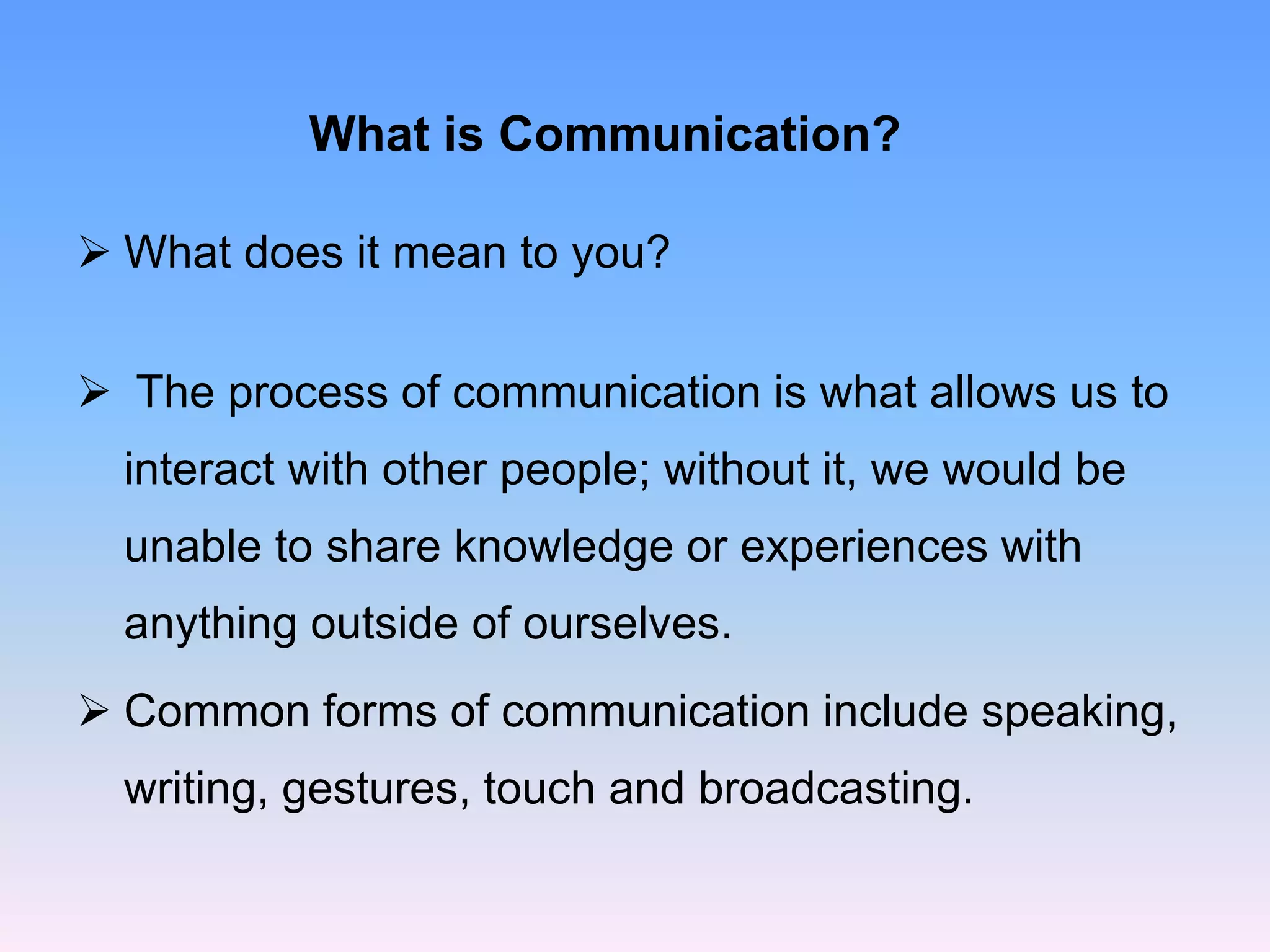
What is Communication?
 What does it mean to you?
 The process of communication is what allows us to
interact with other people; without it, we would be
unable to share knowledge or experiences with
anything outside of ourselves.
 Common forms of communication include speaking,
writing, gestures, touch and broadcasting.
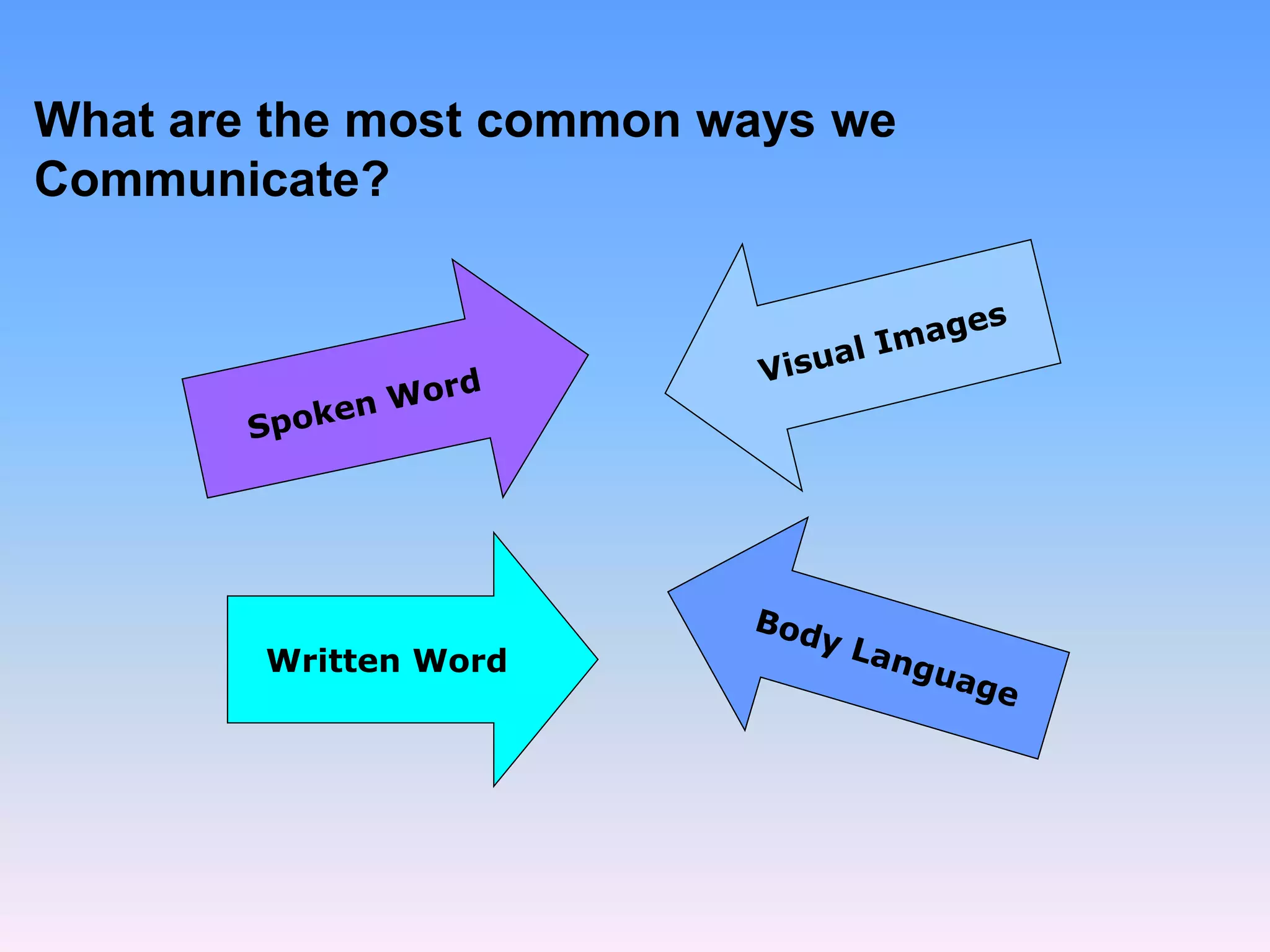
What are the most common ways we
Communicate?
Written Word
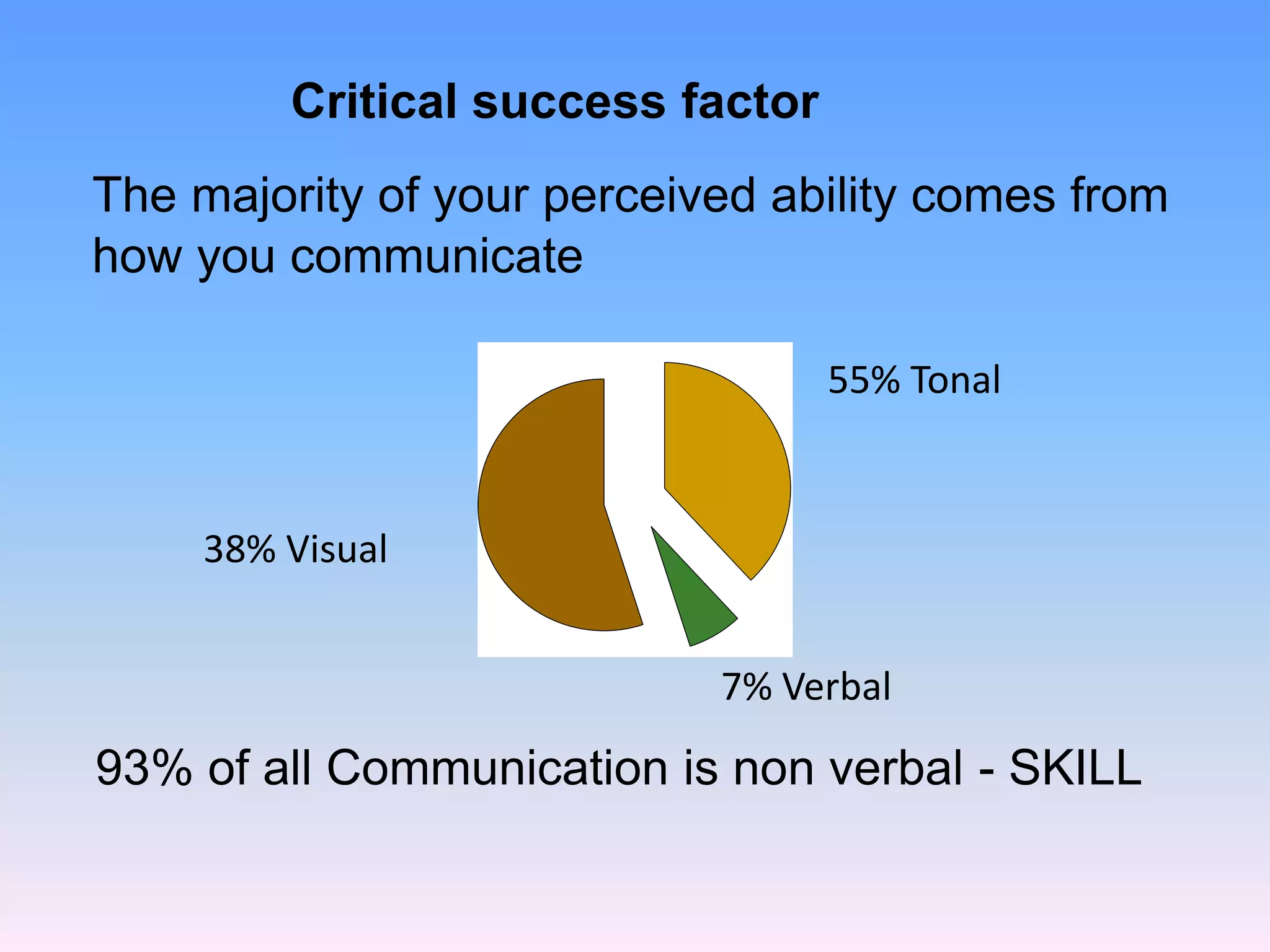
Critical success factor
The majority of your perceived ability comes from
how you communicate
38% Visual
55% Tonal
7% Verbal
93% of all Communication is non verbal - SKILL
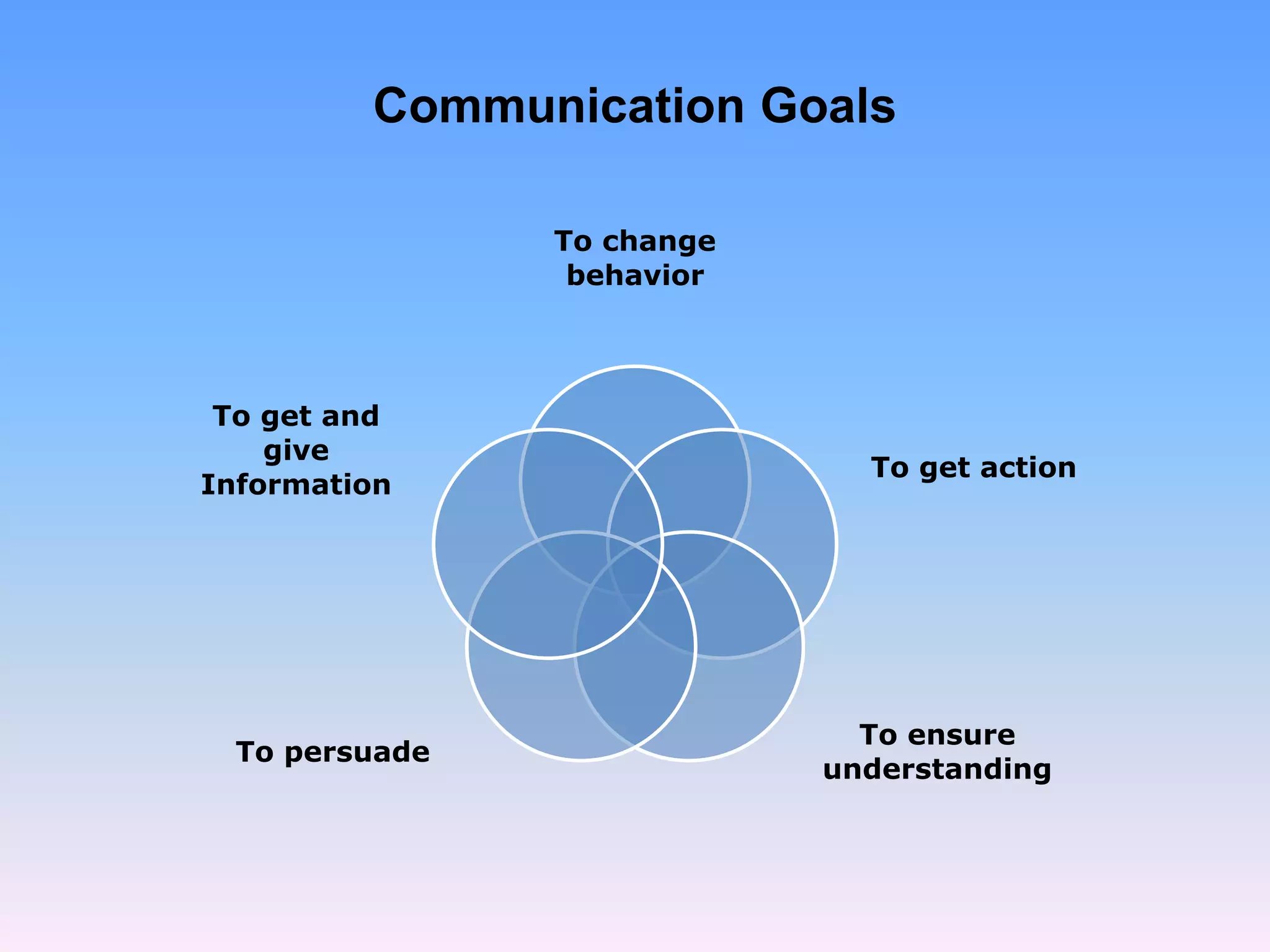
Communication Goals
To change
behavior
To get action
To ensure
understanding
To persuade
To get and
give
Information
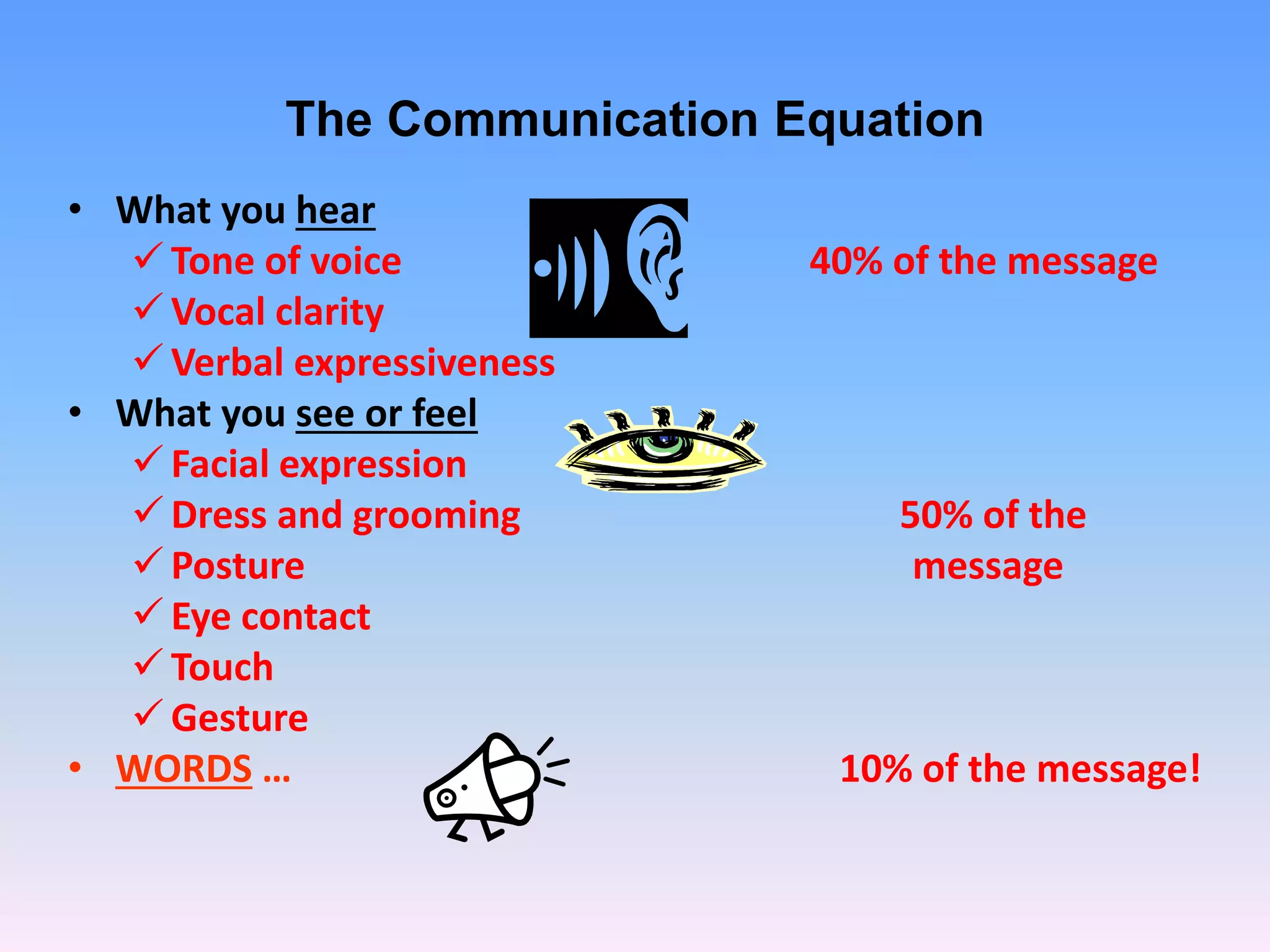
The Communication Equation
• What you hear
 Tone of voice 40% of the message
 Vocal clarity
 Verbal expressiveness
• What you see or feel
 Facial expression
 Dress and grooming 50% of the
 Posture message
 Eye contact
 Touch
 Gesture
• WORDS … 10% of the message!
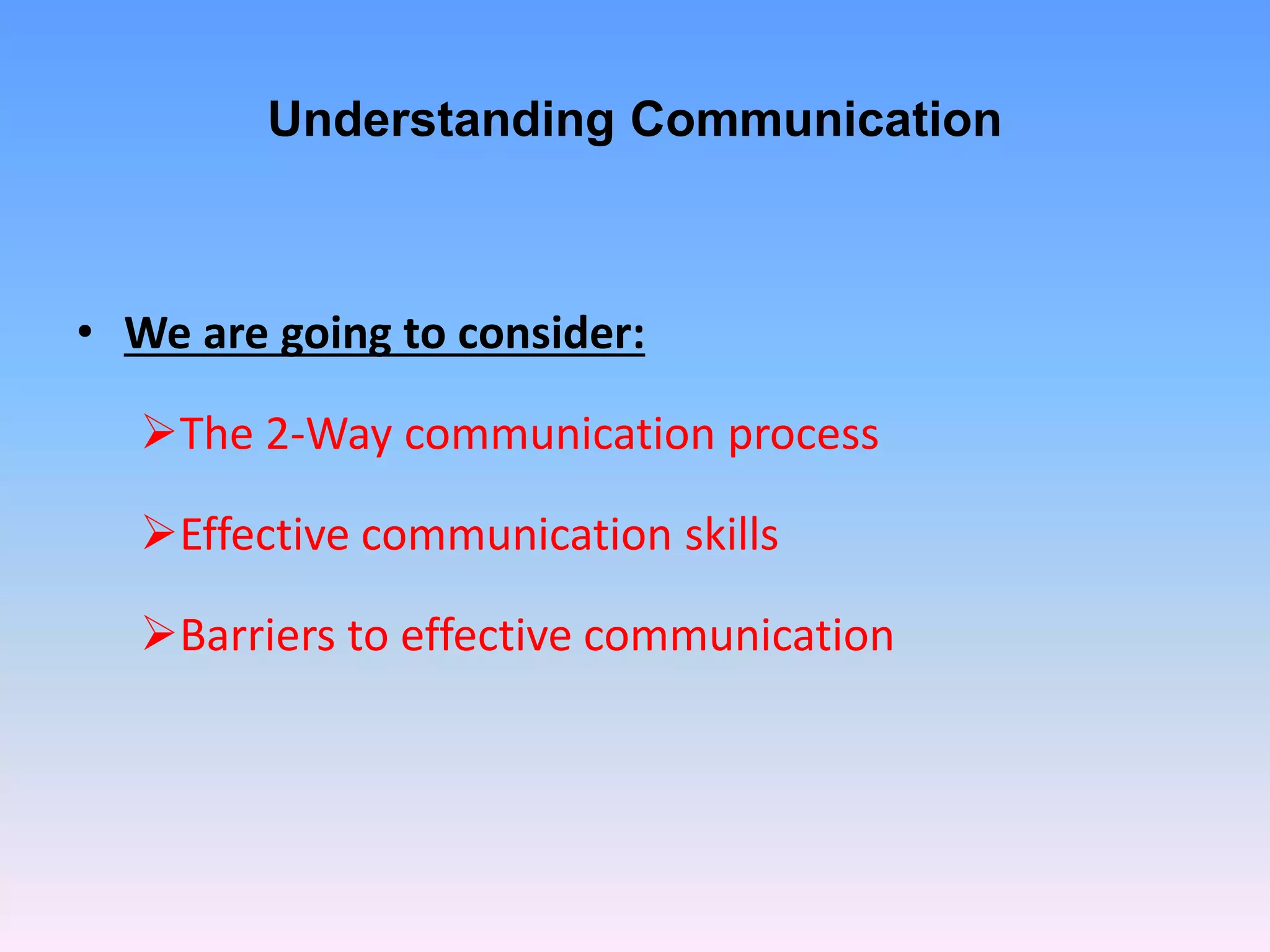
Understanding Communication
• We are going to consider:
The 2-Way communication process
Effective communication skills
Barriers to effective communication
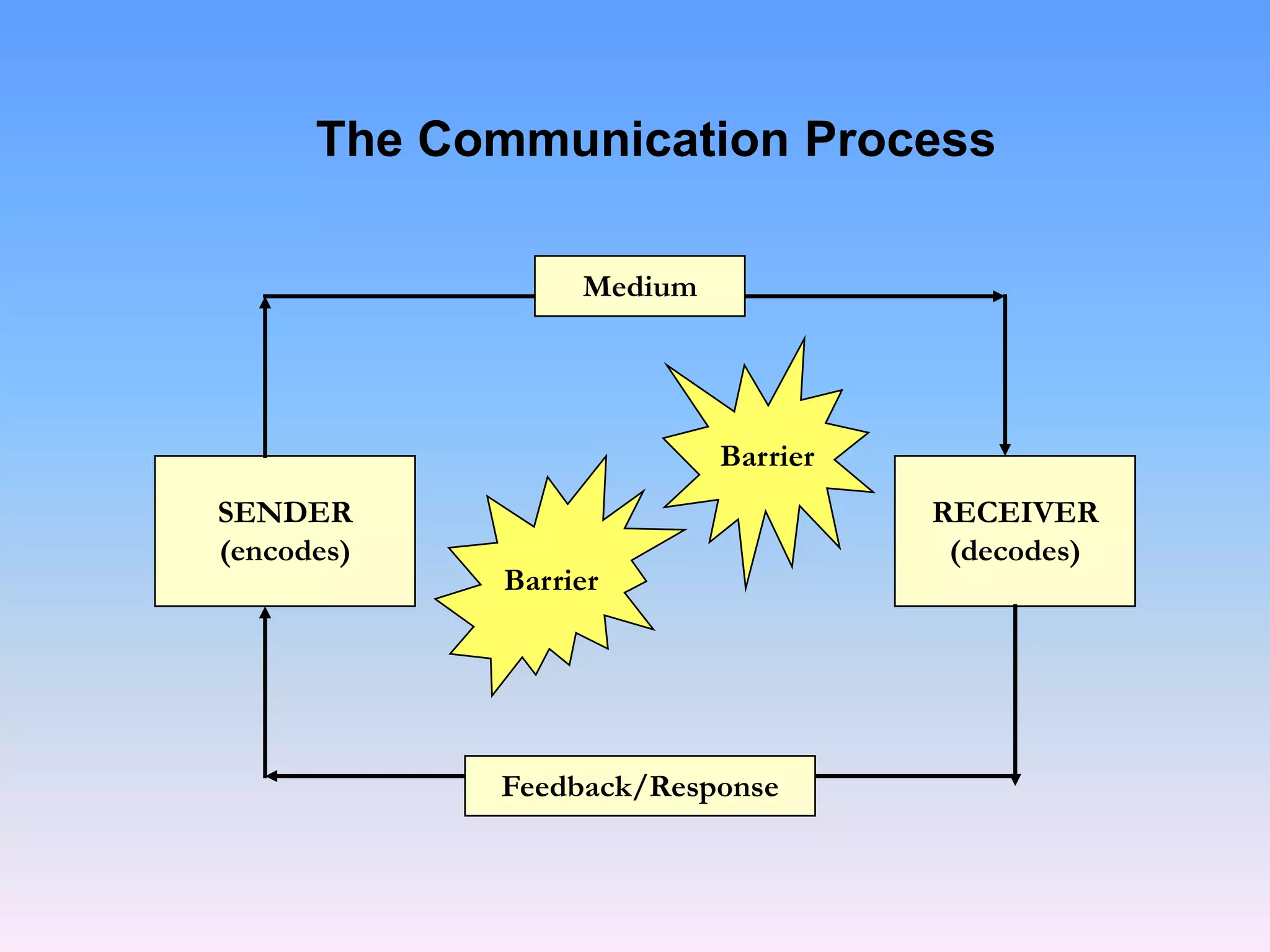
The Communication Process
SENDER
(encodes)
RECEIVER
(decodes)
Barrier
Barrier
Medium
Feedback/Response
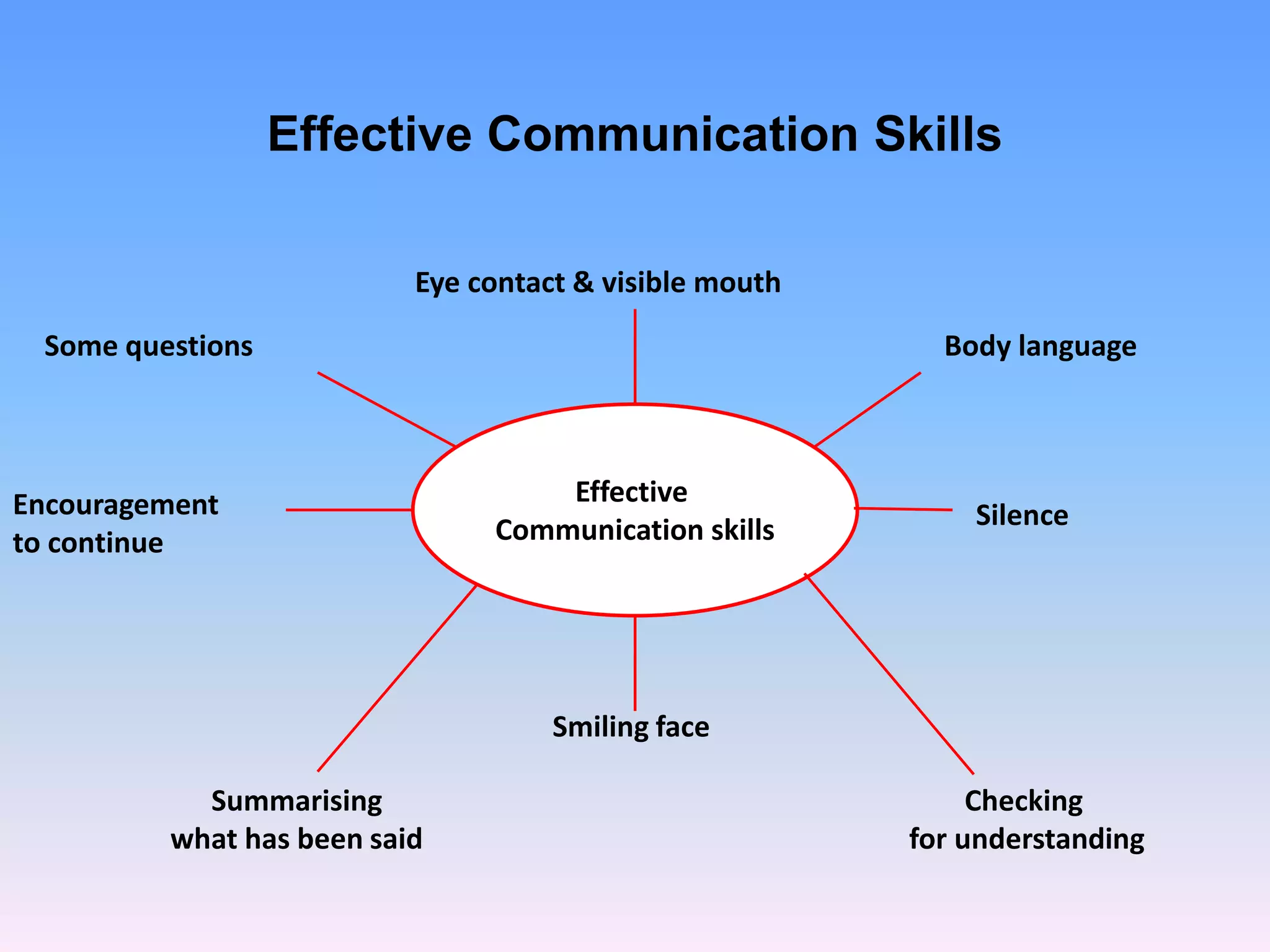
Effective Communication Skills
Effective
Communication skills
Eye contact & visible mouth
Body language
Silence
Checking
for understanding
Smiling face
Summarising
what has been said
Encouragement
to continue
Some questions
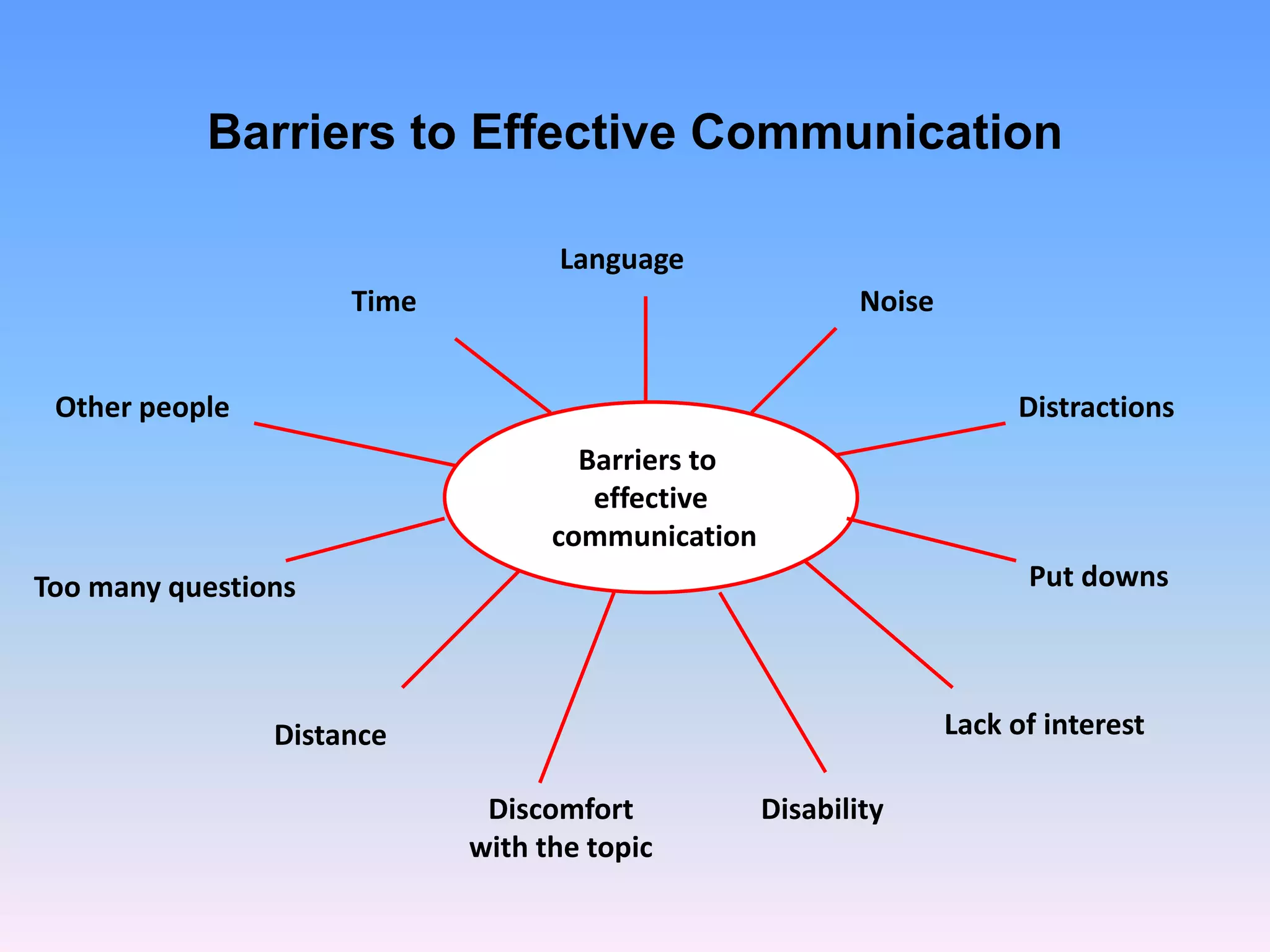
Barriers to Effective Communication
Barriers to
effective
communication
Language
NoiseTime
DistractionsOther people
Put downsToo many questions
Distance
Discomfort
with the topic
Disability
Lack of interest
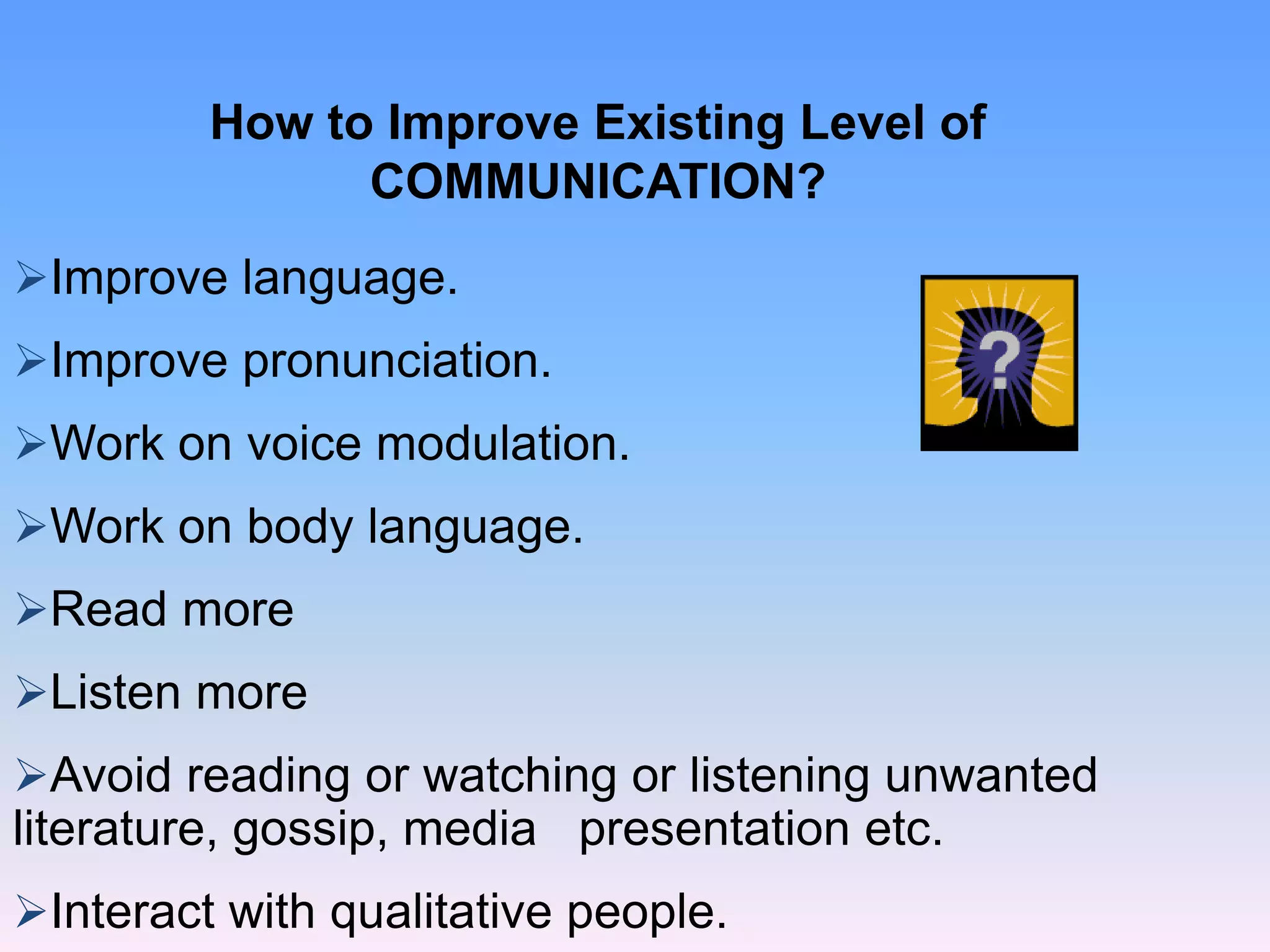
How to Improve Existing Level of
COMMUNICATION?
Improve language.
Improve pronunciation.
Work on voice modulation.
Work on body language.
Read more
Listen more
Avoid reading or watching or listening unwanted
literature, gossip, media presentation etc.
Interact with qualitative people.
The Art of Listening
• “If we were supposed to talk more than listen,
we would have been given two mouths and one
ear.”
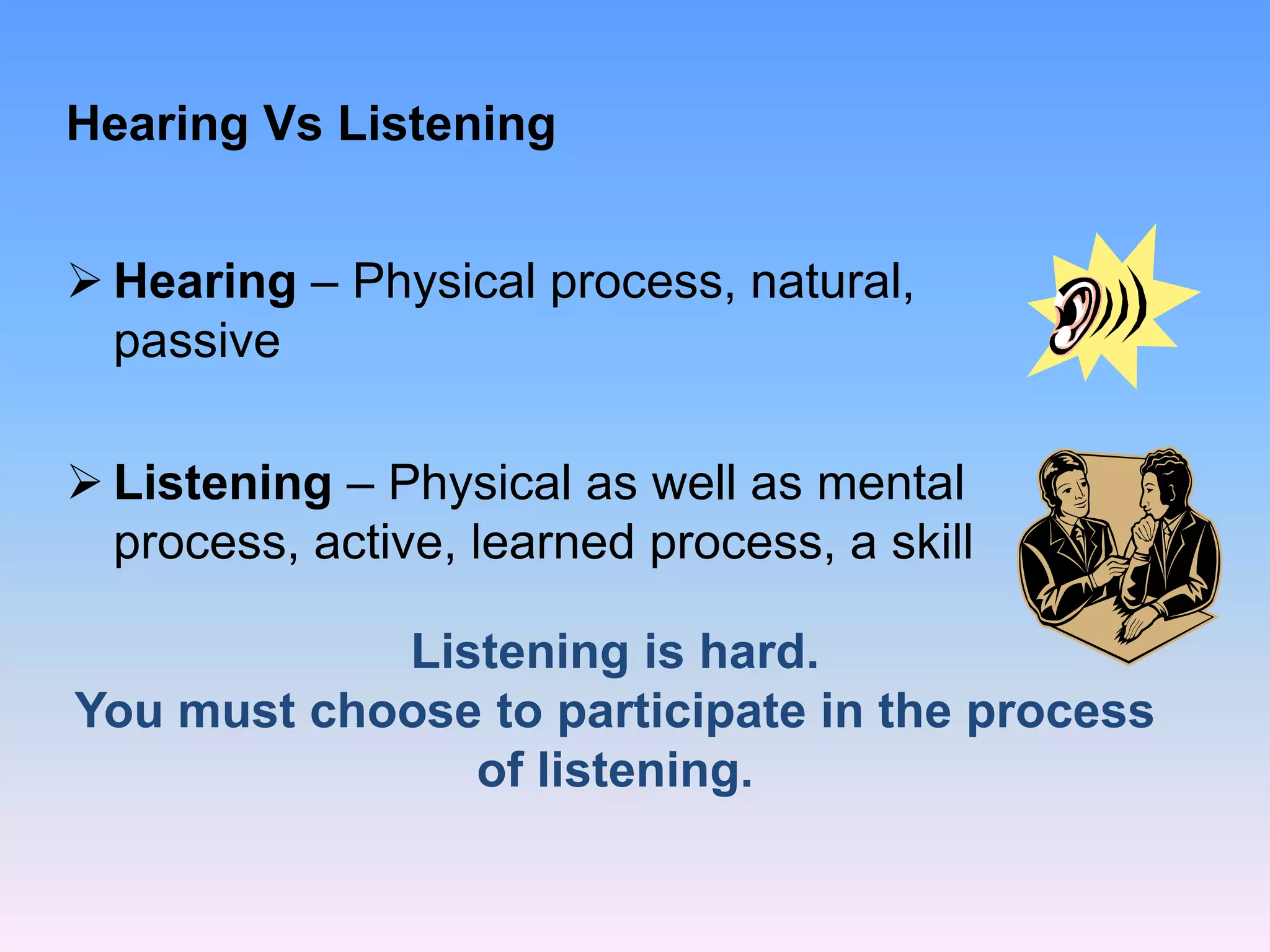
Hearing Vs Listening
 Hearing – Physical process, natural,
passive
 Listening – Physical as well as mental
process, active, learned process, a skill
Listening is hard.
You must choose to participate in the process
of listening.
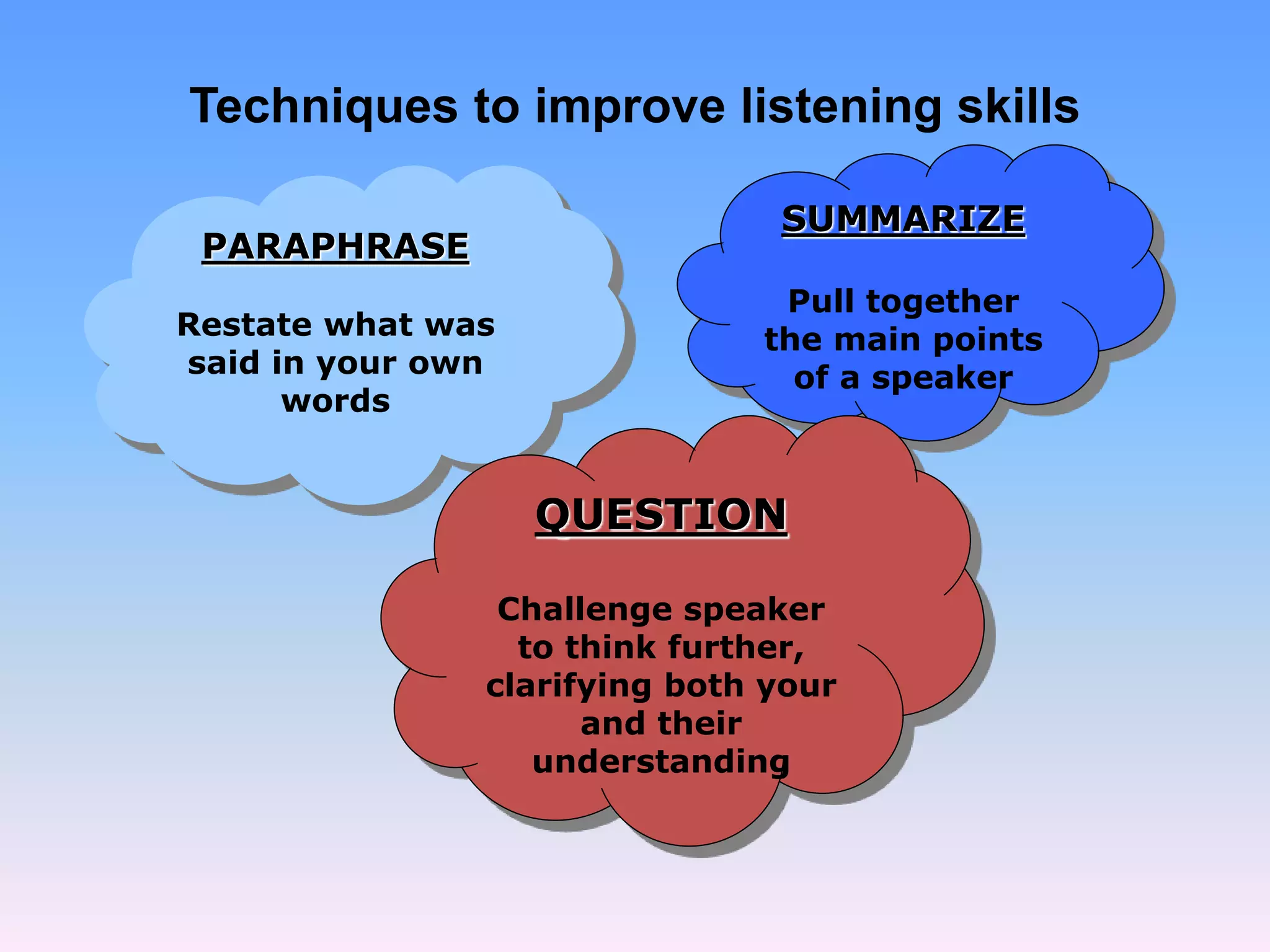
Techniques to improve listening skills
PARAPHRASE
Restate what was
said in your own
words
SUMMARIZE
Pull together
the main points
of a speaker
QUESTION
Challenge speaker
to think further,
clarifying both your
and their
understanding
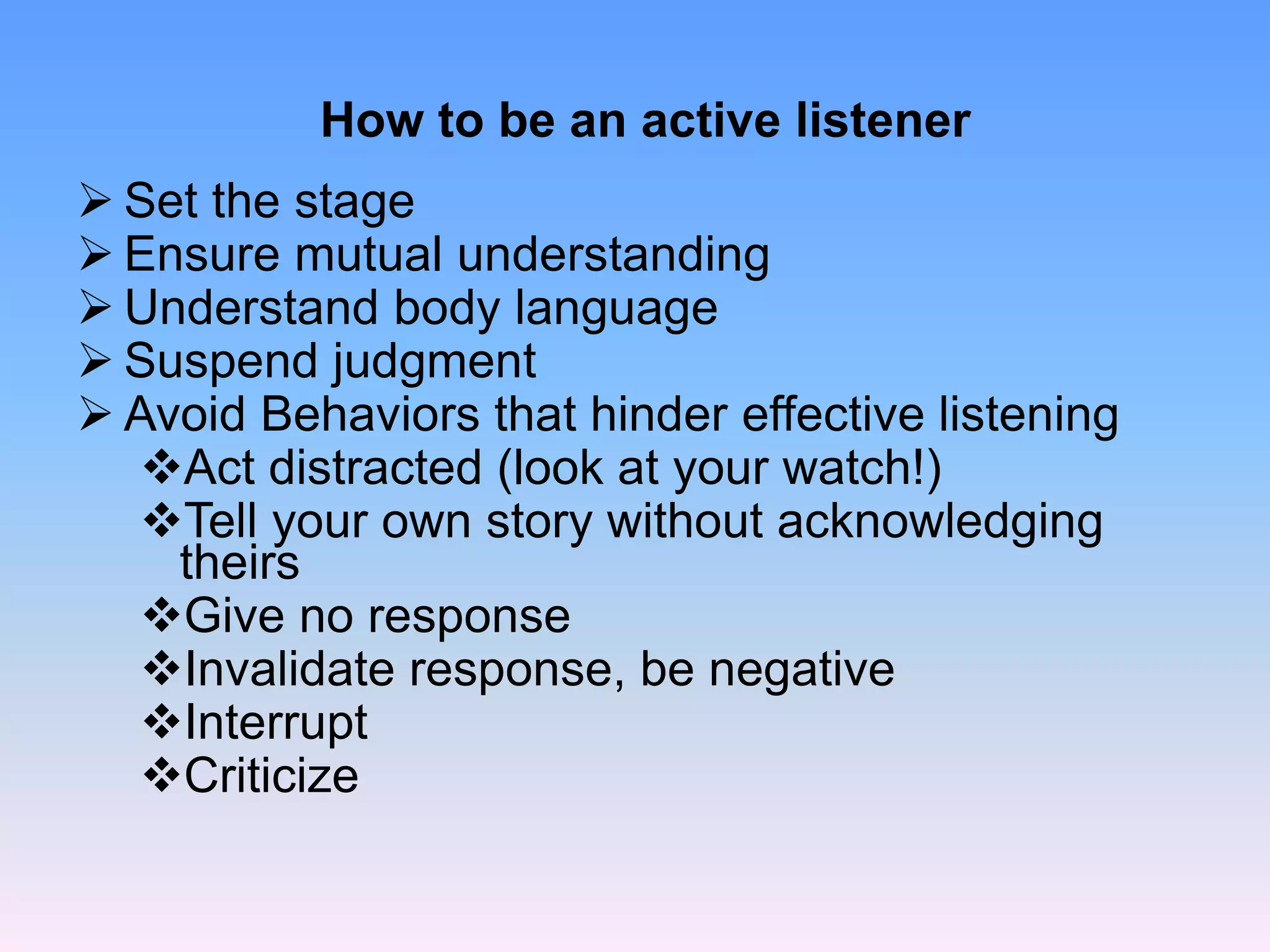
How to be an active listener
 Set the stage
 Ensure mutual understanding
 Understand body language
 Suspend judgment
 Avoid Behaviors that hinder effective listening
Act distracted (look at your watch!)
Tell your own story without acknowledging
theirs
Give no response
Invalidate response, be negative
Interrupt
Criticize
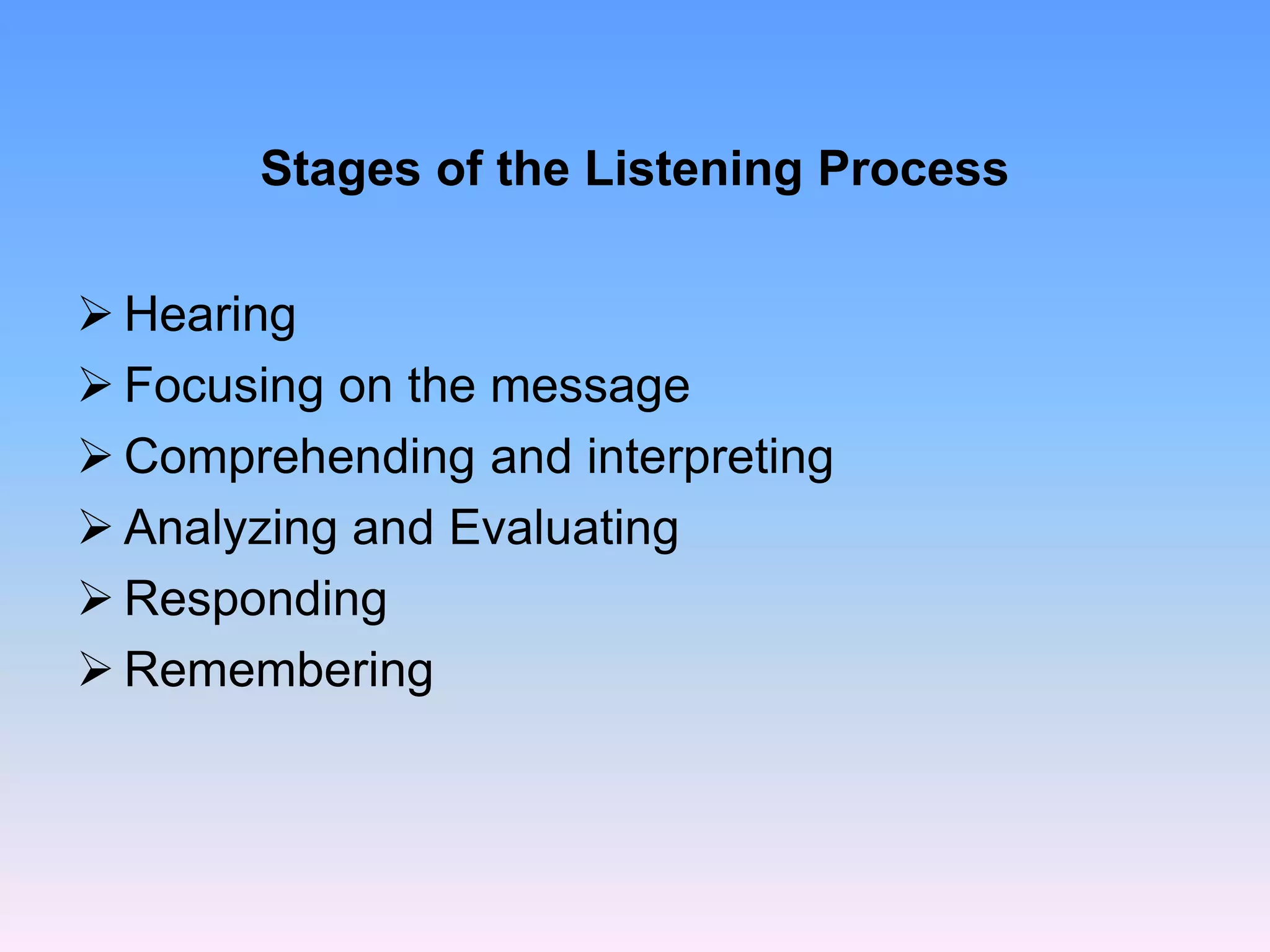
Stages of the Listening Process
 Hearing
 Focusing on the message
 Comprehending and interpreting
 Analyzing and Evaluating
 Responding
 Remembering
Responding
 Responses to check that your perceptions are
correct
 Responses to encourage further communication
 Always think ahead about what you are going to say.
 Use simple words and phrases that are understood by
every body.
 Increase your knowledge on all subjects you are
required to speak.
 Speak clearly and audibly.
 Check twice with the listener whether you have been
understood accurately or not
 In case of an interruption, always do a little recap of
what has been already said.
Essentials of communication dos
 Always pay undivided attention to the speaker while
listening.
 While listening, always make notes of important
points.
 Always ask for clarification if you have failed to grasp
other’s point of view.
 Repeat what the speaker has said to check whether
you have understood accurately.
Essentials of communication dos
Essentials of communication don’ts
Do not instantly react and mutter something in
anger.
Do not use technical terms & terminologies not
understood by majority of people.
Do not speak too fast or too slow.
Do not speak in inaudible surroundings, as you
won’t be heard.
Essentials of communication don’ts
Do not assume that every body understands you.
While listening do not glance here and there as it
might distract the speaker.
Do not interrupt the speaker.
Do not jump to the conclusion that you have
understood every thing.
Improve on you topic of discussion,
Practice meditation & good thoughts.
Think and speak.
Do not speak too fast.
Use simple vocabulary.
Do not speak only to impress someone.
Look presentable and confident.
How to Improve Existing Level of
COMMUNICATION?
Improving Body Language - Tips
 Keep appropriate distance
 Touch only when appropriate
 Take care of your appearance
 Maintain eye contact
 Smile genuinely
28
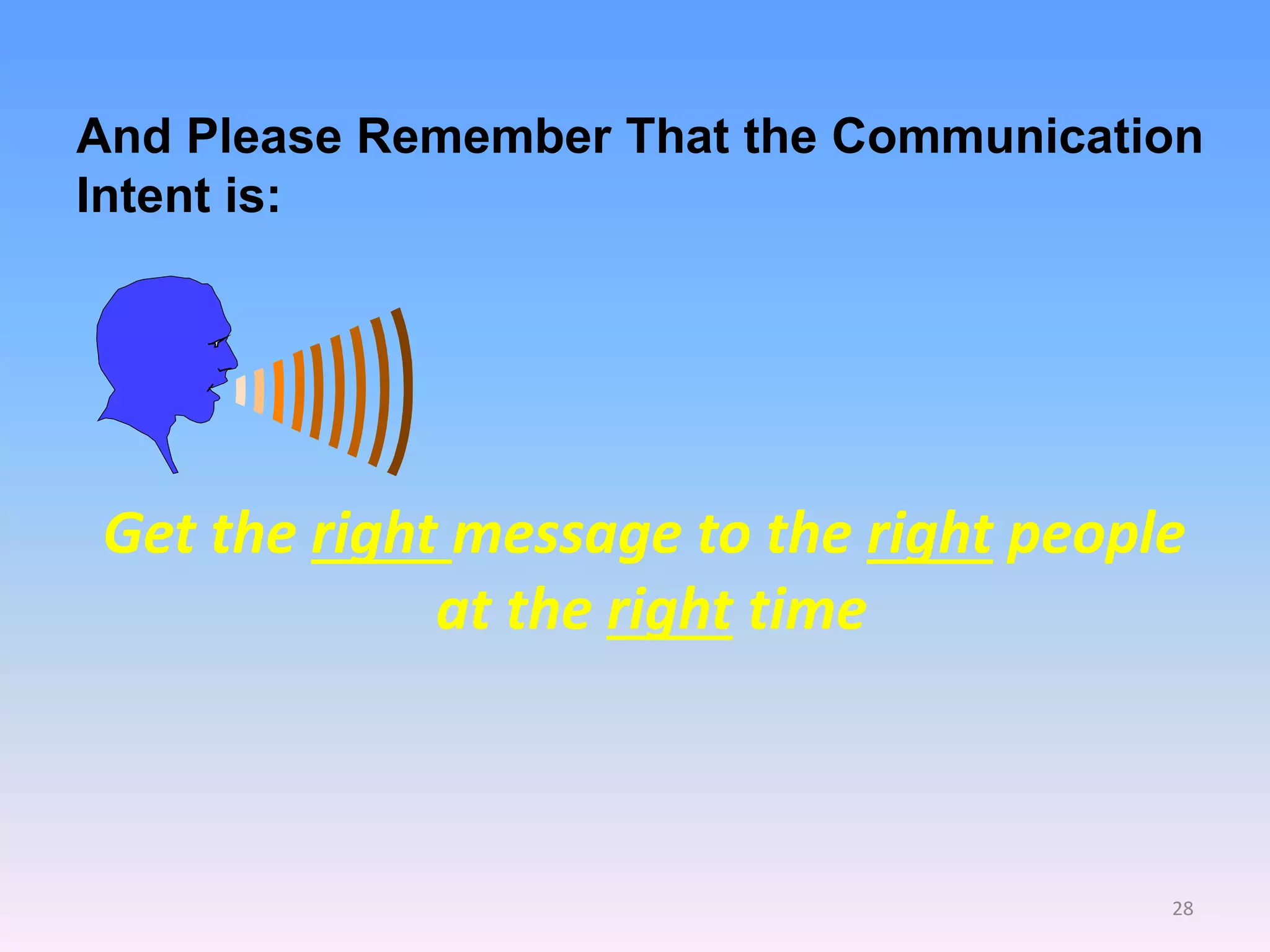
And Please Remember That the Communication
Intent is:
Get the right message to the right people
at the right time
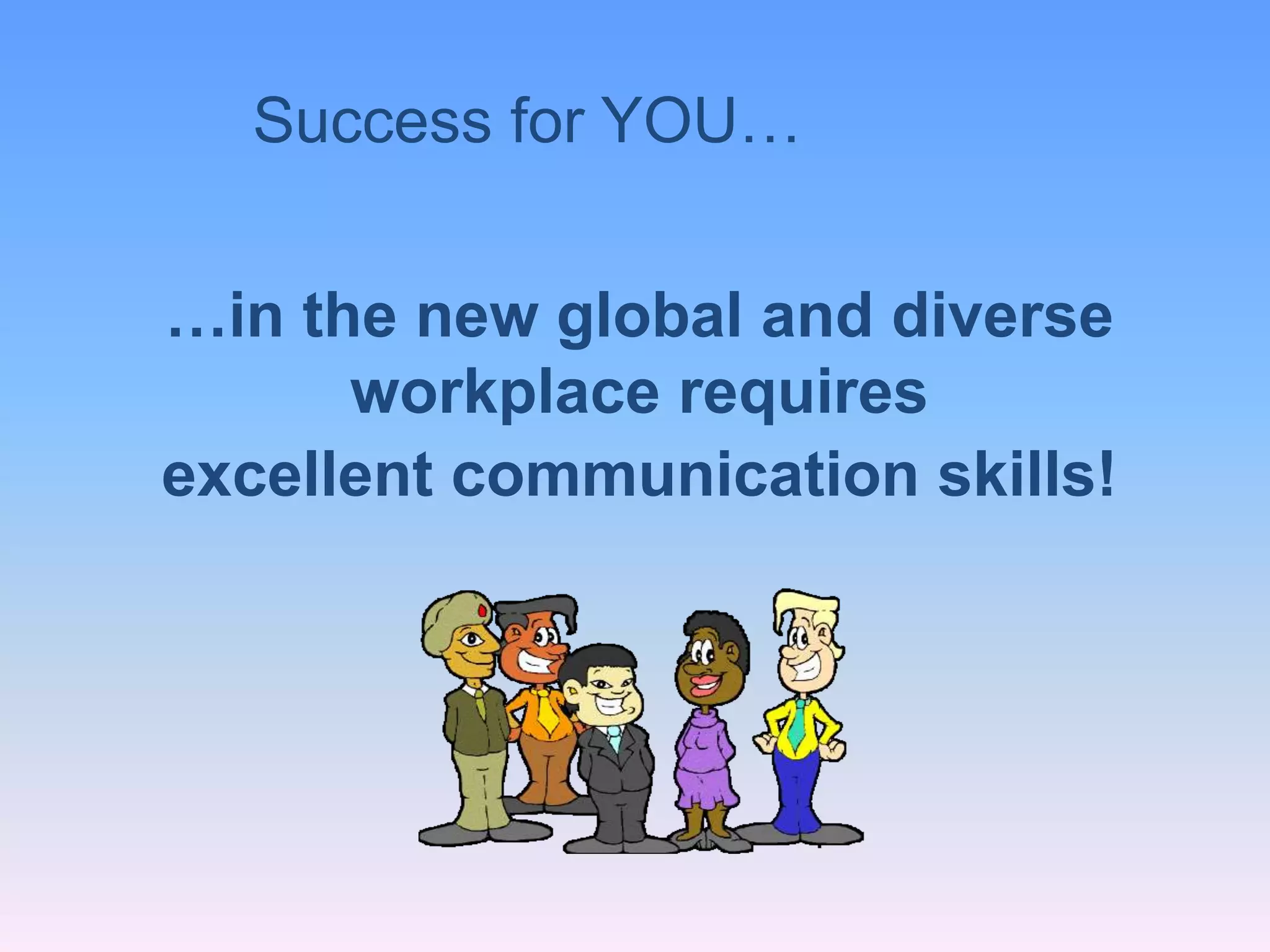
…in the new global and diverse
workplace requires
excellent communication skills!
Success for YOU…
Please feel free to ask any
questions
Malika Haddad

Communication Presentation

  • 2.
    Objectives  To considerverbal and non-verbal Communication methods  To understand and practise effective listening skills  To communicate in clear, respectful and non- judgemental ways  To know when to seek advice
  • 3.
    Cultural Diversity  Whatdo we know about the communication styles of different cultures?  Consider verbal and non verbal, including dress constraints, language difficulties, taboos.
  • 4.
    Why do weneed a high level of Communication? • Communication is a hugely important aspect of the Client-Relationship. • Effective communication skills are a critical element in our career and personal lives. • So how exactly do we communicate? Clearly with such a range of different clients, there is no "one size fits all" communication approach. Some clients want lots of communication. Some want very little. • We all must use a variety of communication techniques to both understand and be understood
  • 5.
    Why is communicationimportant  Inspires confidence  Builds respect in business and social life  Helps make friends  Develops a distinct personality  Reveals your ability to others
  • 6.
    What is Communication? What does it mean to you?  The process of communication is what allows us to interact with other people; without it, we would be unable to share knowledge or experiences with anything outside of ourselves.  Common forms of communication include speaking, writing, gestures, touch and broadcasting.
  • 7.
    What are themost common ways we Communicate? Written Word
  • 8.
    Critical success factor Themajority of your perceived ability comes from how you communicate 38% Visual 55% Tonal 7% Verbal 93% of all Communication is non verbal - SKILL
  • 9.
    Communication Goals To change behavior Toget action To ensure understanding To persuade To get and give Information
  • 10.
    The Communication Equation •What you hear  Tone of voice 40% of the message  Vocal clarity  Verbal expressiveness • What you see or feel  Facial expression  Dress and grooming 50% of the  Posture message  Eye contact  Touch  Gesture • WORDS … 10% of the message!
  • 11.
    Understanding Communication • Weare going to consider: The 2-Way communication process Effective communication skills Barriers to effective communication
  • 12.
  • 13.
    Effective Communication Skills Effective Communicationskills Eye contact & visible mouth Body language Silence Checking for understanding Smiling face Summarising what has been said Encouragement to continue Some questions
  • 14.
    Barriers to EffectiveCommunication Barriers to effective communication Language NoiseTime DistractionsOther people Put downsToo many questions Distance Discomfort with the topic Disability Lack of interest
  • 15.
    How to ImproveExisting Level of COMMUNICATION? Improve language. Improve pronunciation. Work on voice modulation. Work on body language. Read more Listen more Avoid reading or watching or listening unwanted literature, gossip, media presentation etc. Interact with qualitative people.
  • 16.
    The Art ofListening • “If we were supposed to talk more than listen, we would have been given two mouths and one ear.”
  • 17.
    Hearing Vs Listening Hearing – Physical process, natural, passive  Listening – Physical as well as mental process, active, learned process, a skill Listening is hard. You must choose to participate in the process of listening.
  • 18.
    Techniques to improvelistening skills PARAPHRASE Restate what was said in your own words SUMMARIZE Pull together the main points of a speaker QUESTION Challenge speaker to think further, clarifying both your and their understanding
  • 19.
    How to bean active listener  Set the stage  Ensure mutual understanding  Understand body language  Suspend judgment  Avoid Behaviors that hinder effective listening Act distracted (look at your watch!) Tell your own story without acknowledging theirs Give no response Invalidate response, be negative Interrupt Criticize
  • 20.
    Stages of theListening Process  Hearing  Focusing on the message  Comprehending and interpreting  Analyzing and Evaluating  Responding  Remembering
  • 21.
    Responding  Responses tocheck that your perceptions are correct  Responses to encourage further communication
  • 22.
     Always thinkahead about what you are going to say.  Use simple words and phrases that are understood by every body.  Increase your knowledge on all subjects you are required to speak.  Speak clearly and audibly.  Check twice with the listener whether you have been understood accurately or not  In case of an interruption, always do a little recap of what has been already said. Essentials of communication dos
  • 23.
     Always payundivided attention to the speaker while listening.  While listening, always make notes of important points.  Always ask for clarification if you have failed to grasp other’s point of view.  Repeat what the speaker has said to check whether you have understood accurately. Essentials of communication dos
  • 24.
    Essentials of communicationdon’ts Do not instantly react and mutter something in anger. Do not use technical terms & terminologies not understood by majority of people. Do not speak too fast or too slow. Do not speak in inaudible surroundings, as you won’t be heard.
  • 25.
    Essentials of communicationdon’ts Do not assume that every body understands you. While listening do not glance here and there as it might distract the speaker. Do not interrupt the speaker. Do not jump to the conclusion that you have understood every thing.
  • 26.
    Improve on youtopic of discussion, Practice meditation & good thoughts. Think and speak. Do not speak too fast. Use simple vocabulary. Do not speak only to impress someone. Look presentable and confident. How to Improve Existing Level of COMMUNICATION?
  • 27.
    Improving Body Language- Tips  Keep appropriate distance  Touch only when appropriate  Take care of your appearance  Maintain eye contact  Smile genuinely
  • 28.
    28 And Please RememberThat the Communication Intent is: Get the right message to the right people at the right time
  • 29.
    …in the newglobal and diverse workplace requires excellent communication skills! Success for YOU…
  • 30.
    Please feel freeto ask any questions
  • 31.