
Vasudevan Fifth discipline
1
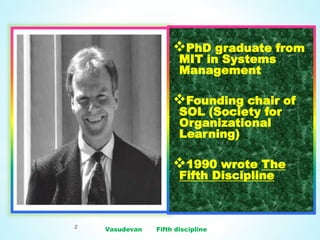
PhD graduate from
MIT in Systems
Management
Founding chair of
SOL (Society for
Organizational
Learning)
1990 wrote The
Fifth Discipline
2
Vasudevan Fifth discipline
3
Vasudevan Fifth discipline
Vasudevan Fifth discipline 4
*
Systems Thinking
Interdependency and change
Focus on whole not individual parts
Long-term goals vs. Short-term
benefits
Better appreciation of systems
leads to more appropriate action
Vasudevan Fifth discipline
5
Vasudevan Fifth discipline 6
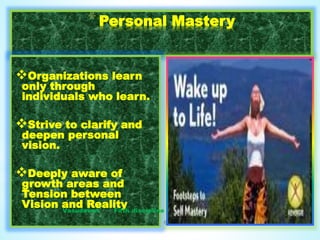
*Personal Mastery
Organizations learn
only through
individuals who learn.
Strive to clarify and
deepen personal
vision.
Deeply aware of
growth areas and
Tension between
Vision and Reality
Vasudevan Fifth discipline 7
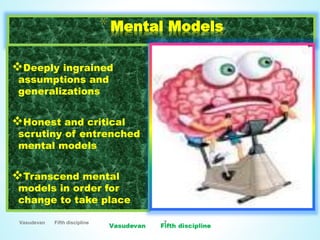
*Mental Models
Deeply ingrained
assumptions and
generalizations
Honest and critical
scrutiny of entrenched
mental models
Transcend mental
models in order for
change to take place
Vasudevan Fifth discipline 8
*Shared Vision
A genuine vision leads to
people wanting to excel and
learn
Leaders must translate
personal visions into shared
visions
Unearthing shared ‘pictures of
the future’ that foster genuine
commitment rather than
compliance
Leaders learn the counter-
productiveness of trying to
dictate a vision, no matter how
heartfelt.
(Senge 1990: 9)
Vasudevan Fifth discipline 9
*
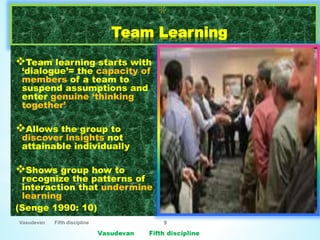
Team Learning
Team learning starts with
‘dialogue’= the capacity of
members of a team to
suspend assumptions and
enter genuine ‘thinking
together’
Allows the group to
discover insights not
attainable individually
Shows group how to
recognize the patterns of
interaction that undermine
learning
(Senge 1990: 10)
10
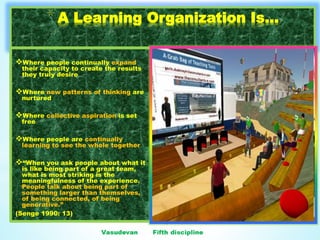
*A Learning Organization Is...
Where people continually expand
their capacity to create the results
they truly desire
Where new patterns of thinking are
nurtured
Where collective aspiration is set
free
Where people are continually
learning to see the whole together
“When you ask people about what it
is like being part of a great team,
what is most striking is the
meaningfulness of the experience.
People talk about being part of
something larger than themselves,
of being connected, of being
generative.”
(Senge 1990: 13)
Vasudevan Fifth discipline 11
*Senge Video Clip

Learning Organization

  • 1.
  • 2.
    PhD graduate from MITin Systems Management Founding chair of SOL (Society for Organizational Learning) 1990 wrote The Fifth Discipline 2 Vasudevan Fifth discipline
  • 3.
  • 4.
    Vasudevan Fifth discipline4 * Systems Thinking Interdependency and change Focus on whole not individual parts Long-term goals vs. Short-term benefits Better appreciation of systems leads to more appropriate action
  • 5.
  • 6.
    Vasudevan Fifth discipline6 *Personal Mastery Organizations learn only through individuals who learn. Strive to clarify and deepen personal vision. Deeply aware of growth areas and Tension between Vision and Reality
  • 7.
    Vasudevan Fifth discipline7 *Mental Models Deeply ingrained assumptions and generalizations Honest and critical scrutiny of entrenched mental models Transcend mental models in order for change to take place
  • 8.
    Vasudevan Fifth discipline8 *Shared Vision A genuine vision leads to people wanting to excel and learn Leaders must translate personal visions into shared visions Unearthing shared ‘pictures of the future’ that foster genuine commitment rather than compliance Leaders learn the counter- productiveness of trying to dictate a vision, no matter how heartfelt. (Senge 1990: 9)
  • 9.
    Vasudevan Fifth discipline9 * Team Learning Team learning starts with ‘dialogue’= the capacity of members of a team to suspend assumptions and enter genuine ‘thinking together’ Allows the group to discover insights not attainable individually Shows group how to recognize the patterns of interaction that undermine learning (Senge 1990: 10)
  • 10.
    10 *A Learning OrganizationIs... Where people continually expand their capacity to create the results they truly desire Where new patterns of thinking are nurtured Where collective aspiration is set free Where people are continually learning to see the whole together “When you ask people about what it is like being part of a great team, what is most striking is the meaningfulness of the experience. People talk about being part of something larger than themselves, of being connected, of being generative.” (Senge 1990: 13)
  • 11.
    Vasudevan Fifth discipline11 *Senge Video Clip