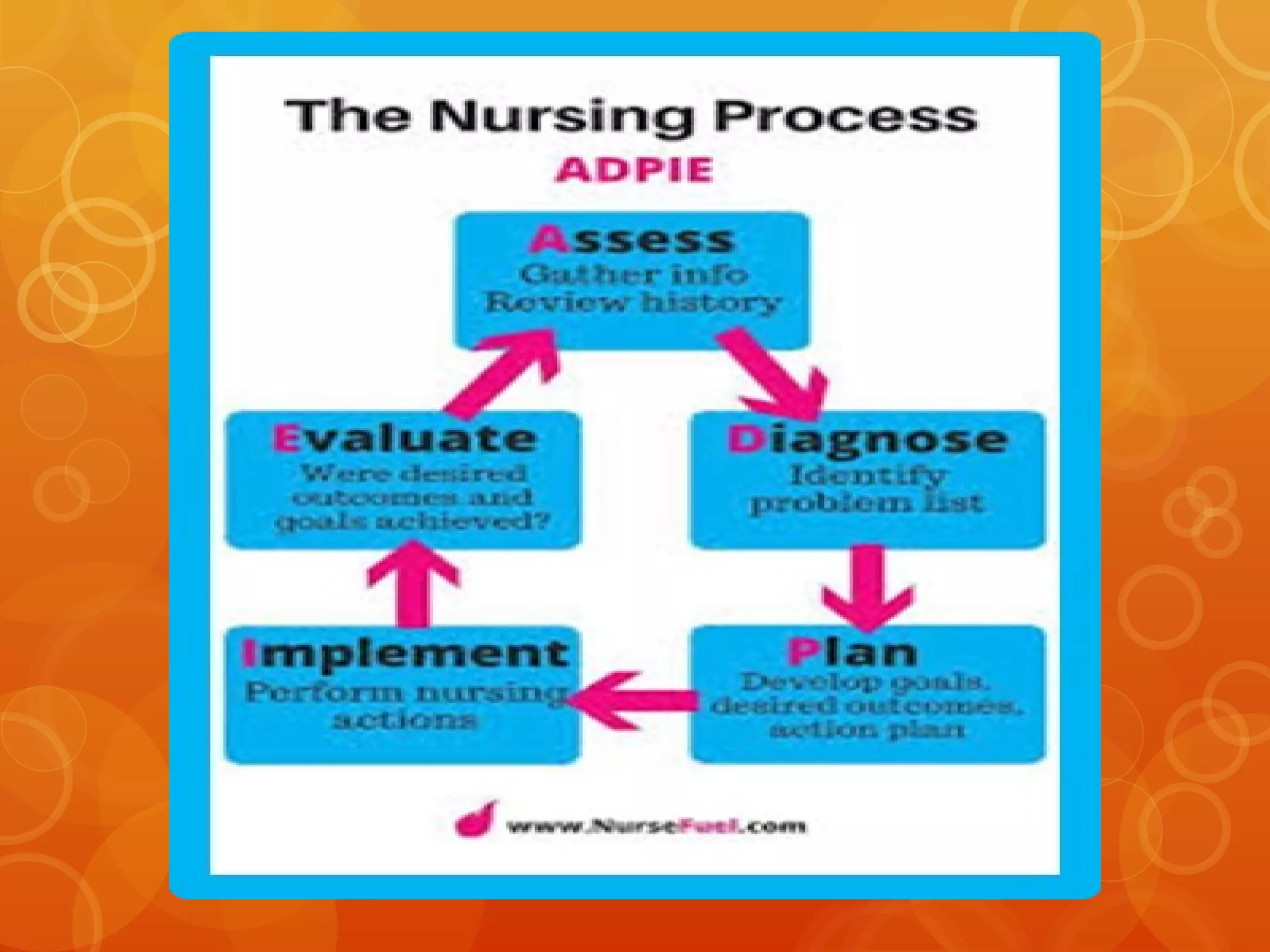
Nursing Process (Asses Diagnise Plan Implement
Evaluate)
Nursing Process
The Nursing Process is a framework that helps organize
and deliver nursing care.
It:
o Is orderly and systematic.
o Is central to all nursing care.
o Is used to identify, prevent and treat actual or potential health
o problems and promote wellness.
o Encompasses all steps taken by the nurse in caring for
o individuals, families, groups, and communities.
o Must be used by nurses
Nursing Process
Definition of the Nursing Process
o An organized sequence of problem solving
o steps used to identify and to manage the
o health problems of clients
o It is accepted for clinical practice
o established by the Nurses Association*
o *THE TRAINED NURSES' ASSOCIATION OF
INDIA (TNAI). ESTD.IN 1908. Registered under the
Societies Act XXI of 1860 in 1917.
Nursing Process
Benefits of Nursing Process
 Provides an orderly & systematic method for
 planning & providing care
 Enhances nursing efficiency by standardizing
 nursing practice
 Facilitates documentation of care
 Provides a unity of language for the nursing profession Is
economical
 Stresses the independent function of nurses
 Increases care quality through the use of
 deliberate actions
Nursing Process
The Nursing Process Utilizes The Following:
 Assessment
 Nursing Diagnosis
 Planning
 Implementation
 Evaluation
Nursing Process
Characteristics of the Nursing Process Within
the legal scope of nursing
Based on knowledge-requiring:
o Critical thinking
o Planned-organized and systematic
o Client-centered
o Goal-directed
o Prioritized
o Dynamic
Nursing Process
And Being Accountable
o Using critical thinking before taking actions
o Being responsible for your actions
o Entering the professional role
o Working at the level of your peers
o Using the nursing process
Nursing Process
Something to think about:
Nurses are responsible for a unique dimension of healthcare –
“ the diagnosis and treatment of human responses to actual or
potential health problems”
Nursing Process
The Nursing Process Is:
o Cyclic and dynamic
o Goal directed and client centered
o Interpersonal and collaborative
o Universally applicable
o Systematic
Nursing process
Nursing Process
1.Assessment – The nurse gathers subjective &
objective information from the Patient & other sources
in order to understand the patient’s situation.
2. Nursing Diagnosis –Organizes (in
collaboration with the Patient), interprets the
data and makes nursing diagnosis s, which is
nursing’s perspective on the appropriate focus
for Patient nursing care.
3.Planning- Sets, in collaboration with Patient,
mutually agreed upon goals of care, desired
outcomes strategies to achieve goals of care &
the identification & prioritization of appropriate
nursing actions
4.Implementation- Perform the nursing
actions identified in planning.
5.Evaluation- Determine if the goals are met
and outcomes achieved.
Nursing Assessment
o After the initial assessment the nurse focuses on
the client’s potential problems by conducting a
more comprehensive assessment.
o How Is Data Obtained?
o Data are obtained through:
o Interviews- patient, nurses, support persons, HCPs
o Physical examinations
o Observations
o Review of records and diagnostic reports
o Collaboration with colleagues
Nursing Process
Advantages of using the Nursing Process
o Continuity of care , Prevention of
duplication
o Individualized care
o Promotes critical thinking & safety
o Increased client participation
o Collaboration of care
o Application of Standards of care.
Nursing Process
Critical Thinking
CRITICAL THINKING - is an active,
organized cognitive process used
to examine one’s own thinking.
 It is a time for making decisions
and reflecting, and taking
nothing for granted.
 Nurses use critical thinking as
they begin to question “WHY”?
What else? Why not??? What?
Nursing Assessment
A nurse who is a good critical thinker & uses the
nursing process as intended, faces problems without
forming a quick simple solution, but considers the
value of all reasonable options.
 Step #1 NURSING ASSESSMENT
Information Gathering & Processing
First assessment to Nursing process
Nursing Assessment
What Is the Nursing Assessment?
Assessment is the first step of the Nursing Process.
It includes the collection & analysis
of subjective & objective data pertinent to a client.
Initially, the nurse must determine if the assessment
should be a quick overview (consider the Patient’s presenting
priorities, specialty area of practice) or a detailed examination of
the client’s case.of practice) or a detailed examination of the
Patient’s case.
In facilities, data is usually collected on standardized
nursing assessment forms, designed to collect targeted relevant
data.
Forms may differ depending on agency and setting.
Data Collection
 Client-usually the best source of information,
pay attention to your client, act interested.
 Family and Significant Others- used as
primary sources of information
about infants, children, and critically ill,
intellectually disabled,
disoriented, or unconscious clients. Can
be used as secondary sources of information.
 Health Care Team /nurse caring for patient
-change of shift report
 Nurse’s Own Experience- Through experience
the nurse learns to ask
questions that yield important information
 Medical or Other Records- medical hx, lab
tests, diagnostic study tests,
educational, military records etc..
 Literature Review, Standards of Care,
Procedures
Assessment Data Gathering
Tools/Reports
Health History –Health promotion & disease
prevention
behaviours, health problems & responses & risk
factors (biological & environmental).
Requisites (needs): Universal SCR, Health Deviation
SCR, Developmental SCR (physiological,
psychological, sociological, spiritual)
Other: Health
practices, family and social support, goals, values,
and expectations about the health care system.
Physical assessment: Head to toe assessment
Nursing Assessment
 During Assessment Use:
 Critical thinking
 Broad knowledge base
 Effective communication skills
 Keen observation and physical
 assessment skills
Nursing Assessment
ASSESSMENT ALSO INCLUDES Patient’S:
• Current and past health and functional status
• Present and past coping patterns (strengths and
limitations)
• Response to therapy (past/present,
nursing/medical)
• Risk for potential problems
• Desire for a higher level of wellness
• Health practices
• Support system
• Goals, values & expectations re health care system
• Need for nursing
Nursing Assessment
 Importance of Client Expectations
 Client/patient expectations
 influence the nurses’ success in
 developing a relationship with the
 client that leads to a directed,
 purposeful and comprehensive
 assessment.
Nursing Assessment
 Subjective vs. Objective Data
 Subjective data- information reported by the Patient.
 Only the Patient can determine this data. Ex: “I am
 scared, about surgery”
 Objective data- observations or measurements
 made by nurse - i.e. vital signs, physical assessments,
laboratory tests/values, changes in
 behavior (physical assessment)
 Based on assessment data gathering tools
 modeled on Orem’s Self-Care Model.
Nursing Assessment
 Nursing Health History
The Nursing Health History is the systematic
collection of subjective and objective data used to
determine a clients self care requisites, functional
ability and ways of coping.
Nursing Health History
 What Are Your Responsibilities?
o Recognize health problems.
o Anticipate complications.
o Initiate actions to ensure appropriate and timely
treatment.
o Begin to think CRITICALLY !!!!!!
Critical Thinking
o MENTAL OPERATIONS –decision
making & reasoning
o KNOWLEDGE-having the facts &
understanding the reason behind the
knowledge
o ATTITUDES- curious/open-
minded/nonjudgmental
Assessment of Well-Being
According to the World Health Organization is well-
being in these domains:
 Emotional
 Physical
 Social
 Spiritual
TYPES OF INTERVIEWS
DIRECTED and NON-DIRECTED
THINGS THAT IMPAIR COMMUNICATION:
o PRESENTING QUICK SOLUTIONS
o UNWARRANTED CHEERFULNESS
o FALSE REASSURANCE
o GIVING ADVICE
o CHANGING THE SUBJECT
CULTURAL DIVERSITY
o MUST PROVIDE CARE CONGRUENT WITH A
patient's EXPECTATIONS
o “This is not about you” ?
o Respect INDIVIDUAL’S DIFFERENCES,
o What is the significance of the problem or
illness to the client?
o What does it mean in the family/community?
COMMON Challenges
Defense Mechanisms
 COMPENSATION
 DENIAL
 DISPLACEMENT
 RATIONALIZATION
 PROJECTION
 REPRESSION
 SUPPRESSION
 REGRESSION
Continued
 THE NURSING PROCESS HELPS NURSES
UNDERSTAND THE STRATEGIES Patient’s USE IN
 their attempt at coping:
 This knowledge will help you
 FURTHER INDIVIDUALIZE THEIR CARE
Resources
 Client
 Other individuals
 Previous records
 Consultations
 Diagnostics studies
 Relevant literature
Assessment
o Data base assessment –
comprehensive information you
gather on initial contact with the
person to assess all aspects of health
status.
o Focus assessment –
the data you gather to determine the
status of a specific condition.
Sources of Data
Primary source: Client
Secondary source:
 Client’s family,
 Reports,
 Test results,
 Information in current and past medical records, and
 Discussions with other health care
 workers
Disease Prevention
o Primary prevention –
Protection from a disease while still in a
healthy state.
o Secondary prevention –
Early detection and treatment of disease.
o Tertiary prevention –
Prevent complications and to maintain
health
once the disease process has occurred.
Verifying Data
o Essential in critical thinking!!!!!
o Measurable data
o Double check personal observations
o Double check equipment
o Check with experts and team members
o Recheck out- liers
o Compare objective and subjective data
o Clarify statements
Planning and General
Guidelines for Setting
Priorities
o Establish the goals, interventions and outcomes
o General Guidelines for Setting Priorities
o 1. Take care of immediate
o life-threatening issues.
o 2. Safety issues.
o 3. Patient-identified issues.
o 4. Nurse-identified priorities based on the overall
picture, the patient as a whole person, and
availability of time and resources.
Nurse Identified Priorities
 Composite of all patient’s strengths
 and health concerns.
 Moral and ethical issues.
 Time, resources, and setting.
 Hierarchy of needs.
 Interdisciplinary planning.
Identifying Client-centered
Outcomes
 State what the patient will do or experience at the
completion of care.
 Give direction to the patient’s overall care.
 Patient behaviors not nurse behaviors!!
“The patient will…”
DIAGNOSIS
Medical Diagnosis
o Sort, cluster, analyze information
o Identify potential problems and strengths
o Write statement of problem or strength
o Risk of infection related to compromised nutrition
Nursing Diagnosis
o Potential for effective breastfeeding related to
knowledge level and support system
o Prioritize the problems
o Not a medical diagnosis
Steps for deriving outcomes
from Nursing Diagnosis
 Look at the first clause of the nursing dx and
restate in a statement that describes improvement,
control or absence of the problem.
 Risk for infection
 Regard to surgical procedure.
 The client will demonstrate no signs or symptoms of
infection.
Components of Outcomes
 Subject: who is the person expected to achieve the
outcome?
 Verb: what actions must the person take to
achieve the outcome?
 Condition: under what circumstances is the person
to perform the actions?
 Performance criteria: how well is the person to
perform the actions?
 Target time: by when is the person expected to be
able to perform the actions?
Nursing Interventions
 Road maps directing the best ways to provide
nursing care.
 Evidence based nursing.
1. Monitor health status.
2. Minimize risks.
3. Resolve or control a problem.
4. Assist with ADLs.
5. Promote optimum health and independence.
Interventions
o Direct interventions: actions performed
through interaction with clients.
o Indirect interventions: Actions performed
away from the client, on behalf of a client or
group of clients.
o Nursing Diagnosis
Health issue that can be prevented,
reduced,
resolved, or enhanced through independent
nursing
measures
Documenting the Plan of Care
 To ensure continuity of care, the plan must be
written and shared with all health care personnel
caring for the client.
Consists of:
1. Prioritized nursing diagnostic statements.
2. Outcomes.
3. Interventions.
Documenting the Plan of
Care
Documentation : Clear and concise
Appropriate terminology:Usually on a designated
form
Physical assessment
Usually by Review of Systems
• Overview of symptoms
• Diet
• Each body system
Documentation
o Use patient’s own words in subjective data –
enclose in “ ___” (quotation marks)
o Avoid generalizations – be specific
o Don’t make summative statements – describe - e.g.
patient is being ornery
o should be patient resists instruction or patient
states “Don’t talk to me, I don’t care about that”
Evaluation
1. Determining outcome achievement
2. Identifying the variables affecting
outcome achievement
3. Deciding whether to continue,
modify, or terminate the plan
Determining Outcome
Achievement
o Must be aware of outcomes set for the client.
o Must be sure patient is ready for evaluation.
o Is patient able to meet outcome criteria?
Is it:
o Completely met?
o Partially met?
o Not met at all?
o Record in progress in notes.
o Update care plan.
Identifying Variable Affecting
Outcome Achievement
Maintain individuality of care plan:
1. Is the plan realistic for the client?
2. Is the plan appropriate at the time for this particular
client?
3. Were changes made in the plan when Needed?
4. How does the client feel about the plan?
Predict, Prevent, and Manage
o Focus on early intervention
o Based on research
o Predict and anticipate problems
o Look for risk factors
Diagnostic Statements
 Name of the health-related issue or problem as
identified in the NANDA list
 Etiology (its cause)
Signs and Symptoms
 The name of the nursing diagnosis is linked to the
etiology with the phrase “related to,” and the signs
and symptoms are identified with the phrase “as
manifested (or evidenced) by”
Collaborative Problems-
Nurse’s Responsibility
 Correlating medical diagnoses or medical treatment
measures with the risk for unique complications
 Documenting the complications for which clients
are at risk
 Making pertinent assessments to detect
complications
The Nursing Process
 Nursing Diagnosis
 Judgment or conclusion about the risk for—
 or actual—need/problem of the patient
 NANDA format
NANDA – North American
Nursing Diagnosis Association
 Identifies nursing functions
 Creates classification system
 Establishes diagnostic labels
 Risk of infection related to compromised
 nutritional state
 Potential complication of seizure disorder
 related to medication compliance
Planning
 The process of prioritizing nursing
 diagnoses and collaborative problems,
 identifying measurable goals or
 outcomes, selecting appropriate
 interventions, and documenting the
 plan of care.
 The nurse consults with the client
 while developing and revising the plan.
Setting Priorities
 Determine problems that require
 immediate action
 Maslow’s Hierarchy of Human Needs
Short-Term Goals
 Outcomes achievable in a few days or 1 week
 Developed form the problem portion of
the diagnostic statement
 Client-centered
 Measurable
 Realistic
 Accompanied by a target date
Long-Term Goals
 Desirable outcomes that take weeks or months to
accomplish for client’s
 with chronic health problems
The Nursing Process
Planning
 Identification of goals and outcome criteria
 Prioritization
 Time frame
Selecting Nursing
Interventions
 Planning the measures that the client and nurse will
use to accomplish identified goals involves critical
thinking.
 Nursing interventions are directed at eliminating the
etiologies.
Selecting an intervention
 The nurse selects strategies based on the
knowledge that certain nursing actions produce
desired effects.
 Nursing interventions must be safe,within the legal
scope of nursing practice, and compatible with
medical orders.
Communicating The Plan
The nurse shares the plan of care with nursing team
members, the client, and client’s family.
The plan is a permanent part of the record.
Evaluation
 The way nurses determine whether a client has
reached a goal.
 It is the analysis of the client’s response, evaluation
helps to determine the effectiveness of nursing
care.
The Nursing Process
Evaluation
 Ongoing part of the nursing process Determining
the status of the goals and outcomes of care
 Monitoring the patient’s response to drug therapy
Documentation
Clear and concise
 Appropriate terminology Usually on a designated
form
Physical assessment
Usually by Review of Systems
• Overview of symptoms
• Diet
• Each body system
Nursing process

Nursing process

  • 2.
    Nursing Process (AssesDiagnise Plan Implement Evaluate) Nursing Process The Nursing Process is a framework that helps organize and deliver nursing care. It: o Is orderly and systematic. o Is central to all nursing care. o Is used to identify, prevent and treat actual or potential health o problems and promote wellness. o Encompasses all steps taken by the nurse in caring for o individuals, families, groups, and communities. o Must be used by nurses
  • 4.
    Nursing Process Definition ofthe Nursing Process o An organized sequence of problem solving o steps used to identify and to manage the o health problems of clients o It is accepted for clinical practice o established by the Nurses Association* o *THE TRAINED NURSES' ASSOCIATION OF INDIA (TNAI). ESTD.IN 1908. Registered under the Societies Act XXI of 1860 in 1917.
  • 5.
    Nursing Process Benefits ofNursing Process  Provides an orderly & systematic method for  planning & providing care  Enhances nursing efficiency by standardizing  nursing practice  Facilitates documentation of care  Provides a unity of language for the nursing profession Is economical  Stresses the independent function of nurses  Increases care quality through the use of  deliberate actions
  • 6.
    Nursing Process The NursingProcess Utilizes The Following:  Assessment  Nursing Diagnosis  Planning  Implementation  Evaluation
  • 7.
    Nursing Process Characteristics ofthe Nursing Process Within the legal scope of nursing Based on knowledge-requiring: o Critical thinking o Planned-organized and systematic o Client-centered o Goal-directed o Prioritized o Dynamic
  • 9.
    Nursing Process And BeingAccountable o Using critical thinking before taking actions o Being responsible for your actions o Entering the professional role o Working at the level of your peers o Using the nursing process
  • 10.
    Nursing Process Something tothink about: Nurses are responsible for a unique dimension of healthcare – “ the diagnosis and treatment of human responses to actual or potential health problems”
  • 11.
    Nursing Process The NursingProcess Is: o Cyclic and dynamic o Goal directed and client centered o Interpersonal and collaborative o Universally applicable o Systematic
  • 12.
  • 13.
    Nursing Process 1.Assessment –The nurse gathers subjective & objective information from the Patient & other sources in order to understand the patient’s situation. 2. Nursing Diagnosis –Organizes (in collaboration with the Patient), interprets the data and makes nursing diagnosis s, which is nursing’s perspective on the appropriate focus for Patient nursing care. 3.Planning- Sets, in collaboration with Patient, mutually agreed upon goals of care, desired outcomes strategies to achieve goals of care & the identification & prioritization of appropriate nursing actions 4.Implementation- Perform the nursing actions identified in planning. 5.Evaluation- Determine if the goals are met and outcomes achieved.
  • 14.
    Nursing Assessment o Afterthe initial assessment the nurse focuses on the client’s potential problems by conducting a more comprehensive assessment. o How Is Data Obtained? o Data are obtained through: o Interviews- patient, nurses, support persons, HCPs o Physical examinations o Observations o Review of records and diagnostic reports o Collaboration with colleagues
  • 15.
    Nursing Process Advantages ofusing the Nursing Process o Continuity of care , Prevention of duplication o Individualized care o Promotes critical thinking & safety o Increased client participation o Collaboration of care o Application of Standards of care.
  • 16.
    Nursing Process Critical Thinking CRITICALTHINKING - is an active, organized cognitive process used to examine one’s own thinking.  It is a time for making decisions and reflecting, and taking nothing for granted.  Nurses use critical thinking as they begin to question “WHY”? What else? Why not??? What?
  • 18.
    Nursing Assessment A nursewho is a good critical thinker & uses the nursing process as intended, faces problems without forming a quick simple solution, but considers the value of all reasonable options.  Step #1 NURSING ASSESSMENT Information Gathering & Processing
  • 19.
    First assessment toNursing process
  • 20.
    Nursing Assessment What Isthe Nursing Assessment? Assessment is the first step of the Nursing Process. It includes the collection & analysis of subjective & objective data pertinent to a client. Initially, the nurse must determine if the assessment should be a quick overview (consider the Patient’s presenting priorities, specialty area of practice) or a detailed examination of the client’s case.of practice) or a detailed examination of the Patient’s case. In facilities, data is usually collected on standardized nursing assessment forms, designed to collect targeted relevant data. Forms may differ depending on agency and setting.
  • 21.
    Data Collection  Client-usuallythe best source of information, pay attention to your client, act interested.  Family and Significant Others- used as primary sources of information about infants, children, and critically ill, intellectually disabled, disoriented, or unconscious clients. Can be used as secondary sources of information.  Health Care Team /nurse caring for patient -change of shift report  Nurse’s Own Experience- Through experience the nurse learns to ask questions that yield important information  Medical or Other Records- medical hx, lab tests, diagnostic study tests, educational, military records etc..  Literature Review, Standards of Care, Procedures
  • 22.
    Assessment Data Gathering Tools/Reports HealthHistory –Health promotion & disease prevention behaviours, health problems & responses & risk factors (biological & environmental). Requisites (needs): Universal SCR, Health Deviation SCR, Developmental SCR (physiological, psychological, sociological, spiritual) Other: Health practices, family and social support, goals, values, and expectations about the health care system. Physical assessment: Head to toe assessment
  • 23.
    Nursing Assessment  DuringAssessment Use:  Critical thinking  Broad knowledge base  Effective communication skills  Keen observation and physical  assessment skills
  • 24.
    Nursing Assessment ASSESSMENT ALSOINCLUDES Patient’S: • Current and past health and functional status • Present and past coping patterns (strengths and limitations) • Response to therapy (past/present, nursing/medical) • Risk for potential problems • Desire for a higher level of wellness • Health practices • Support system • Goals, values & expectations re health care system • Need for nursing
  • 25.
    Nursing Assessment  Importanceof Client Expectations  Client/patient expectations  influence the nurses’ success in  developing a relationship with the  client that leads to a directed,  purposeful and comprehensive  assessment.
  • 26.
    Nursing Assessment  Subjectivevs. Objective Data  Subjective data- information reported by the Patient.  Only the Patient can determine this data. Ex: “I am  scared, about surgery”  Objective data- observations or measurements  made by nurse - i.e. vital signs, physical assessments, laboratory tests/values, changes in  behavior (physical assessment)  Based on assessment data gathering tools  modeled on Orem’s Self-Care Model.
  • 27.
    Nursing Assessment  NursingHealth History The Nursing Health History is the systematic collection of subjective and objective data used to determine a clients self care requisites, functional ability and ways of coping.
  • 28.
    Nursing Health History What Are Your Responsibilities? o Recognize health problems. o Anticipate complications. o Initiate actions to ensure appropriate and timely treatment. o Begin to think CRITICALLY !!!!!!
  • 29.
    Critical Thinking o MENTALOPERATIONS –decision making & reasoning o KNOWLEDGE-having the facts & understanding the reason behind the knowledge o ATTITUDES- curious/open- minded/nonjudgmental
  • 30.
    Assessment of Well-Being Accordingto the World Health Organization is well- being in these domains:  Emotional  Physical  Social  Spiritual
  • 31.
    TYPES OF INTERVIEWS DIRECTEDand NON-DIRECTED THINGS THAT IMPAIR COMMUNICATION: o PRESENTING QUICK SOLUTIONS o UNWARRANTED CHEERFULNESS o FALSE REASSURANCE o GIVING ADVICE o CHANGING THE SUBJECT
  • 32.
    CULTURAL DIVERSITY o MUSTPROVIDE CARE CONGRUENT WITH A patient's EXPECTATIONS o “This is not about you” ? o Respect INDIVIDUAL’S DIFFERENCES, o What is the significance of the problem or illness to the client? o What does it mean in the family/community?
  • 33.
    COMMON Challenges Defense Mechanisms COMPENSATION  DENIAL  DISPLACEMENT  RATIONALIZATION  PROJECTION  REPRESSION  SUPPRESSION  REGRESSION
  • 34.
    Continued  THE NURSINGPROCESS HELPS NURSES UNDERSTAND THE STRATEGIES Patient’s USE IN  their attempt at coping:  This knowledge will help you  FURTHER INDIVIDUALIZE THEIR CARE
  • 35.
    Resources  Client  Otherindividuals  Previous records  Consultations  Diagnostics studies  Relevant literature
  • 36.
    Assessment o Data baseassessment – comprehensive information you gather on initial contact with the person to assess all aspects of health status. o Focus assessment – the data you gather to determine the status of a specific condition.
  • 37.
    Sources of Data Primarysource: Client Secondary source:  Client’s family,  Reports,  Test results,  Information in current and past medical records, and  Discussions with other health care  workers
  • 38.
    Disease Prevention o Primaryprevention – Protection from a disease while still in a healthy state. o Secondary prevention – Early detection and treatment of disease. o Tertiary prevention – Prevent complications and to maintain health once the disease process has occurred.
  • 39.
    Verifying Data o Essentialin critical thinking!!!!! o Measurable data o Double check personal observations o Double check equipment o Check with experts and team members o Recheck out- liers o Compare objective and subjective data o Clarify statements
  • 40.
    Planning and General Guidelinesfor Setting Priorities o Establish the goals, interventions and outcomes o General Guidelines for Setting Priorities o 1. Take care of immediate o life-threatening issues. o 2. Safety issues. o 3. Patient-identified issues. o 4. Nurse-identified priorities based on the overall picture, the patient as a whole person, and availability of time and resources.
  • 41.
    Nurse Identified Priorities Composite of all patient’s strengths  and health concerns.  Moral and ethical issues.  Time, resources, and setting.  Hierarchy of needs.  Interdisciplinary planning.
  • 42.
    Identifying Client-centered Outcomes  Statewhat the patient will do or experience at the completion of care.  Give direction to the patient’s overall care.  Patient behaviors not nurse behaviors!! “The patient will…”
  • 43.
    DIAGNOSIS Medical Diagnosis o Sort,cluster, analyze information o Identify potential problems and strengths o Write statement of problem or strength o Risk of infection related to compromised nutrition Nursing Diagnosis o Potential for effective breastfeeding related to knowledge level and support system o Prioritize the problems o Not a medical diagnosis
  • 44.
    Steps for derivingoutcomes from Nursing Diagnosis  Look at the first clause of the nursing dx and restate in a statement that describes improvement, control or absence of the problem.  Risk for infection  Regard to surgical procedure.  The client will demonstrate no signs or symptoms of infection.
  • 45.
    Components of Outcomes Subject: who is the person expected to achieve the outcome?  Verb: what actions must the person take to achieve the outcome?  Condition: under what circumstances is the person to perform the actions?  Performance criteria: how well is the person to perform the actions?  Target time: by when is the person expected to be able to perform the actions?
  • 46.
    Nursing Interventions  Roadmaps directing the best ways to provide nursing care.  Evidence based nursing. 1. Monitor health status. 2. Minimize risks. 3. Resolve or control a problem. 4. Assist with ADLs. 5. Promote optimum health and independence.
  • 47.
    Interventions o Direct interventions:actions performed through interaction with clients. o Indirect interventions: Actions performed away from the client, on behalf of a client or group of clients. o Nursing Diagnosis Health issue that can be prevented, reduced, resolved, or enhanced through independent nursing measures
  • 48.
    Documenting the Planof Care  To ensure continuity of care, the plan must be written and shared with all health care personnel caring for the client. Consists of: 1. Prioritized nursing diagnostic statements. 2. Outcomes. 3. Interventions.
  • 49.
    Documenting the Planof Care Documentation : Clear and concise Appropriate terminology:Usually on a designated form Physical assessment Usually by Review of Systems • Overview of symptoms • Diet • Each body system
  • 50.
    Documentation o Use patient’sown words in subjective data – enclose in “ ___” (quotation marks) o Avoid generalizations – be specific o Don’t make summative statements – describe - e.g. patient is being ornery o should be patient resists instruction or patient states “Don’t talk to me, I don’t care about that”
  • 51.
    Evaluation 1. Determining outcomeachievement 2. Identifying the variables affecting outcome achievement 3. Deciding whether to continue, modify, or terminate the plan
  • 52.
    Determining Outcome Achievement o Mustbe aware of outcomes set for the client. o Must be sure patient is ready for evaluation. o Is patient able to meet outcome criteria? Is it: o Completely met? o Partially met? o Not met at all? o Record in progress in notes. o Update care plan.
  • 53.
    Identifying Variable Affecting OutcomeAchievement Maintain individuality of care plan: 1. Is the plan realistic for the client? 2. Is the plan appropriate at the time for this particular client? 3. Were changes made in the plan when Needed? 4. How does the client feel about the plan?
  • 54.
    Predict, Prevent, andManage o Focus on early intervention o Based on research o Predict and anticipate problems o Look for risk factors
  • 55.
    Diagnostic Statements  Nameof the health-related issue or problem as identified in the NANDA list  Etiology (its cause) Signs and Symptoms  The name of the nursing diagnosis is linked to the etiology with the phrase “related to,” and the signs and symptoms are identified with the phrase “as manifested (or evidenced) by”
  • 56.
    Collaborative Problems- Nurse’s Responsibility Correlating medical diagnoses or medical treatment measures with the risk for unique complications  Documenting the complications for which clients are at risk  Making pertinent assessments to detect complications
  • 57.
    The Nursing Process Nursing Diagnosis  Judgment or conclusion about the risk for—  or actual—need/problem of the patient  NANDA format
  • 58.
    NANDA – NorthAmerican Nursing Diagnosis Association  Identifies nursing functions  Creates classification system  Establishes diagnostic labels  Risk of infection related to compromised  nutritional state  Potential complication of seizure disorder  related to medication compliance
  • 59.
    Planning  The processof prioritizing nursing  diagnoses and collaborative problems,  identifying measurable goals or  outcomes, selecting appropriate  interventions, and documenting the  plan of care.  The nurse consults with the client  while developing and revising the plan.
  • 60.
    Setting Priorities  Determineproblems that require  immediate action  Maslow’s Hierarchy of Human Needs
  • 61.
    Short-Term Goals  Outcomesachievable in a few days or 1 week  Developed form the problem portion of the diagnostic statement  Client-centered  Measurable  Realistic  Accompanied by a target date
  • 62.
    Long-Term Goals  Desirableoutcomes that take weeks or months to accomplish for client’s  with chronic health problems
  • 63.
    The Nursing Process Planning Identification of goals and outcome criteria  Prioritization  Time frame
  • 64.
    Selecting Nursing Interventions  Planningthe measures that the client and nurse will use to accomplish identified goals involves critical thinking.  Nursing interventions are directed at eliminating the etiologies.
  • 65.
    Selecting an intervention The nurse selects strategies based on the knowledge that certain nursing actions produce desired effects.  Nursing interventions must be safe,within the legal scope of nursing practice, and compatible with medical orders.
  • 66.
    Communicating The Plan Thenurse shares the plan of care with nursing team members, the client, and client’s family. The plan is a permanent part of the record.
  • 67.
    Evaluation  The waynurses determine whether a client has reached a goal.  It is the analysis of the client’s response, evaluation helps to determine the effectiveness of nursing care.
  • 68.
    The Nursing Process Evaluation Ongoing part of the nursing process Determining the status of the goals and outcomes of care  Monitoring the patient’s response to drug therapy
  • 69.
    Documentation Clear and concise Appropriate terminology Usually on a designated form Physical assessment Usually by Review of Systems • Overview of symptoms • Diet • Each body system

Editor's Notes

  • #8 <number>
  • #14 <number>