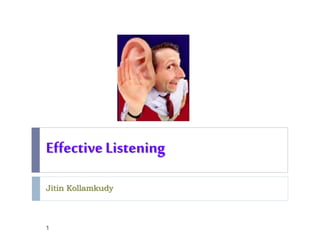

Effective Listening
Jitin Kollamkudy
1
“The principle of listening, someone has said is to
develop a big ear than a big mouth.”
2
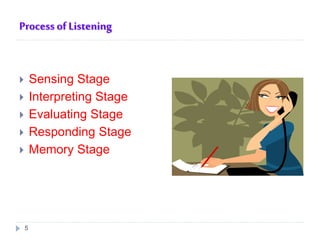
Process of Listening
Three Step Process
1. Receiving
2. Attending
3. Understanding
4. Remembering/ Responding may or may not
follow
3
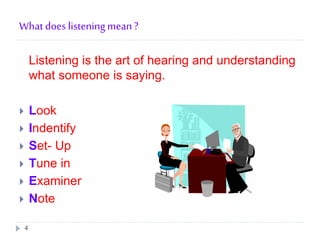
What does listeningmean ?
Listening is the art of hearing and understanding
what someone is saying.
 Look
 Indentify
 Set- Up
 Tune in
 Examiner
 Note
4
Process of Listening
 Sensing Stage
 Interpreting Stage
 Evaluating Stage
 Responding Stage
 Memory Stage
5
Advantages of Listening
 It breaks up the barriers between people.
 We can understand each other more
 It minimizes the losses of potential revenues.
 It prevents miscommunication of objectives and
priorities among people.
 It also prevents time loss because of having to
communicate a second or third time to get things
straightened out.
6
Benefits of Listening
 Listening helps to know the organization
 Listening helps in making better policies
 Listening mollifies complaining employees
 Listening is important for the success of ‘open
door policy’
 Listening forms a bond of respect
 Listening increases productivity, confidence and
accuracy
 Listening can calm people down.
7
ListeningModes
 Combative Listening - Competitive listening
 Active Listening – giving verbal feedback while
listening.
 Passive Listening - listener does not respond
verbally to the speaker.
8
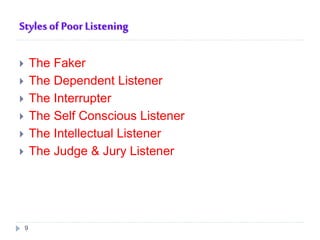
Styles of Poor Listening
 The Faker
 The Dependent Listener
 The Interrupter
 The Self Conscious Listener
 The Intellectual Listener
 The Judge & Jury Listener
9
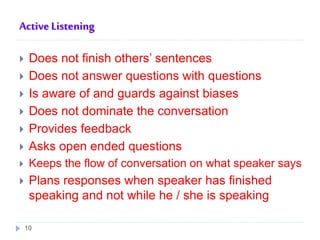
Active Listening
 Does not finish others’ sentences
 Does not answer questions with questions
 Is aware of and guards against biases
 Does not dominate the conversation
 Provides feedback
 Asks open ended questions
 Keeps the flow of conversation on what speaker says
 Plans responses when speaker has finished
speaking and not while he / she is speaking
10
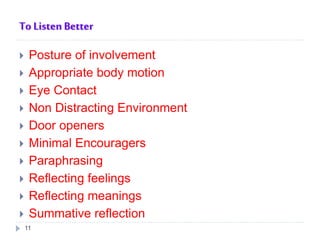
To Listen Better
 Posture of involvement
 Appropriate body motion
 Eye Contact
 Non Distracting Environment
 Door openers
 Minimal Encouragers
 Paraphrasing
 Reflecting feelings
 Reflecting meanings
 Summative reflection
11
Thank You
12

Effective listening

  • 1.
  • 2.
    “The principle oflistening, someone has said is to develop a big ear than a big mouth.” 2
  • 3.
    Process of Listening ThreeStep Process 1. Receiving 2. Attending 3. Understanding 4. Remembering/ Responding may or may not follow 3
  • 4.
    What does listeningmean? Listening is the art of hearing and understanding what someone is saying.  Look  Indentify  Set- Up  Tune in  Examiner  Note 4
  • 5.
    Process of Listening Sensing Stage  Interpreting Stage  Evaluating Stage  Responding Stage  Memory Stage 5
  • 6.
    Advantages of Listening It breaks up the barriers between people.  We can understand each other more  It minimizes the losses of potential revenues.  It prevents miscommunication of objectives and priorities among people.  It also prevents time loss because of having to communicate a second or third time to get things straightened out. 6
  • 7.
    Benefits of Listening Listening helps to know the organization  Listening helps in making better policies  Listening mollifies complaining employees  Listening is important for the success of ‘open door policy’  Listening forms a bond of respect  Listening increases productivity, confidence and accuracy  Listening can calm people down. 7
  • 8.
    ListeningModes  Combative Listening- Competitive listening  Active Listening – giving verbal feedback while listening.  Passive Listening - listener does not respond verbally to the speaker. 8
  • 9.
    Styles of PoorListening  The Faker  The Dependent Listener  The Interrupter  The Self Conscious Listener  The Intellectual Listener  The Judge & Jury Listener 9
  • 10.
    Active Listening  Doesnot finish others’ sentences  Does not answer questions with questions  Is aware of and guards against biases  Does not dominate the conversation  Provides feedback  Asks open ended questions  Keeps the flow of conversation on what speaker says  Plans responses when speaker has finished speaking and not while he / she is speaking 10
  • 11.
    To Listen Better Posture of involvement  Appropriate body motion  Eye Contact  Non Distracting Environment  Door openers  Minimal Encouragers  Paraphrasing  Reflecting feelings  Reflecting meanings  Summative reflection 11
  • 12.