


CROSS-CULTURECROSS-CULTURE
COMMUNICATIONCOMMUNICATION
Jitin Kollamkudy
““The re aso nable pe rso n adapts him se lf to theThe re aso nable pe rso n adapts him se lf to the
wo rld, while the unre aso nable o ne pe rsists inwo rld, while the unre aso nable o ne pe rsists in
trying to adapt the wo rld to him se lf”trying to adapt the wo rld to him se lf”
What is a culture?
Culture is the "le ns" thro ug h which yo u
vie w the wo rld.
It is ce ntralto what yo u se e ,
Ho w yo u m ake se nse o f what yo u se e ,
Ho w yo u e xpre ss yo urse lf.
Culture is the "le ns" thro ug h which yo u
vie w the wo rld.
It is ce ntralto what yo u se e ,
Ho w yo u m ake se nse o f what yo u se e ,
Ho w yo u e xpre ss yo urse lf.
Four Fundamental Patterns of Cultural
Difference
What is different?
1. Communication Styles
2. Attitudes toward conflicts
3. Decision making style
4. Approaches to knowing
Cross Culture CommunicationCross Culture Communication
Intercultural communIcatIon Is the process ofIntercultural communIcatIon Is the process of
sendIng and receIvIng messages between peoplesendIng and receIvIng messages between people
whose cultural background could lead them towhose cultural background could lead them to
Interpret verbal and non-verbal sIgnsInterpret verbal and non-verbal sIgns
dIfferently.dIfferently.
Why Cross CultureWhy Cross Culture
Communication is important ?Communication is important ?
Globalization: Cross border movement of people, goods andCross border movement of people, goods and
data brings more and more cultures into contact with onedata brings more and more cultures into contact with one
another and increases the potential of cross cultureanother and increases the potential of cross culture
communication.communication.
◦ Business Opportunities
◦ Job Opportunities
◦ Improves the contribution of employees in a diverse
workforce
◦ Sharing of views and ideas
◦ Talent improvisation
◦ An understanding of diverse market
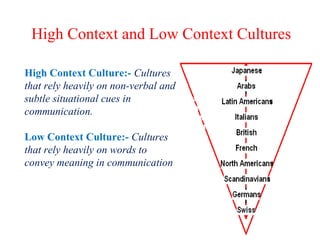
High Context and Low Context Cultures
High Context Culture:- Cultures
that rely heavily on non-verbal and
subtle situational cues in
communication.
Low Context Culture:- Cultures
that rely heavily on words to
convey meaning in communication.
Eye Contact
In some cultures, looking people in the eye is assumed to indicate
honesty and straightforwardness; in others it is seen as
challenging and rude.
 In USA, the cheapest, most
effective way to connect with people
is to look them into the eye.
 Most people in Arab culture
share a great deal of eye contact
and may regard too little as
disrespectful.
 In English culture, a certain
amount of eye contact is required,
but too much makes many people
uncomfortable.
 In South Asian and many
other cultures direct eye contact is
generally regarded as aggressive
and rude.
Cont…
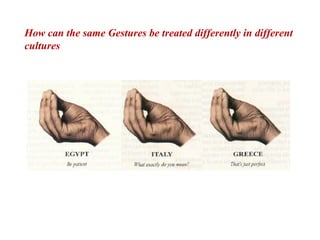
Gesture:
•A motion of the hands, head or body to emphasize an idea orA motion of the hands, head or body to emphasize an idea or
emotion.emotion.
USA=OK JAPAN=MONEY
RUSSIA=ZERO BRAZIL=INSULT
How can the same Gestures be treated differently in different
cultures
Blocks to Cultural Communication
1. Ethnocentrism : Inability to accept another culture's world
view; "my way is the best."
2. Discrimination : Differential treatment of an individual due to
minority status; actual and perceived;
e.g., "we just aren't equipped to .Serve people like that."
3. Stereotyping : Generalizing about a person while ignoring
presence of individual difference;
e.g., "she's like that because she's Asian – all Asians are nonverbal."
4.Cultural Blindness: Differences are ignored and one proceeds as
though differences did not exist; e.g., "there's no need to worry about
a
person's culture
5.Cultural Imposition: Belief that everyone should conform to the
majority; e.g., "we know what's best for you, if you don't like it you can
go elsewhere."
6.Tone Difference : Formal tone change becomes embarrassing and off-
putting in some cultures.
Cont…
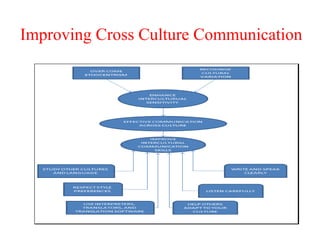
Improving Cross Culture Communication
TEN Pre-cautions in CulturalTEN Pre-cautions in Cultural
CommunicationCommunication
1.1. Slow DownSlow Down
2.2. Separate QuestionsSeparate Questions
3.3. Avoid Negative QuestionsAvoid Negative Questions
4.4. Take TurnsTake Turns
5.5. Write it downWrite it down
6.6. Be SupportiveBe Supportive
7.7. Check MeaningsCheck Meanings
8.8. Avoid SlangsAvoid Slangs
9.9. Watch the humorWatch the humor
10.10. Maintain EtiquetteMaintain Etiquette
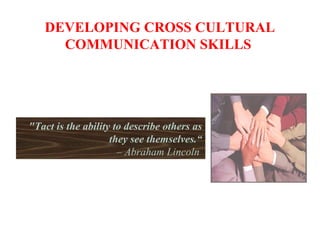
DEVELOPING CROSS CULTURAL
COMMUNICATION SKILLS
"Tact is the ability to describe others as
they see themselves.“
– Abraham Lincoln
Skills To Overcome Differences
Respecting Differences and Working Together
Building Trust Across Cultural Boundaries
Understanding Body Language
Connecting with people
Business in To day’ s Scenario is no t a
“National Match” but is a “Olympics”,
where there are Internatio nal Players.
Only that Individual / Co mpany can
survive which has do ne its ho mewo rk well
& develo ped its uniqueness.
Business is not a one day match
Thank YouThank You
……

Cross communication culture

  • 1.
  • 2.
    ““The re asonable pe rso n adapts him se lf to theThe re aso nable pe rso n adapts him se lf to the wo rld, while the unre aso nable o ne pe rsists inwo rld, while the unre aso nable o ne pe rsists in trying to adapt the wo rld to him se lf”trying to adapt the wo rld to him se lf”
  • 3.
    What is aculture? Culture is the "le ns" thro ug h which yo u vie w the wo rld. It is ce ntralto what yo u se e , Ho w yo u m ake se nse o f what yo u se e , Ho w yo u e xpre ss yo urse lf. Culture is the "le ns" thro ug h which yo u vie w the wo rld. It is ce ntralto what yo u se e , Ho w yo u m ake se nse o f what yo u se e , Ho w yo u e xpre ss yo urse lf.
  • 4.
    Four Fundamental Patternsof Cultural Difference What is different? 1. Communication Styles 2. Attitudes toward conflicts 3. Decision making style 4. Approaches to knowing
  • 5.
    Cross Culture CommunicationCrossCulture Communication Intercultural communIcatIon Is the process ofIntercultural communIcatIon Is the process of sendIng and receIvIng messages between peoplesendIng and receIvIng messages between people whose cultural background could lead them towhose cultural background could lead them to Interpret verbal and non-verbal sIgnsInterpret verbal and non-verbal sIgns dIfferently.dIfferently.
  • 6.
    Why Cross CultureWhyCross Culture Communication is important ?Communication is important ? Globalization: Cross border movement of people, goods andCross border movement of people, goods and data brings more and more cultures into contact with onedata brings more and more cultures into contact with one another and increases the potential of cross cultureanother and increases the potential of cross culture communication.communication. ◦ Business Opportunities ◦ Job Opportunities ◦ Improves the contribution of employees in a diverse workforce ◦ Sharing of views and ideas ◦ Talent improvisation ◦ An understanding of diverse market
  • 7.
    High Context andLow Context Cultures High Context Culture:- Cultures that rely heavily on non-verbal and subtle situational cues in communication. Low Context Culture:- Cultures that rely heavily on words to convey meaning in communication.
  • 8.
    Eye Contact In somecultures, looking people in the eye is assumed to indicate honesty and straightforwardness; in others it is seen as challenging and rude.
  • 9.
     In USA,the cheapest, most effective way to connect with people is to look them into the eye.  Most people in Arab culture share a great deal of eye contact and may regard too little as disrespectful.  In English culture, a certain amount of eye contact is required, but too much makes many people uncomfortable.  In South Asian and many other cultures direct eye contact is generally regarded as aggressive and rude. Cont…
  • 10.
    Gesture: •A motion ofthe hands, head or body to emphasize an idea orA motion of the hands, head or body to emphasize an idea or emotion.emotion. USA=OK JAPAN=MONEY RUSSIA=ZERO BRAZIL=INSULT
  • 11.
    How can thesame Gestures be treated differently in different cultures
  • 12.
    Blocks to CulturalCommunication 1. Ethnocentrism : Inability to accept another culture's world view; "my way is the best." 2. Discrimination : Differential treatment of an individual due to minority status; actual and perceived; e.g., "we just aren't equipped to .Serve people like that." 3. Stereotyping : Generalizing about a person while ignoring presence of individual difference; e.g., "she's like that because she's Asian – all Asians are nonverbal."
  • 13.
    4.Cultural Blindness: Differencesare ignored and one proceeds as though differences did not exist; e.g., "there's no need to worry about a person's culture 5.Cultural Imposition: Belief that everyone should conform to the majority; e.g., "we know what's best for you, if you don't like it you can go elsewhere." 6.Tone Difference : Formal tone change becomes embarrassing and off- putting in some cultures. Cont…
  • 14.
  • 15.
    TEN Pre-cautions inCulturalTEN Pre-cautions in Cultural CommunicationCommunication 1.1. Slow DownSlow Down 2.2. Separate QuestionsSeparate Questions 3.3. Avoid Negative QuestionsAvoid Negative Questions 4.4. Take TurnsTake Turns 5.5. Write it downWrite it down 6.6. Be SupportiveBe Supportive 7.7. Check MeaningsCheck Meanings 8.8. Avoid SlangsAvoid Slangs 9.9. Watch the humorWatch the humor 10.10. Maintain EtiquetteMaintain Etiquette
  • 16.
    DEVELOPING CROSS CULTURAL COMMUNICATIONSKILLS "Tact is the ability to describe others as they see themselves.“ – Abraham Lincoln
  • 17.
    Skills To OvercomeDifferences Respecting Differences and Working Together Building Trust Across Cultural Boundaries Understanding Body Language Connecting with people
  • 18.
    Business in Today’ s Scenario is no t a “National Match” but is a “Olympics”, where there are Internatio nal Players. Only that Individual / Co mpany can survive which has do ne its ho mewo rk well & develo ped its uniqueness. Business is not a one day match
  • 19.