
Jitin Kollamkudy
 Planning
 Organizing
 Staffing
 Leading/Directing
 Controlling
Planning involves the determination of future
course of action, that is why an action what is
to done, how to de done and when to be
done
“Planning bridges the gap from where we are
to where we want to go. It makes it possible
for things to occur which would not otherwise
happen”
-Koontz and O'Donnell
 Planning provides directions
 Planning reduces the risks of uncertainty
 Planning reduces overlapping and wasteful
activities
 Planning provides innovative ideas
 Planning facilitates decision making
 Planning establishes standards for controlling
 Being aware of opportunity
 Setting objectives or goals
 Considering planning premises
 Identifying alternatives
 Comparing alternatives in light of goals
 Choosing an alternative
 Formulating supporting plans
 Quantifying plans by making budgets
 Objectives were defined earlier as the
important ends toward which organizational
& individual activities are directed.
Nature of objectives
 Hierarchy of objectives
 Multiplicity of objectives
 Quantitative & Qualitative objectives
 Strategy can be defined as determination of
basic long term goals and objectives of an
enterprise and the adoption of course of
action and allocation of resources necessary
for carrying out these goals.
 Strategy is a single use plan made to meet
the challenge of a specific situation; when
situation changes ,the strategy becomes
outdated.
 It is a comprehensive & unified action plan
drawn to seek specific objectives in changed
situation.
 Strategy formulation is an intellectual
process that calls for use of analytical
abilities, imagination and creativity on the
part of managers.
 DETERMINING MISSION AND OBJECTIVES
OFTHE ORGANIZATION
 The organizational mission and objectives
serve as the basis to develop a suitable
strategy.
 SWOT ANALYSIS
 SWOT is an acronym for strengths,
weaknesses,opportunities and threats.
 The term’ business policy’ is used
interchangeably with ‘strategic
management'. It is because business policy
provides a broad framework within which the
corporate plans are made.
 Policies are formulated at the top level of the
organization. But with regard to functional &
operational policies, the co-operation of
lower level managers is also sought.
 Identification of Need.
 Collection of Required Information.
 Discovery ofTentative Policy Proposal.
 Evaluation of an Alternative.
 Approval & Application of Policy.
 Policy Review& Appraisal.
 Like all other plans, this strategy also needs
periodic review & evaluation.This is done to
ensure that it is implemented as effectively as
possible.
 Internal Consistency.
 Consistency with Environment.
 Appropriateness of strategy in the Light of
Available Resources.
 Acceptable Degree of Risk Involved in
Strategy.
 Appropriateness ofTime Horizons of
Strategy.
 Workability of Strategy.
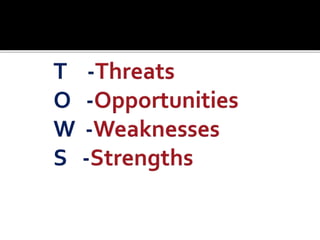
 It’s a modern tool for analysis of the situation.
 TheTOWS matrix has been introduced for
analyzing the competitive situation of the
company .
 TheWT strategy aims to minimize both
weaknesses & threats and maybe called the
Mini-Mini.
 TheWO strategy attempts to minimize the
weaknesses & maximize the opportunities.
 The ST strategy is based on using the
organization’s strengths to deal with threats
in the environment.
 The SO strategy which capitalizes on a
company’s strengths to take advantage of
opportunities ,is the most desirable.
 It focus on opportunities
 It focus on the uncontested market by
offering a product or service that is unique in
a market space where there is no competitor.
 It helps to make the competition irrelevant.
 Identify & eliminate those factors that may
be unimportant to the buyer.
 If elimination is not an option, consider
reducing those factors.
 Raise or strengthen those factors that are
unique.
 Create new or unique factors that are
wanted by the buyers but are ignored by
the competitors.
 This analysis becomes the basis for
formulating generic strategies.
1. Industry analysis
2. Overall cost leadership strategy
3. Differentiation strategy
4. Focused strategy
Planning in management

Planning in management

  • 1.
  • 2.
     Planning  Organizing Staffing  Leading/Directing  Controlling
  • 3.
    Planning involves thedetermination of future course of action, that is why an action what is to done, how to de done and when to be done “Planning bridges the gap from where we are to where we want to go. It makes it possible for things to occur which would not otherwise happen” -Koontz and O'Donnell
  • 4.
     Planning providesdirections  Planning reduces the risks of uncertainty  Planning reduces overlapping and wasteful activities  Planning provides innovative ideas  Planning facilitates decision making  Planning establishes standards for controlling
  • 5.
     Being awareof opportunity  Setting objectives or goals  Considering planning premises  Identifying alternatives  Comparing alternatives in light of goals  Choosing an alternative  Formulating supporting plans  Quantifying plans by making budgets
  • 6.
     Objectives weredefined earlier as the important ends toward which organizational & individual activities are directed.
  • 7.
    Nature of objectives Hierarchy of objectives  Multiplicity of objectives  Quantitative & Qualitative objectives
  • 8.
     Strategy canbe defined as determination of basic long term goals and objectives of an enterprise and the adoption of course of action and allocation of resources necessary for carrying out these goals.
  • 9.
     Strategy isa single use plan made to meet the challenge of a specific situation; when situation changes ,the strategy becomes outdated.  It is a comprehensive & unified action plan drawn to seek specific objectives in changed situation.
  • 10.
     Strategy formulationis an intellectual process that calls for use of analytical abilities, imagination and creativity on the part of managers.
  • 11.
     DETERMINING MISSIONAND OBJECTIVES OFTHE ORGANIZATION  The organizational mission and objectives serve as the basis to develop a suitable strategy.  SWOT ANALYSIS  SWOT is an acronym for strengths, weaknesses,opportunities and threats.
  • 12.
     The term’business policy’ is used interchangeably with ‘strategic management'. It is because business policy provides a broad framework within which the corporate plans are made.
  • 13.
     Policies areformulated at the top level of the organization. But with regard to functional & operational policies, the co-operation of lower level managers is also sought.
  • 14.
     Identification ofNeed.  Collection of Required Information.  Discovery ofTentative Policy Proposal.  Evaluation of an Alternative.  Approval & Application of Policy.  Policy Review& Appraisal.
  • 15.
     Like allother plans, this strategy also needs periodic review & evaluation.This is done to ensure that it is implemented as effectively as possible.
  • 16.
     Internal Consistency. Consistency with Environment.  Appropriateness of strategy in the Light of Available Resources.  Acceptable Degree of Risk Involved in Strategy.  Appropriateness ofTime Horizons of Strategy.  Workability of Strategy.
  • 17.
     It’s amodern tool for analysis of the situation.  TheTOWS matrix has been introduced for analyzing the competitive situation of the company .
  • 19.
     TheWT strategyaims to minimize both weaknesses & threats and maybe called the Mini-Mini.  TheWO strategy attempts to minimize the weaknesses & maximize the opportunities.
  • 20.
     The STstrategy is based on using the organization’s strengths to deal with threats in the environment.  The SO strategy which capitalizes on a company’s strengths to take advantage of opportunities ,is the most desirable.
  • 21.
     It focuson opportunities  It focus on the uncontested market by offering a product or service that is unique in a market space where there is no competitor.  It helps to make the competition irrelevant.
  • 22.
     Identify &eliminate those factors that may be unimportant to the buyer.  If elimination is not an option, consider reducing those factors.  Raise or strengthen those factors that are unique.  Create new or unique factors that are wanted by the buyers but are ignored by the competitors.
  • 23.
     This analysisbecomes the basis for formulating generic strategies. 1. Industry analysis 2. Overall cost leadership strategy 3. Differentiation strategy 4. Focused strategy