LISTENING SKILLS
PRESENTED BY:
Manoj Kumar
Manmeet Singh Khanuja
Manya Gumashta
Megha Sahu
Milind Agrawal
CSE-B
UIT RGPV (2016)
LISTENING SKILLS
• According to M.V.
Rodriques- “Listening is
the process of receiving,
interpretation and
reacting to the message received from the
communication sender.”
• Listening might be defined as the Art of Hearing
and understanding what someone is saying.
LISTENING IS NOT HEARING
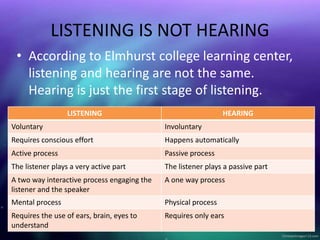
• According to Elmhurst college learning center,
listening and hearing are not the same.
Hearing is just the first stage of listening.
LISTENING HEARING
Voluntary Involuntary
Requires conscious effort Happens automatically
Active process Passive process
The listener plays a very active part The listener plays a passive part
A two way interactive process engaging the
listener and the speaker
A one way process
Mental process Physical process
Requires the use of ears, brain, eyes to
understand
Requires only ears
IMPORTANCE OF LISTENING
 Communication is not complete without
effective listening.
 An attentive listener stimulates better speaking
by the speaker.
 A good listener learns more than an indifferent
listener.
 A good listener can restructure vague speaking in
a way that produces clearer meaning.
 A good listener learns to detect prejudices,
assumptions and attitudes.
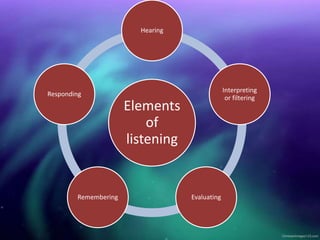
Elements
of
listening
Hearing
Interpreting
or filtering
EvaluatingRemembering
Responding
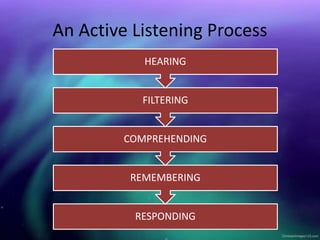
An Active Listening Process
RESPONDING
REMEMBERING
COMPREHENDING
FILTERING
HEARING
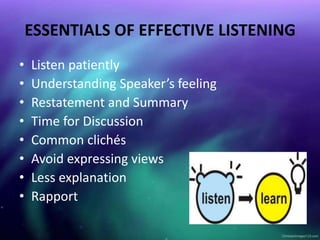
ESSENTIALS OF EFFECTIVE LISTENING
• Listen patiently
• Understanding Speaker’s feeling
• Restatement and Summary
• Time for Discussion
• Common clichés
• Avoid expressing views
• Less explanation
• Rapport
TYPES OF LISTENING
Discriminative
Comprehension
Biased
Evaluating
Appreciative
Therapeutic
Dialogic
Relationship
Sympathetic
Empathetic
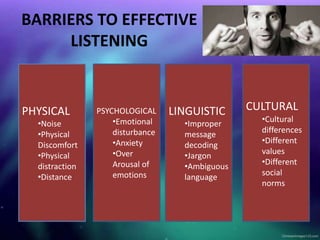
BARRIERS TO EFFECTIVE
LISTENING
PHYSICAL
•Noise
•Physical
Discomfort
•Physical
distraction
•Distance
PSYCHOLOGICAL
•Emotional
disturbance
•Anxiety
•Over
Arousal of
emotions
CULTURAL
•Cultural
differences
•Different
values
•Different
social
norms
LINGUISTIC
•Improper
message
decoding
•Jargon
•Ambiguous
language
OVERCOMING BARRIERS TO
EFFECTIVE LISTENING
• Eye contact
• Bodily exhibition
• Avoid distraction, actions or gestures
• Ask questions
• Paraphrase
• Avoid interpreting
Speaker
• Do not overtake
• Put the Speaker at ease
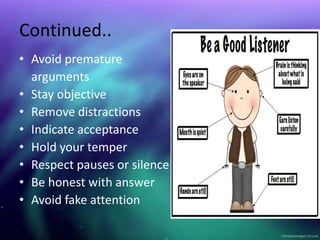
Continued..
• Avoid premature
arguments
• Stay objective
• Remove distractions
• Indicate acceptance
• Hold your temper
• Respect pauses or silence
• Be honest with answer
• Avoid fake attention
TIPS FOR BEING A GOOD LISTENER
• Give your full attention on the person who is
speaking.
• Make sure your mind is focused. If you feel
your mind wandering, change the position of
your body and try concentrate on the
speaker’s words.
• Let the speaker finish before you begin to talk.
When you interrupt, it appears you aren’t
listening, even if you really are.
• Let yourself finish listening before you begin
to speak. You can’t really listen if you’re busy
thinking about what you want to say next.
• Listen for main ideas. Pay special attention to
statements that begin with phrases such as
“My point is..” or “The thing to remember
is…”
• Ask questions. If you are not sure you
understood what the speaker has said, just
ask,
POSITIVE IMPACTS OF POSITIVE
LISTENING
• Increased productivity
• Stronger working relationship
• Better quality of work
• Greater customer satisfaction
• Sense of achievement
• Respected
• Greater cooperation and team work
• Easier and better problem solving
• Less stress
LISTENING SKILLS

LISTENING SKILLS

  • 1.
    LISTENING SKILLS PRESENTED BY: ManojKumar Manmeet Singh Khanuja Manya Gumashta Megha Sahu Milind Agrawal CSE-B UIT RGPV (2016)
  • 2.
    LISTENING SKILLS • Accordingto M.V. Rodriques- “Listening is the process of receiving, interpretation and reacting to the message received from the communication sender.” • Listening might be defined as the Art of Hearing and understanding what someone is saying.
  • 3.
    LISTENING IS NOTHEARING • According to Elmhurst college learning center, listening and hearing are not the same. Hearing is just the first stage of listening. LISTENING HEARING Voluntary Involuntary Requires conscious effort Happens automatically Active process Passive process The listener plays a very active part The listener plays a passive part A two way interactive process engaging the listener and the speaker A one way process Mental process Physical process Requires the use of ears, brain, eyes to understand Requires only ears
  • 4.
    IMPORTANCE OF LISTENING Communication is not complete without effective listening.  An attentive listener stimulates better speaking by the speaker.  A good listener learns more than an indifferent listener.  A good listener can restructure vague speaking in a way that produces clearer meaning.  A good listener learns to detect prejudices, assumptions and attitudes.
  • 5.
  • 6.
    An Active ListeningProcess RESPONDING REMEMBERING COMPREHENDING FILTERING HEARING
  • 7.
    ESSENTIALS OF EFFECTIVELISTENING • Listen patiently • Understanding Speaker’s feeling • Restatement and Summary • Time for Discussion • Common clichés • Avoid expressing views • Less explanation • Rapport
  • 8.
  • 9.
    BARRIERS TO EFFECTIVE LISTENING PHYSICAL •Noise •Physical Discomfort •Physical distraction •Distance PSYCHOLOGICAL •Emotional disturbance •Anxiety •Over Arousalof emotions CULTURAL •Cultural differences •Different values •Different social norms LINGUISTIC •Improper message decoding •Jargon •Ambiguous language
  • 10.
    OVERCOMING BARRIERS TO EFFECTIVELISTENING • Eye contact • Bodily exhibition • Avoid distraction, actions or gestures • Ask questions • Paraphrase • Avoid interpreting Speaker • Do not overtake • Put the Speaker at ease
  • 11.
    Continued.. • Avoid premature arguments •Stay objective • Remove distractions • Indicate acceptance • Hold your temper • Respect pauses or silence • Be honest with answer • Avoid fake attention
  • 13.
    TIPS FOR BEINGA GOOD LISTENER • Give your full attention on the person who is speaking. • Make sure your mind is focused. If you feel your mind wandering, change the position of your body and try concentrate on the speaker’s words. • Let the speaker finish before you begin to talk. When you interrupt, it appears you aren’t listening, even if you really are.
  • 14.
    • Let yourselffinish listening before you begin to speak. You can’t really listen if you’re busy thinking about what you want to say next. • Listen for main ideas. Pay special attention to statements that begin with phrases such as “My point is..” or “The thing to remember is…” • Ask questions. If you are not sure you understood what the speaker has said, just ask,
  • 15.
    POSITIVE IMPACTS OFPOSITIVE LISTENING • Increased productivity • Stronger working relationship • Better quality of work • Greater customer satisfaction • Sense of achievement • Respected • Greater cooperation and team work • Easier and better problem solving • Less stress