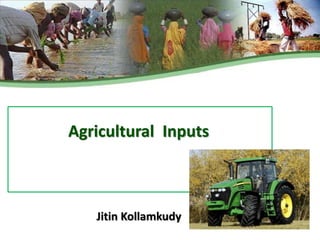
Agricultural Inputs
Jitin Kollamkudy
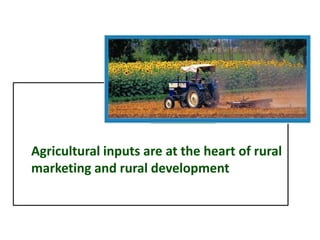
Agricultural inputs are at the heart of rural
marketing and rural development
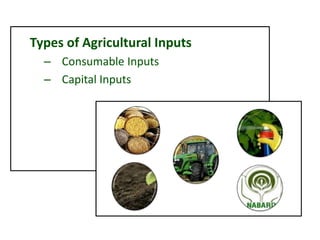
Types of Agricultural Inputs
– Consumable Inputs
– Capital Inputs
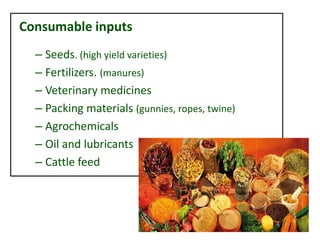
Consumable inputs
– Seeds. (high yield varieties)
– Fertilizers. (manures)
– Veterinary medicines
– Packing materials (gunnies, ropes, twine)
– Agrochemicals
– Oil and lubricants
– Cattle feed
Capital inputs
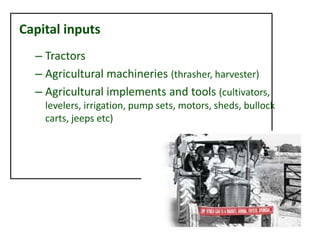
– Tractors
– Agricultural machineries (thrasher, harvester)
– Agricultural implements and tools (cultivators,
levelers, irrigation, pump sets, motors, sheds, bullock
carts, jeeps etc)
Seeds
– Any part of the crop from which a new crop will grow.(Agronomically)
– Seed is a fertilized ovule.(Botanically)
– Seed quality is estimated to account for 20-25% of productivity.
– World seed market is about Rs.2,20,000 Cr
– Indian seed market size is about Rs.9,000 Cr
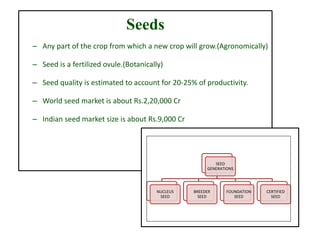
SEED
GENERATIONS
NUCLEUS
SEED
BREEDER
SEED
FOUNDATION
SEED
CERTIFIED
SEED
Challenges
– There is a mismatch between the seed multiplication ratio from breeder
seed to foundation seed and from foundation seed to certified seed.
– Comprehensive and authentic databases on seed production and trade
need to be built up.
– The seed chain and the norms for quality control to be followed without
any compromises or shortcuts.
– For horticulture crops which have a long gestation period , it is imperative
to ensure that only such varieties are imported that are suited to Indian
conditions.
The way forward
– A genetically diverse portfolio of improved crop varieties
needed.
– Timely delivery to farmers of high-yielding varieties requires big
improvements in the system that connects plant germplasm
collections, plant breeding and seed delivery.
– Improving policies and legislation for variety development and
release as well as seed supply.
– Strengthening capacity by creating a new generation of skilled
practitioners to support enhanced breeding.
– Working with farmers to explore the ways in which crops and
varieties contribute to successful intensification
– Revitalizing the public sector and expanding its role in
developing new crop varieties.
Fertilizers
– macronutrients (6): nitrogen, phosphorus, potassium, sulphur,
calcium magnesium - present in plant tissue in quantities from 0.15%
to 6.0% of dry matter
– micronutrients (8) : Molybdenum, Nickel, Copper, Zinc, Manganese,
Iron, Boron, chlorine - present in plant tissue on the order of parts per
million (ppm), ranging from 0.15 to 400 ppm DM, or less than 0.04%
DM
– All nutrients fulfill specific functions in plants and cannot replace each
other
• All of them are equally important, regardless of the amount required
physiologically
• Lack of any single nutrient will limit crop growth even if all the other
nutrients are fully available
• supply of all nutrients is essential to produce high yields of good
quality
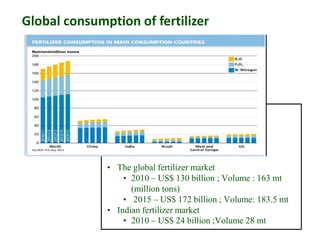
Global consumption of fertilizer
• The global fertilizer market
• 2010 – US$ 130 billion ; Volume : 163 mt
(million tons)
• 2015 – US$ 172 billion ; Volume: 183.5 mt
• Indian fertilizer market
• 2010 – US$ 24 billion ;Volume 28 mt
India: fertilizer use and crop production
– Use of fertilizer started in India with initiation of the planning
process in early fifties
– Food grain production increased from 74mt in 1966-67 to
241.56mt in 2010-11
– India is the 2nd largest producer of Nitrogenous fertilizer and
3rd in production of phosphate fertilizer
– Potash is totally imported
– India is 2nd to China in Nitrogen and Phosphorous consumption
– Fertilizer consumption in India is 16% of global consumption
– Consumption chemical fertilizers during 2010-11 is 28.2 mt
(16.6 mt N ,8.1 mt P & 3.5 mt K)
– Average consumption increase from 95 kg/ha in 2004-05 to
144.6kg/ha in 2010-11
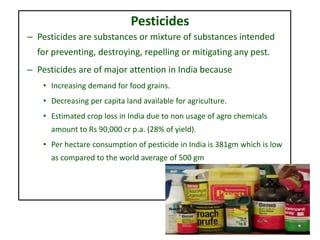
Pesticides
– Pesticides are substances or mixture of substances intended
for preventing, destroying, repelling or mitigating any pest.
– Pesticides are of major attention in India because
• Increasing demand for food grains.
• Decreasing per capita land available for agriculture.
• Estimated crop loss in India due to non usage of agro chemicals
amount to Rs 90,000 cr p.a. (28% of yield).
• Per hectare consumption of pesticide in India is 381gm which is low
as compared to the world average of 500 gm
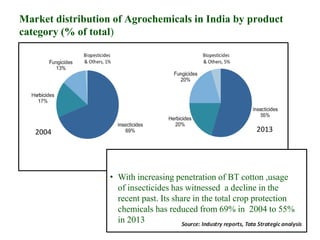
Market distribution of Agrochemicals in India by product
category (% of total)
• With increasing penetration of BT cotton ,usage
of insecticides has witnessed a decline in the
recent past. Its share in the total crop protection
chemicals has reduced from 69% in 2004 to 55%
in 2013
2004 2013
Farm Mechanization
Why farm mechanization
– Labour is available at a higher cost per hectare and this
would increase the demand for mechanization.
– India is a growing economy and to support a growing
population we would require not only efficient but
machinery that would increase the yield of food grains
and commercial crops.
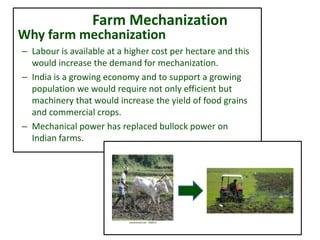
– Mechanical power has replaced bullock power on
Indian farms.
Advantages
– Increase in crop intensity and yield thus ensuring better
returns to the farmer
– Reduction of weather risk and risk of non-availability of
labor thus minimizing post harvest wastages
– Improved working conditions and enhanced safety for the
farmer
– Conversion of uncultivable land to agricultural land through
advanced tilling technologies
– Shifting land used for feed and fodder cultivation for draught
animals towards food grain production
– Increased rural employment.
Issues and challenges
– Highly diverse farm size & soil types: resulting in the need
for customized farm machinery and equipment.
– Skewed and seasonal usage resulting in low economic
viability
– Cattle population: Increased mechanization results in
surplus draught cattle and their upkeep is a concern for the
farmers.
– Extension service: Education and training for efficient
usage of farm equipment is required to be imparted along
with knowledge about selection of appropriate machinery.
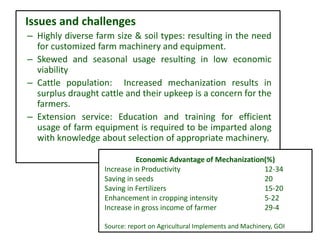
Economic Advantage of Mechanization(%)
Increase in Productivity 12-34
Saving in seeds 20
Saving in Fertilizers 15-20
Enhancement in cropping intensity 5-22
Increase in gross income of farmer 29-4
Source: report on Agricultural Implements and Machinery, GOI
Market – Tractors
– Market size: Approximately 370 000 units annually
– Market growth: 4-5% per annum
– Price sensitive market; sales dependant on Government
subsidy; no subsidy on tractors above 30 HP
– Domestic sector growing due to an increase in the irrigated
area, Government policy related to export which decides crop
switching by farmers
– Smaller tractors are very popular (35-40 HP); this is the fastest
growing segment
– one third are for non agricultural uses i.e. for transport and
haulage
– Low Penetration Level: 17 for every 1000Hectares
– Irrigation potential is about 140 mha.
– 58.4mha from major and medium irrigation sources, and
81.5 mha from minor irrigation sources.
– Ground water provides 70% of irrigation water.
Challenges:
– Persistent gap between the assessed ultimate irrigation
potential and actual potential that has been put to use.
– Inefficient water use in irrigation is leading to environmental
degradation via water logging.
 Efficiency in systems needs to be upgraded from present
level.
 Methods of Micro-irrigation should be taken in use for
better utilisation of water.
 It include Drip and Sprinkler irrigation system.
Irrigation
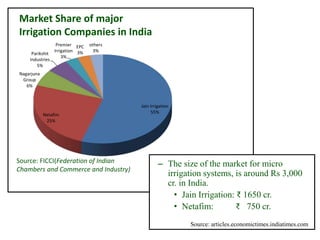
Market Share of major
Irrigation Companies in India
– The size of the market for micro
irrigation systems, is around Rs 3,000
cr. in India.
• Jain Irrigation: ₹ 1650 cr.
• Netafim: ₹ 750 cr.
Source: articles.economictimes.indiatimes.com
Jain Irrigation
55%
Netafim
25%
Nagarjuna
Group
6%
Parikshit
Industries
5%
Premier
Irrigation
3%
EPC
3%
others
3%
Source: FICCI(Federation of Indian
Chambers and Commerce and Industry)
Sources
– Rural Marketing- Focus on Agricultural Inputs, Sukhpal
Sing
– articles.economictimes.indiatimes.com
– Articles.economictimes.brandequity.com
– Report on Agricultural Implements and Machinery, GOI
– Agriculture Today
– www.ibef.org
Thank you…

Agricultural inputs

  • 1.
  • 2.
    Agricultural inputs areat the heart of rural marketing and rural development
  • 3.
    Types of AgriculturalInputs – Consumable Inputs – Capital Inputs
  • 4.
    Consumable inputs – Seeds.(high yield varieties) – Fertilizers. (manures) – Veterinary medicines – Packing materials (gunnies, ropes, twine) – Agrochemicals – Oil and lubricants – Cattle feed
  • 5.
    Capital inputs – Tractors –Agricultural machineries (thrasher, harvester) – Agricultural implements and tools (cultivators, levelers, irrigation, pump sets, motors, sheds, bullock carts, jeeps etc)
  • 6.
    Seeds – Any partof the crop from which a new crop will grow.(Agronomically) – Seed is a fertilized ovule.(Botanically) – Seed quality is estimated to account for 20-25% of productivity. – World seed market is about Rs.2,20,000 Cr – Indian seed market size is about Rs.9,000 Cr SEED GENERATIONS NUCLEUS SEED BREEDER SEED FOUNDATION SEED CERTIFIED SEED
  • 7.
    Challenges – There isa mismatch between the seed multiplication ratio from breeder seed to foundation seed and from foundation seed to certified seed. – Comprehensive and authentic databases on seed production and trade need to be built up. – The seed chain and the norms for quality control to be followed without any compromises or shortcuts. – For horticulture crops which have a long gestation period , it is imperative to ensure that only such varieties are imported that are suited to Indian conditions.
  • 8.
    The way forward –A genetically diverse portfolio of improved crop varieties needed. – Timely delivery to farmers of high-yielding varieties requires big improvements in the system that connects plant germplasm collections, plant breeding and seed delivery. – Improving policies and legislation for variety development and release as well as seed supply. – Strengthening capacity by creating a new generation of skilled practitioners to support enhanced breeding. – Working with farmers to explore the ways in which crops and varieties contribute to successful intensification – Revitalizing the public sector and expanding its role in developing new crop varieties.
  • 9.
    Fertilizers – macronutrients (6):nitrogen, phosphorus, potassium, sulphur, calcium magnesium - present in plant tissue in quantities from 0.15% to 6.0% of dry matter – micronutrients (8) : Molybdenum, Nickel, Copper, Zinc, Manganese, Iron, Boron, chlorine - present in plant tissue on the order of parts per million (ppm), ranging from 0.15 to 400 ppm DM, or less than 0.04% DM – All nutrients fulfill specific functions in plants and cannot replace each other • All of them are equally important, regardless of the amount required physiologically • Lack of any single nutrient will limit crop growth even if all the other nutrients are fully available • supply of all nutrients is essential to produce high yields of good quality
  • 10.
    Global consumption offertilizer • The global fertilizer market • 2010 – US$ 130 billion ; Volume : 163 mt (million tons) • 2015 – US$ 172 billion ; Volume: 183.5 mt • Indian fertilizer market • 2010 – US$ 24 billion ;Volume 28 mt
  • 11.
    India: fertilizer useand crop production – Use of fertilizer started in India with initiation of the planning process in early fifties – Food grain production increased from 74mt in 1966-67 to 241.56mt in 2010-11 – India is the 2nd largest producer of Nitrogenous fertilizer and 3rd in production of phosphate fertilizer – Potash is totally imported – India is 2nd to China in Nitrogen and Phosphorous consumption – Fertilizer consumption in India is 16% of global consumption – Consumption chemical fertilizers during 2010-11 is 28.2 mt (16.6 mt N ,8.1 mt P & 3.5 mt K) – Average consumption increase from 95 kg/ha in 2004-05 to 144.6kg/ha in 2010-11
  • 12.
    Pesticides – Pesticides aresubstances or mixture of substances intended for preventing, destroying, repelling or mitigating any pest. – Pesticides are of major attention in India because • Increasing demand for food grains. • Decreasing per capita land available for agriculture. • Estimated crop loss in India due to non usage of agro chemicals amount to Rs 90,000 cr p.a. (28% of yield). • Per hectare consumption of pesticide in India is 381gm which is low as compared to the world average of 500 gm
  • 13.
    Market distribution ofAgrochemicals in India by product category (% of total) • With increasing penetration of BT cotton ,usage of insecticides has witnessed a decline in the recent past. Its share in the total crop protection chemicals has reduced from 69% in 2004 to 55% in 2013 2004 2013
  • 14.
    Farm Mechanization Why farmmechanization – Labour is available at a higher cost per hectare and this would increase the demand for mechanization. – India is a growing economy and to support a growing population we would require not only efficient but machinery that would increase the yield of food grains and commercial crops. – Mechanical power has replaced bullock power on Indian farms.
  • 15.
    Advantages – Increase incrop intensity and yield thus ensuring better returns to the farmer – Reduction of weather risk and risk of non-availability of labor thus minimizing post harvest wastages – Improved working conditions and enhanced safety for the farmer – Conversion of uncultivable land to agricultural land through advanced tilling technologies – Shifting land used for feed and fodder cultivation for draught animals towards food grain production – Increased rural employment.
  • 16.
    Issues and challenges –Highly diverse farm size & soil types: resulting in the need for customized farm machinery and equipment. – Skewed and seasonal usage resulting in low economic viability – Cattle population: Increased mechanization results in surplus draught cattle and their upkeep is a concern for the farmers. – Extension service: Education and training for efficient usage of farm equipment is required to be imparted along with knowledge about selection of appropriate machinery. Economic Advantage of Mechanization(%) Increase in Productivity 12-34 Saving in seeds 20 Saving in Fertilizers 15-20 Enhancement in cropping intensity 5-22 Increase in gross income of farmer 29-4 Source: report on Agricultural Implements and Machinery, GOI
  • 17.
    Market – Tractors –Market size: Approximately 370 000 units annually – Market growth: 4-5% per annum – Price sensitive market; sales dependant on Government subsidy; no subsidy on tractors above 30 HP – Domestic sector growing due to an increase in the irrigated area, Government policy related to export which decides crop switching by farmers – Smaller tractors are very popular (35-40 HP); this is the fastest growing segment – one third are for non agricultural uses i.e. for transport and haulage – Low Penetration Level: 17 for every 1000Hectares
  • 18.
    – Irrigation potentialis about 140 mha. – 58.4mha from major and medium irrigation sources, and 81.5 mha from minor irrigation sources. – Ground water provides 70% of irrigation water. Challenges: – Persistent gap between the assessed ultimate irrigation potential and actual potential that has been put to use. – Inefficient water use in irrigation is leading to environmental degradation via water logging.  Efficiency in systems needs to be upgraded from present level.  Methods of Micro-irrigation should be taken in use for better utilisation of water.  It include Drip and Sprinkler irrigation system. Irrigation
  • 19.
    Market Share ofmajor Irrigation Companies in India – The size of the market for micro irrigation systems, is around Rs 3,000 cr. in India. • Jain Irrigation: ₹ 1650 cr. • Netafim: ₹ 750 cr. Source: articles.economictimes.indiatimes.com Jain Irrigation 55% Netafim 25% Nagarjuna Group 6% Parikshit Industries 5% Premier Irrigation 3% EPC 3% others 3% Source: FICCI(Federation of Indian Chambers and Commerce and Industry)
  • 20.
    Sources – Rural Marketing-Focus on Agricultural Inputs, Sukhpal Sing – articles.economictimes.indiatimes.com – Articles.economictimes.brandequity.com – Report on Agricultural Implements and Machinery, GOI – Agriculture Today – www.ibef.org
  • 21.