Effective Writing SkillEffective Writing Skill
Trainer: Muzahid Billah
1
Goals & Objectives
 Understanding written communication.
 Understanding importance of possessing good
writing skills.
 Knowing about different types of documents used
for business writing.
2
Writing?
 One of the best methods to communicate.
 Writing is one of the oldest known forms
of communication.
3
Why Written
Communication?
 Creates a permanent record
 Allows you to store information for future
reference
 Easily distributed
 All recipients receive the same information
 Necessary for legal and binding
documentation
4
Questions a writer asks?
 How do I begin?
 What is my purpose?
 How do I make my point clear?
 How do I create a logical flow?
 How do I say what I mean?
 How do I avoid grammatical errors?
 How can I make my message brief?
 How can I create a visual effect?
5
The Writing Process
 Planning
 Brainstorming
 Selecting points & making an outline
 Free writing
 Editing & Rewriting
 Final Draft
6
Types of Writing
 E-mails
 Letters and Memos
 Agendas
 Reports
 Promotional Material
 Academic Documents
 Research (scientific) manuscripts
7
LayoutLayout
 What is E-mail ?
 How to Make an Effective E-Mail.
 Few common e-mail habits that cause Problems.
 Structure of E-Mail..
I. Addressing.
II. Subjects.
III. Message Text.
IV. Attachments.
V. Signature.
8
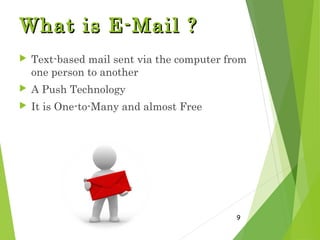
What is E-Mail ?What is E-Mail ?
 Text-based mail sent via the computer from
one person to another
 A Push Technology
 It is One-to-Many and almost Free
9
How to Make an EffectiveHow to Make an Effective
E-mailE-mail
 Selecting Your Audience Correctly
 Make the heading meaningful
 Keep each message short and clear.
 Start each message by stating its purpose/context
Few common e-mail habitsFew common e-mail habits
that cause Problems…that cause Problems…
 Changing the topic without changing the
subject.
 Including multiple subjects
 Misaddressed recipients
 Displaying addresses of recipients who are
strangers to each other
 Replying vs. forwarding
11
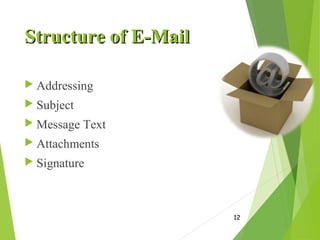
Structure of E-MailStructure of E-Mail
 Addressing
 Subject
 Message Text
 Attachments
 Signature
12
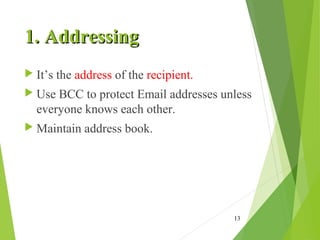
1. Addressing1. Addressing
 It’s the address of the recipient.
 Use BCC to protect Email addresses unless
everyone knows each other.
 Maintain address book.
13
14
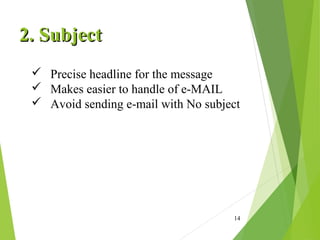
2. Subject2. Subject
 Precise headline for the message
 Makes easier to handle of e-MAIL
 Avoid sending e-mail with No subject
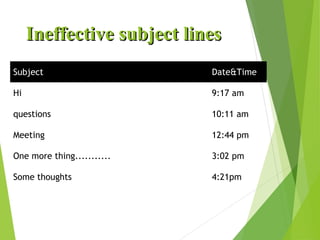
Ineffective subject linesIneffective subject lines
Subject Date&Time
Hi 9:17 am
questions 10:11 am
Meeting 12:44 pm
One more thing........... 3:02 pm
Some thoughts 4:21pm
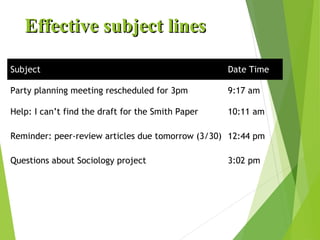
Effective subject linesEffective subject lines
Subject Date Time
Party planning meeting rescheduled for 3pm 9:17 am
Help: I can’t find the draft for the Smith Paper 10:11 am
Reminder: peer-review articles due tomorrow (3/30) 12:44 pm
Questions about Sociology project 3:02 pm
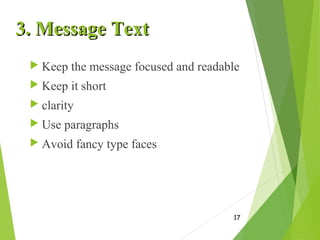
3. Message Text3. Message Text
 Keep the message focused and readable
 Keep it short
 clarity
 Use paragraphs
 Avoid fancy type faces
17
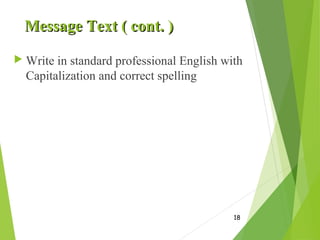
Message Text ( cont. )Message Text ( cont. )
 Write in standard professional English with
Capitalization and correct spelling
18
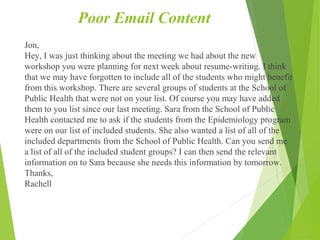
Poor Email Content
Jon,
Hey, I was just thinking about the meeting we had about the new
workshop you were planning for next week about resume-writing. I think
that we may have forgotten to include all of the students who might benefit
from this workshop. There are several groups of students at the School of
Public Health that were not on your list. Of course you may have added
them to you list since our last meeting. Sara from the School of Public
Health contacted me to ask if the students from the Epidemiology program
were on our list of included students. She also wanted a list of all of the
included departments from the School of Public Health. Can you send me
a list of all of the included student groups? I can then send the relevant
information on to Sara because she needs this information by tomorrow.
Thanks,
Rachell
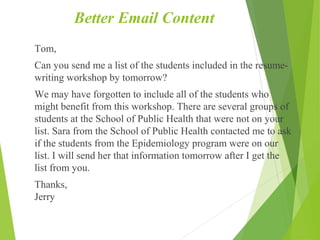
Better Email Content
Tom,
Can you send me a list of the students included in the resume-
writing workshop by tomorrow?
We may have forgotten to include all of the students who
might benefit from this workshop. There are several groups of
students at the School of Public Health that were not on your
list. Sara from the School of Public Health contacted me to ask
if the students from the Epidemiology program were on our
list. I will send her that information tomorrow after I get the
list from you.
Thanks,
Jerry
5. E-mail Signature
 Use an appropriate signature
 Brief (4-5 lines)
 Informative
I. provide all contact information
 Professional
I. do not include pictures, quotes, animations.
II. Whenever a piece of contact information
changes, make sure your signature updated
accordingly.
Before Sending…
 Improper spelling, grammar and punctuation give a bad
impression, and can sometimes even change the meaning
of the text.
 Read the email through the eyes of the recipient before
you send it.
Replies
 Answer swiftly.
 Each e-mail should be replied to within at least
24 hours, and preferably within the same working
day.
 If the email is complicated, send an email
saying that you have received it and that you
will get back to them. This will put the
people’s mind at rest and usually they will
then be very patient!
Conclusions
 Utilize full potential of written
communication
 Use frequent e-mails as per your
requirement
 What you write will ultimately define
you as a professional to your colleagues
and superiors.
 Match the appropriate communication
method to the recipient
24
Discussion
Questions and Comments?
25

Effective email writing

  • 1.
    Effective Writing SkillEffectiveWriting Skill Trainer: Muzahid Billah 1
  • 2.
    Goals & Objectives Understanding written communication.  Understanding importance of possessing good writing skills.  Knowing about different types of documents used for business writing. 2
  • 3.
    Writing?  One ofthe best methods to communicate.  Writing is one of the oldest known forms of communication. 3
  • 4.
    Why Written Communication?  Createsa permanent record  Allows you to store information for future reference  Easily distributed  All recipients receive the same information  Necessary for legal and binding documentation 4
  • 5.
    Questions a writerasks?  How do I begin?  What is my purpose?  How do I make my point clear?  How do I create a logical flow?  How do I say what I mean?  How do I avoid grammatical errors?  How can I make my message brief?  How can I create a visual effect? 5
  • 6.
    The Writing Process Planning  Brainstorming  Selecting points & making an outline  Free writing  Editing & Rewriting  Final Draft 6
  • 7.
    Types of Writing E-mails  Letters and Memos  Agendas  Reports  Promotional Material  Academic Documents  Research (scientific) manuscripts 7
  • 8.
    LayoutLayout  What isE-mail ?  How to Make an Effective E-Mail.  Few common e-mail habits that cause Problems.  Structure of E-Mail.. I. Addressing. II. Subjects. III. Message Text. IV. Attachments. V. Signature. 8
  • 9.
    What is E-Mail?What is E-Mail ?  Text-based mail sent via the computer from one person to another  A Push Technology  It is One-to-Many and almost Free 9
  • 10.
    How to Makean EffectiveHow to Make an Effective E-mailE-mail  Selecting Your Audience Correctly  Make the heading meaningful  Keep each message short and clear.  Start each message by stating its purpose/context
  • 11.
    Few common e-mailhabitsFew common e-mail habits that cause Problems…that cause Problems…  Changing the topic without changing the subject.  Including multiple subjects  Misaddressed recipients  Displaying addresses of recipients who are strangers to each other  Replying vs. forwarding 11
  • 12.
    Structure of E-MailStructureof E-Mail  Addressing  Subject  Message Text  Attachments  Signature 12
  • 13.
    1. Addressing1. Addressing It’s the address of the recipient.  Use BCC to protect Email addresses unless everyone knows each other.  Maintain address book. 13
  • 14.
    14 2. Subject2. Subject Precise headline for the message  Makes easier to handle of e-MAIL  Avoid sending e-mail with No subject
  • 15.
    Ineffective subject linesIneffectivesubject lines Subject Date&Time Hi 9:17 am questions 10:11 am Meeting 12:44 pm One more thing........... 3:02 pm Some thoughts 4:21pm
  • 16.
    Effective subject linesEffectivesubject lines Subject Date Time Party planning meeting rescheduled for 3pm 9:17 am Help: I can’t find the draft for the Smith Paper 10:11 am Reminder: peer-review articles due tomorrow (3/30) 12:44 pm Questions about Sociology project 3:02 pm
  • 17.
    3. Message Text3.Message Text  Keep the message focused and readable  Keep it short  clarity  Use paragraphs  Avoid fancy type faces 17
  • 18.
    Message Text (cont. )Message Text ( cont. )  Write in standard professional English with Capitalization and correct spelling 18
  • 19.
    Poor Email Content Jon, Hey,I was just thinking about the meeting we had about the new workshop you were planning for next week about resume-writing. I think that we may have forgotten to include all of the students who might benefit from this workshop. There are several groups of students at the School of Public Health that were not on your list. Of course you may have added them to you list since our last meeting. Sara from the School of Public Health contacted me to ask if the students from the Epidemiology program were on our list of included students. She also wanted a list of all of the included departments from the School of Public Health. Can you send me a list of all of the included student groups? I can then send the relevant information on to Sara because she needs this information by tomorrow. Thanks, Rachell
  • 20.
    Better Email Content Tom, Canyou send me a list of the students included in the resume- writing workshop by tomorrow? We may have forgotten to include all of the students who might benefit from this workshop. There are several groups of students at the School of Public Health that were not on your list. Sara from the School of Public Health contacted me to ask if the students from the Epidemiology program were on our list. I will send her that information tomorrow after I get the list from you. Thanks, Jerry
  • 21.
    5. E-mail Signature Use an appropriate signature  Brief (4-5 lines)  Informative I. provide all contact information  Professional I. do not include pictures, quotes, animations. II. Whenever a piece of contact information changes, make sure your signature updated accordingly.
  • 22.
    Before Sending…  Improperspelling, grammar and punctuation give a bad impression, and can sometimes even change the meaning of the text.  Read the email through the eyes of the recipient before you send it.
  • 23.
    Replies  Answer swiftly. Each e-mail should be replied to within at least 24 hours, and preferably within the same working day.  If the email is complicated, send an email saying that you have received it and that you will get back to them. This will put the people’s mind at rest and usually they will then be very patient!
  • 24.
    Conclusions  Utilize fullpotential of written communication  Use frequent e-mails as per your requirement  What you write will ultimately define you as a professional to your colleagues and superiors.  Match the appropriate communication method to the recipient 24
  • 25.