









Communication
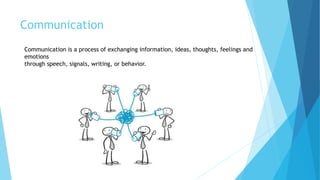
Communication is a process of exchanging information, ideas, thoughts, feelings and
emotions
through speech, signals, writing, or behavior.
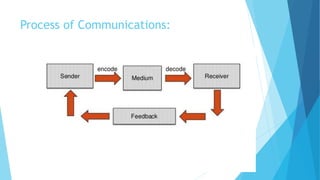
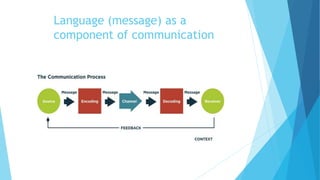
Process of Communications:
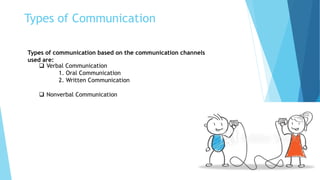
Types of Communication
 Verbal Communication
1. Oral Communication
2. Written Communication
 Nonverbal Communication
Types of communication based on the communication channels
used are:
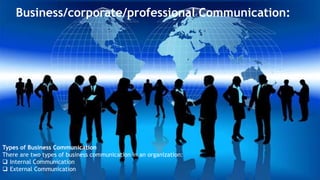
Business/corporate/professional Communication:
Types of Business Communication
There are two types of business communication in an organization:
 Internal Communication
 External Communication
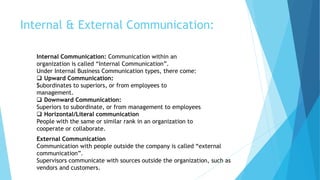
Internal & External Communication:
Internal Communication: Communication within an
organization is called “Internal Communication”.
Under Internal Business Communication types, there come:
 Upward Communication:
Subordinates to superiors, or from employees to
management.
 Downward Communication:
Superiors to subordinate, or from management to employees
 Horizontal/Literal communication
People with the same or similar rank in an organization to
cooperate or collaborate.
External Communication
Communication with people outside the company is called “external
communication”.
Supervisors communicate with sources outside the organization, such as
vendors and customers.
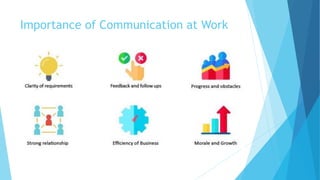
Importance of Communication at Work
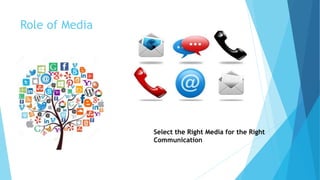
Role of Media
Select the Right Media for the Right
Communication
Language (message) as a
component of communication
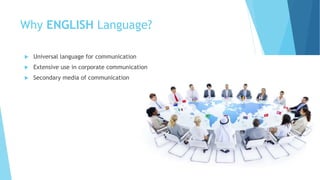
Why ENGLISH Language?
 Universal language for communication
 Extensive use in corporate communication
 Secondary media of communication
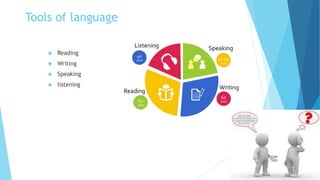
Tools of language
 Reading
 Writing
 Speaking
 listening
Writing
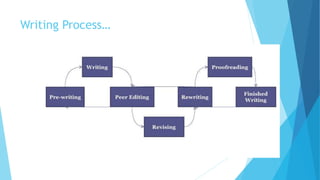
Writing Process…
Writing Skills..
How to
improve
writing Skills
The Process
of Writing
Analysis of
Writing Skill
Types of
Composition
The Purpose
of Writing
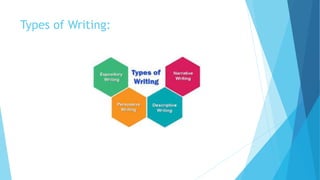
Types of Writing:
Features of Business Writings:
 Should be terse, clear and to the point
 Language has to be effective
 Each country has their own set of norms
concerning writing or spoken
communication
 North American business desires written
form
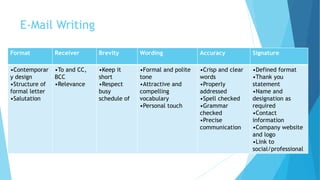
E-Mail Writing
Format Receiver Brevity Wording Accuracy Signature
•Contemporar
y design
•Structure of
formal letter
•Salutation
•To and CC,
BCC
•Relevance
•Keep it
short
•Respect
busy
schedule of
•Formal and polite
tone
•Attractive and
compelling
vocabulary
•Personal touch
•Crisp and clear
words
•Properly
addressed
•Spell checked
•Grammar
checked
•Precise
communication
•Defined format
•Thank you
statement
•Name and
designation as
required
•Contact
information
•Company website
and logo
•Link to
social/professional
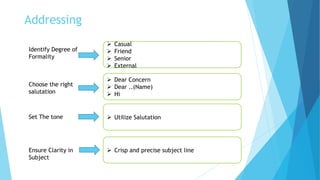
Addressing
Identify Degree of
Formality
Choose the right
salutation
Set The tone
Ensure Clarity in
Subject
 Casual
 Friend
 Senior
 External
 Dear Concern
 Dear ..(Name)
 Hi
 Utilize Salutation
 Crisp and precise subject line
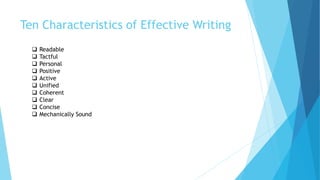
Ten Characteristics of Effective Writing
 Readable
 Tactful
 Personal
 Positive
 Active
 Unified
 Coherent
 Clear
 Concise
 Mechanically Sound
Reading
Reading
 Reading is the most important
skill in English language from
other language skills in acquiring
language.
 If you are good at reading you will
be good in other language skills
like as writing, speaking &
listening.
Reading Skills
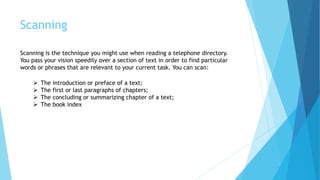
Scanning
Scanning is the technique you might use when reading a telephone directory.
You pass your vision speedily over a section of text in order to find particular
words or phrases that are relevant to your current task. You can scan:
 The introduction or preface of a text;
 The first or last paragraphs of chapters;
 The concluding or summarizing chapter of a text;
 The book index
Skimming
Skimming is the process of speedy reading for general meaning. Let your
eyes skip over sentences or phrases which contain detail. Concentrate on
identifying the central or main points. Use this technique to:
 pre-view a selection of text prior to detailed
reading;
 refresh your understanding of a selection of text
following detailed reading.
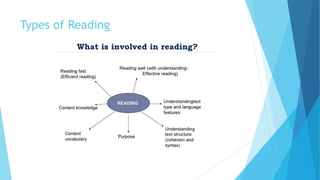
Types of Reading
Listening & Responding
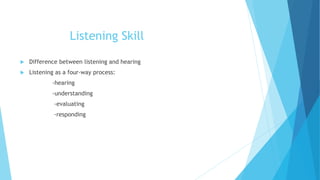
Listening Skill
 Difference between listening and hearing
 Listening as a four-way process:
-hearing
-understanding
-evaluating
-responding
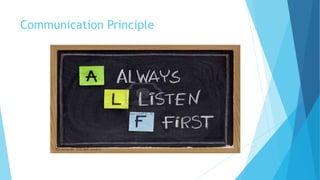
Communication Principle
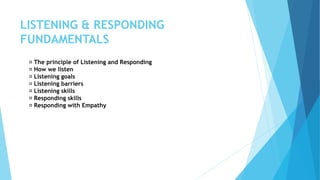
LISTENING & RESPONDING
FUNDAMENTALS
The principle of Listening and Responding
How we listen
Listening goals
Listening barriers
Listening skills
Responding skills
Responding with Empathy
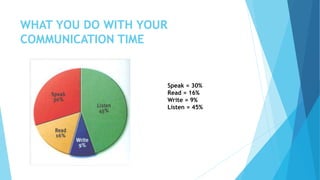
WHAT YOU DO WITH YOUR
COMMUNICATION TIME
Speak = 30%
Read = 16%
Write = 9%
Listen = 45%
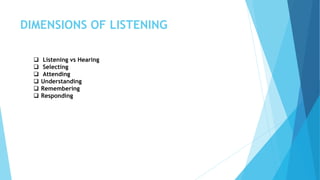
DIMENSIONS OF LISTENING
 Listening vs Hearing
 Selecting
 Attending
 Understanding
 Remembering
 Responding
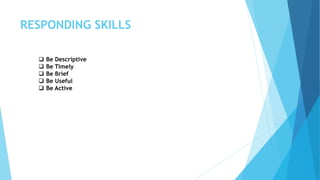
RESPONDING SKILLS
 Be Descriptive
 Be Timely
 Be Brief
 Be Useful
 Be Active
USE EMPATHY WHILE RESPONDING
 Emotional Intelligence
 Understanding Your Partner’s Feelings
 Ask Appropriate Questions
 Paraphrase the Content
 Paraphrase Emotions
Speaking
Speaking is an Art
 Speak slowly.
 Speak with little pause.
 Not to talk more than 15-20 minutes
at a time.
 Use simple words.
 Not to stand still or sit idle.
 Avoid extra-ordinary pause.
SPEAKING REQUIRES. . .
• energy
• sharp focus
• logical thinking
• clear phrasing
• crisp delivery
STAGES OF SPEAKING
• Rapport Building.
• Body Language.
• Focus on fluency vs. Accuracy.
• Topic and it’s delivery.
TOPICS AND ITS DELIVERY:
• Level of Participants.
• Purpose of talk of the topics
• Subject matter of the topics
• Time available
• Logistic supports for the talk:
• Handout
• Related forms and formats
• Exercise/Case study etc.
MAKING EFFECTIVE PRESENTATIONS
• Prepare for the presentation
• Make opening comments
• Make your points
• End the presentation
• Answer questions
Effective business communication

Effective business communication

  • 2.
    Communication Communication is aprocess of exchanging information, ideas, thoughts, feelings and emotions through speech, signals, writing, or behavior.
  • 3.
  • 4.
    Types of Communication Verbal Communication 1. Oral Communication 2. Written Communication  Nonverbal Communication Types of communication based on the communication channels used are:
  • 5.
    Business/corporate/professional Communication: Types ofBusiness Communication There are two types of business communication in an organization:  Internal Communication  External Communication
  • 6.
    Internal & ExternalCommunication: Internal Communication: Communication within an organization is called “Internal Communication”. Under Internal Business Communication types, there come:  Upward Communication: Subordinates to superiors, or from employees to management.  Downward Communication: Superiors to subordinate, or from management to employees  Horizontal/Literal communication People with the same or similar rank in an organization to cooperate or collaborate. External Communication Communication with people outside the company is called “external communication”. Supervisors communicate with sources outside the organization, such as vendors and customers.
  • 7.
  • 8.
    Role of Media Selectthe Right Media for the Right Communication
  • 9.
    Language (message) asa component of communication
  • 10.
    Why ENGLISH Language? Universal language for communication  Extensive use in corporate communication  Secondary media of communication
  • 11.
    Tools of language Reading  Writing  Speaking  listening
  • 12.
  • 14.
  • 15.
    Writing Skills.. How to improve writingSkills The Process of Writing Analysis of Writing Skill Types of Composition The Purpose of Writing
  • 16.
  • 17.
    Features of BusinessWritings:  Should be terse, clear and to the point  Language has to be effective  Each country has their own set of norms concerning writing or spoken communication  North American business desires written form
  • 18.
    E-Mail Writing Format ReceiverBrevity Wording Accuracy Signature •Contemporar y design •Structure of formal letter •Salutation •To and CC, BCC •Relevance •Keep it short •Respect busy schedule of •Formal and polite tone •Attractive and compelling vocabulary •Personal touch •Crisp and clear words •Properly addressed •Spell checked •Grammar checked •Precise communication •Defined format •Thank you statement •Name and designation as required •Contact information •Company website and logo •Link to social/professional
  • 19.
    Addressing Identify Degree of Formality Choosethe right salutation Set The tone Ensure Clarity in Subject  Casual  Friend  Senior  External  Dear Concern  Dear ..(Name)  Hi  Utilize Salutation  Crisp and precise subject line
  • 20.
    Ten Characteristics ofEffective Writing  Readable  Tactful  Personal  Positive  Active  Unified  Coherent  Clear  Concise  Mechanically Sound
  • 21.
  • 22.
    Reading  Reading isthe most important skill in English language from other language skills in acquiring language.  If you are good at reading you will be good in other language skills like as writing, speaking & listening.
  • 23.
  • 24.
    Scanning Scanning is thetechnique you might use when reading a telephone directory. You pass your vision speedily over a section of text in order to find particular words or phrases that are relevant to your current task. You can scan:  The introduction or preface of a text;  The first or last paragraphs of chapters;  The concluding or summarizing chapter of a text;  The book index
  • 25.
    Skimming Skimming is theprocess of speedy reading for general meaning. Let your eyes skip over sentences or phrases which contain detail. Concentrate on identifying the central or main points. Use this technique to:  pre-view a selection of text prior to detailed reading;  refresh your understanding of a selection of text following detailed reading.
  • 26.
  • 27.
  • 28.
    Listening Skill  Differencebetween listening and hearing  Listening as a four-way process: -hearing -understanding -evaluating -responding
  • 29.
  • 30.
    LISTENING & RESPONDING FUNDAMENTALS Theprinciple of Listening and Responding How we listen Listening goals Listening barriers Listening skills Responding skills Responding with Empathy
  • 31.
    WHAT YOU DOWITH YOUR COMMUNICATION TIME Speak = 30% Read = 16% Write = 9% Listen = 45%
  • 32.
    DIMENSIONS OF LISTENING Listening vs Hearing  Selecting  Attending  Understanding  Remembering  Responding
  • 33.
    RESPONDING SKILLS  BeDescriptive  Be Timely  Be Brief  Be Useful  Be Active
  • 34.
    USE EMPATHY WHILERESPONDING  Emotional Intelligence  Understanding Your Partner’s Feelings  Ask Appropriate Questions  Paraphrase the Content  Paraphrase Emotions
  • 35.
  • 36.
    Speaking is anArt  Speak slowly.  Speak with little pause.  Not to talk more than 15-20 minutes at a time.  Use simple words.  Not to stand still or sit idle.  Avoid extra-ordinary pause.
  • 37.
    SPEAKING REQUIRES. .. • energy • sharp focus • logical thinking • clear phrasing • crisp delivery
  • 38.
    STAGES OF SPEAKING •Rapport Building. • Body Language. • Focus on fluency vs. Accuracy. • Topic and it’s delivery.
  • 39.
    TOPICS AND ITSDELIVERY: • Level of Participants. • Purpose of talk of the topics • Subject matter of the topics • Time available • Logistic supports for the talk: • Handout • Related forms and formats • Exercise/Case study etc.
  • 40.
    MAKING EFFECTIVE PRESENTATIONS •Prepare for the presentation • Make opening comments • Make your points • End the presentation • Answer questions