EFFECTIVE
COMMUNICATION
Sandeep Raturi, DTM
About Myself
 MBA in Tourism
 More than 02 Decades of experience in inbound Travel sales
 Have been interacting with foreigners on a regular basis
 Over 10 years of association with Toastmasters
 District Director of District 41 in the year 2018-19 (District Comprises all the
clubs in North & East India, Nepal, Bangladesh)
 Received Leadership Training in India, US, Canada, Malaysia, Colombo
 Conducted trainings sessions in different parts of India, Nepal and Bangladesh
 Founder of online coaching institute ‘Learn n Grow’ where he coaches
learners from diverse professional background and different age groups.
Testimonials
 After searching for right teacher for a year, I met him and I consider him the right
teacher for me. He is very kind , hardworking and open minded teacher. He is
very proficient in English and have a lot of modern styles of teachings. I really
recommend him if somebody wants to learn English.
Sajid Ali, Sofware Engineer, Islamabad, Pakistan
 Sandeep is a perfect tutor. He's very kind and I'm sure that he'll help you to get
proficient in English. Zafer Kiyan, Faculty of Communication, Dept of
Jornalism, Ankara University,Turkey
 Hello Sir just wanted to tell you that I just received my result of Cambridge FCE
Exam and I passed with distinction getting 183/190 marks. So In just wanted to
thank you as you helped and guided me a lot through the classes which enabled
me to achieve score that wouldn’t have been able to get without your help.
Aditi Bahuguna, Class XII Student, St.Angela Sophie Senior Secondary
School, Jaipur
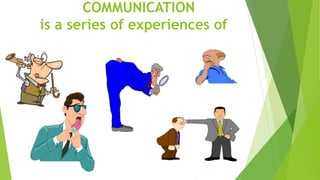
COMMUNICATION
is a series of experiences of
What is Communication ?
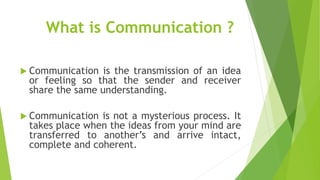
 Communication is the transmission of an idea
or feeling so that the sender and receiver
share the same understanding.
 Communication is not a mysterious process. It
takes place when the ideas from your mind are
transferred to another’s and arrive intact,
complete and coherent.
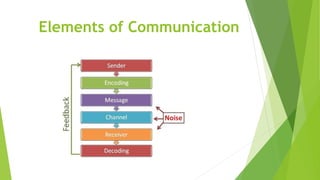
Elements of Communication
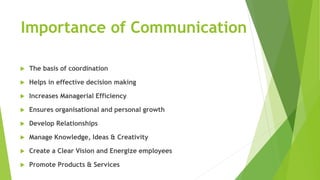
Importance of Communication
 The basis of coordination
 Helps in effective decision making
 Increases Managerial Efficiency
 Ensures organisational and personal growth
 Develop Relationships
 Manage Knowledge, Ideas & Creativity
 Create a Clear Vision and Energize employees
 Promote Products & Services
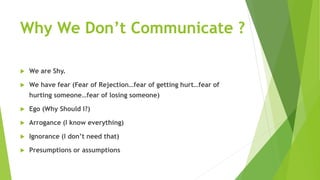
Why We Don’t Communicate ?
 We are Shy.
 We have fear (Fear of Rejection…fear of getting hurt…fear of
hurting someone…fear of losing someone)
 Ego (Why Should I?)
 Arrogance (I know everything)
 Ignorance (I don’t need that)
 Presumptions or assumptions
7 Cs of Communication
 Clear
 Concise
 Complete
 Correct
 Consideration
 Courtesy
 Concreteness
Communication Style
 Passive Communication
 Aggressive Communication
 Assertive Communication
Types of Communication
 On the basis of organization relationship
 Formal
 Informal
 On the basis of Flow
 Vertical
 Crosswise/Diagonal
 Horizontal
 On the basis of Expression
 Oral
 Written
 Gesture
Barriers to Communication
 Semantic Barriers
 Psychological Barriers
 Organizational Barriers
 Personal Barriers
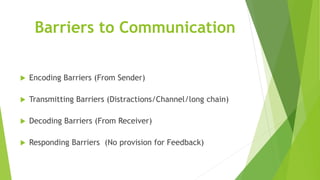
Barriers to Communication
 Encoding Barriers (From Sender)
 Transmitting Barriers (Distractions/Channel/long chain)
 Decoding Barriers (From Receiver)
 Responding Barriers (No provision for Feedback)
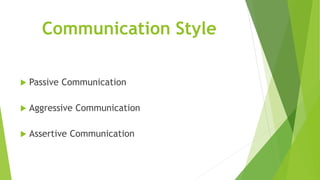
Communication Style
 Passive Communication
 Aggressive Communication
 Assertive Communication
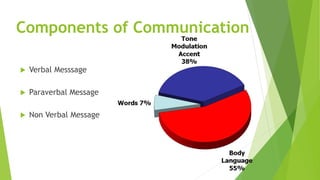
Components of Communication
 Verbal Messsage
 Paraverbal Message
 Non Verbal Message
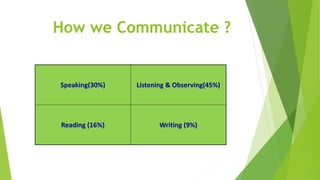
How we Communicate ?
Speaking(30%) Listening & Observing(45%)
Reading (16%) Writing (9%)
Listening Skills
 Hearing Vs Listening
 Passive, Selective, Active Listening Skills
 Flaws in the Listening process :
 Selective Attention
 Selective Perception
 Selective Retention
Why We Do Not Listen -
5 Basic Reasons
 Listening is Hard Work
 Competition
 The Rush for Action
 Speed differences (120 wpm v/s 360 wpm)
 Lack of Training
Examples of
Active Listening Techniques
 Brief verbal affirmations like I see, I know, sure, or I
understand.
 Asking open-ended questions.
 Asking specific questions to seek clarification.
 Waiting to disclose your opinion.
 Disclosing similar experiences to show understanding.
Steps to
Effective Listening skills – Don’ts
 Don’t be preoccupied
 Avoid advising, diagnosing, criticizing, judgments &
reactions
 Avoid fixing-changing what the speaker says
 Resists filling every space with your talk
 Don’t ignore the body language
 Avoid Interruptions
Steps to
Effective Listening skills – Don’ts
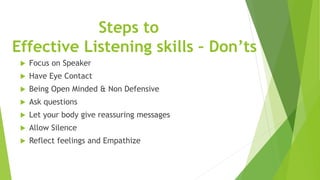
 Focus on Speaker
 Have Eye Contact
 Being Open Minded & Non Defensive
 Ask questions
 Let your body give reassuring messages
 Allow Silence
 Reflect feelings and Empathize
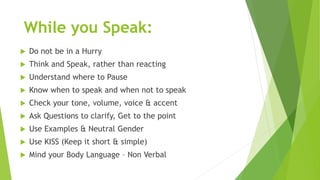
While you Speak:
 Do not be in a Hurry
 Think and Speak, rather than reacting
 Understand where to Pause
 Know when to speak and when not to speak
 Check your tone, volume, voice & accent
 Ask Questions to clarify, Get to the point
 Use Examples & Neutral Gender
 Use KISS (Keep it short & simple)
 Mind your Body Language – Non Verbal
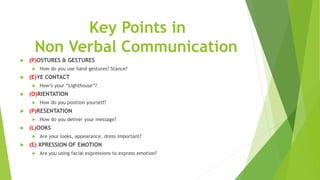
Key Points in
Non Verbal Communication
 (P)OSTURES & GESTURES
 How do you use hand gestures? Stance?
 (E)YE CONTACT
 How’s your “Lighthouse”?
 (O)RIENTATION
 How do you position yourself?
 (P)RESENTATION
 How do you deliver your message?
 (L)OOKS
 Are your looks, appearance, dress important?
 (E) XPRESSION OF EMOTION
 Are you using facial expressions to express emotion?
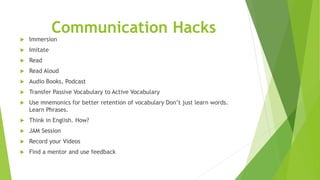
Communication Hacks
 Immersion
 Imitate
 Read
 Read Aloud
 Audio Books, Podcast
 Transfer Passive Vocabulary to Active Vocabulary
 Use mnemonics for better retention of vocabulary Don’t just learn words.
Learn Phrases.
 Think in English. How?
 JAM Session
 Record your Videos
 Find a mentor and use feedback
Toastmasters
- Gain confidence
- Deliver prepared and impromptu speeches
- Acquire and hone leadership skills
- Network with self-motivated learners
 Vocabulary.com
 App - Flashcards
 WordUp (Vocabulary)
 App – Grammarly
 Preply, Cambly, Italki (For personal Tutors)
 Sdfdsf
 Sfsd
 Sdfs
 asfas
 Dslkjds;lfjs
Some useful apps and websites
All the Best !

Effective communication2

  • 1.
  • 2.
    About Myself  MBAin Tourism  More than 02 Decades of experience in inbound Travel sales  Have been interacting with foreigners on a regular basis  Over 10 years of association with Toastmasters  District Director of District 41 in the year 2018-19 (District Comprises all the clubs in North & East India, Nepal, Bangladesh)  Received Leadership Training in India, US, Canada, Malaysia, Colombo  Conducted trainings sessions in different parts of India, Nepal and Bangladesh  Founder of online coaching institute ‘Learn n Grow’ where he coaches learners from diverse professional background and different age groups.
  • 3.
    Testimonials  After searchingfor right teacher for a year, I met him and I consider him the right teacher for me. He is very kind , hardworking and open minded teacher. He is very proficient in English and have a lot of modern styles of teachings. I really recommend him if somebody wants to learn English. Sajid Ali, Sofware Engineer, Islamabad, Pakistan  Sandeep is a perfect tutor. He's very kind and I'm sure that he'll help you to get proficient in English. Zafer Kiyan, Faculty of Communication, Dept of Jornalism, Ankara University,Turkey  Hello Sir just wanted to tell you that I just received my result of Cambridge FCE Exam and I passed with distinction getting 183/190 marks. So In just wanted to thank you as you helped and guided me a lot through the classes which enabled me to achieve score that wouldn’t have been able to get without your help. Aditi Bahuguna, Class XII Student, St.Angela Sophie Senior Secondary School, Jaipur
  • 5.
    COMMUNICATION is a seriesof experiences of
  • 6.
    What is Communication?  Communication is the transmission of an idea or feeling so that the sender and receiver share the same understanding.  Communication is not a mysterious process. It takes place when the ideas from your mind are transferred to another’s and arrive intact, complete and coherent.
  • 7.
  • 8.
    Importance of Communication The basis of coordination  Helps in effective decision making  Increases Managerial Efficiency  Ensures organisational and personal growth  Develop Relationships  Manage Knowledge, Ideas & Creativity  Create a Clear Vision and Energize employees  Promote Products & Services
  • 9.
    Why We Don’tCommunicate ?  We are Shy.  We have fear (Fear of Rejection…fear of getting hurt…fear of hurting someone…fear of losing someone)  Ego (Why Should I?)  Arrogance (I know everything)  Ignorance (I don’t need that)  Presumptions or assumptions
  • 10.
    7 Cs ofCommunication  Clear  Concise  Complete  Correct  Consideration  Courtesy  Concreteness
  • 11.
    Communication Style  PassiveCommunication  Aggressive Communication  Assertive Communication
  • 12.
    Types of Communication On the basis of organization relationship  Formal  Informal  On the basis of Flow  Vertical  Crosswise/Diagonal  Horizontal  On the basis of Expression  Oral  Written  Gesture
  • 13.
    Barriers to Communication Semantic Barriers  Psychological Barriers  Organizational Barriers  Personal Barriers
  • 14.
    Barriers to Communication Encoding Barriers (From Sender)  Transmitting Barriers (Distractions/Channel/long chain)  Decoding Barriers (From Receiver)  Responding Barriers (No provision for Feedback)
  • 15.
    Communication Style  PassiveCommunication  Aggressive Communication  Assertive Communication
  • 16.
    Components of Communication Verbal Messsage  Paraverbal Message  Non Verbal Message
  • 17.
    How we Communicate? Speaking(30%) Listening & Observing(45%) Reading (16%) Writing (9%)
  • 18.
    Listening Skills  HearingVs Listening  Passive, Selective, Active Listening Skills  Flaws in the Listening process :  Selective Attention  Selective Perception  Selective Retention
  • 19.
    Why We DoNot Listen - 5 Basic Reasons  Listening is Hard Work  Competition  The Rush for Action  Speed differences (120 wpm v/s 360 wpm)  Lack of Training
  • 20.
    Examples of Active ListeningTechniques  Brief verbal affirmations like I see, I know, sure, or I understand.  Asking open-ended questions.  Asking specific questions to seek clarification.  Waiting to disclose your opinion.  Disclosing similar experiences to show understanding.
  • 21.
    Steps to Effective Listeningskills – Don’ts  Don’t be preoccupied  Avoid advising, diagnosing, criticizing, judgments & reactions  Avoid fixing-changing what the speaker says  Resists filling every space with your talk  Don’t ignore the body language  Avoid Interruptions
  • 22.
    Steps to Effective Listeningskills – Don’ts  Focus on Speaker  Have Eye Contact  Being Open Minded & Non Defensive  Ask questions  Let your body give reassuring messages  Allow Silence  Reflect feelings and Empathize
  • 23.
    While you Speak: Do not be in a Hurry  Think and Speak, rather than reacting  Understand where to Pause  Know when to speak and when not to speak  Check your tone, volume, voice & accent  Ask Questions to clarify, Get to the point  Use Examples & Neutral Gender  Use KISS (Keep it short & simple)  Mind your Body Language – Non Verbal
  • 24.
    Key Points in NonVerbal Communication  (P)OSTURES & GESTURES  How do you use hand gestures? Stance?  (E)YE CONTACT  How’s your “Lighthouse”?  (O)RIENTATION  How do you position yourself?  (P)RESENTATION  How do you deliver your message?  (L)OOKS  Are your looks, appearance, dress important?  (E) XPRESSION OF EMOTION  Are you using facial expressions to express emotion?
  • 26.
    Communication Hacks  Immersion Imitate  Read  Read Aloud  Audio Books, Podcast  Transfer Passive Vocabulary to Active Vocabulary  Use mnemonics for better retention of vocabulary Don’t just learn words. Learn Phrases.  Think in English. How?  JAM Session  Record your Videos  Find a mentor and use feedback
  • 27.
    Toastmasters - Gain confidence -Deliver prepared and impromptu speeches - Acquire and hone leadership skills - Network with self-motivated learners
  • 28.
     Vocabulary.com  App- Flashcards  WordUp (Vocabulary)  App – Grammarly  Preply, Cambly, Italki (For personal Tutors)  Sdfdsf  Sfsd  Sdfs  asfas  Dslkjds;lfjs Some useful apps and websites
  • 29.