Business Communication
Session-2
• Oral, Writing and Listening Skills
• Non-Verbal Language
• 7’C of Communication
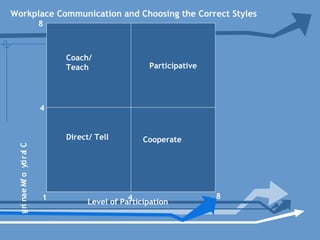
Participative
Coach/
Teach
Direct/ Tell Cooperate
1
4
4 8
8
Level of Participation
ClarityofMeaning
Workplace Communication and Choosing the Correct Styles
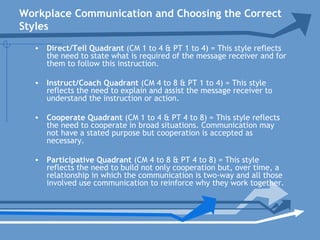
Workplace Communication and Choosing the Correct
Styles
• Direct/Tell Quadrant (CM 1 to 4 & PT 1 to 4) = This style reflects
the need to state what is required of the message receiver and for
them to follow this instruction.
• Instruct/Coach Quadrant (CM 4 to 8 & PT 1 to 4) = This style
reflects the need to explain and assist the message receiver to
understand the instruction or action.
• Cooperate Quadrant (CM 1 to 4 & PT 4 to 8) = This style reflects
the need to cooperate in broad situations. Communication may
not have a stated purpose but cooperation is accepted as
necessary.
• Participative Quadrant (CM 4 to 8 & PT 4 to 8) = This style
reflects the need to build not only cooperation but, over time, a
relationship in which the communication is two-way and all those
involved use communication to reinforce why they work together.
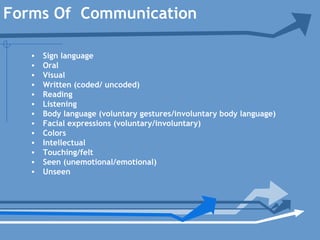
Forms Of Communication
• Sign language
• Oral
• Visual
• Written (coded/ uncoded)
• Reading
• Listening
• Body language (voluntary gestures/involuntary body language)
• Facial expressions (voluntary/involuntary)
• Colors
• Intellectual
• Touching/felt
• Seen (unemotional/emotional)
• Unseen
Communication Variables
There are numerous variables involved in the communication
process. Some of these variables are described below.
• Differences between the sender and receiver affect the odds of
successful communication.
– Attitudes: How different are the attitudes between the sender and
the receiver?
– Information levels. Is the sender or receiver significantly more
informed than the other?
– Communication skills. The greater the difference in the sender’s and
the receiver’s communication skills, the less likely it is that
communication will be successful
– Social systems provide a context or background for interpreting
messages. If the sender and receiver do not share a similar social
system, successful communication is more of a challenge.
– Sensory channel. The five senses (i.e., seeing, hearing, touching,
tasting, and smelling) are the basic channels of communication. Using
more channels increases the chance that communication will be
successful.
Communication Variables
• Differences in communication styles often create an extra
challenge. General behavior patterns of our personalities
form our personal communication styles. These patterns
can be productive, nonproductive, or even
counterproductive, and the interplay of these styles affects
the communication’s effectiveness.
• Differences in previous experiences create a filter through
which we hear the world. Inference, judgment, and
generalization can become as significant as facts.
• Cultural differences will be covered in more detail in Unit
4. Like the three variables described above, cultural
differences impact how a message is sent as well as the
manner in which a message is received. To be effective,
you need to be sensitive to cultural differences without
stereotyping.
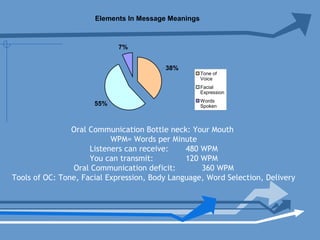
Elements In Message Meanings
55%
7%
38%
Tone of
Voice
Facial
Expression
Words
Spoken
Oral Communication Bottle neck: Your Mouth
WPM= Words per Minute
Listeners can receive: 480 WPM
You can transmit: 120 WPM
Oral Communication deficit: 360 WPM
Tools of OC: Tone, Facial Expression, Body Language, Word Selection, Delivery
Oral Communication
• Element to good talking
• Types of Oral communication
Elements of Good Talking
1. Voice Quality: vocal sounds one hears when another
speaks.
2. Includes: Pitch, tone, delivery speed and volume
3. Talking Style: monotone, sincere, dull, excited.
4. Word Choice and Vocabulary
5. Central Role of Adaptation: fitting the message to the
listener.
Talking is the oral expression of knowledge, viewpoints and
emotions through words.words.
The following are the determinants of good or bad talking.The following are the determinants of good or bad talking.
Voice Quality
• It is pitch and resonance of vocal sounds
• Not all voices are good
• How to improve yours:
– You know good voice quality.
– Listen to yourself.
– Do what you can to improve.
Think about the best/worst speakers.
1. Aik din Geo ke Saath -Sohail
2. Sohail Hashmi
3. Pervez Musharraf
Talking Style
• It is the blending of pitch,
speed, and volume.
• To improve
– Analyze your style. Listen to
yourself.
– Then do what you can to make
yours better.
Word Choice
• Adapt.
• Choose words in your listener’s
vocabulary.
• Avoid statements that give the wrong
impression.
• If you find yourself using negative words,
phrases or sentences, you need to take
corrective action i.e. Use “Positive Words”
• (Remember…if you don’t have anything
nice to say don’t say anything at all)
• Avoid jargon
Adaptation
• The preceding suggestion applied to
the whole message.
• It is more than just word choice. It
also concerns idea simplification.
Courtesy in Talking
• Don’t dominate or drown out others.
• Don’t butt in while others are talking.
• Don’t use big words to imply superiority.
• Good talkers encourage others to make
their voices heard.
• Apply the Golden Rule; accord others the
courtesy you expect from them.
Oral Communication
• Oral communication is fluid and dynamic, and is shaped by
both the speaker and the audience. Oral communication is
enhanced by nonverbal communication such as body
language and tone of voice.
• Types of oral communication include:
– Individual briefings.
– Phone conversations.
– Public speeches.
– On-air interviews.
– Public Service Announcement (radio and/or television)
Writing Communication
• In many situations, it is best to use written communication.
Never underestimate the value of documentation. It allows
the information to:
– Be consulted in the future.
– Exist independent of human memory.
– Be reviewed and revised before it is delivered.
– Be passed on intact to a second audience.
VISUAL FORMS OF
COMMUNICATIONWRITTEN (coded/uncoded)
• Letter
• Postcard
• Telegram
• Email
• Note
• Card (Birthday, Christmas, Etc)
• Poster
• Formal Notice
• Pointing Hand Or Arrow
• Signs (Words/Symbols)
Listening Communication
• Process of Listening
• Roadblocks of Listening
• Improve Listening Skills
“If speaking is silver,
then listening is gold.”
--Turkish Proverb
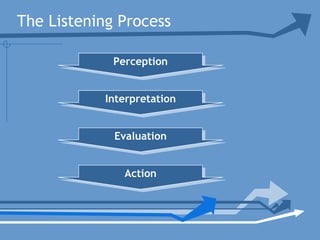
The Listening Process
EvaluationEvaluation
ActionAction
InterpretationInterpretation
PerceptionPerception
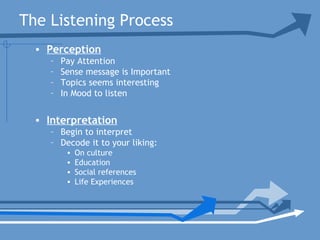
The Listening Process
• Perception
– Pay Attention
– Sense message is Important
– Topics seems interesting
– In Mood to listen
• Interpretation
– Begin to interpret
– Decode it to your liking:
• On culture
• Education
• Social references
• Life Experiences
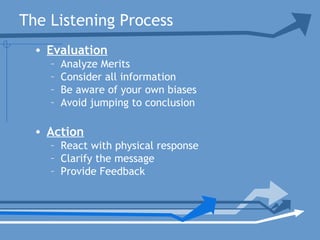
The Listening Process
• Evaluation
– Analyze Merits
– Consider all information
– Be aware of your own biases
– Avoid jumping to conclusion
• Action
– React with physical response
– Clarify the message
– Provide Feedback
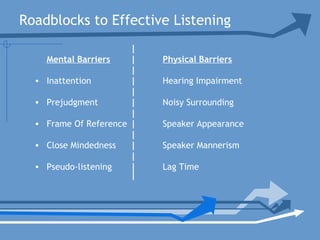
Roadblocks to Effective Listening
Roadblocks to effective listening can be external or internal.
• External roadblocks (e.g., noise, an uncomfortable temperature
or seating, or an inappropriate location) or internal. Try to be
aware of external roadblocks and offset them if possible.
• Internal roadblocks include a variety of conditions or reactions
within the speaker or audience, such as:
– Emotional interference.
– Defensiveness.
– Hearing only facts and not feelings.
– Not seeking clarification.
– Hearing what is expected instead of what is said.
– Stereotyping.
– The halo effect (i.e., the tendency for something to be influenced by
a loosely associated factor)
– Automatic dismissal (e.g., “We’ve never done it that way before.”)
– Resistance to change.
|
Mental Barriers | Physical Barriers
|
• Inattention | Hearing Impairment
|
• Prejudgment | Noisy Surrounding
|
• Frame Of Reference | Speaker Appearance
|
• Close Mindedness | Speaker Mannerism
|
• Pseudo-listening | Lag Time
|
Roadblocks to Effective Listening
• Noise can be interfere with every aspect of the communication
process. Noise may be external or internal
• External Noise: comes from you surroundings
– Phone line crackling with static
– A telephone ringing or a co-worker laughing in a cubical next to
you
• Internal noise: comes from within
– Such factors as dislike of your receiver
– Distraction by another problem
– Prejudice against a person
Cause of Miscommunication
The Ten Commandments
of Listening
1. Stop talking
2. Put talker at ease
3. Show talker you want to listen
4. Remove distractions
5. Empathize with talker
6. Be patient
7. Hold your temper
8. Go easy on argument and
criticism
9. Ask questions
10.Stop talking
2 EARS, 1 MOUTH
Listening in the Workplace
• Listening to superiors
• Listening to employees
• Listening to customers
Non-Verbal Communication
• Body Language
• Voluntary
• Involuntary
• Facial Expression
Types of nonverbal communication
• How we gesture with arms, fingers, hands, face
• How we stand, walk
• Our posture
• Our eye movements
• The clothes we wear and how we wear them
-Occasion, time of day, audience, colors of
clothes.
• How we decorate our bodies (tattoos, piercing)
1) Body language1) Body language
BODY LANGUAGE
• Voluntary Gestures
– Gestures 
– Raised Eyebrows (Meaning: 'Next!')
– Raised Hand (As A Greeting)
– Finger Pointing (To Indicate Position) 
– Shrug (For Indifference)
– Raised Hand (To Stop Further Discussion)
• Involuntary Body Language
– Shudder
– Flinch
– Positioning When Sitting
– Style Of Walking
– Posture
FACIAL EXPRESSIONS
• Voluntary
– Grimace
– Wink
– Withering Look
– Quizzical Look
• Involuntary
– Stunned Look
– Tic
– Open-mouthed
– Frequency Of Blinking
– Position Of Eyes When Remembering, Or Recounting
– Giveaways When Lying
– Tongue Lolling
Non-Verbal Communication
• Posture
– Hunched
– Upright
• MANNER
– Confident
– Hesitant
• HEAD
– Nod
– Shake Head
• TONGUE
– Lick Lips
– Stick Out Tongue
• EYES
– Rolled Eyes
– Looking Skyward
• Eye Contact (Hostile/Friendly)
– Avoidance Of Eye Contact
Non-Verbal Communication
• Colours
– Colour-coding
– Colours To Change Emotions
– Colours To Suit Situations (Funeral, Etc.)
– Colour-coordinated
• Clothing
– Functional
– Fashionable
– Condition (Clean/Dirty)
– Age
Non-Verbal Communication
• Intellectual Forms Of Communication
– Word/Picture Association
– Thought Processes From Clues (Deduction)
• FELT/TOUCHINGFELT/NON-TOUCHINGNON-EMOTIONAL
– Handshake
– Prod
• EMOTIONAL
– Caress
– Stroke
– Fumble
– Kiss
– Tickle
Types of nonverbal communication:
• Intimate zone physical contact to 18 inches
• common zone for intimate relationships
• Personal zone 18 inches to 4 feet
• common zone for interpersonal communication
• * Social zone 4 feet to 10- 12 feet
• normal distance used in work settings
• * Public zone 1 0- 12 feet and beyond
• communication at this distance is general formal
• Our behavior in each is determined by our culture.
• We need to be sensitive to the space conditioning of
others.
2) Space2) Space
Types of nonverbal communication:
• Concepts of time also vary by
culture.
• Punctuality, orderly activities
vary in importance by culture.
3) Time3) Time
Types of Nonverbal Communication
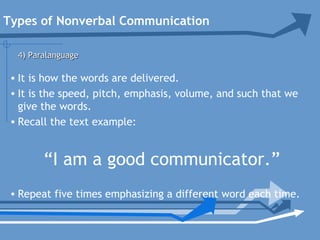
• It is how the words are delivered.
• It is the speed, pitch, emphasis, volume, and such that we
give the words.
• Recall the text example:
“I am a good communicator.”
• Repeat five times emphasizing a different word each time.
4) Paralanguage4) Paralanguage
7’C of Effective Communication
• Correctness
• Conciseness
• Clarity
• Completeness
• Concreteness
• Consideration
• Courtesy
1.Complete
The essential elements of good business communication have not changed.
Following are the seven "C's" of a good business letter:
• COMPLETE
• The message should be complete to bring desirable results.
• It should include everything the reader needs for the reaction you
desire.
• You must know what information our reader wants or needs You
should be able to know the reader’s background viewpoint needs
attitudes and emotions.
• Provide all necessary information.
• Answer all questions asked.
• Give something Extra, when Desirable.
– Have you given all the facts?
– Have you covered the essentials?
– Have you answered all his/her questions?
– Did you PLAN what you said?
1.Complete
Check for 5 W and 1 H
1.What
2.Why
3.When
4.Where
5.Who
1.How
2.Courteous
• Courtesy is more important and advantageous in business
writing than it is in face to face communication or
conversation.
• Courteous message strengthen present relations and make
new friends. It is a goodwill building.
• Answer your mail promptly
• Be sincerely tactful thoughtful and appreciative
• Use expressions that show respect
– Will it win good will?
– Have you used positive, "pleasant-toned" words?
– Have you used "I appreciate," "please", and "thank you"
somewhere in your message?
– Would you enjoy reading what you have said?
3.Consider
• Consideration refers to you attitude sympathy the human
touch and understanding of human nature.
• Consideration means the message with the receiver in
mind. You should try to visualize your readers their desires
problems emotions circumstances and possible reaction to
your request.
• Focus on you instead I & We
• Show reader benefit or interest in reader
• Emphasize
– The YOU-Attitude
– Have you put the client first?
– Have you floodlighted his/her interests?
– Have you walked in his/her moccasins?
– Have you talked his/her language?
4.Consciences
• The writer is also a loser if he writes wordy
messages because it involves more time and
money to type and read. Conciseness makes the
message more understandable and
comprehensible
• Eliminate wordy Expressions.
• Include only relevant material.
• Avoided unnecessary Repetition.
– Have you plunged right into the subject of the message?
– Have you avoided rehashing the reader's letter?
– Have you said enough, but just enough?
– Have you avoided needless "filler" words and phrase?
5.Clear
• Clarity demands that the business message should be
correct concise complete concrete and with consideration
• Use the right level of language
• Proper punctuation make the writing clear
• Choose short, familiar, conversational words.
• Construct effective sentences and paragraphs.
• Achieve appropriate readability (and listen ability).
• Include examples, illustrations, and other visual aids, when
desirable.
• Check Accuracy of fact figure & Words
– Have you used familiar words, short sentences?
– Have you presented only one idea in each sentence?
– Have you avoided "business" and technical terms?
– Have you used the reader's language?
6.Concrete
The business writing should be specific definite
unambiguous and vivid rather than vague and
general The following guidelines lead to
concreteness.
• Use specific facts and figures
• Put action in your verb
• Choose vivid image building words.
– Have you given the crisp details the client needs?
– Have you made the details razor and needle-sharp?
– Have you flashed word pictures, made facts vivid?
7.Correct
To be correct in communication the following principles should be
borne in mind.
• Use the correct level of language
• Include only facts words and figures
• Maintain acceptable writing mechanics
• Apply the following qualities
• There should be proper grammar punctuation spelling and
paragraphing
– Have you checked all facts for correctness?
– Have you spelled the reader's name correctly?
– Have you verified all numbers and amounts?
– Is the appearance of the letter effective? Is it clean, well-
spaced?
– Have you checked your spelling, punctuation, grammar, etc.?
• The chief art in writing is to know:
• How much to put in.
• What to leave out.
• When to quit.
Thank You

Session2

  • 1.
    Business Communication Session-2 • Oral,Writing and Listening Skills • Non-Verbal Language • 7’C of Communication
  • 2.
    Participative Coach/ Teach Direct/ Tell Cooperate 1 4 48 8 Level of Participation ClarityofMeaning Workplace Communication and Choosing the Correct Styles
  • 3.
    Workplace Communication andChoosing the Correct Styles • Direct/Tell Quadrant (CM 1 to 4 & PT 1 to 4) = This style reflects the need to state what is required of the message receiver and for them to follow this instruction. • Instruct/Coach Quadrant (CM 4 to 8 & PT 1 to 4) = This style reflects the need to explain and assist the message receiver to understand the instruction or action. • Cooperate Quadrant (CM 1 to 4 & PT 4 to 8) = This style reflects the need to cooperate in broad situations. Communication may not have a stated purpose but cooperation is accepted as necessary. • Participative Quadrant (CM 4 to 8 & PT 4 to 8) = This style reflects the need to build not only cooperation but, over time, a relationship in which the communication is two-way and all those involved use communication to reinforce why they work together.
  • 4.
    Forms Of Communication •Sign language • Oral • Visual • Written (coded/ uncoded) • Reading • Listening • Body language (voluntary gestures/involuntary body language) • Facial expressions (voluntary/involuntary) • Colors • Intellectual • Touching/felt • Seen (unemotional/emotional) • Unseen
  • 5.
    Communication Variables There arenumerous variables involved in the communication process. Some of these variables are described below. • Differences between the sender and receiver affect the odds of successful communication. – Attitudes: How different are the attitudes between the sender and the receiver? – Information levels. Is the sender or receiver significantly more informed than the other? – Communication skills. The greater the difference in the sender’s and the receiver’s communication skills, the less likely it is that communication will be successful – Social systems provide a context or background for interpreting messages. If the sender and receiver do not share a similar social system, successful communication is more of a challenge. – Sensory channel. The five senses (i.e., seeing, hearing, touching, tasting, and smelling) are the basic channels of communication. Using more channels increases the chance that communication will be successful.
  • 6.
    Communication Variables • Differencesin communication styles often create an extra challenge. General behavior patterns of our personalities form our personal communication styles. These patterns can be productive, nonproductive, or even counterproductive, and the interplay of these styles affects the communication’s effectiveness. • Differences in previous experiences create a filter through which we hear the world. Inference, judgment, and generalization can become as significant as facts. • Cultural differences will be covered in more detail in Unit 4. Like the three variables described above, cultural differences impact how a message is sent as well as the manner in which a message is received. To be effective, you need to be sensitive to cultural differences without stereotyping.
  • 7.
    Elements In MessageMeanings 55% 7% 38% Tone of Voice Facial Expression Words Spoken Oral Communication Bottle neck: Your Mouth WPM= Words per Minute Listeners can receive: 480 WPM You can transmit: 120 WPM Oral Communication deficit: 360 WPM Tools of OC: Tone, Facial Expression, Body Language, Word Selection, Delivery
  • 8.
    Oral Communication • Elementto good talking • Types of Oral communication
  • 9.
    Elements of GoodTalking 1. Voice Quality: vocal sounds one hears when another speaks. 2. Includes: Pitch, tone, delivery speed and volume 3. Talking Style: monotone, sincere, dull, excited. 4. Word Choice and Vocabulary 5. Central Role of Adaptation: fitting the message to the listener. Talking is the oral expression of knowledge, viewpoints and emotions through words.words. The following are the determinants of good or bad talking.The following are the determinants of good or bad talking.
  • 10.
    Voice Quality • Itis pitch and resonance of vocal sounds • Not all voices are good • How to improve yours: – You know good voice quality. – Listen to yourself. – Do what you can to improve. Think about the best/worst speakers. 1. Aik din Geo ke Saath -Sohail 2. Sohail Hashmi 3. Pervez Musharraf
  • 11.
    Talking Style • Itis the blending of pitch, speed, and volume. • To improve – Analyze your style. Listen to yourself. – Then do what you can to make yours better.
  • 12.
    Word Choice • Adapt. •Choose words in your listener’s vocabulary. • Avoid statements that give the wrong impression. • If you find yourself using negative words, phrases or sentences, you need to take corrective action i.e. Use “Positive Words” • (Remember…if you don’t have anything nice to say don’t say anything at all) • Avoid jargon
  • 13.
    Adaptation • The precedingsuggestion applied to the whole message. • It is more than just word choice. It also concerns idea simplification.
  • 14.
    Courtesy in Talking •Don’t dominate or drown out others. • Don’t butt in while others are talking. • Don’t use big words to imply superiority. • Good talkers encourage others to make their voices heard. • Apply the Golden Rule; accord others the courtesy you expect from them.
  • 15.
    Oral Communication • Oralcommunication is fluid and dynamic, and is shaped by both the speaker and the audience. Oral communication is enhanced by nonverbal communication such as body language and tone of voice. • Types of oral communication include: – Individual briefings. – Phone conversations. – Public speeches. – On-air interviews. – Public Service Announcement (radio and/or television)
  • 16.
  • 17.
    Writing Communication • Inmany situations, it is best to use written communication. Never underestimate the value of documentation. It allows the information to: – Be consulted in the future. – Exist independent of human memory. – Be reviewed and revised before it is delivered. – Be passed on intact to a second audience.
  • 18.
    VISUAL FORMS OF COMMUNICATIONWRITTEN (coded/uncoded) •Letter • Postcard • Telegram • Email • Note • Card (Birthday, Christmas, Etc) • Poster • Formal Notice • Pointing Hand Or Arrow • Signs (Words/Symbols)
  • 19.
    Listening Communication • Processof Listening • Roadblocks of Listening • Improve Listening Skills
  • 20.
    “If speaking issilver, then listening is gold.” --Turkish Proverb
  • 21.
  • 22.
    The Listening Process •Perception – Pay Attention – Sense message is Important – Topics seems interesting – In Mood to listen • Interpretation – Begin to interpret – Decode it to your liking: • On culture • Education • Social references • Life Experiences
  • 23.
    The Listening Process •Evaluation – Analyze Merits – Consider all information – Be aware of your own biases – Avoid jumping to conclusion • Action – React with physical response – Clarify the message – Provide Feedback
  • 24.
    Roadblocks to EffectiveListening Roadblocks to effective listening can be external or internal. • External roadblocks (e.g., noise, an uncomfortable temperature or seating, or an inappropriate location) or internal. Try to be aware of external roadblocks and offset them if possible. • Internal roadblocks include a variety of conditions or reactions within the speaker or audience, such as: – Emotional interference. – Defensiveness. – Hearing only facts and not feelings. – Not seeking clarification. – Hearing what is expected instead of what is said. – Stereotyping. – The halo effect (i.e., the tendency for something to be influenced by a loosely associated factor) – Automatic dismissal (e.g., “We’ve never done it that way before.”) – Resistance to change.
  • 25.
    | Mental Barriers |Physical Barriers | • Inattention | Hearing Impairment | • Prejudgment | Noisy Surrounding | • Frame Of Reference | Speaker Appearance | • Close Mindedness | Speaker Mannerism | • Pseudo-listening | Lag Time | Roadblocks to Effective Listening
  • 26.
    • Noise canbe interfere with every aspect of the communication process. Noise may be external or internal • External Noise: comes from you surroundings – Phone line crackling with static – A telephone ringing or a co-worker laughing in a cubical next to you • Internal noise: comes from within – Such factors as dislike of your receiver – Distraction by another problem – Prejudice against a person Cause of Miscommunication
  • 27.
    The Ten Commandments ofListening 1. Stop talking 2. Put talker at ease 3. Show talker you want to listen 4. Remove distractions 5. Empathize with talker 6. Be patient 7. Hold your temper 8. Go easy on argument and criticism 9. Ask questions 10.Stop talking 2 EARS, 1 MOUTH
  • 28.
    Listening in theWorkplace • Listening to superiors • Listening to employees • Listening to customers
  • 29.
    Non-Verbal Communication • BodyLanguage • Voluntary • Involuntary • Facial Expression
  • 30.
    Types of nonverbalcommunication • How we gesture with arms, fingers, hands, face • How we stand, walk • Our posture • Our eye movements • The clothes we wear and how we wear them -Occasion, time of day, audience, colors of clothes. • How we decorate our bodies (tattoos, piercing) 1) Body language1) Body language
  • 31.
    BODY LANGUAGE • VoluntaryGestures – Gestures  – Raised Eyebrows (Meaning: 'Next!') – Raised Hand (As A Greeting) – Finger Pointing (To Indicate Position)  – Shrug (For Indifference) – Raised Hand (To Stop Further Discussion) • Involuntary Body Language – Shudder – Flinch – Positioning When Sitting – Style Of Walking – Posture
  • 32.
    FACIAL EXPRESSIONS • Voluntary –Grimace – Wink – Withering Look – Quizzical Look • Involuntary – Stunned Look – Tic – Open-mouthed – Frequency Of Blinking – Position Of Eyes When Remembering, Or Recounting – Giveaways When Lying – Tongue Lolling
  • 33.
    Non-Verbal Communication • Posture –Hunched – Upright • MANNER – Confident – Hesitant • HEAD – Nod – Shake Head • TONGUE – Lick Lips – Stick Out Tongue • EYES – Rolled Eyes – Looking Skyward • Eye Contact (Hostile/Friendly) – Avoidance Of Eye Contact
  • 34.
    Non-Verbal Communication • Colours –Colour-coding – Colours To Change Emotions – Colours To Suit Situations (Funeral, Etc.) – Colour-coordinated • Clothing – Functional – Fashionable – Condition (Clean/Dirty) – Age
  • 35.
    Non-Verbal Communication • IntellectualForms Of Communication – Word/Picture Association – Thought Processes From Clues (Deduction) • FELT/TOUCHINGFELT/NON-TOUCHINGNON-EMOTIONAL – Handshake – Prod • EMOTIONAL – Caress – Stroke – Fumble – Kiss – Tickle
  • 36.
    Types of nonverbalcommunication: • Intimate zone physical contact to 18 inches • common zone for intimate relationships • Personal zone 18 inches to 4 feet • common zone for interpersonal communication • * Social zone 4 feet to 10- 12 feet • normal distance used in work settings • * Public zone 1 0- 12 feet and beyond • communication at this distance is general formal • Our behavior in each is determined by our culture. • We need to be sensitive to the space conditioning of others. 2) Space2) Space
  • 37.
    Types of nonverbalcommunication: • Concepts of time also vary by culture. • Punctuality, orderly activities vary in importance by culture. 3) Time3) Time
  • 38.
    Types of NonverbalCommunication • It is how the words are delivered. • It is the speed, pitch, emphasis, volume, and such that we give the words. • Recall the text example: “I am a good communicator.” • Repeat five times emphasizing a different word each time. 4) Paralanguage4) Paralanguage
  • 39.
    7’C of EffectiveCommunication • Correctness • Conciseness • Clarity • Completeness • Concreteness • Consideration • Courtesy
  • 40.
    1.Complete The essential elementsof good business communication have not changed. Following are the seven "C's" of a good business letter: • COMPLETE • The message should be complete to bring desirable results. • It should include everything the reader needs for the reaction you desire. • You must know what information our reader wants or needs You should be able to know the reader’s background viewpoint needs attitudes and emotions. • Provide all necessary information. • Answer all questions asked. • Give something Extra, when Desirable. – Have you given all the facts? – Have you covered the essentials? – Have you answered all his/her questions? – Did you PLAN what you said?
  • 41.
    1.Complete Check for 5W and 1 H 1.What 2.Why 3.When 4.Where 5.Who 1.How
  • 42.
    2.Courteous • Courtesy ismore important and advantageous in business writing than it is in face to face communication or conversation. • Courteous message strengthen present relations and make new friends. It is a goodwill building. • Answer your mail promptly • Be sincerely tactful thoughtful and appreciative • Use expressions that show respect – Will it win good will? – Have you used positive, "pleasant-toned" words? – Have you used "I appreciate," "please", and "thank you" somewhere in your message? – Would you enjoy reading what you have said?
  • 43.
    3.Consider • Consideration refersto you attitude sympathy the human touch and understanding of human nature. • Consideration means the message with the receiver in mind. You should try to visualize your readers their desires problems emotions circumstances and possible reaction to your request. • Focus on you instead I & We • Show reader benefit or interest in reader • Emphasize – The YOU-Attitude – Have you put the client first? – Have you floodlighted his/her interests? – Have you walked in his/her moccasins? – Have you talked his/her language?
  • 44.
    4.Consciences • The writeris also a loser if he writes wordy messages because it involves more time and money to type and read. Conciseness makes the message more understandable and comprehensible • Eliminate wordy Expressions. • Include only relevant material. • Avoided unnecessary Repetition. – Have you plunged right into the subject of the message? – Have you avoided rehashing the reader's letter? – Have you said enough, but just enough? – Have you avoided needless "filler" words and phrase?
  • 45.
    5.Clear • Clarity demandsthat the business message should be correct concise complete concrete and with consideration • Use the right level of language • Proper punctuation make the writing clear • Choose short, familiar, conversational words. • Construct effective sentences and paragraphs. • Achieve appropriate readability (and listen ability). • Include examples, illustrations, and other visual aids, when desirable. • Check Accuracy of fact figure & Words – Have you used familiar words, short sentences? – Have you presented only one idea in each sentence? – Have you avoided "business" and technical terms? – Have you used the reader's language?
  • 46.
    6.Concrete The business writingshould be specific definite unambiguous and vivid rather than vague and general The following guidelines lead to concreteness. • Use specific facts and figures • Put action in your verb • Choose vivid image building words. – Have you given the crisp details the client needs? – Have you made the details razor and needle-sharp? – Have you flashed word pictures, made facts vivid?
  • 47.
    7.Correct To be correctin communication the following principles should be borne in mind. • Use the correct level of language • Include only facts words and figures • Maintain acceptable writing mechanics • Apply the following qualities • There should be proper grammar punctuation spelling and paragraphing – Have you checked all facts for correctness? – Have you spelled the reader's name correctly? – Have you verified all numbers and amounts? – Is the appearance of the letter effective? Is it clean, well- spaced? – Have you checked your spelling, punctuation, grammar, etc.? • The chief art in writing is to know: • How much to put in. • What to leave out. • When to quit.
  • 48.