Presented By:
Suchitra Singh
Communication Skills
Communication
• Communication is a dynamic process.
• Through this process we convey a thought or
feeling to someone else.
• How it is received depends on a set of events,
stimuli, that person is exposed to.
• How you say, what you say plays an
important role in communication.
• Influence is the most basic function of
communication.
• Cybernetics is the science of Communication.
Communication IQ
Communication which occupies approximately
70% of our waking hours, is what many
leaders find the most frustrating.
Many of us were never taught to communicate
in ways that lead to positive outcomes.
Here’s how to communicate better to get better
outcomes.
To Raise Your Communication IQ
• Talk less, hear more:
We want to be heard and listened to but
we don’t always concentrate on listening
to others.
 We focus more on our agenda than on
the other person’s concerns or issues.
• Don’t Shoot the messenger
 We want to understand but our ability is
tainted by our perceptions of the person
speaking or the outcome we are looking for.
So, we often pass judgment on the speaker
and disregard the message.
Concentrate on the message not the
messenger.
• Avoid Mind Reading
 We want some kind of action or response
from another person.
 However, we don’t let them know what we
really want or how to achieve it.
 Before assuming the other knows what you
want, first inform and then ask for
feedback.
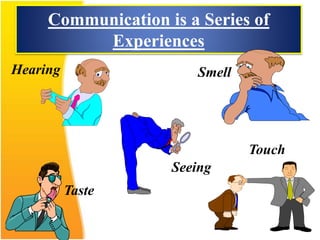
Communication is a Series of
Experiences
Hearing
Taste
Seeing
Touch
Smell
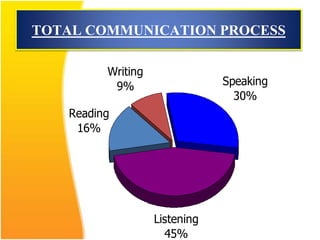
TOTAL COMMUNICATION PROCESS
Reading
16%
Writing
9% Speaking
30%
Listening
45%
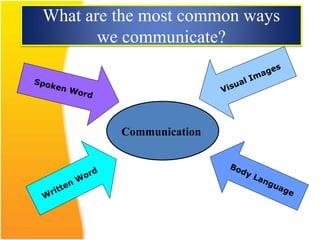
What are the most common ways
we communicate?
Communication
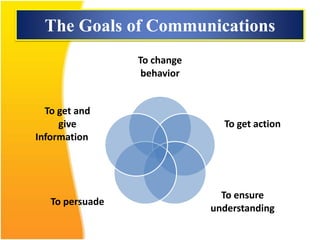
The Goals of Communications
To change
behavior
To get action
To ensure
understanding
To persuade
To get and
give
Information
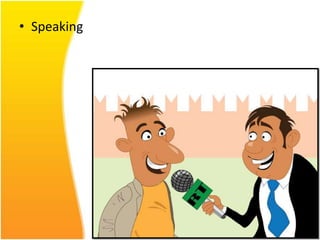
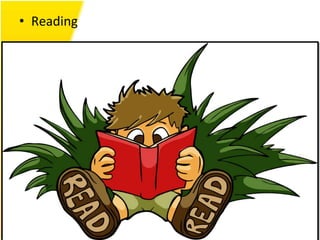
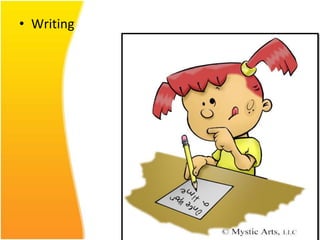
Components of Communication
Listening
• Speaking
• Reading
• Writing
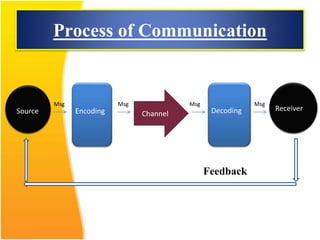
Process of Communication
Source Encoding Channel Decoding Receiver
Feedback
Msg Msg Msg Msg
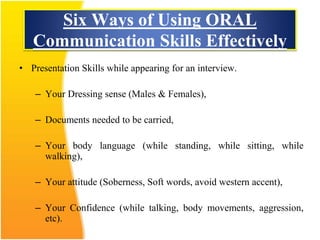
Six Ways of Using ORAL
Communication Skills Effectively
• Presentation Skills while appearing for an interview.
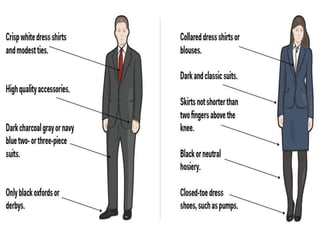
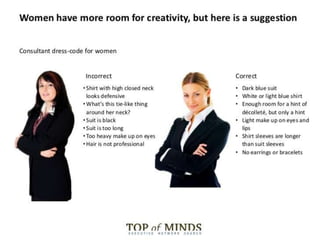
– Your Dressing sense (Males & Females),
– Documents needed to be carried,
– Your body language (while standing, while sitting, while
walking),
– Your attitude (Soberness, Soft words, avoid western accent),
– Your Confidence (while talking, body movements, aggression,
etc).
Audience Awareness
• The Classroom Environment
• Classroom Strategies
Critical Listening
Few tips to reduces the critical listening and
increases the active listening:
1. Understand your own communication style.
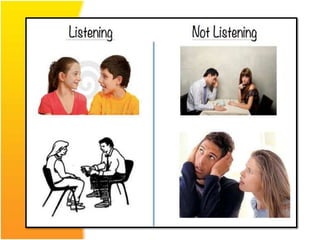
2. Be an active listener.
3. Use normal communication.
4. Give Feedback
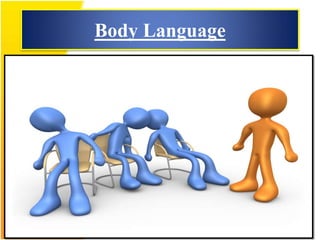
Body Language
Kinesics
Kinesics means body movement.
Body language is a reflection of thoughts and
feelings.
By nodding our head, blinking eyes, waving
hands; we send out signals and messages which
are louder then words.
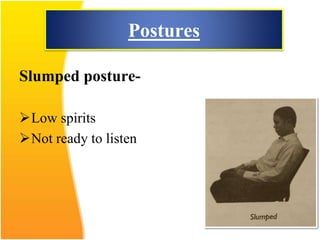
Postures
Slumped posture-
Low spirits
Not ready to listen
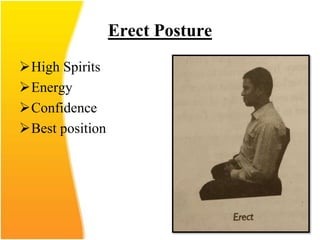
Erect Posture
High Spirits
Energy
Confidence
Best position
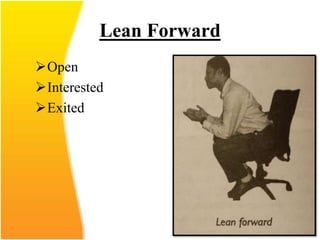
Lean Forward
Open
Interested
Exited
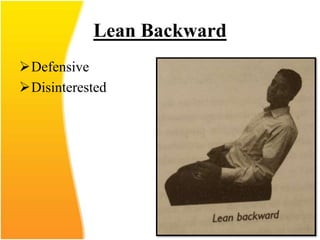
Lean Backward
Defensive
Disinterested
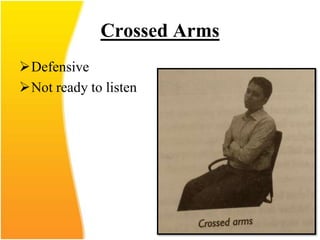
Crossed Arms
Defensive
Not ready to listen
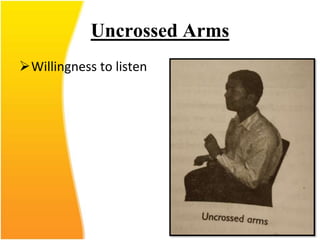
Uncrossed Arms
Willingness to listen
Oculesics/Eye Contact
 Oculesics is the study of role of eyes in non- verbal
communication.
 Eyes are perhaps the most expressive features on
human being.
 Eye contact can indicate a lot of emotions ranging
from interest, attention and involvement.
 A good speaker looks at his audience while speaking
and not elsewhere.
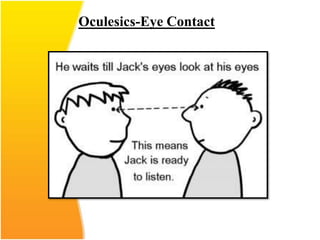
Oculesics-Eye Contact
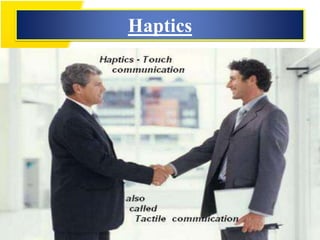
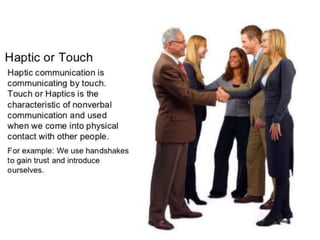
Haptics
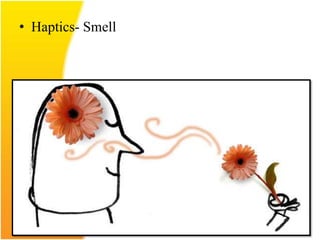
• Haptics- Smell
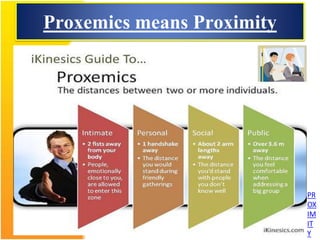
Proxemics means Proximity
PR
OX
IM
IT
Y
 Clothing is the primary instrument in creating a
positive first impressions.
 Clothing can increases your perceived status among
your peers.
 Dressing sharp helps with your confidence.
 The requirements of dressing sharp teaches
responsibility.
Artifacts-Dress & Attire
A good dresser notices detail in others.
 Dressing sharp makes you more useful at
work.
Colors and patterns speak for you.
Specific clothing pieces make statements
about you.
Written Communication
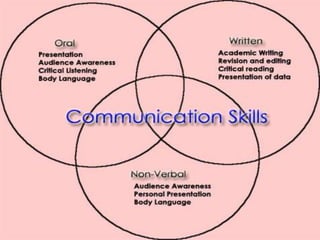
• Academic writing
• Revision and editing
• Critical Reading
• Presentation of Data
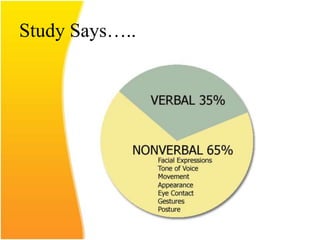
Study Says…..
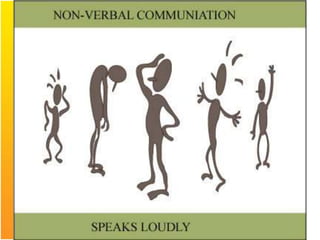
Non-Verbal Communication
 Non-verbal communication means any way of expressing yourself to
others without words, meaning either spoken, written or both.
 A good example of non-verbal communication would be a traffic sign
with a curving arrow indicating a sharp turn in the road.
 Face to face, a wink, or a knowing look might communicate a lot to
another person.
 Over the phone, you might sigh, or grunt your approval.
 Body Language like posture, gestures, movements or facial expressions
are a form of non-verbal communication.
Importance of Non-verbal
Communication
 Complement verbal message by adding to its meaning.
 Regulate verbal communication.
 Can substitute for verbal message.
 Accent what you are saying.
 Be used as follow up and reiterate verbal message.
 Emphasize parts of verbal message.
 Contradict verbal messages.
SIX WAYS OF USING NON-VERBAL
COMMUNICATION SKILLS EFFECTIVELY
Some major areas of nonverbal behaviors to
explore are:
 Eye contact
 Facial expressions
 Gestures
 Posture and body orientation
 Proximity
 Paralinguistic
 Humor
EYE Contact
Eye is an direct and most expressive part of our body.
Different ways of Eye Contact:
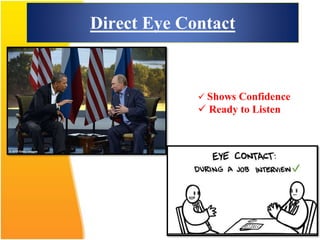
– Direct Eye Contact: (Shows confidence, Ready to listen)
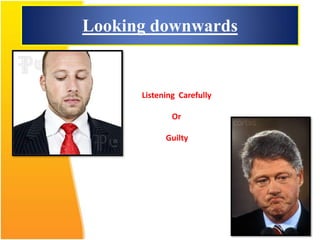
– Looking downwards (Listening carefully or Guilty)
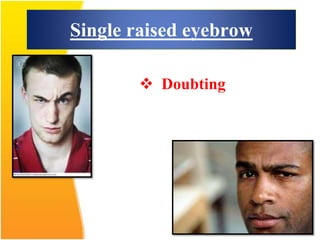
– Single raised eyebrow (Doubting)
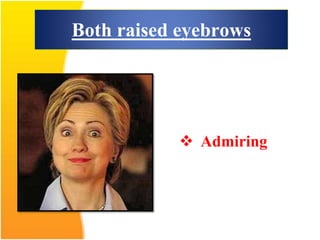
– Both raised eyebrows (Admiring)
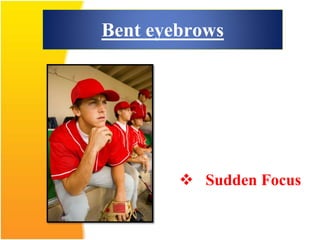
– Bent eyebrows (Sudden focus)
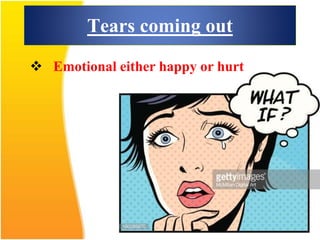
– Tears coming out (Emotional either happy or hurt)
Direct Eye Contact
 Shows Confidence
 Ready to Listen
Looking downwards
Listening Carefully
Or
Guilty
Single raised eyebrow
 Doubting
Both raised eyebrows
 Admiring
Bent eyebrows
 Sudden Focus
Tears coming out
 Emotional either happy or hurt
6 ways to dramatically
improve your eye contact
skills
Talking to a group
 When talking to a group of people it is great to have
direct contact with your listeners.
 Don’t make the mistake of maintaining eye contact
with just one person as this will stop the other
members of the group from listening.
 To get past this, focus on a different member of the
group with every new sentence.
 This way you are talking to all of the group and
keeping them all interested.
Talking to an individual
 It is great to maintain eye contact when talking to a person
however it can become a bit creepy and uncomfortable if
you stare intensely at them.
 To combat this, break eye contact every 5 seconds or so.
 When breaking the eye contact don’t look down as this
might indicate the ending of your part of the conversation.
Instead, look up or to the side as if your are remembering
something.
 So when your listener sees this they will think you are
trying to remember something and keep on listening to
you.
Listening to someone
 When you are listening to someone it can be off putting for the
talker if you stare at them too hard.
 The technique is called ‘The triangle’.
 This is when I look at one eye for about 5 seconds, look at the
other eye for 5 seconds and then look at the mouth for 5
seconds and keep on rotating in this way.
 This technique coupled with other listening skills such as
nodding, occasional agreement words such as ‘yes’, ‘Uh –huh’
‘mm’ etc is a great way to keep the talker talking and to show
them you are interested in what they are saying.
Arguing
 Arguing with someone is a skill in itself and if you
want to compete in an argument holding the gaze
shows strength.
 If you look away when arguing with someone you
have all but lost the argument.
 Obviously this depends on who you are arguing with
but in general it is better to hold the gaze whilst you
are making your point and also when you are
listening to the other person.
We have all come across the person who is
great at arguing and making you feel small,
you will notice that everyone who is like this
try to stare you out.
 Stare back, it will surprise them, piss them off
and put them off what they are trying to say.
Staying silent and staring at someone who is
trying to rile you is also an effective way to
win an argument without saying a word.
Attracting someone
 When you are trying to attract someone and show them you
are interested you can talk and listen with your eyes.
 When a person you like is speaking use the whole face as
your focal point. Look at their eyes, listen to what they are
saying, smile in the appropriate places, raise your eyebrows in
the appropriate places.
 Smiling when listening to someone is a great way to show you
are interested in them.
 You have to listen with your ears as well as listening with your
eyes (yes I did mean listening with your eyes, you listen to
someone’s body language with your eyes)
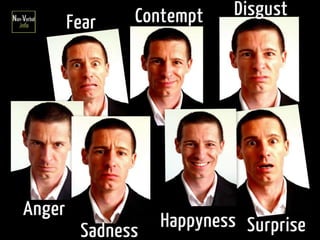
FACIAL EXPRESSION
Smile covers the most part of facial expression:
Smiling is a powerful cue that transmits:
– Happiness
– Friendliness
– Warmth
– Liking
– Affiliation
GESTURES
• If you fail to gesture while speaking, you may be
perceived as boring, stiff and unanimated.
• A lively and animated teaching style captures
students' attention, makes the material more
interesting, facilitates learning and provides a bit
of entertainment.
• Head nods, a form of gestures, communicate
positive reinforcement to students and indicate
that you are listening.
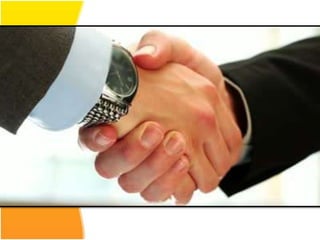
Handshake
 Hands Not Damp or Clammy.
 Firm Grip, But Not Bone Crusher or Wimp.
 Thumb and Forefinger Web Touches the Other Person’s
Web Area.
 Maintain Eye Contact During Handshake.
 Give a Couple of Shakes – Then Let Go.
 Stand Up When Handshaking.
Different Kinds of Handshakes
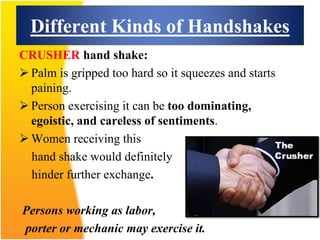
CRUSHER hand shake:
 Palm is gripped too hard so it squeezes and starts
paining.
 Person exercising it can be too dominating,
egoistic, and careless of sentiments.
 Women receiving this
hand shake would definitely
hinder further exchange.
Persons working as labor,
porter or mechanic may exercise it.
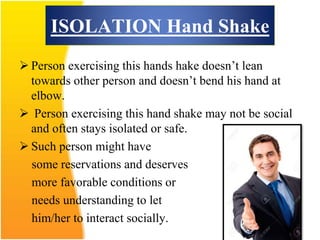
ISOLATION Hand Shake
 Person exercising this hands hake doesn’t lean
towards other person and doesn’t bend his hand at
elbow.
 Person exercising this hand shake may not be social
and often stays isolated or safe.
 Such person might have
some reservations and deserves
more favorable conditions or
needs understanding to let
him/her to interact socially.
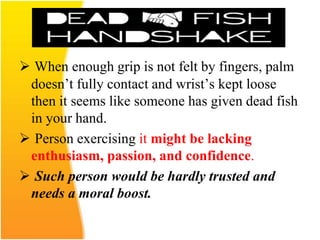
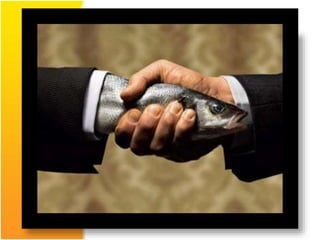
 When enough grip is not felt by fingers, palm
doesn’t fully contact and wrist’s kept loose
then it seems like someone has given dead fish
in your hand.
 Person exercising it might be lacking
enthusiasm, passion, and confidence.
 Such person would be hardly trusted and
needs a moral boost.
SKIPPING Handshake
 When only fingers of other person touches to your palm then it
seems that person wants to avoid full contact of palms and is
in hurry.
 Person exercising it might be not paying enough attention to
you or not serious about relationship or refraining it.
 In some cases, person might have genuine reason to skip
handshake and rush for other tasks.
 You would receive such hand shake from surgeons, craftsmen
or performing artists because they protect their fingers from
being hurt. Also, women or religious leaders may offer this
hand shake as part of custom.
DOMED PALM Handshake
When palm of other person doesn’t exert
enough pressure on yours and it appears to be
curved inside then that person may want to
not maintain rapport with you willfully.
Striking positive communication from your
side could alter person's perceptions about
you.
PALM UP/DOWN Handshake
 When palm of other person faces
downward (palm down) then it simply
expresses desire of controlling the
relationship whereas palm facing
upwards (palm up) expresses desire
of letting you control it.
Such kind of handshakes is offered to
maintain hierarchy or favoritism. This
handshake should be avoided to
motivate equality.
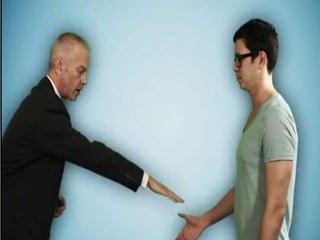
INVADER Handshake
When person pushes hand much inside (stab)
or pulls your hand out (grab) of invisible
interpersonal boundary then it’s quite obvious
that person is unaware of comfortable social
distance.
Such person should undergo immediate
consultation.
HANDCUFF Handshake
When hand of other person covers over union
of palms then it becomes the handcuff. Person
exercising it wants to gain or express
sympathy and fulfill personal interest.
 Most politicians offer this kind of handshake
during election campaigns or meeting thus it's
less trustworthy.
It can be exercised in exceptional case like at
the time of condolence or while passing deep
gratitude informally.
HYGIENIC Handshake
When person suddenly withdraws hand right
after palms come into contact then it suggests
that the person wants to avoid any kind of
infection caused by physical contact or
proximity.
Such person may not want to communicate (at
given time) with you spontaneously due to
some personal differences or insecure feelings.
Also, kids may exercise it with strangers.

CLOSE UP Handshake
When person exercises a hands hake by keeping
hand in front of chest, bringing torso and face
much closer then it becomes very personal and
intimate.
This kind of handshake’s only acceptable
among women, children, elders - children, close
relatives and couples closely.
 Politicians and bureaucrats might exercise it to
ensure trustworthiness looking into eyes.
Fingers
Legs – Sitting Positions
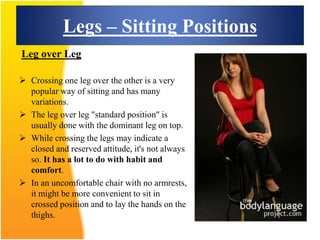
Leg over Leg
 Crossing one leg over the other is a very
popular way of sitting and has many
variations.
 The leg over leg "standard position" is
usually done with the dominant leg on top.
 While crossing the legs may indicate a
closed and reserved attitude, it's not always
so. It has a lot to do with habit and
comfort.
 In an uncomfortable chair with no armrests,
it might be more convenient to sit in
crossed position and to lay the hands on the
thighs.
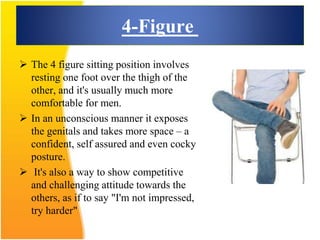
4-Figure
 The 4 figure sitting position involves
resting one foot over the thigh of the
other, and it's usually much more
comfortable for men.
 In an unconscious manner it exposes
the genitals and takes more space – a
confident, self assured and even cocky
posture.
 It's also a way to show competitive
and challenging attitude towards the
others, as if to say "I'm not impressed,
try harder"
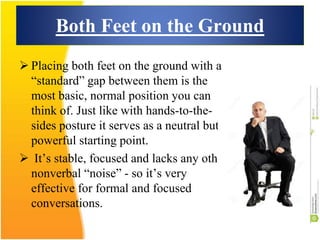
Both Feet on the Ground
 Placing both feet on the ground with a
“standard” gap between them is the
most basic, normal position you can
think of. Just like with hands-to-the-
sides posture it serves as a neutral but
powerful starting point.
 It’s stable, focused and lacks any other
nonverbal “noise” - so it’s very
effective for formal and focused
conversations.
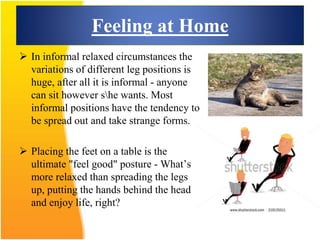
Feeling at Home
 In informal relaxed circumstances the
variations of different leg positions is
huge, after all it is informal - anyone
can sit however she wants. Most
informal positions have the tendency to
be spread out and take strange forms.
 Placing the feet on a table is the
ultimate "feel good" posture - What’s
more relaxed than spreading the legs
up, putting the hands behind the head
and enjoy life, right?
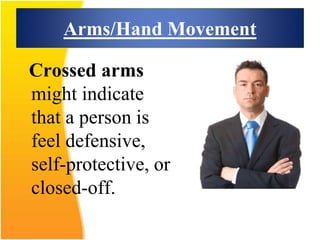
Arms/Hand Movement
Crossed arms
might indicate
that a person is
feel defensive,
self-protective, or
closed-off.
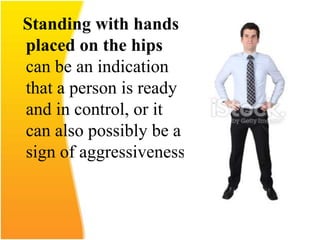
Standing with hands
placed on the hips
can be an indication
that a person is ready
and in control, or it
can also possibly be a
sign of aggressiveness.
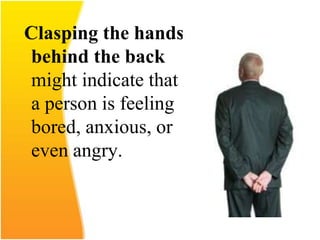
Clasping the hands
behind the back
might indicate that
a person is feeling
bored, anxious, or
even angry.
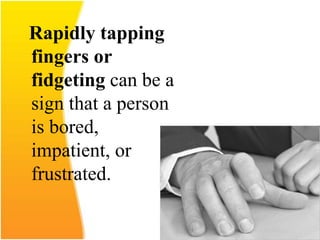
Rapidly tapping
fingers or
fidgeting can be a
sign that a person
is bored,
impatient, or
frustrated.
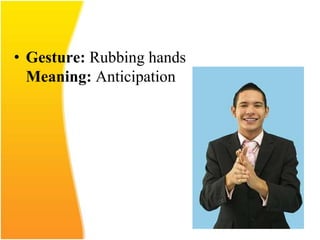
• Gesture: Rubbing hands
Meaning: Anticipation
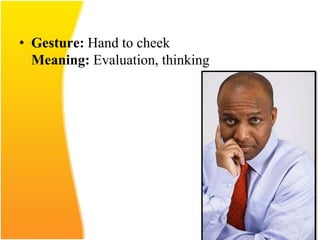
• Gesture: Hand to cheek
Meaning: Evaluation, thinking
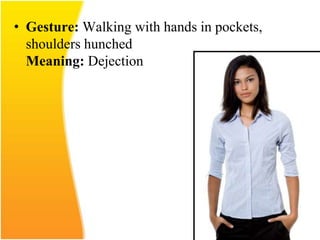
• Gesture: Walking with hands in pockets,
shoulders hunched
Meaning: Dejection
POSTURE AND BODY ORIENTATION
• You communicate numerous messages by the way you
walk, talk, stand and sit.
• Standing erect, but not rigid, and leaning slightly forward
communicates to students that you are approachable,
receptive and friendly.
• Furthermore, interpersonal closeness results when you
and your students face each other.
• Speaking with your back turned or looking at the floor or
ceiling should be avoided; it communicates disinterest to
your class.
Standing Positions
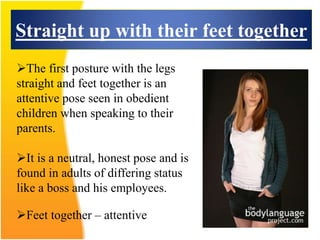
Straight up with their feet together
Feet together – attentive
The first posture with the legs
straight and feet together is an
attentive pose seen in obedient
children when speaking to their
parents.
It is a neutral, honest pose and is
found in adults of differing status
like a boss and his employees.
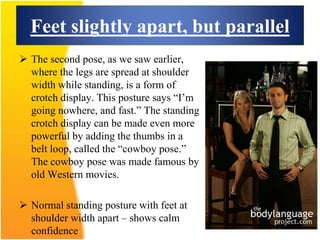
Feet slightly apart, but parallel
 The second pose, as we saw earlier,
where the legs are spread at shoulder
width while standing, is a form of
crotch display. This posture says “I’m
going nowhere, and fast.” The standing
crotch display can be made even more
powerful by adding the thumbs in a
belt loop, called the “cowboy pose.”
The cowboy pose was made famous by
old Western movies.
 Normal standing posture with feet at
shoulder width apart – shows calm
confidence
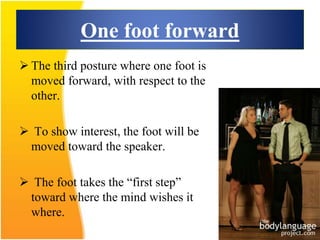
One foot forward
 The third posture where one foot is
moved forward, with respect to the
other.
 To show interest, the foot will be
moved toward the speaker.
 The foot takes the “first step”
toward where the mind wishes it
where.
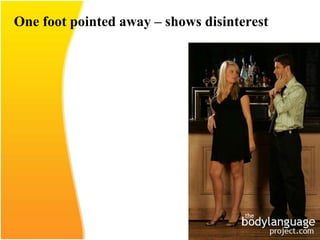
One foot pointed away – shows disinterest
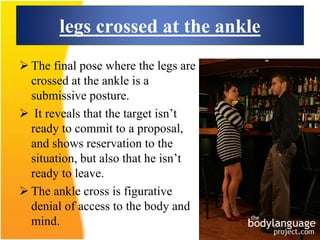
legs crossed at the ankle
 The final pose where the legs are
crossed at the ankle is a
submissive posture.
 It reveals that the target isn’t
ready to commit to a proposal,
and shows reservation to the
situation, but also that he isn’t
ready to leave.
 The ankle cross is figurative
denial of access to the body and
mind.
PROXIMITY
• Cultural norms dictate a comfortable distance for interaction
with audience.
• You should look for signals of discomfort caused by invading
young audience‘s space.
• Some of these are:
– Rocking,
– Leg swinging,
– Tapping,
– Gaze aversion,
• To counteract this, move around the classroom to increase
interaction with your students. Increasing proximity enables
you to make better eye contact and increases the
opportunities for students to speak.
(Next)
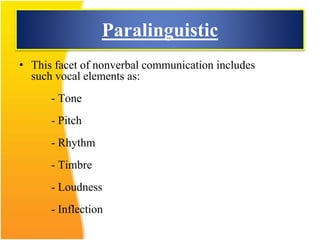
Paralinguistic
• This facet of nonverbal communication includes
such vocal elements as:
- Tone
- Pitch
- Rhythm
- Timbre
- Loudness
- Inflection
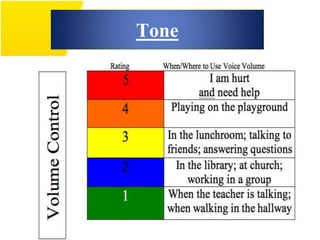
Tone
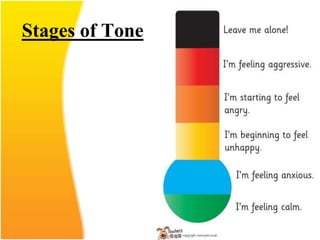
Stages of Tone
What causes distortion or the
barriers to Communications?
• Perceptions
• Language
• Semantics
• Personal Interests
• Emotions
• Environment – noise
• Preconceived notions/expectations
• Wordiness
• Attention span
• Physical hearing problem
• Speed of thought
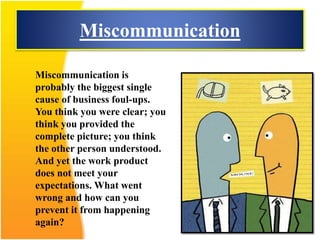
Miscommunication
Miscommunication is
probably the biggest single
cause of business foul-ups.
You think you were clear; you
think you provided the
complete picture; you think
the other person understood.
And yet the work product
does not meet your
expectations. What went
wrong and how can you
prevent it from happening
again?
How to Improve Existing Level of
COMMUNICATION?
Improve Language.
Improve Pronunciations.
Work on Voice Modulation.
Work on Body Language.
Read more
Listen more
Avoid Reading or watching or listening
unwanted Literature, Gossip, Media
Presentation etc.
Interact with Qualitative People.
Improve on your Topic of Discussions.
Practice Meditation & Good Thoughts.
Think and Speak.
Do not Speak too fast.
Use simple Vocabulary.
Do not speak only to impress someone.
Look Presentable and Confident.
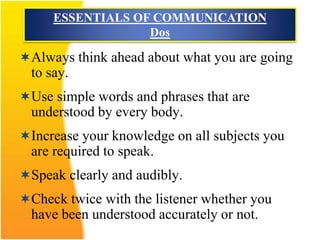
Always think ahead about what you are going
to say.
Use simple words and phrases that are
understood by every body.
Increase your knowledge on all subjects you
are required to speak.
Speak clearly and audibly.
Check twice with the listener whether you
have been understood accurately or not.
ESSENTIALS OF COMMUNICATION
Dos
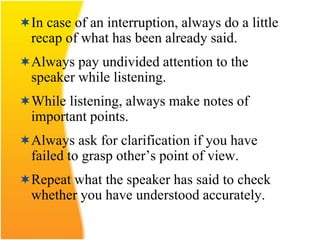
In case of an interruption, always do a little
recap of what has been already said.
Always pay undivided attention to the
speaker while listening.
While listening, always make notes of
important points.
Always ask for clarification if you have
failed to grasp other’s point of view.
Repeat what the speaker has said to check
whether you have understood accurately.
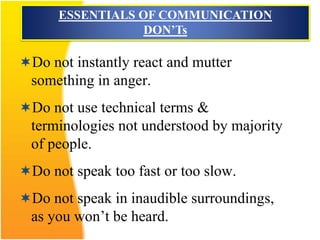
Do not instantly react and mutter
something in anger.
Do not use technical terms &
terminologies not understood by majority
of people.
Do not speak too fast or too slow.
Do not speak in inaudible surroundings,
as you won’t be heard.
ESSENTIALS OF COMMUNICATION
DON’Ts
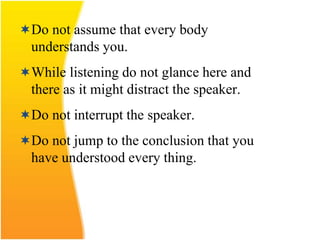
Do not assume that every body
understands you.
While listening do not glance here and
there as it might distract the speaker.
Do not interrupt the speaker.
Do not jump to the conclusion that you
have understood every thing.
Communication skills

Communication skills

  • 1.
  • 3.
    Communication • Communication isa dynamic process. • Through this process we convey a thought or feeling to someone else. • How it is received depends on a set of events, stimuli, that person is exposed to. • How you say, what you say plays an important role in communication. • Influence is the most basic function of communication. • Cybernetics is the science of Communication.
  • 4.
    Communication IQ Communication whichoccupies approximately 70% of our waking hours, is what many leaders find the most frustrating. Many of us were never taught to communicate in ways that lead to positive outcomes. Here’s how to communicate better to get better outcomes.
  • 5.
    To Raise YourCommunication IQ • Talk less, hear more: We want to be heard and listened to but we don’t always concentrate on listening to others.  We focus more on our agenda than on the other person’s concerns or issues.
  • 6.
    • Don’t Shootthe messenger  We want to understand but our ability is tainted by our perceptions of the person speaking or the outcome we are looking for. So, we often pass judgment on the speaker and disregard the message. Concentrate on the message not the messenger.
  • 7.
    • Avoid MindReading  We want some kind of action or response from another person.  However, we don’t let them know what we really want or how to achieve it.  Before assuming the other knows what you want, first inform and then ask for feedback.
  • 8.
    Communication is aSeries of Experiences Hearing Taste Seeing Touch Smell
  • 9.
  • 10.
    What are themost common ways we communicate? Communication
  • 11.
    The Goals ofCommunications To change behavior To get action To ensure understanding To persuade To get and give Information
  • 12.
  • 13.
  • 14.
  • 15.
  • 16.
    Process of Communication SourceEncoding Channel Decoding Receiver Feedback Msg Msg Msg Msg
  • 18.
    Six Ways ofUsing ORAL Communication Skills Effectively • Presentation Skills while appearing for an interview. – Your Dressing sense (Males & Females), – Documents needed to be carried, – Your body language (while standing, while sitting, while walking), – Your attitude (Soberness, Soft words, avoid western accent), – Your Confidence (while talking, body movements, aggression, etc).
  • 19.
    Audience Awareness • TheClassroom Environment • Classroom Strategies
  • 20.
    Critical Listening Few tipsto reduces the critical listening and increases the active listening: 1. Understand your own communication style. 2. Be an active listener. 3. Use normal communication. 4. Give Feedback
  • 21.
  • 22.
    Kinesics Kinesics means bodymovement. Body language is a reflection of thoughts and feelings. By nodding our head, blinking eyes, waving hands; we send out signals and messages which are louder then words.
  • 23.
  • 24.
  • 25.
  • 26.
  • 27.
  • 28.
  • 30.
    Oculesics/Eye Contact  Oculesicsis the study of role of eyes in non- verbal communication.  Eyes are perhaps the most expressive features on human being.  Eye contact can indicate a lot of emotions ranging from interest, attention and involvement.  A good speaker looks at his audience while speaking and not elsewhere.
  • 31.
  • 33.
  • 35.
  • 36.
  • 40.
     Clothing isthe primary instrument in creating a positive first impressions.  Clothing can increases your perceived status among your peers.  Dressing sharp helps with your confidence.  The requirements of dressing sharp teaches responsibility. Artifacts-Dress & Attire
  • 41.
    A good dressernotices detail in others.  Dressing sharp makes you more useful at work. Colors and patterns speak for you. Specific clothing pieces make statements about you.
  • 45.
    Written Communication • Academicwriting • Revision and editing • Critical Reading • Presentation of Data
  • 47.
  • 48.
    Non-Verbal Communication  Non-verbalcommunication means any way of expressing yourself to others without words, meaning either spoken, written or both.  A good example of non-verbal communication would be a traffic sign with a curving arrow indicating a sharp turn in the road.  Face to face, a wink, or a knowing look might communicate a lot to another person.  Over the phone, you might sigh, or grunt your approval.  Body Language like posture, gestures, movements or facial expressions are a form of non-verbal communication.
  • 49.
    Importance of Non-verbal Communication Complement verbal message by adding to its meaning.  Regulate verbal communication.  Can substitute for verbal message.  Accent what you are saying.  Be used as follow up and reiterate verbal message.  Emphasize parts of verbal message.  Contradict verbal messages.
  • 50.
    SIX WAYS OFUSING NON-VERBAL COMMUNICATION SKILLS EFFECTIVELY Some major areas of nonverbal behaviors to explore are:  Eye contact  Facial expressions  Gestures  Posture and body orientation  Proximity  Paralinguistic  Humor
  • 51.
    EYE Contact Eye isan direct and most expressive part of our body. Different ways of Eye Contact: – Direct Eye Contact: (Shows confidence, Ready to listen) – Looking downwards (Listening carefully or Guilty) – Single raised eyebrow (Doubting) – Both raised eyebrows (Admiring) – Bent eyebrows (Sudden focus) – Tears coming out (Emotional either happy or hurt)
  • 52.
    Direct Eye Contact Shows Confidence  Ready to Listen
  • 53.
  • 54.
  • 55.
  • 56.
  • 57.
    Tears coming out Emotional either happy or hurt
  • 58.
    6 ways todramatically improve your eye contact skills
  • 59.
    Talking to agroup  When talking to a group of people it is great to have direct contact with your listeners.  Don’t make the mistake of maintaining eye contact with just one person as this will stop the other members of the group from listening.  To get past this, focus on a different member of the group with every new sentence.  This way you are talking to all of the group and keeping them all interested.
  • 60.
    Talking to anindividual  It is great to maintain eye contact when talking to a person however it can become a bit creepy and uncomfortable if you stare intensely at them.  To combat this, break eye contact every 5 seconds or so.  When breaking the eye contact don’t look down as this might indicate the ending of your part of the conversation. Instead, look up or to the side as if your are remembering something.  So when your listener sees this they will think you are trying to remember something and keep on listening to you.
  • 61.
    Listening to someone When you are listening to someone it can be off putting for the talker if you stare at them too hard.  The technique is called ‘The triangle’.  This is when I look at one eye for about 5 seconds, look at the other eye for 5 seconds and then look at the mouth for 5 seconds and keep on rotating in this way.  This technique coupled with other listening skills such as nodding, occasional agreement words such as ‘yes’, ‘Uh –huh’ ‘mm’ etc is a great way to keep the talker talking and to show them you are interested in what they are saying.
  • 62.
    Arguing  Arguing withsomeone is a skill in itself and if you want to compete in an argument holding the gaze shows strength.  If you look away when arguing with someone you have all but lost the argument.  Obviously this depends on who you are arguing with but in general it is better to hold the gaze whilst you are making your point and also when you are listening to the other person.
  • 63.
    We have allcome across the person who is great at arguing and making you feel small, you will notice that everyone who is like this try to stare you out.  Stare back, it will surprise them, piss them off and put them off what they are trying to say. Staying silent and staring at someone who is trying to rile you is also an effective way to win an argument without saying a word.
  • 64.
    Attracting someone  Whenyou are trying to attract someone and show them you are interested you can talk and listen with your eyes.  When a person you like is speaking use the whole face as your focal point. Look at their eyes, listen to what they are saying, smile in the appropriate places, raise your eyebrows in the appropriate places.  Smiling when listening to someone is a great way to show you are interested in them.  You have to listen with your ears as well as listening with your eyes (yes I did mean listening with your eyes, you listen to someone’s body language with your eyes)
  • 65.
    FACIAL EXPRESSION Smile coversthe most part of facial expression: Smiling is a powerful cue that transmits: – Happiness – Friendliness – Warmth – Liking – Affiliation
  • 67.
    GESTURES • If youfail to gesture while speaking, you may be perceived as boring, stiff and unanimated. • A lively and animated teaching style captures students' attention, makes the material more interesting, facilitates learning and provides a bit of entertainment. • Head nods, a form of gestures, communicate positive reinforcement to students and indicate that you are listening.
  • 68.
    Handshake  Hands NotDamp or Clammy.  Firm Grip, But Not Bone Crusher or Wimp.  Thumb and Forefinger Web Touches the Other Person’s Web Area.  Maintain Eye Contact During Handshake.  Give a Couple of Shakes – Then Let Go.  Stand Up When Handshaking.
  • 69.
    Different Kinds ofHandshakes CRUSHER hand shake:  Palm is gripped too hard so it squeezes and starts paining.  Person exercising it can be too dominating, egoistic, and careless of sentiments.  Women receiving this hand shake would definitely hinder further exchange. Persons working as labor, porter or mechanic may exercise it.
  • 70.
    ISOLATION Hand Shake Person exercising this hands hake doesn’t lean towards other person and doesn’t bend his hand at elbow.  Person exercising this hand shake may not be social and often stays isolated or safe.  Such person might have some reservations and deserves more favorable conditions or needs understanding to let him/her to interact socially.
  • 71.
     When enoughgrip is not felt by fingers, palm doesn’t fully contact and wrist’s kept loose then it seems like someone has given dead fish in your hand.  Person exercising it might be lacking enthusiasm, passion, and confidence.  Such person would be hardly trusted and needs a moral boost.
  • 73.
    SKIPPING Handshake  Whenonly fingers of other person touches to your palm then it seems that person wants to avoid full contact of palms and is in hurry.  Person exercising it might be not paying enough attention to you or not serious about relationship or refraining it.  In some cases, person might have genuine reason to skip handshake and rush for other tasks.  You would receive such hand shake from surgeons, craftsmen or performing artists because they protect their fingers from being hurt. Also, women or religious leaders may offer this hand shake as part of custom.
  • 74.
    DOMED PALM Handshake Whenpalm of other person doesn’t exert enough pressure on yours and it appears to be curved inside then that person may want to not maintain rapport with you willfully. Striking positive communication from your side could alter person's perceptions about you.
  • 75.
    PALM UP/DOWN Handshake When palm of other person faces downward (palm down) then it simply expresses desire of controlling the relationship whereas palm facing upwards (palm up) expresses desire of letting you control it. Such kind of handshakes is offered to maintain hierarchy or favoritism. This handshake should be avoided to motivate equality.
  • 76.
    INVADER Handshake When personpushes hand much inside (stab) or pulls your hand out (grab) of invisible interpersonal boundary then it’s quite obvious that person is unaware of comfortable social distance. Such person should undergo immediate consultation.
  • 78.
    HANDCUFF Handshake When handof other person covers over union of palms then it becomes the handcuff. Person exercising it wants to gain or express sympathy and fulfill personal interest.  Most politicians offer this kind of handshake during election campaigns or meeting thus it's less trustworthy. It can be exercised in exceptional case like at the time of condolence or while passing deep gratitude informally.
  • 80.
    HYGIENIC Handshake When personsuddenly withdraws hand right after palms come into contact then it suggests that the person wants to avoid any kind of infection caused by physical contact or proximity. Such person may not want to communicate (at given time) with you spontaneously due to some personal differences or insecure feelings. Also, kids may exercise it with strangers.
  • 82.
    CLOSE UP Handshake Whenperson exercises a hands hake by keeping hand in front of chest, bringing torso and face much closer then it becomes very personal and intimate. This kind of handshake’s only acceptable among women, children, elders - children, close relatives and couples closely.  Politicians and bureaucrats might exercise it to ensure trustworthiness looking into eyes.
  • 84.
  • 85.
    Legs – SittingPositions Leg over Leg  Crossing one leg over the other is a very popular way of sitting and has many variations.  The leg over leg "standard position" is usually done with the dominant leg on top.  While crossing the legs may indicate a closed and reserved attitude, it's not always so. It has a lot to do with habit and comfort.  In an uncomfortable chair with no armrests, it might be more convenient to sit in crossed position and to lay the hands on the thighs.
  • 86.
    4-Figure  The 4figure sitting position involves resting one foot over the thigh of the other, and it's usually much more comfortable for men.  In an unconscious manner it exposes the genitals and takes more space – a confident, self assured and even cocky posture.  It's also a way to show competitive and challenging attitude towards the others, as if to say "I'm not impressed, try harder"
  • 87.
    Both Feet onthe Ground  Placing both feet on the ground with a “standard” gap between them is the most basic, normal position you can think of. Just like with hands-to-the- sides posture it serves as a neutral but powerful starting point.  It’s stable, focused and lacks any other nonverbal “noise” - so it’s very effective for formal and focused conversations.
  • 88.
    Feeling at Home In informal relaxed circumstances the variations of different leg positions is huge, after all it is informal - anyone can sit however she wants. Most informal positions have the tendency to be spread out and take strange forms.  Placing the feet on a table is the ultimate "feel good" posture - What’s more relaxed than spreading the legs up, putting the hands behind the head and enjoy life, right?
  • 89.
    Arms/Hand Movement Crossed arms mightindicate that a person is feel defensive, self-protective, or closed-off.
  • 90.
    Standing with hands placedon the hips can be an indication that a person is ready and in control, or it can also possibly be a sign of aggressiveness.
  • 91.
    Clasping the hands behindthe back might indicate that a person is feeling bored, anxious, or even angry.
  • 92.
    Rapidly tapping fingers or fidgetingcan be a sign that a person is bored, impatient, or frustrated.
  • 93.
    • Gesture: Rubbinghands Meaning: Anticipation
  • 94.
    • Gesture: Handto cheek Meaning: Evaluation, thinking
  • 95.
    • Gesture: Walkingwith hands in pockets, shoulders hunched Meaning: Dejection
  • 96.
    POSTURE AND BODYORIENTATION • You communicate numerous messages by the way you walk, talk, stand and sit. • Standing erect, but not rigid, and leaning slightly forward communicates to students that you are approachable, receptive and friendly. • Furthermore, interpersonal closeness results when you and your students face each other. • Speaking with your back turned or looking at the floor or ceiling should be avoided; it communicates disinterest to your class.
  • 97.
  • 98.
    Straight up withtheir feet together Feet together – attentive The first posture with the legs straight and feet together is an attentive pose seen in obedient children when speaking to their parents. It is a neutral, honest pose and is found in adults of differing status like a boss and his employees.
  • 99.
    Feet slightly apart,but parallel  The second pose, as we saw earlier, where the legs are spread at shoulder width while standing, is a form of crotch display. This posture says “I’m going nowhere, and fast.” The standing crotch display can be made even more powerful by adding the thumbs in a belt loop, called the “cowboy pose.” The cowboy pose was made famous by old Western movies.  Normal standing posture with feet at shoulder width apart – shows calm confidence
  • 100.
    One foot forward The third posture where one foot is moved forward, with respect to the other.  To show interest, the foot will be moved toward the speaker.  The foot takes the “first step” toward where the mind wishes it where.
  • 101.
    One foot pointedaway – shows disinterest
  • 102.
    legs crossed atthe ankle  The final pose where the legs are crossed at the ankle is a submissive posture.  It reveals that the target isn’t ready to commit to a proposal, and shows reservation to the situation, but also that he isn’t ready to leave.  The ankle cross is figurative denial of access to the body and mind.
  • 103.
    PROXIMITY • Cultural normsdictate a comfortable distance for interaction with audience. • You should look for signals of discomfort caused by invading young audience‘s space. • Some of these are: – Rocking, – Leg swinging, – Tapping, – Gaze aversion, • To counteract this, move around the classroom to increase interaction with your students. Increasing proximity enables you to make better eye contact and increases the opportunities for students to speak. (Next)
  • 104.
    Paralinguistic • This facetof nonverbal communication includes such vocal elements as: - Tone - Pitch - Rhythm - Timbre - Loudness - Inflection
  • 105.
  • 106.
  • 108.
    What causes distortionor the barriers to Communications? • Perceptions • Language • Semantics • Personal Interests • Emotions • Environment – noise • Preconceived notions/expectations • Wordiness • Attention span • Physical hearing problem • Speed of thought
  • 109.
    Miscommunication Miscommunication is probably thebiggest single cause of business foul-ups. You think you were clear; you think you provided the complete picture; you think the other person understood. And yet the work product does not meet your expectations. What went wrong and how can you prevent it from happening again?
  • 110.
    How to ImproveExisting Level of COMMUNICATION? Improve Language. Improve Pronunciations. Work on Voice Modulation. Work on Body Language. Read more Listen more Avoid Reading or watching or listening unwanted Literature, Gossip, Media Presentation etc.
  • 111.
    Interact with QualitativePeople. Improve on your Topic of Discussions. Practice Meditation & Good Thoughts. Think and Speak. Do not Speak too fast. Use simple Vocabulary. Do not speak only to impress someone. Look Presentable and Confident.
  • 112.
    Always think aheadabout what you are going to say. Use simple words and phrases that are understood by every body. Increase your knowledge on all subjects you are required to speak. Speak clearly and audibly. Check twice with the listener whether you have been understood accurately or not. ESSENTIALS OF COMMUNICATION Dos
  • 113.
    In case ofan interruption, always do a little recap of what has been already said. Always pay undivided attention to the speaker while listening. While listening, always make notes of important points. Always ask for clarification if you have failed to grasp other’s point of view. Repeat what the speaker has said to check whether you have understood accurately.
  • 114.
    Do not instantlyreact and mutter something in anger. Do not use technical terms & terminologies not understood by majority of people. Do not speak too fast or too slow. Do not speak in inaudible surroundings, as you won’t be heard. ESSENTIALS OF COMMUNICATION DON’Ts
  • 115.
    Do not assumethat every body understands you. While listening do not glance here and there as it might distract the speaker. Do not interrupt the speaker. Do not jump to the conclusion that you have understood every thing.