1
Master Guide Seminar
Basic Pathfinder Discipline
20 July 2014
Presenter: Melusi Moyo
The word discipline comes from Latin:
disciplina which means ‘training’.
It is closely associated with the Latin word disciplus which
means ‘a learner’.
This is the word from which the English word disciple is
derived. The two root words lead us to understand that a
disciple is a learner who is in training. The Bible teaches
that the process of discipline (discipling) or learning and
training is most effective when it is carried out in a caring,
supporting and loving environment.
“If you refuse to discipline your children, it proves you
don’t love them, if you love your children, you will be
prompt to discipline them”. Proverbs 13:24.
Discipline in the Bible is presented in two perspectives:
The constructive and the redemptive.
From the constructive perspective, discipline is presented
as a necessary path on the way to knowing God and
enjoying a productive life.
“The fear of the Lord is the beginning of knowledge. Only
fools despise wisdom and discipline”. Proverbs 1:7 NLT
God’s discipline leads to a good life.
“Lord, your discipline is good, for it leads to life and
health. You have restored me to life!” Isaiah 38:16 NLT
Biblical Viewpoint
“Happy are those whom you discipline, Lord, and those
whom you teach from your law. You give them relief from
troubled times”. Psalms 94:12,13a NLT
The redemptive perspective of discipline is observed in
the Bible when God’s children have turned away from
Him and will not respond to His repeated appeals to
return to Him. God either withdraws His protection or
directly allows His children to experience difficulties with
the hope that they will sense their need and return to
Him. Notice how Jeremiah talks about this to the people
of Israel.
God’s discipline will provide happiness and peace.
“For I am with you and save you, says the
Lord. I will completely destroy the nations
where I have scattered you, but I will not
destroy you. But I must discipline you; I
cannot let you go unpunished”. Jeremiah
30:11 NLT
Discipline is designed to train individuals
towards a better way of life. The
Pathfinder organisation is committed to
that ministry.
God’s discipline will provide happiness and peace.
Pathfinders come from many families where discipline is
administered by different methods. They come with a
whole range of experiences and expectations. Often,
they encounter a different kind of discipline than that
which is practiced in their home. They either experience
a new kind of freedom with a total lack of restraint, or
they encounter unaccustomed restraint. There are
situations where the expectations of the club in regards
to discipline are very different from those at home.
Consequently, it is expected that in a Pathfinder club,
there will be individuals who might initially be unable or
unwilling to conform to the accepted values and conduct
expected in a Pathfinder Club.
Why Discipline Becomes an Issue in a Pathfinder Club
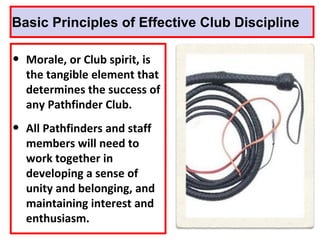
Basic Principles of Effective Club Discipline
• Morale, or Club spirit, is
the tangible element that
determines the success of
any Pathfinder Club.
• All Pathfinders and staff
members will need to
work together in
developing a sense of
unity and belonging, and
maintaining interest and
enthusiasm.
Club staff need to check for the following:
• Spiritual Objective
• Attendance
• Home contact
• Round table discussion
• Unit Captain’s Table
• Making Members
Welcome
• Putting Friends
Together
• Reviewing the
Counsellor's Work
• Planning a balanced
Programme
• Developing Unit
Cohesiveness
• Pathfinder Meeting place
• Planning a Pathfinder
programme
• Equipment
• Camping Equipment
• Teaching Materials
Pathfinder Club Discipline
The goal of disciplining children must be :
a. to guide them as sons and daughters of
God.
b. to show them love and understanding.
c. to teach them God’s character as
revealed in order and discipline. to make
them useful members of the church and
community.
d. to help them respect their leaders and
parents.
a. Feel that they are being
born into a new
experience
b. Learn that they are being
loved by the kind of
correction and discipline
they receive
c. Learn to discipline their
desires
Pathfinders must:
Discipline has been administered in many different ways.
Each of them has their own strengths and their
weaknesses. The main four methods are:
1. Authoritarian Discipline.
Authoritarian Discipline lays down the rules and polices
them.
Fear, guilt, and force are used to obtain order and respect.
Authoritarian discipline brings instant order to a club but
does not guarantee self discipline. The Pathfinder staff is in
charge and cannot rest at anytime because the rules have
to be maintained.
Different Styles of Discipline
2. Permissive Discipline.
Permissive Discipline appeals to the Pathfinder’s better self
and does not enforce obedience. Love and praise are used
to motivate productivity. Order, obedience, and self-
discipline are not highly valued. Achieving requirements
and maintaining standards including safety are not
ensured.
The outcomes are based on the success of gaining
cooperation. The Pathfinder can take charge and enforce
what they feel like doing without any regard for standards
or expectations. For the club to exist the staff have to go
along with the Pathfinders.
3. Neglectful Discipline.
Neglectful Discipline is when there are
minimal rules or support for the group being
led. It is a situation where no one knows
what is going to happen because everyone is
only interested in their own agenda.
Both the staff and the Pathfinders have no
real goals or purpose for the club. This type
of discipline cannot last because either the
club will fold, or another style of leadership
will be adopted.
4. Authoritative or Positive Discipline.
This is where discipline involves the
Pathfinders in the decision making as
much as possible. The Pathfinders are
held responsible and accountable for
the outcomes.
Affirmation and rewards are the chief
motivators of order and respect.
Pathfinders are held to the
consequences of negative choices. The
Pathfinder staff is ultimately
responsible.
a. Provides an environment that supports cheerful
attitudes and cooperative behavior
b. Emphasises guidance rather than restraint;
constructive rather than destructive
c. Enables not cripples
d. Encourages self-control and purposeful activity
e. Is present not seen
f. Teaches a child to do the right thing at the right time
in the right way and for the right reason
g. Prevents trouble
Good Discipline
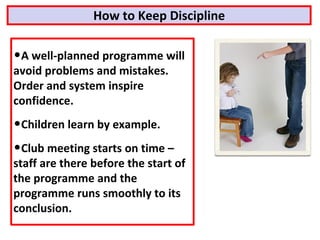
How to Keep Discipline
•A well-planned programme will
avoid problems and mistakes.
Order and system inspire
confidence.
•Children learn by example.
•Club meeting starts on time –
staff are there before the start of
the programme and the
programme runs smoothly to its
conclusion.
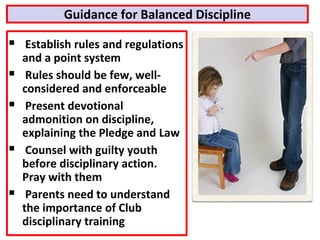
Guidance for Balanced Discipline
 Establish rules and regulations
and a point system
 Rules should be few, well-
considered and enforceable
 Present devotional
admonition on discipline,
explaining the Pledge and Law
 Counsel with guilty youth
before disciplinary action.
Pray with them
 Parents need to understand
the importance of Club
disciplinary training
Guidelines for Balanced Disciple
•Establish Rules and regulation and a
point system.
•Inform the Pathfinders of the rules,
your expectation and methods of
enforcements
•“Rules should be few and well
considered, and when once made,
they should be enforced. Whether is
found impossible to change, the
minds learns to recognise and adapt
itself to” (Education page 290)
•Present devotional on discipline,
explaining the Pledge and Law.
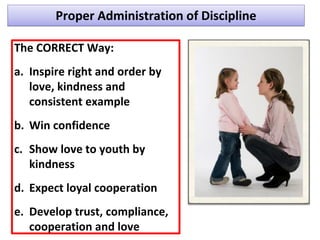
Proper Administration of Discipline
The CORRECT Way:
a. Inspire right and order by
love, kindness and
consistent example
b. Win confidence
c. Show love to youth by
kindness
d. Expect loyal cooperation
e. Develop trust, compliance,
cooperation and love
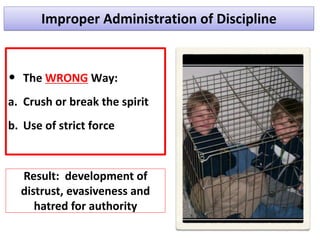
Improper Administration of Discipline
• The WRONG Way:
a. Crush or break the spirit
b. Use of strict force
Result: development of
distrust, evasiveness and
hatred for authority
Prevention of Discipline Problems
 Plan an extensive
program of activities
 Never go to meetings
unprepared
 Be friendly, caring and
approachable
 Cultivate a sense of
humour
 Avoid the use of ridicule
and sarcasm
 Don’t be a fault finder
 Be fair and impartial
 Show self-control
 Watch the use of your
voice
 Maintain eye contact
 Give clear, precise
instructions and
commands
 Eliminate mannerisms
that could lead to
ridicule
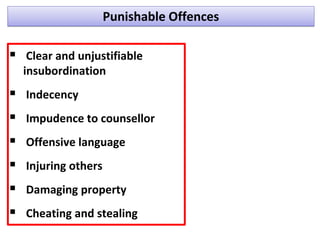
Punishable Offences
 Clear and unjustifiable
insubordination
 Indecency
 Impudence to counsellor
 Offensive language
 Injuring others
 Damaging property
 Cheating and stealing
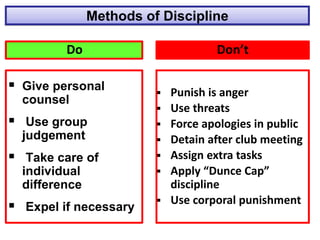
Methods of Discipline
 Give personal
counsel
 Use group
judgement
 Take care of
individual
difference
 Expel if necessary
 Punish is anger
 Use threats
 Force apologies in public
 Detain after club meeting
 Assign extra tasks
 Apply “Dunce Cap”
discipline
 Use corporal punishment
Do Don’t
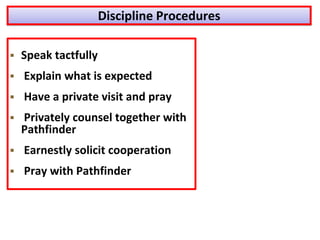
Discipline Procedures
 Speak tactfully
 Explain what is expected
 Have a private visit and pray
 Privately counsel together with
Pathfinder
 Earnestly solicit cooperation
 Pray with Pathfinder
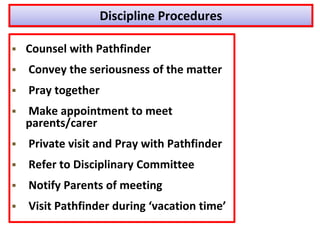
Discipline Procedures
 Counsel with Pathfinder
 Convey the seriousness of the matter
 Pray together
 Make appointment to meet
parents/carer
 Private visit and Pray with Pathfinder
 Refer to Disciplinary Committee
 Notify Parents of meeting
 Visit Pathfinder during ‘vacation time’
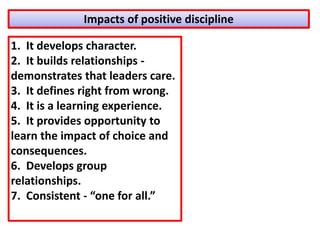
1. It develops character.
2. It builds relationships -
demonstrates that leaders care.
3. It defines right from wrong.
4. It is a learning experience.
5. It provides opportunity to
learn the impact of choice and
consequences.
6. Develops group
relationships.
7. Consistent - “one for all.”
Impacts of positive discipline

Understanding Pathfinders Discipline

  • 1.
    1 Master Guide Seminar BasicPathfinder Discipline 20 July 2014 Presenter: Melusi Moyo
  • 2.
    The word disciplinecomes from Latin: disciplina which means ‘training’. It is closely associated with the Latin word disciplus which means ‘a learner’. This is the word from which the English word disciple is derived. The two root words lead us to understand that a disciple is a learner who is in training. The Bible teaches that the process of discipline (discipling) or learning and training is most effective when it is carried out in a caring, supporting and loving environment. “If you refuse to discipline your children, it proves you don’t love them, if you love your children, you will be prompt to discipline them”. Proverbs 13:24.
  • 3.
    Discipline in theBible is presented in two perspectives: The constructive and the redemptive. From the constructive perspective, discipline is presented as a necessary path on the way to knowing God and enjoying a productive life. “The fear of the Lord is the beginning of knowledge. Only fools despise wisdom and discipline”. Proverbs 1:7 NLT God’s discipline leads to a good life. “Lord, your discipline is good, for it leads to life and health. You have restored me to life!” Isaiah 38:16 NLT Biblical Viewpoint
  • 4.
    “Happy are thosewhom you discipline, Lord, and those whom you teach from your law. You give them relief from troubled times”. Psalms 94:12,13a NLT The redemptive perspective of discipline is observed in the Bible when God’s children have turned away from Him and will not respond to His repeated appeals to return to Him. God either withdraws His protection or directly allows His children to experience difficulties with the hope that they will sense their need and return to Him. Notice how Jeremiah talks about this to the people of Israel. God’s discipline will provide happiness and peace.
  • 5.
    “For I amwith you and save you, says the Lord. I will completely destroy the nations where I have scattered you, but I will not destroy you. But I must discipline you; I cannot let you go unpunished”. Jeremiah 30:11 NLT Discipline is designed to train individuals towards a better way of life. The Pathfinder organisation is committed to that ministry. God’s discipline will provide happiness and peace.
  • 6.
    Pathfinders come frommany families where discipline is administered by different methods. They come with a whole range of experiences and expectations. Often, they encounter a different kind of discipline than that which is practiced in their home. They either experience a new kind of freedom with a total lack of restraint, or they encounter unaccustomed restraint. There are situations where the expectations of the club in regards to discipline are very different from those at home. Consequently, it is expected that in a Pathfinder club, there will be individuals who might initially be unable or unwilling to conform to the accepted values and conduct expected in a Pathfinder Club. Why Discipline Becomes an Issue in a Pathfinder Club
  • 7.
    Basic Principles ofEffective Club Discipline • Morale, or Club spirit, is the tangible element that determines the success of any Pathfinder Club. • All Pathfinders and staff members will need to work together in developing a sense of unity and belonging, and maintaining interest and enthusiasm.
  • 8.
    Club staff needto check for the following: • Spiritual Objective • Attendance • Home contact • Round table discussion • Unit Captain’s Table • Making Members Welcome • Putting Friends Together • Reviewing the Counsellor's Work • Planning a balanced Programme • Developing Unit Cohesiveness • Pathfinder Meeting place • Planning a Pathfinder programme • Equipment • Camping Equipment • Teaching Materials
  • 9.
    Pathfinder Club Discipline Thegoal of disciplining children must be : a. to guide them as sons and daughters of God. b. to show them love and understanding. c. to teach them God’s character as revealed in order and discipline. to make them useful members of the church and community. d. to help them respect their leaders and parents.
  • 10.
    a. Feel thatthey are being born into a new experience b. Learn that they are being loved by the kind of correction and discipline they receive c. Learn to discipline their desires Pathfinders must:
  • 11.
    Discipline has beenadministered in many different ways. Each of them has their own strengths and their weaknesses. The main four methods are: 1. Authoritarian Discipline. Authoritarian Discipline lays down the rules and polices them. Fear, guilt, and force are used to obtain order and respect. Authoritarian discipline brings instant order to a club but does not guarantee self discipline. The Pathfinder staff is in charge and cannot rest at anytime because the rules have to be maintained. Different Styles of Discipline
  • 12.
    Different Styles ofDiscipline 2. Permissive Discipline. Permissive Discipline appeals to the Pathfinder’s better self and does not enforce obedience. Love and praise are used to motivate productivity. Order, obedience, and self- discipline are not highly valued. Achieving requirements and maintaining standards including safety are not ensured. The outcomes are based on the success of gaining cooperation. The Pathfinder can take charge and enforce what they feel like doing without any regard for standards or expectations. For the club to exist the staff have to go along with the Pathfinders.
  • 13.
    3. Neglectful Discipline. NeglectfulDiscipline is when there are minimal rules or support for the group being led. It is a situation where no one knows what is going to happen because everyone is only interested in their own agenda. Both the staff and the Pathfinders have no real goals or purpose for the club. This type of discipline cannot last because either the club will fold, or another style of leadership will be adopted.
  • 14.
    4. Authoritative orPositive Discipline. This is where discipline involves the Pathfinders in the decision making as much as possible. The Pathfinders are held responsible and accountable for the outcomes. Affirmation and rewards are the chief motivators of order and respect. Pathfinders are held to the consequences of negative choices. The Pathfinder staff is ultimately responsible.
  • 15.
    a. Provides anenvironment that supports cheerful attitudes and cooperative behavior b. Emphasises guidance rather than restraint; constructive rather than destructive c. Enables not cripples d. Encourages self-control and purposeful activity e. Is present not seen f. Teaches a child to do the right thing at the right time in the right way and for the right reason g. Prevents trouble Good Discipline
  • 16.
    How to KeepDiscipline •A well-planned programme will avoid problems and mistakes. Order and system inspire confidence. •Children learn by example. •Club meeting starts on time – staff are there before the start of the programme and the programme runs smoothly to its conclusion.
  • 17.
    Guidance for BalancedDiscipline  Establish rules and regulations and a point system  Rules should be few, well- considered and enforceable  Present devotional admonition on discipline, explaining the Pledge and Law  Counsel with guilty youth before disciplinary action. Pray with them  Parents need to understand the importance of Club disciplinary training
  • 18.
    Guidelines for BalancedDisciple •Establish Rules and regulation and a point system. •Inform the Pathfinders of the rules, your expectation and methods of enforcements •“Rules should be few and well considered, and when once made, they should be enforced. Whether is found impossible to change, the minds learns to recognise and adapt itself to” (Education page 290) •Present devotional on discipline, explaining the Pledge and Law.
  • 19.
    Proper Administration ofDiscipline The CORRECT Way: a. Inspire right and order by love, kindness and consistent example b. Win confidence c. Show love to youth by kindness d. Expect loyal cooperation e. Develop trust, compliance, cooperation and love
  • 20.
    Improper Administration ofDiscipline • The WRONG Way: a. Crush or break the spirit b. Use of strict force Result: development of distrust, evasiveness and hatred for authority
  • 21.
    Prevention of DisciplineProblems  Plan an extensive program of activities  Never go to meetings unprepared  Be friendly, caring and approachable  Cultivate a sense of humour  Avoid the use of ridicule and sarcasm  Don’t be a fault finder  Be fair and impartial  Show self-control  Watch the use of your voice  Maintain eye contact  Give clear, precise instructions and commands  Eliminate mannerisms that could lead to ridicule
  • 22.
    Punishable Offences  Clearand unjustifiable insubordination  Indecency  Impudence to counsellor  Offensive language  Injuring others  Damaging property  Cheating and stealing
  • 23.
    Methods of Discipline Give personal counsel  Use group judgement  Take care of individual difference  Expel if necessary  Punish is anger  Use threats  Force apologies in public  Detain after club meeting  Assign extra tasks  Apply “Dunce Cap” discipline  Use corporal punishment Do Don’t
  • 24.
    Discipline Procedures  Speaktactfully  Explain what is expected  Have a private visit and pray  Privately counsel together with Pathfinder  Earnestly solicit cooperation  Pray with Pathfinder
  • 25.
    Discipline Procedures  Counselwith Pathfinder  Convey the seriousness of the matter  Pray together  Make appointment to meet parents/carer  Private visit and Pray with Pathfinder  Refer to Disciplinary Committee  Notify Parents of meeting  Visit Pathfinder during ‘vacation time’
  • 26.
    1. It developscharacter. 2. It builds relationships - demonstrates that leaders care. 3. It defines right from wrong. 4. It is a learning experience. 5. It provides opportunity to learn the impact of choice and consequences. 6. Develops group relationships. 7. Consistent - “one for all.” Impacts of positive discipline