By: Vaishali Misra
 What is communication?
 History of communication
 Purpose of communication
 Essential Skills for communication
 Types of communication
 Barriers of communication
 Skills for efficient communication
 Conclusion
 The ability to convey or share ideas, feelings to
another person effectively and efficiently.
 Exchange of info can be done by gestures,
speech, writing and many more.
 Proper understanding of info is very
important aspect in communication.
 Speech was recognised about 2 lakhs years
ago.
 Writing was developed around 7000 years
ago.
Evolution of brain differentiated humans
from animals, it allowed humans to master a
very efficient form of communication- speech.
The purpose of communication is to
• Educate
• Entertain
• Persuade
• Socialise
• Maintain relationship
• Exchange information
 Listening skills
Speaking skills
Reading skills
Writing skills
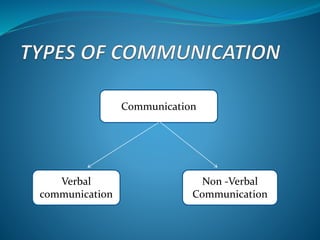
Communication
Verbal
communication
Non -Verbal
Communication
The communication which is done through the
spoken words is referred as Verbal
communication.
Two types :-
1. Oral communication
2. Written communication
Wordless communication like
 Gestures
 Eye contact
 Body language
 Facial expressions
 Symbols or signs
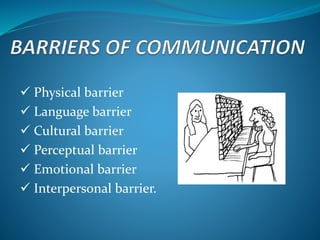
 Physical barrier
 Language barrier
 Cultural barrier
 Perceptual barrier
 Emotional barrier
 Interpersonal barrier.
 Be specific
Don’t interrupt
Listen to others
Give time to speak
Talk appropriate
Maintain eye contact
Modulate your voice levels
Good body language & facial expressions.
 Communication is necessary to relate with
others, the way we go about it affects anyone
who come in contact with us either positively or
negatively.
 To communicate effectively take absolute
control on your attitude and exercise good
behavioural skills.
Communication skills

Communication skills

  • 1.
  • 2.
     What iscommunication?  History of communication  Purpose of communication  Essential Skills for communication  Types of communication  Barriers of communication  Skills for efficient communication  Conclusion
  • 3.
     The abilityto convey or share ideas, feelings to another person effectively and efficiently.  Exchange of info can be done by gestures, speech, writing and many more.  Proper understanding of info is very important aspect in communication.
  • 4.
     Speech wasrecognised about 2 lakhs years ago.  Writing was developed around 7000 years ago. Evolution of brain differentiated humans from animals, it allowed humans to master a very efficient form of communication- speech.
  • 5.
    The purpose ofcommunication is to • Educate • Entertain • Persuade • Socialise • Maintain relationship • Exchange information
  • 6.
     Listening skills Speakingskills Reading skills Writing skills
  • 7.
  • 8.
    The communication whichis done through the spoken words is referred as Verbal communication. Two types :- 1. Oral communication 2. Written communication
  • 9.
    Wordless communication like Gestures  Eye contact  Body language  Facial expressions  Symbols or signs
  • 10.
     Physical barrier Language barrier  Cultural barrier  Perceptual barrier  Emotional barrier  Interpersonal barrier.
  • 11.
     Be specific Don’tinterrupt Listen to others Give time to speak Talk appropriate Maintain eye contact Modulate your voice levels Good body language & facial expressions.
  • 12.
     Communication isnecessary to relate with others, the way we go about it affects anyone who come in contact with us either positively or negatively.  To communicate effectively take absolute control on your attitude and exercise good behavioural skills.