MATRUSRI
ENGINEERING COLLEGE
Objectives
• To understand the basic construction of a dynamometer instrument.
• Explain basic operation and development of torque expressions for ammeter,
voltmeter and wattmeter.
• Study of ammeter, voltmeter and wattmeter connections.
• To investigate the errors involve in wattmeter readings and its compensation.
• Understanding the effect of inductance of voltage coil (moving coil) on the
wattmeter readings.
MATRUSRI ENGINEERING COLLEGE
DEPARTMENT OF ELECTRICAL AND ELECTRONICS
ENGINEERING
SUBJECT NAME: Electrodynamometer type instruments
FACULTY NAME: Mrs.N.KALPANA
MATRUSRI
ENGINEERING COLLEGE
MATRUSRI
ENGINEERING COLLEGE
Contents: Electrodynamometer type instruments
 Construction
 Principle of operation
 Working
 Torque equation
 Types of Electrostatic Voltmeters
Learning Outcomes: At end of this course the student will able to
LO1. To understand the basic construction of a dynamometer instrument.
• Explain basic operation and development of torque expressions for ammeter, voltmeter
and wattmeter.
• Study of ammeter, voltmeter and wattmeter connections.
• To investigate the errors involve in wattmeter readings and its compensation.
• Understanding the effect of inductance of voltage coil (moving coil) on the wattmeter
readings.
.
MODULE-3
• Power can be defined as the time rate of energy transfer or energy
dissipation in a load.
• Power is the rate of using or supplying energy.
• The rate at which work is done to maintain an electric current in a
circuit is termed ELECTRIC POWER.
• Electric power is measured in watts (W).
• The SI unit of power is the watt (W), where W = 1 J/s.
• The kilowatt is a commonly used unit where
• I kilowatt = 1000 watts.
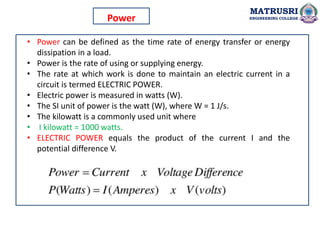
• ELECTRIC POWER equals the product of the current I and the
potential difference V.
MATRUSRI
ENGINEERING COLLEGE
Power
MATRUSRI
ENGINEERING COLLEGE
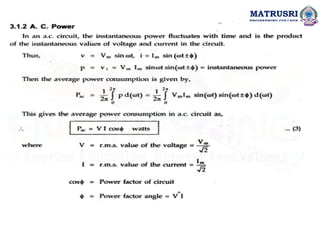
The POWER in DC circuit is
equal to the product of voltage and current.
[Power = Current × Voltage]
When the system voltage is constant, ammeter readings are almost a
sufficient indication of the POWER taken.
The POWER is calculated by using voltmeter and ammeter or wattmeter.
P = I × V = I² × R = V² / R
where:
P = power in watts (W)
I = current in amps (A)
R = resistance in ohms ( )
V = voltage in volts (V)
MATRUSRI
ENGINEERING COLLEGE
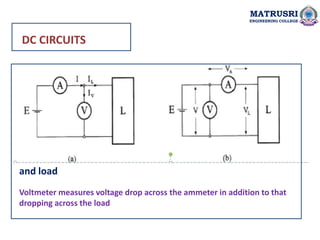
Ammeter measures current which flow into the voltmeter
and load
Voltmeter measures voltage drop across the ammeter in addition to that
dropping across the load
DC CIRCUITS
MATRUSRI
ENGINEERING COLLEGE
MATRUSRI
ENGINEERING COLLEGE
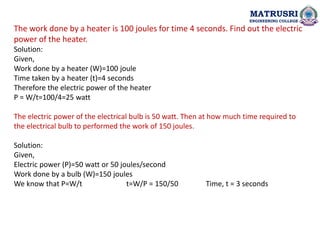
The work done by a heater is 100 joules for time 4 seconds. Find out the electric
power of the heater.
Solution:
Given,
Work done by a heater (W)=100 joule
Time taken by a heater (t)=4 seconds
Therefore the electric power of the heater
P = W/t=100/4=25 watt
The electric power of the electrical bulb is 50 watt. Then at how much time required to
the electrical bulb to performed the work of 150 joules.
Solution:
Given,
Electric power (P)=50 watt or 50 joules/second
Work done by a bulb (W)=150 joules
We know that P=W/t t=W/P = 150/50 Time, t = 3 seconds
MATRUSRI
ENGINEERING COLLEGE
MATRUSRI
ENGINEERING COLLEGE
Electrodynamometer type instruments:
Electrodynamometer instrument is a transfer instrument
The necessity for the AC calibration of moving iron instruments as well as another type
of instruments which cannot be correctly calibrated requires the use of a transfer type
of instrument.
A transfer instrument is one that may be calibrated with a d.c source and then used
without modification to measure a.c.
This requires the transfer type instrument to have the same accuracy for both a.c and
d.c, which have electrodynamometer instruments have.
Electrodynamometer type instruments are used as a.c voltmeters and ammeters both
in the range of power frequencies and lower part of the audio frequency range. They
are used as watt-meters,varmeters and with some modification as power factor
meters and frequency meters.
MATRUSRI
ENGINEERING COLLEGE
MATRUSRI
ENGINEERING COLLEGE
Electrodynamometer Wattmeter
Definition: The instrument whose working depends on the reaction between the
magnetic field of moving and fixed coils is known as the Electrodynamo-meter
Wattmeter. It uses for measuring the power of both the AC and DC circuits.
The working principle of the Electrodynamometer Wattmeter is very simple and
easy. Their working depends on the theory that the current carrying conductor
placed in a magnetic field experiences a mechanical force. This mechanical force
deflects the pointer which is mounted on the calibrated scale.
Construction of Electrodynamometer Wattmeter
The important parts of the Electrodynamometer Wattmeter are
1.Fixed coil
2. Moving coil
3. Controlling torque
4. Damping torque
5. Scales and pointers
MATRUSRI
ENGINEERING COLLEGE
Construction of Electrodynamometer Wattmeter
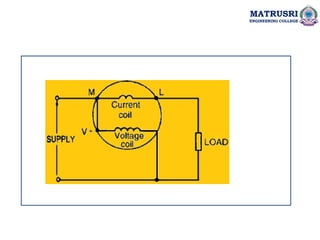
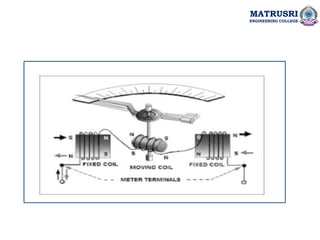
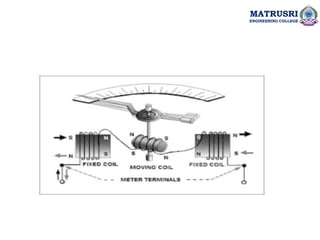
Fixed coil – The fixed coil connects in series with the load. It is considered as a current coil because
the load current flows through it. For making the construction easy the fixed coil divide into two
parts. And these two elements are parallel connected to each other. The fixed coil produces the
uniform electric field which is essentials for the working of the instruments. The current coil of the
instruments is designed to carry the current of approximately 20 amperes for saving the power.
Moving Coil – The moving coil consider as the pressure coil of the instruments. It connects in parallel
with the supply voltage. The current flows through them is directly proportional to the supply voltage.
The pointer mounts on the moving coil. The movement of the pointer controls with the help of the
spring. The current flows through the coil increases their temperature. The flows of currents control
with the help of resistor which connects in series with the moving coil.
Control – The control system provides the controlling torque to the instruments. The gravity control
and the spring control are the two types of control system. Out of two, the Electrodynamometer
Wattmeter uses spring control system. The spring control system is used for the movement of the
pointer.
Damping – The damping is the effect which reduces the movement of the pointer. In this Wattmeter
the damping torque produces because of the air friction. The other types of damping are not used in
the system because they destroy the useful magnetic flux.
Scales and pointers – The instruments use a linear scale because their moving coil moves linearly. The
apparatus uses the knife edge pointer for removing the parallax error which causes because of
oversights.
MATRUSRI
ENGINEERING COLLEGE
MATRUSRI
ENGINEERING COLLEGE
Working of Electrodynamometer Wattmeter
MATRUSRI
ENGINEERING COLLEGE
Working of Electrodynamometer Wattmeter
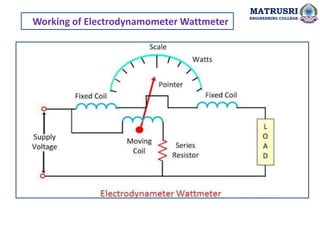
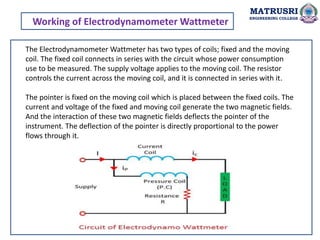
The Electrodynamometer Wattmeter has two types of coils; fixed and the moving
coil. The fixed coil connects in series with the circuit whose power consumption
use to be measured. The supply voltage applies to the moving coil. The resistor
controls the current across the moving coil, and it is connected in series with it.
The pointer is fixed on the moving coil which is placed between the fixed coils. The
current and voltage of the fixed and moving coil generate the two magnetic fields.
And the interaction of these two magnetic fields deflects the pointer of the
instrument. The deflection of the pointer is directly proportional to the power
flows through it.
MATRUSRI
ENGINEERING COLLEGE
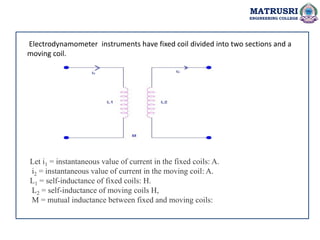
Electrodynamometer instruments have fixed coil divided into two sections and a
moving coil.
Let i1 = instantaneous value of current in the fixed coils: A.
i2 = instantaneous value of current in the moving coil: A.
L1 = self-inductance of fixed coils: H.
L2 = self-inductance of moving coils H,
M = mutual inductance between fixed and moving coils:
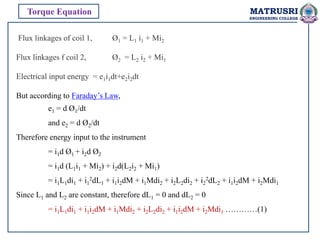
Flux linkages of coil 1, Ø1 = L1 i1 + Mi2
Flux linkages f coil 2, Ø2 = L2 i2 + Mi1
Electrical input energy = e1i1dt+e2i2dt
But according to Faraday’s Law,
e1 = d Ø1/dt
and e2 = d Ø2/dt
Therefore energy input to the instrument
= i1d Ø1 + i2d Ø2
= i1d (L1i1 + Mi2) + i2d(L2i2 + Mi1)
= i1L1di1 + i1
2dL1 + i1i2dM + i1Mdi2 + i2L2di2 + i2
2dL2 + i1i2dM + i2Mdi1
Since L1 and L2 are constant, therefore dL1 = 0 and dL2 = 0
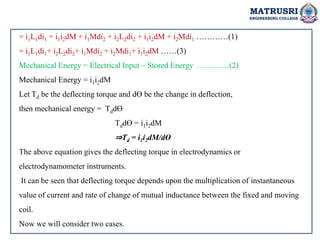
= i1L1di1 + i1i2dM + i1Mdi2 + i2L2di2 + i1i2dM + i2Mdi1 …………(1)
Torque Equation MATRUSRI
ENGINEERING COLLEGE
MATRUSRI
ENGINEERING COLLEGE
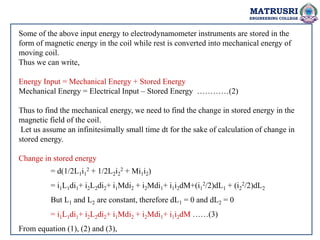
Some of the above input energy to electrodynamometer instruments are stored in the
form of magnetic energy in the coil while rest is converted into mechanical energy of
moving coil.
Thus we can write,
Energy Input = Mechanical Energy + Stored Energy
Mechanical Energy = Electrical Input – Stored Energy …………(2)
Thus to find the mechanical energy, we need to find the change in stored energy in the
magnetic field of the coil.
Let us assume an infinitesimally small time dt for the sake of calculation of change in
stored energy.
Change in stored energy
= d(1/2L1i1
2 + 1/2L2i2
2 + Mi1i2)
= i1L1di1+ i2L2di2+ i1Mdi2 + i2Mdi1+ i1i2dM+(i1
2/2)dL1 + (i2
2/2)dL2
But L1 and L2 are constant, therefore dL1 = 0 and dL2 = 0
= i1L1di1+ i2L2di2+ i1Mdi2 + i2Mdi1+ i1i2dM ……(3)
From equation (1), (2) and (3),
MATRUSRI
ENGINEERING COLLEGE
= i1L1di1 + i1i2dM + i1Mdi2 + i2L2di2 + i1i2dM + i2Mdi1 …………(1)
= i1L1di1+ i2L2di2+ i1Mdi2 + i2Mdi1+ i1i2dM ……(3)
Mechanical Energy = Electrical Input – Stored Energy …………(2)
Mechanical Energy = i1i2dM
Let Td be the deflecting torque and dƟ be the change in deflection,
then mechanical energy = TddƟ
TddƟ = i1i2dM
⇒Td = i1i2dM/dƟ
The above equation gives the deflecting torque in electrodynamics or
electrodynamometer instruments.
It can be seen that deflecting torque depends upon the multiplication of instantaneous
value of current and rate of change of mutual inductance between the fixed and moving
coil.
Now we will consider two cases.
MATRUSRI
ENGINEERING COLLEGE
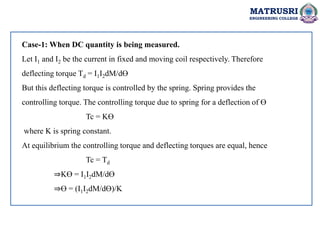
Case-1: When DC quantity is being measured.
Let I1 and I2 be the current in fixed and moving coil respectively. Therefore
deflecting torque Td = I1I2dM/dƟ
But this deflecting torque is controlled by the spring. Spring provides the
controlling torque. The controlling torque due to spring for a deflection of Ɵ
Tc = KƟ
where K is spring constant.
At equilibrium the controlling torque and deflecting torques are equal, hence
Tc = Td
⇒KƟ = I1I2dM/dƟ
⇒Ɵ = (I1I2dM/dƟ)/K
MATRUSRI
ENGINEERING COLLEGE
Let i1 and i2 are sinusoidal current having a phase displacement of Ø. Therefore we can write
as i1 = Im1Sinwt
i2 = Im2Sin(wt-Ø)
Thus the instantaneous deflecting torque is given as
Td = (Im1Sinwt)[ Im2Sin(wt-Ø)]dM/dƟ
The average torque for one time period of the currents are given by
Td = (I1I2CosØ)dM/dƟ
Where I1 = RMS Value of i1
I2 = RMS value of i2
From the above two cases, we can have following conclusions:
1. For sinusoidal alternating current, the deflecting torque is determined by the product of RMS value
of coil currents and the cosine of phase angle between them.
2. When the instrument is used for AC, the instantaneous torque is proportional to i2. Thus the torque
varies as the current varies but the direction of torque remains the same. Because of the inertia of
the instrument, the needle does not follow the change in torque rather it takes a position where the
average torque becomes equal to the controlling torque.
Case-2: When AC quantity is being measured.
MATRUSRI
ENGINEERING COLLEGE
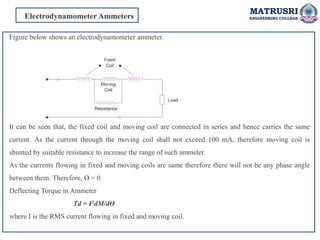
Figure below shows an electrodynamometer ammeter.
It can be seen that, the fixed coil and moving coil are connected in series and hence carries the same
current. As the current through the moving coil shall not exceed 100 mA, therefore moving coil is
shunted by suitable resistance to increase the range of such ammeter.
As the currents flowing in fixed and moving coils are same therefore there will not be any phase angle
between them. Therefore, Ø = 0
Deflecting Torque in Ammeter
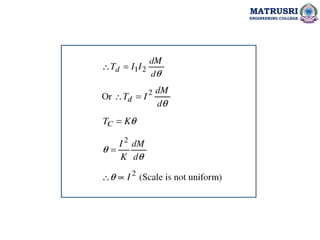
Td = I2dM/dƟ
where I is the RMS current flowing in fixed and moving coil.
Electrodynamometer Ammeters
MATRUSRI
ENGINEERING COLLEGE
MATRUSRI
ENGINEERING COLLEGE
Electrodynamometer Voltmeter
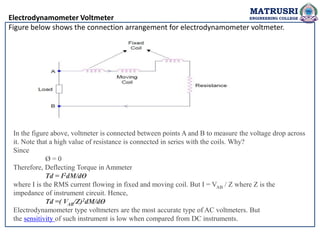
Figure below shows the connection arrangement for electrodynamometer voltmeter.
In the figure above, voltmeter is connected between points A and B to measure the voltage drop across
it. Note that a high value of resistance is connected in series with the coils. Why?
Since
Ø = 0
Therefore, Deflecting Torque in Ammeter
Td = I2dM/dƟ
where I is the RMS current flowing in fixed and moving coil. But I = VAB / Z where Z is the
impedance of instrument circuit. Hence,
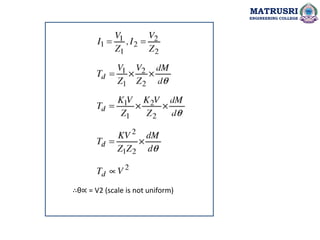
Td =( VAB/Z)2dM/dƟ
Electrodynamometer type voltmeters are the most accurate type of AC voltmeters. But
the sensitivity of such instrument is low when compared from DC instruments.
MATRUSRI
ENGINEERING COLLEGE
∴θ∝ = V2 (scale is not uniform)
MATRUSRI
ENGINEERING COLLEGE
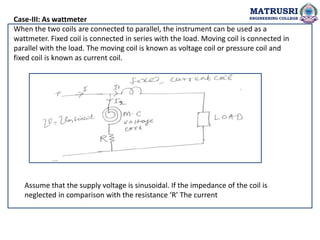
Case-III: As wattmeter
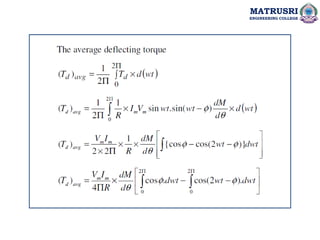
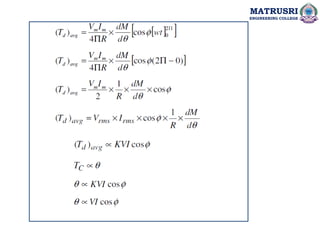
When the two coils are connected to parallel, the instrument can be used as a
wattmeter. Fixed coil is connected in series with the load. Moving coil is connected in
parallel with the load. The moving coil is known as voltage coil or pressure coil and
fixed coil is known as current coil.
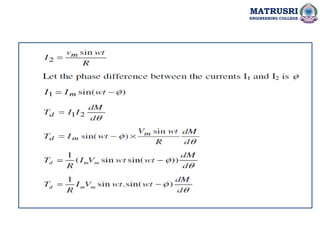
Assume that the supply voltage is sinusoidal. If the impedance of the coil is
neglected in comparison with the resistance ‘R’ The current
MATRUSRI
ENGINEERING COLLEGE
MATRUSRI
ENGINEERING COLLEGE
MATRUSRI
ENGINEERING COLLEGE
MATRUSRI
ENGINEERING COLLEGE
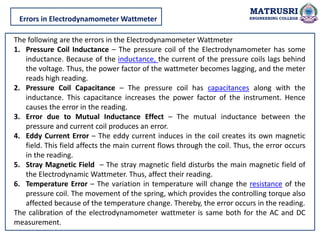
Errors in Electrodynamometer Wattmeter
The following are the errors in the Electrodynamometer Wattmeter
1. Pressure Coil Inductance – The pressure coil of the Electrodynamometer has some
inductance. Because of the inductance, the current of the pressure coils lags behind
the voltage. Thus, the power factor of the wattmeter becomes lagging, and the meter
reads high reading.
2. Pressure Coil Capacitance – The pressure coil has capacitances along with the
inductance. This capacitance increases the power factor of the instrument. Hence
causes the error in the reading.
3. Error due to Mutual Inductance Effect – The mutual inductance between the
pressure and current coil produces an error.
4. Eddy Current Error – The eddy current induces in the coil creates its own magnetic
field. This field affects the main current flows through the coil. Thus, the error occurs
in the reading.
5. Stray Magnetic Field – The stray magnetic field disturbs the main magnetic field of
the Electrodynamic Wattmeter. Thus, affect their reading.
6. Temperature Error – The variation in temperature will change the resistance of the
pressure coil. The movement of the spring, which provides the controlling torque also
affected because of the temperature change. Thereby, the error occurs in the reading.
The calibration of the electrodynamometer wattmeter is same both for the AC and DC
measurement.
MATRUSRI
ENGINEERING COLLEGE
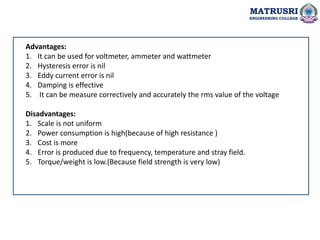
Advantages:
1. It can be used for voltmeter, ammeter and wattmeter
2. Hysteresis error is nil
3. Eddy current error is nil
4. Damping is effective
5. It can be measure correctively and accurately the rms value of the voltage
Disadvantages:
1. Scale is not uniform
2. Power consumption is high(because of high resistance )
3. Cost is more
4. Error is produced due to frequency, temperature and stray field.
5. Torque/weight is low.(Because field strength is very low)
MATRUSRI
ENGINEERING COLLEGE

Electrical Measurements & Instrumentation/Electrodynamometer Type Instruments

  • 1.
    MATRUSRI ENGINEERING COLLEGE Objectives • Tounderstand the basic construction of a dynamometer instrument. • Explain basic operation and development of torque expressions for ammeter, voltmeter and wattmeter. • Study of ammeter, voltmeter and wattmeter connections. • To investigate the errors involve in wattmeter readings and its compensation. • Understanding the effect of inductance of voltage coil (moving coil) on the wattmeter readings.
  • 2.
    MATRUSRI ENGINEERING COLLEGE DEPARTMENTOF ELECTRICAL AND ELECTRONICS ENGINEERING SUBJECT NAME: Electrodynamometer type instruments FACULTY NAME: Mrs.N.KALPANA MATRUSRI ENGINEERING COLLEGE
  • 3.
    MATRUSRI ENGINEERING COLLEGE Contents: Electrodynamometertype instruments  Construction  Principle of operation  Working  Torque equation  Types of Electrostatic Voltmeters Learning Outcomes: At end of this course the student will able to LO1. To understand the basic construction of a dynamometer instrument. • Explain basic operation and development of torque expressions for ammeter, voltmeter and wattmeter. • Study of ammeter, voltmeter and wattmeter connections. • To investigate the errors involve in wattmeter readings and its compensation. • Understanding the effect of inductance of voltage coil (moving coil) on the wattmeter readings. . MODULE-3
  • 4.
    • Power canbe defined as the time rate of energy transfer or energy dissipation in a load. • Power is the rate of using or supplying energy. • The rate at which work is done to maintain an electric current in a circuit is termed ELECTRIC POWER. • Electric power is measured in watts (W). • The SI unit of power is the watt (W), where W = 1 J/s. • The kilowatt is a commonly used unit where • I kilowatt = 1000 watts. • ELECTRIC POWER equals the product of the current I and the potential difference V. MATRUSRI ENGINEERING COLLEGE Power
  • 5.
    MATRUSRI ENGINEERING COLLEGE The POWERin DC circuit is equal to the product of voltage and current. [Power = Current × Voltage] When the system voltage is constant, ammeter readings are almost a sufficient indication of the POWER taken. The POWER is calculated by using voltmeter and ammeter or wattmeter. P = I × V = I² × R = V² / R where: P = power in watts (W) I = current in amps (A) R = resistance in ohms ( ) V = voltage in volts (V)
  • 6.
    MATRUSRI ENGINEERING COLLEGE Ammeter measurescurrent which flow into the voltmeter and load Voltmeter measures voltage drop across the ammeter in addition to that dropping across the load DC CIRCUITS
  • 7.
  • 8.
    MATRUSRI ENGINEERING COLLEGE The workdone by a heater is 100 joules for time 4 seconds. Find out the electric power of the heater. Solution: Given, Work done by a heater (W)=100 joule Time taken by a heater (t)=4 seconds Therefore the electric power of the heater P = W/t=100/4=25 watt The electric power of the electrical bulb is 50 watt. Then at how much time required to the electrical bulb to performed the work of 150 joules. Solution: Given, Electric power (P)=50 watt or 50 joules/second Work done by a bulb (W)=150 joules We know that P=W/t t=W/P = 150/50 Time, t = 3 seconds
  • 9.
  • 10.
    MATRUSRI ENGINEERING COLLEGE Electrodynamometer typeinstruments: Electrodynamometer instrument is a transfer instrument The necessity for the AC calibration of moving iron instruments as well as another type of instruments which cannot be correctly calibrated requires the use of a transfer type of instrument. A transfer instrument is one that may be calibrated with a d.c source and then used without modification to measure a.c. This requires the transfer type instrument to have the same accuracy for both a.c and d.c, which have electrodynamometer instruments have. Electrodynamometer type instruments are used as a.c voltmeters and ammeters both in the range of power frequencies and lower part of the audio frequency range. They are used as watt-meters,varmeters and with some modification as power factor meters and frequency meters.
  • 11.
  • 12.
    MATRUSRI ENGINEERING COLLEGE Electrodynamometer Wattmeter Definition:The instrument whose working depends on the reaction between the magnetic field of moving and fixed coils is known as the Electrodynamo-meter Wattmeter. It uses for measuring the power of both the AC and DC circuits. The working principle of the Electrodynamometer Wattmeter is very simple and easy. Their working depends on the theory that the current carrying conductor placed in a magnetic field experiences a mechanical force. This mechanical force deflects the pointer which is mounted on the calibrated scale. Construction of Electrodynamometer Wattmeter The important parts of the Electrodynamometer Wattmeter are 1.Fixed coil 2. Moving coil 3. Controlling torque 4. Damping torque 5. Scales and pointers
  • 13.
    MATRUSRI ENGINEERING COLLEGE Construction ofElectrodynamometer Wattmeter Fixed coil – The fixed coil connects in series with the load. It is considered as a current coil because the load current flows through it. For making the construction easy the fixed coil divide into two parts. And these two elements are parallel connected to each other. The fixed coil produces the uniform electric field which is essentials for the working of the instruments. The current coil of the instruments is designed to carry the current of approximately 20 amperes for saving the power. Moving Coil – The moving coil consider as the pressure coil of the instruments. It connects in parallel with the supply voltage. The current flows through them is directly proportional to the supply voltage. The pointer mounts on the moving coil. The movement of the pointer controls with the help of the spring. The current flows through the coil increases their temperature. The flows of currents control with the help of resistor which connects in series with the moving coil. Control – The control system provides the controlling torque to the instruments. The gravity control and the spring control are the two types of control system. Out of two, the Electrodynamometer Wattmeter uses spring control system. The spring control system is used for the movement of the pointer. Damping – The damping is the effect which reduces the movement of the pointer. In this Wattmeter the damping torque produces because of the air friction. The other types of damping are not used in the system because they destroy the useful magnetic flux. Scales and pointers – The instruments use a linear scale because their moving coil moves linearly. The apparatus uses the knife edge pointer for removing the parallax error which causes because of oversights.
  • 14.
  • 15.
    MATRUSRI ENGINEERING COLLEGE Working ofElectrodynamometer Wattmeter
  • 16.
    MATRUSRI ENGINEERING COLLEGE Working ofElectrodynamometer Wattmeter The Electrodynamometer Wattmeter has two types of coils; fixed and the moving coil. The fixed coil connects in series with the circuit whose power consumption use to be measured. The supply voltage applies to the moving coil. The resistor controls the current across the moving coil, and it is connected in series with it. The pointer is fixed on the moving coil which is placed between the fixed coils. The current and voltage of the fixed and moving coil generate the two magnetic fields. And the interaction of these two magnetic fields deflects the pointer of the instrument. The deflection of the pointer is directly proportional to the power flows through it.
  • 17.
    MATRUSRI ENGINEERING COLLEGE Electrodynamometer instrumentshave fixed coil divided into two sections and a moving coil. Let i1 = instantaneous value of current in the fixed coils: A. i2 = instantaneous value of current in the moving coil: A. L1 = self-inductance of fixed coils: H. L2 = self-inductance of moving coils H, M = mutual inductance between fixed and moving coils:
  • 18.
    Flux linkages ofcoil 1, Ø1 = L1 i1 + Mi2 Flux linkages f coil 2, Ø2 = L2 i2 + Mi1 Electrical input energy = e1i1dt+e2i2dt But according to Faraday’s Law, e1 = d Ø1/dt and e2 = d Ø2/dt Therefore energy input to the instrument = i1d Ø1 + i2d Ø2 = i1d (L1i1 + Mi2) + i2d(L2i2 + Mi1) = i1L1di1 + i1 2dL1 + i1i2dM + i1Mdi2 + i2L2di2 + i2 2dL2 + i1i2dM + i2Mdi1 Since L1 and L2 are constant, therefore dL1 = 0 and dL2 = 0 = i1L1di1 + i1i2dM + i1Mdi2 + i2L2di2 + i1i2dM + i2Mdi1 …………(1) Torque Equation MATRUSRI ENGINEERING COLLEGE
  • 19.
    MATRUSRI ENGINEERING COLLEGE Some ofthe above input energy to electrodynamometer instruments are stored in the form of magnetic energy in the coil while rest is converted into mechanical energy of moving coil. Thus we can write, Energy Input = Mechanical Energy + Stored Energy Mechanical Energy = Electrical Input – Stored Energy …………(2) Thus to find the mechanical energy, we need to find the change in stored energy in the magnetic field of the coil. Let us assume an infinitesimally small time dt for the sake of calculation of change in stored energy. Change in stored energy = d(1/2L1i1 2 + 1/2L2i2 2 + Mi1i2) = i1L1di1+ i2L2di2+ i1Mdi2 + i2Mdi1+ i1i2dM+(i1 2/2)dL1 + (i2 2/2)dL2 But L1 and L2 are constant, therefore dL1 = 0 and dL2 = 0 = i1L1di1+ i2L2di2+ i1Mdi2 + i2Mdi1+ i1i2dM ……(3) From equation (1), (2) and (3),
  • 20.
    MATRUSRI ENGINEERING COLLEGE = i1L1di1+ i1i2dM + i1Mdi2 + i2L2di2 + i1i2dM + i2Mdi1 …………(1) = i1L1di1+ i2L2di2+ i1Mdi2 + i2Mdi1+ i1i2dM ……(3) Mechanical Energy = Electrical Input – Stored Energy …………(2) Mechanical Energy = i1i2dM Let Td be the deflecting torque and dƟ be the change in deflection, then mechanical energy = TddƟ TddƟ = i1i2dM ⇒Td = i1i2dM/dƟ The above equation gives the deflecting torque in electrodynamics or electrodynamometer instruments. It can be seen that deflecting torque depends upon the multiplication of instantaneous value of current and rate of change of mutual inductance between the fixed and moving coil. Now we will consider two cases.
  • 21.
    MATRUSRI ENGINEERING COLLEGE Case-1: WhenDC quantity is being measured. Let I1 and I2 be the current in fixed and moving coil respectively. Therefore deflecting torque Td = I1I2dM/dƟ But this deflecting torque is controlled by the spring. Spring provides the controlling torque. The controlling torque due to spring for a deflection of Ɵ Tc = KƟ where K is spring constant. At equilibrium the controlling torque and deflecting torques are equal, hence Tc = Td ⇒KƟ = I1I2dM/dƟ ⇒Ɵ = (I1I2dM/dƟ)/K
  • 22.
    MATRUSRI ENGINEERING COLLEGE Let i1and i2 are sinusoidal current having a phase displacement of Ø. Therefore we can write as i1 = Im1Sinwt i2 = Im2Sin(wt-Ø) Thus the instantaneous deflecting torque is given as Td = (Im1Sinwt)[ Im2Sin(wt-Ø)]dM/dƟ The average torque for one time period of the currents are given by Td = (I1I2CosØ)dM/dƟ Where I1 = RMS Value of i1 I2 = RMS value of i2 From the above two cases, we can have following conclusions: 1. For sinusoidal alternating current, the deflecting torque is determined by the product of RMS value of coil currents and the cosine of phase angle between them. 2. When the instrument is used for AC, the instantaneous torque is proportional to i2. Thus the torque varies as the current varies but the direction of torque remains the same. Because of the inertia of the instrument, the needle does not follow the change in torque rather it takes a position where the average torque becomes equal to the controlling torque. Case-2: When AC quantity is being measured.
  • 23.
    MATRUSRI ENGINEERING COLLEGE Figure belowshows an electrodynamometer ammeter. It can be seen that, the fixed coil and moving coil are connected in series and hence carries the same current. As the current through the moving coil shall not exceed 100 mA, therefore moving coil is shunted by suitable resistance to increase the range of such ammeter. As the currents flowing in fixed and moving coils are same therefore there will not be any phase angle between them. Therefore, Ø = 0 Deflecting Torque in Ammeter Td = I2dM/dƟ where I is the RMS current flowing in fixed and moving coil. Electrodynamometer Ammeters
  • 24.
  • 25.
    MATRUSRI ENGINEERING COLLEGE Electrodynamometer Voltmeter Figurebelow shows the connection arrangement for electrodynamometer voltmeter. In the figure above, voltmeter is connected between points A and B to measure the voltage drop across it. Note that a high value of resistance is connected in series with the coils. Why? Since Ø = 0 Therefore, Deflecting Torque in Ammeter Td = I2dM/dƟ where I is the RMS current flowing in fixed and moving coil. But I = VAB / Z where Z is the impedance of instrument circuit. Hence, Td =( VAB/Z)2dM/dƟ Electrodynamometer type voltmeters are the most accurate type of AC voltmeters. But the sensitivity of such instrument is low when compared from DC instruments.
  • 26.
    MATRUSRI ENGINEERING COLLEGE ∴θ∝ =V2 (scale is not uniform)
  • 27.
    MATRUSRI ENGINEERING COLLEGE Case-III: Aswattmeter When the two coils are connected to parallel, the instrument can be used as a wattmeter. Fixed coil is connected in series with the load. Moving coil is connected in parallel with the load. The moving coil is known as voltage coil or pressure coil and fixed coil is known as current coil. Assume that the supply voltage is sinusoidal. If the impedance of the coil is neglected in comparison with the resistance ‘R’ The current
  • 28.
  • 29.
  • 30.
  • 31.
    MATRUSRI ENGINEERING COLLEGE Errors inElectrodynamometer Wattmeter The following are the errors in the Electrodynamometer Wattmeter 1. Pressure Coil Inductance – The pressure coil of the Electrodynamometer has some inductance. Because of the inductance, the current of the pressure coils lags behind the voltage. Thus, the power factor of the wattmeter becomes lagging, and the meter reads high reading. 2. Pressure Coil Capacitance – The pressure coil has capacitances along with the inductance. This capacitance increases the power factor of the instrument. Hence causes the error in the reading. 3. Error due to Mutual Inductance Effect – The mutual inductance between the pressure and current coil produces an error. 4. Eddy Current Error – The eddy current induces in the coil creates its own magnetic field. This field affects the main current flows through the coil. Thus, the error occurs in the reading. 5. Stray Magnetic Field – The stray magnetic field disturbs the main magnetic field of the Electrodynamic Wattmeter. Thus, affect their reading. 6. Temperature Error – The variation in temperature will change the resistance of the pressure coil. The movement of the spring, which provides the controlling torque also affected because of the temperature change. Thereby, the error occurs in the reading. The calibration of the electrodynamometer wattmeter is same both for the AC and DC measurement.
  • 32.
    MATRUSRI ENGINEERING COLLEGE Advantages: 1. Itcan be used for voltmeter, ammeter and wattmeter 2. Hysteresis error is nil 3. Eddy current error is nil 4. Damping is effective 5. It can be measure correctively and accurately the rms value of the voltage Disadvantages: 1. Scale is not uniform 2. Power consumption is high(because of high resistance ) 3. Cost is more 4. Error is produced due to frequency, temperature and stray field. 5. Torque/weight is low.(Because field strength is very low)
  • 33.