MATRUSRI ENGINEERING COLLEGE
DEPARTMENT OF ELECTRICAL AND ELECTRONICS
ENGINEERING
SUBJECT NAME: HIGH VOLTAGE ENGINEERING
FACULTY NAME: Mrs.N.KALPANA
MATRUSRI
ENGINEERING COLLEGE
SYLLABUS
UNIT I
Conduction And Breakdown In Gaseous Insulating Materials: Ionization Processes And
Current Growth-Townsend’s Criterion For Breakdown- Break Down In Electro Negative
Gases- Time Lags For Breakdown- Paschen’s Law- Corona Discharges And Breakdown In
Non-Uniform Fields- Practical Considerations For Selecting Gases For Insulation Purposes.
UNIT II
Conduction and Breakdown in Liquid Dielectrics: Various mechanisms of breakdown in liquid
dielectrics-Liquid dielectrics used in practice-Various processes-Breakdown in solid
dielectrics- solid dielectrics used in practice.
UNIT III:GENERATION OF HIGH VOLTAGES AND CURRENTS
Generation of High DC voltages using multiplier circuits- Van De Graff generator. Generation
of High alternating voltages voltages using cascade transformers-Production of high frequency
A.C high voltages- standard Impulse wave shapes-Marx circuit-Generation of switching
surges-Impulse current generation- Tripping and control of impulse generators.
UNIT IV: MEASUREMENT OF HIGH VOLTAGES AND CURRENTS
High DC voltages measurement technique- Methods of measurement for power frequency -
A.C. voltages- Sphere gap measurement technique- Potential divider or impulse voltage
measurement-Measurement of high D.C. and A.C. and Impulse currents –Use of CRC for
impulse voltage and current measurements.
UNIT V: HIGH VOLTAGE TESTING
Testing on Insulators, Testing on bushing, Testing of Isolators and circuit breakers- Cables
testing, Testing of Transformers, Testing of Surge Arresters, Radio Interference
measurements, -Use of I.S.S. for testing.
MATRUSRI
ENGINEERING COLLEGE
MATRUSRI
ENGINEERING COLLEGE
Contents:
 Testing on Insulators
 Testing on bushing
 Testing of Isolators and circuit breakers
 Cables testing, Testing of Transformers
 Testing of Surge Arresters, Radio Interference measurements
 Use of I.S.S. for testing.
UNIT-1
Course Outcomes: At end of this course the student will able to
CO1. Conduct high voltage test of materials and apparatus
What is High Voltage ?
High Voltage Engineering Introduction
I f an AC voltage is > 1000V(HVAC)
DC > 1500V HVDC
Application of High voltage in Gas, Solid and liquid medium is
called High Voltage Engineering
Mainly used in design of dielectric, design of protective devices
What is High Voltage Engineering ?
MATRUSRI
ENGINEERING COLLEGE
MATRUSRI
ENGINEERING COLLEGE
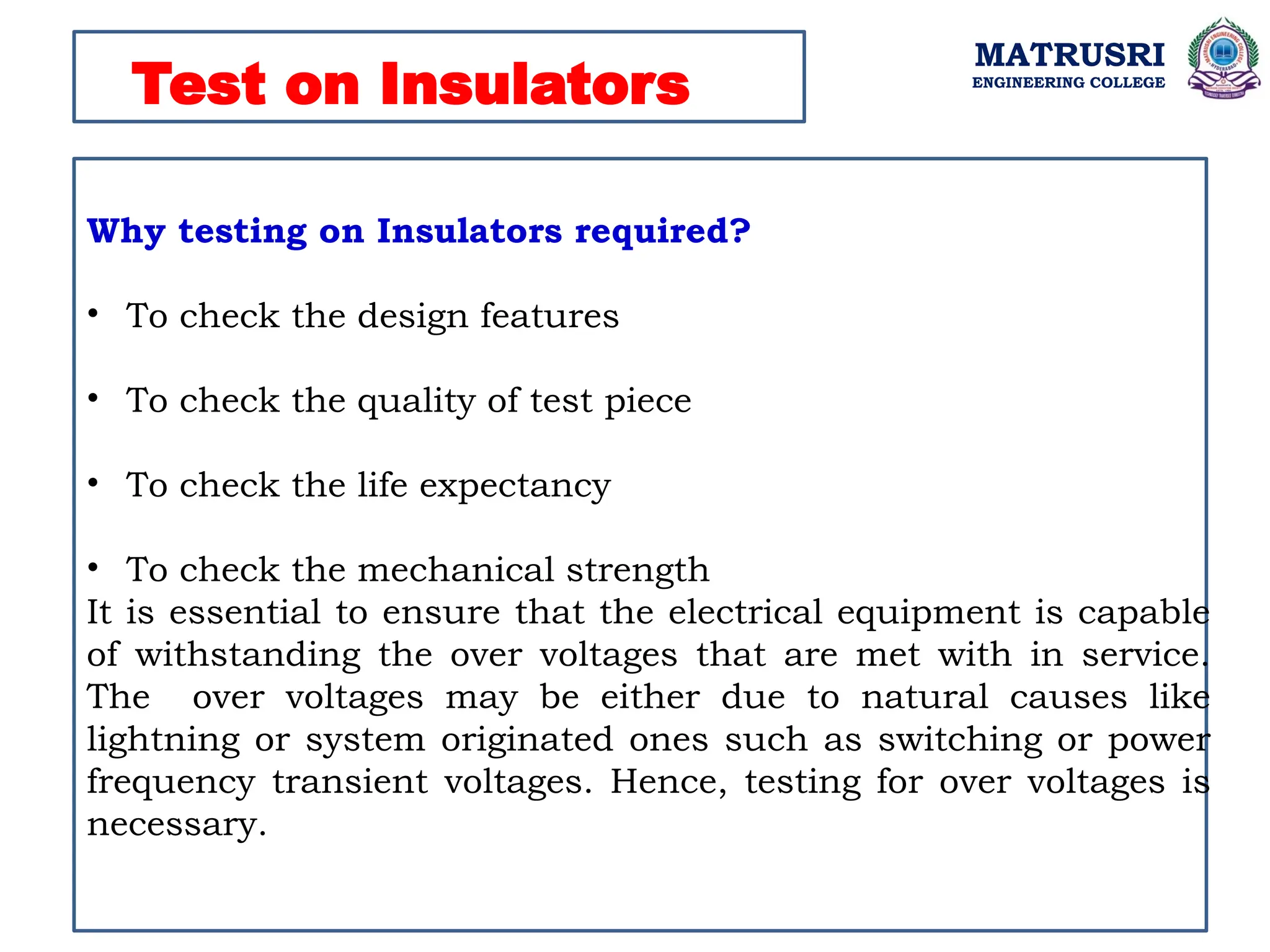
Test on Insulators
Why testing on Insulators required?
• To check the design features
• To check the quality of test piece
• To check the life expectancy
• To check the mechanical strength
It is essential to ensure that the electrical equipment is capable
of withstanding the over voltages that are met with in service.
The over voltages may be either due to natural causes like
lightning or system originated ones such as switching or power
frequency transient voltages. Hence, testing for over voltages is
necessary.
MATRUSRI
ENGINEERING COLLEGE
Definitions
(a) Disruptive Discharge Voltage This is defined as the voltage which
produces the loss of dielectric strength of an insulation. It is that voltage
at which the electrical stress in the insulation causes a failure which
includes the collapse of voltage and passage of current. In solids, this
causes a permanent loss of strength, and in liquids or gases, only
temporary loss may be caused. When a discharge takes place between
two electrodes in a gas or a liquid or over a solid surface in air, it is
called flashover. If the discharge occurs through a solid insulation it is
called puncture.
(b) Withstand Voltage The voltage which has to be applied to a test
object under specified conditions in a withstand test is called the
withstand voltage [as per IS: 731 and IS: 2099–1963].
(c) Fifty Per Cent Flashover Voltage This is the voltage which has a
probability of 50% flashover, when applied to a test object. This is
normally applied in impulse test in which the loss of insulation strength
is temporary.
(d) Hundred Per Cent Flashover Voltage The voltage, that causes a
flashover at each of its applications under specified conditions, when
applied to test objects as specified, is hundred per cent flashover voltage.
(e) Creepage Distance It is the shortest distance on the contour of the
external surface of the insulator unit or between two metal fittings on
the insulator.
MATRUSRI
ENGINEERING COLLEGE
Test on Insulators
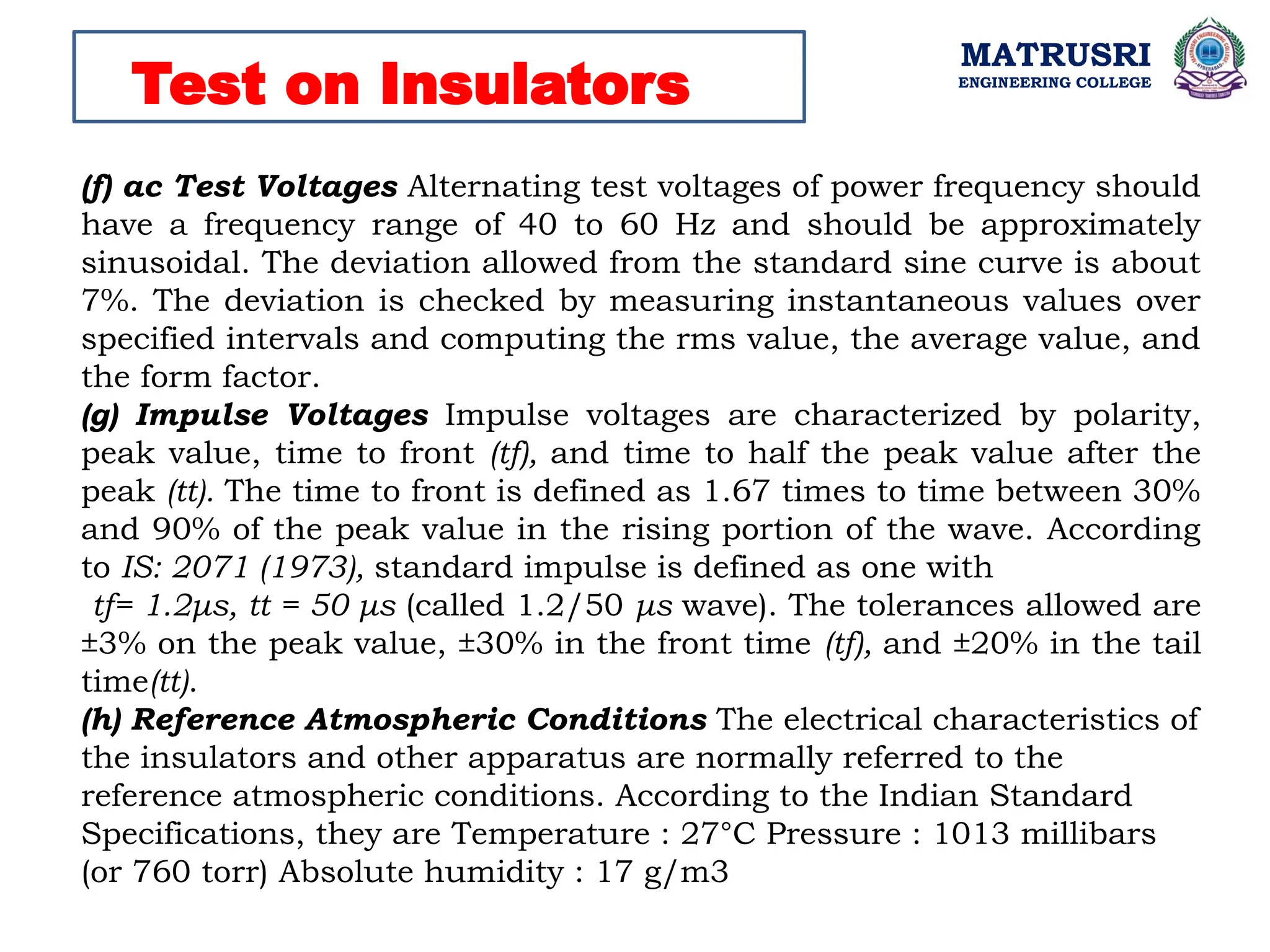
(f) ac Test Voltages Alternating test voltages of power frequency should
have a frequency range of 40 to 60 Hz and should be approximately
sinusoidal. The deviation allowed from the standard sine curve is about
7%. The deviation is checked by measuring instantaneous values over
specified intervals and computing the rms value, the average value, and
the form factor.
(g) Impulse Voltages Impulse voltages are characterized by polarity,
peak value, time to front (tf), and time to half the peak value after the
peak (tt). The time to front is defined as 1.67 times to time between 30%
and 90% of the peak value in the rising portion of the wave. According
to IS: 2071 (1973), standard impulse is defined as one with
tf= 1.2μs, tt = 50 μs (called 1.2/50 μs wave). The tolerances allowed are
±3% on the peak value, ±30% in the front time (tf), and ±20% in the tail
time(tt).
(h) Reference Atmospheric Conditions The electrical characteristics of
the insulators and other apparatus are normally referred to the
reference atmospheric conditions. According to the Indian Standard
Specifications, they are Temperature : 27°C Pressure : 1013 millibars
(or 760 torr) Absolute humidity : 17 g/m3
MATRUSRI
ENGINEERING COLLEGE
Test on Insulators
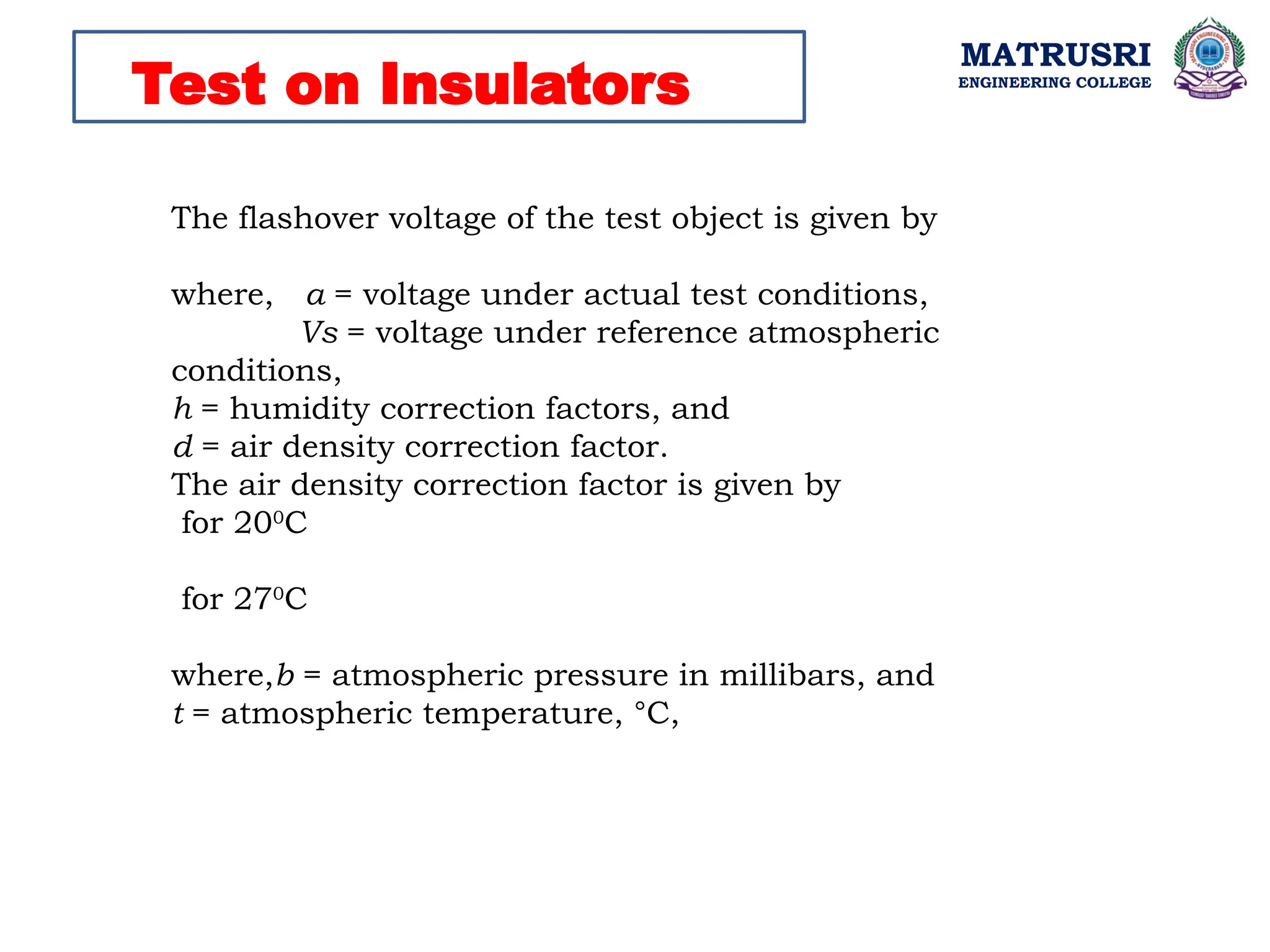
The flashover voltage of the test object is given by
where, a = voltage under actual test conditions,
Vs = voltage under reference atmospheric
conditions,
h = humidity correction factors, and
d = air density correction factor.
The air density correction factor is given by
for 200
C
for 270
C
where,b = atmospheric pressure in millibars, and
t = atmospheric temperature, °C,
MATRUSRI
ENGINEERING COLLEGE
Test on Insulators
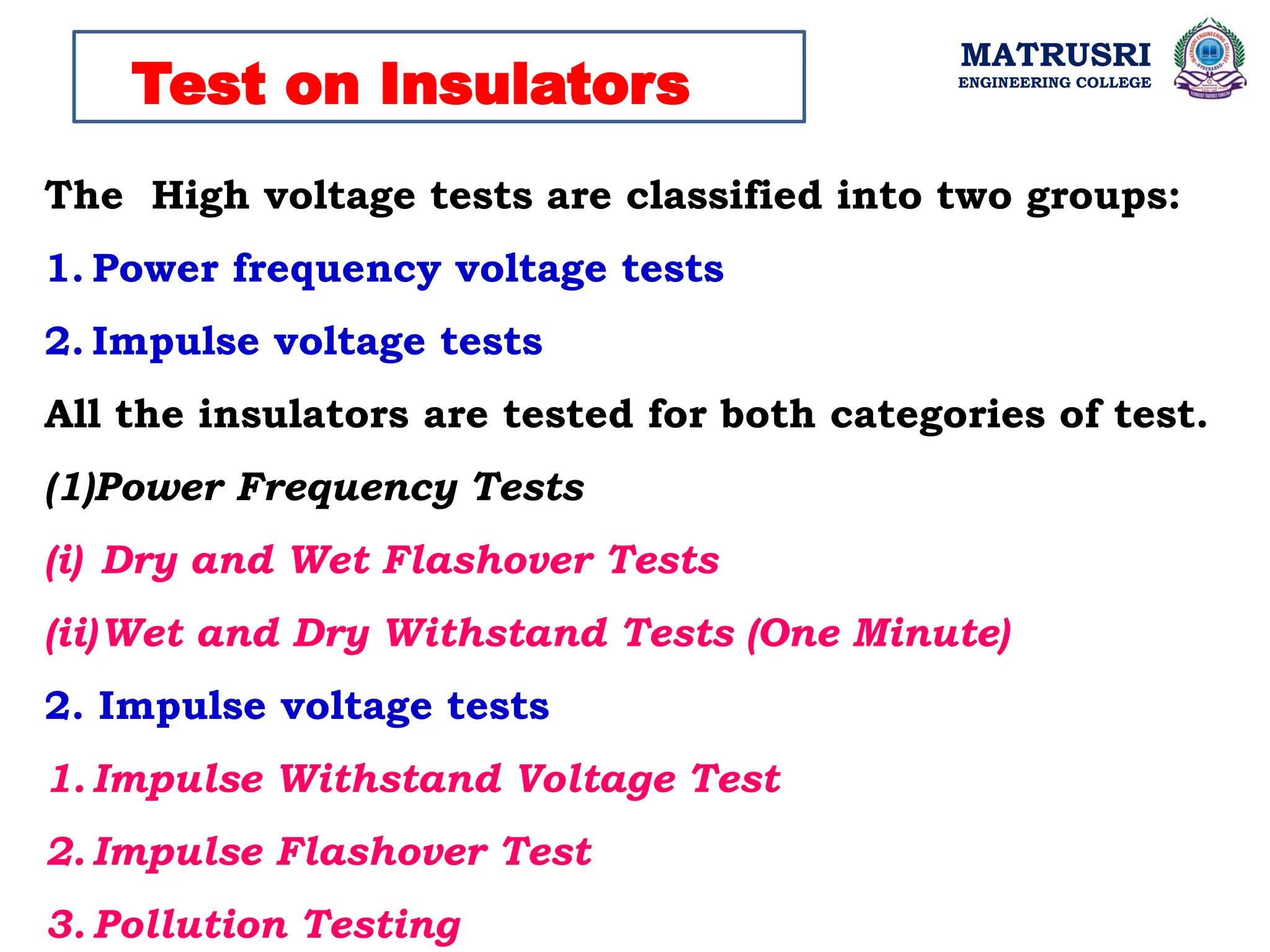
The High voltage tests are classified into two groups:
1. Power frequency voltage tests
2. Impulse voltage tests
All the insulators are tested for both categories of test.
(1)Power Frequency Tests
(i) Dry and Wet Flashover Tests
(ii)Wet and Dry Withstand Tests (One Minute)
2. Impulse voltage tests
1. Impulse Withstand Voltage Test
2. Impulse Flashover Test
3. Pollution Testing
MATRUSRI
ENGINEERING COLLEGE
Test on Insulators
(i) Dry and Wet Flashover Tests
In these tests, the ac voltage of power frequency is applied across the
insulators and increased at a uniform rate of about 2 % per second of 75%
of the estimated test voltage, to such a value that a breakdown occurs
along the surface of the insulator.
If the test is conducted under normal conditions without any rain or
precipitation, it is called ‘dry flashover test’.
If the test is done under conditions of rain, it is called ‘wet flashover test’.
The test object is subjected to a spray of water of given conductivity by
means of nozzles. The spray is arranged such that the water drops fall
approximately at an inclination of 45° to the vertical. The test object is
sprayed for at least one minute before the voltage application, and the
spray is continued during the voltage application.
(ii) Wet and Dry Withstand Tests (One Minute)
In these tests, the voltage specified in the relevant specification is applied
under dry or wet conditions for a period of one minute with an insulator
mounted as in service conditions. The test piece should withstand the
specified voltage.
MATRUSRI
ENGINEERING COLLEGE
Test on Insulators
(b)Impulse Tests
(i) Impulse Withstand Voltage Test
This test is done by applying standard impulse voltage of specified value
under dry conditions with both positive and negative polarities of the
wave. If five consecutive waves do not cause a flashover or puncture, the
insulator is deemed to have passed the test. If two applications cause
flashover, the object is deemed to have failed. If there is only one failure,
additional ten applications of the voltage wave are made. If the test object
has withstood the subsequent applications, it is said to have passed the
test.
(ii) Impulse Flashover Test
The test is done as above with the specified voltage. Usually, the
probability of failure is determined for 40% and 60% failure values or
20% and 80% failure values, since it is difficult to adjust the test voltage
for the exact 50% flashover values. The average value of the upper and
the lower limits is taken. The insulator surface should not be damaged by
these tests, but slight marking on its surface or chipping off of the
cement is allowed.
MATRUSRI
ENGINEERING COLLEGE
Test on Insulators
(iii) Pollution Testing
Because of the problem of pollution of outdoor electrical insulation and
consequent problems of the maintenance of electrical power systems, pollution
testing is gaining importance.
The normal types of pollution are
(i) dust, microorganisms, bird secretions, flies, etc.,
(ii) industrial pollution like smoke, petroleum vapours, dust, and other deposits,
(iii) coastal pollution in which corrosive and hygroscopic salt layers are deposited
on the insulator surfaces,
(iv) desert pollution in which sand storms cause deposition of sand and dust
layers
(v) ice and fog deposits at high altitudes and in polar countries. These pollutions
cause corrosion, non uniform gradients along the insulator strings and
surface of insulators and also cause deterioration of the material. Also,
pollution causes partial discharges and radio interference. Hence, pollution
testing is important for extra high-voltage systems.
At present there is no standard pollution test available. The popular test that is
normally done is the salt fog test. In this test, the maximum normal withstand
voltage is applied on the insulator and then artificial salt fog is created around
the insulator by jets of salt water and compressed air. If the flashover occurs
within one hour, the test is repeated with fog of lower salinity, otherwise, with a
fog to higher salinity.
MATRUSRI
ENGINEERING COLLEGE
Testing of Bushings
MATRUSRI
ENGINEERING COLLEGE
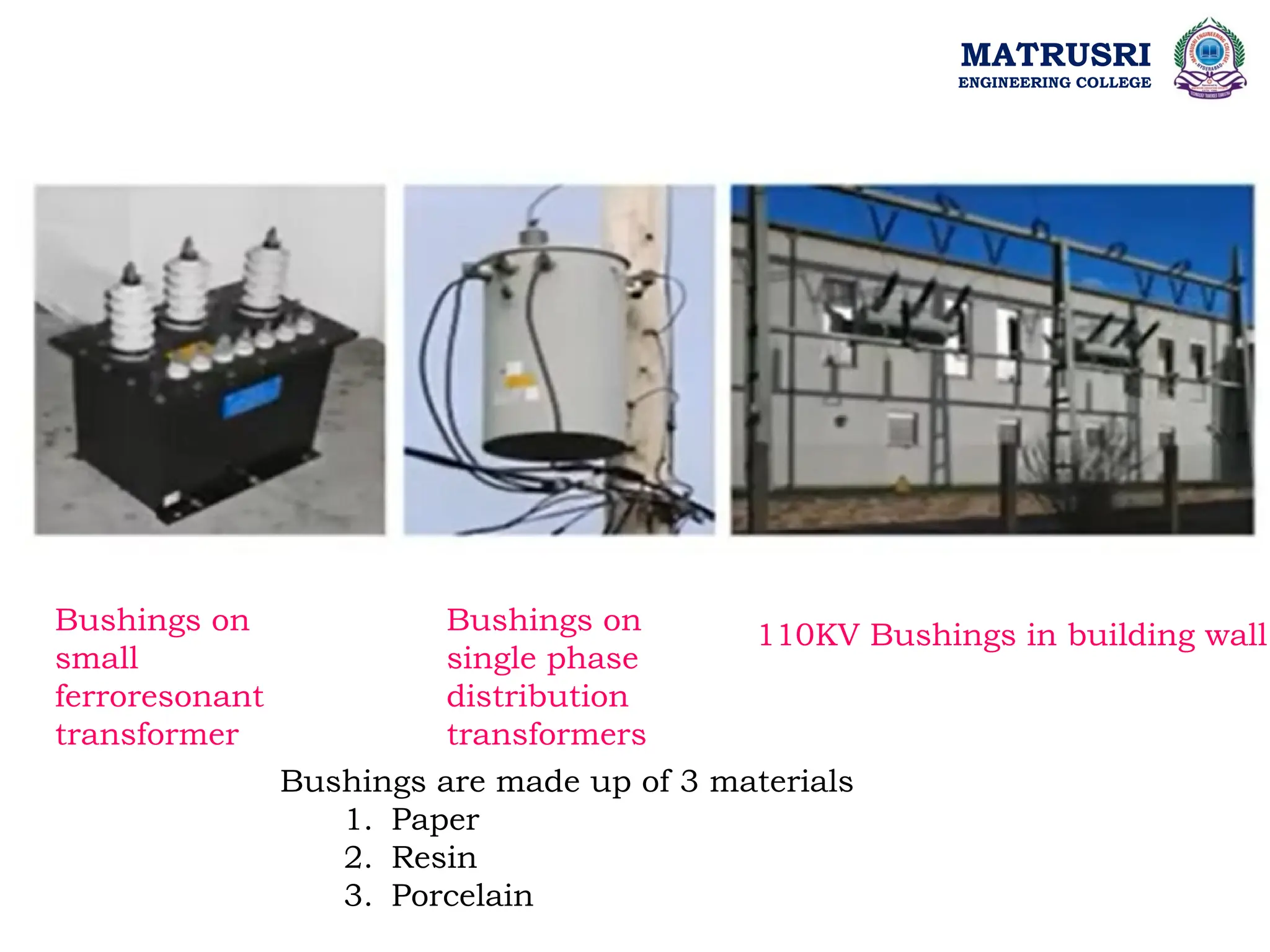
Bushings on
small
ferroresonant
transformer
Bushings on
single phase
distribution
transformers
110KV Bushings in building wall
Bushings are made up of 3 materials
1. Paper
2. Resin
3. Porcelain
MATRUSRI
ENGINEERING COLLEGE
Testing of Bushings
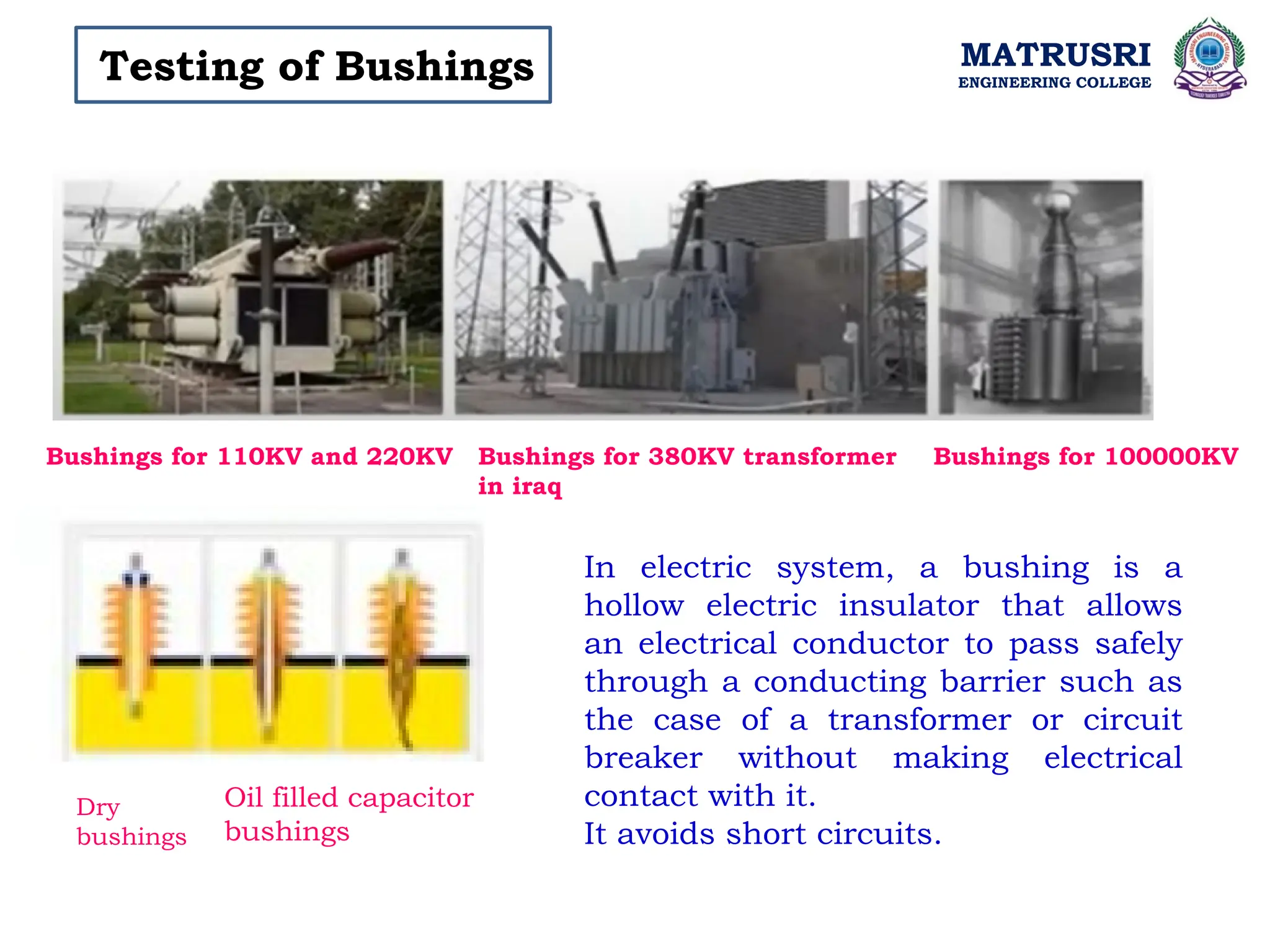
Bushings for 110KV and 220KV Bushings for 380KV transformer
in iraq
Bushings for 100000KV
In electric system, a bushing is a
hollow electric insulator that allows
an electrical conductor to pass safely
through a conducting barrier such as
the case of a transformer or circuit
breaker without making electrical
contact with it.
It avoids short circuits.
Dry
bushings
Oil filled capacitor
bushings
MATRUSRI
ENGINEERING COLLEGE
Testing of Bushings
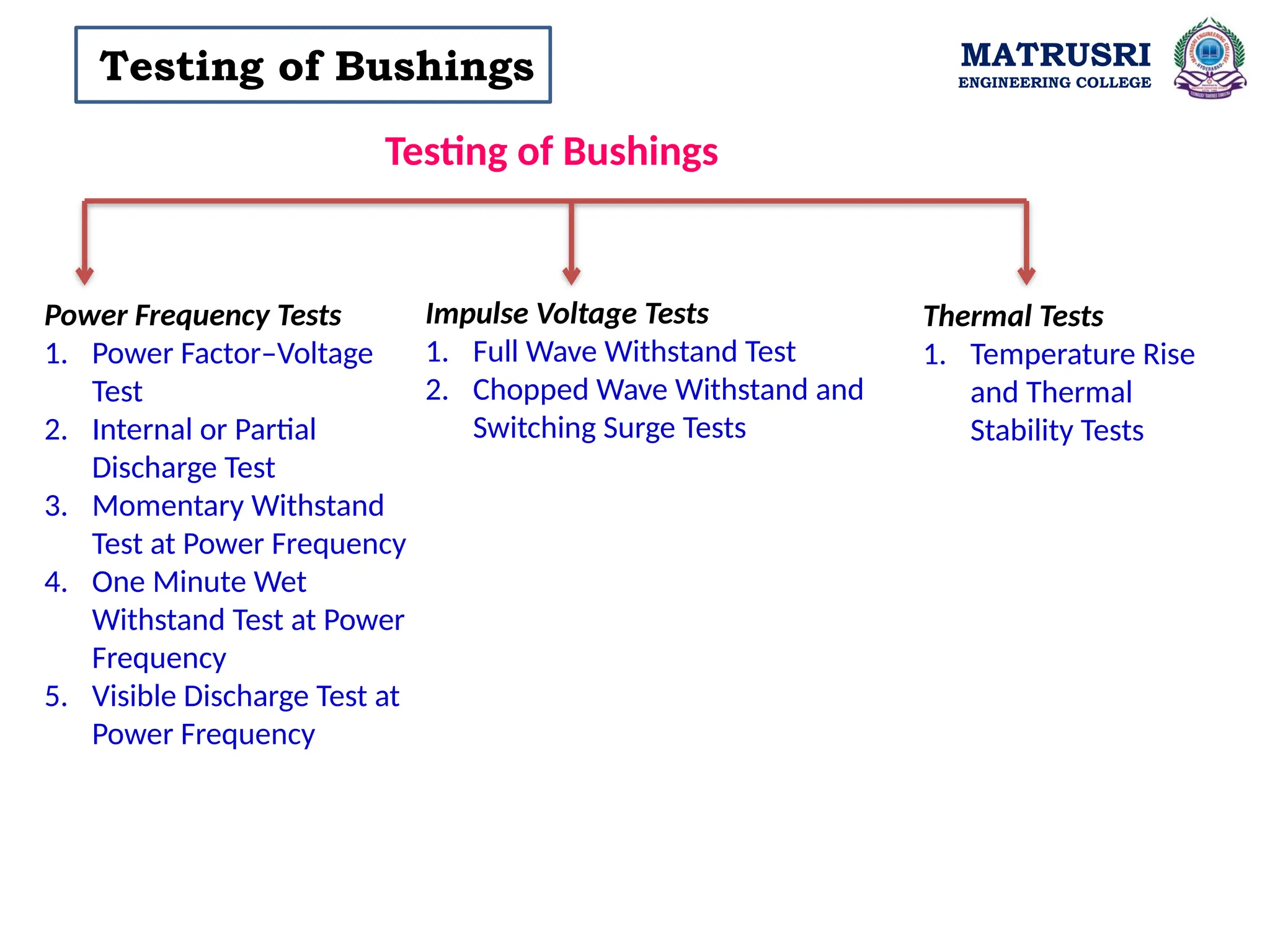
Testing of Bushings
Power Frequency Tests
1. Power Factor–Voltage
Test
2. Internal or Partial
Discharge Test
3. Momentary Withstand
Test at Power Frequency
4. One Minute Wet
Withstand Test at Power
Frequency
5. Visible Discharge Test at
Power Frequency
Impulse Voltage Tests
1. Full Wave Withstand Test
2. Chopped Wave Withstand and
Switching Surge Tests
Thermal Tests
1. Temperature Rise
and Thermal
Stability Tests
MATRUSRI
ENGINEERING COLLEGE
Testing of Bushings
A. Power Frequency Tests
(i) Power Factor–Voltage Test
the bushing is set up as in service or immersed in oil. It is connected such
that the line conductor goes to the high-voltage side and the tank or earth
portion goes to the detector side of the high-voltage Schering-bridge.
Voltage is applied up to the line value in increasing steps and then
reduced. The capacitance and power factor (or tan δ) are recorded at each
step. The characteristic of power factor or tan d versus applied voltage is
drawn. This is a normal routine test but sometimes may be conducted on
percentage basis. If the value of di electic loss is high better replace the
bushings.
(ii) Internal or Partial Discharge Test
This test is intended to find the deterioration or failure due to internal
discharges caused in the composite insulation of the bushing. This is
done by using internal or partial discharge arrangement (see Sec. 9.4).
The voltage versus discharge magnitude as well as the quadratic rate,
gives an excellent record of the performance of the bushing in service.
This is now a routine test for high-voltage bushings.
MATRUSRI
ENGINEERING COLLEGE
Testing of Bushings
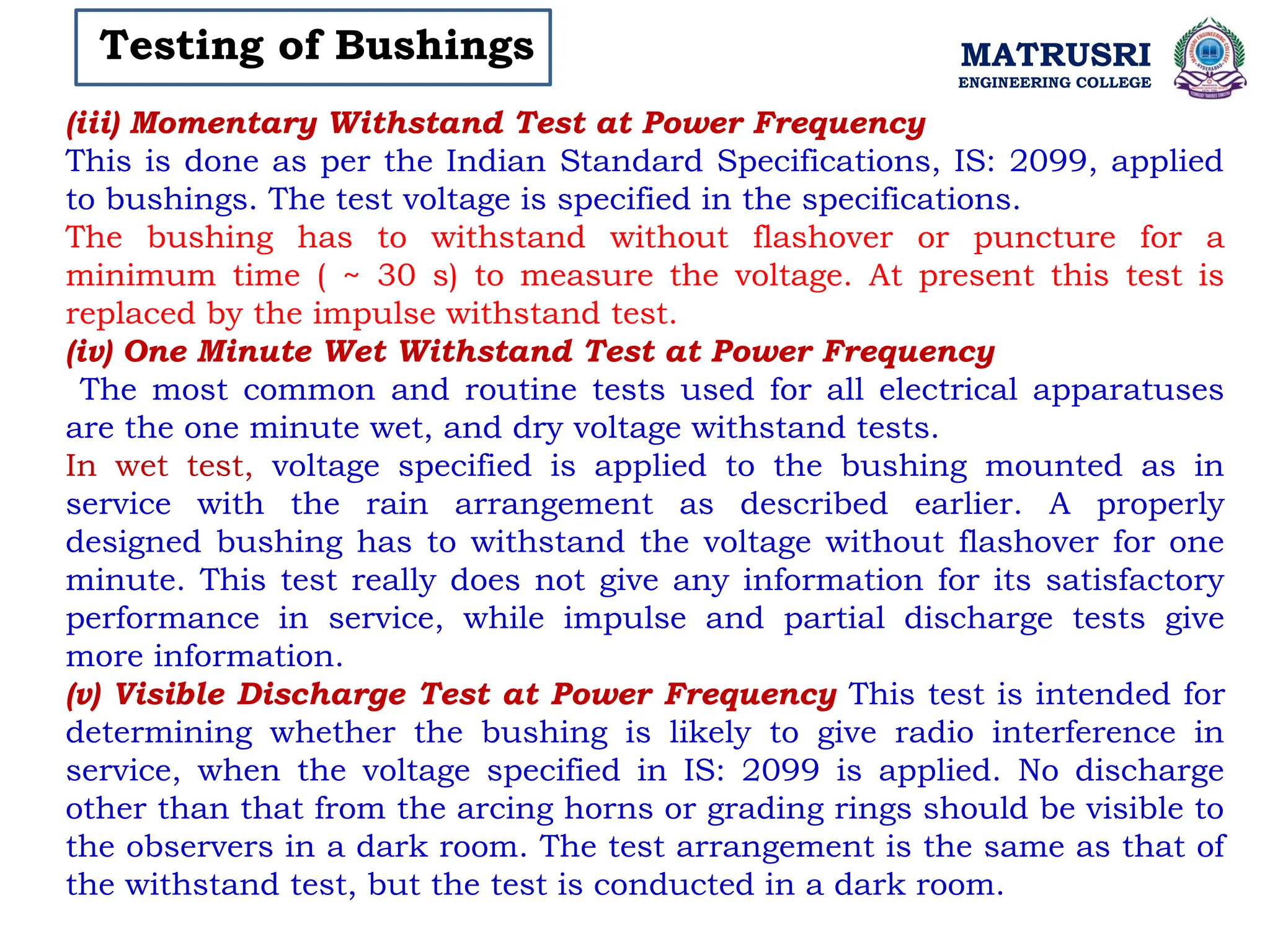
(iii) Momentary Withstand Test at Power Frequency
This is done as per the Indian Standard Specifications, IS: 2099, applied
to bushings. The test voltage is specified in the specifications.
The bushing has to withstand without flashover or puncture for a
minimum time ( ~ 30 s) to measure the voltage. At present this test is
replaced by the impulse withstand test.
(iv) One Minute Wet Withstand Test at Power Frequency
The most common and routine tests used for all electrical apparatuses
are the one minute wet, and dry voltage withstand tests.
In wet test, voltage specified is applied to the bushing mounted as in
service with the rain arrangement as described earlier. A properly
designed bushing has to withstand the voltage without flashover for one
minute. This test really does not give any information for its satisfactory
performance in service, while impulse and partial discharge tests give
more information.
(v) Visible Discharge Test at Power Frequency This test is intended for
determining whether the bushing is likely to give radio interference in
service, when the voltage specified in IS: 2099 is applied. No discharge
other than that from the arcing horns or grading rings should be visible to
the observers in a dark room. The test arrangement is the same as that of
the withstand test, but the test is conducted in a dark room.
MATRUSRI
ENGINEERING COLLEGE
Testing of Bushings
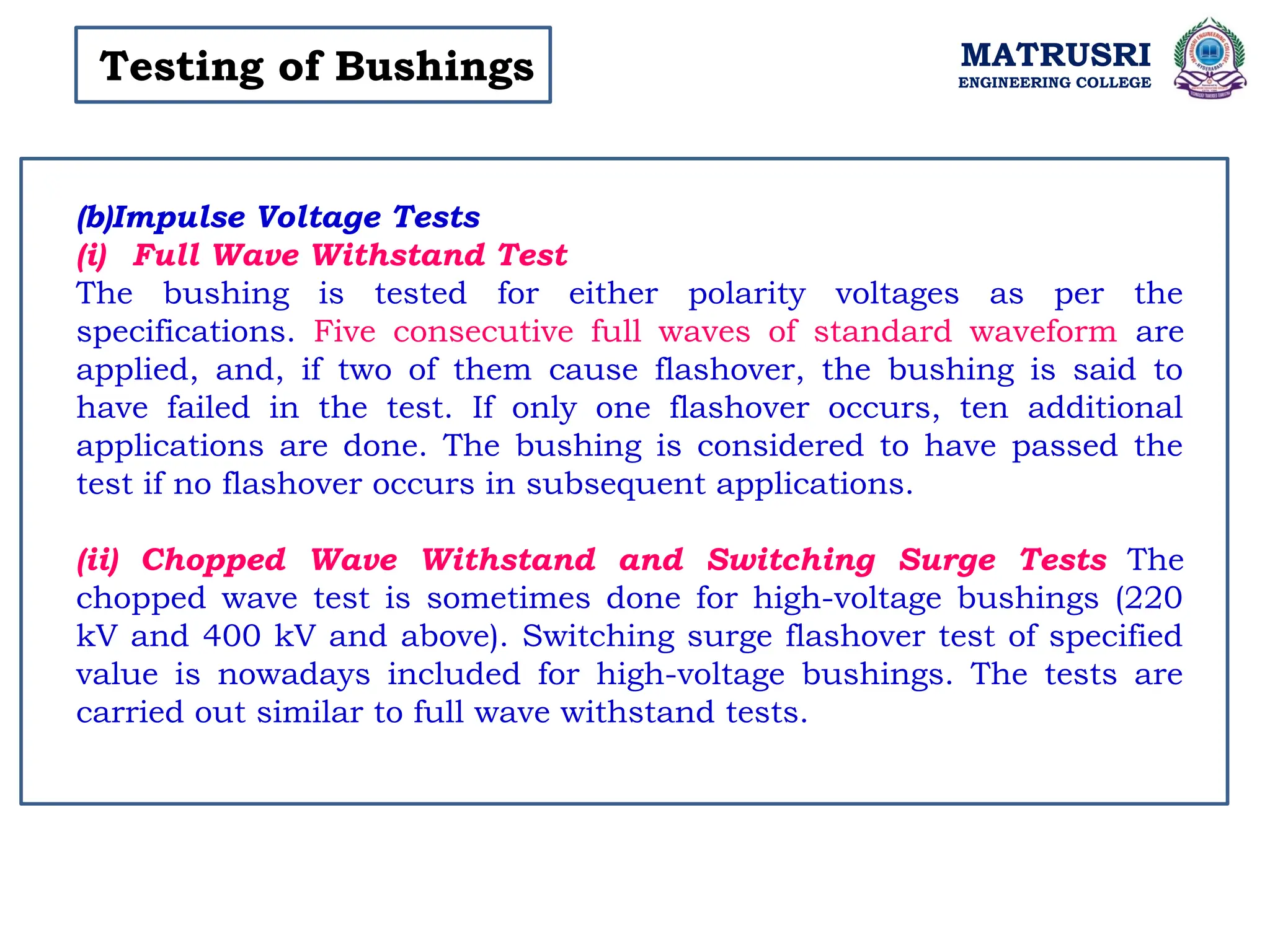
(b)Impulse Voltage Tests
(i) Full Wave Withstand Test
The bushing is tested for either polarity voltages as per the
specifications. Five consecutive full waves of standard waveform are
applied, and, if two of them cause flashover, the bushing is said to
have failed in the test. If only one flashover occurs, ten additional
applications are done. The bushing is considered to have passed the
test if no flashover occurs in subsequent applications.
(ii) Chopped Wave Withstand and Switching Surge Tests The
chopped wave test is sometimes done for high-voltage bushings (220
kV and 400 kV and above). Switching surge flashover test of specified
value is nowadays included for high-voltage bushings. The tests are
carried out similar to full wave withstand tests.
MATRUSRI
ENGINEERING COLLEGE
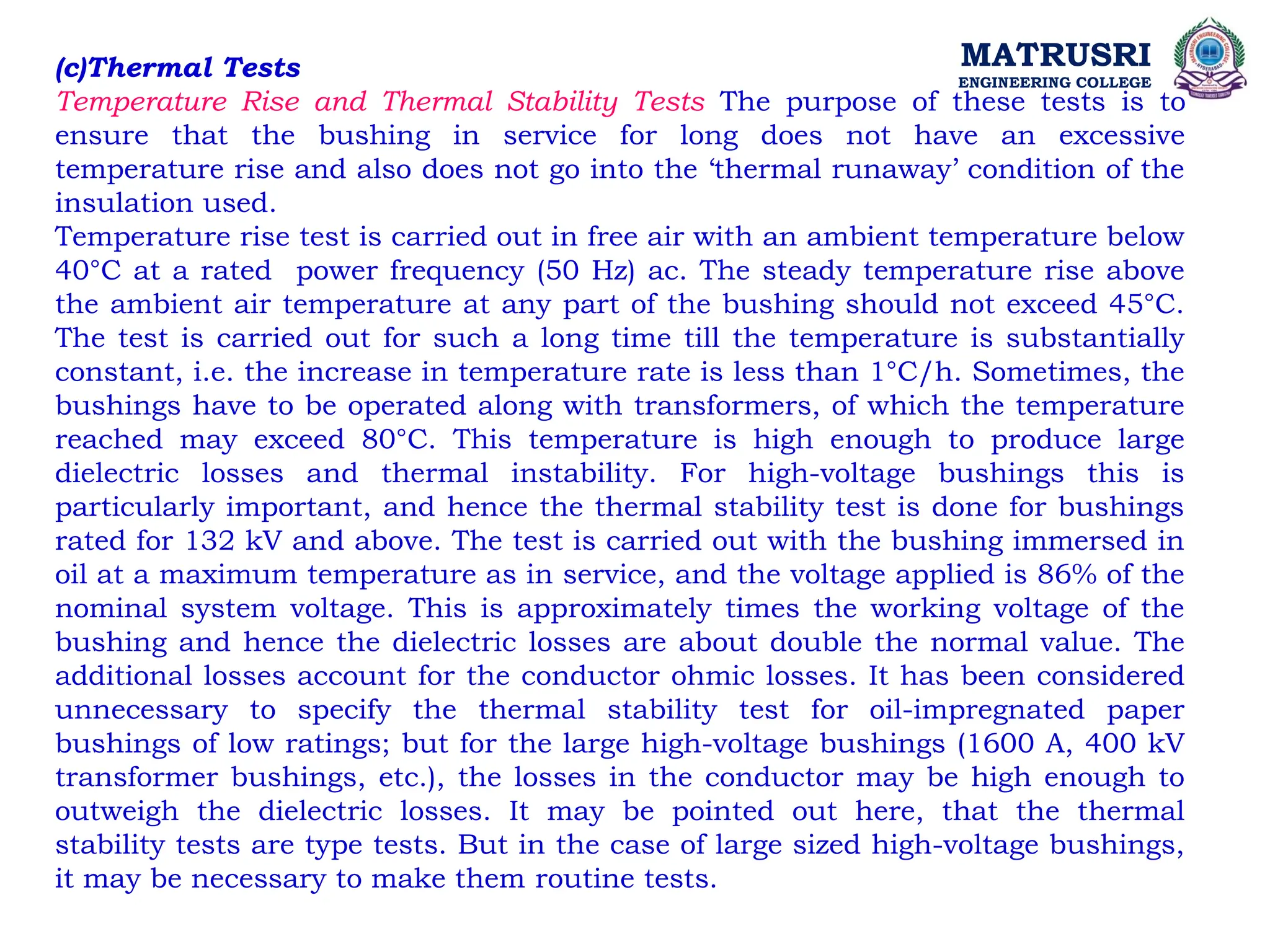
(c)Thermal Tests
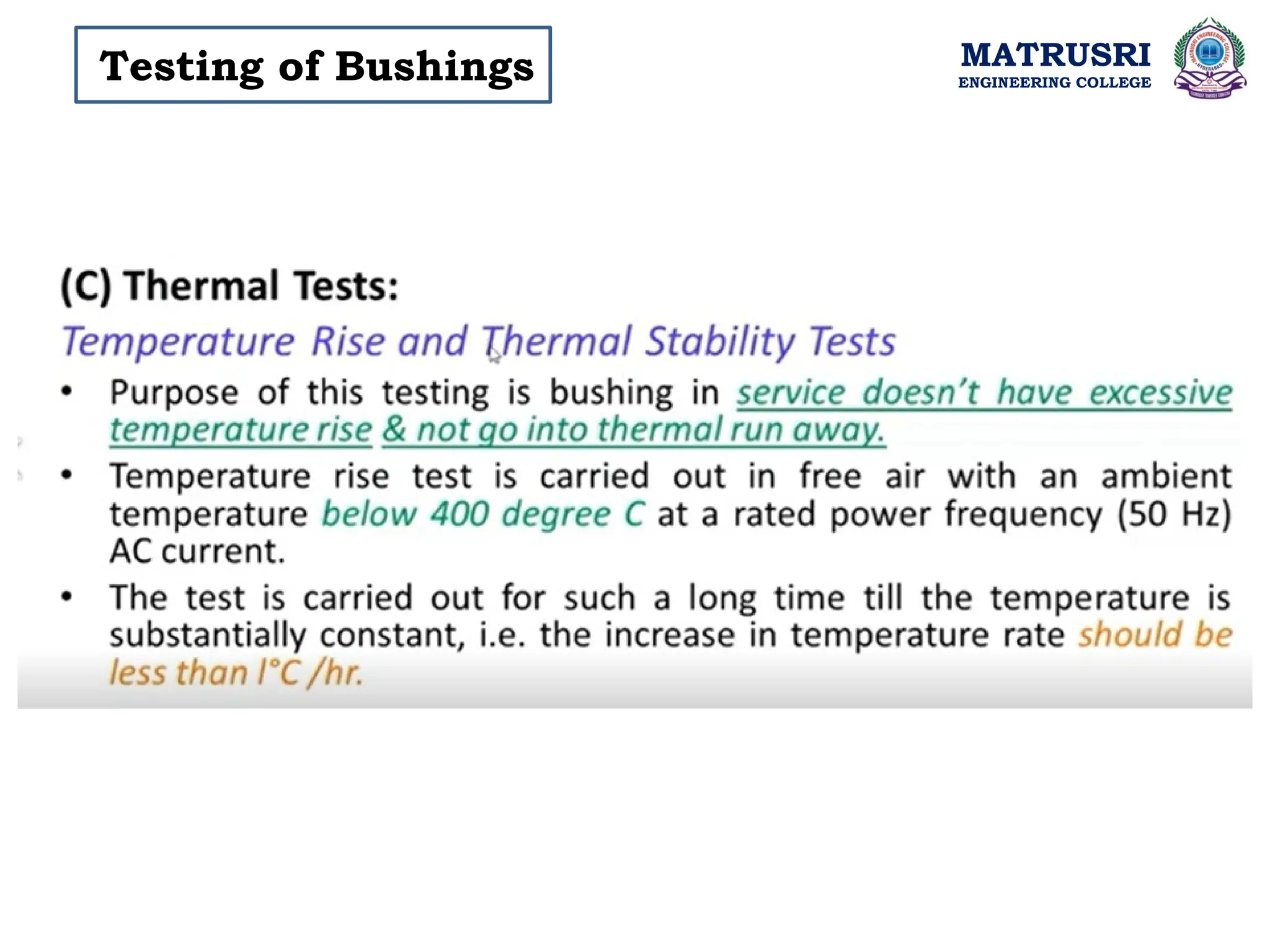
Temperature Rise and Thermal Stability Tests The purpose of these tests is to
ensure that the bushing in service for long does not have an excessive
temperature rise and also does not go into the ‘thermal runaway’ condition of the
insulation used.
Temperature rise test is carried out in free air with an ambient temperature below
40°C at a rated power frequency (50 Hz) ac. The steady temperature rise above
the ambient air temperature at any part of the bushing should not exceed 45°C.
The test is carried out for such a long time till the temperature is substantially
constant, i.e. the increase in temperature rate is less than 1°C/h. Sometimes, the
bushings have to be operated along with transformers, of which the temperature
reached may exceed 80°C. This temperature is high enough to produce large
dielectric losses and thermal instability. For high-voltage bushings this is
particularly important, and hence the thermal stability test is done for bushings
rated for 132 kV and above. The test is carried out with the bushing immersed in
oil at a maximum temperature as in service, and the voltage applied is 86% of the
nominal system voltage. This is approximately times the working voltage of the
bushing and hence the dielectric losses are about double the normal value. The
additional losses account for the conductor ohmic losses. It has been considered
unnecessary to specify the thermal stability test for oil-impregnated paper
bushings of low ratings; but for the large high-voltage bushings (1600 A, 400 kV
transformer bushings, etc.), the losses in the conductor may be high enough to
outweigh the dielectric losses. It may be pointed out here, that the thermal
stability tests are type tests. But in the case of large sized high-voltage bushings,
it may be necessary to make them routine tests.
MATRUSRI
ENGINEERING COLLEGE
Testing of Bushings
MATRUSRI
ENGINEERING COLLEGE
TESTING OF ISOLATORS AND CIRCUIT BREAKERS
Definition of an Isolator or a Disconnector as per IS: 9921
An isolator or a disconnector is a mechanical switching device, which
provides in the open position, an isolating distance in accordance with
special requirements. An isolator is capable of opening and closing a
circuit when either negligible current is broken or made or when no
significant change in the voltage across the terminals of each of the poles
of the isolator occurs. It is also capable of carrying currents under normal
circuit conditions, and carrying for a specified time, currents under
abnormal conditions such as those of a short circuit.
Testing of circuit breakers is intended to evaluate
(a) the constructional and operational characteristics
(b) the electrical characteristics of the circuit which the switch or the
breaker has to interrupt or make.
The different characteristics of a circuit breaker or a switch may be
summarized as per the following groups.
MATRUSRI
ENGINEERING COLLEGE
Testing of Circuit breaker
(i) (a) The electrical characteristics
which determine the arcing voltage, the current chopping
characteristics, the residual current, the rate of decrease of
conductance of the arc space and the plasma, and the shunting effects
in interruption.
(b) physical characteristics including the media in which the
arc is extinguished, the pressure developed or impressed at the point of
interruption, the speed of the contact travel, the number of
breaks, the size of the arcing chamber, and the materials and
configuration of the circuit interruption.
(ii) The characteristics of the circuit include
 the degree of electrical loading
 the normally generated or applied voltage
 the type of fault in the system which the breaker has to clear
 the time of interruption
 the time constant
 the natural frequency and the power factor of the circuit
 the rate of rise of recovery voltage
 the restriking voltage, the decrease in the ac component of the short
circuit current, and the degree of asymmetry and the dc component of
the short circuit current.
MATRUSRI
ENGINEERING COLLEGE
the main tests conducted on the circuit breakers and isolator
switches are
(i) the dielectric tests or overvoltage tests,
(ii) the temperature rise tests,
(iii) the mechanical tests, and
(iv) the short circuit tests
MATRUSRI
ENGINEERING COLLEGE
Dielectric tests consist of overvoltage withstand tests of power
frequency, lightning and switching impulse voltages. Tests are done for
both internal and external insulation with the switch or circuit breaker
in both the open and closed positions. In the open position, the test
voltage levels are 15% higher than the test voltages used when the
breaker is in closed position. As such there is always the possibility of
line to ground flashover. To avoid this, the circuit breaker is mounted
on insulators above the ground, and hence the insulation level of the
body of the circuit breaker is raised.
The impulse tests
with the lightning impulse wave of standard shape are done in a similar
manner as in the case of insulators. In addition, the switching surge
tests with switching overvoltages are done on circuit breakers and
isolators to assess their performance under overvoltages due to
switching operations.
Temperature rise and mechanical tests are type tests on circuit
breakers and are done according to the specifications.
MATRUSRI
ENGINEERING COLLEGE
Short-Circuit Tests
The most important test carried out on circuit breakers are short
circuit tests, since these tests assess the primary performance of these
devices, i.e. their ability to safely interrupt the fault currents. These
tests consist of determining the making and breaking capacities at
various load currents and rated voltages. In the case of isolators, the
short circuit tests are conducted only with the limited purpose to
determine their capacity to carry the rated short circuit current for a
given duration; and no breaking or making current tests is done.
The different methods of conducting short-circuit tests are the
following:
(a) Direct Tests
(I) Using a short circuit generator as the source
(II) Using the power utility system or network as the source
(b) Synthetic Tests
(i) Direct Testing in the Networks or in the Fields Circuit
breakers are sometimes tested for their ability to make or break the
circuit under normal load conditions or under short-circuit conditions
in the network itself. This is done during period of limited energy
consumption or when the electrical energy is diverted to other sections
of the network which are not connected to the circuit under test.
MATRUSRI
ENGINEERING COLLEGE
The advantages of field tests are the following:
(i) The circuit breaker is tested under actual conditions like those that
occur in a given network.
(ii) Special occasions like breaking of charging currents of long lines, very
short line faults, interruption of small inductive currents, etc. can be
tested by direct testing only.
(iii) To assess the thermal and dynamic effects of short circuit currents, to
study applications of safety devices, and to revise the performance test
procedures, etc.
The disadvantages are the following:
(i) The circuit breaker can be tested at only a given rated voltage and
network capacity.
(ii) The necessity to interrupt the normal services and to test only at light
load conditions.
(iii) Extra inconvenience and expenses in installation of controlling and
measuring equipment in the
field.
MATRUSRI
ENGINEERING COLLEGE
(ii) Direct Testing in Short-Circuit Test Laboratories
In order to test the circuit breakers at different voltages and at different
short-circuit currents, short-circuit laboratories are provided. The
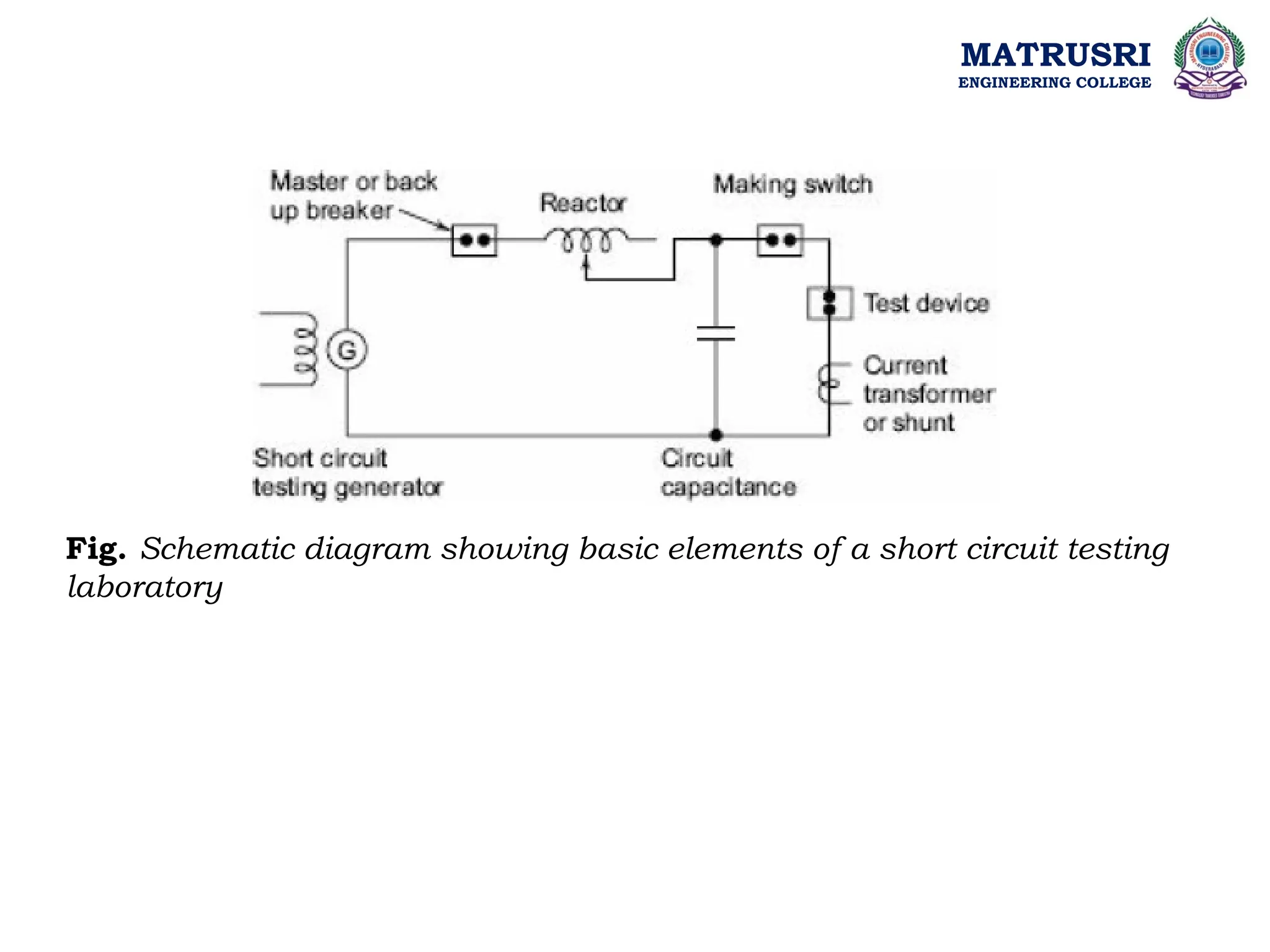
schematic layout of a short circuit testing laboratory is given in Fig. 10.3.
It consists of a short-circuit generator in association with a master circuit
breaker, resistors, reactors and measuring devices. A make switch initiates
the short circuit and the master circuit breaker isolates the test device
from the source at the end of a predetermined time set on a test sequence
controller. Also, the master circuit breaker can be tripped if the test device
fails to operate properly. Short-circuit generators with induction motors as
prime movers are also available.
(iii) Synthetic Testing of Circuit Breakers Due to very high interrupting
capacities of circuit breakers, it is not economical to have a single source
to provide the required short circuit and the rated voltage. Hence, the
effect of a short circuit is obtained as regards to the intensity of the
current and the recovery voltage as a combination of the effects of two
sources, one of which supplies the ac current and the other the high-
voltage.
In the initial period of the short-circuit test, the ac current source supplies
the heavy current at a low voltage, and then the recovery voltage is
simulated by a source of comparatively high voltage of small current
capacity. A schematic diagram of a synthetic testing station is shown in
below Fig.
MATRUSRI
ENGINEERING COLLEGE
Fig. Schematic diagram showing basic elements of a short circuit testing
laboratory
MATRUSRI
ENGINEERING COLLEGE
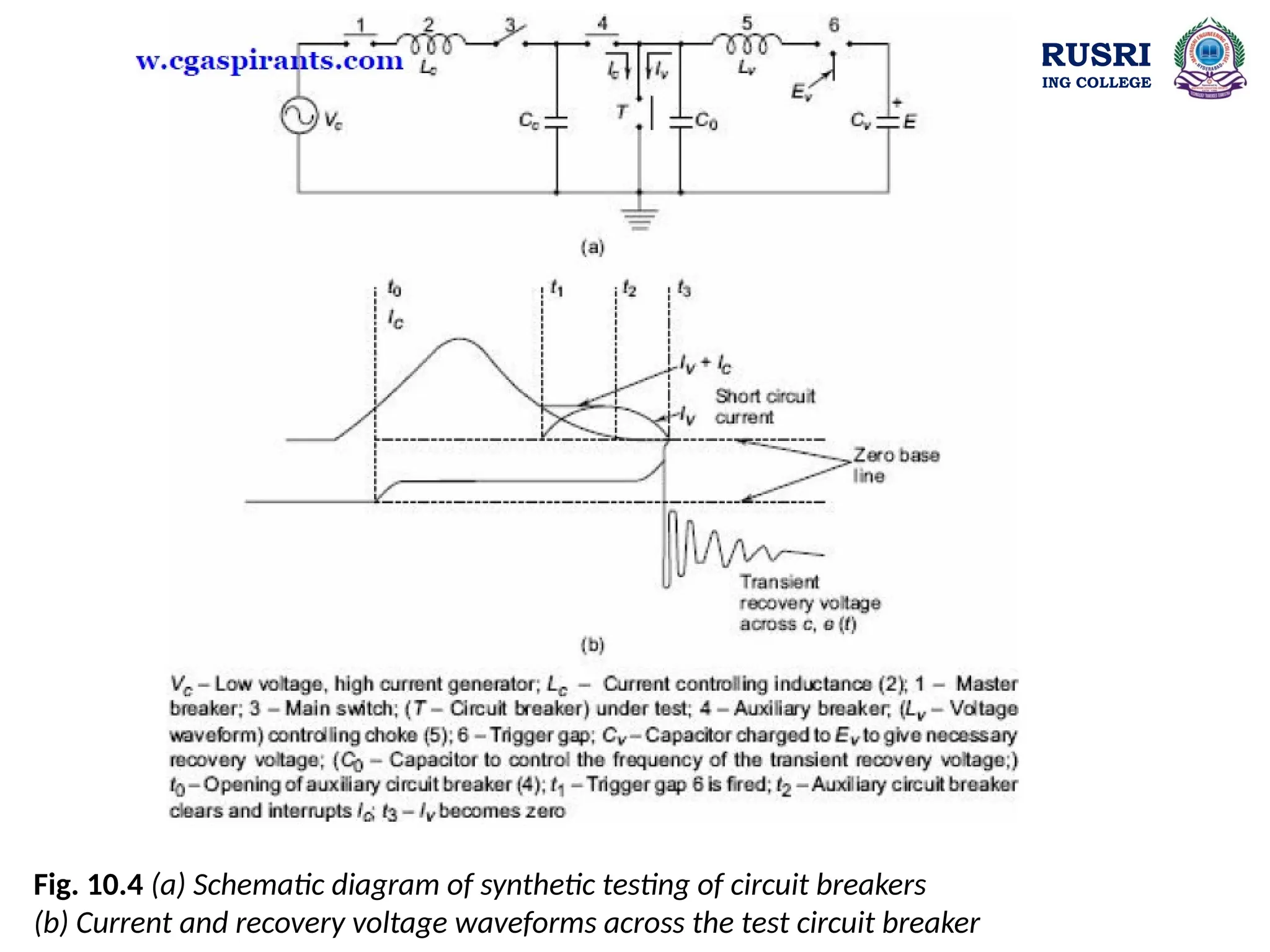
With the auxiliary breaker (3) and the test breaker (T) closed, the
closing of the making switch (1) causes the current to flow in the test
circuit breaker. At some instant say t0, the test circuit breaker (T)
begins to operate and the master circuit breaker (1) becomes ready to
clear the generator circuit. At some time t1, just before the zero of the
generator current, the trigger gap (6) closes and the higher frequency
current from the discharging capacitor Cv also flows through the arc.
At time t2, when the generator current is zero, the circuit breaker (1)
clears that circuit, leaving only the current from Cv which has the
required rate of change of current at its zero flowing in the test circuit
breaker. At the zero of this current, full test voltage will be available.
The closing of gap (6) would be a little earlier in time than shown in
Fig. 10.4, but it has been drawn as shown, for clarity at current zeros.
It is important to see that the high-current source is disconnected and
a high-voltage source applied with absolute precision (by means of an
auxiliary circuit breaker) at the instant of circuit breaking.
MATRUSRI
ENGINEERING COLLEGE
Fig. 10.4 (a) Schematic diagram of synthetic testing of circuit breakers
(b) Current and recovery voltage waveforms across the test circuit breaker
MATRUSRI
ENGINEERING COLLEGE
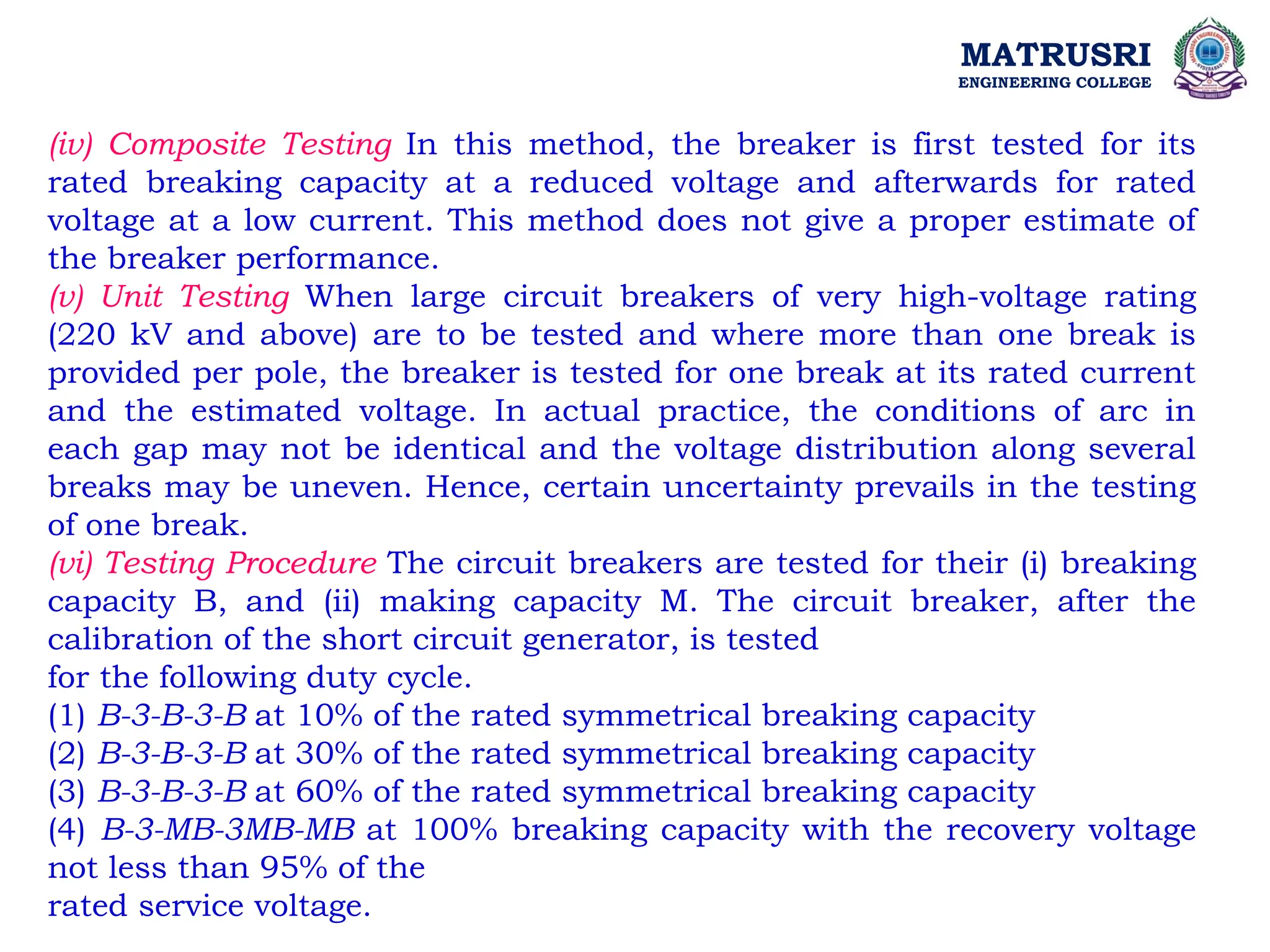
(iv) Composite Testing In this method, the breaker is first tested for its
rated breaking capacity at a reduced voltage and afterwards for rated
voltage at a low current. This method does not give a proper estimate of
the breaker performance.
(v) Unit Testing When large circuit breakers of very high-voltage rating
(220 kV and above) are to be tested and where more than one break is
provided per pole, the breaker is tested for one break at its rated current
and the estimated voltage. In actual practice, the conditions of arc in
each gap may not be identical and the voltage distribution along several
breaks may be uneven. Hence, certain uncertainty prevails in the testing
of one break.
(vi) Testing Procedure The circuit breakers are tested for their (i) breaking
capacity B, and (ii) making capacity M. The circuit breaker, after the
calibration of the short circuit generator, is tested
for the following duty cycle.
(1) B-3-B-3-B at 10% of the rated symmetrical breaking capacity
(2) B-3-B-3-B at 30% of the rated symmetrical breaking capacity
(3) B-3-B-3-B at 60% of the rated symmetrical breaking capacity
(4) B-3-MB-3MB-MB at 100% breaking capacity with the recovery voltage
not less than 95% of the
rated service voltage.
MATRUSRI
ENGINEERING COLLEGE
The power factor in these tests is generally between 0.15 and 0.3. The
numeral 3 in the above duty cycle indicates the time interval in
minutes between the tests.
(vii) Asymmetrical Tests One test cycle is repeated for the symmetrical
breaking capacity in which the dc component at the instant of
contact separation is not less than 50% of the ac component

high voltahe testing(Insulators,Bushings,Circuit breaker).pptx

  • 1.
    MATRUSRI ENGINEERING COLLEGE DEPARTMENTOF ELECTRICAL AND ELECTRONICS ENGINEERING SUBJECT NAME: HIGH VOLTAGE ENGINEERING FACULTY NAME: Mrs.N.KALPANA MATRUSRI ENGINEERING COLLEGE
  • 2.
    SYLLABUS UNIT I Conduction AndBreakdown In Gaseous Insulating Materials: Ionization Processes And Current Growth-Townsend’s Criterion For Breakdown- Break Down In Electro Negative Gases- Time Lags For Breakdown- Paschen’s Law- Corona Discharges And Breakdown In Non-Uniform Fields- Practical Considerations For Selecting Gases For Insulation Purposes. UNIT II Conduction and Breakdown in Liquid Dielectrics: Various mechanisms of breakdown in liquid dielectrics-Liquid dielectrics used in practice-Various processes-Breakdown in solid dielectrics- solid dielectrics used in practice. UNIT III:GENERATION OF HIGH VOLTAGES AND CURRENTS Generation of High DC voltages using multiplier circuits- Van De Graff generator. Generation of High alternating voltages voltages using cascade transformers-Production of high frequency A.C high voltages- standard Impulse wave shapes-Marx circuit-Generation of switching surges-Impulse current generation- Tripping and control of impulse generators. UNIT IV: MEASUREMENT OF HIGH VOLTAGES AND CURRENTS High DC voltages measurement technique- Methods of measurement for power frequency - A.C. voltages- Sphere gap measurement technique- Potential divider or impulse voltage measurement-Measurement of high D.C. and A.C. and Impulse currents –Use of CRC for impulse voltage and current measurements. UNIT V: HIGH VOLTAGE TESTING Testing on Insulators, Testing on bushing, Testing of Isolators and circuit breakers- Cables testing, Testing of Transformers, Testing of Surge Arresters, Radio Interference measurements, -Use of I.S.S. for testing. MATRUSRI ENGINEERING COLLEGE
  • 3.
    MATRUSRI ENGINEERING COLLEGE Contents:  Testingon Insulators  Testing on bushing  Testing of Isolators and circuit breakers  Cables testing, Testing of Transformers  Testing of Surge Arresters, Radio Interference measurements  Use of I.S.S. for testing. UNIT-1 Course Outcomes: At end of this course the student will able to CO1. Conduct high voltage test of materials and apparatus
  • 4.
    What is HighVoltage ? High Voltage Engineering Introduction I f an AC voltage is > 1000V(HVAC) DC > 1500V HVDC Application of High voltage in Gas, Solid and liquid medium is called High Voltage Engineering Mainly used in design of dielectric, design of protective devices What is High Voltage Engineering ? MATRUSRI ENGINEERING COLLEGE
  • 5.
    MATRUSRI ENGINEERING COLLEGE Test onInsulators Why testing on Insulators required? • To check the design features • To check the quality of test piece • To check the life expectancy • To check the mechanical strength It is essential to ensure that the electrical equipment is capable of withstanding the over voltages that are met with in service. The over voltages may be either due to natural causes like lightning or system originated ones such as switching or power frequency transient voltages. Hence, testing for over voltages is necessary.
  • 6.
    MATRUSRI ENGINEERING COLLEGE Definitions (a) DisruptiveDischarge Voltage This is defined as the voltage which produces the loss of dielectric strength of an insulation. It is that voltage at which the electrical stress in the insulation causes a failure which includes the collapse of voltage and passage of current. In solids, this causes a permanent loss of strength, and in liquids or gases, only temporary loss may be caused. When a discharge takes place between two electrodes in a gas or a liquid or over a solid surface in air, it is called flashover. If the discharge occurs through a solid insulation it is called puncture. (b) Withstand Voltage The voltage which has to be applied to a test object under specified conditions in a withstand test is called the withstand voltage [as per IS: 731 and IS: 2099–1963]. (c) Fifty Per Cent Flashover Voltage This is the voltage which has a probability of 50% flashover, when applied to a test object. This is normally applied in impulse test in which the loss of insulation strength is temporary. (d) Hundred Per Cent Flashover Voltage The voltage, that causes a flashover at each of its applications under specified conditions, when applied to test objects as specified, is hundred per cent flashover voltage. (e) Creepage Distance It is the shortest distance on the contour of the external surface of the insulator unit or between two metal fittings on the insulator.
  • 7.
    MATRUSRI ENGINEERING COLLEGE Test onInsulators (f) ac Test Voltages Alternating test voltages of power frequency should have a frequency range of 40 to 60 Hz and should be approximately sinusoidal. The deviation allowed from the standard sine curve is about 7%. The deviation is checked by measuring instantaneous values over specified intervals and computing the rms value, the average value, and the form factor. (g) Impulse Voltages Impulse voltages are characterized by polarity, peak value, time to front (tf), and time to half the peak value after the peak (tt). The time to front is defined as 1.67 times to time between 30% and 90% of the peak value in the rising portion of the wave. According to IS: 2071 (1973), standard impulse is defined as one with tf= 1.2μs, tt = 50 μs (called 1.2/50 μs wave). The tolerances allowed are ±3% on the peak value, ±30% in the front time (tf), and ±20% in the tail time(tt). (h) Reference Atmospheric Conditions The electrical characteristics of the insulators and other apparatus are normally referred to the reference atmospheric conditions. According to the Indian Standard Specifications, they are Temperature : 27°C Pressure : 1013 millibars (or 760 torr) Absolute humidity : 17 g/m3
  • 8.
    MATRUSRI ENGINEERING COLLEGE Test onInsulators The flashover voltage of the test object is given by where, a = voltage under actual test conditions, Vs = voltage under reference atmospheric conditions, h = humidity correction factors, and d = air density correction factor. The air density correction factor is given by for 200 C for 270 C where,b = atmospheric pressure in millibars, and t = atmospheric temperature, °C,
  • 9.
    MATRUSRI ENGINEERING COLLEGE Test onInsulators The High voltage tests are classified into two groups: 1. Power frequency voltage tests 2. Impulse voltage tests All the insulators are tested for both categories of test. (1)Power Frequency Tests (i) Dry and Wet Flashover Tests (ii)Wet and Dry Withstand Tests (One Minute) 2. Impulse voltage tests 1. Impulse Withstand Voltage Test 2. Impulse Flashover Test 3. Pollution Testing
  • 10.
    MATRUSRI ENGINEERING COLLEGE Test onInsulators (i) Dry and Wet Flashover Tests In these tests, the ac voltage of power frequency is applied across the insulators and increased at a uniform rate of about 2 % per second of 75% of the estimated test voltage, to such a value that a breakdown occurs along the surface of the insulator. If the test is conducted under normal conditions without any rain or precipitation, it is called ‘dry flashover test’. If the test is done under conditions of rain, it is called ‘wet flashover test’. The test object is subjected to a spray of water of given conductivity by means of nozzles. The spray is arranged such that the water drops fall approximately at an inclination of 45° to the vertical. The test object is sprayed for at least one minute before the voltage application, and the spray is continued during the voltage application. (ii) Wet and Dry Withstand Tests (One Minute) In these tests, the voltage specified in the relevant specification is applied under dry or wet conditions for a period of one minute with an insulator mounted as in service conditions. The test piece should withstand the specified voltage.
  • 11.
    MATRUSRI ENGINEERING COLLEGE Test onInsulators (b)Impulse Tests (i) Impulse Withstand Voltage Test This test is done by applying standard impulse voltage of specified value under dry conditions with both positive and negative polarities of the wave. If five consecutive waves do not cause a flashover or puncture, the insulator is deemed to have passed the test. If two applications cause flashover, the object is deemed to have failed. If there is only one failure, additional ten applications of the voltage wave are made. If the test object has withstood the subsequent applications, it is said to have passed the test. (ii) Impulse Flashover Test The test is done as above with the specified voltage. Usually, the probability of failure is determined for 40% and 60% failure values or 20% and 80% failure values, since it is difficult to adjust the test voltage for the exact 50% flashover values. The average value of the upper and the lower limits is taken. The insulator surface should not be damaged by these tests, but slight marking on its surface or chipping off of the cement is allowed.
  • 12.
    MATRUSRI ENGINEERING COLLEGE Test onInsulators (iii) Pollution Testing Because of the problem of pollution of outdoor electrical insulation and consequent problems of the maintenance of electrical power systems, pollution testing is gaining importance. The normal types of pollution are (i) dust, microorganisms, bird secretions, flies, etc., (ii) industrial pollution like smoke, petroleum vapours, dust, and other deposits, (iii) coastal pollution in which corrosive and hygroscopic salt layers are deposited on the insulator surfaces, (iv) desert pollution in which sand storms cause deposition of sand and dust layers (v) ice and fog deposits at high altitudes and in polar countries. These pollutions cause corrosion, non uniform gradients along the insulator strings and surface of insulators and also cause deterioration of the material. Also, pollution causes partial discharges and radio interference. Hence, pollution testing is important for extra high-voltage systems. At present there is no standard pollution test available. The popular test that is normally done is the salt fog test. In this test, the maximum normal withstand voltage is applied on the insulator and then artificial salt fog is created around the insulator by jets of salt water and compressed air. If the flashover occurs within one hour, the test is repeated with fog of lower salinity, otherwise, with a fog to higher salinity.
  • 13.
  • 14.
    MATRUSRI ENGINEERING COLLEGE Bushings on small ferroresonant transformer Bushingson single phase distribution transformers 110KV Bushings in building wall Bushings are made up of 3 materials 1. Paper 2. Resin 3. Porcelain
  • 15.
    MATRUSRI ENGINEERING COLLEGE Testing ofBushings Bushings for 110KV and 220KV Bushings for 380KV transformer in iraq Bushings for 100000KV In electric system, a bushing is a hollow electric insulator that allows an electrical conductor to pass safely through a conducting barrier such as the case of a transformer or circuit breaker without making electrical contact with it. It avoids short circuits. Dry bushings Oil filled capacitor bushings
  • 16.
    MATRUSRI ENGINEERING COLLEGE Testing ofBushings Testing of Bushings Power Frequency Tests 1. Power Factor–Voltage Test 2. Internal or Partial Discharge Test 3. Momentary Withstand Test at Power Frequency 4. One Minute Wet Withstand Test at Power Frequency 5. Visible Discharge Test at Power Frequency Impulse Voltage Tests 1. Full Wave Withstand Test 2. Chopped Wave Withstand and Switching Surge Tests Thermal Tests 1. Temperature Rise and Thermal Stability Tests
  • 17.
    MATRUSRI ENGINEERING COLLEGE Testing ofBushings A. Power Frequency Tests (i) Power Factor–Voltage Test the bushing is set up as in service or immersed in oil. It is connected such that the line conductor goes to the high-voltage side and the tank or earth portion goes to the detector side of the high-voltage Schering-bridge. Voltage is applied up to the line value in increasing steps and then reduced. The capacitance and power factor (or tan δ) are recorded at each step. The characteristic of power factor or tan d versus applied voltage is drawn. This is a normal routine test but sometimes may be conducted on percentage basis. If the value of di electic loss is high better replace the bushings. (ii) Internal or Partial Discharge Test This test is intended to find the deterioration or failure due to internal discharges caused in the composite insulation of the bushing. This is done by using internal or partial discharge arrangement (see Sec. 9.4). The voltage versus discharge magnitude as well as the quadratic rate, gives an excellent record of the performance of the bushing in service. This is now a routine test for high-voltage bushings.
  • 18.
    MATRUSRI ENGINEERING COLLEGE Testing ofBushings (iii) Momentary Withstand Test at Power Frequency This is done as per the Indian Standard Specifications, IS: 2099, applied to bushings. The test voltage is specified in the specifications. The bushing has to withstand without flashover or puncture for a minimum time ( ~ 30 s) to measure the voltage. At present this test is replaced by the impulse withstand test. (iv) One Minute Wet Withstand Test at Power Frequency The most common and routine tests used for all electrical apparatuses are the one minute wet, and dry voltage withstand tests. In wet test, voltage specified is applied to the bushing mounted as in service with the rain arrangement as described earlier. A properly designed bushing has to withstand the voltage without flashover for one minute. This test really does not give any information for its satisfactory performance in service, while impulse and partial discharge tests give more information. (v) Visible Discharge Test at Power Frequency This test is intended for determining whether the bushing is likely to give radio interference in service, when the voltage specified in IS: 2099 is applied. No discharge other than that from the arcing horns or grading rings should be visible to the observers in a dark room. The test arrangement is the same as that of the withstand test, but the test is conducted in a dark room.
  • 19.
    MATRUSRI ENGINEERING COLLEGE Testing ofBushings (b)Impulse Voltage Tests (i) Full Wave Withstand Test The bushing is tested for either polarity voltages as per the specifications. Five consecutive full waves of standard waveform are applied, and, if two of them cause flashover, the bushing is said to have failed in the test. If only one flashover occurs, ten additional applications are done. The bushing is considered to have passed the test if no flashover occurs in subsequent applications. (ii) Chopped Wave Withstand and Switching Surge Tests The chopped wave test is sometimes done for high-voltage bushings (220 kV and 400 kV and above). Switching surge flashover test of specified value is nowadays included for high-voltage bushings. The tests are carried out similar to full wave withstand tests.
  • 20.
    MATRUSRI ENGINEERING COLLEGE (c)Thermal Tests TemperatureRise and Thermal Stability Tests The purpose of these tests is to ensure that the bushing in service for long does not have an excessive temperature rise and also does not go into the ‘thermal runaway’ condition of the insulation used. Temperature rise test is carried out in free air with an ambient temperature below 40°C at a rated power frequency (50 Hz) ac. The steady temperature rise above the ambient air temperature at any part of the bushing should not exceed 45°C. The test is carried out for such a long time till the temperature is substantially constant, i.e. the increase in temperature rate is less than 1°C/h. Sometimes, the bushings have to be operated along with transformers, of which the temperature reached may exceed 80°C. This temperature is high enough to produce large dielectric losses and thermal instability. For high-voltage bushings this is particularly important, and hence the thermal stability test is done for bushings rated for 132 kV and above. The test is carried out with the bushing immersed in oil at a maximum temperature as in service, and the voltage applied is 86% of the nominal system voltage. This is approximately times the working voltage of the bushing and hence the dielectric losses are about double the normal value. The additional losses account for the conductor ohmic losses. It has been considered unnecessary to specify the thermal stability test for oil-impregnated paper bushings of low ratings; but for the large high-voltage bushings (1600 A, 400 kV transformer bushings, etc.), the losses in the conductor may be high enough to outweigh the dielectric losses. It may be pointed out here, that the thermal stability tests are type tests. But in the case of large sized high-voltage bushings, it may be necessary to make them routine tests.
  • 21.
  • 22.
    MATRUSRI ENGINEERING COLLEGE TESTING OFISOLATORS AND CIRCUIT BREAKERS Definition of an Isolator or a Disconnector as per IS: 9921 An isolator or a disconnector is a mechanical switching device, which provides in the open position, an isolating distance in accordance with special requirements. An isolator is capable of opening and closing a circuit when either negligible current is broken or made or when no significant change in the voltage across the terminals of each of the poles of the isolator occurs. It is also capable of carrying currents under normal circuit conditions, and carrying for a specified time, currents under abnormal conditions such as those of a short circuit. Testing of circuit breakers is intended to evaluate (a) the constructional and operational characteristics (b) the electrical characteristics of the circuit which the switch or the breaker has to interrupt or make. The different characteristics of a circuit breaker or a switch may be summarized as per the following groups.
  • 23.
    MATRUSRI ENGINEERING COLLEGE Testing ofCircuit breaker (i) (a) The electrical characteristics which determine the arcing voltage, the current chopping characteristics, the residual current, the rate of decrease of conductance of the arc space and the plasma, and the shunting effects in interruption. (b) physical characteristics including the media in which the arc is extinguished, the pressure developed or impressed at the point of interruption, the speed of the contact travel, the number of breaks, the size of the arcing chamber, and the materials and configuration of the circuit interruption. (ii) The characteristics of the circuit include  the degree of electrical loading  the normally generated or applied voltage  the type of fault in the system which the breaker has to clear  the time of interruption  the time constant  the natural frequency and the power factor of the circuit  the rate of rise of recovery voltage  the restriking voltage, the decrease in the ac component of the short circuit current, and the degree of asymmetry and the dc component of the short circuit current.
  • 24.
    MATRUSRI ENGINEERING COLLEGE the maintests conducted on the circuit breakers and isolator switches are (i) the dielectric tests or overvoltage tests, (ii) the temperature rise tests, (iii) the mechanical tests, and (iv) the short circuit tests
  • 25.
    MATRUSRI ENGINEERING COLLEGE Dielectric testsconsist of overvoltage withstand tests of power frequency, lightning and switching impulse voltages. Tests are done for both internal and external insulation with the switch or circuit breaker in both the open and closed positions. In the open position, the test voltage levels are 15% higher than the test voltages used when the breaker is in closed position. As such there is always the possibility of line to ground flashover. To avoid this, the circuit breaker is mounted on insulators above the ground, and hence the insulation level of the body of the circuit breaker is raised. The impulse tests with the lightning impulse wave of standard shape are done in a similar manner as in the case of insulators. In addition, the switching surge tests with switching overvoltages are done on circuit breakers and isolators to assess their performance under overvoltages due to switching operations. Temperature rise and mechanical tests are type tests on circuit breakers and are done according to the specifications.
  • 26.
    MATRUSRI ENGINEERING COLLEGE Short-Circuit Tests Themost important test carried out on circuit breakers are short circuit tests, since these tests assess the primary performance of these devices, i.e. their ability to safely interrupt the fault currents. These tests consist of determining the making and breaking capacities at various load currents and rated voltages. In the case of isolators, the short circuit tests are conducted only with the limited purpose to determine their capacity to carry the rated short circuit current for a given duration; and no breaking or making current tests is done. The different methods of conducting short-circuit tests are the following: (a) Direct Tests (I) Using a short circuit generator as the source (II) Using the power utility system or network as the source (b) Synthetic Tests (i) Direct Testing in the Networks or in the Fields Circuit breakers are sometimes tested for their ability to make or break the circuit under normal load conditions or under short-circuit conditions in the network itself. This is done during period of limited energy consumption or when the electrical energy is diverted to other sections of the network which are not connected to the circuit under test.
  • 27.
    MATRUSRI ENGINEERING COLLEGE The advantagesof field tests are the following: (i) The circuit breaker is tested under actual conditions like those that occur in a given network. (ii) Special occasions like breaking of charging currents of long lines, very short line faults, interruption of small inductive currents, etc. can be tested by direct testing only. (iii) To assess the thermal and dynamic effects of short circuit currents, to study applications of safety devices, and to revise the performance test procedures, etc. The disadvantages are the following: (i) The circuit breaker can be tested at only a given rated voltage and network capacity. (ii) The necessity to interrupt the normal services and to test only at light load conditions. (iii) Extra inconvenience and expenses in installation of controlling and measuring equipment in the field.
  • 28.
    MATRUSRI ENGINEERING COLLEGE (ii) DirectTesting in Short-Circuit Test Laboratories In order to test the circuit breakers at different voltages and at different short-circuit currents, short-circuit laboratories are provided. The schematic layout of a short circuit testing laboratory is given in Fig. 10.3. It consists of a short-circuit generator in association with a master circuit breaker, resistors, reactors and measuring devices. A make switch initiates the short circuit and the master circuit breaker isolates the test device from the source at the end of a predetermined time set on a test sequence controller. Also, the master circuit breaker can be tripped if the test device fails to operate properly. Short-circuit generators with induction motors as prime movers are also available. (iii) Synthetic Testing of Circuit Breakers Due to very high interrupting capacities of circuit breakers, it is not economical to have a single source to provide the required short circuit and the rated voltage. Hence, the effect of a short circuit is obtained as regards to the intensity of the current and the recovery voltage as a combination of the effects of two sources, one of which supplies the ac current and the other the high- voltage. In the initial period of the short-circuit test, the ac current source supplies the heavy current at a low voltage, and then the recovery voltage is simulated by a source of comparatively high voltage of small current capacity. A schematic diagram of a synthetic testing station is shown in below Fig.
  • 29.
    MATRUSRI ENGINEERING COLLEGE Fig. Schematicdiagram showing basic elements of a short circuit testing laboratory
  • 30.
    MATRUSRI ENGINEERING COLLEGE With theauxiliary breaker (3) and the test breaker (T) closed, the closing of the making switch (1) causes the current to flow in the test circuit breaker. At some instant say t0, the test circuit breaker (T) begins to operate and the master circuit breaker (1) becomes ready to clear the generator circuit. At some time t1, just before the zero of the generator current, the trigger gap (6) closes and the higher frequency current from the discharging capacitor Cv also flows through the arc. At time t2, when the generator current is zero, the circuit breaker (1) clears that circuit, leaving only the current from Cv which has the required rate of change of current at its zero flowing in the test circuit breaker. At the zero of this current, full test voltage will be available. The closing of gap (6) would be a little earlier in time than shown in Fig. 10.4, but it has been drawn as shown, for clarity at current zeros. It is important to see that the high-current source is disconnected and a high-voltage source applied with absolute precision (by means of an auxiliary circuit breaker) at the instant of circuit breaking.
  • 31.
    MATRUSRI ENGINEERING COLLEGE Fig. 10.4(a) Schematic diagram of synthetic testing of circuit breakers (b) Current and recovery voltage waveforms across the test circuit breaker
  • 32.
    MATRUSRI ENGINEERING COLLEGE (iv) CompositeTesting In this method, the breaker is first tested for its rated breaking capacity at a reduced voltage and afterwards for rated voltage at a low current. This method does not give a proper estimate of the breaker performance. (v) Unit Testing When large circuit breakers of very high-voltage rating (220 kV and above) are to be tested and where more than one break is provided per pole, the breaker is tested for one break at its rated current and the estimated voltage. In actual practice, the conditions of arc in each gap may not be identical and the voltage distribution along several breaks may be uneven. Hence, certain uncertainty prevails in the testing of one break. (vi) Testing Procedure The circuit breakers are tested for their (i) breaking capacity B, and (ii) making capacity M. The circuit breaker, after the calibration of the short circuit generator, is tested for the following duty cycle. (1) B-3-B-3-B at 10% of the rated symmetrical breaking capacity (2) B-3-B-3-B at 30% of the rated symmetrical breaking capacity (3) B-3-B-3-B at 60% of the rated symmetrical breaking capacity (4) B-3-MB-3MB-MB at 100% breaking capacity with the recovery voltage not less than 95% of the rated service voltage.
  • 33.
    MATRUSRI ENGINEERING COLLEGE The powerfactor in these tests is generally between 0.15 and 0.3. The numeral 3 in the above duty cycle indicates the time interval in minutes between the tests. (vii) Asymmetrical Tests One test cycle is repeated for the symmetrical breaking capacity in which the dc component at the instant of contact separation is not less than 50% of the ac component