HVDC TRANSMISSION
Presented by
SAURABH DAYAL SINGH (130050109106)
Semester – VII
Guided by
Mrs. Shradha Gautam
ELECTRICAL ENGINEERING DEPARTMENT
BABARIA INSITUTE OF TECHNOLOGY
VARNAMA
ADVANCED POWER ELECTRONICS
HISTORICAL SKETCH
Evolution of Power Systems:
Late 1870s- Commercial use of electricity.
In 1882- First Electric power system which includes Generator,
Cable,fuse,Load designed by Thomas Edison at Pearl Street station in New
york.
It was DC System (Low Voltage 110V),underground cable is used to distribute
the power to consumers. Only 59 consumers are benefited by this low voltage
DC system. Incandescent lamps are used as a load.
In 1884-Motors were developed by Frank Sprague. After the invention of
motors electricity is used more effectively or it was appreciated.
In 1886 - Limitation of DC
High losses and Voltage Drop Transformation of Voltage required.
• Transformer and AC distribution (150 lamps) developed by William
Stanley of Westing house.
• In 1889- First AC transmission system in USA between Willamette falls
and Portland, Oregon. It was 1-Phase,4KV,Over 21 Km.
• Before that in the year of 1888-N.Tesla developed Poly Phase system and
had patents of Generator,Motor,Transformer, transmission lines. Later
Westing House bought it.
• In 1890-Controversy on whether industry should standardize AC or DC.
Edison-DC System Westing House-AC System
Later because of features of AC System, its dominated
1. Voltage increase is possible
2. Simpler and cheaper generators and motors.
ENTRY OF HVDC SYSTEM
• HVDC transmission was designed by a French Engineer, RENE
THURY. Simultaneously AC system was also developed slowly.
• In between 1880-1911,atleast 11 Thury system were installed in
Europe. The prominent was Mouteirs to Lyons(France) in 1906. It
comprises 180Km(4.5 km underground cable),4.3MW,57.6KV,75A.
Features :
DC series generators were used.
Constant control current mode.
In1920-Transverter(Mechanicalconverter-polyphase transformer)were
developed. Again AC system dominated.
In 1938-All the Thury system were dismantled. Because in DC system, we
need frequent maintenance , cost also is not effective.
Again AC revolution back till 1950. In the year of 1950, Mercury arc valves
(Bulky converter) it was possible to convert AC to DC.
In 1954, first HVDC System between Sweden and Gotland island was
commissioned by cable. Conversion carried out by Mercury arc rectifier.
Again people think about DC transmission because of the limitation in AC
system.
Continues……..
• HVAC transmission is having several limitations like line length , uncontrolled
power flow, over/low voltages during lightly / over loaded conditions, stability
problems, fault isolation etc
• The advantage of HVDC is the ability to transmit large amounts of power over
long distances with lower capital costs and with lower losses than AC.
• In a number of applications HVDC is more effective than AC transmission.
Examples include:
• Undersea cables, where high capacitance causes additional AC losses. (e.g.
250 km Baltic Cable between Sweden and Germany) .
• 600 km NorNed cable between Norway and the Netherlands
• HVDC transmission allows efficient use of energy sources remote from load
centers. Depending on voltage level and construction details, losses are quoted
as about 3% per 1,000 km.
COMPARISION OF HVAC & HVDC SYSTEMS
• In HVDC Long power transmission without intermediate taps, for example, in
remote areas .
• Increasing the capacity of an existing power grid in situations where additional
wires are difficult or expensive to install
• Power transmission and stabilization between unsynchronized AC distribution
systems
• Reducing line cost:
 fewer conductors
 thinner conductors since HVDC does not suffer from the skin effect
• Connecting a remote generating plant to the distribution grid
• Asynchronous operation possible between regions having different electrical
parameters .
• Facilitate power transmission between different countries that use AC at differing
voltages and/or frequencies
Terminal Cost AC
Terminal Cost DC
Line Cost DC
Line Cost AC
Break Even Distance
COST: HVAC vs. HVDC Transmission
• HVDC Cheaper than HVAC for long distance.
COMPARISION OF HVAC & HVDC SYSTEMS
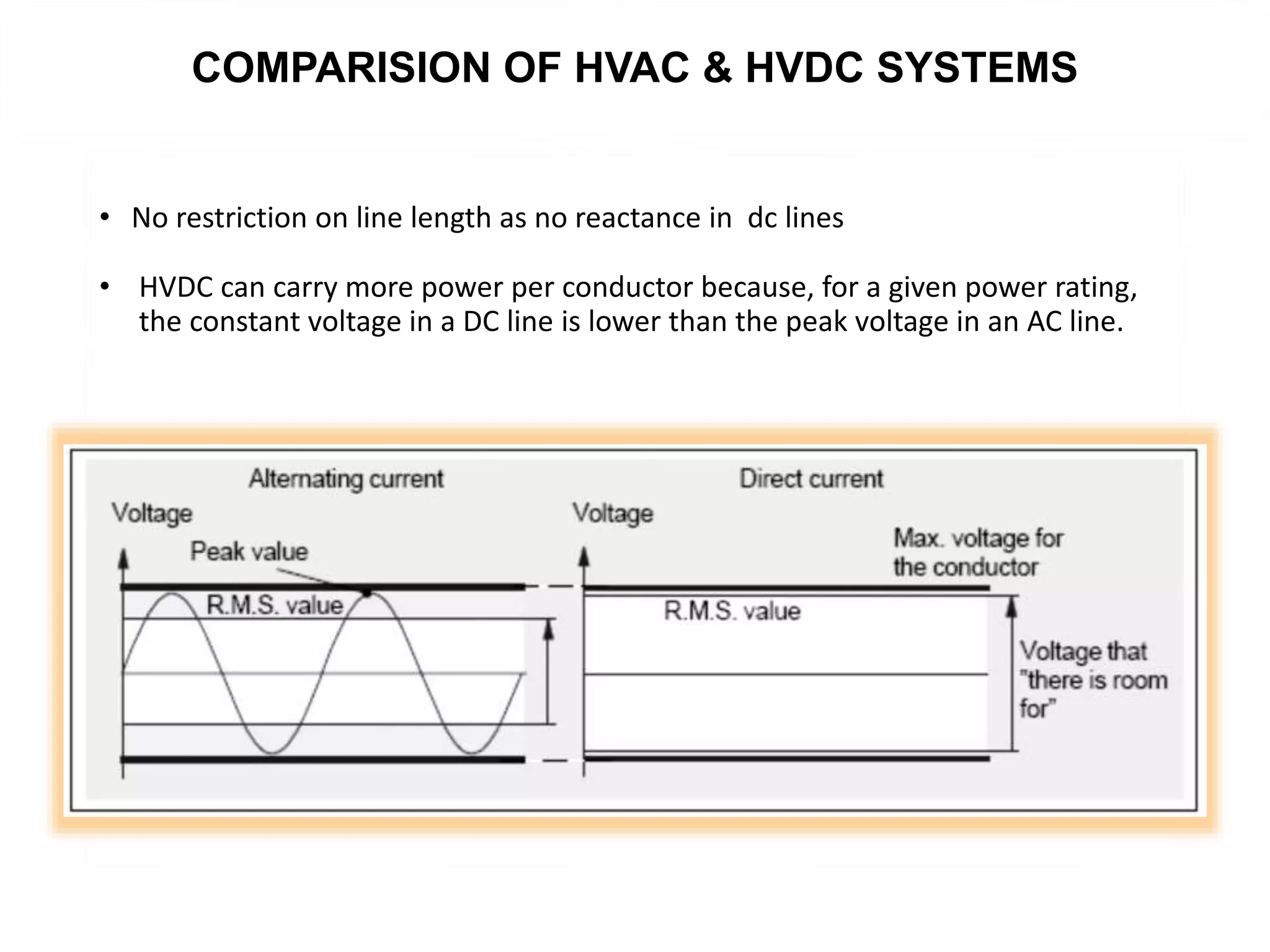
• No restriction on line length as no reactance in dc lines
• HVDC can carry more power per conductor because, for a given power rating,
the constant voltage in a DC line is lower than the peak voltage in an AC line.
COMPARISION OF HVAC & HVDC SYSTEMS
• AC current will struggle against inertia in the line
(100times/sec)-electrical resistance –inductance-
reactive power
• Direct current : Roll along the line ; opposing force
friction (electrical resistance )
• HVDC uses less current i.e. low losses.
COMPARISION OF HVAC & HVDC SYSTEMS
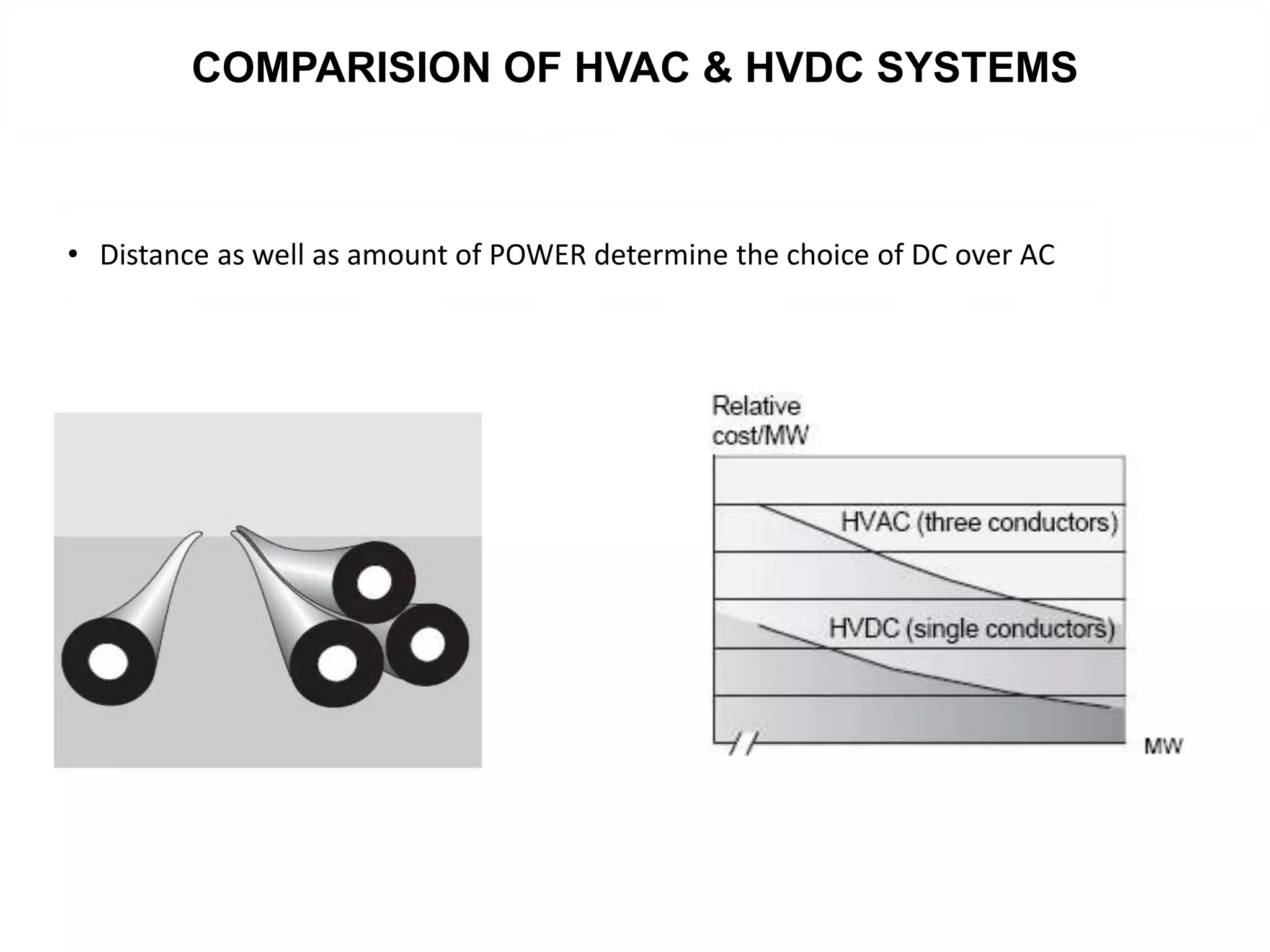
• Distance as well as amount of POWER determine the choice of DC over AC
COMPARISION OF HVAC & HVDC SYSTEMS
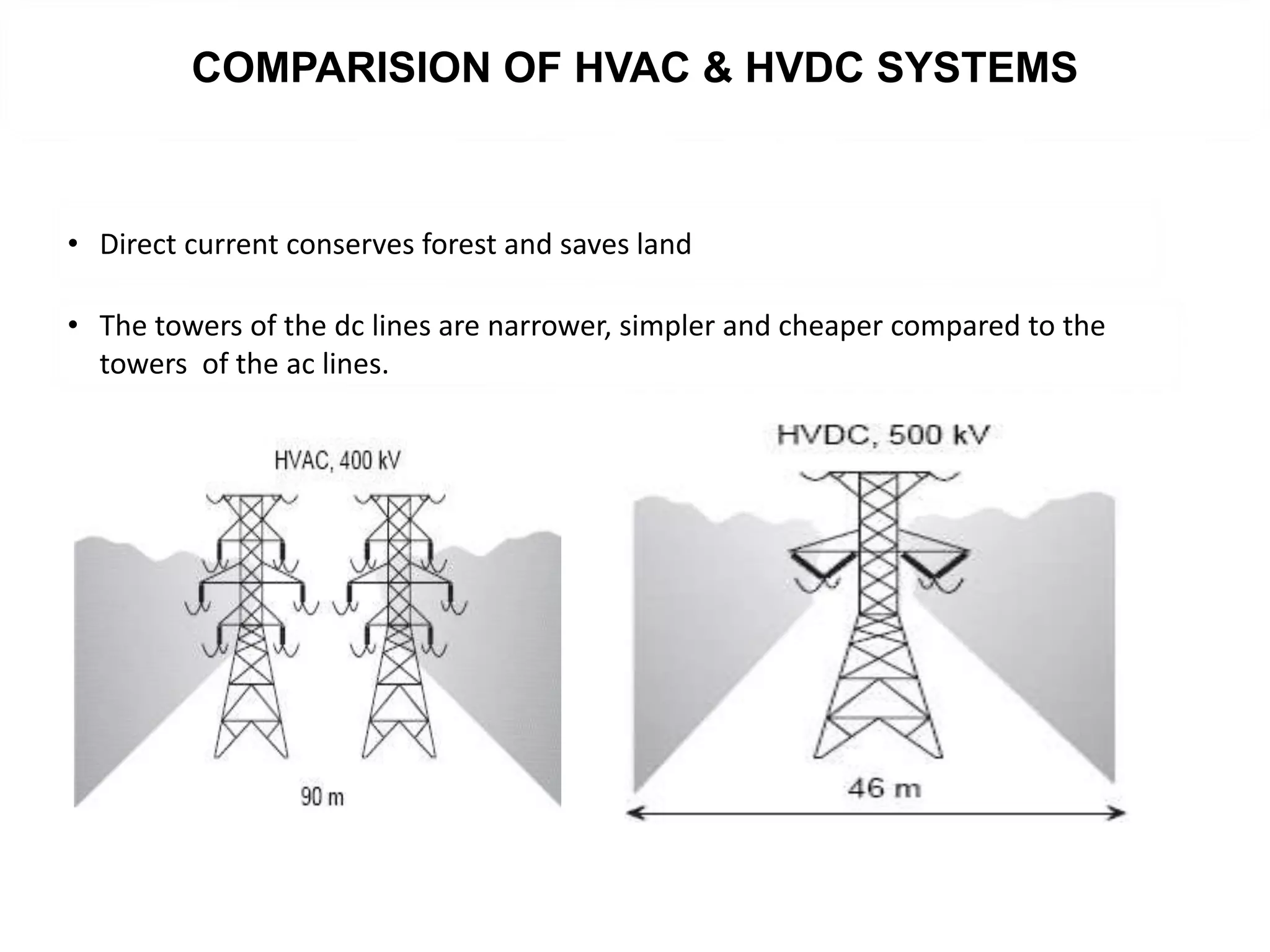
• Direct current conserves forest and saves land
• The towers of the dc lines are narrower, simpler and cheaper compared to the
towers of the ac lines.
AC Transmission Line Corridor
COMPARISION OF HVAC & HVDC SYSTEMS
DC Transmission Line Corridor
COMPARISION OF HVAC & HVDC SYSTEMS
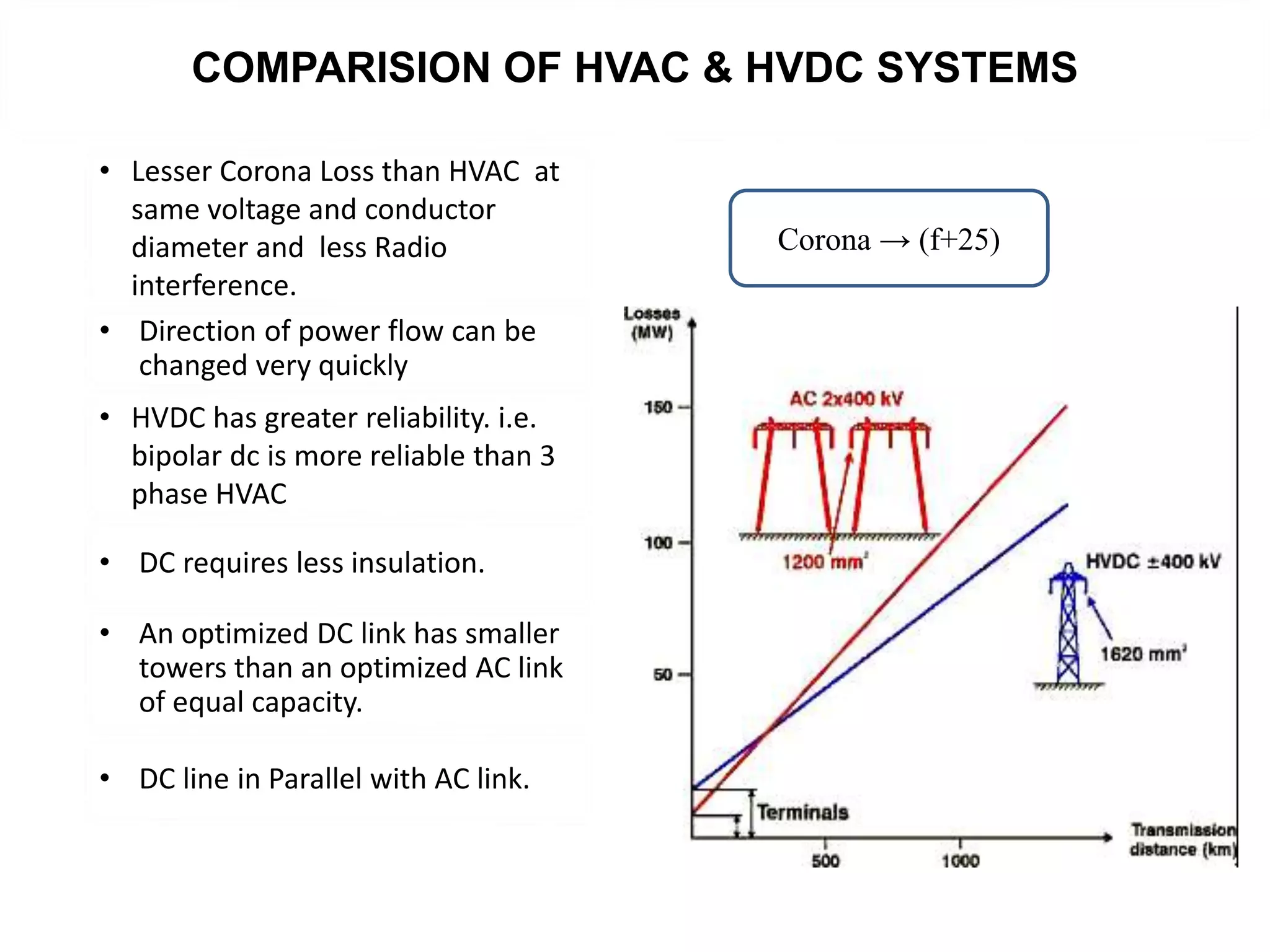
• HVDC has greater reliability. i.e.
bipolar dc is more reliable than 3
phase HVAC
• DC requires less insulation.
• An optimized DC link has smaller
towers than an optimized AC link
of equal capacity.
• Lesser Corona Loss than HVAC at
same voltage and conductor
diameter and less Radio
interference.
• Direction of power flow can be
changed very quickly
• DC line in Parallel with AC link.
Corona → (f+25)
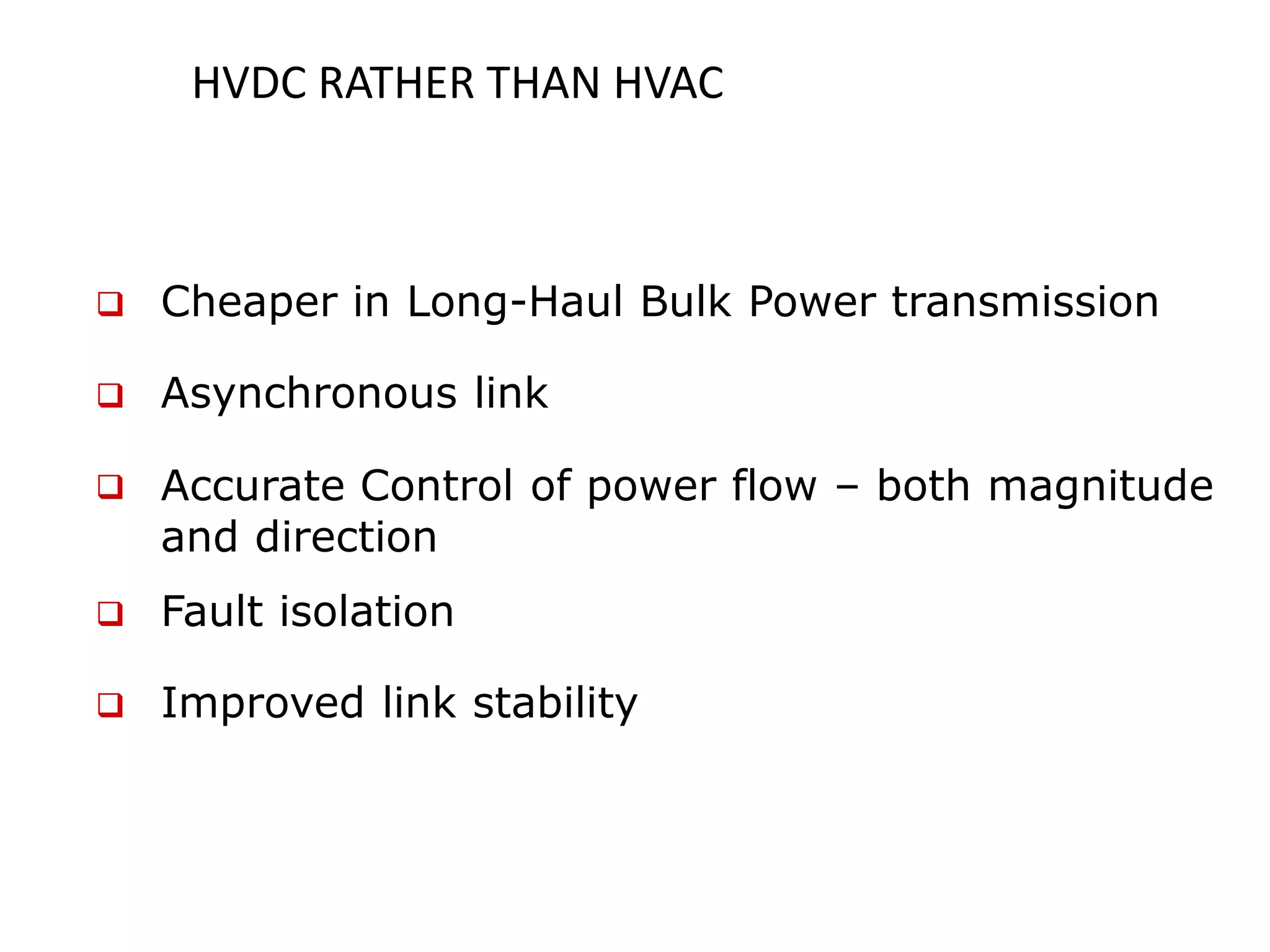
HVDC RATHER THAN HVAC
Cheaper in Long-Haul Bulk Power transmission
Asynchronous link
Accurate Control of power flow – both magnitude
and direction

Fault isolation
Improved link stability
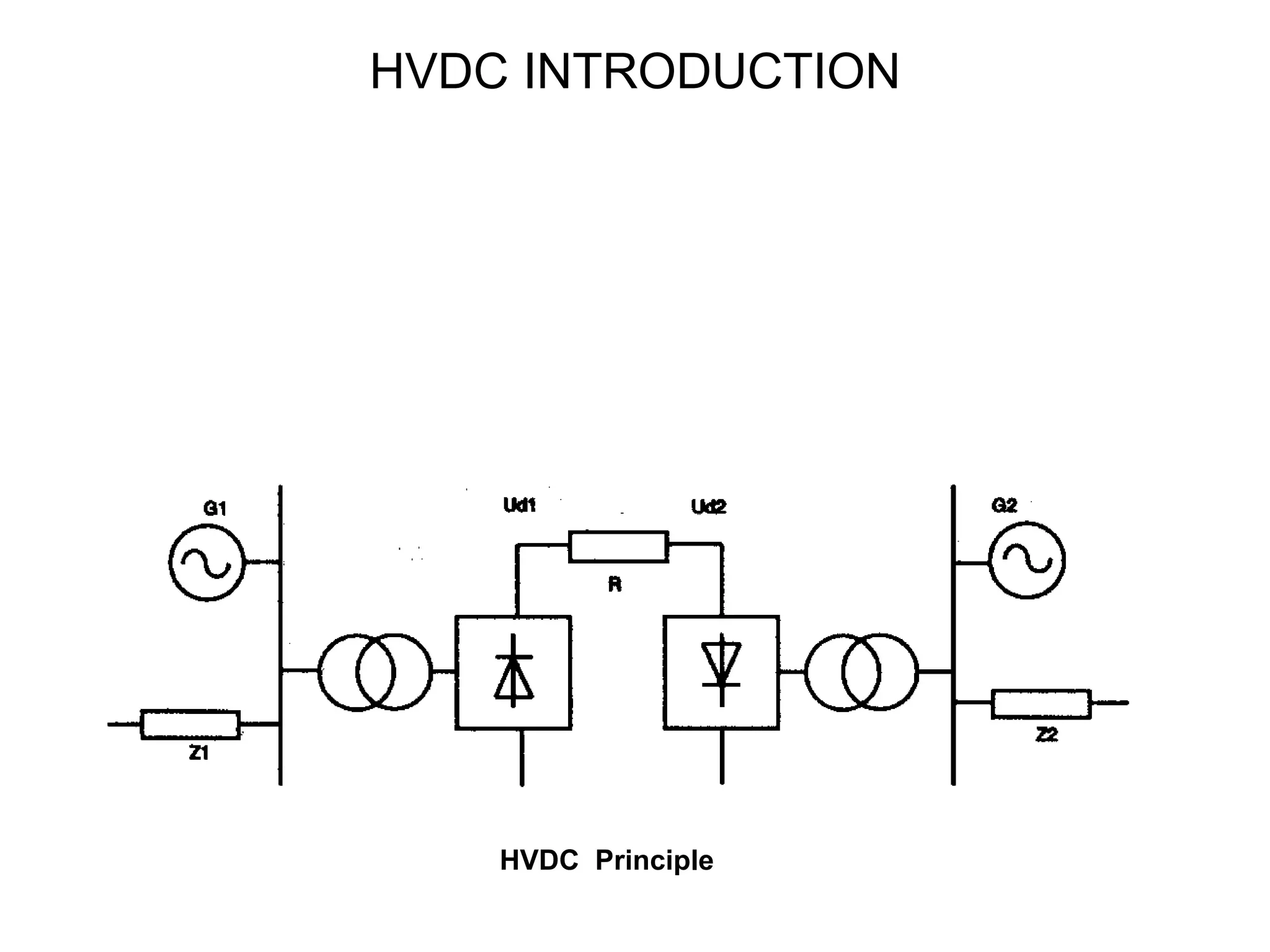
HVDC INTRODUCTION
HVDC Principle
What
Basic
is HVDC ?
DC vs.Image : AC Transmission
S
Distance Distance
 Voltage/Power – Decrease (Loss)
 Angle – No Change
 Voltage/Power – Decrease (Loss)
 Angle – Change (Reactive Power)
Receiving
Voltage/
Power
Sending
Voltage/
Power
Receiving
Voltage/
Power
Sending
Voltage/
Power
+
–
R
T
AC
3-Phase
DC
1-Phase (±)
Basic Diagram of HVDC System
TERMINAL A
(Converter)
DC
LINE
TERMINAL B
(Converter)AC 1 AC 2
FILTERFILTERF
Vd
Ld
Id
Ld
Pd = Vd Id
PROBLEMS OF AC INTERCONNECTION
• When two power systems are connected through AC ties(Synchronous
interconnection),the automatic generation control of both systems have to be
coordinated using tie line power and frequency signals.
• Even with coordinated control of interconnected systems, the operation of AC
ties can be problematic due to
a) The presence of large power oscillations which can lead to frequent tripping.
b) Increase in fault level
c) Transmission of disturbances from one system to the other
• The controllability of power flow in DC lines eliminates all the above
problem. In addition, for asynchronous DC ties, there is no need of
coordinated control.
• It is obvious that two systems which have different nominal frequencies
cannot be interconnected directly with AC ties and require the use of DC links.
• Bulk power transmission
For this DC system is the best option. (Or) HVDC transmission where
bulk power is transmitted from one point to another point over long distance.
• Power flow control (Back to Back HVDC)
If two regions are very nearby, we can monitor the power flow from
one region to another to control, emergency support as per our
requirement.(Or)Back to Back link where rectification and inversion is carried
out in the same converter station with very small or no DC lines
• To provide stability to AC system
This is basically used to control the power and stabilize the system. It
is also used to connect two different frequencies system.
(Modulation of AC) AC system is connected parallel with DC
system.(or)Parallel connection of AC and DC links. Where both AC and DC
run parallel. It is mainly used to modulate the power of AC lines.
HVDC is the better option for above cited purposes while compare with
its AC system.
PURPOSE OF HVDC BASED ON INTERCONNECTION
BASIC HVDC Single Line Diagram
Smoothing Reactor DC OH Line Smoothing Reactor
Thyristor
Valves
Thyristor
Valves DC Filter: DC Filter:
Converter Converter
TransformerTransformer
DC Filter: DC Filter:
AC Bus AC Bus
AC Filters AC Filters
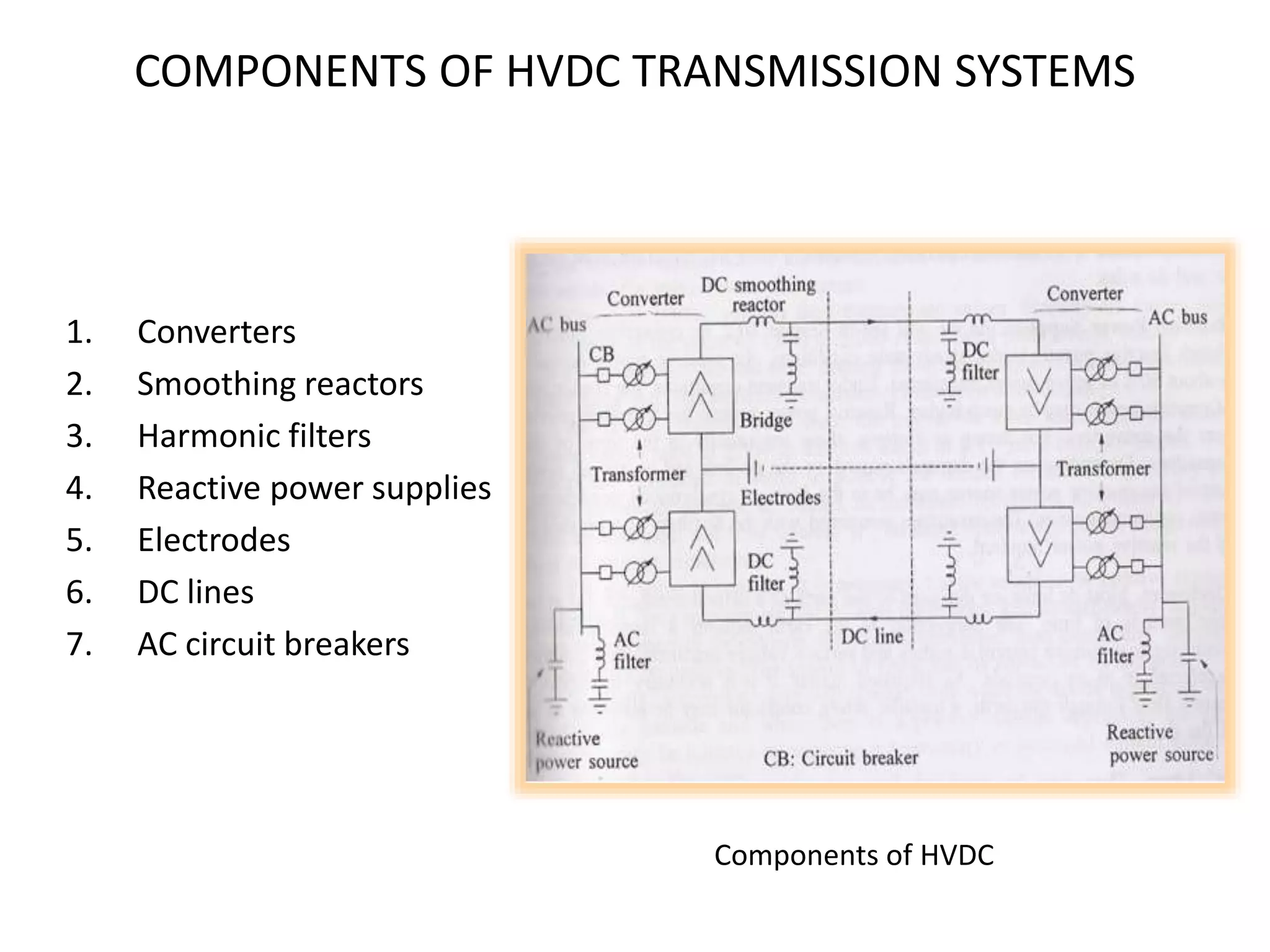
COMPONENTS OF HVDC TRANSMISSION SYSTEMS
1. Converters
2. Smoothing reactors
3. Harmonic filters
4. Reactive power supplies
5. Electrodes
6. DC lines
7. AC circuit breakers
Components of HVDC
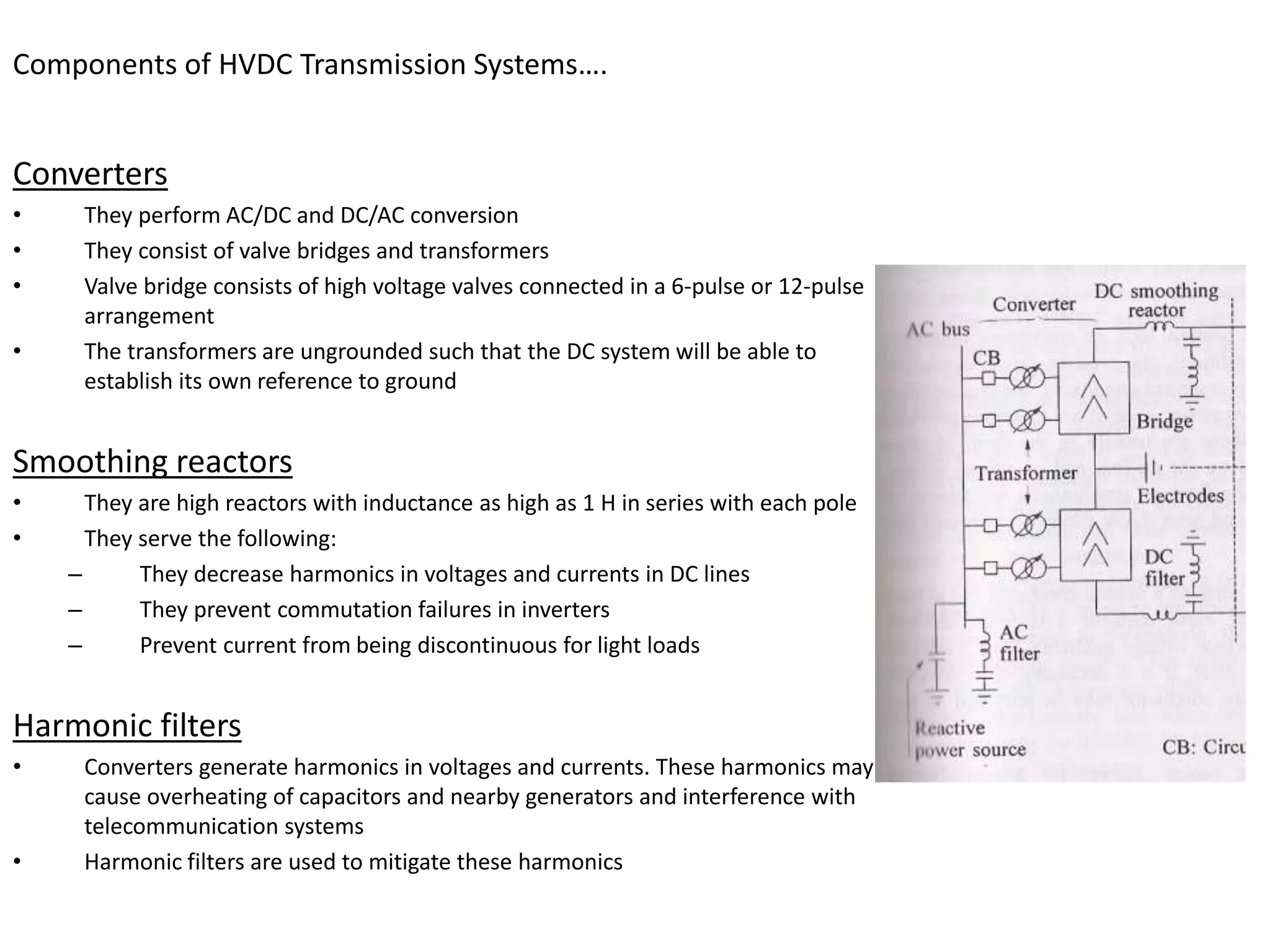
Components of HVDC Transmission Systems….
Converters
• They perform AC/DC and DC/AC conversion
• They consist of valve bridges and transformers
• Valve bridge consists of high voltage valves connected in a 6-pulse or 12-pulse
arrangement
• The transformers are ungrounded such that the DC system will be able to
establish its own reference to ground
Smoothing reactors
• They are high reactors with inductance as high as 1 H in series with each pole
• They serve the following:
– They decrease harmonics in voltages and currents in DC lines
– They prevent commutation failures in inverters
– Prevent current from being discontinuous for light loads
Harmonic filters
• Converters generate harmonics in voltages and currents. These harmonics may
cause overheating of capacitors and nearby generators and interference with
telecommunication systems
• Harmonic filters are used to mitigate these harmonics
Reactive power supplies
• Under steady state condition, the reactive power consumed by the converter
is about 50% of the active power transferred
• Under transient conditions it could be much higher
• Reactive power is, therefore, provided near the converters
• For a strong AC power system, this reactive power is provided by a shunt
capacitor
Electrodes
• Electrodes are conductors that provide connection to the earth for neutral.
They have large surface to minimize current densities and surface voltage
gradients
DC lines
• They may be overhead lines or cables
• DC lines are very similar to AC lines
AC circuit breakers
• They used to clear faults in the transformer and for taking the DC link out of
service
• They are not used for clearing DC faults
• DC faults are cleared by converter control more rapidly
Components of HVDC Transmission Systems….
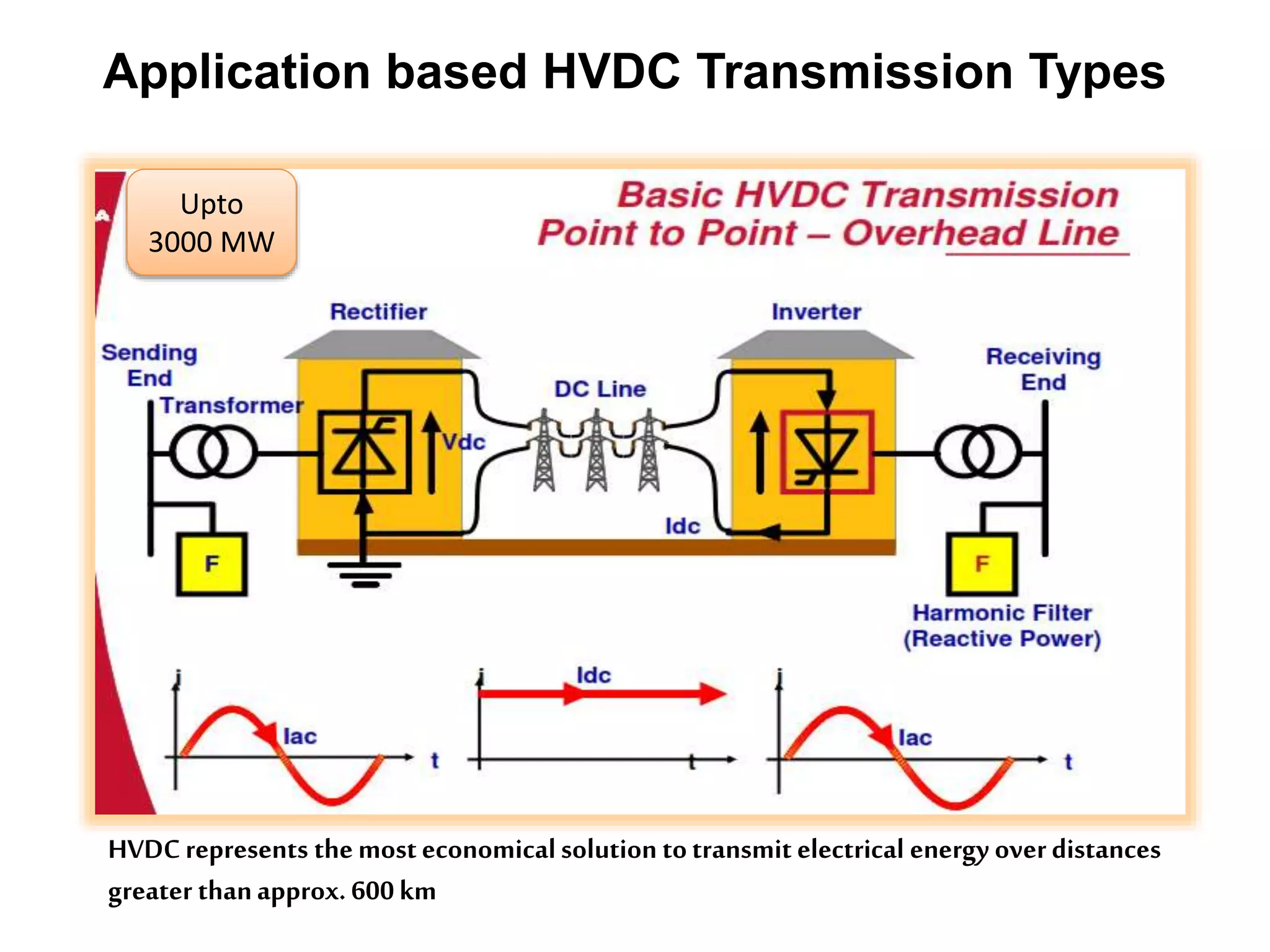
Application based HVDC Transmission Types
Upto
600MW
50 Hz 60 Hz
HVDC istheuniquesolution to interconnect Asynchronoussystems orgrids with different
frequencies.
Application based HVDC Transmission Types
Upto
3000 MW
HVDC represents themosteconomicalsolution totransmit electrical energy overdistances
greater thanapprox. 600km
Application based HVDC Transmission Types
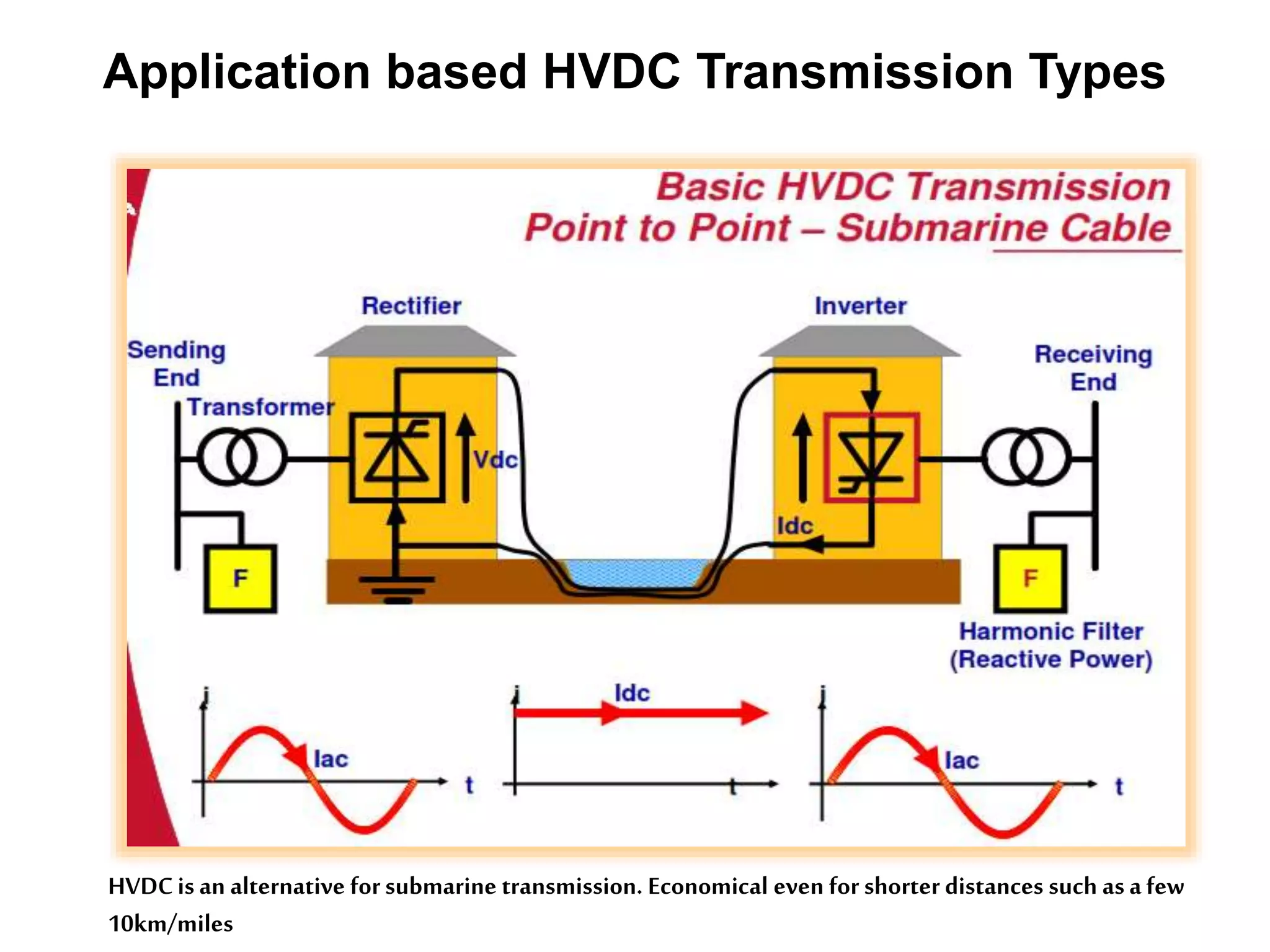
HVDCis an alternative forsubmarine transmission. Economical even for shorter distances such as a few
10km/miles
Application based HVDC Transmission Types
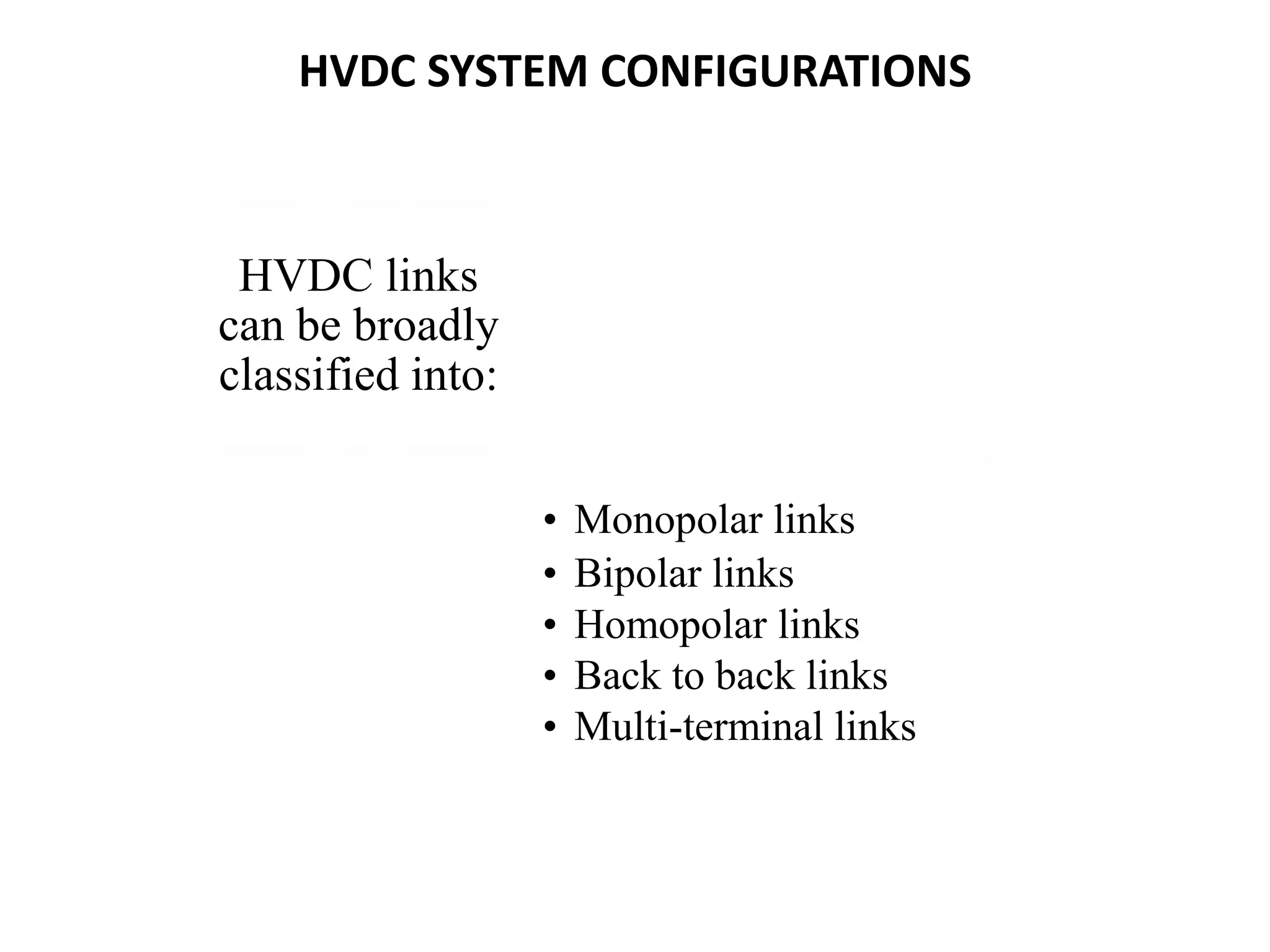
• Monopolar links
• Bipolar links
• Homopolar links
• Back to back links
• Multi-terminal links
HVDC links
can be broadly
classified into:
HVDC SYSTEM CONFIGURATIONS
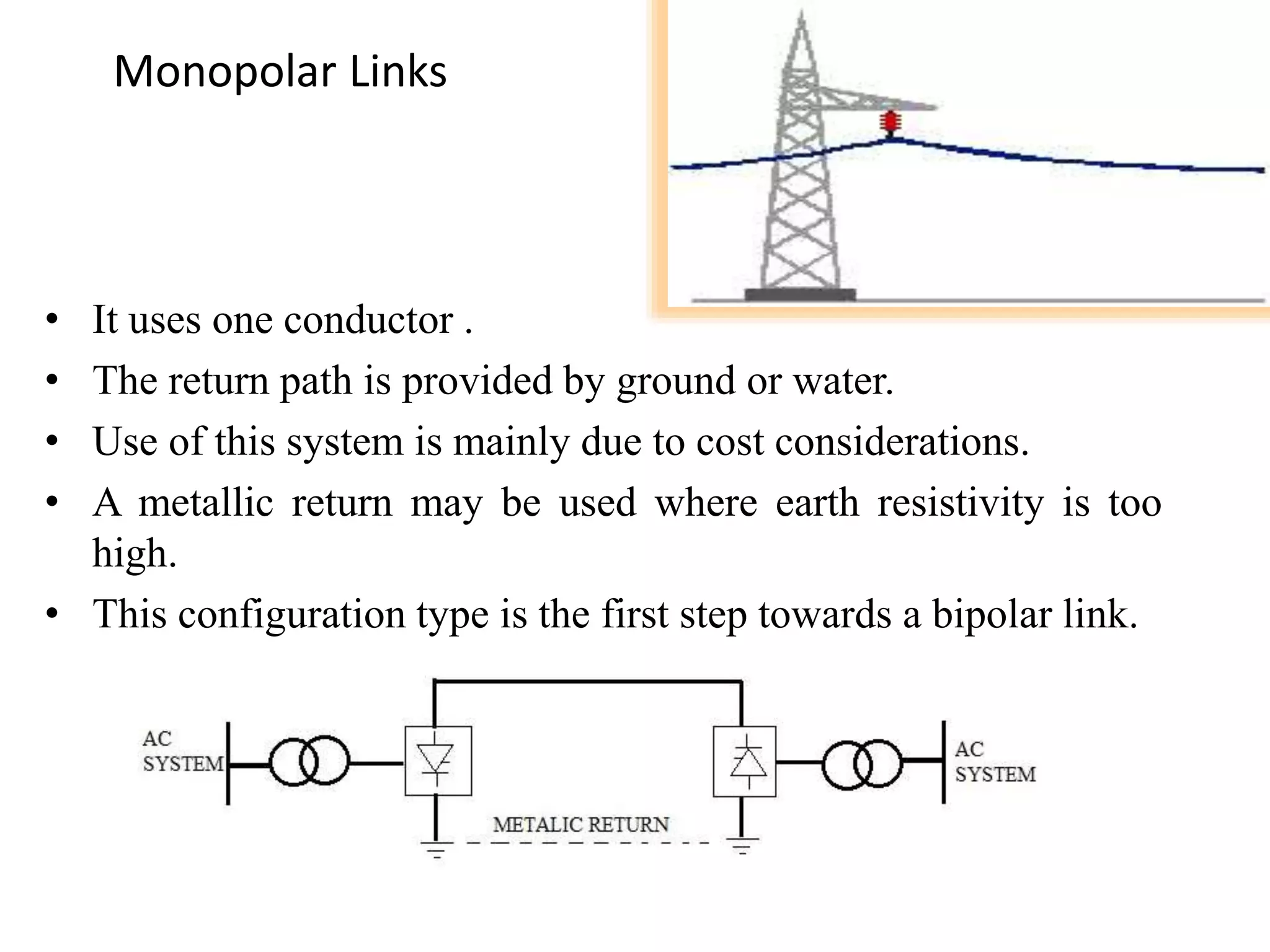
Monopolar Links
• It uses one conductor .
• The return path is provided by ground or water.
• Use of this system is mainly due to cost considerations.
• A metallic return may be used where earth resistivity is too
high.
• This configuration type is the first step towards a bipolar link.
Bipolar Links
• Each terminal has two converters of equal rated voltage,
connected in series on the DC side.
• The junctions between the converters is grounded.
• If one pole is isolated due to fault, the other pole can operate
with ground and carry half the rated load (or more using
overload capabilities of its converter line).
Homopolar Links
• It has two or more conductors all having the same polarity,
usually negative.
• Since the corona effect in DC transmission lines is less for
negative polarity, homopolar link is usually operated with
negative polarity.
• The return path for such a system is through ground.
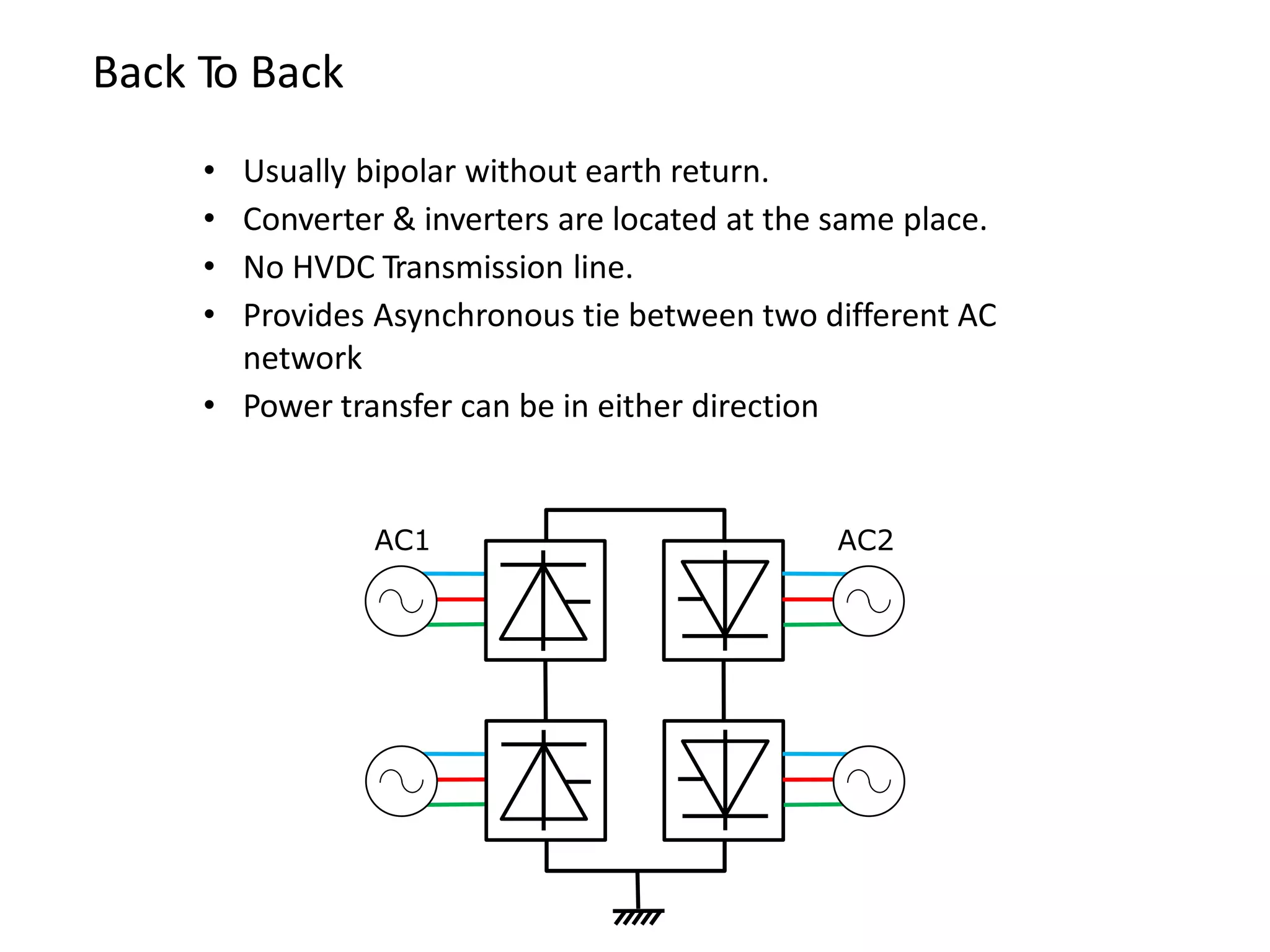
Back To Back
• Usually bipolar without earth return.
• Converter & inverters are located at the same place.
• No HVDC Transmission line.
• Provides Asynchronous tie between two different AC
network
• Power transfer can be in either direction
AC1 AC2
Multi Terminal System
• Three or more terminals connected in parallel, some feed
power and some receive power from HVDC Bus.
• Provides Inter connection among three or more AC
network.
AC1 AC2 AC3
DC AS A MEANS OF TRANSMISSION
DC Transmission has been possible with beginning of
• High power/ high current capability thyristor.
• Fast acting computerized controls
1. Convert AC into DC (rectifier)
2. Transmit DC
3. Convert DC into AC ( inverter)
Since our
primary source
of power is A.C,
The three basic
steps are
SINGLE PHASE FULL WAVE RECTIFIER
SIX PULSE RECTIFIER
T1 T3 T5
T4 T6 T2
VbVc
Va
+
Vo
-
The operating principle of the circuit is that, the pair of SCR connected between the
lines having highest amount of line-to-line voltage will conduct provided that the
gate signal is applied to SCRs at that instant.
The converters are called Line Commutated converters or current source converter.
Every 60º one Thyristor from +ve limb and one Thyristor from –ve limb is triggered
SIX PULSE RECTIFIER WAVEFORMS
Vcb Vab Vac Vbc Vba Vca
α α+π/3 α+2π/3 α+π α+4π/3 α+5π/3 α+2π
Vo(ωt)
ωt
ia(ωt)
ωt
IG
Id
-Id
T6 T1 T2 T3 T4 T5 T6
4,5 1,65,6 1,2 2,3 3,4 4,5 5,6
OPERATION OF SIX PULSE RECTIFIER
0 0.5 1 1.5 2 2.5 3
-1
-0.5
0
0.5
1
 (rad)
NormalizedAverageVoltage
Rectification Region Inversion Region
Normalized Average (DC) Voltage as function of
0 60 120 180 240 300 360 420 480 540 600 660
0
20
40
60
80
100
=/6
Frequency Hz
NormalizedHarmonicMagnitude
Specturm at alpha=pi/6
B
A
2
C
1

u u
Vd
u
3
 
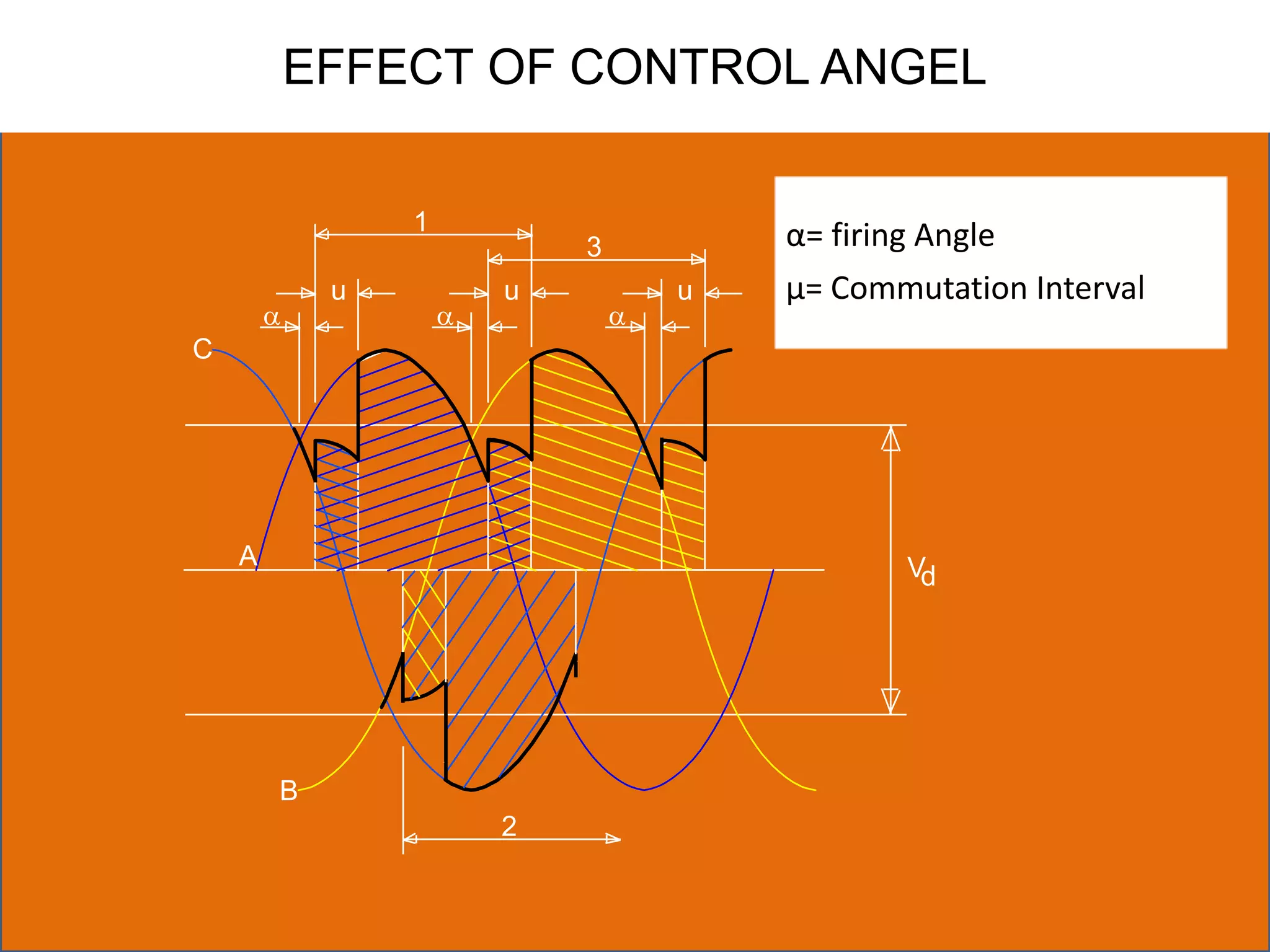
EFFECT OF CONTROL ANGEL
α= firing Angle
μ= Commutation Interval
120 º
RECTIFICATION
0
240 º180 º 300 º 120 º60 º 180 º
0.866E . 2LL
E . 2LL
DC TERMINAL VOLTAGE
DC TERMINAL VOLTAGE
120 º
INVERSION
0
240 º180 º 300 º 120 º60 º 180 º
0.866E . 2LL
E . 2LL
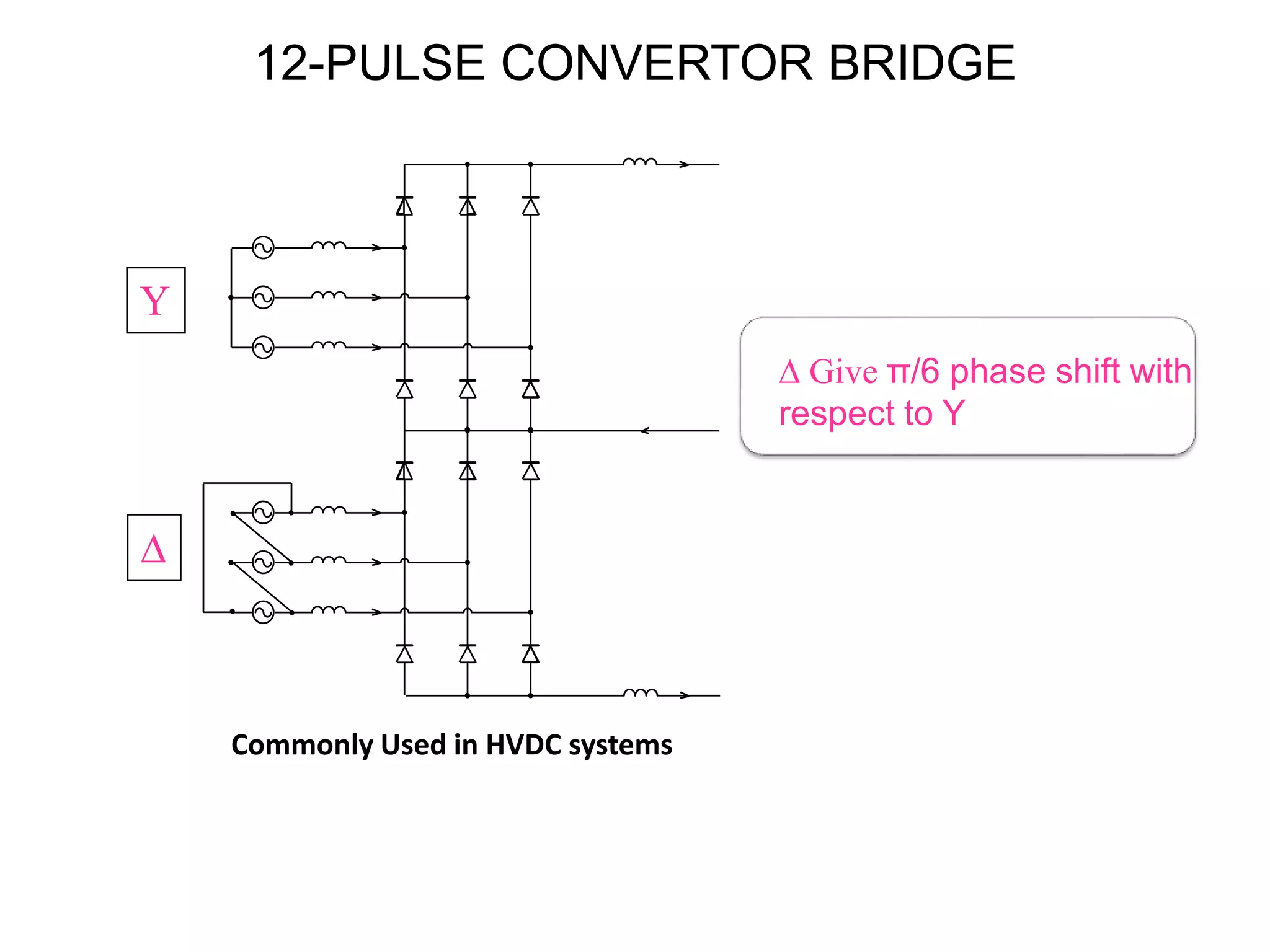
12-PULSE CONVERTOR BRIDGE
Y

Commonly Used in HVDC systems
 Give π/6 phase shift with
respect to Y
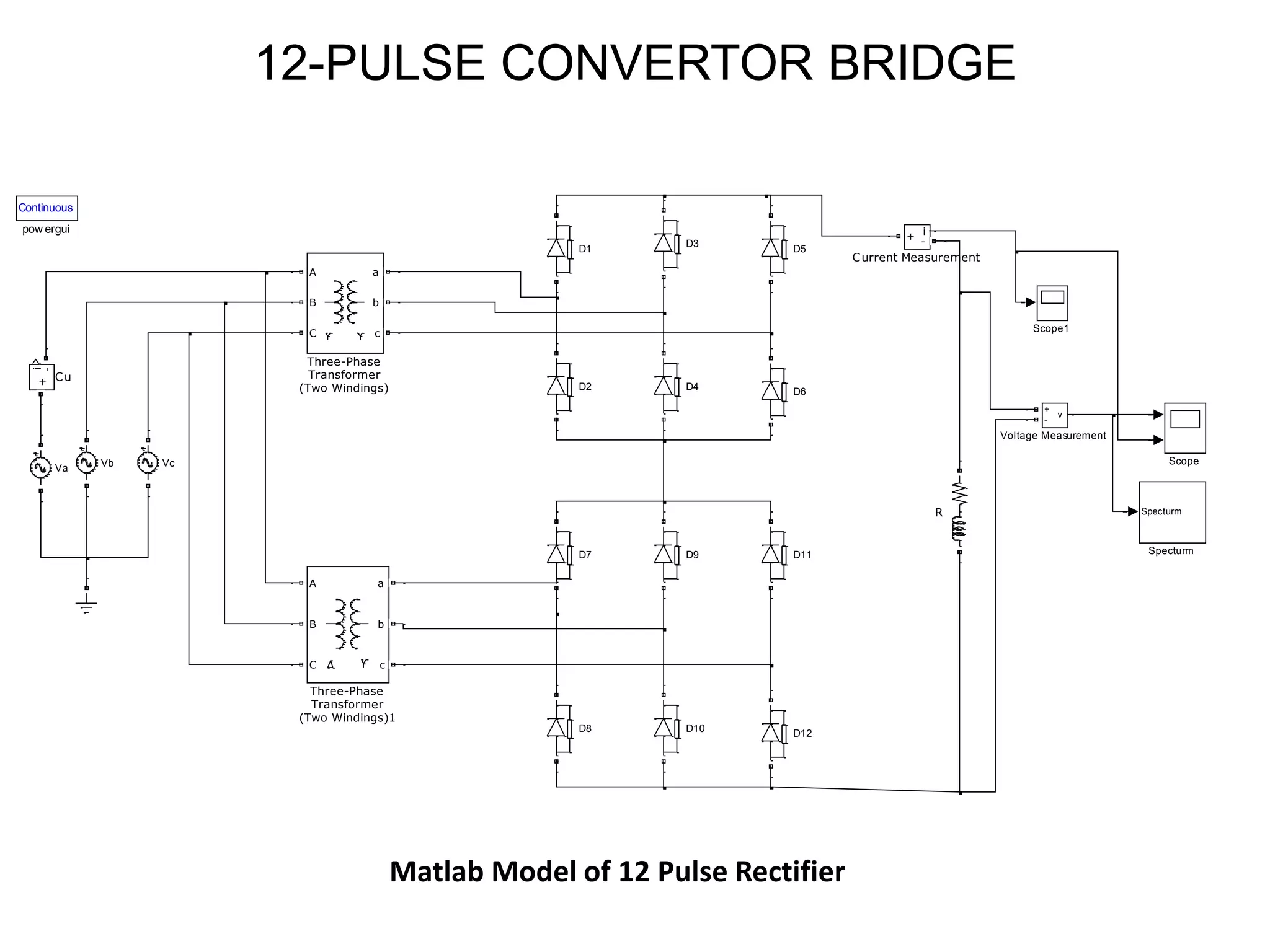
12-PULSE CONVERTOR BRIDGE
Matlab Model of 12 Pulse Rectifier
Continuous
pow ergui
v
+
-
Voltage Measurement
VcVbVa
A
B
C
a
b
c
Three-Phase
Transformer
(Two Windings)1
A
B
C
a
b
c
Three-Phase
Transformer
(Two Windings)
Specturm
Specturm
Scope1
Scope
R
D9
D8
D7
D6
D5
D4
D3
D2
D12
D11
D10
D1
i
+ -
Current Measurement
i+
-
Cu
12-PULSE CONVERTOR BRIDGE
• Commonly adopted in all HVDC applications
• Two 6 pulse bridges connected in series
• 30º phase shift between Star and Delta windings of the converter transformer
• Due to this phase shift, 5th and 7th harmonics are reduced and filtering higher
order harmonics is easier
• Higher pulse number than 12 is not economical
12-PULSE CONVERTOR BRIDGE
• From Voltage spectrum it can be seen that by using 12 pulse, nearly harmonic
free DC output is obtained.
0 60 120 180 240 300 360 420 480 540 600 660
0
20
40
60
80
100
Frequency
NormalizedHarmonicsMagnitude
Displacement
Factor
Distortion
Factor
Power
Factor
0.7583 0.9755 0.7397
0.6391 0.9677 0.6185
0.4873 0.9556 0.4656
12 Pulse Rectifier Normalized
output Voltage Spectrum
0 60 120 180 240 300 360 420 480 540 600 660
0
20
40
60
80
100
=/6
Frequency Hz
NormalizedHarmonicMagnitude
12 Pulse Rectifier Normalized input current
Spectrum for =
CONTROL OF DC VOLTAGE
V 1 V 3 V 5
V 2V 6V 4
Phase A
Ud
Phase B
Phase C
Id
Power FlowAC System DC System
V 1 V 3 V 5
V 2V 6V 4
Phase A
Ud
Phase B
Phase C
Id
AC System DC SystemPower Flow
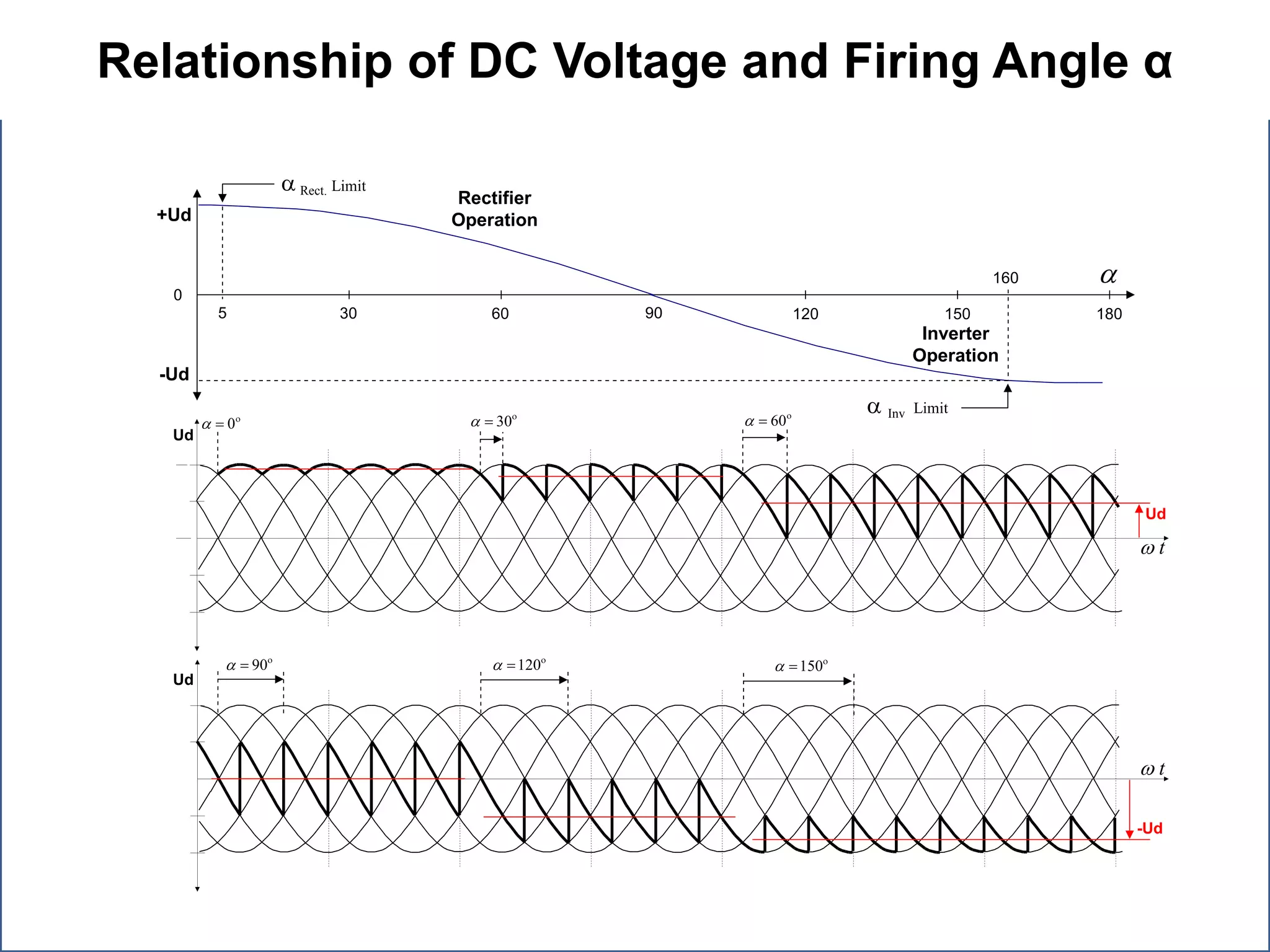
30 60 90 120 150 180
0
+Ud
-Ud
160
5
Rectifier
Operation
Inverter
Operation

Rectifier Operation Inverter Operation
Relationship of DC Voltage and Firing Angle α
30 60 90 120 150 180
0

+Ud
-Ud
160
Limit Inv
5
Limit Rect.
Rectifier
Operation
Inverter
Operation
tw
o
60=
Ud
o
30=o
0=
o
90= o
120= o
150=
-Ud
tw
Ud
Ud
Decrease voltage at station B or increase voltage at station A. power flows from A B Normal
direction
Decrease voltage at station B or increase voltage at station A. power flows from A B Normal
direction
VOLTAGE SOURCE CONVERTER 300MW
VSC Based HVDC
Can generate and absorb reactive power. Power flow is changed by shift voltage waveform (
changing power angle)
li
ciisici
X
UU
P
)sin(  
=
The main areas of application based on the economics and
technical performances, are
Long distance bulk power transmission.
The underground of submarine cables.
Asynchronous connection of AC system with different
frequencies.
Control and stabilize the power system with power flow
control.
Based on the interconnection, three types of HVDC is
possible.
Bulk Power transmission
Back to back connection
Modulation of AC system
APPLICATION OF HVDC TRANSMISSION
• Cheaper for long distance
transmission
• Asynchronous operation possible
• No switching transient
• No transmission of short circuit
power
• No compensation problem
• Low short circuit current
• Fast fault clearing time
ADVANTAGES OF HVDC TRANSMISSION
• No reactive power loss
• No Stability Problem
• No Charging Current
• No Skin & Ferranti Effect
• Power control is possible
• Requires less space compared to
ac for same voltage rating and
size.
• Ground can be used as return
conductor
• Less corona loss and Radio
interference
DISADVANTAGES OF HVDC TRANSMISSION
• The disadvantages of HVDC are in conversion, switching and control.
• Expensive inverters with limited overload capacity.
• Higher losses in static inverters at smaller transmission distances.
• The cost of the inverters may not be offset by reductions in line construction
cost and lower line loss.
• High voltage DC circuit breakers are difficult to build because some mechanism
must be included in the circuit breaker to force current to zero, otherwise
arcing and contact wear would be too great to allow reliable switching.
• HVDC is less reliable and has lower availability than AC systems, mainly due to
the extra conversion equipment.
CONTROL OF HVDC SYSTEMS
Objective
s of
Control
• Principle of operation of various
control systems.
• Implementation and their
performance during normal and
abnormal system conditions.
Content
• Efficient and stable operation.
• Maximum flexibility of power
control without compromising the
safety of equipment.
BASIC PRINCIPLES OF CONTROL
• Direct current from the rectifier to the inverter
• Power at the rectifier terminal
• Power at the inverter terminal
cilcr
doidor
d
RRR
VV
I


=
 coscos
ddrdr IVP =
2
dLdrddidi IRPIVP ==
Schematic diagram of control
BASIC MEANS OF CONTROL
• Internal voltages and can used be controlled to
control the voltages at any point on the line and the current flow
(power).
• This can be accomplished by:
1. Controlling firing angles of the rectifier and inverter (for fast
action).
2. Changing taps on the transformers on the AC side (slow
response).
• Power reversal is obtained by reversal of polarity of direct voltages
at both ends.
cosdorV cosdoiV
• Following considerations influence the selection of control
characteristics:
– Prevention of large fluctuation in DC voltage/current due
to variation In AC side voltage
– Maintaining direct voltage near rated value
– Power factor at the receiving and sending ends should be
as high as possible
BASIC FOR SELECTION OF CONTROL
CONTROL IMPLEMENTATION
• Power control
To transmit a scheduled power, the corresponding current order
is determined by:
• Rectifier control and protection
Determines firing angles and sets their limits.
• Inverter control and protection
Determines firing angles and set frequency of resulting AC.
• Master Control
It coordinates the conversion of current order to a firing angle
order, tap changer control and other protection sequences.
CONTROL IMPLEMENTATION
HVDC 12-pulse Transmission System 1000 MW (500kV-2kA) 50/60 Hz
phi = 80 deg. 3rd harm.
500kV, 60 Hz
5000 MVA equivalent
345kV, 50 Hz,
10,000 MVA equivalent
phi = 80 deg. 3rd harm.
Rectifier
Control and Protection
A
B
C
+
-
Rectifier
Master Control
Master Control Inverter
Control and Protection
A
B
C
+
-
Inverter
A
B
C
AC filters
50 Hz
600 Mvar
A
B
C
AC filters
60 Hz
600 Mvar
DC line 300 km
DC Fault
A
B
C
a
b
c
Brect
A
B
C
a
b
c
Binv
A-G Fault
A
B
C
A
B
C
A
B
C
A
B
C
0.5 H0.5 H
A
B
C
A
B
C
A 1000 MW (500 kV, 2 kA) DC interconnection is used to transmit power from a 500 kV,
5000 MVA, 60 Hz system to a 345 kV, 10000 MVA, 50 Hz system.
The rectifier and the inverter are 12-pulse converters
Control Implementation
• A 1000 MW (500 kV, 2 kA) DC interconnection is used to transmit power from a
500 kV, 5000 MVA, 60 Hz system to a 345 kV, 10000 MVA, 50 Hz system.
• The rectifier and the inverter are 12-pulse converters
• The converters are interconnected through a 300-km line and 0.5 H smoothing
reactors
• Frequency adaptive inverter-System’s AC is used.
• From the AC point of view, an HVDC converter acts as a source of harmonic
currents. From the DC point of view, it is a source of harmonic voltages.
• Two circuit breakers are used to apply faults: one on the rectifier DC side and
the other on the inverter AC side..
CONCLUSION
• HVDC is very important issue in transmission energy.
• Very large investments in e.g in China and India shows that high-voltage direct
current will very important in the future, especially in big, new-industries
countries
• Recent studies indicate that HVDC systems are very reliable.
• The data collected from 31 utilities says that forced unavailability of energy
due to the converter station is 1.62%.
• The scheduled unavailability of energy is about 5.39%.
• HVDC offers powerful alternative to increase stability of a power system as well
as to improve system operating flexibility and loss reduction
• To keep the losses to a minimum, the control system shall be designed to keep
as high voltage as possible.
Theory of HVDC transmission

Theory of HVDC transmission

  • 1.
    HVDC TRANSMISSION Presented by SAURABHDAYAL SINGH (130050109106) Semester – VII Guided by Mrs. Shradha Gautam ELECTRICAL ENGINEERING DEPARTMENT BABARIA INSITUTE OF TECHNOLOGY VARNAMA ADVANCED POWER ELECTRONICS
  • 2.
    HISTORICAL SKETCH Evolution ofPower Systems: Late 1870s- Commercial use of electricity. In 1882- First Electric power system which includes Generator, Cable,fuse,Load designed by Thomas Edison at Pearl Street station in New york. It was DC System (Low Voltage 110V),underground cable is used to distribute the power to consumers. Only 59 consumers are benefited by this low voltage DC system. Incandescent lamps are used as a load. In 1884-Motors were developed by Frank Sprague. After the invention of motors electricity is used more effectively or it was appreciated. In 1886 - Limitation of DC High losses and Voltage Drop Transformation of Voltage required.
  • 3.
    • Transformer andAC distribution (150 lamps) developed by William Stanley of Westing house. • In 1889- First AC transmission system in USA between Willamette falls and Portland, Oregon. It was 1-Phase,4KV,Over 21 Km. • Before that in the year of 1888-N.Tesla developed Poly Phase system and had patents of Generator,Motor,Transformer, transmission lines. Later Westing House bought it. • In 1890-Controversy on whether industry should standardize AC or DC. Edison-DC System Westing House-AC System Later because of features of AC System, its dominated 1. Voltage increase is possible 2. Simpler and cheaper generators and motors.
  • 4.
    ENTRY OF HVDCSYSTEM • HVDC transmission was designed by a French Engineer, RENE THURY. Simultaneously AC system was also developed slowly. • In between 1880-1911,atleast 11 Thury system were installed in Europe. The prominent was Mouteirs to Lyons(France) in 1906. It comprises 180Km(4.5 km underground cable),4.3MW,57.6KV,75A. Features : DC series generators were used. Constant control current mode.
  • 5.
    In1920-Transverter(Mechanicalconverter-polyphase transformer)were developed. AgainAC system dominated. In 1938-All the Thury system were dismantled. Because in DC system, we need frequent maintenance , cost also is not effective. Again AC revolution back till 1950. In the year of 1950, Mercury arc valves (Bulky converter) it was possible to convert AC to DC. In 1954, first HVDC System between Sweden and Gotland island was commissioned by cable. Conversion carried out by Mercury arc rectifier. Again people think about DC transmission because of the limitation in AC system. Continues……..
  • 6.
    • HVAC transmissionis having several limitations like line length , uncontrolled power flow, over/low voltages during lightly / over loaded conditions, stability problems, fault isolation etc • The advantage of HVDC is the ability to transmit large amounts of power over long distances with lower capital costs and with lower losses than AC. • In a number of applications HVDC is more effective than AC transmission. Examples include: • Undersea cables, where high capacitance causes additional AC losses. (e.g. 250 km Baltic Cable between Sweden and Germany) . • 600 km NorNed cable between Norway and the Netherlands • HVDC transmission allows efficient use of energy sources remote from load centers. Depending on voltage level and construction details, losses are quoted as about 3% per 1,000 km. COMPARISION OF HVAC & HVDC SYSTEMS
  • 7.
    COMPARISION OF HVAC& HVDC SYSTEMS • In HVDC Long power transmission without intermediate taps, for example, in remote areas . • Increasing the capacity of an existing power grid in situations where additional wires are difficult or expensive to install • Power transmission and stabilization between unsynchronized AC distribution systems • Reducing line cost:  fewer conductors  thinner conductors since HVDC does not suffer from the skin effect • Connecting a remote generating plant to the distribution grid • Asynchronous operation possible between regions having different electrical parameters . • Facilitate power transmission between different countries that use AC at differing voltages and/or frequencies
  • 8.
    Terminal Cost AC TerminalCost DC Line Cost DC Line Cost AC Break Even Distance COST: HVAC vs. HVDC Transmission • HVDC Cheaper than HVAC for long distance. COMPARISION OF HVAC & HVDC SYSTEMS
  • 9.
    COMPARISION OF HVAC& HVDC SYSTEMS • No restriction on line length as no reactance in dc lines • HVDC can carry more power per conductor because, for a given power rating, the constant voltage in a DC line is lower than the peak voltage in an AC line.
  • 10.
    COMPARISION OF HVAC& HVDC SYSTEMS • AC current will struggle against inertia in the line (100times/sec)-electrical resistance –inductance- reactive power • Direct current : Roll along the line ; opposing force friction (electrical resistance ) • HVDC uses less current i.e. low losses.
  • 11.
    COMPARISION OF HVAC& HVDC SYSTEMS • Distance as well as amount of POWER determine the choice of DC over AC
  • 12.
    COMPARISION OF HVAC& HVDC SYSTEMS • Direct current conserves forest and saves land • The towers of the dc lines are narrower, simpler and cheaper compared to the towers of the ac lines.
  • 13.
    AC Transmission LineCorridor COMPARISION OF HVAC & HVDC SYSTEMS
  • 14.
    DC Transmission LineCorridor COMPARISION OF HVAC & HVDC SYSTEMS
  • 15.
    COMPARISION OF HVAC& HVDC SYSTEMS • HVDC has greater reliability. i.e. bipolar dc is more reliable than 3 phase HVAC • DC requires less insulation. • An optimized DC link has smaller towers than an optimized AC link of equal capacity. • Lesser Corona Loss than HVAC at same voltage and conductor diameter and less Radio interference. • Direction of power flow can be changed very quickly • DC line in Parallel with AC link. Corona → (f+25)
  • 16.
    HVDC RATHER THANHVAC Cheaper in Long-Haul Bulk Power transmission Asynchronous link Accurate Control of power flow – both magnitude and direction  Fault isolation Improved link stability
  • 17.
  • 18.
    What Basic is HVDC ? DCvs.Image : AC Transmission S Distance Distance  Voltage/Power – Decrease (Loss)  Angle – No Change  Voltage/Power – Decrease (Loss)  Angle – Change (Reactive Power) Receiving Voltage/ Power Sending Voltage/ Power Receiving Voltage/ Power Sending Voltage/ Power + – R T AC 3-Phase DC 1-Phase (±)
  • 19.
    Basic Diagram ofHVDC System TERMINAL A (Converter) DC LINE TERMINAL B (Converter)AC 1 AC 2 FILTERFILTERF Vd Ld Id Ld Pd = Vd Id
  • 20.
    PROBLEMS OF ACINTERCONNECTION • When two power systems are connected through AC ties(Synchronous interconnection),the automatic generation control of both systems have to be coordinated using tie line power and frequency signals. • Even with coordinated control of interconnected systems, the operation of AC ties can be problematic due to a) The presence of large power oscillations which can lead to frequent tripping. b) Increase in fault level c) Transmission of disturbances from one system to the other • The controllability of power flow in DC lines eliminates all the above problem. In addition, for asynchronous DC ties, there is no need of coordinated control. • It is obvious that two systems which have different nominal frequencies cannot be interconnected directly with AC ties and require the use of DC links.
  • 21.
    • Bulk powertransmission For this DC system is the best option. (Or) HVDC transmission where bulk power is transmitted from one point to another point over long distance. • Power flow control (Back to Back HVDC) If two regions are very nearby, we can monitor the power flow from one region to another to control, emergency support as per our requirement.(Or)Back to Back link where rectification and inversion is carried out in the same converter station with very small or no DC lines • To provide stability to AC system This is basically used to control the power and stabilize the system. It is also used to connect two different frequencies system. (Modulation of AC) AC system is connected parallel with DC system.(or)Parallel connection of AC and DC links. Where both AC and DC run parallel. It is mainly used to modulate the power of AC lines. HVDC is the better option for above cited purposes while compare with its AC system. PURPOSE OF HVDC BASED ON INTERCONNECTION
  • 22.
    BASIC HVDC SingleLine Diagram Smoothing Reactor DC OH Line Smoothing Reactor Thyristor Valves Thyristor Valves DC Filter: DC Filter: Converter Converter TransformerTransformer DC Filter: DC Filter: AC Bus AC Bus AC Filters AC Filters
  • 23.
    COMPONENTS OF HVDCTRANSMISSION SYSTEMS 1. Converters 2. Smoothing reactors 3. Harmonic filters 4. Reactive power supplies 5. Electrodes 6. DC lines 7. AC circuit breakers Components of HVDC
  • 24.
    Components of HVDCTransmission Systems…. Converters • They perform AC/DC and DC/AC conversion • They consist of valve bridges and transformers • Valve bridge consists of high voltage valves connected in a 6-pulse or 12-pulse arrangement • The transformers are ungrounded such that the DC system will be able to establish its own reference to ground Smoothing reactors • They are high reactors with inductance as high as 1 H in series with each pole • They serve the following: – They decrease harmonics in voltages and currents in DC lines – They prevent commutation failures in inverters – Prevent current from being discontinuous for light loads Harmonic filters • Converters generate harmonics in voltages and currents. These harmonics may cause overheating of capacitors and nearby generators and interference with telecommunication systems • Harmonic filters are used to mitigate these harmonics
  • 25.
    Reactive power supplies •Under steady state condition, the reactive power consumed by the converter is about 50% of the active power transferred • Under transient conditions it could be much higher • Reactive power is, therefore, provided near the converters • For a strong AC power system, this reactive power is provided by a shunt capacitor Electrodes • Electrodes are conductors that provide connection to the earth for neutral. They have large surface to minimize current densities and surface voltage gradients DC lines • They may be overhead lines or cables • DC lines are very similar to AC lines AC circuit breakers • They used to clear faults in the transformer and for taking the DC link out of service • They are not used for clearing DC faults • DC faults are cleared by converter control more rapidly Components of HVDC Transmission Systems….
  • 26.
    Application based HVDCTransmission Types Upto 600MW 50 Hz 60 Hz HVDC istheuniquesolution to interconnect Asynchronoussystems orgrids with different frequencies.
  • 27.
    Application based HVDCTransmission Types Upto 3000 MW HVDC represents themosteconomicalsolution totransmit electrical energy overdistances greater thanapprox. 600km
  • 28.
    Application based HVDCTransmission Types HVDCis an alternative forsubmarine transmission. Economical even for shorter distances such as a few 10km/miles
  • 29.
    Application based HVDCTransmission Types
  • 30.
    • Monopolar links •Bipolar links • Homopolar links • Back to back links • Multi-terminal links HVDC links can be broadly classified into: HVDC SYSTEM CONFIGURATIONS
  • 31.
    Monopolar Links • Ituses one conductor . • The return path is provided by ground or water. • Use of this system is mainly due to cost considerations. • A metallic return may be used where earth resistivity is too high. • This configuration type is the first step towards a bipolar link.
  • 32.
    Bipolar Links • Eachterminal has two converters of equal rated voltage, connected in series on the DC side. • The junctions between the converters is grounded. • If one pole is isolated due to fault, the other pole can operate with ground and carry half the rated load (or more using overload capabilities of its converter line).
  • 33.
    Homopolar Links • Ithas two or more conductors all having the same polarity, usually negative. • Since the corona effect in DC transmission lines is less for negative polarity, homopolar link is usually operated with negative polarity. • The return path for such a system is through ground.
  • 34.
    Back To Back •Usually bipolar without earth return. • Converter & inverters are located at the same place. • No HVDC Transmission line. • Provides Asynchronous tie between two different AC network • Power transfer can be in either direction AC1 AC2
  • 35.
    Multi Terminal System •Three or more terminals connected in parallel, some feed power and some receive power from HVDC Bus. • Provides Inter connection among three or more AC network. AC1 AC2 AC3
  • 36.
    DC AS AMEANS OF TRANSMISSION DC Transmission has been possible with beginning of • High power/ high current capability thyristor. • Fast acting computerized controls 1. Convert AC into DC (rectifier) 2. Transmit DC 3. Convert DC into AC ( inverter) Since our primary source of power is A.C, The three basic steps are
  • 37.
    SINGLE PHASE FULLWAVE RECTIFIER
  • 38.
    SIX PULSE RECTIFIER T1T3 T5 T4 T6 T2 VbVc Va + Vo - The operating principle of the circuit is that, the pair of SCR connected between the lines having highest amount of line-to-line voltage will conduct provided that the gate signal is applied to SCRs at that instant. The converters are called Line Commutated converters or current source converter. Every 60º one Thyristor from +ve limb and one Thyristor from –ve limb is triggered
  • 39.
    SIX PULSE RECTIFIERWAVEFORMS Vcb Vab Vac Vbc Vba Vca α α+π/3 α+2π/3 α+π α+4π/3 α+5π/3 α+2π Vo(ωt) ωt ia(ωt) ωt IG Id -Id T6 T1 T2 T3 T4 T5 T6 4,5 1,65,6 1,2 2,3 3,4 4,5 5,6
  • 40.
    OPERATION OF SIXPULSE RECTIFIER 0 0.5 1 1.5 2 2.5 3 -1 -0.5 0 0.5 1  (rad) NormalizedAverageVoltage Rectification Region Inversion Region Normalized Average (DC) Voltage as function of 0 60 120 180 240 300 360 420 480 540 600 660 0 20 40 60 80 100 =/6 Frequency Hz NormalizedHarmonicMagnitude Specturm at alpha=pi/6
  • 41.
    B A 2 C 1  u u Vd u 3   EFFECTOF CONTROL ANGEL α= firing Angle μ= Commutation Interval
  • 42.
    120 º RECTIFICATION 0 240 º180º 300 º 120 º60 º 180 º 0.866E . 2LL E . 2LL DC TERMINAL VOLTAGE
  • 43.
    DC TERMINAL VOLTAGE 120º INVERSION 0 240 º180 º 300 º 120 º60 º 180 º 0.866E . 2LL E . 2LL
  • 44.
    12-PULSE CONVERTOR BRIDGE Y  CommonlyUsed in HVDC systems  Give π/6 phase shift with respect to Y
  • 45.
    12-PULSE CONVERTOR BRIDGE MatlabModel of 12 Pulse Rectifier Continuous pow ergui v + - Voltage Measurement VcVbVa A B C a b c Three-Phase Transformer (Two Windings)1 A B C a b c Three-Phase Transformer (Two Windings) Specturm Specturm Scope1 Scope R D9 D8 D7 D6 D5 D4 D3 D2 D12 D11 D10 D1 i + - Current Measurement i+ - Cu
  • 46.
    12-PULSE CONVERTOR BRIDGE •Commonly adopted in all HVDC applications • Two 6 pulse bridges connected in series • 30º phase shift between Star and Delta windings of the converter transformer • Due to this phase shift, 5th and 7th harmonics are reduced and filtering higher order harmonics is easier • Higher pulse number than 12 is not economical
  • 47.
    12-PULSE CONVERTOR BRIDGE •From Voltage spectrum it can be seen that by using 12 pulse, nearly harmonic free DC output is obtained. 0 60 120 180 240 300 360 420 480 540 600 660 0 20 40 60 80 100 Frequency NormalizedHarmonicsMagnitude Displacement Factor Distortion Factor Power Factor 0.7583 0.9755 0.7397 0.6391 0.9677 0.6185 0.4873 0.9556 0.4656 12 Pulse Rectifier Normalized output Voltage Spectrum 0 60 120 180 240 300 360 420 480 540 600 660 0 20 40 60 80 100 =/6 Frequency Hz NormalizedHarmonicMagnitude 12 Pulse Rectifier Normalized input current Spectrum for =
  • 48.
    CONTROL OF DCVOLTAGE V 1 V 3 V 5 V 2V 6V 4 Phase A Ud Phase B Phase C Id Power FlowAC System DC System V 1 V 3 V 5 V 2V 6V 4 Phase A Ud Phase B Phase C Id AC System DC SystemPower Flow 30 60 90 120 150 180 0 +Ud -Ud 160 5 Rectifier Operation Inverter Operation  Rectifier Operation Inverter Operation
  • 49.
    Relationship of DCVoltage and Firing Angle α 30 60 90 120 150 180 0  +Ud -Ud 160 Limit Inv 5 Limit Rect. Rectifier Operation Inverter Operation tw o 60= Ud o 30=o 0= o 90= o 120= o 150= -Ud tw Ud Ud
  • 50.
    Decrease voltage atstation B or increase voltage at station A. power flows from A B Normal direction Decrease voltage at station B or increase voltage at station A. power flows from A B Normal direction
  • 51.
    VOLTAGE SOURCE CONVERTER300MW VSC Based HVDC Can generate and absorb reactive power. Power flow is changed by shift voltage waveform ( changing power angle) li ciisici X UU P )sin(   =
  • 52.
    The main areasof application based on the economics and technical performances, are Long distance bulk power transmission. The underground of submarine cables. Asynchronous connection of AC system with different frequencies. Control and stabilize the power system with power flow control. Based on the interconnection, three types of HVDC is possible. Bulk Power transmission Back to back connection Modulation of AC system APPLICATION OF HVDC TRANSMISSION
  • 53.
    • Cheaper forlong distance transmission • Asynchronous operation possible • No switching transient • No transmission of short circuit power • No compensation problem • Low short circuit current • Fast fault clearing time ADVANTAGES OF HVDC TRANSMISSION • No reactive power loss • No Stability Problem • No Charging Current • No Skin & Ferranti Effect • Power control is possible • Requires less space compared to ac for same voltage rating and size. • Ground can be used as return conductor • Less corona loss and Radio interference
  • 54.
    DISADVANTAGES OF HVDCTRANSMISSION • The disadvantages of HVDC are in conversion, switching and control. • Expensive inverters with limited overload capacity. • Higher losses in static inverters at smaller transmission distances. • The cost of the inverters may not be offset by reductions in line construction cost and lower line loss. • High voltage DC circuit breakers are difficult to build because some mechanism must be included in the circuit breaker to force current to zero, otherwise arcing and contact wear would be too great to allow reliable switching. • HVDC is less reliable and has lower availability than AC systems, mainly due to the extra conversion equipment.
  • 55.
    CONTROL OF HVDCSYSTEMS Objective s of Control • Principle of operation of various control systems. • Implementation and their performance during normal and abnormal system conditions. Content • Efficient and stable operation. • Maximum flexibility of power control without compromising the safety of equipment.
  • 56.
    BASIC PRINCIPLES OFCONTROL • Direct current from the rectifier to the inverter • Power at the rectifier terminal • Power at the inverter terminal cilcr doidor d RRR VV I   =  coscos ddrdr IVP = 2 dLdrddidi IRPIVP == Schematic diagram of control
  • 57.
    BASIC MEANS OFCONTROL • Internal voltages and can used be controlled to control the voltages at any point on the line and the current flow (power). • This can be accomplished by: 1. Controlling firing angles of the rectifier and inverter (for fast action). 2. Changing taps on the transformers on the AC side (slow response). • Power reversal is obtained by reversal of polarity of direct voltages at both ends. cosdorV cosdoiV
  • 58.
    • Following considerationsinfluence the selection of control characteristics: – Prevention of large fluctuation in DC voltage/current due to variation In AC side voltage – Maintaining direct voltage near rated value – Power factor at the receiving and sending ends should be as high as possible BASIC FOR SELECTION OF CONTROL
  • 59.
  • 60.
    CONTROL IMPLEMENTATION • Powercontrol To transmit a scheduled power, the corresponding current order is determined by: • Rectifier control and protection Determines firing angles and sets their limits. • Inverter control and protection Determines firing angles and set frequency of resulting AC. • Master Control It coordinates the conversion of current order to a firing angle order, tap changer control and other protection sequences.
  • 61.
    CONTROL IMPLEMENTATION HVDC 12-pulseTransmission System 1000 MW (500kV-2kA) 50/60 Hz phi = 80 deg. 3rd harm. 500kV, 60 Hz 5000 MVA equivalent 345kV, 50 Hz, 10,000 MVA equivalent phi = 80 deg. 3rd harm. Rectifier Control and Protection A B C + - Rectifier Master Control Master Control Inverter Control and Protection A B C + - Inverter A B C AC filters 50 Hz 600 Mvar A B C AC filters 60 Hz 600 Mvar DC line 300 km DC Fault A B C a b c Brect A B C a b c Binv A-G Fault A B C A B C A B C A B C 0.5 H0.5 H A B C A B C A 1000 MW (500 kV, 2 kA) DC interconnection is used to transmit power from a 500 kV, 5000 MVA, 60 Hz system to a 345 kV, 10000 MVA, 50 Hz system. The rectifier and the inverter are 12-pulse converters
  • 62.
    Control Implementation • A1000 MW (500 kV, 2 kA) DC interconnection is used to transmit power from a 500 kV, 5000 MVA, 60 Hz system to a 345 kV, 10000 MVA, 50 Hz system. • The rectifier and the inverter are 12-pulse converters • The converters are interconnected through a 300-km line and 0.5 H smoothing reactors • Frequency adaptive inverter-System’s AC is used. • From the AC point of view, an HVDC converter acts as a source of harmonic currents. From the DC point of view, it is a source of harmonic voltages. • Two circuit breakers are used to apply faults: one on the rectifier DC side and the other on the inverter AC side..
  • 63.
    CONCLUSION • HVDC isvery important issue in transmission energy. • Very large investments in e.g in China and India shows that high-voltage direct current will very important in the future, especially in big, new-industries countries • Recent studies indicate that HVDC systems are very reliable. • The data collected from 31 utilities says that forced unavailability of energy due to the converter station is 1.62%. • The scheduled unavailability of energy is about 5.39%. • HVDC offers powerful alternative to increase stability of a power system as well as to improve system operating flexibility and loss reduction • To keep the losses to a minimum, the control system shall be designed to keep as high voltage as possible.