MATRUSRI ENGINEERING COLLEGE
DEPARTMENT OF ELECTRICAL AND ELECTRONICS
ENGINEERING
SUBJECT NAME: HIGH VOLTAGE ENGINEERING
Conduction and Breakdown in Liquid Dielectrics
FACULTY NAME: Dr.N.KALPANA
MATRUSRI
ENGINEERING COLLEGE
SYLLABUS
UNIT I
Conduction And Breakdown In Gaseous Insulating Materials: Ionization Processes And
Current Growth-Townsend’s Criterion For Breakdown- Break Down In Electro Negative
Gases- Time Lags For Breakdown- Paschen’s Law- Corona Discharges And Breakdown In
Non-Uniform Fields- Practical Considerations For Selecting Gases For Insulation Purposes.
UNIT II
Conduction and Breakdown in Liquid Dielectrics: Various mechanisms of breakdown in liquid
dielectrics-Liquid dielectrics used in practice-Various processes-Breakdown in solid
dielectrics- solid dielectrics used in practice.
UNIT III:GENERATION OF HIGH VOLTAGES AND CURRENTS
Generation of High DC voltages using multiplier circuits- Van De Graff generator. Generation
of High alternating voltages voltages using cascade transformers-Production of high frequency
A.C high voltages- standard Impulse wave shapes-Marx circuit-Generation of switching
surges-Impulse current generation- Tripping and control of impulse generators.
UNIT IV: MEASUREMENT OF HIGH VOLTAGES AND CURRENTS
High DC voltages measurement technique- Methods of measurement for power frequency -
A.C. voltages- Sphere gap measurement technique- Potential divider or impulse voltage
measurement-Measurement of high D.C. and A.C. and Impulse currents –Use of CRC for
impulse voltage and current measurements.
UNIT V: HIGH VOLTAGE TESTING
Testing on Insulators, Testing on bushing, Testing of Isolators and circuit breakers- Cables
testing, Testing of Transformers, Testing of Surge Arresters, Radio Interference
measurements, -Use of I.S.S. for testing.
MATRUSRI
ENGINEERING COLLEGE
MATRUSRI
ENGINEERING COLLEGE
Contents:
 Conduction and Breakdown in Liquid Dielectrics..
 Various mechanisms of breakdown in liquid dielectric.
 Liquid dielectrics used in practice Various processes.
 Breakdown in solid dielectrics.
 Solid dielectrics used in practice.
UNIT-2
Course Outcomes: At end of this course the student will able to
CO1. Understand breakdown of HV insulation (solid, Liquid)
Compute the breakdown strength of liquids and solids insulation systems
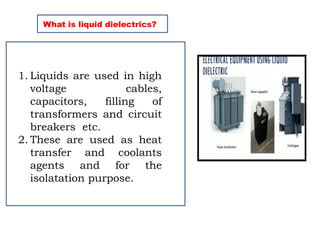
What is liquid dielectrics?
1. Liquids are used in high
voltage cables,
capacitors, filling of
transformers and circuit
breakers etc.
2. These are used as heat
transfer and coolants
agents and for the
isolatation purpose.
MATRUSRI
ENGINEERING COLLEGE
LIQUID AS INSULATOR
1. Liquids are used in high voltage equipment to serve the dual purpose
of insulation and heat conduction.
2. Temporary failures due to over voltages are reinsulated quickly by
liquid flow to the attacked area.
3. Highly purified liquids have dielectric strengths as high as 1MV/cm.
4. Under actual service conditions, the breakdown strength reduces
considerably due to the presence of impurities.
5. The breakdown mechanism in the case of very pure liquids is the same
as the gas breakdown, but in commercial liquids, the breakdown
mechanisms are significantly altered by the presence of the solid
impurities and dissolved gases.
6. Petroleum oils are the commonest insulating liquids. However,
askarels, fluoro -carbons, silicones, and organic esters including
castor oil are used in significant quantities.
7. A number of considerations enter into the selection of any dielectric
liquid.
8. The important electrical properties of the liquid include the dielectric
strength, conductivity, flash point, gas content, viscosity, dielectric
constant, dissipation factor and stability. Because of their low
dissipation factor and other excellent characteristics, polybutanes are
being increasingly used in the electrical industry.
MATRUSRI
ENGINEERING COLLEGE
1. In 1970 it was found that askarels which more extensively used, exhibit
health hazards and therefore most countries have legally banned their
production and use.
2. Many new liquids have since been developed which have no adverse
environmental hazards. These include silicone oils, synthetic and
fluorinated hydrocarbons.
3. In practical applications liquids are normally used at voltage stresses of
about 50-60 kV/cm when the equipment is continuously operated.
4. On the other hand, in applications like high voltage bushings, where the
liquid only fills up the voids in the solid dielectric, it can be used at
stresses as high as 100-200 kV/cm.
LIQUID AS INSULATOR
MATRUSRI
ENGINEERING COLLEGE
Conduction and Breakdown in Liquid Dielectrics
 Liquid dielectrics, because of their inherent properties, appear as
though they would be more useful as insulating materials than either
solids or gases.
 This is because both liquids and solids are usually 103 times denser
than gases.
 Also, liquids, like gases, fill the complete volume to be insulated and
simultaneously will dissipate heat by convection.
 Oil is about 10 times more efficient than air or nitrogen in its heat
transfer capability when used in transformers.
 Although liquids are expected to give very high dielectric strength of
the order of 10 MV/cm, in actual practice the strengths obtained are
only of the order of 100 kV/cm.
 Liquid dielectrics are used mainly as impregnants in high voltage
cables and capacitors, and for filling up of transformers, circuit
breakers.
 Liquid dielectrics also act as heat transfer agents in transformers and
as arc quenching media in circuit breakers.
 Petroleum oils are the most commonly used liquid dielectrics.
Synthetic hydrocarbons and halogenated hydrocarbons are also used
for certain applications
MATRUSRI
ENGINEERING COLLEGE
Conduction and Breakdown in Liquid Dielectrics
 For very high temperature application, silicone oils and fluorinated
hydrocarbons are also employed.
 However, it may be mentioned that askerels have been found to be
very toxic and poisonous, hence their use has been almost stopped.
 Liquid dielectrics normally are mixtures of hydrocarbons and are
weakly polarised. When used for electrical insulation purposes they
should be free from moisture, products of oxidation and other
contaminants.
 The most important factor that affects the electrical strength of an
insulating oil is the presence of water.
 The presence of even 0.01% water in transformer oil reduces its
electrical strength to 20% of the dry oil value.
 The dielectric strength of oil reduces more sharply, if it contains
fibrous impurities in addition to water.
 In practice, the choice of a liquid dielectric for a given application is
made mainly on the basis of its chemical stability.
 Other factors such as saving of space, cost, previous usage, and
susceptibility to the environmental influences are also considered
Classification of Liquid Dielectrics
Transformer oils(mineral oil)
Silicon oil
Synthetic hydrocarbons
Chlorinated Hydro carbons
Ester
MATRUSRI
ENGINEERING COLLEGE
Classification of Liquid Dielectrics
• In recent years, a substitute to mineral oils,
other polyester oils have been developed which
are extensively used in transformer in Europe and
other countries.
• One such oil is the halogen free Penta-
Etythrite- Tetra Fatty Acid Polyester oil (PETFP
Oil) which has very good electrical, physical and
thermal properties. It also has negligible toxicity
and does not contribute to pollution.
MATRUSRI
ENGINEERING COLLEGE
 Transformer oil is the most commonly used liquid dielectric in power
apparatus.
 It is an almost colourless liquid consisting a mixture of
hydrocarbons which include paraffins, iso-paraffins, naphthalenes
and aromatics.
 When in service, the liquid in a transformer is subjected to
prolonged heating at high temperatures of about 95 ,
℃ and
consequently it undergoes a gradual ageing process.
 With time the oil becomes darker due to the formation of acids and
resins, or sludge in the liquid.
 Some of the acids are corrosive to the solid insulating materials and
metal parts in the transformer.
 Deposits of sludge on the transformer core, on the coils and inside
the oil ducts reduce circulation of oil and thus its heat transfer
capability gets considerably reduced.
 Complete specifications for the testing of transformer oils are given
in, International Electro technical Commission (IEC) Standards.
 The International Electro technical Commission is the international
standards and conformity assessment body for all fields of
Electrotechnology.
Transformer Oil
MATRUSRI
ENGINEERING COLLEGE
 With time the oil becomes darker due to the formation of
acids and resins, or sludge in the liquid.
 Some of the acids are corrosive to the solid insulating
materials and metal parts in the transformer.
 Deposits of sludge on the transformer core, on the coils
and inside the oil ducts reduce circulation of oil and thus
its heat transfer capability gets considerably reduced.
 Complete specifications for the testing of transformer oils
are given in, International Electrotechnical Commission
(IEC) Standards.
 The International Electrotechnical Commission is the
international standards and conformity assessment body
for all fields of Electrotechnology.
Transformer Oil
MATRUSRI
ENGINEERING COLLEGE
 Among synthetic liquid dielectrics, poly-olefins are the
dielectrics of choice for applications in power cables.
 Over 55% of synthetic hydrocarbons produced wordwide
today are poly-olefins.
 The most commonly used olefins are poly butylene and
alkyl-aromatic hydrocarbons.
 Their general zharacteristics are very similar to those of
mineral oils.
Synthetic Hydrocarbons
MATRUSRI
ENGINEERING COLLEGE
 Two aromatic hydrocarbons, benzene and diphenyl,
are chlorinated to produce chlorinated aromatic
compounds are askarels or simply polychlorinated
biphenyl (PCB).
 They possess hire fire point and excellent electrical
properties.
 In recent years their use has been banned
throughout the world, because they pose serious
health hazards.
Chlorinated Hydrocarbons
MATRUSRI
ENGINEERING COLLEGE
1. Silicone oils represent an alternative to PCBs
but are expensive. Even at a temperature of
150 , they exhibit high long thermal stability.
℃
2. Silicone oils are resistant to most chemicals,
and oxidation resistant, even at higher
temperatures.
3. They can be used at higher temperatures than
mineral oils.
4. Silicone oils are acceptable substitute for PCBs
in transformers despite of their slightly inferior
non- flammable properties.
Silicone Oils
MATRUSRI
ENGINEERING COLLEGE
1. Natural esters such as castor oil has been used as
capacitor impregnant for many years, but currently two
types of synthetic esters are being used such as organic
esters and phosphate esters.
2. Organic esters have high boiling points in relation to their
viscosity and therefore, high fire points.
3. They have good viscosity temperature relationship are
used extensively in capacitors.
4. Phosphate esters have high boiling points and low
flammability and therefore are used in transformers that
are to installed in hazardous areas.
Esters
MATRUSRI
ENGINEERING COLLEGE
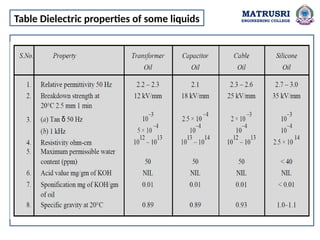
Table Dielectric properties of some liquids
MATRUSRI
ENGINEERING COLLEGE
Characteristic of Liquid Dielectrics
Essentially, a liquid dielectrics should possesses good dielectric
properties, excellent heat transfer characteristics and must be
chemically stable under range of conditions under which the
equipment operates.
• The characteristics of liquid dielectrics are:
1. Electrical Properties
2. Heat Transfer Characteristics
3. Chemical Stability.
MATRUSRI
ENGINEERING COLLEGE
Electrical Properties
Tetra-chloro-ethylene is a non flammable insulating fluid, and is used
in mixtures with mineral oil.
The electrical properties that are essential in determining the dielectric
performance of a liquid dielectric are its
1. Capacitance per unit volume or its relative permittivity
2. Resistivity
3. Loss tangent(tan ) or its power factor which is an indication of the
𝛿
power loss under a.c. voltage application
4. Ability to withstand high electric stresses.
MATRUSRI
ENGINEERING COLLEGE
 Permittivities of most of the petroleum oils vary from 2.0 to 2.6 while
those of silicone oils from 2.0 to 73.
 In case of the non-polar liquids, the permittivity is independent of
frequency but in the case of polar liquids, such as water, it changes
with frequency. For example, the permittivity of water is 78 at 50 Hz
and reduces to about 5.0 at 1 MHz.
 Resistivities of insulating liquids used for high voltage applications
should be more than 1016 ohm-metre and most of the liquids in their
pure state exhibit this property.
 Power Factor of a liquid dielectric under A.C voltage will determine its
performance under load conditions. Power factor is a measure of the
power loss and is an important parameter in cable and capacitor
systems.
 However, in the case of transformers, the dielectric loss in the oil is
negligible when compared to copper and iron losses.
 Pure and dry transformer oil will have a very low power factor varying
between 10−4 at 2O and 10−3 at 90 at a frequency of 50 Hz.
℃ ℃
 Power Factor of a liquid dielectric under A.C voltage will determine its
performance under load conditions. Power factor is a measure of the
power loss and is an important parameter in cable and capacitor
systems.
MATRUSRI
ENGINEERING COLLEGE
 Dielectric Strength is the most important parameter in the
choice of a given liquid dielectric for a given application.
 The dielectric strength depends on the atomic and molecular
properties of the liquid itself.
 Under practical conditions the dielectric strength depends on
the material of the electrodes, temperature, type of applied
voltage, gas content in the liquid, which change the dielectric
strength by changing the molecular properties of the liquid.
 The above factors which control the breakdown strength and
lead to electrical breakdown of the liquid dielectrics.
MATRUSRI
ENGINEERING COLLEGE
• In equipments filled with a liquid dielectric (transformer, cable,
circuits breaker), heat is transferred mainly by convection.
Under natural atmospheric cooling conditions convection (N) is
given by = [ 3 / ]
𝑁 𝑓 𝐾 𝐴𝐶 𝑣 𝑛
Where K= thermal conductivity,
A = coefficient of expansion,
C= specific heat per unit volume,
𝑣 = kinetic viscosity, and = 0.25~ 0.33.
𝑛
• The main factors that control the heat transfer are thermal
conductivity K and the viscosity .
𝑣
• The higher value of K is preferable for apparatus likely to operate
continuously at a high temperature. On the other hand, a low value
of K and high viscosity can lead to localized overheating or even
electrical “burn out”. • Silicone oils do not exhibit these properties
and therefore can pose severe overheating problems in equipment
that use these oils.
Heat Transfer Characteristics
MATRUSRI
ENGINEERING COLLEGE
Chemical Stability
• In service, insulating liquids are subjected to thermal and electrical
stresses in the presence of material like 2, water, fibres and
𝑂
decomposition products of solid insulation.
• These either singly or in combination cause degradation of the liquid
with the result that can soluble solid and gaseous products are found,
which can result in corrosion, impairment of heat transfer,
deterioration of electrical properties, increased dielectric losses,
discharges and arcing.
• In the absence of any remedial action, this cycle continues and
produces an ever worsening liquid purity and equipment condition.
MATRUSRI
ENGINEERING COLLEGE
Pure and Commercial Liquids
Pure liquids are those which are chemically pure and do
not contain any other impurity and are structurally
simple.
Examples of such simple pure liquids are
n-hexane , n-heptane and other paraffin hydrocarbons.
By using simple and pure liquids, it is easier to separate
out the various factors that influence conduction and
breakdown in them.
The commercial liquids which are insulating liquids like
oils which are not chemically pure, normally consist of
mixtures of complex organic molecules which cannot be
easily specified or reproduced in a series of experiments.
MATRUSRI
ENGINEERING COLLEGE
Purification
1. The main impurities in liquid dielectrics are dust, moisture,
dissolved gases and ionic impurities.
2. Various methods employed for purification are
 filtration (through mechanical filters, spray filters,
and electrostatic filters),
 centrifuging,
 degassing
 distillation
 chemical treatment.
3. Dust particles when present become charged and reduce the
breakdown strength of the liquid dielectrics, and they can be
removed by careful filtration.
4. Liquid will normally contain moisture and dissolved gases in small
quantities.
5. Gases like oxygen and carbon dioxide significantly affect the
breakdown strength of the liquids, and hence it is necessary to
control the amount of gas present.
MATRUSRI
ENGINEERING COLLEGE
Purification
 This is done by distillation and degassing. Ionic
impurity in liquids, like water vapour which
easily dissociates, leads to very high conductivity
and heating of the liquid depending on the
applied electric field.
 Water is removed using drying agents or by
vacuum drying.
 Sometimes liquids are shaken with some
concentrated sulfuric acid to remove wax and
residue abd washed with caustic soda and
distilled water.
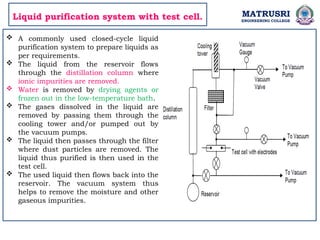
 A commonly used closed-cycle liquid
purification system to prepare liquids as
per requirements.
 The liquid from the reservoir flows
through the distillation column where
ionic impurities are removed.
 Water is removed by drying agents or
frozen out in the low-temperature bath.
 The gases dissolved in the liquid are
removed by passing them through the
cooling tower and/or pumped out by
the vacuum pumps.
 The liquid then passes through the filter
where dust particles are removed. The
liquid thus purified is then used in the
test cell.
 The used liquid then flows back into the
reservoir. The vacuum system thus
helps to remove the moisture and other
gaseous impurities.
Liquid purification system with test cell. MATRUSRI
ENGINEERING COLLEGE
MATRUSRI
ENGINEERING COLLEGE
Breakdown Tests
1. Breakdown tests are normally conducted using test cells.
2. For testing pure liquids, the test cells used are small so that less
quantity of liquid is used during testing.
3. The electrodes used for breakdown voltage measurements are
usually spheres of 0.5 to 1cm in diameter with gap spacing of
about 100-200 .
𝜇𝑚
4. The gap is accurately controlled by using a micro meter.
Sometimes parallel plane uniform-field electrode systems are also
used.
5. Electrode separation is very critical in measurements with liquids,
and also the electrode surface smoothness and the presence of
oxide films have a marked influence on the breakdown strength.
6. The gap is accurately controlled by using a micro meter.
Sometimes parallel plane uniform-field electrode systems are also
used.
7. The test voltages required for these tests are usually low, of the
order of 50-100 kV, because of small electrode spacing.
MATRUSRI
ENGINEERING COLLEGE
Conduction and Breakdown in Pure Liquids
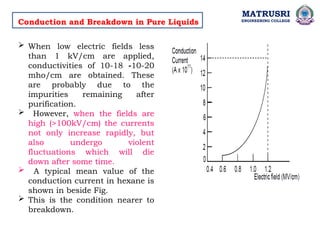
 When low electric fields less
than 1 kV/cm are applied,
conductivities of 10-18 -10-20
mho/cm are obtained. These
are probably due to the
impurities remaining after
purification.
 However, when the fields are
high (>100kV/cm) the currents
not only increase rapidly, but
also undergo violent
fluctuations which will die
down after some time.
 A typical mean value of the
conduction current in hexane is
shown in beside Fig.
 This is the condition nearer to
breakdown.
MATRUSRI
ENGINEERING COLLEGE
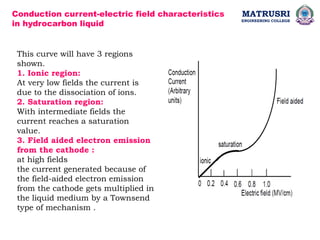
Conduction current-electric field characteristics
in hydrocarbon liquid
This curve will have 3 regions
shown.
1. Ionic region:
At very low fields the current is
due to the dissociation of ions.
2. Saturation region:
With intermediate fields the
current reaches a saturation
value.
3. Field aided electron emission
from the cathode :
at high fields
the current generated because of
the field-aided electron emission
from the cathode gets multiplied in
the liquid medium by a Townsend
type of mechanism .
MATRUSRI
ENGINEERING COLLEGE
Conduction and Breakdown in Commercial
Liquids
• Commercial insulating liquids are not chemically pure and have
impurities like gas bubbles, suspended particles.
• These impurities reduce the breakdown strength of these liquids
considerably.
• The breakdown mechanisms are also considerably influenced by
the presence of these impurities.
• When breakdown occurs in these liquids, additional gases and
gas bubbles are evolved and solid decomposition products are
formed.
• The electrode surfaces become rough, and at times explosive
sounds are heard due to the generation of impulsive pressure
through the liquid.
• The breakdown mechanism in commercial liquids is dependent
on several factors, such as, the nature and condition of the
electrodes, the physical properties of the liquid, and the
impurities and gases present in the liquid.
MATRUSRI
ENGINEERING COLLEGE
Several theories have been proposed to explain the
breakdown in liquids, and they are classified as follows:
 Electronic breakdown
 Suspended Particle Mechanism
 Cavitation and Bubble Mechanism
 Stressed Oil Volume Mechanism
MATRUSRI
ENGINEERING COLLEGE
Electronic breakdown
At high fields the current generated because of the field-aided electron
emission from the cathode gets multiplied in the liquid medium by a
Townsend type of mechanism.
The emission occurs due to surface irregularities or interfaces of
impurities and liquid. The increase in current by these processes
continues till breakdown occurs.
Breakdown mechanism:
The electrons are generated from the cathode by field emission of
electrons. These electrons are injected in to the liquid, it gains the energy
from the applied field. Some electrons gets more energy from the field and
collides with neutral molecules & produces positive ions and electrons.
These positive ions reaching the cathode generates secondary electrons.
So avalanche is formed. This will lead to breakdown. This process is
similar to Townsend’s ionization process condition for the formation of
electron avalanche is the energy gained by the electron equals the energy
lost during ionization (electron emission) and is given by
eEλ=chv
where E is the applied field, λ the electron mean free path,
hv the quantum of energy lost
in ionizing the molecule and c an arbitrary constant.
MATRUSRI
ENGINEERING COLLEGE
Break down voltage depends on
 Field gap separation
 Cathode work function
 Temperature of the cathode
 Viscosity of liquid
 Liquid temperature
 Density of liquid
 Molecular structure of the liquid
MATRUSRI
ENGINEERING COLLEGE
Suspended Particle Theory
The permittivity of the liquid dielectrics is (ε1)
In commercial liquids, the presence of solid impurities can not be
avoided. These impurities will be present as fibre or as dispersed solid
particles.
The permittivity of these particles is (ε2)
If ε2> ε1, force F is directed towards areas of maximum stress.
(towards the solid impurities)
If ε2< ε1, force F is directed towards areas of lower stress
Let consider these impurities to be spherical particles of radius ‘r’ & if
the applied field is E then the particles experience a force F,
Suspended Particle Mechanism
Breakdown mechanism:
When the voltage is continuously applied (d.c) or the duration of the
voltage is long (A.C) then this force drives the particles towards the
areas of max stress.
If the no of particles present are large, they become aligned due to
these forces and thus from a stable chain bridging the electrode gap
causing a breakdown between the electrodes.
If a single conducting particle is present between the electrodes, it will
give raise to local field enhancement depending on its shape.
If this field exceeds the breakdown strength of the liquid, local BD will
occur. And this will result in formation of gas bubbles wich may lead to
the bd of the liquid.
The impurity particles reduce the BD strength and it was observed that
the larger the size of particles the lower was the breakdown strength.
MATRUSRI
ENGINEERING COLLEGE
Cavitation and Bubble Theory
Formation of vapour bubbles occur due to the following reasons
 Gas packets at the surface of the electrodes
 Changes in Temperature
 Gaseous products due to the dissociation of liquid molecules by
electron collisions.
 Liquid vaporization by corona type discharge from points &
irregularities on the electrodes
BD mechanism:
Once a bubble is formed it will elongated (long and thin) in the direction
of the electric field under the influence of electrostatic forces.
The volume of the bubble remains constant during elongation.
Breakdown occurs when the voltage drop along the length of the bubble
becomes equal to the minimum value on the Paschen’s curve for the gas
in the bubble.
MATRUSRI
ENGINEERING COLLEGE
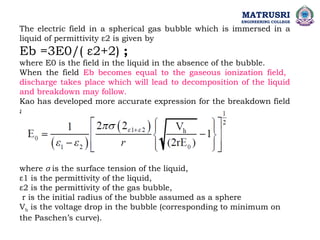
The electric field in a spherical gas bubble which is immersed in a
liquid of permittivity ε2 is given by
Eb =3E0/( ε2+2) ;
where E0 is the field in the liquid in the absence of the bubble.
When the field Eb becomes equal to the gaseous ionization field,
discharge takes place which will lead to decomposition of the liquid
and breakdown may follow.
Kao has developed more accurate expression for the breakdown field
as
where σ is the surface tension of the liquid,
ε1 is the permittivity of the liquid,
ε2 is the permittivity of the gas bubble,
r is the initial radius of the bubble assumed as a sphere
Vb is the voltage drop in the bubble (corresponding to minimum on
the Paschen’s curve).
MATRUSRI
ENGINEERING COLLEGE
From this equation it can be seen that the
breakdown strength depends on the initial size
of the bubble which in turn is influenced by
the hydrostatic pressure and temperature of
the liquid. But this theory does not take into
account the production of the initial bubble
and hence the results given by this theory do
not agree well with the experimental results.
In general, the cavitation and bubble theories
try to explain the highest breakdown
strengths obtainable, considering the cavities
or bubbles formed in the liquid dielectrics.
MATRUSRI
ENGINEERING COLLEGE
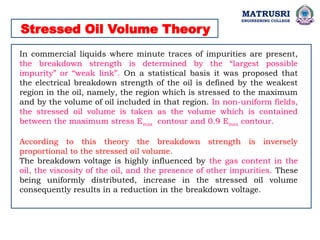
Stressed Oil Volume Theory
In commercial liquids where minute traces of impurities are present,
the breakdown strength is determined by the “largest possible
impurity” or “weak link”. On a statistical basis it was proposed that
the electrical breakdown strength of the oil is defined by the weakest
region in the oil, namely, the region which is stressed to the maximum
and by the volume of oil included in that region. In non-uniform fields,
the stressed oil volume is taken as the volume which is contained
between the maximum stress Emax contour and 0.9 Emax contour.
According to this theory the breakdown strength is inversely
proportional to the stressed oil volume.
The breakdown voltage is highly influenced by the gas content in the
oil, the viscosity of the oil, and the presence of other impurities. These
being uniformly distributed, increase in the stressed oil volume
consequently results in a reduction in the breakdown voltage.
MATRUSRI
ENGINEERING COLLEGE
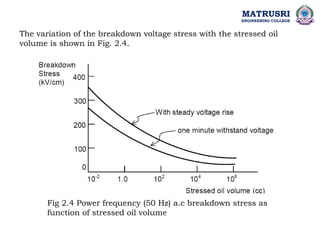
The variation of the breakdown voltage stress with the stressed oil
volume is shown in Fig. 2.4.
Fig 2.4 Power frequency (50 Hz) a.c breakdown stress as
function of stressed oil volume
MATRUSRI
ENGINEERING COLLEGE
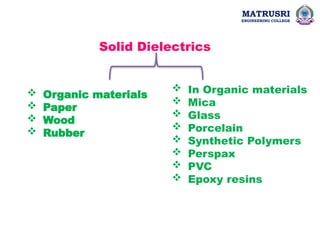
Solid Dielectrics
 Organic materials
 Paper
 Wood
 Rubber
 In Organic materials
 Mica
 Glass
 Porcelain
 Synthetic Polymers
 Perspax
 PVC
 Epoxy resins
MATRUSRI
ENGINEERING COLLEGE
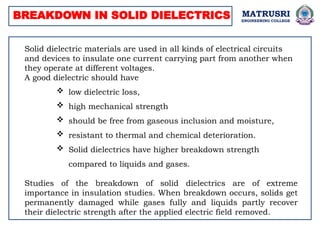
BREAKDOWN IN SOLID DIELECTRICS
Solid dielectric materials are used in all kinds of electrical circuits
and devices to insulate one current carrying part from another when
they operate at different voltages.
A good dielectric should have
 low dielectric loss,
 high mechanical strength
 should be free from gaseous inclusion and moisture,
 resistant to thermal and chemical deterioration.
 Solid dielectrics have higher breakdown strength
compared to liquids and gases.
Studies of the breakdown of solid dielectrics are of extreme
importance in insulation studies. When breakdown occurs, solids get
permanently damaged while gases fully and liquids partly recover
their dielectric strength after the applied electric field removed.
MATRUSRI
ENGINEERING COLLEGE
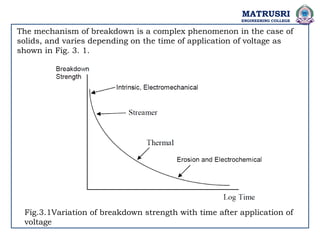
The mechanism of breakdown is a complex phenomenon in the case of
solids, and varies depending on the time of application of voltage as
shown in Fig. 3. 1.
Fig.3.1Variation of breakdown strength with time after application of
voltage
MATRUSRI
ENGINEERING COLLEGE
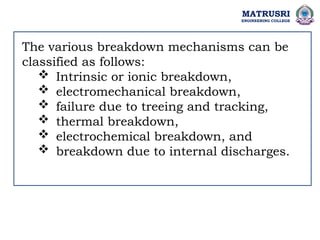
The various breakdown mechanisms can be
classified as follows:
 Intrinsic or ionic breakdown,
 electromechanical breakdown,
 failure due to treeing and tracking,
 thermal breakdown,
 electrochemical breakdown, and
 breakdown due to internal discharges.
MATRUSRI
ENGINEERING COLLEGE
INTRINSIC BREAKDOWN
When voltages are applied only for short durations of the order of 10-8
s
the dielectric strength of a solid dielectric increases very rapidly to an
upper limit called the intrinsic electric strength. Experimentally, this
highest dielectric strength can be obtained only under the best
experimental conditions when all extraneous influences have been
isolated and the value depends only on the structure of the material and
the temperature. The maximum electrical strength recorder is 15
MV/cm for polyvinyl-alcohol at -1960
C. The maximum strength usually
obtainable ranges from 5 MV/cm.
Intrinsic breakdown depends upon the presence of free electrons which
are capable of migration through the lattice of the dielectric. Usually, a
small number of conduction electrons are present in solid dielectrics,
along with some structural imperfections and small amounts of
impurities. The impurity atoms, or molecules or both act as traps for the
conduction electrons up to certain ranges of electric fields and
temperatures. When these ranges are exceeded, additional electrons in
addition to trapped electrons are released, and these electrons
participate in the conduction process. Based on this principle, two types
of intrinsic breakdown mechanisms have been proposed.
MATRUSRI
ENGINEERING COLLEGE
i) Electronic Breakdown
Intrinsic breakdown occurs in time of the order of
10-8 s and therefore is assumed to be electronic in
nature. The initial density of conduction (free)
electrons is also assumed to be large, and electron-
electron collisions occur. When an electric field is
applied, electrons gain energy from the electric field
and cross the forbidden energy gap from the valence
band to the conduction band. When this process is
repeated, more and more electrons become available
in the conduction band, eventually leading to
breakdown.
MATRUSRI
ENGINEERING COLLEGE
ii) Avalanche or Streamer Breakdown
This is similar to breakdown in gases due to cumulative ionization.
Conduction electrons gain sufficient energy above a certain critical
electric field and cause liberation of electrons from the lattice atoms by
collision. Under uniform field conditions, if the electrodes are
embedded in the specimen, breakdown will occur when an electron
avalanche bridges the electrode gap.
An electron within the dielectric, starting from the cathode will drift
towards the anode and during this motion gains energy from the field
and loses it during collisions. When the energy gained by an electron
exceeds the lattice ionization potential, an additional electron will be
liberated due to collision of the first electron. This process repeats
itself resulting in the formation of an electron avalanche. Breakdown
will occur, when the avalanche exceeds a certain critical size.
In practice, breakdown does not occur by the formation of a single
avalanche itself, but occurs as a result of many avalanches formed
within the dielectric and extending step by step through the entire
thickness of the material.
MATRUSRI
ENGINEERING COLLEGE
ELECTROMECHANICAL BREAKDOWN
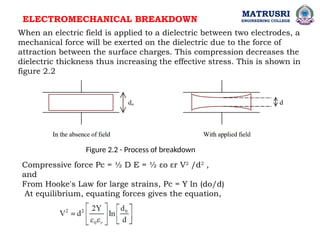
When an electric field is applied to a dielectric between two electrodes, a
mechanical force will be exerted on the dielectric due to the force of
attraction between the surface charges. This compression decreases the
dielectric thickness thus increasing the effective stress. This is shown in
figure 2.2
MATRUSRI
ENGINEERING COLLEGE
Figure 2.2 - Process of breakdown
Compressive force Pc = ½ D E = ½ εo εr V2
/d2
,
and
From Hooke's Law for large strains, Pc = Y ln (do/d)
At equilibrium, equating forces gives the equation,
ELECTROMECHANICAL BREAKDOWN
MATRUSRI
ENGINEERING COLLEGE
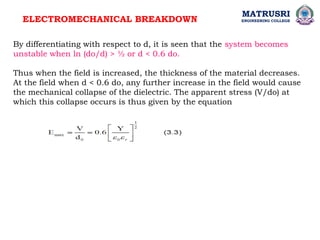
By differentiating with respect to d, it is seen that the system becomes
unstable when ln (do/d) > ½ or d < 0.6 do.
Thus when the field is increased, the thickness of the material decreases.
At the field when d < 0.6 do, any further increase in the field would cause
the mechanical collapse of the dielectric. The apparent stress (V/do) at
which this collapse occurs is thus given by the equation
ELECTROMECHANICAL BREAKDOWN
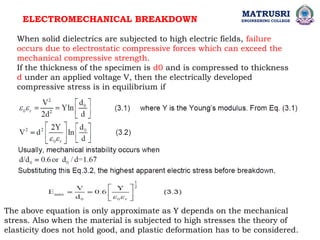
When solid dielectrics are subjected to high electric fields, failure
occurs due to electrostatic compressive forces which can exceed the
mechanical compressive strength.
If the thickness of the specimen is d0 and is compressed to thickness
d under an applied voltage V, then the electrically developed
compressive stress is in equilibrium if
The above equation is only approximate as Y depends on the mechanical
stress. Also when the material is subjected to high stresses the theory of
elasticity does not hold good, and plastic deformation has to be considered.
MATRUSRI
ENGINEERING COLLEGE
THERMAL BREAKDOWN
In general, the breakdown voltage of a solid dielectric should increase
with its thickness. But this is true only up to a certain thickness above
which the heat generated in the dielectric due to the flow of current
determines the conduction.
When an electric field is applied to a dielectric, conduction current
however small it may be, flows through the material. The current heats
up the specimen and the temperature rise. The heat generated is
transferred to the surrounding medium by conduction through the
solid dielectric and by radiation from its outer surfaces. Equilibrium is
reached when the heat used to raise the temperature of the dielectric,
plus the heat radiated out, equals the heat generated. The heat
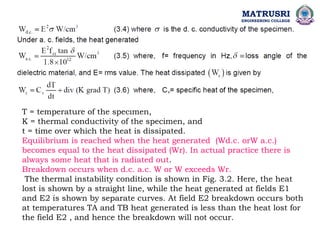
generated under d. c. stress E is given as
MATRUSRI
ENGINEERING COLLEGE
T = temperature of the specımen,
K = thermal conductivity of the specimen, and
t = time over which the heat is dissipated.
Equilibrium is reached when the heat generated (Wd.c. orW a.c.)
becomes equal to the heat dissipated (Wr). In actual practice there is
always some heat that is radiated out.
Breakdown occurs when d.c. a.c. W or W exceeds Wr.
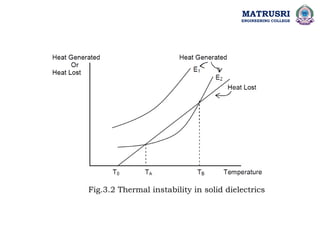
The thermal instability condition is shown in Fig. 3.2. Here, the heat
lost is shown by a straight line, while the heat generated at fields E1
and E2 is shown by separate curves. At field E2 breakdown occurs both
at temperatures TA and TB heat generated is less than the heat lost for
the field E2 , and hence the breakdown will not occur.
MATRUSRI
ENGINEERING COLLEGE
Fig.3.2 Thermal instability in solid dielectrics
MATRUSRI
ENGINEERING COLLEGE
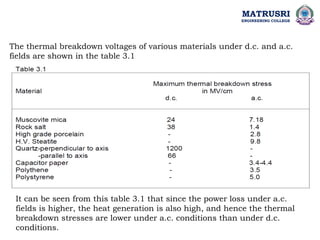
The thermal breakdown voltages of various materials under d.c. and a.c.
fields are shown in the table 3.1
It can be seen from this table 3.1 that since the power loss under a.c.
fields is higher, the heat generation is also high, and hence the thermal
breakdown stresses are lower under a.c. conditions than under d.c.
conditions.
MATRUSRI
ENGINEERING COLLEGE
BREAKDOWN OF SOLID DIELECTRICS IN
PRACTICE
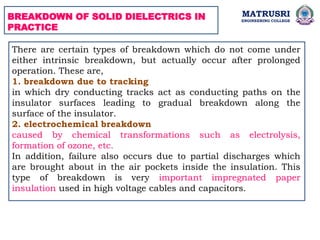
There are certain types of breakdown which do not come under
either intrinsic breakdown, but actually occur after prolonged
operation. These are,
1. breakdown due to tracking
in which dry conducting tracks act as conducting paths on the
insulator surfaces leading to gradual breakdown along the
surface of the insulator.
2. electrochemical breakdown
caused by chemical transformations such as electrolysis,
formation of ozone, etc.
In addition, failure also occurs due to partial discharges which
are brought about in the air pockets inside the insulation. This
type of breakdown is very important impregnated paper
insulation used in high voltage cables and capacitors.
MATRUSRI
ENGINEERING COLLEGE
Chemical and Electrochemical
Deterioration and Breakdown
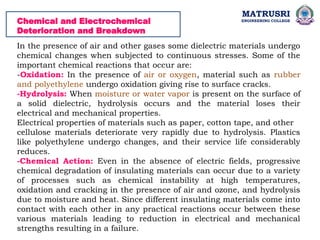
In the presence of air and other gases some dielectric materials undergo
chemical changes when subjected to continuous stresses. Some of the
important chemical reactions that occur are:
-Oxidation: In the presence of air or oxygen, material such as rubber
and polyethylene undergo oxidation giving rise to surface cracks.
-Hydrolysis: When moisture or water vapor is present on the surface of
a solid dielectric, hydrolysis occurs and the material loses their
electrical and mechanical properties.
Electrical properties of materials such as paper, cotton tape, and other
cellulose materials deteriorate very rapidly due to hydrolysis. Plastics
like polyethylene undergo changes, and their service life considerably
reduces.
-Chemical Action: Even in the absence of electric fields, progressive
chemical degradation of insulating materials can occur due to a variety
of processes such as chemical instability at high temperatures,
oxidation and cracking in the presence of air and ozone, and hydrolysis
due to moisture and heat. Since different insulating materials come into
contact with each other in any practical reactions occur between these
various materials leading to reduction in electrical and mechanical
strengths resulting in a failure.
MATRUSRI
ENGINEERING COLLEGE
The effects of electrochemical and chemical deterioration could be
minimized by carefully studying and examining the materials.
High soda content glass insulation should be avoided in moist and
damp conditions, because sodium, being very mobile, leaches to the
surface giving rise to the formation of a strong alkali which will cause
deterioration.
It was observed that this type of material will lose its mechanical
strength within 24 hrs, when it is exposed to atmospheres having
100% relative humidity at 700 C.
In paper insulation, even if partial discharges are prevented
completely, breakdown can occur due to chemical degradation. The
chemical and electrochemical deterioration increases very rapidly with
temperature, and hence high temperatures should be avoided.
MATRUSRI
ENGINEERING COLLEGE
Breakdown Due to Treeing and Tracking
When a solid dielectric subjected to electrical stresses for a long time
fails,
normally two kinds of visible markings are observed on the dielectric
material. They are:
a) the presence of a conducting path across the surface of the
insulation:
b) a mechanism whereby leakage current passes through the
conducting path finally leading to the formation of a spark.
Insulation deterioration occurs as a result of these sparks.
The spreading of spark channels during tracking, in the form of the
branches of a tree is called treeing.
MATRUSRI
ENGINEERING COLLEGE
Consider a system of a solid dielectric having a conducting
film and two electrodes on its surface.
In practice, the conducting film very often is formed due to
moisture. On application of voltage, the film starts conducting,
resulting in generation of heat, and the surface starts
becoming dry. The conducting film becomes separate due to
drying, and so sparks are drawn damaging the dielectric
surface.
With organic insulating materials such as paper and bakelite,
the dielectric carbonizes at the region of sparking, and the
carbonized regions act as permanent conducting channels
resulting in increased stress over the rest of the region. This is
a cumulative process, and insulation failure occurs when
carbonized tracks bridge the distance between the electrodes.
This phenomenon, called tracking is common between layers
of bakelite, paper and similar dielectrics built of laminates.
MATRUSRI
ENGINEERING COLLEGE
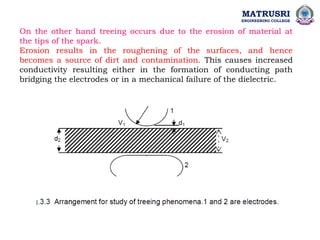
On the other hand treeing occurs due to the erosion of material at
the tips of the spark.
Erosion results in the roughening of the surfaces, and hence
becomes a source of dirt and contamination. This causes increased
conductivity resulting either in the formation of conducting path
bridging the electrodes or in a mechanical failure of the dielectric.
MATRUSRI
ENGINEERING COLLEGE
When a dielectric material lies between two electrodes as shown in
above Fig. there is possibility for two different dielectric media, the
air and the dielectric, to come series.
The voltages across the two media are as shown (V1 across the air
gap, and V2 across the dielectric). The voltage V1 across the air gap
is given as,
Since ε 2 > ε1 most of the voltage appears across d1 , the air gap.
Sparking will occur in the air gap and charge accumulation takes place
on the surface of the insulation. Sometimes the spark erodes the
surface of the insulation. As time passes, break-down channels spread
through the insulation in an irregular “tree’ like fashion leading to the
formation of conducting channels. This kind of channeling is called
treeing.
Under a.c. voltage conditions treeing can occur in a few minute or
several hours. Hence, care must be taken to see that no series air gaps
or other weaker insulation gaps are formed.
MATRUSRI
ENGINEERING COLLEGE
MATRUSRI
ENGINEERING COLLEGE
Usually, tracking occurs even at very low voltage of the order of about
100 V, whereas treeing requires high voltages.
For testing of tracking, low and medium voltage tracking tests are
specified. These tests are done at low voltages but for times of about 100
hr or more.
The insulation should not fail. Sometimes the tests are done using 5 to
10 kV with shorter durations of 4 to 6 hour. The numerical value that
initiates or causes the formation of a track is called “tracking index” and
this is used to qualify the surface properties of dielectric materials.
Treeing can be prevented by having clean, dry, and undamaged surfaces
and a clean environment.
The materials chosen should be resistant to tracking. Sometimes
moisture repellant greases are used. But this needs frequent cleaning
and regressing. Increasing creeping distances should prevent tracking,
but in practice the presence of moisture films defeat the purpose.
Usually, treeing phenomena is observed in capacitors and cables, and
extensive work is being done to investigate the real nature and causes of
this phenomenon.
MATRUSRI
ENGINEERING COLLEGE
Breakdown Due to Internal Discharges
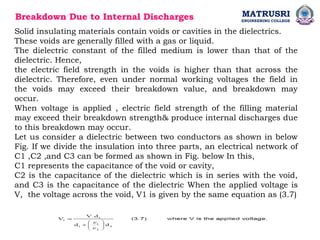
Solid insulating materials contain voids or cavities in the dielectrics.
These voids are generally filled with a gas or liquid.
The dielectric constant of the filled medium is lower than that of the
dielectric. Hence,
the electric field strength in the voids is higher than that across the
dielectric. Therefore, even under normal working voltages the field in
the voids may exceed their breakdown value, and breakdown may
occur.
When voltage is applied , electric field strength of the filling material
may exceed their breakdown strength& produce internal discharges due
to this breakdown may occur.
Let us consider a dielectric between two conductors as shown in below
Fig. If we divide the insulation into three parts, an electrical network of
C1 ,C2 ,and C3 can be formed as shown in Fig. below In this,
C1 represents the capacitance of the void or cavity,
C2 is the capacitance of the dielectric which is in series with the void,
and C3 is the capacitance of the dielectric When the applied voltage is
V, the voltage across the void, V1 is given by the same equation as (3.7)
MATRUSRI
ENGINEERING COLLEGE
Breakdown Due to Internal Discharges
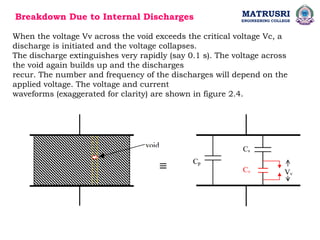
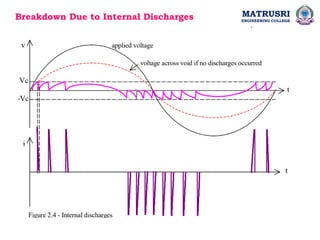
When the voltage Vv across the void exceeds the critical voltage Vc, a
discharge is initiated and the voltage collapses.
The discharge extinguishes very rapidly (say 0.1 s). The voltage across
the void again builds up and the discharges
recur. The number and frequency of the discharges will depend on the
applied voltage. The voltage and current
waveforms (exaggerated for clarity) are shown in figure 2.4.
Breakdown Due to Internal Discharges MATRUSRI
ENGINEERING COLLEGE
In each of the discharges, there will be heat dissipated in the voids which
will cause carbonization of the surface of the voids and erosion of the
material. The gradual erosion of the material and consequent reduction in
the thickness of the insulating material eventually leads to breakdown.
Breakdown by this process is slow and may occur in a few days or may
take a few years.
Deterioration due to internal discharges
In organic liquid-solid dielectrics, internal discharges produce gradual
deterioration because of
(a) disintegration of the solid dielectric under the bombardment of
electrons set free by the discharges
(b) chemical action on the dielectric of the products of ionization of the gas
(c) high temperatures in the region of the discharges.
All voids in the dielectric can be removed by careful impregnation and this
results in an increase in the discharge inception stress Ei. The final value
Ei then depends on electrical processes which lead to gas formation.
In oil impregnated paper these are
(a) decomposition of moisture in paper (b) local electrical breakdown of the
oil.
The stress at which gas is evolved from paper containing appreciable
quantities of moisture can be less than 10 V/m, but increases
continuously with increasing dryness and can be higher than 100 V/m
when the paper is thoroughly dry. Except in very dry conditions, the
gas first formed arises from electrochemical decomposition of water
held in the paper. When a gas bubble is formed in an oil-paper
dielectric at the discharge inception stress Ei, discharges in the bubble
decompose the molecules of the oil, resulting in further gas formation
and a rapid growth of the bubble. As long as the bubble remains in the
dielectric, the inception stress Ei is low, often lower than the rated
stress, but resting the dielectric long enough for the gas to dissolve in
the oil restores the initial high discharge inception stress. Although on
resting Ei improves, permanent damage has been caused by the
discharges and this manifests itself in an increase of loss angle and is
due to the formation of ions by the discharges. Also, due to the
discharges, widespread carbonization occur.
MATRUSRI
ENGINEERING COLLEGE
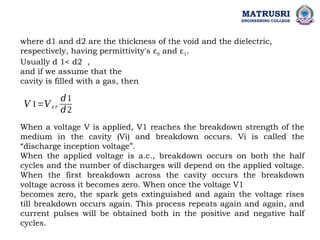
where d1 and d2 are the thickness of the void and the dielectric,
respectively, having permittivity's ε0 and ε1.
Usually d 1< d2 ,
and if we assume that the
cavity is filled with a gas, then
𝑉 1=𝑉𝜀𝑟
𝑑1
𝑑2
When a voltage V is applied, V1 reaches the breakdown strength of the
medium in the cavity (Vi) and breakdown occurs. Vi is called the
“discharge inception voltage”.
When the applied voltage is a.c., breakdown occurs on both the half
cycles and the number of discharges will depend on the applied voltage.
When the first breakdown across the cavity occurs the breakdown
voltage across it becomes zero. When once the voltage V1
becomes zero, the spark gets extinguished and again the voltage rises
till breakdown occurs again. This process repeats again and again, and
current pulses will be obtained both in the positive and negative half
cycles.
MATRUSRI
ENGINEERING COLLEGE
BREAKDOWN OF COMPOSITE INSULATION
Different dieelctric materials can be in parallel with each
other(air or SF6 gas in parallel with solid insulation) or in
series with one other. Such insulating systems are called
composite dielectrics.
BD mechanism:
Composite insulating materials contain voids & composed
of different chemical substances when voltage is applied
to the solid dielectric, chemical reactions occure and heat
is produced. Composite dielectric undergoes chemical
deterioration & reduces the mechanical, electrical strength
and BD occures.
MATRUSRI
ENGINEERING COLLEGE
Properties of composite dielectrics
A composite dielectric generally consists of a large number of layers
arranged one over the other.
This is called ‘the layered construction’ and is widely used in cables,
capacitors and transformers.
Three properties of composite dielectrics
(a) Effect of Multiple Layers
(b) Effect of Layer Thickness
(c) Effect of Interfaces
Effect of Multiple Layers
The simplest composite dielectric consists of two layers of the same material. Here,
advantage is : two thin sheets have a higher dielectric strength than a single sheet of the
same total thickness.
The advantage is particularly significant in the case of materials having a wide variation
in dielectric strength values measured at different points on its surface.
MATRUSRI
ENGINEERING COLLEGE
 Increase in layer thickness normally gives increased breakdown
voltage.
 In a layered construction, breakdown channels occur at the interfaces
only and not directly through another layer.
 The use of layered construction is very important in the case of
insulating paper since the paper thickness itself varies from point to
point and consequently the dielectric strength also varies (across its
surface is not homogeneous.)
 The differences in the thickness impart a rough surface to the paper
which can produce an electric field stress comparable to that of the
discharge channel. The rough surface of the paper also helps in better
impregnation when tightly wound. On the other hand, the existence of
areas with lower thickness in the paper can cause breakdown at these
points at considerably lower voltages.
Various investigations on composite dielectrics have shown that
(i) the discharge inception voltage depends on the thickness of the solid
dielectric, as well as on the dielectric constant of both the liquid and solid
dielectric, and
(ii) the difference in the dielectric constants between the liquid and solid
dielectrics does not significantly affect the rate of change of electric field
at the electrode edge with the change in the dielectric thickness.
(b) Effect of Layer Thickness
MATRUSRI
ENGINEERING COLLEGE
The interface between two dielectric surfaces in a composite
dielectric
system plays an important role in determining its
 pre-breakdown and
 breakdown strengths.
Discharges usually occur at the interfaces and
the magnitude of the discharge depends on the associated
surface resistance and capacitance. When the surface
conductivity increases, the discharge magnitude also increases,
resulting in damage to the dielectric cause BD
Effect of Interfaces
MATRUSRI
ENGINEERING COLLEGE
Mechanisms of Breakdown in
Composite Dielectrics
Threre are 2 types of mechanisms
Short-term Breakdown
Long-term Breakdown

Conduction and Breakdown in Liquid Dielectrics

  • 1.
    MATRUSRI ENGINEERING COLLEGE DEPARTMENTOF ELECTRICAL AND ELECTRONICS ENGINEERING SUBJECT NAME: HIGH VOLTAGE ENGINEERING Conduction and Breakdown in Liquid Dielectrics FACULTY NAME: Dr.N.KALPANA MATRUSRI ENGINEERING COLLEGE
  • 2.
    SYLLABUS UNIT I Conduction AndBreakdown In Gaseous Insulating Materials: Ionization Processes And Current Growth-Townsend’s Criterion For Breakdown- Break Down In Electro Negative Gases- Time Lags For Breakdown- Paschen’s Law- Corona Discharges And Breakdown In Non-Uniform Fields- Practical Considerations For Selecting Gases For Insulation Purposes. UNIT II Conduction and Breakdown in Liquid Dielectrics: Various mechanisms of breakdown in liquid dielectrics-Liquid dielectrics used in practice-Various processes-Breakdown in solid dielectrics- solid dielectrics used in practice. UNIT III:GENERATION OF HIGH VOLTAGES AND CURRENTS Generation of High DC voltages using multiplier circuits- Van De Graff generator. Generation of High alternating voltages voltages using cascade transformers-Production of high frequency A.C high voltages- standard Impulse wave shapes-Marx circuit-Generation of switching surges-Impulse current generation- Tripping and control of impulse generators. UNIT IV: MEASUREMENT OF HIGH VOLTAGES AND CURRENTS High DC voltages measurement technique- Methods of measurement for power frequency - A.C. voltages- Sphere gap measurement technique- Potential divider or impulse voltage measurement-Measurement of high D.C. and A.C. and Impulse currents –Use of CRC for impulse voltage and current measurements. UNIT V: HIGH VOLTAGE TESTING Testing on Insulators, Testing on bushing, Testing of Isolators and circuit breakers- Cables testing, Testing of Transformers, Testing of Surge Arresters, Radio Interference measurements, -Use of I.S.S. for testing. MATRUSRI ENGINEERING COLLEGE
  • 3.
    MATRUSRI ENGINEERING COLLEGE Contents:  Conductionand Breakdown in Liquid Dielectrics..  Various mechanisms of breakdown in liquid dielectric.  Liquid dielectrics used in practice Various processes.  Breakdown in solid dielectrics.  Solid dielectrics used in practice. UNIT-2 Course Outcomes: At end of this course the student will able to CO1. Understand breakdown of HV insulation (solid, Liquid) Compute the breakdown strength of liquids and solids insulation systems
  • 4.
    What is liquiddielectrics? 1. Liquids are used in high voltage cables, capacitors, filling of transformers and circuit breakers etc. 2. These are used as heat transfer and coolants agents and for the isolatation purpose.
  • 5.
    MATRUSRI ENGINEERING COLLEGE LIQUID ASINSULATOR 1. Liquids are used in high voltage equipment to serve the dual purpose of insulation and heat conduction. 2. Temporary failures due to over voltages are reinsulated quickly by liquid flow to the attacked area. 3. Highly purified liquids have dielectric strengths as high as 1MV/cm. 4. Under actual service conditions, the breakdown strength reduces considerably due to the presence of impurities. 5. The breakdown mechanism in the case of very pure liquids is the same as the gas breakdown, but in commercial liquids, the breakdown mechanisms are significantly altered by the presence of the solid impurities and dissolved gases. 6. Petroleum oils are the commonest insulating liquids. However, askarels, fluoro -carbons, silicones, and organic esters including castor oil are used in significant quantities. 7. A number of considerations enter into the selection of any dielectric liquid. 8. The important electrical properties of the liquid include the dielectric strength, conductivity, flash point, gas content, viscosity, dielectric constant, dissipation factor and stability. Because of their low dissipation factor and other excellent characteristics, polybutanes are being increasingly used in the electrical industry.
  • 6.
    MATRUSRI ENGINEERING COLLEGE 1. In1970 it was found that askarels which more extensively used, exhibit health hazards and therefore most countries have legally banned their production and use. 2. Many new liquids have since been developed which have no adverse environmental hazards. These include silicone oils, synthetic and fluorinated hydrocarbons. 3. In practical applications liquids are normally used at voltage stresses of about 50-60 kV/cm when the equipment is continuously operated. 4. On the other hand, in applications like high voltage bushings, where the liquid only fills up the voids in the solid dielectric, it can be used at stresses as high as 100-200 kV/cm. LIQUID AS INSULATOR
  • 7.
    MATRUSRI ENGINEERING COLLEGE Conduction andBreakdown in Liquid Dielectrics  Liquid dielectrics, because of their inherent properties, appear as though they would be more useful as insulating materials than either solids or gases.  This is because both liquids and solids are usually 103 times denser than gases.  Also, liquids, like gases, fill the complete volume to be insulated and simultaneously will dissipate heat by convection.  Oil is about 10 times more efficient than air or nitrogen in its heat transfer capability when used in transformers.  Although liquids are expected to give very high dielectric strength of the order of 10 MV/cm, in actual practice the strengths obtained are only of the order of 100 kV/cm.  Liquid dielectrics are used mainly as impregnants in high voltage cables and capacitors, and for filling up of transformers, circuit breakers.  Liquid dielectrics also act as heat transfer agents in transformers and as arc quenching media in circuit breakers.  Petroleum oils are the most commonly used liquid dielectrics. Synthetic hydrocarbons and halogenated hydrocarbons are also used for certain applications
  • 8.
    MATRUSRI ENGINEERING COLLEGE Conduction andBreakdown in Liquid Dielectrics  For very high temperature application, silicone oils and fluorinated hydrocarbons are also employed.  However, it may be mentioned that askerels have been found to be very toxic and poisonous, hence their use has been almost stopped.  Liquid dielectrics normally are mixtures of hydrocarbons and are weakly polarised. When used for electrical insulation purposes they should be free from moisture, products of oxidation and other contaminants.  The most important factor that affects the electrical strength of an insulating oil is the presence of water.  The presence of even 0.01% water in transformer oil reduces its electrical strength to 20% of the dry oil value.  The dielectric strength of oil reduces more sharply, if it contains fibrous impurities in addition to water.  In practice, the choice of a liquid dielectric for a given application is made mainly on the basis of its chemical stability.  Other factors such as saving of space, cost, previous usage, and susceptibility to the environmental influences are also considered
  • 9.
    Classification of LiquidDielectrics Transformer oils(mineral oil) Silicon oil Synthetic hydrocarbons Chlorinated Hydro carbons Ester
  • 10.
    MATRUSRI ENGINEERING COLLEGE Classification ofLiquid Dielectrics • In recent years, a substitute to mineral oils, other polyester oils have been developed which are extensively used in transformer in Europe and other countries. • One such oil is the halogen free Penta- Etythrite- Tetra Fatty Acid Polyester oil (PETFP Oil) which has very good electrical, physical and thermal properties. It also has negligible toxicity and does not contribute to pollution.
  • 11.
    MATRUSRI ENGINEERING COLLEGE  Transformeroil is the most commonly used liquid dielectric in power apparatus.  It is an almost colourless liquid consisting a mixture of hydrocarbons which include paraffins, iso-paraffins, naphthalenes and aromatics.  When in service, the liquid in a transformer is subjected to prolonged heating at high temperatures of about 95 , ℃ and consequently it undergoes a gradual ageing process.  With time the oil becomes darker due to the formation of acids and resins, or sludge in the liquid.  Some of the acids are corrosive to the solid insulating materials and metal parts in the transformer.  Deposits of sludge on the transformer core, on the coils and inside the oil ducts reduce circulation of oil and thus its heat transfer capability gets considerably reduced.  Complete specifications for the testing of transformer oils are given in, International Electro technical Commission (IEC) Standards.  The International Electro technical Commission is the international standards and conformity assessment body for all fields of Electrotechnology. Transformer Oil
  • 12.
    MATRUSRI ENGINEERING COLLEGE  Withtime the oil becomes darker due to the formation of acids and resins, or sludge in the liquid.  Some of the acids are corrosive to the solid insulating materials and metal parts in the transformer.  Deposits of sludge on the transformer core, on the coils and inside the oil ducts reduce circulation of oil and thus its heat transfer capability gets considerably reduced.  Complete specifications for the testing of transformer oils are given in, International Electrotechnical Commission (IEC) Standards.  The International Electrotechnical Commission is the international standards and conformity assessment body for all fields of Electrotechnology. Transformer Oil
  • 13.
    MATRUSRI ENGINEERING COLLEGE  Amongsynthetic liquid dielectrics, poly-olefins are the dielectrics of choice for applications in power cables.  Over 55% of synthetic hydrocarbons produced wordwide today are poly-olefins.  The most commonly used olefins are poly butylene and alkyl-aromatic hydrocarbons.  Their general zharacteristics are very similar to those of mineral oils. Synthetic Hydrocarbons
  • 14.
    MATRUSRI ENGINEERING COLLEGE  Twoaromatic hydrocarbons, benzene and diphenyl, are chlorinated to produce chlorinated aromatic compounds are askarels or simply polychlorinated biphenyl (PCB).  They possess hire fire point and excellent electrical properties.  In recent years their use has been banned throughout the world, because they pose serious health hazards. Chlorinated Hydrocarbons
  • 15.
    MATRUSRI ENGINEERING COLLEGE 1. Siliconeoils represent an alternative to PCBs but are expensive. Even at a temperature of 150 , they exhibit high long thermal stability. ℃ 2. Silicone oils are resistant to most chemicals, and oxidation resistant, even at higher temperatures. 3. They can be used at higher temperatures than mineral oils. 4. Silicone oils are acceptable substitute for PCBs in transformers despite of their slightly inferior non- flammable properties. Silicone Oils
  • 16.
    MATRUSRI ENGINEERING COLLEGE 1. Naturalesters such as castor oil has been used as capacitor impregnant for many years, but currently two types of synthetic esters are being used such as organic esters and phosphate esters. 2. Organic esters have high boiling points in relation to their viscosity and therefore, high fire points. 3. They have good viscosity temperature relationship are used extensively in capacitors. 4. Phosphate esters have high boiling points and low flammability and therefore are used in transformers that are to installed in hazardous areas. Esters
  • 17.
  • 18.
    MATRUSRI ENGINEERING COLLEGE Characteristic ofLiquid Dielectrics Essentially, a liquid dielectrics should possesses good dielectric properties, excellent heat transfer characteristics and must be chemically stable under range of conditions under which the equipment operates. • The characteristics of liquid dielectrics are: 1. Electrical Properties 2. Heat Transfer Characteristics 3. Chemical Stability.
  • 19.
    MATRUSRI ENGINEERING COLLEGE Electrical Properties Tetra-chloro-ethyleneis a non flammable insulating fluid, and is used in mixtures with mineral oil. The electrical properties that are essential in determining the dielectric performance of a liquid dielectric are its 1. Capacitance per unit volume or its relative permittivity 2. Resistivity 3. Loss tangent(tan ) or its power factor which is an indication of the 𝛿 power loss under a.c. voltage application 4. Ability to withstand high electric stresses.
  • 20.
    MATRUSRI ENGINEERING COLLEGE  Permittivitiesof most of the petroleum oils vary from 2.0 to 2.6 while those of silicone oils from 2.0 to 73.  In case of the non-polar liquids, the permittivity is independent of frequency but in the case of polar liquids, such as water, it changes with frequency. For example, the permittivity of water is 78 at 50 Hz and reduces to about 5.0 at 1 MHz.  Resistivities of insulating liquids used for high voltage applications should be more than 1016 ohm-metre and most of the liquids in their pure state exhibit this property.  Power Factor of a liquid dielectric under A.C voltage will determine its performance under load conditions. Power factor is a measure of the power loss and is an important parameter in cable and capacitor systems.  However, in the case of transformers, the dielectric loss in the oil is negligible when compared to copper and iron losses.  Pure and dry transformer oil will have a very low power factor varying between 10−4 at 2O and 10−3 at 90 at a frequency of 50 Hz. ℃ ℃  Power Factor of a liquid dielectric under A.C voltage will determine its performance under load conditions. Power factor is a measure of the power loss and is an important parameter in cable and capacitor systems.
  • 21.
    MATRUSRI ENGINEERING COLLEGE  DielectricStrength is the most important parameter in the choice of a given liquid dielectric for a given application.  The dielectric strength depends on the atomic and molecular properties of the liquid itself.  Under practical conditions the dielectric strength depends on the material of the electrodes, temperature, type of applied voltage, gas content in the liquid, which change the dielectric strength by changing the molecular properties of the liquid.  The above factors which control the breakdown strength and lead to electrical breakdown of the liquid dielectrics.
  • 22.
    MATRUSRI ENGINEERING COLLEGE • Inequipments filled with a liquid dielectric (transformer, cable, circuits breaker), heat is transferred mainly by convection. Under natural atmospheric cooling conditions convection (N) is given by = [ 3 / ] 𝑁 𝑓 𝐾 𝐴𝐶 𝑣 𝑛 Where K= thermal conductivity, A = coefficient of expansion, C= specific heat per unit volume, 𝑣 = kinetic viscosity, and = 0.25~ 0.33. 𝑛 • The main factors that control the heat transfer are thermal conductivity K and the viscosity . 𝑣 • The higher value of K is preferable for apparatus likely to operate continuously at a high temperature. On the other hand, a low value of K and high viscosity can lead to localized overheating or even electrical “burn out”. • Silicone oils do not exhibit these properties and therefore can pose severe overheating problems in equipment that use these oils. Heat Transfer Characteristics
  • 23.
    MATRUSRI ENGINEERING COLLEGE Chemical Stability •In service, insulating liquids are subjected to thermal and electrical stresses in the presence of material like 2, water, fibres and 𝑂 decomposition products of solid insulation. • These either singly or in combination cause degradation of the liquid with the result that can soluble solid and gaseous products are found, which can result in corrosion, impairment of heat transfer, deterioration of electrical properties, increased dielectric losses, discharges and arcing. • In the absence of any remedial action, this cycle continues and produces an ever worsening liquid purity and equipment condition.
  • 24.
    MATRUSRI ENGINEERING COLLEGE Pure andCommercial Liquids Pure liquids are those which are chemically pure and do not contain any other impurity and are structurally simple. Examples of such simple pure liquids are n-hexane , n-heptane and other paraffin hydrocarbons. By using simple and pure liquids, it is easier to separate out the various factors that influence conduction and breakdown in them. The commercial liquids which are insulating liquids like oils which are not chemically pure, normally consist of mixtures of complex organic molecules which cannot be easily specified or reproduced in a series of experiments.
  • 25.
    MATRUSRI ENGINEERING COLLEGE Purification 1. Themain impurities in liquid dielectrics are dust, moisture, dissolved gases and ionic impurities. 2. Various methods employed for purification are  filtration (through mechanical filters, spray filters, and electrostatic filters),  centrifuging,  degassing  distillation  chemical treatment. 3. Dust particles when present become charged and reduce the breakdown strength of the liquid dielectrics, and they can be removed by careful filtration. 4. Liquid will normally contain moisture and dissolved gases in small quantities. 5. Gases like oxygen and carbon dioxide significantly affect the breakdown strength of the liquids, and hence it is necessary to control the amount of gas present.
  • 26.
    MATRUSRI ENGINEERING COLLEGE Purification  Thisis done by distillation and degassing. Ionic impurity in liquids, like water vapour which easily dissociates, leads to very high conductivity and heating of the liquid depending on the applied electric field.  Water is removed using drying agents or by vacuum drying.  Sometimes liquids are shaken with some concentrated sulfuric acid to remove wax and residue abd washed with caustic soda and distilled water.
  • 27.
     A commonlyused closed-cycle liquid purification system to prepare liquids as per requirements.  The liquid from the reservoir flows through the distillation column where ionic impurities are removed.  Water is removed by drying agents or frozen out in the low-temperature bath.  The gases dissolved in the liquid are removed by passing them through the cooling tower and/or pumped out by the vacuum pumps.  The liquid then passes through the filter where dust particles are removed. The liquid thus purified is then used in the test cell.  The used liquid then flows back into the reservoir. The vacuum system thus helps to remove the moisture and other gaseous impurities. Liquid purification system with test cell. MATRUSRI ENGINEERING COLLEGE
  • 28.
    MATRUSRI ENGINEERING COLLEGE Breakdown Tests 1.Breakdown tests are normally conducted using test cells. 2. For testing pure liquids, the test cells used are small so that less quantity of liquid is used during testing. 3. The electrodes used for breakdown voltage measurements are usually spheres of 0.5 to 1cm in diameter with gap spacing of about 100-200 . 𝜇𝑚 4. The gap is accurately controlled by using a micro meter. Sometimes parallel plane uniform-field electrode systems are also used. 5. Electrode separation is very critical in measurements with liquids, and also the electrode surface smoothness and the presence of oxide films have a marked influence on the breakdown strength. 6. The gap is accurately controlled by using a micro meter. Sometimes parallel plane uniform-field electrode systems are also used. 7. The test voltages required for these tests are usually low, of the order of 50-100 kV, because of small electrode spacing.
  • 29.
    MATRUSRI ENGINEERING COLLEGE Conduction andBreakdown in Pure Liquids  When low electric fields less than 1 kV/cm are applied, conductivities of 10-18 -10-20 mho/cm are obtained. These are probably due to the impurities remaining after purification.  However, when the fields are high (>100kV/cm) the currents not only increase rapidly, but also undergo violent fluctuations which will die down after some time.  A typical mean value of the conduction current in hexane is shown in beside Fig.  This is the condition nearer to breakdown.
  • 30.
    MATRUSRI ENGINEERING COLLEGE Conduction current-electricfield characteristics in hydrocarbon liquid This curve will have 3 regions shown. 1. Ionic region: At very low fields the current is due to the dissociation of ions. 2. Saturation region: With intermediate fields the current reaches a saturation value. 3. Field aided electron emission from the cathode : at high fields the current generated because of the field-aided electron emission from the cathode gets multiplied in the liquid medium by a Townsend type of mechanism .
  • 31.
    MATRUSRI ENGINEERING COLLEGE Conduction andBreakdown in Commercial Liquids • Commercial insulating liquids are not chemically pure and have impurities like gas bubbles, suspended particles. • These impurities reduce the breakdown strength of these liquids considerably. • The breakdown mechanisms are also considerably influenced by the presence of these impurities. • When breakdown occurs in these liquids, additional gases and gas bubbles are evolved and solid decomposition products are formed. • The electrode surfaces become rough, and at times explosive sounds are heard due to the generation of impulsive pressure through the liquid. • The breakdown mechanism in commercial liquids is dependent on several factors, such as, the nature and condition of the electrodes, the physical properties of the liquid, and the impurities and gases present in the liquid.
  • 32.
    MATRUSRI ENGINEERING COLLEGE Several theorieshave been proposed to explain the breakdown in liquids, and they are classified as follows:  Electronic breakdown  Suspended Particle Mechanism  Cavitation and Bubble Mechanism  Stressed Oil Volume Mechanism
  • 33.
    MATRUSRI ENGINEERING COLLEGE Electronic breakdown Athigh fields the current generated because of the field-aided electron emission from the cathode gets multiplied in the liquid medium by a Townsend type of mechanism. The emission occurs due to surface irregularities or interfaces of impurities and liquid. The increase in current by these processes continues till breakdown occurs. Breakdown mechanism: The electrons are generated from the cathode by field emission of electrons. These electrons are injected in to the liquid, it gains the energy from the applied field. Some electrons gets more energy from the field and collides with neutral molecules & produces positive ions and electrons. These positive ions reaching the cathode generates secondary electrons. So avalanche is formed. This will lead to breakdown. This process is similar to Townsend’s ionization process condition for the formation of electron avalanche is the energy gained by the electron equals the energy lost during ionization (electron emission) and is given by eEλ=chv where E is the applied field, λ the electron mean free path, hv the quantum of energy lost in ionizing the molecule and c an arbitrary constant.
  • 34.
    MATRUSRI ENGINEERING COLLEGE Break downvoltage depends on  Field gap separation  Cathode work function  Temperature of the cathode  Viscosity of liquid  Liquid temperature  Density of liquid  Molecular structure of the liquid
  • 35.
    MATRUSRI ENGINEERING COLLEGE Suspended ParticleTheory The permittivity of the liquid dielectrics is (ε1) In commercial liquids, the presence of solid impurities can not be avoided. These impurities will be present as fibre or as dispersed solid particles. The permittivity of these particles is (ε2) If ε2> ε1, force F is directed towards areas of maximum stress. (towards the solid impurities) If ε2< ε1, force F is directed towards areas of lower stress Let consider these impurities to be spherical particles of radius ‘r’ & if the applied field is E then the particles experience a force F,
  • 36.
    Suspended Particle Mechanism Breakdownmechanism: When the voltage is continuously applied (d.c) or the duration of the voltage is long (A.C) then this force drives the particles towards the areas of max stress. If the no of particles present are large, they become aligned due to these forces and thus from a stable chain bridging the electrode gap causing a breakdown between the electrodes. If a single conducting particle is present between the electrodes, it will give raise to local field enhancement depending on its shape. If this field exceeds the breakdown strength of the liquid, local BD will occur. And this will result in formation of gas bubbles wich may lead to the bd of the liquid. The impurity particles reduce the BD strength and it was observed that the larger the size of particles the lower was the breakdown strength. MATRUSRI ENGINEERING COLLEGE
  • 37.
    Cavitation and BubbleTheory Formation of vapour bubbles occur due to the following reasons  Gas packets at the surface of the electrodes  Changes in Temperature  Gaseous products due to the dissociation of liquid molecules by electron collisions.  Liquid vaporization by corona type discharge from points & irregularities on the electrodes BD mechanism: Once a bubble is formed it will elongated (long and thin) in the direction of the electric field under the influence of electrostatic forces. The volume of the bubble remains constant during elongation. Breakdown occurs when the voltage drop along the length of the bubble becomes equal to the minimum value on the Paschen’s curve for the gas in the bubble. MATRUSRI ENGINEERING COLLEGE
  • 38.
    The electric fieldin a spherical gas bubble which is immersed in a liquid of permittivity ε2 is given by Eb =3E0/( ε2+2) ; where E0 is the field in the liquid in the absence of the bubble. When the field Eb becomes equal to the gaseous ionization field, discharge takes place which will lead to decomposition of the liquid and breakdown may follow. Kao has developed more accurate expression for the breakdown field as where σ is the surface tension of the liquid, ε1 is the permittivity of the liquid, ε2 is the permittivity of the gas bubble, r is the initial radius of the bubble assumed as a sphere Vb is the voltage drop in the bubble (corresponding to minimum on the Paschen’s curve). MATRUSRI ENGINEERING COLLEGE
  • 39.
    From this equationit can be seen that the breakdown strength depends on the initial size of the bubble which in turn is influenced by the hydrostatic pressure and temperature of the liquid. But this theory does not take into account the production of the initial bubble and hence the results given by this theory do not agree well with the experimental results. In general, the cavitation and bubble theories try to explain the highest breakdown strengths obtainable, considering the cavities or bubbles formed in the liquid dielectrics. MATRUSRI ENGINEERING COLLEGE
  • 40.
    Stressed Oil VolumeTheory In commercial liquids where minute traces of impurities are present, the breakdown strength is determined by the “largest possible impurity” or “weak link”. On a statistical basis it was proposed that the electrical breakdown strength of the oil is defined by the weakest region in the oil, namely, the region which is stressed to the maximum and by the volume of oil included in that region. In non-uniform fields, the stressed oil volume is taken as the volume which is contained between the maximum stress Emax contour and 0.9 Emax contour. According to this theory the breakdown strength is inversely proportional to the stressed oil volume. The breakdown voltage is highly influenced by the gas content in the oil, the viscosity of the oil, and the presence of other impurities. These being uniformly distributed, increase in the stressed oil volume consequently results in a reduction in the breakdown voltage. MATRUSRI ENGINEERING COLLEGE
  • 41.
    The variation ofthe breakdown voltage stress with the stressed oil volume is shown in Fig. 2.4. Fig 2.4 Power frequency (50 Hz) a.c breakdown stress as function of stressed oil volume MATRUSRI ENGINEERING COLLEGE
  • 42.
    Solid Dielectrics  Organicmaterials  Paper  Wood  Rubber  In Organic materials  Mica  Glass  Porcelain  Synthetic Polymers  Perspax  PVC  Epoxy resins MATRUSRI ENGINEERING COLLEGE
  • 43.
    BREAKDOWN IN SOLIDDIELECTRICS Solid dielectric materials are used in all kinds of electrical circuits and devices to insulate one current carrying part from another when they operate at different voltages. A good dielectric should have  low dielectric loss,  high mechanical strength  should be free from gaseous inclusion and moisture,  resistant to thermal and chemical deterioration.  Solid dielectrics have higher breakdown strength compared to liquids and gases. Studies of the breakdown of solid dielectrics are of extreme importance in insulation studies. When breakdown occurs, solids get permanently damaged while gases fully and liquids partly recover their dielectric strength after the applied electric field removed. MATRUSRI ENGINEERING COLLEGE
  • 44.
    The mechanism ofbreakdown is a complex phenomenon in the case of solids, and varies depending on the time of application of voltage as shown in Fig. 3. 1. Fig.3.1Variation of breakdown strength with time after application of voltage MATRUSRI ENGINEERING COLLEGE
  • 45.
    The various breakdownmechanisms can be classified as follows:  Intrinsic or ionic breakdown,  electromechanical breakdown,  failure due to treeing and tracking,  thermal breakdown,  electrochemical breakdown, and  breakdown due to internal discharges. MATRUSRI ENGINEERING COLLEGE
  • 46.
    INTRINSIC BREAKDOWN When voltagesare applied only for short durations of the order of 10-8 s the dielectric strength of a solid dielectric increases very rapidly to an upper limit called the intrinsic electric strength. Experimentally, this highest dielectric strength can be obtained only under the best experimental conditions when all extraneous influences have been isolated and the value depends only on the structure of the material and the temperature. The maximum electrical strength recorder is 15 MV/cm for polyvinyl-alcohol at -1960 C. The maximum strength usually obtainable ranges from 5 MV/cm. Intrinsic breakdown depends upon the presence of free electrons which are capable of migration through the lattice of the dielectric. Usually, a small number of conduction electrons are present in solid dielectrics, along with some structural imperfections and small amounts of impurities. The impurity atoms, or molecules or both act as traps for the conduction electrons up to certain ranges of electric fields and temperatures. When these ranges are exceeded, additional electrons in addition to trapped electrons are released, and these electrons participate in the conduction process. Based on this principle, two types of intrinsic breakdown mechanisms have been proposed. MATRUSRI ENGINEERING COLLEGE
  • 47.
    i) Electronic Breakdown Intrinsicbreakdown occurs in time of the order of 10-8 s and therefore is assumed to be electronic in nature. The initial density of conduction (free) electrons is also assumed to be large, and electron- electron collisions occur. When an electric field is applied, electrons gain energy from the electric field and cross the forbidden energy gap from the valence band to the conduction band. When this process is repeated, more and more electrons become available in the conduction band, eventually leading to breakdown. MATRUSRI ENGINEERING COLLEGE
  • 48.
    ii) Avalanche orStreamer Breakdown This is similar to breakdown in gases due to cumulative ionization. Conduction electrons gain sufficient energy above a certain critical electric field and cause liberation of electrons from the lattice atoms by collision. Under uniform field conditions, if the electrodes are embedded in the specimen, breakdown will occur when an electron avalanche bridges the electrode gap. An electron within the dielectric, starting from the cathode will drift towards the anode and during this motion gains energy from the field and loses it during collisions. When the energy gained by an electron exceeds the lattice ionization potential, an additional electron will be liberated due to collision of the first electron. This process repeats itself resulting in the formation of an electron avalanche. Breakdown will occur, when the avalanche exceeds a certain critical size. In practice, breakdown does not occur by the formation of a single avalanche itself, but occurs as a result of many avalanches formed within the dielectric and extending step by step through the entire thickness of the material. MATRUSRI ENGINEERING COLLEGE
  • 49.
    ELECTROMECHANICAL BREAKDOWN When anelectric field is applied to a dielectric between two electrodes, a mechanical force will be exerted on the dielectric due to the force of attraction between the surface charges. This compression decreases the dielectric thickness thus increasing the effective stress. This is shown in figure 2.2 MATRUSRI ENGINEERING COLLEGE Figure 2.2 - Process of breakdown Compressive force Pc = ½ D E = ½ εo εr V2 /d2 , and From Hooke's Law for large strains, Pc = Y ln (do/d) At equilibrium, equating forces gives the equation,
  • 50.
    ELECTROMECHANICAL BREAKDOWN MATRUSRI ENGINEERING COLLEGE Bydifferentiating with respect to d, it is seen that the system becomes unstable when ln (do/d) > ½ or d < 0.6 do. Thus when the field is increased, the thickness of the material decreases. At the field when d < 0.6 do, any further increase in the field would cause the mechanical collapse of the dielectric. The apparent stress (V/do) at which this collapse occurs is thus given by the equation
  • 51.
    ELECTROMECHANICAL BREAKDOWN When soliddielectrics are subjected to high electric fields, failure occurs due to electrostatic compressive forces which can exceed the mechanical compressive strength. If the thickness of the specimen is d0 and is compressed to thickness d under an applied voltage V, then the electrically developed compressive stress is in equilibrium if The above equation is only approximate as Y depends on the mechanical stress. Also when the material is subjected to high stresses the theory of elasticity does not hold good, and plastic deformation has to be considered. MATRUSRI ENGINEERING COLLEGE
  • 52.
    THERMAL BREAKDOWN In general,the breakdown voltage of a solid dielectric should increase with its thickness. But this is true only up to a certain thickness above which the heat generated in the dielectric due to the flow of current determines the conduction. When an electric field is applied to a dielectric, conduction current however small it may be, flows through the material. The current heats up the specimen and the temperature rise. The heat generated is transferred to the surrounding medium by conduction through the solid dielectric and by radiation from its outer surfaces. Equilibrium is reached when the heat used to raise the temperature of the dielectric, plus the heat radiated out, equals the heat generated. The heat generated under d. c. stress E is given as MATRUSRI ENGINEERING COLLEGE
  • 53.
    T = temperatureof the specımen, K = thermal conductivity of the specimen, and t = time over which the heat is dissipated. Equilibrium is reached when the heat generated (Wd.c. orW a.c.) becomes equal to the heat dissipated (Wr). In actual practice there is always some heat that is radiated out. Breakdown occurs when d.c. a.c. W or W exceeds Wr. The thermal instability condition is shown in Fig. 3.2. Here, the heat lost is shown by a straight line, while the heat generated at fields E1 and E2 is shown by separate curves. At field E2 breakdown occurs both at temperatures TA and TB heat generated is less than the heat lost for the field E2 , and hence the breakdown will not occur. MATRUSRI ENGINEERING COLLEGE
  • 54.
    Fig.3.2 Thermal instabilityin solid dielectrics MATRUSRI ENGINEERING COLLEGE
  • 55.
    The thermal breakdownvoltages of various materials under d.c. and a.c. fields are shown in the table 3.1 It can be seen from this table 3.1 that since the power loss under a.c. fields is higher, the heat generation is also high, and hence the thermal breakdown stresses are lower under a.c. conditions than under d.c. conditions. MATRUSRI ENGINEERING COLLEGE
  • 56.
    BREAKDOWN OF SOLIDDIELECTRICS IN PRACTICE There are certain types of breakdown which do not come under either intrinsic breakdown, but actually occur after prolonged operation. These are, 1. breakdown due to tracking in which dry conducting tracks act as conducting paths on the insulator surfaces leading to gradual breakdown along the surface of the insulator. 2. electrochemical breakdown caused by chemical transformations such as electrolysis, formation of ozone, etc. In addition, failure also occurs due to partial discharges which are brought about in the air pockets inside the insulation. This type of breakdown is very important impregnated paper insulation used in high voltage cables and capacitors. MATRUSRI ENGINEERING COLLEGE
  • 57.
    Chemical and Electrochemical Deteriorationand Breakdown In the presence of air and other gases some dielectric materials undergo chemical changes when subjected to continuous stresses. Some of the important chemical reactions that occur are: -Oxidation: In the presence of air or oxygen, material such as rubber and polyethylene undergo oxidation giving rise to surface cracks. -Hydrolysis: When moisture or water vapor is present on the surface of a solid dielectric, hydrolysis occurs and the material loses their electrical and mechanical properties. Electrical properties of materials such as paper, cotton tape, and other cellulose materials deteriorate very rapidly due to hydrolysis. Plastics like polyethylene undergo changes, and their service life considerably reduces. -Chemical Action: Even in the absence of electric fields, progressive chemical degradation of insulating materials can occur due to a variety of processes such as chemical instability at high temperatures, oxidation and cracking in the presence of air and ozone, and hydrolysis due to moisture and heat. Since different insulating materials come into contact with each other in any practical reactions occur between these various materials leading to reduction in electrical and mechanical strengths resulting in a failure. MATRUSRI ENGINEERING COLLEGE
  • 58.
    The effects ofelectrochemical and chemical deterioration could be minimized by carefully studying and examining the materials. High soda content glass insulation should be avoided in moist and damp conditions, because sodium, being very mobile, leaches to the surface giving rise to the formation of a strong alkali which will cause deterioration. It was observed that this type of material will lose its mechanical strength within 24 hrs, when it is exposed to atmospheres having 100% relative humidity at 700 C. In paper insulation, even if partial discharges are prevented completely, breakdown can occur due to chemical degradation. The chemical and electrochemical deterioration increases very rapidly with temperature, and hence high temperatures should be avoided. MATRUSRI ENGINEERING COLLEGE
  • 59.
    Breakdown Due toTreeing and Tracking When a solid dielectric subjected to electrical stresses for a long time fails, normally two kinds of visible markings are observed on the dielectric material. They are: a) the presence of a conducting path across the surface of the insulation: b) a mechanism whereby leakage current passes through the conducting path finally leading to the formation of a spark. Insulation deterioration occurs as a result of these sparks. The spreading of spark channels during tracking, in the form of the branches of a tree is called treeing. MATRUSRI ENGINEERING COLLEGE
  • 60.
    Consider a systemof a solid dielectric having a conducting film and two electrodes on its surface. In practice, the conducting film very often is formed due to moisture. On application of voltage, the film starts conducting, resulting in generation of heat, and the surface starts becoming dry. The conducting film becomes separate due to drying, and so sparks are drawn damaging the dielectric surface. With organic insulating materials such as paper and bakelite, the dielectric carbonizes at the region of sparking, and the carbonized regions act as permanent conducting channels resulting in increased stress over the rest of the region. This is a cumulative process, and insulation failure occurs when carbonized tracks bridge the distance between the electrodes. This phenomenon, called tracking is common between layers of bakelite, paper and similar dielectrics built of laminates. MATRUSRI ENGINEERING COLLEGE
  • 61.
    On the otherhand treeing occurs due to the erosion of material at the tips of the spark. Erosion results in the roughening of the surfaces, and hence becomes a source of dirt and contamination. This causes increased conductivity resulting either in the formation of conducting path bridging the electrodes or in a mechanical failure of the dielectric. MATRUSRI ENGINEERING COLLEGE
  • 62.
    When a dielectricmaterial lies between two electrodes as shown in above Fig. there is possibility for two different dielectric media, the air and the dielectric, to come series. The voltages across the two media are as shown (V1 across the air gap, and V2 across the dielectric). The voltage V1 across the air gap is given as, Since ε 2 > ε1 most of the voltage appears across d1 , the air gap. Sparking will occur in the air gap and charge accumulation takes place on the surface of the insulation. Sometimes the spark erodes the surface of the insulation. As time passes, break-down channels spread through the insulation in an irregular “tree’ like fashion leading to the formation of conducting channels. This kind of channeling is called treeing. Under a.c. voltage conditions treeing can occur in a few minute or several hours. Hence, care must be taken to see that no series air gaps or other weaker insulation gaps are formed. MATRUSRI ENGINEERING COLLEGE
  • 63.
    MATRUSRI ENGINEERING COLLEGE Usually, trackingoccurs even at very low voltage of the order of about 100 V, whereas treeing requires high voltages. For testing of tracking, low and medium voltage tracking tests are specified. These tests are done at low voltages but for times of about 100 hr or more. The insulation should not fail. Sometimes the tests are done using 5 to 10 kV with shorter durations of 4 to 6 hour. The numerical value that initiates or causes the formation of a track is called “tracking index” and this is used to qualify the surface properties of dielectric materials. Treeing can be prevented by having clean, dry, and undamaged surfaces and a clean environment. The materials chosen should be resistant to tracking. Sometimes moisture repellant greases are used. But this needs frequent cleaning and regressing. Increasing creeping distances should prevent tracking, but in practice the presence of moisture films defeat the purpose. Usually, treeing phenomena is observed in capacitors and cables, and extensive work is being done to investigate the real nature and causes of this phenomenon.
  • 64.
    MATRUSRI ENGINEERING COLLEGE Breakdown Dueto Internal Discharges Solid insulating materials contain voids or cavities in the dielectrics. These voids are generally filled with a gas or liquid. The dielectric constant of the filled medium is lower than that of the dielectric. Hence, the electric field strength in the voids is higher than that across the dielectric. Therefore, even under normal working voltages the field in the voids may exceed their breakdown value, and breakdown may occur. When voltage is applied , electric field strength of the filling material may exceed their breakdown strength& produce internal discharges due to this breakdown may occur. Let us consider a dielectric between two conductors as shown in below Fig. If we divide the insulation into three parts, an electrical network of C1 ,C2 ,and C3 can be formed as shown in Fig. below In this, C1 represents the capacitance of the void or cavity, C2 is the capacitance of the dielectric which is in series with the void, and C3 is the capacitance of the dielectric When the applied voltage is V, the voltage across the void, V1 is given by the same equation as (3.7)
  • 65.
    MATRUSRI ENGINEERING COLLEGE Breakdown Dueto Internal Discharges When the voltage Vv across the void exceeds the critical voltage Vc, a discharge is initiated and the voltage collapses. The discharge extinguishes very rapidly (say 0.1 s). The voltage across the void again builds up and the discharges recur. The number and frequency of the discharges will depend on the applied voltage. The voltage and current waveforms (exaggerated for clarity) are shown in figure 2.4.
  • 66.
    Breakdown Due toInternal Discharges MATRUSRI ENGINEERING COLLEGE
  • 67.
    In each ofthe discharges, there will be heat dissipated in the voids which will cause carbonization of the surface of the voids and erosion of the material. The gradual erosion of the material and consequent reduction in the thickness of the insulating material eventually leads to breakdown. Breakdown by this process is slow and may occur in a few days or may take a few years. Deterioration due to internal discharges In organic liquid-solid dielectrics, internal discharges produce gradual deterioration because of (a) disintegration of the solid dielectric under the bombardment of electrons set free by the discharges (b) chemical action on the dielectric of the products of ionization of the gas (c) high temperatures in the region of the discharges. All voids in the dielectric can be removed by careful impregnation and this results in an increase in the discharge inception stress Ei. The final value Ei then depends on electrical processes which lead to gas formation. In oil impregnated paper these are (a) decomposition of moisture in paper (b) local electrical breakdown of the oil.
  • 68.
    The stress atwhich gas is evolved from paper containing appreciable quantities of moisture can be less than 10 V/m, but increases continuously with increasing dryness and can be higher than 100 V/m when the paper is thoroughly dry. Except in very dry conditions, the gas first formed arises from electrochemical decomposition of water held in the paper. When a gas bubble is formed in an oil-paper dielectric at the discharge inception stress Ei, discharges in the bubble decompose the molecules of the oil, resulting in further gas formation and a rapid growth of the bubble. As long as the bubble remains in the dielectric, the inception stress Ei is low, often lower than the rated stress, but resting the dielectric long enough for the gas to dissolve in the oil restores the initial high discharge inception stress. Although on resting Ei improves, permanent damage has been caused by the discharges and this manifests itself in an increase of loss angle and is due to the formation of ions by the discharges. Also, due to the discharges, widespread carbonization occur.
  • 69.
    MATRUSRI ENGINEERING COLLEGE where d1and d2 are the thickness of the void and the dielectric, respectively, having permittivity's ε0 and ε1. Usually d 1< d2 , and if we assume that the cavity is filled with a gas, then 𝑉 1=𝑉𝜀𝑟 𝑑1 𝑑2 When a voltage V is applied, V1 reaches the breakdown strength of the medium in the cavity (Vi) and breakdown occurs. Vi is called the “discharge inception voltage”. When the applied voltage is a.c., breakdown occurs on both the half cycles and the number of discharges will depend on the applied voltage. When the first breakdown across the cavity occurs the breakdown voltage across it becomes zero. When once the voltage V1 becomes zero, the spark gets extinguished and again the voltage rises till breakdown occurs again. This process repeats again and again, and current pulses will be obtained both in the positive and negative half cycles.
  • 70.
    MATRUSRI ENGINEERING COLLEGE BREAKDOWN OFCOMPOSITE INSULATION Different dieelctric materials can be in parallel with each other(air or SF6 gas in parallel with solid insulation) or in series with one other. Such insulating systems are called composite dielectrics. BD mechanism: Composite insulating materials contain voids & composed of different chemical substances when voltage is applied to the solid dielectric, chemical reactions occure and heat is produced. Composite dielectric undergoes chemical deterioration & reduces the mechanical, electrical strength and BD occures.
  • 71.
    MATRUSRI ENGINEERING COLLEGE Properties ofcomposite dielectrics A composite dielectric generally consists of a large number of layers arranged one over the other. This is called ‘the layered construction’ and is widely used in cables, capacitors and transformers. Three properties of composite dielectrics (a) Effect of Multiple Layers (b) Effect of Layer Thickness (c) Effect of Interfaces Effect of Multiple Layers The simplest composite dielectric consists of two layers of the same material. Here, advantage is : two thin sheets have a higher dielectric strength than a single sheet of the same total thickness. The advantage is particularly significant in the case of materials having a wide variation in dielectric strength values measured at different points on its surface.
  • 72.
    MATRUSRI ENGINEERING COLLEGE  Increasein layer thickness normally gives increased breakdown voltage.  In a layered construction, breakdown channels occur at the interfaces only and not directly through another layer.  The use of layered construction is very important in the case of insulating paper since the paper thickness itself varies from point to point and consequently the dielectric strength also varies (across its surface is not homogeneous.)  The differences in the thickness impart a rough surface to the paper which can produce an electric field stress comparable to that of the discharge channel. The rough surface of the paper also helps in better impregnation when tightly wound. On the other hand, the existence of areas with lower thickness in the paper can cause breakdown at these points at considerably lower voltages. Various investigations on composite dielectrics have shown that (i) the discharge inception voltage depends on the thickness of the solid dielectric, as well as on the dielectric constant of both the liquid and solid dielectric, and (ii) the difference in the dielectric constants between the liquid and solid dielectrics does not significantly affect the rate of change of electric field at the electrode edge with the change in the dielectric thickness. (b) Effect of Layer Thickness
  • 73.
    MATRUSRI ENGINEERING COLLEGE The interfacebetween two dielectric surfaces in a composite dielectric system plays an important role in determining its  pre-breakdown and  breakdown strengths. Discharges usually occur at the interfaces and the magnitude of the discharge depends on the associated surface resistance and capacitance. When the surface conductivity increases, the discharge magnitude also increases, resulting in damage to the dielectric cause BD Effect of Interfaces
  • 74.
    MATRUSRI ENGINEERING COLLEGE Mechanisms ofBreakdown in Composite Dielectrics Threre are 2 types of mechanisms Short-term Breakdown Long-term Breakdown