‫خواب‬ ‫و‬ ‫زیستی‬ ‫های‬ ‫چرخه‬
• Biological rhythm:
Circadian rhythm
Menstrual rhythm
Time stimulus like dark/light ,temperature
are zeitgeber.
They organize circadian rhythm.
There are two sleep drives, one homeostatic and
the other circadian.
The homeostatic drive increases with the
duration of wakefulness, whereas the circadian
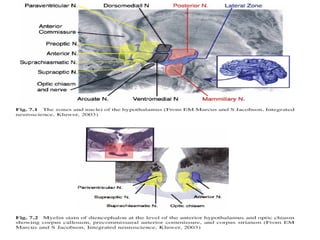
signals are controlled by the suprachiasmatic
nucleus of the hypothalamus.
Recent evidence has shown that neurons of the
ventrolateral preoptic nucleus of the
hypothalamus are sleep active and sleep
promoting, confirming old observations that
lesions in this area induce insomnia.
These neurons express the inhibitory transmitters, galanin and GABA,
and innervate wake-promoting areas ,including:
The hypocretin (also known as orexin) containing neurons of the
posterolateral hypothalamus,
histaminergic neurons of the tuberomammillary nucleus,
the serotonergic dorsal raphe,
norepinephrine containing neurons of the locus ceruleus, and
the cholinergic neurons of the dorsal midbrain and pons.
In turn, monoaminergic wake-promoting areas inhibit the ventrolateral
preoptic nucleus, thereby resulting in reciprocal inhibition that self-
reinforces
Orexin
Orexin is subject both to circadian and homeostatic
regulation as the ablation of the suprachiasmatic
nucleus abolishes its production, while its levels are
enhanced by sleep deprivation .
Therefore, orexin seems to be an essential component of
the mechanisms maintaining prolonged wakefulness and
opposing to homeostatic sleep propensity.
As for REM sleep it has been found that the
Tuberomammilary nucleus,
Locus ceruleus and
Raphe nuclei contain Orexin receptors
exerting an Inhibitory effect on REM sleep
Therefore the absence of excitatory
orexin input would augment the
strength of REM mechanisms, thus
facilitating more frequent transitions to
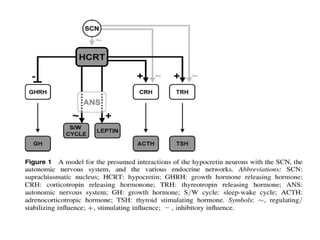
Circadian rhythms generated by the central pace-maker in
the suprachiasmatic nucleus (SCN) control the timing
of wake and REM sleep , perhaps in part via projections
to orexin neurons that then relay this information to
sleep-regulatory and wake-regulatory regions .
It has been hypothesized that daytime sleepiness and
fragmented sleep of human narcolepsy could be
caused by impaired circadian control since circadian
signals help time and consolidate sleep-wake behavior .
Oscillatory EEG patterns arise because of
pacemaker cells, in which membrane
voltage fluctuates spontaneously, or
because of the reciprocal interaction of
excitatory and inhibitory neurons in circuit
loops.
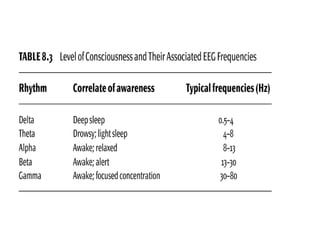
The human EEG shows activity over the
range of 1 to 30 Hz, with amplitudes in the
range of 20 to 300 µV.
thalamocortical connections are critical in
the synchronization of electrical activity,
such as sleep spindles.
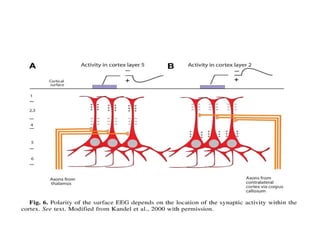
It has been estimated that each EEG
electrode “sees” the summed activity of
roughly 6 cm2 of underlying cortex.
These pathological waves of cortical
excitation and subsequent inhibition
affecting broad regions of excessively
synchronized cortex are thought to
underlie the spikes, sharp waves, and
sharp and slow wave complexes we
recognize as pathological correlates in
routine EEG interpretation.
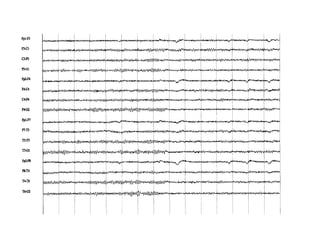
Alpha rhythm
As with all repeating rhythms, it is most important to note the
frequency and the location of the activity, its amplitude, and its
reactivity. The alpha rhythm oscillation is between 8 and 12 Hz and
is most prominent over the more posterior aspects of the head. Its
amplitude or voltage in a bipolar (P4–O2) derivation is any-where
from 15 to 65 µV. This is reactive or responsive to mental activity
and to eye opening or closure. The rhythm is partially or completely
blocked by mental activity or by eye opening . Likewise, it is
enhanced by relaxation and by eye closure (Fig. 1). In a few healthy
subjects (<2%), no apparent alpha rhythm can be seen. in some
subjects (<7%), a very low-voltage alpha rhythm is observed.
Because recordings are bipolar, one can improve on alpha
detections by increasing the inter-electrode distances.
There may be a side-to-side amplitude
asymmetry, noted in approximately 60%
of people, in which the right side tends to
be of slightly higher amplitude.
The left side may be more predominant in
left handed individuals.
The difference in amplitude between the two
hemispheres is not more than 50%.
Beta activity (>12 Hz) is defined by three relatively
distinct frequency bands: 18 to 25 Hz activity,
which is the most frequently encountered; 14 to
17 Hz activity, which is less common; and the
still rarer, greater than 25 Hz activity. The first
two frequencies are seen commonly over the
frontal regions and become more prominent as
the subject gets drowsy. These two beta
rhythms are usually of low voltage (<25 µV). It
can be markedly increased by the use of some
drugs, most notably the benzodiazepines and
barbiturates. However, in those
Mu Rhythm
The mu rhythm is a centrally located rhythm
with a frequency of 8 to 10 Hz. It is
thought to be the resting rhythm of the
pre- and post-Rolandic cortex.
Theta
• Theta activity is defined as activity between 4 and 7 Hz.
Although theta activity is often a sign of disease or of
sleep onset, it may also be seen as part of a normal
awake EEG. Although some intermittent low-voltage
theta activity is seen over the frontal–central regions in
healthy people while resting and awake, this is usually
not a well-developed nor regular rhythm. Under a
circumstance in which the subject is performing some
moderately difficult mental task, such as spelling or
mathematics, one can occasionally see a well-developed
theta rhythm in the frontal midline region . A small
amount of left temporal theta activity during wakefulness
is also expected as a normal factor in aging, starting
around the age of 50 yr .
Lambda wave
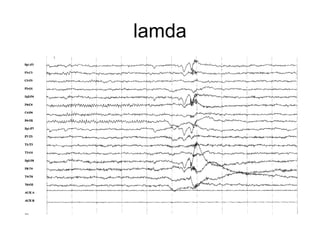
• These waves may be quite asymmetric,They
will then have the patient close their eyes,
whichwill block the normal lambda wave but
usually not have an effect on the abnormal
activity.They will then have them open their eyes
and look at a plain piece of paper, which also
blocksthe normal lambda wave but will not effect
the epileptiform discharges, which are most
oftenmistaken for a lambda wave (3).
lamda
Stage I
The first suggestion that a patient is going
to sleep is that there is a sudden drop in
the voltage of their background alpha
rhythm, followed by intermittent theta
activity noted over the more posterior
head regions (Fig. 4). This presleep or
twilight state is usually followed by early
Stage II.
STAGE II
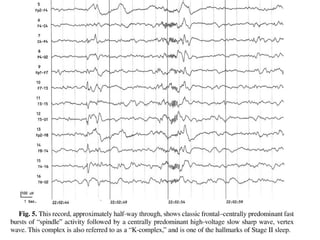
This stage’s onset is identified by the appearance of
spindles. They are frontal–centrally predominant waves
that occur as a cluster lasting for one to several seconds
in duration. The spindle frequency is between 11 and 15
Hz and, in healthy adults, they are bilateral and
synchronous in their appearance, with an amplitude up
to 30 µV. Spindles may appear by themselves or
following a vertex wave. In that latter situation, the wave
is called a “K complex”.
During the progression into deeper aspects of Stage II, the
background rhythm continues to slow into the slower
theta ranges, and high voltage generalized and frontally
predominant delta slow waves are noted (<4 Hz).
STAGE III
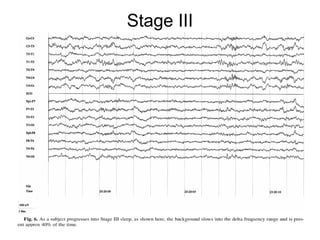
Occasionally a patient may go on to Stage III
sleep. In this phase, there are still vertex waves,
spindles, and K-complexes, but they occur less
frequently and seem to be over-whelmed by the
more prominent delta wave activity (<4 Hz). This
slow wave activity is widespread but has a
frontal and central predominance. It should be
the most frequently noted rhythm and should be
present for 20 to 50% of the record .
Stage III and the later Stage IV of sleep are most
often associated with increases in the interictal
discharges of temporal lobe epilepsy.
Stage III
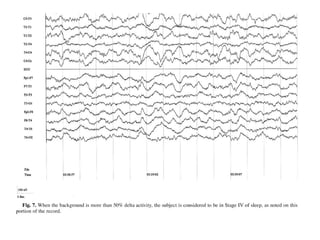
STAGE IV
Stage IV also has rudimentary vertex
waves, spindles, and K-complexes, but
shows further slowing and a more
persistent delta-frequency background.
In this stage, most (>50%) of the time of
the recording is associated with
continuously appearing delta activity .
This stage is only rarely achieved in the
routine EEG recording.
REM
In sleep laboratories, the REM stage is divided into tonic
and phasic components based on the simultaneous
recording of other physiological parameters not routinely
monitored during EEG acquisitions .
The other recordings include respiration effort and pulse
oximetry, and chin and leg EMG activity.
From a strictly EEG perspective, the background rhythm
returns to what seems to be a drowsy or wakeful state,
with low-voltage theta and alpha frequency activity,
and with large, slow lateral eye movements .
This stage of sleep is also rarely encountered in routine
EEG.
• REM and NREM sleep differ physiologically.
• REM sleep is characterized by both phasic and tonic
changes in physiology. The drop in baseline EMG
correlates with a tonic change.
• Tonic physiological changes also include impaired
thermo regulation, reduction in ventilatory
chemosensitivity, hypotension, bradycardia, increased
cerebral blood flow, and intracranial pressure, increased
respiratory rate, and penile erection.
• Phasic changes include vasoconstriction, increased
blood pressure, tachycardia, and further increases in
cerebral blood flow and respiratory rate.
• During NREM sleep, the physiological state is more
stable, with an overall reduction in blood pressure, heart
rate, cardiac output, and respiratory rate. One
characteristic feature of NREM, slow-wave sleep is the
secretion of growth hormone.
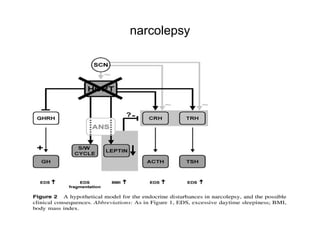
narcolepsy
leptin
Reduced circulating leptin levels may be involved in the
pathogenesis of obesity in narcoleptic patients.
The fact that narcoleptic patients are obese in the face of
hypophagia suggests that they spend less energy, which
is supported by early observations.
Leptin is critically involved in the control of energy
expenditure and hypoleptinemia is associated with a
lower metabolic rate in obese animal models.
Alternatively ,hypocretin deficiency may reduce basal
metabolism directly via its inhibitory impact on the
sympathetic nervous system.
adenosine
It has been described that approximately 30% of Hcrt cells express A1
adenosine receptor. Adenosine is hypnogenic molecule that inhibits
wakefulness promoting neurons via a postsynaptic action mediated
through A1 adenosine receptor.
Caffeine is a xanthine derivative. The mechanism of action of caffeine
on wakefulness involves nonspecific adenosine receptor
antagonism. Adenosine is an endogenous sleep-promoting
substance with neuronal inhibitory effects.
In animals, sleep can be induced after administration of metabolically
stable adenosine analogues with adenosine A1 receptors (A1R) or
A2A receptors (A2AR) agonistic properties.
Adenosine content is increased in the basal forebrain after sleep
deprivation.
Adenosine has thus been proposed to be a sleep-inducing substance
accumulating in the brain during prolonged wakefulness .
• During slow wave sleep, activity of hcrt
neurons diminishes and results in
disinhibition of GABAergic neurons in the
ventrolateral preoptic area. During REM
sleep, hcrt neurons are silent and
disinhibit REM-on neurons in the
brainstem (16). In narcolepsy, the
absence of hypocretin neurons results in
lack of integration and coordination of
excitatory signals that modulate
wakefulness (17).
Sleep disorders
• Pseudoinsomnia
• Idiopathic insomnia
• Delayed sleep phase insomnia
• Drug insomnia
• Secondary insomnia
• Narcolepsia
• somnambolism
• Hypocretin neurons are activated by CRF in
response to stimuli that cause stress and this
activation may be responsible for the extended
arousal.
• stress is known to promote relapse of drug
seeking (21). Using an animal paradigm of
cocaine self-administration, we have shown that
a single injection of hypocretin can reinstate
cocaine seeking behavior in extinguished
animals (22).
• Among the regions innervated by the hypocretin neurons are the
ventral tegmental area(VTA), the locus ceorulus (LC), the prefrontal
cortex, the hippocampus, the nucleus accumbens, the amygdala,
the ventral pallidum and the TMN (14, 19, 20). Defined as the
mesocorticolimbic dopamine system, these neurons are related to
brain mechanisms of reward, reinforcement, and emotional arousal.
In accordance to this, we have inves-tigated whether the
hypocretinergic system has a role in the hyperaroused state that is
associated with stress and drug addiction. We hypothesized that
corticotrophin-releasing factor, a hormone that initiates the stress
response and activates the hypothalamo-pituitary-adrenal axis,
exerted an effect on hypocretin neurons. Indeed,CRF-containing
synaptic terminals contact hypocretin neurons and hypocretin
neurons express CRF receptors.

چرخه های زیستی و خواب

  • 1.
    ‫خواب‬ ‫و‬ ‫زیستی‬‫های‬ ‫چرخه‬
  • 2.
    • Biological rhythm: Circadianrhythm Menstrual rhythm
  • 3.
    Time stimulus likedark/light ,temperature are zeitgeber. They organize circadian rhythm.
  • 4.
    There are twosleep drives, one homeostatic and the other circadian. The homeostatic drive increases with the duration of wakefulness, whereas the circadian signals are controlled by the suprachiasmatic nucleus of the hypothalamus. Recent evidence has shown that neurons of the ventrolateral preoptic nucleus of the hypothalamus are sleep active and sleep promoting, confirming old observations that lesions in this area induce insomnia.
  • 5.
    These neurons expressthe inhibitory transmitters, galanin and GABA, and innervate wake-promoting areas ,including: The hypocretin (also known as orexin) containing neurons of the posterolateral hypothalamus, histaminergic neurons of the tuberomammillary nucleus, the serotonergic dorsal raphe, norepinephrine containing neurons of the locus ceruleus, and the cholinergic neurons of the dorsal midbrain and pons. In turn, monoaminergic wake-promoting areas inhibit the ventrolateral preoptic nucleus, thereby resulting in reciprocal inhibition that self- reinforces
  • 8.
    Orexin Orexin is subjectboth to circadian and homeostatic regulation as the ablation of the suprachiasmatic nucleus abolishes its production, while its levels are enhanced by sleep deprivation . Therefore, orexin seems to be an essential component of the mechanisms maintaining prolonged wakefulness and opposing to homeostatic sleep propensity.
  • 9.
    As for REMsleep it has been found that the Tuberomammilary nucleus, Locus ceruleus and Raphe nuclei contain Orexin receptors exerting an Inhibitory effect on REM sleep Therefore the absence of excitatory orexin input would augment the strength of REM mechanisms, thus facilitating more frequent transitions to
  • 10.
    Circadian rhythms generatedby the central pace-maker in the suprachiasmatic nucleus (SCN) control the timing of wake and REM sleep , perhaps in part via projections to orexin neurons that then relay this information to sleep-regulatory and wake-regulatory regions . It has been hypothesized that daytime sleepiness and fragmented sleep of human narcolepsy could be caused by impaired circadian control since circadian signals help time and consolidate sleep-wake behavior .
  • 13.
    Oscillatory EEG patternsarise because of pacemaker cells, in which membrane voltage fluctuates spontaneously, or because of the reciprocal interaction of excitatory and inhibitory neurons in circuit loops. The human EEG shows activity over the range of 1 to 30 Hz, with amplitudes in the range of 20 to 300 µV.
  • 14.
    thalamocortical connections arecritical in the synchronization of electrical activity, such as sleep spindles.
  • 16.
    It has beenestimated that each EEG electrode “sees” the summed activity of roughly 6 cm2 of underlying cortex.
  • 17.
    These pathological wavesof cortical excitation and subsequent inhibition affecting broad regions of excessively synchronized cortex are thought to underlie the spikes, sharp waves, and sharp and slow wave complexes we recognize as pathological correlates in routine EEG interpretation.
  • 18.
    Alpha rhythm As withall repeating rhythms, it is most important to note the frequency and the location of the activity, its amplitude, and its reactivity. The alpha rhythm oscillation is between 8 and 12 Hz and is most prominent over the more posterior aspects of the head. Its amplitude or voltage in a bipolar (P4–O2) derivation is any-where from 15 to 65 µV. This is reactive or responsive to mental activity and to eye opening or closure. The rhythm is partially or completely blocked by mental activity or by eye opening . Likewise, it is enhanced by relaxation and by eye closure (Fig. 1). In a few healthy subjects (<2%), no apparent alpha rhythm can be seen. in some subjects (<7%), a very low-voltage alpha rhythm is observed. Because recordings are bipolar, one can improve on alpha detections by increasing the inter-electrode distances.
  • 20.
    There may bea side-to-side amplitude asymmetry, noted in approximately 60% of people, in which the right side tends to be of slightly higher amplitude. The left side may be more predominant in left handed individuals. The difference in amplitude between the two hemispheres is not more than 50%.
  • 21.
    Beta activity (>12Hz) is defined by three relatively distinct frequency bands: 18 to 25 Hz activity, which is the most frequently encountered; 14 to 17 Hz activity, which is less common; and the still rarer, greater than 25 Hz activity. The first two frequencies are seen commonly over the frontal regions and become more prominent as the subject gets drowsy. These two beta rhythms are usually of low voltage (<25 µV). It can be markedly increased by the use of some drugs, most notably the benzodiazepines and barbiturates. However, in those
  • 22.
    Mu Rhythm The murhythm is a centrally located rhythm with a frequency of 8 to 10 Hz. It is thought to be the resting rhythm of the pre- and post-Rolandic cortex.
  • 23.
    Theta • Theta activityis defined as activity between 4 and 7 Hz. Although theta activity is often a sign of disease or of sleep onset, it may also be seen as part of a normal awake EEG. Although some intermittent low-voltage theta activity is seen over the frontal–central regions in healthy people while resting and awake, this is usually not a well-developed nor regular rhythm. Under a circumstance in which the subject is performing some moderately difficult mental task, such as spelling or mathematics, one can occasionally see a well-developed theta rhythm in the frontal midline region . A small amount of left temporal theta activity during wakefulness is also expected as a normal factor in aging, starting around the age of 50 yr .
  • 24.
    Lambda wave • Thesewaves may be quite asymmetric,They will then have the patient close their eyes, whichwill block the normal lambda wave but usually not have an effect on the abnormal activity.They will then have them open their eyes and look at a plain piece of paper, which also blocksthe normal lambda wave but will not effect the epileptiform discharges, which are most oftenmistaken for a lambda wave (3).
  • 25.
  • 26.
    Stage I The firstsuggestion that a patient is going to sleep is that there is a sudden drop in the voltage of their background alpha rhythm, followed by intermittent theta activity noted over the more posterior head regions (Fig. 4). This presleep or twilight state is usually followed by early Stage II.
  • 27.
    STAGE II This stage’sonset is identified by the appearance of spindles. They are frontal–centrally predominant waves that occur as a cluster lasting for one to several seconds in duration. The spindle frequency is between 11 and 15 Hz and, in healthy adults, they are bilateral and synchronous in their appearance, with an amplitude up to 30 µV. Spindles may appear by themselves or following a vertex wave. In that latter situation, the wave is called a “K complex”. During the progression into deeper aspects of Stage II, the background rhythm continues to slow into the slower theta ranges, and high voltage generalized and frontally predominant delta slow waves are noted (<4 Hz).
  • 29.
    STAGE III Occasionally apatient may go on to Stage III sleep. In this phase, there are still vertex waves, spindles, and K-complexes, but they occur less frequently and seem to be over-whelmed by the more prominent delta wave activity (<4 Hz). This slow wave activity is widespread but has a frontal and central predominance. It should be the most frequently noted rhythm and should be present for 20 to 50% of the record . Stage III and the later Stage IV of sleep are most often associated with increases in the interictal discharges of temporal lobe epilepsy.
  • 30.
  • 31.
    STAGE IV Stage IValso has rudimentary vertex waves, spindles, and K-complexes, but shows further slowing and a more persistent delta-frequency background. In this stage, most (>50%) of the time of the recording is associated with continuously appearing delta activity . This stage is only rarely achieved in the routine EEG recording.
  • 33.
    REM In sleep laboratories,the REM stage is divided into tonic and phasic components based on the simultaneous recording of other physiological parameters not routinely monitored during EEG acquisitions . The other recordings include respiration effort and pulse oximetry, and chin and leg EMG activity. From a strictly EEG perspective, the background rhythm returns to what seems to be a drowsy or wakeful state, with low-voltage theta and alpha frequency activity, and with large, slow lateral eye movements . This stage of sleep is also rarely encountered in routine EEG.
  • 34.
    • REM andNREM sleep differ physiologically. • REM sleep is characterized by both phasic and tonic changes in physiology. The drop in baseline EMG correlates with a tonic change. • Tonic physiological changes also include impaired thermo regulation, reduction in ventilatory chemosensitivity, hypotension, bradycardia, increased cerebral blood flow, and intracranial pressure, increased respiratory rate, and penile erection. • Phasic changes include vasoconstriction, increased blood pressure, tachycardia, and further increases in cerebral blood flow and respiratory rate. • During NREM sleep, the physiological state is more stable, with an overall reduction in blood pressure, heart rate, cardiac output, and respiratory rate. One characteristic feature of NREM, slow-wave sleep is the secretion of growth hormone.
  • 35.
  • 36.
    leptin Reduced circulating leptinlevels may be involved in the pathogenesis of obesity in narcoleptic patients. The fact that narcoleptic patients are obese in the face of hypophagia suggests that they spend less energy, which is supported by early observations. Leptin is critically involved in the control of energy expenditure and hypoleptinemia is associated with a lower metabolic rate in obese animal models. Alternatively ,hypocretin deficiency may reduce basal metabolism directly via its inhibitory impact on the sympathetic nervous system.
  • 37.
    adenosine It has beendescribed that approximately 30% of Hcrt cells express A1 adenosine receptor. Adenosine is hypnogenic molecule that inhibits wakefulness promoting neurons via a postsynaptic action mediated through A1 adenosine receptor. Caffeine is a xanthine derivative. The mechanism of action of caffeine on wakefulness involves nonspecific adenosine receptor antagonism. Adenosine is an endogenous sleep-promoting substance with neuronal inhibitory effects. In animals, sleep can be induced after administration of metabolically stable adenosine analogues with adenosine A1 receptors (A1R) or A2A receptors (A2AR) agonistic properties. Adenosine content is increased in the basal forebrain after sleep deprivation. Adenosine has thus been proposed to be a sleep-inducing substance accumulating in the brain during prolonged wakefulness .
  • 38.
    • During slowwave sleep, activity of hcrt neurons diminishes and results in disinhibition of GABAergic neurons in the ventrolateral preoptic area. During REM sleep, hcrt neurons are silent and disinhibit REM-on neurons in the brainstem (16). In narcolepsy, the absence of hypocretin neurons results in lack of integration and coordination of excitatory signals that modulate wakefulness (17).
  • 39.
    Sleep disorders • Pseudoinsomnia •Idiopathic insomnia • Delayed sleep phase insomnia • Drug insomnia • Secondary insomnia • Narcolepsia • somnambolism
  • 40.
    • Hypocretin neuronsare activated by CRF in response to stimuli that cause stress and this activation may be responsible for the extended arousal. • stress is known to promote relapse of drug seeking (21). Using an animal paradigm of cocaine self-administration, we have shown that a single injection of hypocretin can reinstate cocaine seeking behavior in extinguished animals (22).
  • 41.
    • Among theregions innervated by the hypocretin neurons are the ventral tegmental area(VTA), the locus ceorulus (LC), the prefrontal cortex, the hippocampus, the nucleus accumbens, the amygdala, the ventral pallidum and the TMN (14, 19, 20). Defined as the mesocorticolimbic dopamine system, these neurons are related to brain mechanisms of reward, reinforcement, and emotional arousal. In accordance to this, we have inves-tigated whether the hypocretinergic system has a role in the hyperaroused state that is associated with stress and drug addiction. We hypothesized that corticotrophin-releasing factor, a hormone that initiates the stress response and activates the hypothalamo-pituitary-adrenal axis, exerted an effect on hypocretin neurons. Indeed,CRF-containing synaptic terminals contact hypocretin neurons and hypocretin neurons express CRF receptors.