Effect of sleep on EEG
Khalaf A. Sayed
Assistant lecturer of
pediatrics
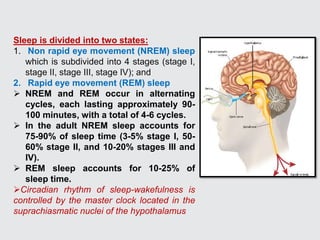
Sleep is divided into two states:
1. Non rapid eye movement (NREM) sleep
which is subdivided into 4 stages (stage I,
stage II, stage III, stage IV); and
2. Rapid eye movement (REM) sleep
 NREM and REM occur in alternating
cycles, each lasting approximately 90-
100 minutes, with a total of 4-6 cycles.
 In the adult NREM sleep accounts for
75-90% of sleep time (3-5% stage I, 50-
60% stage II, and 10-20% stages III and
IV).
 REM sleep accounts for 10-25% of
sleep time.
Circadian rhythm of sleep-wakefulness is
controlled by the master clock located in the
suprachiasmatic nuclei of the hypothalamus
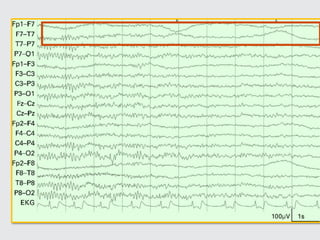
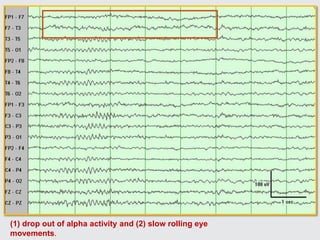
(1) drop out of alpha activity and (2) slow rolling eye
movements.
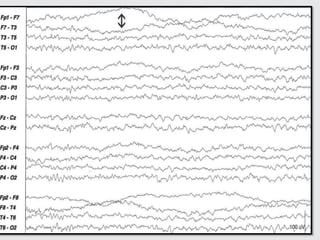
Slow rolling eye movements (SREMs):
 SREMs are usually the first evidence of drowsiness.
SREMs of drowsiness are most often horizontal but
can be vertical or oblique, and their distribution is similar
to eye movements in general. However, they are slow
(ie, typically 0.25-0.5 Hz).
 SREMs disappear in stage II and deeper sleep
stages.
Attenuation (drop out) of the alpha rhythm:
Typically occurs together with or nearby SREM.
The alpha rhythm gradually becomes slower, less
prominent, and fragmented.
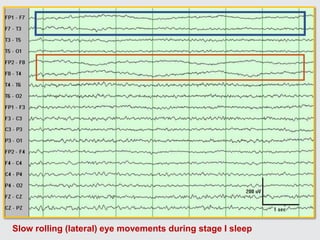
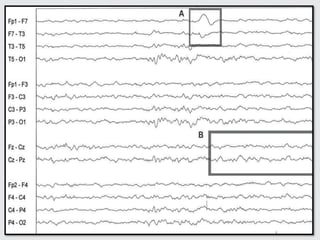
Slow rolling (lateral) eye movements during stage I sleep
Drowsiness (Stage 1)
 Alpha dropout
 Slow eye movement
 Increased beta activity over the frontocentral
regions
 Diffuse rhythmic theta activity with anterior
predominance
 Deep drowsiness is marked by the vertex waves
and POSTS that persist during light sleep and deep
sleep
 Hypnagogic hypersynchrony
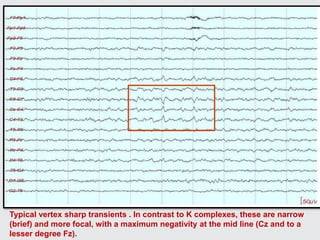
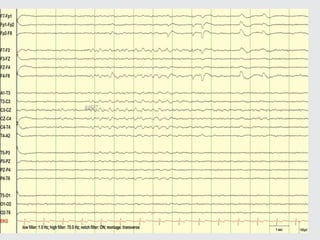
Typical vertex sharp transients . In contrast to K complexes, these are narrow
(brief) and more focal, with a maximum negativity at the mid line (Cz and to a
lesser degree Fz).
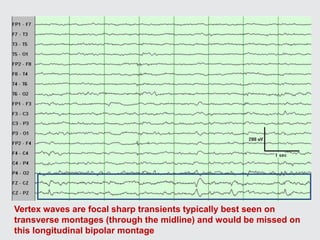
Vertex waves are focal sharp transients typically best seen on
transverse montages (through the midline) and would be missed on
this longitudinal bipolar montage
 They are largest and most evident at the vertex
bilaterally and usually symmetrically.
 They show phase reversal at the vertex.
 V waves tend to occur especially during stage 2 sleep
and may be multiple.
 Often, they occur after sleep disturbances (eg, brief
sounds) and, like K complexes, may occur during brief
semiarousals.
Vertex sharp transients: (vertex waves
or V waves)
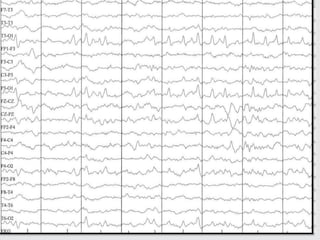
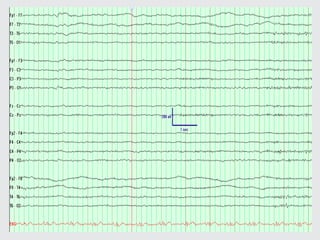
Positive occipital sharp transients of sleep (POSTS) are seen in both occipital
regions. They also have morphology classically described as "reverse check
mark" and often occur in consecutive runs of several seconds
Positive occipital sharp transients of sleep (POSTS):
 start to occur in healthy people at age 3 years, become fairly
common by age 15 years.
 POSTS are seen very commonly on EEG and more common
during daytime naps than during nocturnal sleep.
 Most characteristics of POSTS are contained in their name.
They have a positive maximum at the occiput, are contoured
sharply, and occur in early sleep (stages I and II).
Their morphology is classically described as "reverse check
mark," and their amplitude is 50-100 µV. They typically occur in
runs of 4-5 Hz and are bisynchronous, although they may be
asymmetric.
 They persist in stage II sleep but usually disappear in
subsequent stages.
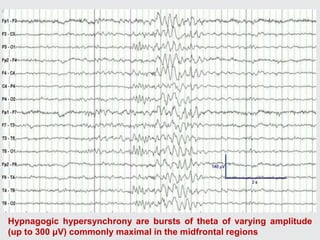
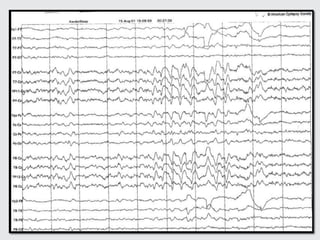
Hypnagogic hypersynchrony are bursts of theta of varying amplitude
(up to 300 μV) commonly maximal in the midfrontal regions
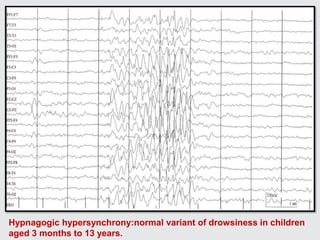
Hypnagogic hypersynchrony:normal variant of drowsiness in children
aged 3 months to 13 years.
Stage 2 sleep
Sleep spindles in the 12–15/sec range are hallmark of
sleep onset.
Symmetric, synchronous theta rhythms with posterior
predominance, vertex sharp waves, K-complexes, and
POSTS.
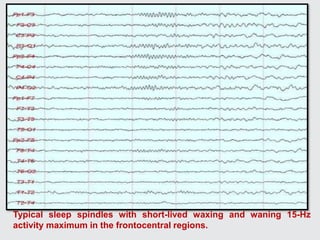
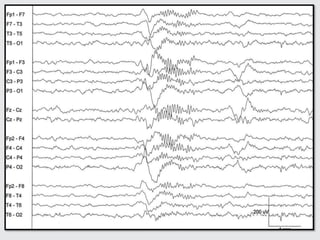
Typical sleep spindles with short-lived waxing and waning 15-Hz
activity maximum in the frontocentral regions.
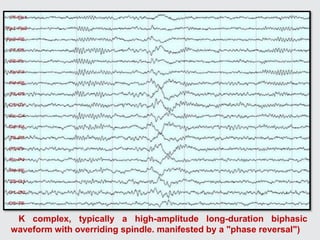
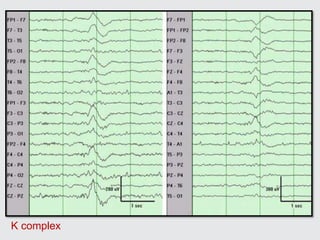
K complex, typically a high-amplitude long-duration biphasic
waveform with overriding spindle. manifested by a "phase reversal")
K complex
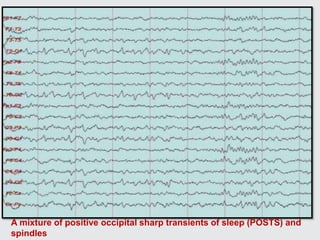
A mixture of positive occipital sharp transients of sleep (POSTS) and
spindles
Sleep spindles
 Normally first appear in infants aged 6-8 weeks and are
bilaterally asynchronous.
These become well-formed spindles and bilaterally
synchronous by the time the individual is aged 2 years.
Sleep spindles have a frequency of 12-16 Hz (typically
14 Hz) and are maximal in the central region (vertex),
although they occasionally predominate in the frontal
regions.
They occur in short bursts of waxing and waning spindle
like (fusiform) rhythmic activity. Amplitude is usually 20-
100 µV.
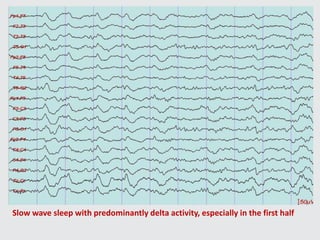
Slow wave sleep with predominantly delta activity, especially in the first half
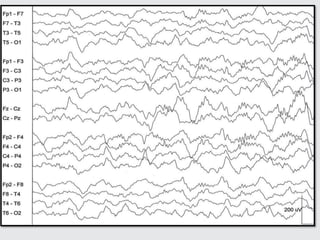
Stage III and IV Sleep
 Grouped together as "slow wave sleep" or "delta sleep.
 Stage III is defined by delta activity that occupies 20-50% of
the time, whereas in stage IV, delta activity represents greater
than 50% of the time.
 Sleep spindles and K complexes may persist in stage III and
even to some degree in stage IV, but they are not prominent.
 Arousal at this stage can be correlated with sleep disorders
(somnambulism, nocturnal terror, or enuresis), and can cause
confusion
 Occasionally, spikes in temporal lobe epilepsy will only appear
in stage 3 and 4 sleep.
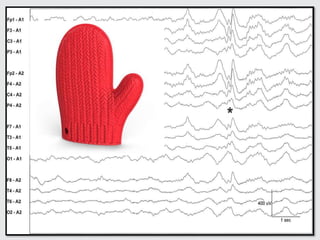
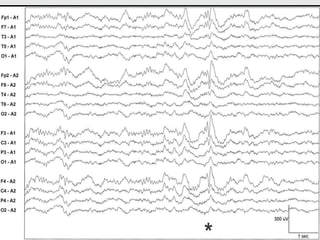
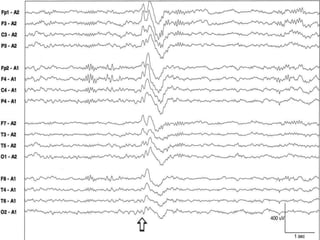
Mitten patterns
1. Consist of a sharp-contoured waveform on the slope of
a slow wave of the same polarity that resembles a
mitten, with a thumb of mitten formed by the last wave
of a spindle and the hand portion by the slower wave
component.
2. Maximal at the frontocentral vertex.
3. Variant of a vertex wave or K-complex and should not
be mistaken for a spike-and-wave discharge.
4. It is best seen in referential montage in stage 3 sleep.
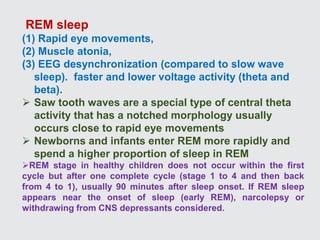
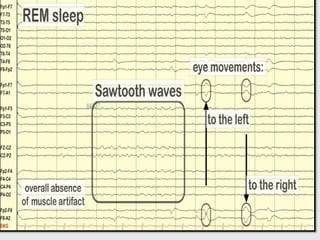
REM sleep
(1) Rapid eye movements,
(2) Muscle atonia,
(3) EEG desynchronization (compared to slow wave
sleep). faster and lower voltage activity (theta and
beta).
 Saw tooth waves are a special type of central theta
activity that has a notched morphology usually
occurs close to rapid eye movements
 Newborns and infants enter REM more rapidly and
spend a higher proportion of sleep in REM
REM stage in healthy children does not occur within the first
cycle but after one complete cycle (stage 1 to 4 and then back
from 4 to 1), usually 90 minutes after sleep onset. If REM sleep
appears near the onset of sleep (early REM), narcolepsy or
withdrawing from CNS depressants considered.
Thank
s
A Lot
Eeg

Eeg

  • 1.
  • 2.
    Khalaf A. Sayed Assistantlecturer of pediatrics
  • 3.
    Sleep is dividedinto two states: 1. Non rapid eye movement (NREM) sleep which is subdivided into 4 stages (stage I, stage II, stage III, stage IV); and 2. Rapid eye movement (REM) sleep  NREM and REM occur in alternating cycles, each lasting approximately 90- 100 minutes, with a total of 4-6 cycles.  In the adult NREM sleep accounts for 75-90% of sleep time (3-5% stage I, 50- 60% stage II, and 10-20% stages III and IV).  REM sleep accounts for 10-25% of sleep time. Circadian rhythm of sleep-wakefulness is controlled by the master clock located in the suprachiasmatic nuclei of the hypothalamus
  • 5.
    (1) drop outof alpha activity and (2) slow rolling eye movements.
  • 7.
    Slow rolling eyemovements (SREMs):  SREMs are usually the first evidence of drowsiness. SREMs of drowsiness are most often horizontal but can be vertical or oblique, and their distribution is similar to eye movements in general. However, they are slow (ie, typically 0.25-0.5 Hz).  SREMs disappear in stage II and deeper sleep stages. Attenuation (drop out) of the alpha rhythm: Typically occurs together with or nearby SREM. The alpha rhythm gradually becomes slower, less prominent, and fragmented.
  • 8.
    Slow rolling (lateral)eye movements during stage I sleep
  • 9.
    Drowsiness (Stage 1) Alpha dropout  Slow eye movement  Increased beta activity over the frontocentral regions  Diffuse rhythmic theta activity with anterior predominance  Deep drowsiness is marked by the vertex waves and POSTS that persist during light sleep and deep sleep  Hypnagogic hypersynchrony
  • 10.
    Typical vertex sharptransients . In contrast to K complexes, these are narrow (brief) and more focal, with a maximum negativity at the mid line (Cz and to a lesser degree Fz).
  • 11.
    Vertex waves arefocal sharp transients typically best seen on transverse montages (through the midline) and would be missed on this longitudinal bipolar montage
  • 12.
     They arelargest and most evident at the vertex bilaterally and usually symmetrically.  They show phase reversal at the vertex.  V waves tend to occur especially during stage 2 sleep and may be multiple.  Often, they occur after sleep disturbances (eg, brief sounds) and, like K complexes, may occur during brief semiarousals. Vertex sharp transients: (vertex waves or V waves)
  • 13.
    Positive occipital sharptransients of sleep (POSTS) are seen in both occipital regions. They also have morphology classically described as "reverse check mark" and often occur in consecutive runs of several seconds
  • 14.
    Positive occipital sharptransients of sleep (POSTS):  start to occur in healthy people at age 3 years, become fairly common by age 15 years.  POSTS are seen very commonly on EEG and more common during daytime naps than during nocturnal sleep.  Most characteristics of POSTS are contained in their name. They have a positive maximum at the occiput, are contoured sharply, and occur in early sleep (stages I and II). Their morphology is classically described as "reverse check mark," and their amplitude is 50-100 µV. They typically occur in runs of 4-5 Hz and are bisynchronous, although they may be asymmetric.  They persist in stage II sleep but usually disappear in subsequent stages.
  • 16.
    Hypnagogic hypersynchrony arebursts of theta of varying amplitude (up to 300 μV) commonly maximal in the midfrontal regions
  • 17.
    Hypnagogic hypersynchrony:normal variantof drowsiness in children aged 3 months to 13 years.
  • 18.
    Stage 2 sleep Sleepspindles in the 12–15/sec range are hallmark of sleep onset. Symmetric, synchronous theta rhythms with posterior predominance, vertex sharp waves, K-complexes, and POSTS.
  • 19.
    Typical sleep spindleswith short-lived waxing and waning 15-Hz activity maximum in the frontocentral regions.
  • 20.
    K complex, typicallya high-amplitude long-duration biphasic waveform with overriding spindle. manifested by a "phase reversal")
  • 22.
  • 23.
    A mixture ofpositive occipital sharp transients of sleep (POSTS) and spindles
  • 24.
    Sleep spindles  Normallyfirst appear in infants aged 6-8 weeks and are bilaterally asynchronous. These become well-formed spindles and bilaterally synchronous by the time the individual is aged 2 years. Sleep spindles have a frequency of 12-16 Hz (typically 14 Hz) and are maximal in the central region (vertex), although they occasionally predominate in the frontal regions. They occur in short bursts of waxing and waning spindle like (fusiform) rhythmic activity. Amplitude is usually 20- 100 µV.
  • 25.
    Slow wave sleepwith predominantly delta activity, especially in the first half
  • 26.
    Stage III andIV Sleep  Grouped together as "slow wave sleep" or "delta sleep.  Stage III is defined by delta activity that occupies 20-50% of the time, whereas in stage IV, delta activity represents greater than 50% of the time.  Sleep spindles and K complexes may persist in stage III and even to some degree in stage IV, but they are not prominent.  Arousal at this stage can be correlated with sleep disorders (somnambulism, nocturnal terror, or enuresis), and can cause confusion  Occasionally, spikes in temporal lobe epilepsy will only appear in stage 3 and 4 sleep.
  • 29.
    Mitten patterns 1. Consistof a sharp-contoured waveform on the slope of a slow wave of the same polarity that resembles a mitten, with a thumb of mitten formed by the last wave of a spindle and the hand portion by the slower wave component. 2. Maximal at the frontocentral vertex. 3. Variant of a vertex wave or K-complex and should not be mistaken for a spike-and-wave discharge. 4. It is best seen in referential montage in stage 3 sleep.
  • 32.
    REM sleep (1) Rapideye movements, (2) Muscle atonia, (3) EEG desynchronization (compared to slow wave sleep). faster and lower voltage activity (theta and beta).  Saw tooth waves are a special type of central theta activity that has a notched morphology usually occurs close to rapid eye movements  Newborns and infants enter REM more rapidly and spend a higher proportion of sleep in REM REM stage in healthy children does not occur within the first cycle but after one complete cycle (stage 1 to 4 and then back from 4 to 1), usually 90 minutes after sleep onset. If REM sleep appears near the onset of sleep (early REM), narcolepsy or withdrawing from CNS depressants considered.
  • 39.