SIMPLE HARMONIC MOTION


               Dr. Popat S. Tambade
                   Associate Professor


Prof. Ramkrishna More Arts, Commerce and Science College
                  Akurdi, Pune 411 044
Content
               1. Equilibrium
               2. Stable equilibrium
Oscillations


               3. Unstable Equilibrium
               4. Oscillatory Motion
               5. Spring –Mass system
               6. Simple harmonic Motion
               7. Displacement and velocity
               8. Periodic Time
               9. Frequency
               10.Displacement and Acceleration
              11.Energy of SHM
               12.Lissajous Figures
               13.Angular SHM
               14.Simple Pendulum

                                                  P. S. Tambade
Equilibrium
               The body is said to be in equilibrium at a point
Oscillations

               when net force acting on the body at that point is
               zero.


                •    Types of equilibriums
                1.   Stable Equilibrium
                2.   Unstable equilibrium
               3.   Neutral equilibrium


     C
                                                          P. S. Tambade
Oscillations                   Stable equilibrium


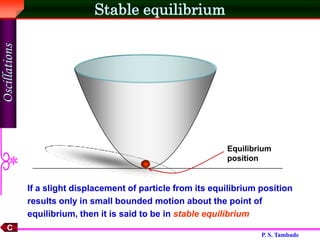
                                                                Equilibrium
                                                               position


               If a slight displacement of particle from its equilibrium position
               results only in small bounded motion about the point of
               equilibrium, then it is said to be in stable equilibrium
     C
                                                                         P. S. Tambade
Potential energy curve for stable equilibrium
                  Tangent at B                      V(x)                       Tangent at A
Oscillations


                                       B                              A
                         dV                                                                   dV
                 Slope =                                                        Slope =
                         dx                                                                   dx
                       Negative                                                      Positive


                                           F                      F
                                 -a                   0                  +a
                                                                                         x
                                               -x             x
               Force
                                 dV
                       F =             Force is positive i.e. directed towards equilibrium
                                                negative i.e. directed towards equilibrium
                                 dx    position
                                                                                    Simulation
     C
                                                                                    P. S. Tambade
Unstable equilibrium
               Equilibrium
Oscillations

               position


     

               If a slight displacement of the particle from its equilibrium position
               results unbounded motion away from the equilibrium
               position, then it is said to be in unstable equilibrium
     C
                                                                         P. S. Tambade
Potential energy curve for unstable equilibrium
                                                     V(x)    Tangent at A
Oscillations


                         dV                B                        A                           dV
                 Slope =                                                             Slope =
                         dx                                                                     dx
                       Positive                                                         Negative


                   Tangent at B
                                       F                                    F
                                                                                            x
                                 -a            -x
                                                        0
                                                              x                 +a
               Force
                              dV
                       F =             Force is negative i.e. directed away from equilibrium
                                       Force is positive i.e. directed away from equilibrium
                              dx
                                       position
                                       position


     C
                                                                                       P. S. Tambade
Oscillatory Motion
               Any motion that repeats itself after equal intervals of time is called
               periodic motion.
Oscillations


                 If an object in periodic motion moves back and forth over the
                 same path, the motion is called oscillatory or vibratory motion

     


    C
                                                                          P. S. Tambade
Oscillations      Spring-Mass system

                                    m                 Relaxed mode


                                   x=0


                                         F
                                                  m
                                                      Extended mode

                                              x


                            m
                                   F

                                                      Compressed mode
                              –x
               We know that for an ideal
               spring, the force is related
               to the displacement by
                                                      F          kx
     C
                                                                 P. S. Tambade
Simple Harmonic Motion
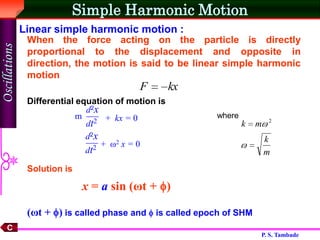
               Linear simple harmonic motion :
                When the force acting on the particle is directly
Oscillations


                proportional to the displacement and opposite in
                direction, the motion is said to be linear simple harmonic
                motion
                                           F         kx
                Differential equation of motion is
                               d 2x
                             m 2 + kx = 0                 where
                                                                          2
                               dt                                 k   m
                               d 2x                                       k
                                  2 + ω x=0
                                       2
                               dt                                         m
               Solution is

                              x = a sin (ωt + )

                (ωt + ) is called phase and is called epoch of SHM
     C
                                                                      P. S. Tambade
The displacement of particle from equilibrium position is
Oscillations


                            x = a sin (ωt + )
               • a and are determined uniquely by the position
                 and velocity of the particle at t = 0
               • If at t = 0 the particle is at x = 0, then    =0
               • If at t = 0 the particle is at x = a, then    = π/2
     • The phase of the motion is the quantity (ωt + )
               • x (t) is periodic and its value is the same each
                 time ωt increases by 2π radians

     C
                                                                  P. S. Tambade
Oscillations


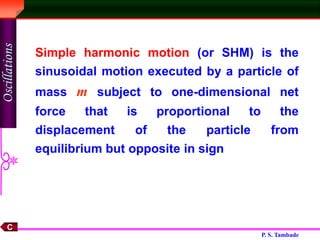
               Simple harmonic motion (or SHM) is the
               sinusoidal motion executed by a particle of
               mass m subject to one-dimensional net
               force   that   is    proportional   to         the
               displacement    of    the    particle       from
               equilibrium but opposite in sign
     


     C
                                                        P. S. Tambade
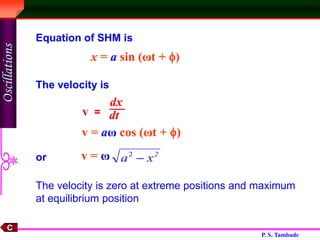
Equation of SHM is
Oscillations


                          x = a sin (ωt + )

               The velocity is
                             dx
                        v = dt
                        v = aω cos (ωt + )

              or       v = ω a2     x2

               The velocity is zero at extreme positions and maximum
               at equilibrium position

     C
                                                             P. S. Tambade
Graphs of Displacement and Velocity

                    x = a sin (ωt + )                         v = aω cos (ωt + )
Oscillations


                                      π
                        For       =
                                      2
                                                    π
               x                                             ωT
                                                             T
                                                    2
          +a


                    v
                              π       π   3π   2π       5π   3π       7π   4π            t, time
                             2           2              2             2        ω
                                                                                T T
                                                                                                   ωt
               -a
                                                                  π
                                                                  2

                        T is = 2 , difference between velocity and displacement is π
                         ωT called periodic time
                        The phase The period of oscillation is T = 2 / ω
                                                                                        2
     C
                                                                                      P. S. Tambade
Periodic Time
               The period of SHM is defined as the time taken by the
Oscillations

               oscillator to perform one complete oscillation
               After every time T, the particle will have the same
               position, velocity and the direction

                         2                        m
                    T                 T    2
                                                  k
                                                       T

               T    m       whe nk is constant
                     1
                T            whe nm is constant
                     k
                                                                             m

     C
                                                                     P. S. Tambade
Frequency
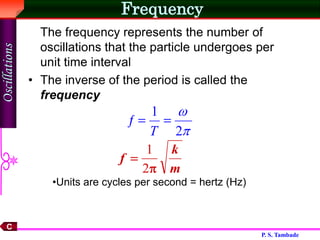
                 The frequency represents the number of
                 oscillations that the particle undergoes per
Oscillations


                 unit time interval
               • The inverse of the period is called the
                 frequency
                                       1
                                   ƒ
                                       T 2
                                      1 k
                                f
                                     2   m
                   •Units are cycles per second = hertz (Hz)


    C
                                                               P. S. Tambade
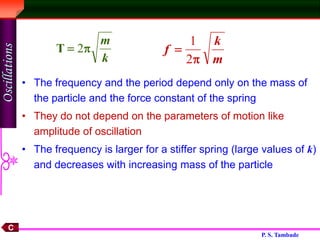
m                  1   k
                     T    2
Oscillations

                                           f
                              k                 2    m
               • The frequency and the period depend only on the mass of
                 the particle and the force constant of the spring
               • They do not depend on the parameters of motion like
                 amplitude of oscillation
      • The frequency is larger for a stiffer spring (large values of k)
      and decreases with increasing mass of the particle


     C
                                                               P. S. Tambade
Displacement and acceleration

                   x = a sin (ωt + )                          A = - aω2 sin (ωt + )
Oscillations


                                                 π
                                      For   =
                                                 2

               x                  π


                         π                  5π
                                                                                         ωt
                             π   3π   2π             3π   7π    4π
                         2       2           2             2
                   Ax
                                                          π


                   The phase difference between acceleration and displacement is   π
     C
                                                                             P. S. Tambade
Energy
               The potential energy is
Oscillations


                                             1
                                   V=        2
                                                 k x2
               The kinetic energy is
                                             1
                                  K=         2
                                                 mv2
                                         1
                     or           K=     2
                                                 m ω 2 (a2 – x2)
                 The total energy is

                                E=K + V
                                         1
                          or     E=      2
                                             m ω 2 a2

                Thus, total energy of the oscillator is constant and proportional to
                the square of amplitude of oscillations
   C
                                                                       P. S. Tambade
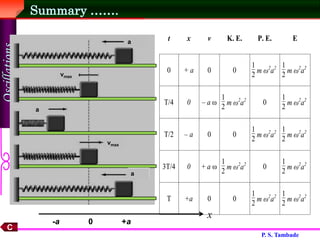
Summary …….

                                           a
                                                    t     x     v     K. E.      P. E.      E
Oscillations


                                                                                1   2 2 1
                                                    0     +a    0       0         mωa     m ω2a2
                        vmax                                                    2       2

                                                                     1                   1
                                                   T/4    0    –aω     m ω2a2      0       m ω2a2
               a                                                     2                   2

                                                                                1        1
                                                   T/2    –a    0       0         m ω2a2 m ω2a2
                                   vmax
                                                                                2        2


                                                  3T/4   0    +aω
                                                                     1
                                                                       m ω2a2      0
                                                                                         1
                                                                                           m ω2a2
                                           A
                                           a max                     2                   2

                                                                                1        1
                                                    T     +a    0       0         m ω2a2 m ω2a2
                                                                                2        2
                                                                x
                   -a          0          +a
     C
                                                                                  P. S. Tambade
Graphical Representation of K. E. and P. E.
                                                  Energy
                                                                                     1
Oscillations

                                                                            E=       2
                                                                                         m ω 2 a2
                                                                    P. E.


                                                                            P. E. = K. E.


                                                                   K. E.
                                                                                 x
                        -a                    0            a/ 2   +a
                               - a/ 2
               The total mechanical energy is constant
               The total mechanical energy is proportional to the square of the amplitude
               Energy is continuously being transferred between potential energy stored
    C          in the spring and the kinetic energy of the block
                                                                             P. S. Tambade
Variation of K.E. and P. E. With time
                                                   1                      1
                   x = a sin (ωt + )          V=   2
                                                       k   x2        K=   2
                                                                              m ω 2 (a2 – x2)
               x
Oscillations


               0
                      π    π   3π        5π   3π       7π
                                                                                                ωt
                                    2π                          4π
                      2        2          2             2
                                                                                                   π
                                                                                   For    =        2
               E
                                                                                          K. E.
     
                                                                                              P. E.
               0                                                                                       ωt
          For one cycle of oscillation of particle there are two cycles for K. E.
          and P.E.. Thus frequency of K. E. or P. E. is 2
    C
                                                                                   P. S. Tambade
Angular SHM
                If path of particle of a body performing an oscillatory
                motion is curved, the motion is known as angular
Oscillations


                simple harmonic motion


               Definition : Angular simple harmonic motion is defined
      as the oscillatory motion of a body in which the body is
     acted upon by a restoring torque (couple) which is
      directly proportional to its angular displacement from
      the equilibrium position and directed opposite to the
      angular displacement
                                                                 P. S. Tambade
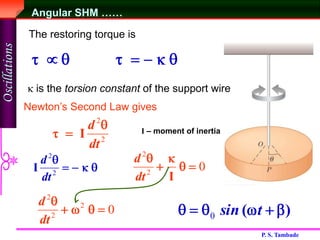
Angular SHM ……

               The restoring torque is
Oscillations


                 is the torsion constant of the support wire
               Newton’s Second Law gives
                           d2            I – moment of inertia
                          I 2
                           dt
                d2                   d2
                I 2                                     0
                 dt                   dt 2      I
                 d2       2
                                0                           0   sin ( t       )
                 dt 2
                                                                      P. S. Tambade
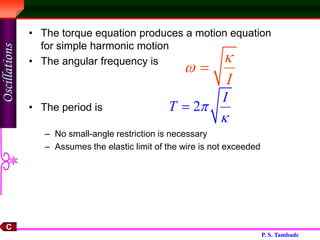
• The torque equation produces a motion equation
                 for simple harmonic motion
Oscillations


               • The angular frequency is
                                                                I
                                                               I
               • The period is                   T     2
                  – No small-angle restriction is necessary
                  – Assumes the elastic limit of the wire is not exceeded
     


    C
                                                                            P. S. Tambade
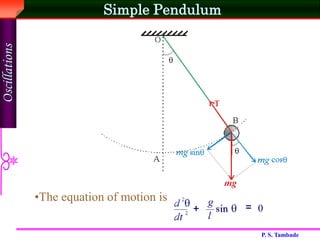
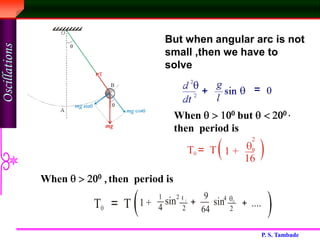
Oscillations                Simple Pendulum


     

               •The equation of motion is

                                              P. S. Tambade
Oscillations


               • When angle is very small, we have sin
                               d
                                  2
                                        g
                                    2 +
                                                = 0
                                dt      l

                The Period is               l
                                 T=2
                                            g
                                                         P. S. Tambade
But when angular arc is not
Oscillations


                                     small ,then we have to
                                     solve


                                        When          but
                                        then period is
                                                                   2
                                                T = T 1+
                                                               16
               When    then period is
                                 1                 9
                      T = T   1+ 4   sin2       +    sin4       + ....
                                            2     64        2


                                                                         P. S. Tambade
Oscillations


     

               Dr. P. S. Tambade received an outstanding paper award in E-Learn
               2008, Las Vegas


                                                                                  P. S. Tambade
Simple harmonic motion

Simple harmonic motion

  • 1.
    SIMPLE HARMONIC MOTION Dr. Popat S. Tambade Associate Professor Prof. Ramkrishna More Arts, Commerce and Science College Akurdi, Pune 411 044
  • 2.
    Content 1. Equilibrium 2. Stable equilibrium Oscillations 3. Unstable Equilibrium 4. Oscillatory Motion 5. Spring –Mass system 6. Simple harmonic Motion 7. Displacement and velocity 8. Periodic Time 9. Frequency 10.Displacement and Acceleration  11.Energy of SHM 12.Lissajous Figures 13.Angular SHM 14.Simple Pendulum P. S. Tambade
  • 3.
    Equilibrium The body is said to be in equilibrium at a point Oscillations when net force acting on the body at that point is zero. • Types of equilibriums 1. Stable Equilibrium 2. Unstable equilibrium  3. Neutral equilibrium C P. S. Tambade
  • 4.
    Oscillations Stable equilibrium Equilibrium  position If a slight displacement of particle from its equilibrium position results only in small bounded motion about the point of equilibrium, then it is said to be in stable equilibrium C P. S. Tambade
  • 5.
    Potential energy curvefor stable equilibrium Tangent at B V(x) Tangent at A Oscillations B A dV dV Slope = Slope = dx dx Negative Positive F F  -a 0 +a x -x x Force dV F = Force is positive i.e. directed towards equilibrium negative i.e. directed towards equilibrium dx position Simulation C P. S. Tambade
  • 6.
    Unstable equilibrium Equilibrium Oscillations position  If a slight displacement of the particle from its equilibrium position results unbounded motion away from the equilibrium position, then it is said to be in unstable equilibrium C P. S. Tambade
  • 7.
    Potential energy curvefor unstable equilibrium V(x) Tangent at A Oscillations dV B A dV Slope = Slope = dx dx Positive Negative Tangent at B F F x  -a -x 0 x +a Force dV F = Force is negative i.e. directed away from equilibrium Force is positive i.e. directed away from equilibrium dx position position C P. S. Tambade
  • 8.
    Oscillatory Motion Any motion that repeats itself after equal intervals of time is called periodic motion. Oscillations If an object in periodic motion moves back and forth over the same path, the motion is called oscillatory or vibratory motion  C P. S. Tambade
  • 9.
    Oscillations Spring-Mass system m Relaxed mode x=0 F m Extended mode x  m F Compressed mode –x We know that for an ideal spring, the force is related to the displacement by F kx C P. S. Tambade
  • 10.
    Simple Harmonic Motion Linear simple harmonic motion : When the force acting on the particle is directly Oscillations proportional to the displacement and opposite in direction, the motion is said to be linear simple harmonic motion F kx Differential equation of motion is d 2x m 2 + kx = 0 where 2 dt k m d 2x k 2 + ω x=0 2 dt m  Solution is x = a sin (ωt + ) (ωt + ) is called phase and is called epoch of SHM C P. S. Tambade
  • 11.
    The displacement ofparticle from equilibrium position is Oscillations x = a sin (ωt + ) • a and are determined uniquely by the position and velocity of the particle at t = 0 • If at t = 0 the particle is at x = 0, then =0 • If at t = 0 the particle is at x = a, then = π/2 • The phase of the motion is the quantity (ωt + ) • x (t) is periodic and its value is the same each time ωt increases by 2π radians C P. S. Tambade
  • 12.
    Oscillations Simple harmonic motion (or SHM) is the sinusoidal motion executed by a particle of mass m subject to one-dimensional net force that is proportional to the displacement of the particle from equilibrium but opposite in sign  C P. S. Tambade
  • 13.
    Equation of SHMis Oscillations x = a sin (ωt + ) The velocity is dx v = dt v = aω cos (ωt + )  or v = ω a2 x2 The velocity is zero at extreme positions and maximum at equilibrium position C P. S. Tambade
  • 14.
    Graphs of Displacementand Velocity x = a sin (ωt + ) v = aω cos (ωt + ) Oscillations π For = 2 π x ωT T 2 +a v π π 3π 2π 5π 3π 7π 4π t, time  2 2 2 2 ω T T ωt -a π 2 T is = 2 , difference between velocity and displacement is π ωT called periodic time The phase The period of oscillation is T = 2 / ω 2 C P. S. Tambade
  • 15.
    Periodic Time The period of SHM is defined as the time taken by the Oscillations oscillator to perform one complete oscillation After every time T, the particle will have the same position, velocity and the direction 2 m T T 2 k T  T m whe nk is constant 1 T whe nm is constant k m C P. S. Tambade
  • 16.
    Frequency The frequency represents the number of oscillations that the particle undergoes per Oscillations unit time interval • The inverse of the period is called the frequency 1 ƒ T 2 1 k  f 2 m •Units are cycles per second = hertz (Hz) C P. S. Tambade
  • 17.
    m 1 k T 2 Oscillations f k 2 m • The frequency and the period depend only on the mass of the particle and the force constant of the spring • They do not depend on the parameters of motion like amplitude of oscillation • The frequency is larger for a stiffer spring (large values of k)  and decreases with increasing mass of the particle C P. S. Tambade
  • 18.
    Displacement and acceleration x = a sin (ωt + ) A = - aω2 sin (ωt + ) Oscillations π For = 2 x π π 5π ωt π 3π 2π 3π 7π 4π 2 2 2 2  Ax π The phase difference between acceleration and displacement is π C P. S. Tambade
  • 19.
    Energy The potential energy is Oscillations 1 V= 2 k x2 The kinetic energy is 1 K= 2 mv2 1 or K= 2 m ω 2 (a2 – x2) The total energy is  E=K + V 1 or E= 2 m ω 2 a2 Thus, total energy of the oscillator is constant and proportional to the square of amplitude of oscillations C P. S. Tambade
  • 20.
    Summary ……. a t x v K. E. P. E. E Oscillations 1 2 2 1 0 +a 0 0 mωa m ω2a2 vmax 2 2 1 1 T/4 0 –aω m ω2a2 0 m ω2a2 a 2 2 1 1 T/2 –a 0 0 m ω2a2 m ω2a2 vmax 2 2  3T/4 0 +aω 1 m ω2a2 0 1 m ω2a2 A a max 2 2 1 1 T +a 0 0 m ω2a2 m ω2a2 2 2 x -a 0 +a C P. S. Tambade
  • 21.
    Graphical Representation ofK. E. and P. E. Energy 1 Oscillations E= 2 m ω 2 a2 P. E. P. E. = K. E.  K. E. x -a 0 a/ 2 +a - a/ 2 The total mechanical energy is constant The total mechanical energy is proportional to the square of the amplitude Energy is continuously being transferred between potential energy stored C in the spring and the kinetic energy of the block P. S. Tambade
  • 22.
    Variation of K.E.and P. E. With time 1 1 x = a sin (ωt + ) V= 2 k x2 K= 2 m ω 2 (a2 – x2) x Oscillations 0 π π 3π 5π 3π 7π ωt 2π 4π 2 2 2 2 π For = 2 E K. E.  P. E. 0 ωt For one cycle of oscillation of particle there are two cycles for K. E. and P.E.. Thus frequency of K. E. or P. E. is 2 C P. S. Tambade
  • 23.
    Angular SHM If path of particle of a body performing an oscillatory motion is curved, the motion is known as angular Oscillations simple harmonic motion Definition : Angular simple harmonic motion is defined as the oscillatory motion of a body in which the body is acted upon by a restoring torque (couple) which is directly proportional to its angular displacement from the equilibrium position and directed opposite to the angular displacement P. S. Tambade
  • 24.
    Angular SHM …… The restoring torque is Oscillations is the torsion constant of the support wire Newton’s Second Law gives d2 I – moment of inertia I 2 dt  d2 d2 I 2 0 dt dt 2 I d2 2 0 0 sin ( t ) dt 2 P. S. Tambade
  • 25.
    • The torqueequation produces a motion equation for simple harmonic motion Oscillations • The angular frequency is I I • The period is T 2 – No small-angle restriction is necessary – Assumes the elastic limit of the wire is not exceeded  C P. S. Tambade
  • 26.
    Oscillations Simple Pendulum  •The equation of motion is P. S. Tambade
  • 27.
    Oscillations • When angle is very small, we have sin  d 2 g 2 + = 0 dt l The Period is l T=2 g P. S. Tambade
  • 28.
    But when angulararc is not Oscillations small ,then we have to solve When but then period is 2 T = T 1+  16 When then period is 1 9 T = T 1+ 4 sin2 + sin4 + .... 2 64 2 P. S. Tambade
  • 29.
    Oscillations  Dr. P. S. Tambade received an outstanding paper award in E-Learn 2008, Las Vegas P. S. Tambade