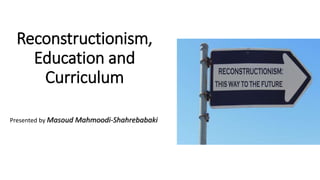
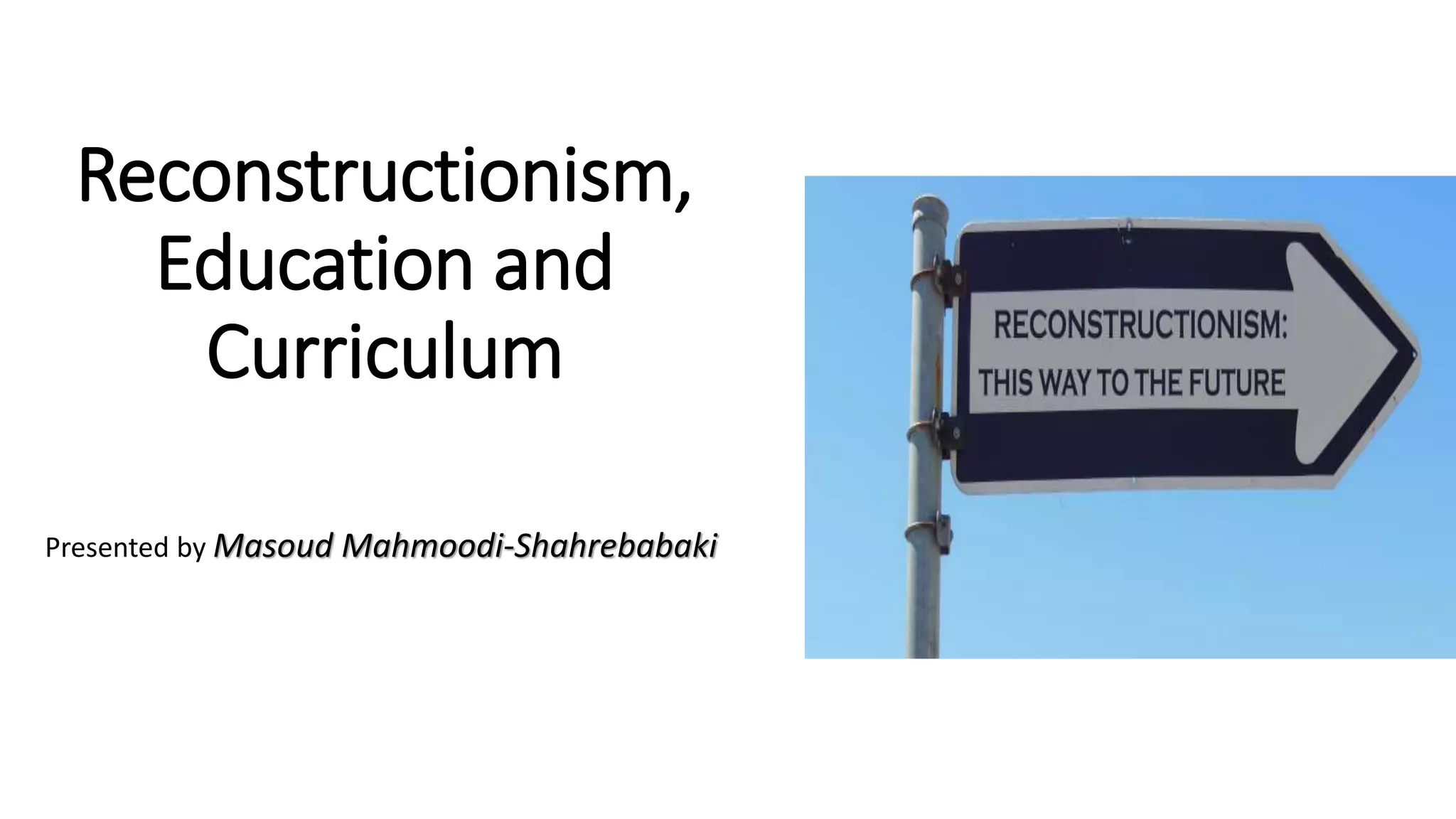
Reconstructionism,
Education and
Curriculum
Presented by Masoud Mahmoodi-Shahrebabaki
Background
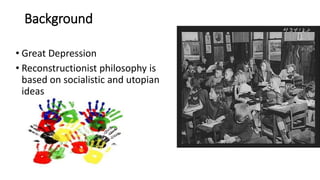
• Great Depression
• Reconstructionist philosophy is
based on socialistic and utopian
ideas
Theodore Brameld`s Perspective
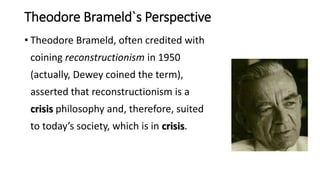
• Theodore Brameld, often credited with
coining reconstructionism in 1950
(actually, Dewey coined the term),
asserted that reconstructionism is a
crisis philosophy and, therefore, suited
to today’s society, which is in crisis.
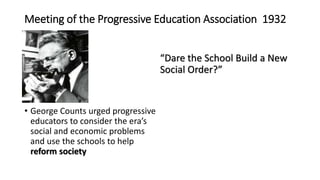
Meeting of the Progressive Education Association 1932
• George Counts urged progressive
educators to consider the era’s
social and economic problems
and use the schools to help
reform society
“Dare the School Build a New
Social Order?”
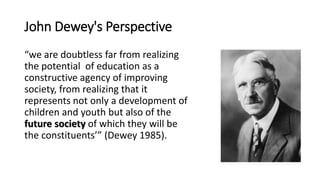
John Dewey's Perspective
“we are doubtless far from realizing
the potential of education as a
constructive agency of improving
society, from realizing that it
represents not only a development of
children and youth but also of the
future society of which they will be
the constituents’” (Dewey 1985).
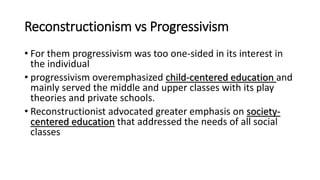
Reconstructionism vs Progressivism
• For them progressivism was too one-sided in its interest in
the individual
• progressivism overemphasized child-centered education and
mainly served the middle and upper classes with its play
theories and private schools.
• Reconstructionist advocated greater emphasis on society-
centered education that addressed the needs of all social
classes
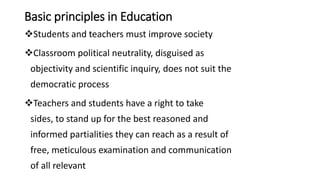
Basic principles in Education
Students and teachers must improve society
Classroom political neutrality, disguised as
objectivity and scientific inquiry, does not suit the
democratic process
Teachers and students have a right to take
sides, to stand up for the best reasoned and
informed partialities they can reach as a result of
free, meticulous examination and communication
of all relevant
Role of Teachers
• Teachers must measure up to their
social responsibilities.
• Teacher are agents of societal
change
• Teachers should strengthen control
of the schools by and for the goal-
seeking interests of the majority of
mankind.
Basic principles in Curriculum
• Curriculum must be transformed in
keeping with a new social-economic-
political education
• It must incorporate reform strategies
• Society is always changing, and the
curriculum has to change.
• A curriculum based on social issues
and services is ideal.
A Good Curriculum:
(1) critically examines a society’s
cultural heritage,
(2) examines controversial issues
unabashedly,
(3) commits to bringing about
constructive social change,
(4) cultivates a future-oriented
attitude that considers school reform
(5) enlists students and teachers to
enhance educational opportunities for
all children and youth.
Legacy : Critical Pedagogy
• students have the capacity to think, question, and
be critical.
• Teachers and schools need to educate students to be informed
citizens and agents for change.
• The students must be viewed as the major resource for promoting
and protecting democracy
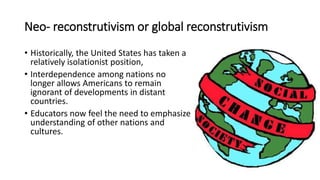
Neo- reconstrutivism or global reconstrutivism
• Historically, the United States has taken a
relatively isolationist position,
• Interdependence among nations no
longer allows Americans to remain
ignorant of developments in distant
countries.
• Educators now feel the need to emphasize
understanding of other nations and
cultures.
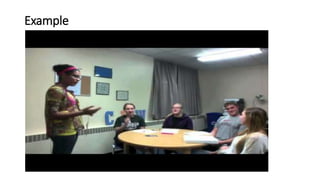
Example
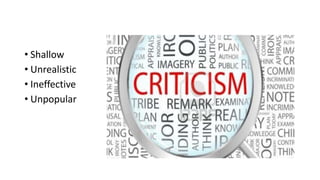
• Shallow
• Unrealistic
• Ineffective
• Unpopular

Reconstructionism, education and curriculum

  • 1.
  • 2.
    Background • Great Depression •Reconstructionist philosophy is based on socialistic and utopian ideas
  • 3.
    Theodore Brameld`s Perspective •Theodore Brameld, often credited with coining reconstructionism in 1950 (actually, Dewey coined the term), asserted that reconstructionism is a crisis philosophy and, therefore, suited to today’s society, which is in crisis.
  • 4.
    Meeting of theProgressive Education Association 1932 • George Counts urged progressive educators to consider the era’s social and economic problems and use the schools to help reform society “Dare the School Build a New Social Order?”
  • 5.
    John Dewey's Perspective “weare doubtless far from realizing the potential of education as a constructive agency of improving society, from realizing that it represents not only a development of children and youth but also of the future society of which they will be the constituents’” (Dewey 1985).
  • 6.
    Reconstructionism vs Progressivism •For them progressivism was too one-sided in its interest in the individual • progressivism overemphasized child-centered education and mainly served the middle and upper classes with its play theories and private schools. • Reconstructionist advocated greater emphasis on society- centered education that addressed the needs of all social classes
  • 7.
    Basic principles inEducation Students and teachers must improve society Classroom political neutrality, disguised as objectivity and scientific inquiry, does not suit the democratic process Teachers and students have a right to take sides, to stand up for the best reasoned and informed partialities they can reach as a result of free, meticulous examination and communication of all relevant
  • 8.
    Role of Teachers •Teachers must measure up to their social responsibilities. • Teacher are agents of societal change • Teachers should strengthen control of the schools by and for the goal- seeking interests of the majority of mankind.
  • 9.
    Basic principles inCurriculum • Curriculum must be transformed in keeping with a new social-economic- political education • It must incorporate reform strategies • Society is always changing, and the curriculum has to change. • A curriculum based on social issues and services is ideal.
  • 10.
    A Good Curriculum: (1)critically examines a society’s cultural heritage, (2) examines controversial issues unabashedly, (3) commits to bringing about constructive social change, (4) cultivates a future-oriented attitude that considers school reform (5) enlists students and teachers to enhance educational opportunities for all children and youth.
  • 11.
    Legacy : CriticalPedagogy • students have the capacity to think, question, and be critical. • Teachers and schools need to educate students to be informed citizens and agents for change. • The students must be viewed as the major resource for promoting and protecting democracy
  • 12.
    Neo- reconstrutivism orglobal reconstrutivism • Historically, the United States has taken a relatively isolationist position, • Interdependence among nations no longer allows Americans to remain ignorant of developments in distant countries. • Educators now feel the need to emphasize understanding of other nations and cultures.
  • 13.
  • 14.
    • Shallow • Unrealistic •Ineffective • Unpopular