

All dramatization is essentially
a process of communication, in
which both participant and
spectators are engaged.
DRAMATIC
EXPERIENCES come next to
contrived experiences in the
CONE. Can do these dramatic
experiences require us to be
dramatic in our entrance into a
classroom and in lesson
presentation.
A dramatic entrance is something
that catches an holds our attention
and has an emotional impact.
Something dramatic is something
that is stirring or affecting or moving.
If our teaching is dramatic, students
may get attracted, interested and
affected and may leave an impact on
them.
Dramatized experiences can
range from the formal plays,
pageants to less formal
tableau, pantomime,
puppets and role playing.
Depict life, character, or
culture or a combination of all
three.They offer excellent
opportunities to poverty vividly
important ideas about life.
1. PLAYS
2. PAGEANTS
Usually community dramas
that are based on local history,
presented by local actors.
An example is a historical
pageant that traces the growth
of a school.
3. PANTOMIME
Art of conveying a story
through bodily movements
only. Its effects on the
audience depends on the
movements of the actors.
4.TABLEAU
(a French word which means
picture). A picture like scene
composed of people against a
background. Often used to
celebrate Independence Day,
Christmas, and United Nations
Day.
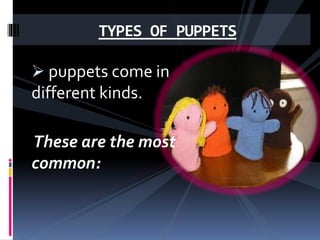
 puppets come in
different kinds.
These are the most
common:
TYPES OF PUPPETS
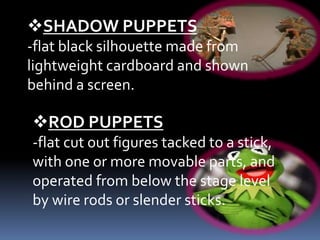
SHADOW PUPPETS
-flat black silhouette made from
lightweight cardboard and shown
behind a screen.
ROD PUPPETS
-flat cut out figures tacked to a stick,
with one or more movable parts, and
operated from below the stage level
by wire rods or slender sticks.
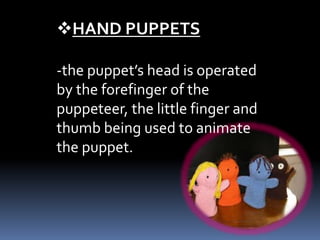
HAND PUPPETS
-the puppet’s head is operated
by the forefinger of the
puppeteer, the little finger and
thumb being used to animate
the puppet.
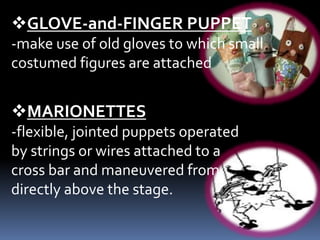
GLOVE-and-FINGER PUPPET
-make use of old gloves to which small
costumed figures are attached
MARIONETTES
-flexible, jointed puppets operated
by strings or wires attached to a
cross bar and maneuvered from
directly above the stage.
ADVANTAGES
1.Drama can improve vocabulary and reading comprehension.
2.Dramatizations provide for the development of
intelligences like linguistic and bodily-kinesthetic which
could not be enhanced through ordinary pen and paper test.
3.Drama could also develop skills in acquiring a foreign language.
4.Drama can stir the learner’s creativity and imagination.
5.Drama could be helpful in teaching attitude areas
including trust, self-acceptance, acceptance of others, and
empowerment.
6.The dramatizations could present a large chunk of concepts
within a short time.
LIMITATIONS
1.Dramatizations require a great deal of
money and labor.
2.Content may get out of context if role playing
is for older students.
THANK
YOU

Lesson 6 dramatization learning experience

  • 2.
    All dramatization isessentially a process of communication, in which both participant and spectators are engaged.
  • 3.
    DRAMATIC EXPERIENCES come nextto contrived experiences in the CONE. Can do these dramatic experiences require us to be dramatic in our entrance into a classroom and in lesson presentation.
  • 4.
    A dramatic entranceis something that catches an holds our attention and has an emotional impact. Something dramatic is something that is stirring or affecting or moving. If our teaching is dramatic, students may get attracted, interested and affected and may leave an impact on them.
  • 5.
    Dramatized experiences can rangefrom the formal plays, pageants to less formal tableau, pantomime, puppets and role playing.
  • 6.
    Depict life, character,or culture or a combination of all three.They offer excellent opportunities to poverty vividly important ideas about life. 1. PLAYS
  • 7.
    2. PAGEANTS Usually communitydramas that are based on local history, presented by local actors. An example is a historical pageant that traces the growth of a school.
  • 8.
    3. PANTOMIME Art ofconveying a story through bodily movements only. Its effects on the audience depends on the movements of the actors.
  • 9.
    4.TABLEAU (a French wordwhich means picture). A picture like scene composed of people against a background. Often used to celebrate Independence Day, Christmas, and United Nations Day.
  • 11.
     puppets comein different kinds. These are the most common: TYPES OF PUPPETS
  • 12.
    SHADOW PUPPETS -flat blacksilhouette made from lightweight cardboard and shown behind a screen. ROD PUPPETS -flat cut out figures tacked to a stick, with one or more movable parts, and operated from below the stage level by wire rods or slender sticks.
  • 13.
    HAND PUPPETS -the puppet’shead is operated by the forefinger of the puppeteer, the little finger and thumb being used to animate the puppet.
  • 14.
    GLOVE-and-FINGER PUPPET -make useof old gloves to which small costumed figures are attached MARIONETTES -flexible, jointed puppets operated by strings or wires attached to a cross bar and maneuvered from directly above the stage.
  • 15.
    ADVANTAGES 1.Drama can improvevocabulary and reading comprehension. 2.Dramatizations provide for the development of intelligences like linguistic and bodily-kinesthetic which could not be enhanced through ordinary pen and paper test. 3.Drama could also develop skills in acquiring a foreign language. 4.Drama can stir the learner’s creativity and imagination. 5.Drama could be helpful in teaching attitude areas including trust, self-acceptance, acceptance of others, and empowerment. 6.The dramatizations could present a large chunk of concepts within a short time.
  • 16.
    LIMITATIONS 1.Dramatizations require agreat deal of money and labor. 2.Content may get out of context if role playing is for older students.
  • 17.