 Comes from the word perennial meaning everlasting.
 A very conservative and inflexible philosophy of
education.
 A teacher-centered philosophy that emphasizes the
importance of transferring knowledge, information,
and skills from the older (presumably wiser)
generation to the younger one.
 Perennialism says since people are human, one
should teach first about humans, not machines or
techniques.
 Its similarity with essentialism
 Philosophers who described these theories
 Rules given by robert hutchins
 Teaching tules class tools
 Secular Perennialism –
 Definition of secular perennialism
◦ Robert Hutchins and Mortimer Adler
◦ Perennialism is learning to reason
◦ Advocates using original work in education
◦ Comprises the humanist and scientific traditions
◦ Secular Perennialist’s view point
 Religious Perennialism –
 Definition /Introduction
◦ First developed by Thomas Aquinas
◦ Religious Perennialism continues to shape the
nature of Catholic schools throughout the world
◦ John Henry Newman
 Definition of philosophical rationale
 Its positions
 Metaphysicsical Position
 Aristotelian ontology
 Father william Mcgucken
 Epistomological position
1. Permanence is more real than change
2. Human nature remains essentially the same
no matter the culture
3. The good life-the life that is fit for
man/woman to live-remains essentially the
same
4. Moral principles remain essentially the same
5. Education that men/women receive should
remain essentially the same
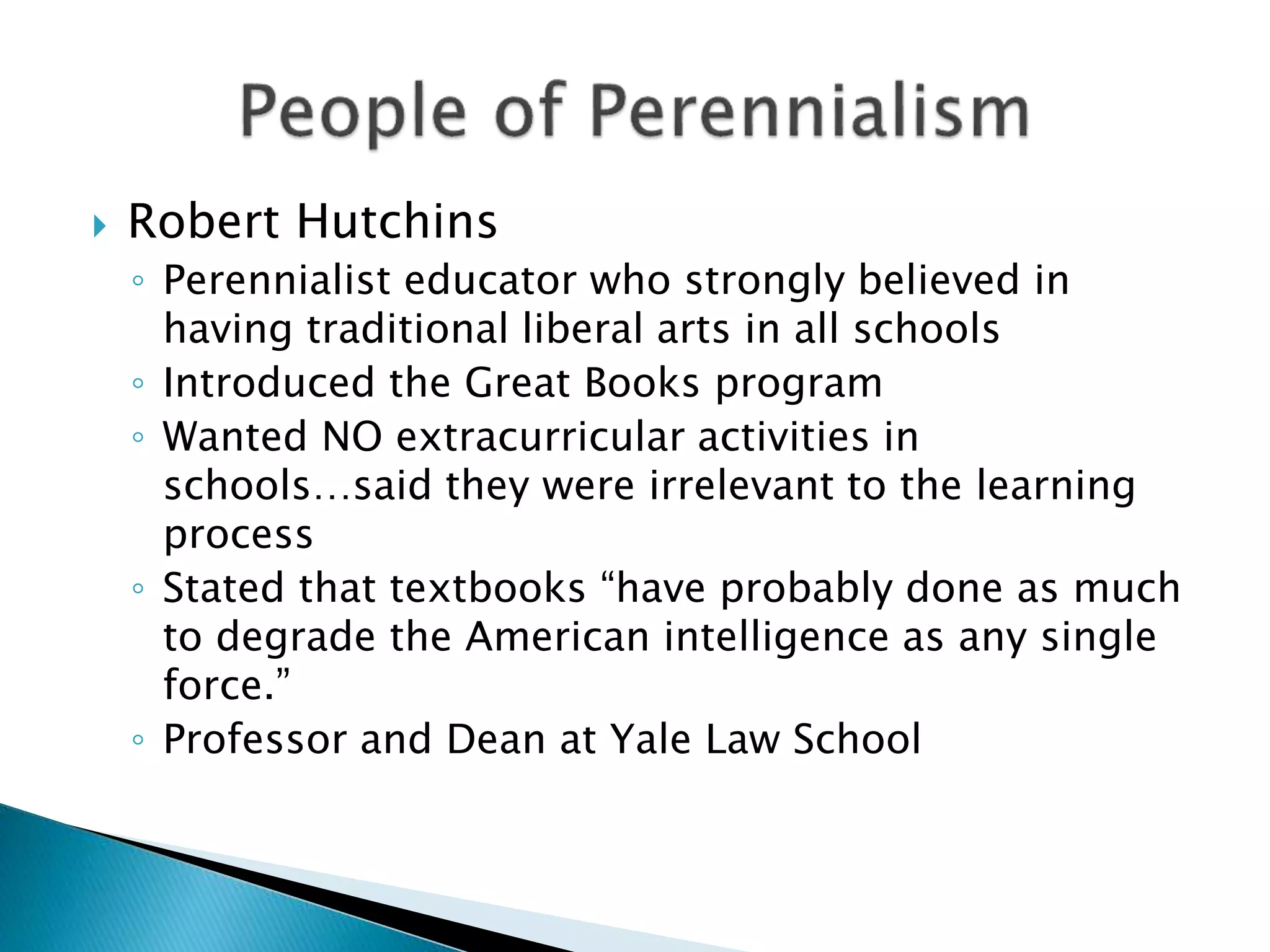
 Robert Hutchins
◦ Perennialist educator who strongly believed in
having traditional liberal arts in all schools
◦ Introduced the Great Books program
◦ Wanted NO extracurricular activities in
schools…said they were irrelevant to the learning
process
◦ Stated that textbooks “have probably done as much
to degrade the American intelligence as any single
force.”
◦ Professor and Dean at Yale Law School
 Mortimer Adler
◦ Helped Hutchins organize the Great Books program
◦ Proposed a single elementary and secondary
curriculum for all students, with no curricular
electives except the choice of a second language
◦ Professor of Philosophy at Columbia University
 Students spend most of their time mastering
the three “Rs”- reading, ‘riting, ‘rithmetic
 Greatest importance placed on reading
 Teach values and character training through
discussions about underlying values and
moral principles in stories
 Only elective is the choice of second language
 Few, if any, textbooks
 Schools are organized around books, ideas,
and concepts
 Teach from the Great Books-works by
history’s finest thinkers and writers
 Teachers do not lecture but lead and facilitate
discussions
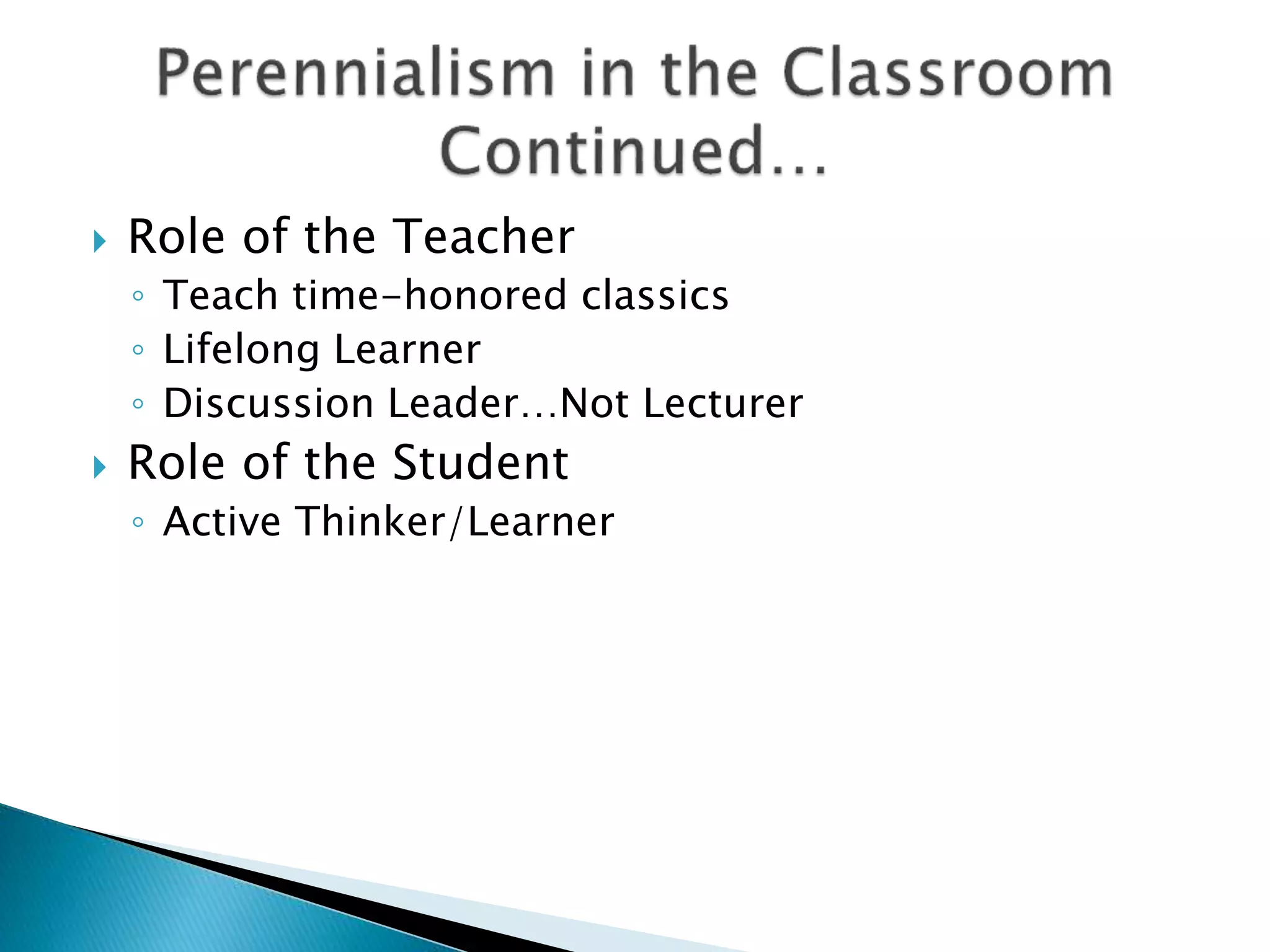
 Role of the Teacher
◦ Teach time-honored classics
◦ Lifelong Learner
◦ Discussion Leader…Not Lecturer
 Role of the Student
◦ Active Thinker/Learner
 Teaching Tools
◦ Standardized Tests
◦ Teacher-made tests
◦ Memorization
◦ Classic Books
 Classroom Management
◦ Orderly rows
◦ Neat/Clean room
◦ Strict rules
◦ Punishment/Rewards
 Perennialism was started in the 1930s
 Perennialism IS still around
 St. John’s College in Annapolis, Maryland
◦ Adopted the Great Books as a core curriculum in
1937
◦ Readings in Literature, Philosophy, Theology,
History, Social Sciences, Mathematics, and Music
◦ Students write extensively and attend weekly
seminars to discuss assigned readings
 Grades are given but students only receive
their grades upon request
 Expected to learn for learning’s sake
 Thrives in small-group atmosphere
 2nd campus opened in 1964 in Santa Fe, New
Mexico
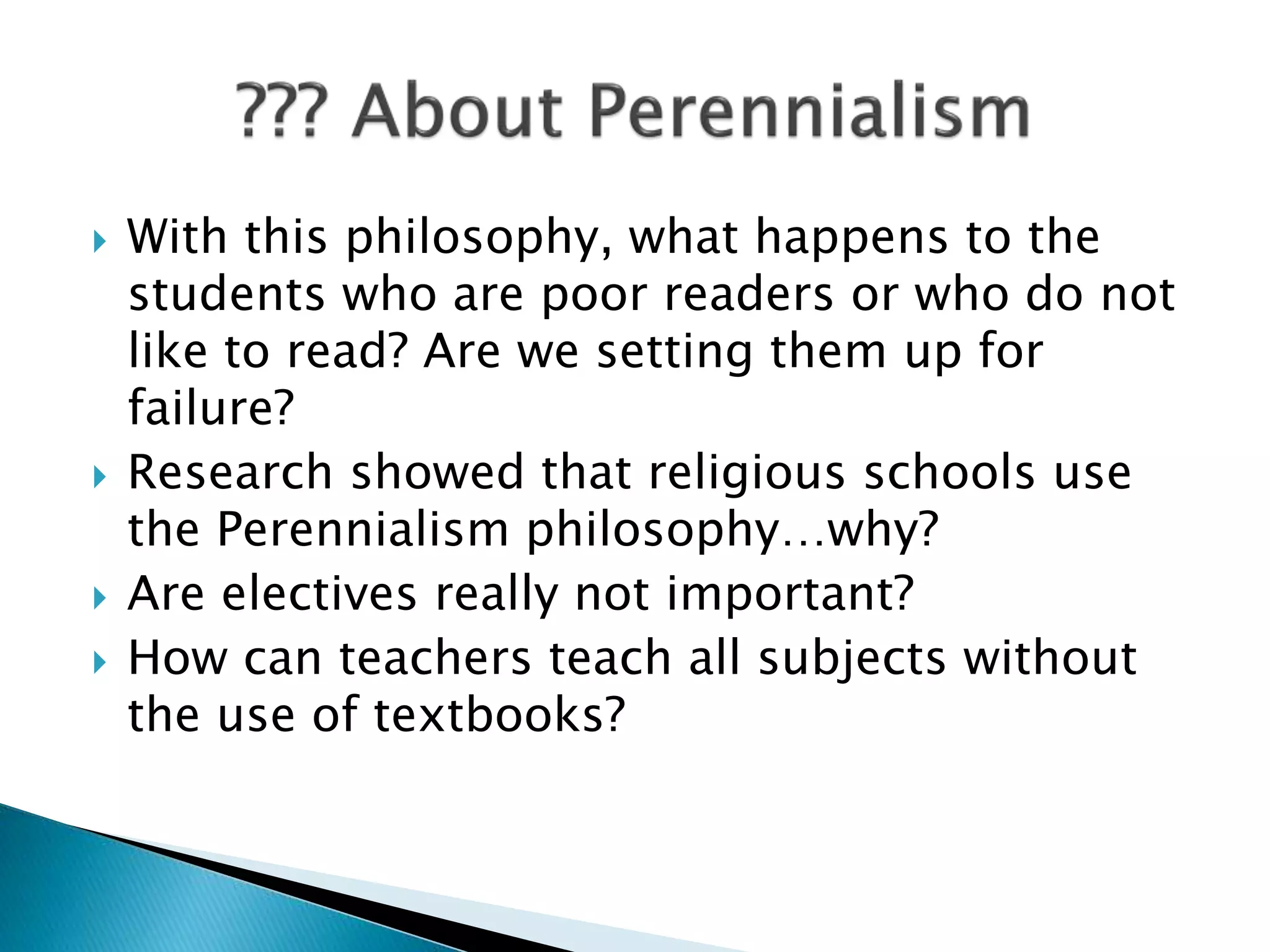
 With this philosophy, what happens to the
students who are poor readers or who do not
like to read? Are we setting them up for
failure?
 Research showed that religious schools use
the Perennialism philosophy…why?
 Are electives really not important?
 How can teachers teach all subjects without
the use of textbooks?
 www.oregonstate.edu
 www.successfuleducation.info
 Ediger, M. (1997). Influence of ten leading
educators of American education. Education,
118(2), 267. Retrieved from EBSCOhost.
 Perennialism (2003). Retrieved from
http://www.mtsu.edu/~tsbrown/pere.htm
 Sadker, D., Zittleman, K. Teachers, Schools,
and Society: A Brief Introduction to Education.
p.200-207. Retrieved from
http://www.education.com

Perennialism theory of education

  • 2.
     Comes fromthe word perennial meaning everlasting.  A very conservative and inflexible philosophy of education.  A teacher-centered philosophy that emphasizes the importance of transferring knowledge, information, and skills from the older (presumably wiser) generation to the younger one.  Perennialism says since people are human, one should teach first about humans, not machines or techniques.  Its similarity with essentialism  Philosophers who described these theories  Rules given by robert hutchins  Teaching tules class tools
  • 3.
     Secular Perennialism–  Definition of secular perennialism ◦ Robert Hutchins and Mortimer Adler ◦ Perennialism is learning to reason ◦ Advocates using original work in education ◦ Comprises the humanist and scientific traditions ◦ Secular Perennialist’s view point
  • 4.
     Religious Perennialism–  Definition /Introduction ◦ First developed by Thomas Aquinas ◦ Religious Perennialism continues to shape the nature of Catholic schools throughout the world ◦ John Henry Newman
  • 5.
     Definition ofphilosophical rationale  Its positions  Metaphysicsical Position  Aristotelian ontology  Father william Mcgucken  Epistomological position
  • 7.
    1. Permanence ismore real than change 2. Human nature remains essentially the same no matter the culture 3. The good life-the life that is fit for man/woman to live-remains essentially the same 4. Moral principles remain essentially the same 5. Education that men/women receive should remain essentially the same
  • 8.
     Robert Hutchins ◦Perennialist educator who strongly believed in having traditional liberal arts in all schools ◦ Introduced the Great Books program ◦ Wanted NO extracurricular activities in schools…said they were irrelevant to the learning process ◦ Stated that textbooks “have probably done as much to degrade the American intelligence as any single force.” ◦ Professor and Dean at Yale Law School
  • 9.
     Mortimer Adler ◦Helped Hutchins organize the Great Books program ◦ Proposed a single elementary and secondary curriculum for all students, with no curricular electives except the choice of a second language ◦ Professor of Philosophy at Columbia University
  • 10.
     Students spendmost of their time mastering the three “Rs”- reading, ‘riting, ‘rithmetic  Greatest importance placed on reading  Teach values and character training through discussions about underlying values and moral principles in stories  Only elective is the choice of second language
  • 11.
     Few, ifany, textbooks  Schools are organized around books, ideas, and concepts  Teach from the Great Books-works by history’s finest thinkers and writers  Teachers do not lecture but lead and facilitate discussions
  • 12.
     Role ofthe Teacher ◦ Teach time-honored classics ◦ Lifelong Learner ◦ Discussion Leader…Not Lecturer  Role of the Student ◦ Active Thinker/Learner
  • 13.
     Teaching Tools ◦Standardized Tests ◦ Teacher-made tests ◦ Memorization ◦ Classic Books  Classroom Management ◦ Orderly rows ◦ Neat/Clean room ◦ Strict rules ◦ Punishment/Rewards
  • 14.
     Perennialism wasstarted in the 1930s  Perennialism IS still around  St. John’s College in Annapolis, Maryland ◦ Adopted the Great Books as a core curriculum in 1937 ◦ Readings in Literature, Philosophy, Theology, History, Social Sciences, Mathematics, and Music ◦ Students write extensively and attend weekly seminars to discuss assigned readings
  • 15.
     Grades aregiven but students only receive their grades upon request  Expected to learn for learning’s sake  Thrives in small-group atmosphere  2nd campus opened in 1964 in Santa Fe, New Mexico
  • 16.
     With thisphilosophy, what happens to the students who are poor readers or who do not like to read? Are we setting them up for failure?  Research showed that religious schools use the Perennialism philosophy…why?  Are electives really not important?  How can teachers teach all subjects without the use of textbooks?
  • 17.
     www.oregonstate.edu  www.successfuleducation.info Ediger, M. (1997). Influence of ten leading educators of American education. Education, 118(2), 267. Retrieved from EBSCOhost.  Perennialism (2003). Retrieved from http://www.mtsu.edu/~tsbrown/pere.htm  Sadker, D., Zittleman, K. Teachers, Schools, and Society: A Brief Introduction to Education. p.200-207. Retrieved from http://www.education.com