Philosophical School of Thought


RECONSTRUCTIO
      N
Thinkers

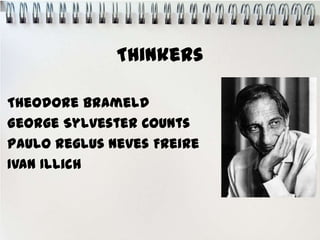
Theodore Brameld
George Sylvester Counts
Paulo Reglus Neves Freire
Ivan Illich
Assumptions
• Man to a significant degree plan and control his
  society.
• Society is in need of constant reconstruction.
• Social change involves a reconstruction of
  education and the use of education in reconstructing
  society.
• Mankind has the intellectual, technological, and
  moral potential to create a world civilization of
  abundance, health and human capacity.
Role of Teachers
• Lead the learners in designing programs for social,
  educational, practical and economic change.

• Primary agent of social change.

• Initiates lively discussions on controversial issues,
  political and educational.

• Enables the learners to critically examine their cultural
  heritage.
Models/
             and
          Strategies

Community-based projects
Problem-oriented method
Educational Aim
• Education is based on the
 quest for better society.

• Education enlivens the
 students’ awareness of
 different societal
 problems.
Curriculum Emphasis
• Stresses learning that enable the individual to live in a
  global milieu.

• Controversial national and international issues.

• Emphasis on social sciences and social research methods;
  examination of social, economic and political problems.

• Focused on present and future trends.
THE END

Reconstructivism

  • 1.
    Philosophical School ofThought RECONSTRUCTIO N
  • 2.
    Thinkers Theodore Brameld George SylvesterCounts Paulo Reglus Neves Freire Ivan Illich
  • 3.
    Assumptions • Man toa significant degree plan and control his society. • Society is in need of constant reconstruction. • Social change involves a reconstruction of education and the use of education in reconstructing society. • Mankind has the intellectual, technological, and moral potential to create a world civilization of abundance, health and human capacity.
  • 4.
    Role of Teachers •Lead the learners in designing programs for social, educational, practical and economic change. • Primary agent of social change. • Initiates lively discussions on controversial issues, political and educational. • Enables the learners to critically examine their cultural heritage.
  • 5.
    Models/ and Strategies Community-based projects Problem-oriented method
  • 6.
    Educational Aim • Educationis based on the quest for better society. • Education enlivens the students’ awareness of different societal problems.
  • 7.
    Curriculum Emphasis • Stresseslearning that enable the individual to live in a global milieu. • Controversial national and international issues. • Emphasis on social sciences and social research methods; examination of social, economic and political problems. • Focused on present and future trends.
  • 8.