Also known as SOCIAL
RECONSTRUCTIONISM, this theory
claims to be the true successor of
progressivism and declares that the chief
of purpose of education is to
“RECONSTRUCT” society in order to
meet the cultural crisis brought about by
social, political, and economic problems.
Is a philosophy that emphasizes the
addressing of social questions and a quest
to create a better society an worldwide
democracy. Typically a Reconstructionist
focuses on a curriculum that highlights
social reform.
Social Reconstructionism
Philosophical Root
Pragmatism
- A reasonable
and logical way
of doing things
or thinking about
problems that is
based on dealing
w i t h s p e c i f i c
s i t u a t i o n s
instead of ideas
and theories.
Theodore Brameld
(1904-1987) was
considered the founder
of social
reconstructionism
He recognized the
potential for either
human annihilation
through technology
and human cruelty,
and the use technology
and human
compassion to create a
beneficent society.
Principal Proponents
George Counts (1889-1974)
Recognized that education was the
means of preparing people for
creating this new social order.
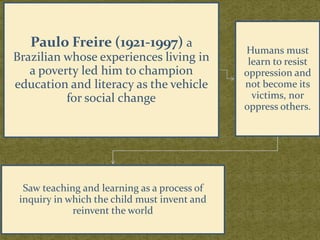
Paulo Freire (1921-1997) a
Brazilian whose experiences living in
a poverty led him to champion
education and literacy as the vehicle
for social change
Humans must
learn to resist
oppression and
not become its
victims, nor
oppress others.
Saw teaching and learning as a process of
inquiry in which the child must invent and
reinvent the world
Critically examine all
cultural and educational
institutions and
recommended change
and reform as needed,
To teach students and
the public not to settle
for “what is” but rather to
dream about “what
might be”
Prepare Students to
become agents for
change
The Purpose of Schooling
Students are a critical element in bringing
social change.
Students are capable of initiating and
adapting to change especially if they are
influenced by appropriate adult role models.
Nature of the Learner
Reflect
democratic
ideals and
emphasize
civic
education.
Opportunity for
students to gain
first hand
experience in
studying real
social problems
and
controversial
issues.
Students consider
societal problems
such as place of
ethics in
improving quality
of life, conserve
natural resources,
and issues of
foreign policy and
naturalism
Curriculum
Cooperative learning, problem solving,
critical thinking.
Focus on active learning and activities
outside of school.
Students spend time in the community to
learn its problems.
Would analyze research and link issues to
place in the community and larger society.
Take action of responsibility in planning
or change.
Instructional Methods
KAMSAHAMNIDA

Reconstructionism

  • 2.
    Also known asSOCIAL RECONSTRUCTIONISM, this theory claims to be the true successor of progressivism and declares that the chief of purpose of education is to “RECONSTRUCT” society in order to meet the cultural crisis brought about by social, political, and economic problems.
  • 3.
    Is a philosophythat emphasizes the addressing of social questions and a quest to create a better society an worldwide democracy. Typically a Reconstructionist focuses on a curriculum that highlights social reform. Social Reconstructionism
  • 4.
    Philosophical Root Pragmatism - Areasonable and logical way of doing things or thinking about problems that is based on dealing w i t h s p e c i f i c s i t u a t i o n s instead of ideas and theories.
  • 5.
    Theodore Brameld (1904-1987) was consideredthe founder of social reconstructionism He recognized the potential for either human annihilation through technology and human cruelty, and the use technology and human compassion to create a beneficent society. Principal Proponents
  • 6.
    George Counts (1889-1974) Recognizedthat education was the means of preparing people for creating this new social order.
  • 7.
    Paulo Freire (1921-1997)a Brazilian whose experiences living in a poverty led him to champion education and literacy as the vehicle for social change Humans must learn to resist oppression and not become its victims, nor oppress others. Saw teaching and learning as a process of inquiry in which the child must invent and reinvent the world
  • 8.
    Critically examine all culturaland educational institutions and recommended change and reform as needed, To teach students and the public not to settle for “what is” but rather to dream about “what might be” Prepare Students to become agents for change The Purpose of Schooling
  • 9.
    Students are acritical element in bringing social change. Students are capable of initiating and adapting to change especially if they are influenced by appropriate adult role models. Nature of the Learner
  • 10.
    Reflect democratic ideals and emphasize civic education. Opportunity for studentsto gain first hand experience in studying real social problems and controversial issues. Students consider societal problems such as place of ethics in improving quality of life, conserve natural resources, and issues of foreign policy and naturalism Curriculum
  • 11.
    Cooperative learning, problemsolving, critical thinking. Focus on active learning and activities outside of school. Students spend time in the community to learn its problems. Would analyze research and link issues to place in the community and larger society. Take action of responsibility in planning or change. Instructional Methods
  • 12.