Educational Ethics
Bharti Kumari
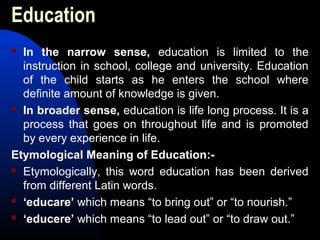
Education
 In the narrow sense, education is limited to the
instruction in school, college and university. Education
of the child starts as he enters the school where
definite amount of knowledge is given.
 In broader sense, education is life long process. It is a
process that goes on throughout life and is promoted
by every experience in life.
Etymological Meaning of Education:-
 Etymologically, this word education has been derived
from different Latin words.
 ‘educare’ which means “to bring out” or “to nourish.”
 ‘educere’ which means “to lead out” or “to draw out.”
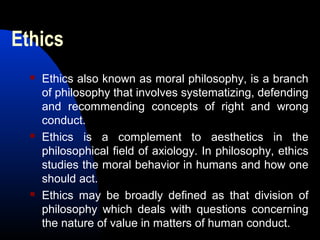
Ethics
 Ethics also known as moral philosophy, is a branch
of philosophy that involves systematizing, defending
and recommending concepts of right and wrong
conduct.
 Ethics is a complement to aesthetics in the
philosophical field of axiology. In philosophy, ethics
studies the moral behavior in humans and how one
should act.
 Ethics may be broadly defined as that division of
philosophy which deals with questions concerning
the nature of value in matters of human conduct.
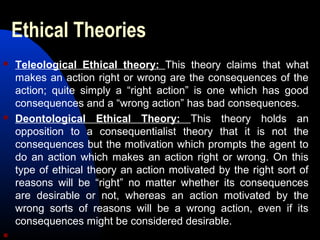
Ethical Theories
 Teleological Ethical theory: This theory claims that what
makes an action right or wrong are the consequences of the
action; quite simply a “right action” is one which has good
consequences and a “wrong action” has bad consequences.
 Deontological Ethical Theory: This theory holds an
opposition to a consequentialist theory that it is not the
consequences but the motivation which prompts the agent to
do an action which makes an action right or wrong. On this
type of ethical theory an action motivated by the right sort of
reasons will be “right” no matter whether its consequences
are desirable or not, whereas an action motivated by the
wrong sorts of reasons will be a wrong action, even if its
consequences might be considered desirable.

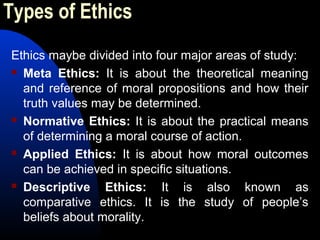
Types of Ethics
Ethics maybe divided into four major areas of study:
 Meta Ethics: It is about the theoretical meaning
and reference of moral propositions and how their
truth values may be determined.
 Normative Ethics: It is about the practical means
of determining a moral course of action.
 Applied Ethics: It is about how moral outcomes
can be achieved in specific situations.
 Descriptive Ethics: It is also known as
comparative ethics. It is the study of people’s
beliefs about morality.
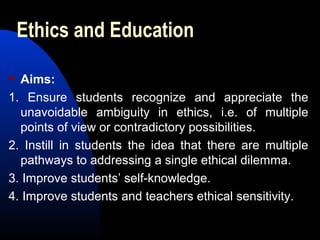
Ethics and Education
 Aims:
1. Ensure students recognize and appreciate the
unavoidable ambiguity in ethics, i.e. of multiple
points of view or contradictory possibilities.
2. Instill in students the idea that there are multiple
pathways to addressing a single ethical dilemma.
3. Improve students’ self-knowledge.
4. Improve students and teachers ethical sensitivity.
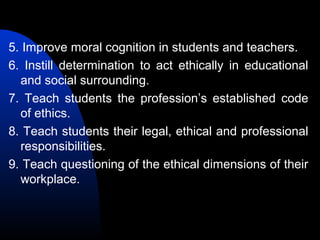
5. Improve moral cognition in students and teachers.
6. Instill determination to act ethically in educational
and social surrounding.
7. Teach students the profession’s established code
of ethics.
8. Teach students their legal, ethical and professional
responsibilities.
9. Teach questioning of the ethical dimensions of their
workplace.
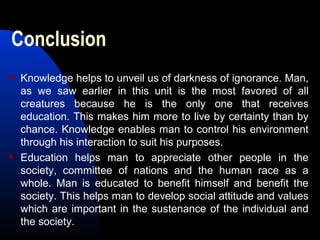
Conclusion
 Knowledge helps to unveil us of darkness of ignorance. Man,
as we saw earlier in this unit is the most favored of all
creatures because he is the only one that receives
education. This makes him more to live by certainty than by
chance. Knowledge enables man to control his environment
through his interaction to suit his purposes.
 Education helps man to appreciate other people in the
society, committee of nations and the human race as a
whole. Man is educated to benefit himself and benefit the
society. This helps man to develop social attitude and values
which are important in the sustenance of the individual and
the society.
Conclusion
 The development of positive social values and attitude helps
to improve his personality and character which are the
hallmark of all educated person. Man is a social animal who
is not capable of solitary life. By implication, he lives in the
society and abides by the societal demands. Every society
where man finds himself is built on the principles of morality
as its foundation.
 Since man is capable of being good and bad, he needs to be
prepared to do good at all times through education. This is
what makes education a value laden enterprise because it
aims at the betterment of man in order to live a better life in
the society.
That's all
Thank you for your attention.

Educational philosophy

  • 1.
  • 2.
    Education  In thenarrow sense, education is limited to the instruction in school, college and university. Education of the child starts as he enters the school where definite amount of knowledge is given.  In broader sense, education is life long process. It is a process that goes on throughout life and is promoted by every experience in life. Etymological Meaning of Education:-  Etymologically, this word education has been derived from different Latin words.  ‘educare’ which means “to bring out” or “to nourish.”  ‘educere’ which means “to lead out” or “to draw out.”
  • 3.
    Ethics  Ethics alsoknown as moral philosophy, is a branch of philosophy that involves systematizing, defending and recommending concepts of right and wrong conduct.  Ethics is a complement to aesthetics in the philosophical field of axiology. In philosophy, ethics studies the moral behavior in humans and how one should act.  Ethics may be broadly defined as that division of philosophy which deals with questions concerning the nature of value in matters of human conduct.
  • 4.
    Ethical Theories  TeleologicalEthical theory: This theory claims that what makes an action right or wrong are the consequences of the action; quite simply a “right action” is one which has good consequences and a “wrong action” has bad consequences.  Deontological Ethical Theory: This theory holds an opposition to a consequentialist theory that it is not the consequences but the motivation which prompts the agent to do an action which makes an action right or wrong. On this type of ethical theory an action motivated by the right sort of reasons will be “right” no matter whether its consequences are desirable or not, whereas an action motivated by the wrong sorts of reasons will be a wrong action, even if its consequences might be considered desirable. 
  • 5.
    Types of Ethics Ethicsmaybe divided into four major areas of study:  Meta Ethics: It is about the theoretical meaning and reference of moral propositions and how their truth values may be determined.  Normative Ethics: It is about the practical means of determining a moral course of action.  Applied Ethics: It is about how moral outcomes can be achieved in specific situations.  Descriptive Ethics: It is also known as comparative ethics. It is the study of people’s beliefs about morality.
  • 6.
    Ethics and Education Aims: 1. Ensure students recognize and appreciate the unavoidable ambiguity in ethics, i.e. of multiple points of view or contradictory possibilities. 2. Instill in students the idea that there are multiple pathways to addressing a single ethical dilemma. 3. Improve students’ self-knowledge. 4. Improve students and teachers ethical sensitivity.
  • 7.
    5. Improve moralcognition in students and teachers. 6. Instill determination to act ethically in educational and social surrounding. 7. Teach students the profession’s established code of ethics. 8. Teach students their legal, ethical and professional responsibilities. 9. Teach questioning of the ethical dimensions of their workplace.
  • 8.
    Conclusion  Knowledge helpsto unveil us of darkness of ignorance. Man, as we saw earlier in this unit is the most favored of all creatures because he is the only one that receives education. This makes him more to live by certainty than by chance. Knowledge enables man to control his environment through his interaction to suit his purposes.  Education helps man to appreciate other people in the society, committee of nations and the human race as a whole. Man is educated to benefit himself and benefit the society. This helps man to develop social attitude and values which are important in the sustenance of the individual and the society.
  • 9.
    Conclusion  The developmentof positive social values and attitude helps to improve his personality and character which are the hallmark of all educated person. Man is a social animal who is not capable of solitary life. By implication, he lives in the society and abides by the societal demands. Every society where man finds himself is built on the principles of morality as its foundation.  Since man is capable of being good and bad, he needs to be prepared to do good at all times through education. This is what makes education a value laden enterprise because it aims at the betterment of man in order to live a better life in the society.
  • 10.
    That's all Thank youfor your attention.