“My Portfolio in
Educational Technology”
The student
Educational Technology in a Nutshell
Learning Through Educational
Technology 1 and Educational
Technology 2
The Student after Educational
Technology
 References
“The STUDENT”
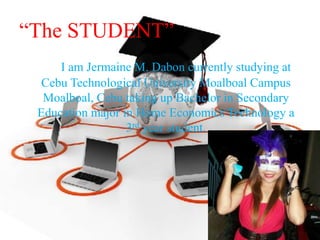
I am Jermaine M. Dabon currently studying at
Cebu Technological University Moalboal Campus
Moalboal, Cebu taking up Bachelor in Secondary
Education major in Home Economics Technology a
3rd year student.
“Educational Technology”
INTRODUCTION
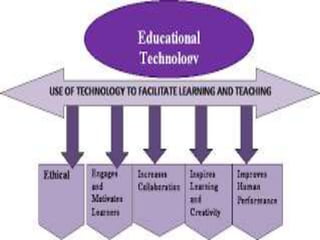
Educational technology is the effective use of
technological tools in learning. As a concept, it
concerns an array of tools, such as media, machines and
networking hardware, as well as considering underlying
theoretical perspectives for their effective application.
Educational technology is not restricted to high
technology.] Also called e-learning, it includes an array
of approaches, components, and delivery methods.
“Educational Technology”
Preference of the Technology Generation
Text vs. Visual
Linear vs. Hyper Media
Independent vs. Social Learners
Learning to do vs. To pass the Test
Delayed rewards vs. Instant gratification
Rote memory vs. Fun learning
“Educational Technology”
Higher Thinking Skills Through
IT-Based Projects
The four IT-based projects:
1. Resource-based Projects
2. Simple Creation
3. Guided Hypermedia Projects
4. Web-based Project
“Educational Technology”
Consist of the designs and environments that
engage learners and reliable techniques or
method for engaging learners such as
cognitive learning and critical thinking skills.
Educational Technology “BOON or
BANE”?
• Technology is necessary but not always a
positive influence in modern life. This issue
has especially come into vogue in the last
decade due to the mind-boggling pace of
technology. Also, this issue is a complex one
because it involves a conflict between the
traditional and the modern.
Educational Technology “BANE”
• Bane is a Modern English word meaning "that which causes ruin or
woe",
Some people consider technology bane because it is making people
lazy. Kids that used to go outside and play stay in and play video
games and go on the computer all day. People tend to forget how to do
things for themselves, even using a calculator just to do simple math
that you could easily write down and figure out. Instead of exercising
our minds we just use a calculator. While technology is great and
helpful and a HUGE part of modern society if one day it failed, we'd go
into chaos. No bank, no super information highway, no radio, no
computer, no telephone, our missiles and dangerous things like that
would be compromised. If you haven't, watch the movie Wall-E. In
there you will see how they portray how the future of people might
behave if we all had such sophisticated technology we'd grow fat and
ride around in chairs. Hope that helps a bit and sparks some ideas of
your own on how technology can be bane.
Educational Technology “BOON”
• Technology advances show people a more efficient way
to do things, and these processes get results. For
example, education has been greatly advanced by the
technological advances of computers. Students are able
to learn on a global scale without ever leaving their
classrooms. Agricultural processes that once required
dozens upon dozens of human workers can now be
automated, thanks to advances in technology, which
means cost-efficiency for farmers. Medical discoveries
occur at a much more rapid rate, thanks to machines
and computers that aid in the research process and
allow for more intense educational research into
medical matters.
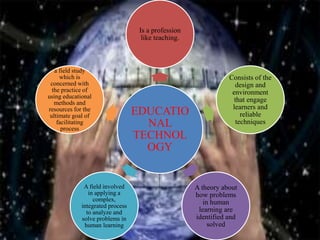
EDUCATIO
NAL
TECHNOL
OGY
Is a profession
like teaching.
Consists of the
design and
environment
that engage
learners and
reliable
techniques
A theory about
how problems
in human
learning are
identified and
solved
A field involved
in applying a
complex,
integrated process
to analyze and
solve problems in
human learning
a field study
which is
concerned with
the practice of
using educational
methods and
resources for the
ultimate goal of
facilitating
process
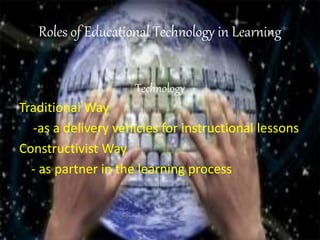
Roles of Educational Technology in Learning
Technology
Traditional Way
-as a delivery vehicles for instructional lessons
Constructivist Way
- as partner in the learning process
TECHNOLOGY
TRADITIONAL
 technology serves as source and presenter
of knowledge.
 it is assumed that “knowledge is
embedded in the technology” and the
technology presents that knowledge to a
student
 technology like computers is seen as
productivity tool
Technology
CONSTRUCTIVIST
 educational technology serves as learning
tools to learn with
 it engages learners in active, constructive,
intentional, authentic and cooperative
learning.
 it provides opportunities for technology and
learner interaction for meaningful learning
ROLES OF TECHNOLOGY
 technology as tools to support knowledge
construction
 technology as information vehicles for exploring
knowledge to support learning-by-constructing
 technology as context to support learning-by-
doing
 technology as a social medium to support
learning by conversing
 technology as intellectual partner to support
learning-by-reflecting
Systematic Approach to Teaching
• It is a network of elements or parts
different from each other but each
one is special in the sense that each
performs a unique function for the
life and effectiveness of the
instructional system.
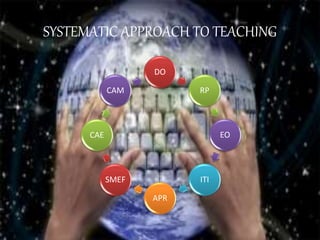
SYSTEMATIC APPROACH TO TEACHING
DO
RP
EO
ITI
APR
SMEF
CAE
CAM
Learning in Educational Technology 1
• Educational technology refers to the use of
both physical hardware and educational
theoretics. It encompasses several domains,
including learning theory, computer-based
training, online learning, and, where mobile
technologies are used, m-learning.
Accordingly, there are several discrete aspects
to describing the intellectual and technical
development of educational technology.
Learning in Educational Technology 1
• Educational technology is an inclusive term for
the tools and the theoretical foundations for
supporting learning and teaching. Educational
technology is not restricted to high
technology.
Learning in Educational Technology 2
• Educational technology 2 is concerned with
“Integrating Technology into Teaching and Learning.”
Specifically this is focused on introducing, reinforcing,
supplementing and extending the knowledge and skills
to learners so that they can become exemplary users of
educational technology. Mainly directed to student
teachers, also professional teachers who may wish to
update their knowledge of educational technology, it is
our goal that this course can help our target learners to
weave technology in teaching with software (computer
programmed learning materials) becoming a natural
extension of their learning tools.
What is Technology if it is not;
 Not a collection of machine
 Not a product
 Not a software
 Not about learning how to use hardware and
software
“Past Education”
The past education, students learned
from the teachers. Facts were learned
from textbooks. Learning took place in
the classroom. Teachers asked questions
and students answered them. Information
about far away places was found in
books.
“Present Education”
• I The present education students learned
from the teachers, each other, the internet,
books, movies, people inside the school,
people outside the school, people in the
countries. Students learn through inquiry. They
ask questions, wonder, explore, experiment
and investigate new ideas. They make online
global connections and learn about far way
places directly from people who live in them.
“FUTURE EDUCATION”
– Teachers form the past could never have
envisioned what’s happening in the present. I can
imagine the immediate future, since there are many
inspiring educators who are already way ahead of
our school in creating global connections and
collaborating across the world in all sorts of
exciting ways. They are motivating us to flatten
our classroom walls still more. And after that the
possibilities are ENDLESS!!!
The Student after Edtech2
• The future is about access, anywhere learning
and collaboration, both locally and
globally. Teachingand learning is going to be
social. Schools of the future could have a
traditional cohort of students, as well as online
only students who live across the country or
even the world. Things are already starting to
move this way with the emergence of massive
open online courses (MOOCs)
REFERENCES:
 “Hand-out / Power Point Print out
https://www.google.com.ph/search?q=the+st
udent+after+education+technology
http://www.famu.edu/index.cfm?TechEd&Def
initionofTechnologyEducation

My Final Presentation about Ed Tech 1 and 2.

  • 1.
  • 2.
    The student Educational Technologyin a Nutshell Learning Through Educational Technology 1 and Educational Technology 2 The Student after Educational Technology  References
  • 3.
    “The STUDENT” I amJermaine M. Dabon currently studying at Cebu Technological University Moalboal Campus Moalboal, Cebu taking up Bachelor in Secondary Education major in Home Economics Technology a 3rd year student.
  • 4.
    “Educational Technology” INTRODUCTION Educational technologyis the effective use of technological tools in learning. As a concept, it concerns an array of tools, such as media, machines and networking hardware, as well as considering underlying theoretical perspectives for their effective application. Educational technology is not restricted to high technology.] Also called e-learning, it includes an array of approaches, components, and delivery methods.
  • 5.
    “Educational Technology” Preference ofthe Technology Generation Text vs. Visual Linear vs. Hyper Media Independent vs. Social Learners Learning to do vs. To pass the Test Delayed rewards vs. Instant gratification Rote memory vs. Fun learning
  • 6.
    “Educational Technology” Higher ThinkingSkills Through IT-Based Projects The four IT-based projects: 1. Resource-based Projects 2. Simple Creation 3. Guided Hypermedia Projects 4. Web-based Project
  • 7.
    “Educational Technology” Consist ofthe designs and environments that engage learners and reliable techniques or method for engaging learners such as cognitive learning and critical thinking skills.
  • 8.
    Educational Technology “BOONor BANE”? • Technology is necessary but not always a positive influence in modern life. This issue has especially come into vogue in the last decade due to the mind-boggling pace of technology. Also, this issue is a complex one because it involves a conflict between the traditional and the modern.
  • 9.
    Educational Technology “BANE” •Bane is a Modern English word meaning "that which causes ruin or woe", Some people consider technology bane because it is making people lazy. Kids that used to go outside and play stay in and play video games and go on the computer all day. People tend to forget how to do things for themselves, even using a calculator just to do simple math that you could easily write down and figure out. Instead of exercising our minds we just use a calculator. While technology is great and helpful and a HUGE part of modern society if one day it failed, we'd go into chaos. No bank, no super information highway, no radio, no computer, no telephone, our missiles and dangerous things like that would be compromised. If you haven't, watch the movie Wall-E. In there you will see how they portray how the future of people might behave if we all had such sophisticated technology we'd grow fat and ride around in chairs. Hope that helps a bit and sparks some ideas of your own on how technology can be bane.
  • 10.
    Educational Technology “BOON” •Technology advances show people a more efficient way to do things, and these processes get results. For example, education has been greatly advanced by the technological advances of computers. Students are able to learn on a global scale without ever leaving their classrooms. Agricultural processes that once required dozens upon dozens of human workers can now be automated, thanks to advances in technology, which means cost-efficiency for farmers. Medical discoveries occur at a much more rapid rate, thanks to machines and computers that aid in the research process and allow for more intense educational research into medical matters.
  • 11.
    EDUCATIO NAL TECHNOL OGY Is a profession liketeaching. Consists of the design and environment that engage learners and reliable techniques A theory about how problems in human learning are identified and solved A field involved in applying a complex, integrated process to analyze and solve problems in human learning a field study which is concerned with the practice of using educational methods and resources for the ultimate goal of facilitating process
  • 12.
    Roles of EducationalTechnology in Learning Technology Traditional Way -as a delivery vehicles for instructional lessons Constructivist Way - as partner in the learning process
  • 13.
    TECHNOLOGY TRADITIONAL  technology servesas source and presenter of knowledge.  it is assumed that “knowledge is embedded in the technology” and the technology presents that knowledge to a student  technology like computers is seen as productivity tool
  • 14.
    Technology CONSTRUCTIVIST  educational technologyserves as learning tools to learn with  it engages learners in active, constructive, intentional, authentic and cooperative learning.  it provides opportunities for technology and learner interaction for meaningful learning
  • 16.
    ROLES OF TECHNOLOGY technology as tools to support knowledge construction  technology as information vehicles for exploring knowledge to support learning-by-constructing  technology as context to support learning-by- doing  technology as a social medium to support learning by conversing  technology as intellectual partner to support learning-by-reflecting
  • 17.
    Systematic Approach toTeaching • It is a network of elements or parts different from each other but each one is special in the sense that each performs a unique function for the life and effectiveness of the instructional system.
  • 18.
    SYSTEMATIC APPROACH TOTEACHING DO RP EO ITI APR SMEF CAE CAM
  • 20.
    Learning in EducationalTechnology 1 • Educational technology refers to the use of both physical hardware and educational theoretics. It encompasses several domains, including learning theory, computer-based training, online learning, and, where mobile technologies are used, m-learning. Accordingly, there are several discrete aspects to describing the intellectual and technical development of educational technology.
  • 21.
    Learning in EducationalTechnology 1 • Educational technology is an inclusive term for the tools and the theoretical foundations for supporting learning and teaching. Educational technology is not restricted to high technology.
  • 22.
    Learning in EducationalTechnology 2 • Educational technology 2 is concerned with “Integrating Technology into Teaching and Learning.” Specifically this is focused on introducing, reinforcing, supplementing and extending the knowledge and skills to learners so that they can become exemplary users of educational technology. Mainly directed to student teachers, also professional teachers who may wish to update their knowledge of educational technology, it is our goal that this course can help our target learners to weave technology in teaching with software (computer programmed learning materials) becoming a natural extension of their learning tools.
  • 23.
    What is Technologyif it is not;  Not a collection of machine  Not a product  Not a software  Not about learning how to use hardware and software
  • 25.
    “Past Education” The pasteducation, students learned from the teachers. Facts were learned from textbooks. Learning took place in the classroom. Teachers asked questions and students answered them. Information about far away places was found in books.
  • 26.
    “Present Education” • IThe present education students learned from the teachers, each other, the internet, books, movies, people inside the school, people outside the school, people in the countries. Students learn through inquiry. They ask questions, wonder, explore, experiment and investigate new ideas. They make online global connections and learn about far way places directly from people who live in them.
  • 27.
    “FUTURE EDUCATION” – Teachersform the past could never have envisioned what’s happening in the present. I can imagine the immediate future, since there are many inspiring educators who are already way ahead of our school in creating global connections and collaborating across the world in all sorts of exciting ways. They are motivating us to flatten our classroom walls still more. And after that the possibilities are ENDLESS!!!
  • 28.
    The Student afterEdtech2 • The future is about access, anywhere learning and collaboration, both locally and globally. Teachingand learning is going to be social. Schools of the future could have a traditional cohort of students, as well as online only students who live across the country or even the world. Things are already starting to move this way with the emergence of massive open online courses (MOOCs)
  • 29.
    REFERENCES:  “Hand-out /Power Point Print out https://www.google.com.ph/search?q=the+st udent+after+education+technology http://www.famu.edu/index.cfm?TechEd&Def initionofTechnologyEducation