It’s the study and ethical practice of facilitating learning and improving performance by creating, using and managing appropriate technological processes and resources .
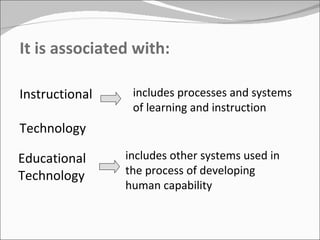
It is associated with: includes other systems used in the process of developing human capability   Educational  Technology includes processes and systems of learning and instruction Instructional  Technology
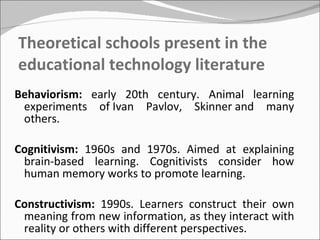
Theoretical schools present in the educational technology literature Behaviorism:  early 20th century. Animal learning experiments of Ivan Pavlov, Skinner and many others.  Cognitivism:  1960s and 1970s. Aimed at explaining brain-based learning. Cognitivists consider how human memory works to promote learning. Constructivism:  1990s. Learners construct their own meaning from new information, as they interact with reality or others with different perspectives.
Benefits Easy-to-access course materials : information is    available whenever necessary. Student motivation : instant feedback, no judgement.  Wide participation : long distance learning and access    for wider audiences. Students’ writing : the use of word processors helps to    improve students’ writing.
Easier learning : software designed and developed to    help students learn specific subjects. Better monitoring. Adaptable lessons and material.  Differentiated instruction and active participation.
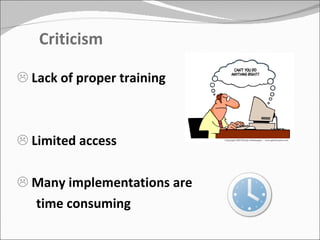
Criticism Lack of proper training Limited access Many implementations are  time consuming
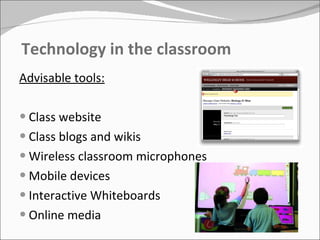
Technology in the classroom Advisable tools: Class website Class blogs and wikis Wireless classroom microphones Mobile devices Interactive Whiteboards Online media
Computers are used to support 4 goals: Teachers select media they believe will promote their instructional goals. Building student capacity for research. Making student inquiry more realistic, enabling students to present information in appealing forms. Offering students access to learning resources within and beyond the school.
A vision of 21st Century Teachers
References: Dudeney, Gavin & Hocly Nicly. (2007).  How to teach English with technology. England.  Pearson Longman. “ School technology in Education.”  Retrieved  April, 20, 2011, from: http://www.answers.com/topic/school-technology-in-education
Educational Technology . Retrieved  April, 20, 2011, from: http://en.wikipedia.org/wiki/Educational_technology A Vision of 21st Century Teachers.  Retrieved  April, 20, 2011, from: http://www.youtube.com/watch?v=B4g5M06YyVw&feature=related

Informatica

  • 1.
  • 2.
    It’s the studyand ethical practice of facilitating learning and improving performance by creating, using and managing appropriate technological processes and resources .
  • 3.
    It is associatedwith: includes other systems used in the process of developing human capability Educational Technology includes processes and systems of learning and instruction Instructional Technology
  • 4.
    Theoretical schools presentin the educational technology literature Behaviorism: early 20th century. Animal learning experiments of Ivan Pavlov, Skinner and many others.  Cognitivism: 1960s and 1970s. Aimed at explaining brain-based learning. Cognitivists consider how human memory works to promote learning. Constructivism: 1990s. Learners construct their own meaning from new information, as they interact with reality or others with different perspectives.
  • 5.
    Benefits Easy-to-access coursematerials : information is available whenever necessary. Student motivation : instant feedback, no judgement. Wide participation : long distance learning and access for wider audiences. Students’ writing : the use of word processors helps to improve students’ writing.
  • 6.
    Easier learning :software designed and developed to help students learn specific subjects. Better monitoring. Adaptable lessons and material. Differentiated instruction and active participation.
  • 7.
    Criticism Lack ofproper training Limited access Many implementations are time consuming
  • 8.
    Technology in theclassroom Advisable tools: Class website Class blogs and wikis Wireless classroom microphones Mobile devices Interactive Whiteboards Online media
  • 9.
    Computers are usedto support 4 goals: Teachers select media they believe will promote their instructional goals. Building student capacity for research. Making student inquiry more realistic, enabling students to present information in appealing forms. Offering students access to learning resources within and beyond the school.
  • 10.
    A vision of21st Century Teachers
  • 11.
    References: Dudeney, Gavin& Hocly Nicly. (2007). How to teach English with technology. England. Pearson Longman. “ School technology in Education.” Retrieved April, 20, 2011, from: http://www.answers.com/topic/school-technology-in-education
  • 12.
    Educational Technology .Retrieved April, 20, 2011, from: http://en.wikipedia.org/wiki/Educational_technology A Vision of 21st Century Teachers. Retrieved April, 20, 2011, from: http://www.youtube.com/watch?v=B4g5M06YyVw&feature=related