
B1 CC 01
EDUCATIONAL
PHILOSOPHY
IN
INDIAN CONTEXT
By
M.VIJAYALAKSHMI
Assistant Professor
UNIT-I
Educational Philosophy In
Traditional and Modern
Indian Society
UNIT-I
Educational Philosophy In Traditional
and Modern Indian Society
1.4 Ancient Indian values like spirituality,
simplicity, pursuit of truth, dignity of
labour, universal tolerance and
acceptance – Eternal Values for a
Changing Society.
ANCIENT
INDIAN VALUES
Meaning
• Value is that which satisfies human desire
• Refers to the ideals in various acts of
behaviour; they refer to what we ‘ought to’
do in preference to something which we
should not do
• It is an endeavour which satisfies need
system, psychological as well as physiological
Definition
• M.T.Ramji’s –
“A value is what is desired or what is sought.
Values may be operationally conceived as
those guiding principles of life which are
conducive to one’s physical and mental
health as well as to social welfare and
adjustment and which are in tune with one’s
culture”
Concept of Values
• Axiology – study of the concept of
values
• Value is an emotive expression –
Logical positivists
• Value is a Quality of a Thing –
Realists
• Value is an essence – Idealists
Types
• Interior and Exterior Values
• Desired and Intelligent Values
• Mechanical and Natural Values
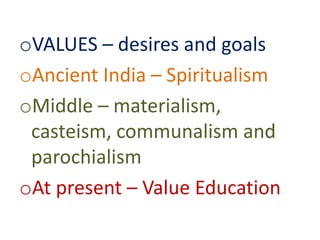
oVALUES – desires and goals
oAncient India – Spiritualism
oMiddle – materialism,
casteism, communalism and
parochialism
oAt present – Value Education
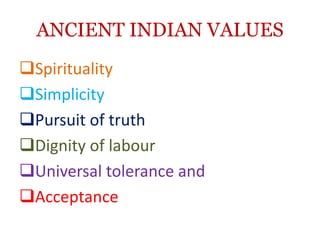
ANCIENT INDIAN VALUES
Spirituality
Simplicity
Pursuit of truth
Dignity of labour
Universal tolerance and
Acceptance
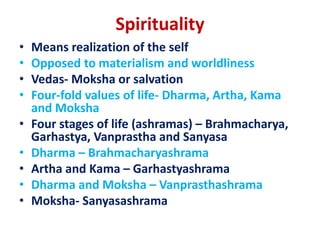
Spirituality
• Means realization of the self
• Opposed to materialism and worldliness
• Vedas- Moksha or salvation
• Four-fold values of life- Dharma, Artha, Kama
and Moksha
• Four stages of life (ashramas) – Brahmacharya,
Garhastya, Vanprastha and Sanyasa
• Dharma – Brahmacharyashrama
• Artha and Kama – Garhastyashrama
• Dharma and Moksha – Vanprasthashrama
• Moksha- Sanyasashrama
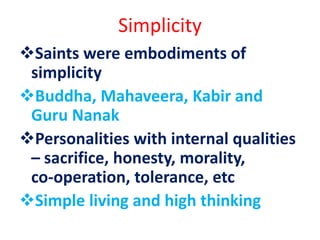
Simplicity
Saints were embodiments of
simplicity
Buddha, Mahaveera, Kabir and
Guru Nanak
Personalities with internal qualities
– sacrifice, honesty, morality,
co-operation, tolerance, etc
Simple living and high thinking
Pursuit of truth
• Chief goal of life
• Sacrificed everything for the sake of
truth
• Truth alone triumphs – main slogan of
our culture
• Gandhiji – Truth or Sathyagraha –
powerful weapon
• ‘The Story of My Experiments with
Truth’ – illustrate the power of truth
Dignity of Labour
• Great saints – Saint Kabir, Saint
Namdev, Guru Ravi Dass and Guru
Nanak
• Devotion towards their work
• Gandhiji – Those who do not work
with hands soon lose the music of
their life
Universal tolerance and Acceptance
 Essence of the Vedic culture
 Hinduism – most tolerant religions in the
world
 Eg: Asoka, Harsha, Kanishka and Akbar
 Harmony and Unity
 Growth of communalism, casteism and
religious fundamentalism – co-operation
among the people
Indian Philosophy - Values
 Faith in God
 Tolerance
 Spiritualism
 Non-violence
 Courtesy
 Dignity of Manual Work
 Nishkama karma
 Simple living and High thinking
 Social Service
 Brotherhood of man
Values should be imparted…
• Respect
• Professionalism
• Concern for others and also Nature
• Character Formation
• Citizenship
• Moral values
Common values for life
• Simplicity
• Pursuit of Truth
• Dignity of Labour
• Tolerance
• Broadmindedness
• Attainment of bliss – Moksha
• Welfare of mankind
• Holy life
• Purity and simple living
School Programmes for
Inculcation of Values
• Community prayer
• Health and cleanliness Programmes
• Teaching Learning Situations
• Production and craft Programmes
• Training in citizenship
• Cultural and Recreational Activities
• Social service programme
Means or Mediums
• Morning Assembly
• Compulsory Subject
• Redesigning of Curriculum
• Extension Lectures
• Declamation Contests
• Skits and Dramas
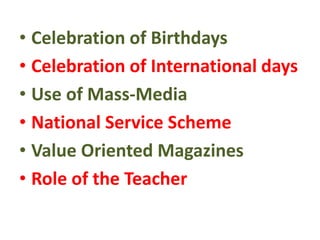
• Celebration of Birthdays
• Celebration of International days
• Use of Mass-Media
• National Service Scheme
• Value Oriented Magazines
• Role of the Teacher
THANK YOU

Educational Philosophy - Ancient Indian Values

  • 1.
    B1 CC 01 EDUCATIONAL PHILOSOPHY IN INDIANCONTEXT By M.VIJAYALAKSHMI Assistant Professor
  • 2.
  • 3.
    UNIT-I Educational Philosophy InTraditional and Modern Indian Society 1.4 Ancient Indian values like spirituality, simplicity, pursuit of truth, dignity of labour, universal tolerance and acceptance – Eternal Values for a Changing Society.
  • 4.
  • 5.
    Meaning • Value isthat which satisfies human desire • Refers to the ideals in various acts of behaviour; they refer to what we ‘ought to’ do in preference to something which we should not do • It is an endeavour which satisfies need system, psychological as well as physiological
  • 6.
    Definition • M.T.Ramji’s – “Avalue is what is desired or what is sought. Values may be operationally conceived as those guiding principles of life which are conducive to one’s physical and mental health as well as to social welfare and adjustment and which are in tune with one’s culture”
  • 7.
    Concept of Values •Axiology – study of the concept of values • Value is an emotive expression – Logical positivists • Value is a Quality of a Thing – Realists • Value is an essence – Idealists
  • 8.
    Types • Interior andExterior Values • Desired and Intelligent Values • Mechanical and Natural Values
  • 9.
    oVALUES – desiresand goals oAncient India – Spiritualism oMiddle – materialism, casteism, communalism and parochialism oAt present – Value Education
  • 10.
    ANCIENT INDIAN VALUES Spirituality Simplicity Pursuitof truth Dignity of labour Universal tolerance and Acceptance
  • 11.
    Spirituality • Means realizationof the self • Opposed to materialism and worldliness • Vedas- Moksha or salvation • Four-fold values of life- Dharma, Artha, Kama and Moksha • Four stages of life (ashramas) – Brahmacharya, Garhastya, Vanprastha and Sanyasa • Dharma – Brahmacharyashrama • Artha and Kama – Garhastyashrama • Dharma and Moksha – Vanprasthashrama • Moksha- Sanyasashrama
  • 12.
    Simplicity Saints were embodimentsof simplicity Buddha, Mahaveera, Kabir and Guru Nanak Personalities with internal qualities – sacrifice, honesty, morality, co-operation, tolerance, etc Simple living and high thinking
  • 13.
    Pursuit of truth •Chief goal of life • Sacrificed everything for the sake of truth • Truth alone triumphs – main slogan of our culture • Gandhiji – Truth or Sathyagraha – powerful weapon • ‘The Story of My Experiments with Truth’ – illustrate the power of truth
  • 14.
    Dignity of Labour •Great saints – Saint Kabir, Saint Namdev, Guru Ravi Dass and Guru Nanak • Devotion towards their work • Gandhiji – Those who do not work with hands soon lose the music of their life
  • 15.
    Universal tolerance andAcceptance  Essence of the Vedic culture  Hinduism – most tolerant religions in the world  Eg: Asoka, Harsha, Kanishka and Akbar  Harmony and Unity  Growth of communalism, casteism and religious fundamentalism – co-operation among the people
  • 16.
    Indian Philosophy -Values  Faith in God  Tolerance  Spiritualism  Non-violence  Courtesy  Dignity of Manual Work  Nishkama karma  Simple living and High thinking  Social Service  Brotherhood of man
  • 17.
    Values should beimparted… • Respect • Professionalism • Concern for others and also Nature • Character Formation • Citizenship • Moral values
  • 18.
    Common values forlife • Simplicity • Pursuit of Truth • Dignity of Labour • Tolerance • Broadmindedness • Attainment of bliss – Moksha • Welfare of mankind • Holy life • Purity and simple living
  • 19.
    School Programmes for Inculcationof Values • Community prayer • Health and cleanliness Programmes • Teaching Learning Situations • Production and craft Programmes • Training in citizenship • Cultural and Recreational Activities • Social service programme
  • 20.
    Means or Mediums •Morning Assembly • Compulsory Subject • Redesigning of Curriculum • Extension Lectures • Declamation Contests • Skits and Dramas
  • 21.
    • Celebration ofBirthdays • Celebration of International days • Use of Mass-Media • National Service Scheme • Value Oriented Magazines • Role of the Teacher
  • 22.