HINDUISM / HINDU PHILOSOPHY
RAIZA JOY MAGALONA ORCENA, MAED
HINDUISM
 Hinduism is the main religion of India which includes
the worship of many gods and the belief that after you die,
you return to life in a different form.
 It is a collective term applied to the many philosophical and
religious traditions native to India.
 It has neither a specific moment of origin nor a specific founder.
Rather, the tradition understands itself to be timeless, having always existed.
SAMARA AND KARMA
 The Hindu worldview is grounded in the doctrines of
samsara (the cyle of rebirth) and karma
(the universal law of cause and effect), and fundamentally
holds that one’s actions (including one’s thoughts)
directly determine one’s life, both one’s current life and one’s future life.
TRIMURTI (TRINITY)
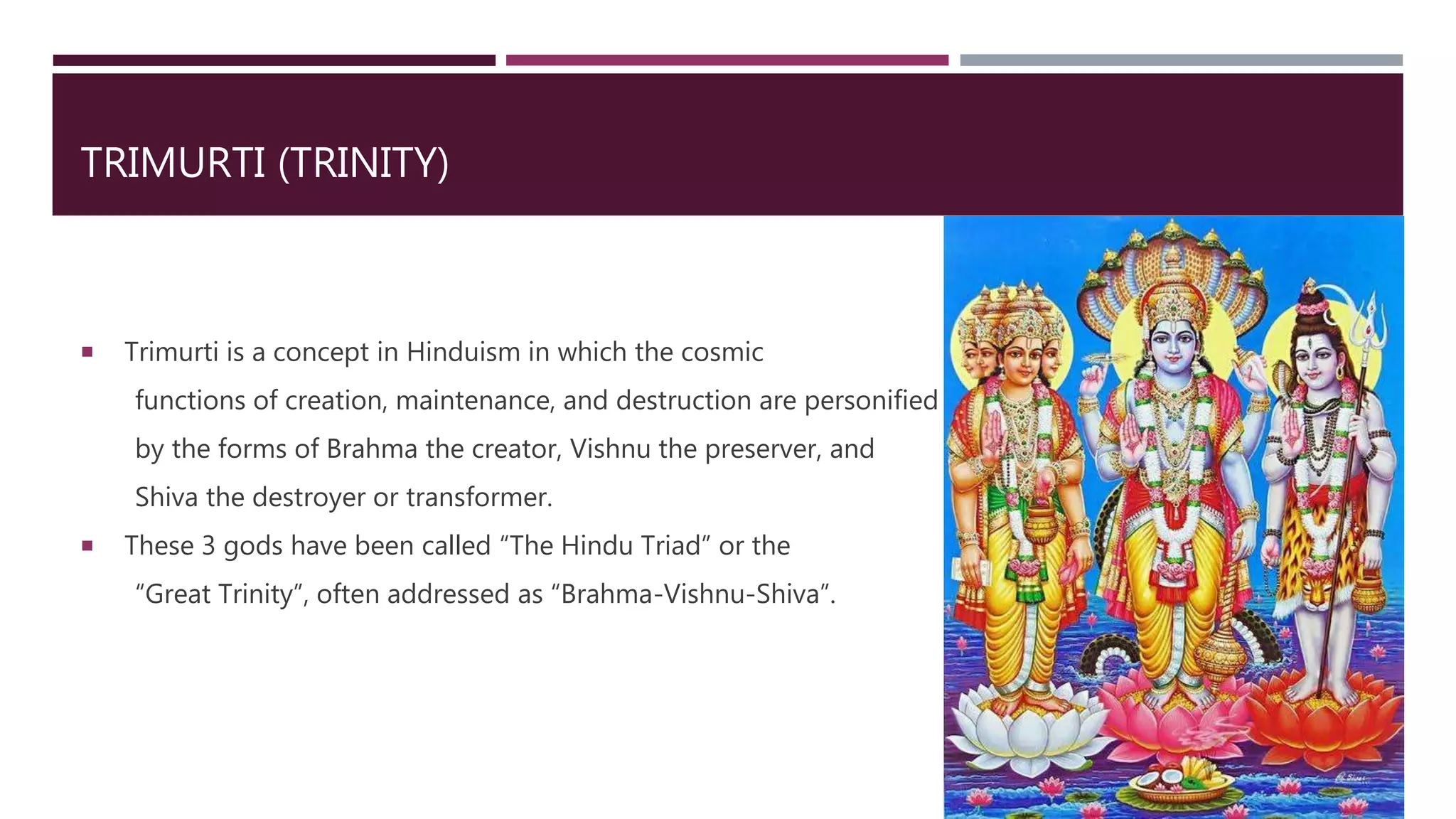
 Trimurti is a concept in Hinduism in which the cosmic
functions of creation, maintenance, and destruction are personified
by the forms of Brahma the creator, Vishnu the preserver, and
Shiva the destroyer or transformer.
 These 3 gods have been called “The Hindu Triad” or the
“Great Trinity”, often addressed as “Brahma-Vishnu-Shiva”.
SANATANA DHARMA
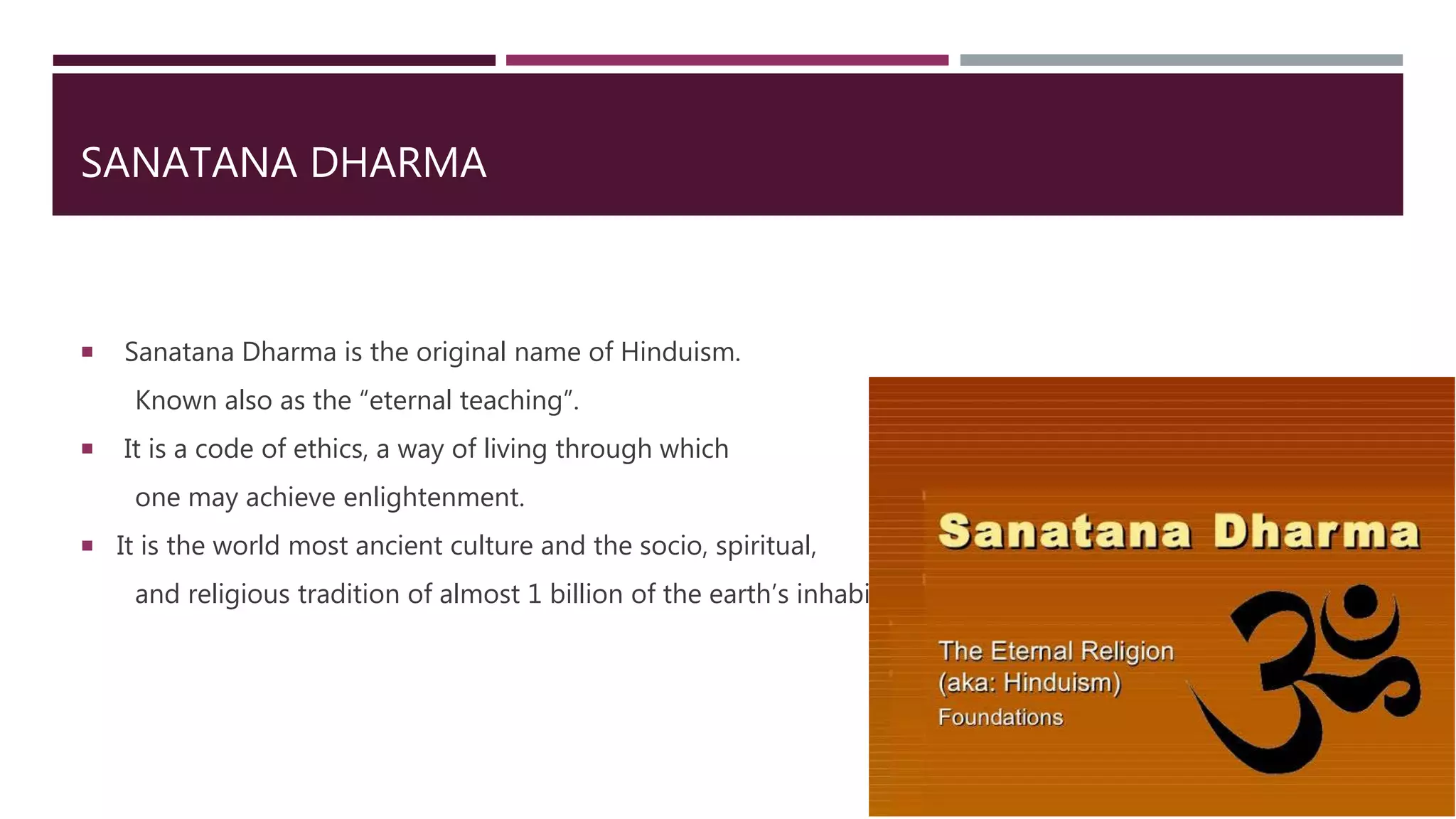
 Sanatana Dharma is the original name of Hinduism.
Known also as the “eternal teaching”.
 It is a code of ethics, a way of living through which
one may achieve enlightenment.
 It is the world most ancient culture and the socio, spiritual,
and religious tradition of almost 1 billion of the earth’s inhabitants.
3 GOLDEN RULE
1. Who is helping you, do not forget them.
2. Who is loving you, do not hate them.
3. Who is trusting you, do not cheat them.
WAYS OF LIFE AS MEMBER OF HINDUISM
 God-centered rather than prophet-centered.
 Experience based rather than belief-based.
 Beyond any historical date of founding.
 The process of growth, which comes from the seed.
 Inherent in, and inclusive of all.
HINDU EDUCATIONAL SYSTEM - HISTORY
 In ancient India, the child follow the occupation of his father.
UNIQUENESS OF ANCIENT INDIAN EDUCATION:
 The State and the society did not in any way interfered with the curriculum of studies or regulating the
payment of fees or hours of instructions.
UNIQUENESS OF ANCIENT INDIAN EDUCATION:
 The education was fully and compulsorily residential. The student had to live in the house of his teacher
for the whole duration of his studies and learn from him not only what was taught but also observed
how his teacher responded to different situation arising in daily life and learn from it.
UNIQUENESS OF ANCIENT INDIAN EDUCATION:
 Stress was laid on having a personal relation between the teacher and the taught. Each student used to
meet the teacher separately and learn from him through separate instruction and guidance.
UNIQUENESS OF ANCIENT INDIAN EDUCATION:
 Education was absolutely free and the teacher looked after the primary needs of the students including
food and clothing.
UNIQUENESS OF ANCIENT INDIAN EDUCATION:
 Upheld the dignity of labor. Hence, even a student aiming the highest philosophical knowledge, was
duty bound to do some manual labor such as collecting fuel, tending cattle, etc.
UNIQUENESS OF ANCIENT INDIAN EDUCATION:
 Education in ancient India was more of seminar type where students used to learn through discussions
and debates.
AIMS OF EDUCATION
 The aims of education were to provide good training to young men and women in the performance of
their social, economic, and religious duties. Also preservation and enrichment of culture, character, and
personality development and cultivation of noble ideas.
COMMENCEMENT OF EDUCATION – 5 YEARS OLD
 In the Vedic system, education of a child commenced with the ceremony called VIDYARAMBHA.
 It was marked by learning the alphabets for the first time and offering worship to Goddess
SARASWATHI.
 SARASWATHI is the Hindu Goddess of knowledge, music, arts, wisdom and learning.
COMMENCEMENT OF EDUCATION – 8 YEARS OLD
 In the Vedic system, education of a child commenced with the ceremony called UPANAYANA.
 A child must leave his / her parents’ home and stay in the house of his teacher to commence his study.
He is then called, BRAHMACHARIN.
 UPANAYANA ceremony was conducted by BRAHMIN.
 BRAHMIN is a specialized priest, teacher, and protectors of sacred learning across generations.
 Indian texts suggested that Brahmins were often agriculturists and warriors in ancient and medieval
India.
COMMENCEMENT OF EDUCATION – 10 YEARS OLD
 In the Vedic system, education of a child commenced with the ceremony called KSHATRIYA.
 To protect society by fighting wartime and governing in peacetime.
COMMENCEMENT OF EDUCATION – 10 YEARS OLD
 In the Vedic system, education of a child commenced with the ceremony called VAISHYA.
 Vaishyas are landowners, traders and money-lenders.
EDUCATION OF WOMEN IN VEDIC SYSTEM
 Women were trained with the art of housekeeping, music and dancing.
CLASSES OF EDUCATED WOMEN
 SADYODWAHAS – a woman who prosecuted studies till their marriages.
 BRAMHAVADINIS – a woman who did not marry and pursued their studies throughout their lives.
COMMENCEMENT OF EDUCATION – BUDDHIST SYSTEM
 In the Buddhist system of education, a child commenced his education at the age of eight after an
initiation ceremony called PABBAJJA.
 After the initiation ceremony, the child left his home to live in a monastery under the guidance and
supervision of his preceptor (monk).
 The child now is called SRAMANA, which means “one who performs acts of austerity. He used to wear a
yellow robe.
VOCATIONAL EDUCATION
 weaving
 perfume manufacturing
 agriculture
 art of dance
 art of tanning leather
 boat manufacturing
 building houses
 chariots
 the art of training elephants and horses
 Art of making jewelry
 sculpture
 medical science
 veterinary science
 Dyeing
 chemist
METHODS OF LEARNING
 memorization
 critical analysis
 seminar
 introspection
 story telling
 question and answer
 hands-on
TYPES OF TEACHERS
1. ACHARYA – a type of teacher who taught his pupils without charging fee.
2. UPADHYAYA – adopted teaching as a profession to earn his livelihood.
3. CHARAKAS – known as wandering scholars; toured the country in quest of higher knowledge.
4. GURU – earned his livelihood after imparting education to his disciples and maintain his family.
5. SIKSHAKA – gave instruction in arts like dancing
REFERENCES
 Hindu Philosophy by Angel Dixcee – slideshare.com


Hinduism

  • 1.
    HINDUISM / HINDUPHILOSOPHY RAIZA JOY MAGALONA ORCENA, MAED
  • 2.
    HINDUISM  Hinduism isthe main religion of India which includes the worship of many gods and the belief that after you die, you return to life in a different form.  It is a collective term applied to the many philosophical and religious traditions native to India.  It has neither a specific moment of origin nor a specific founder. Rather, the tradition understands itself to be timeless, having always existed.
  • 3.
    SAMARA AND KARMA The Hindu worldview is grounded in the doctrines of samsara (the cyle of rebirth) and karma (the universal law of cause and effect), and fundamentally holds that one’s actions (including one’s thoughts) directly determine one’s life, both one’s current life and one’s future life.
  • 4.
    TRIMURTI (TRINITY)  Trimurtiis a concept in Hinduism in which the cosmic functions of creation, maintenance, and destruction are personified by the forms of Brahma the creator, Vishnu the preserver, and Shiva the destroyer or transformer.  These 3 gods have been called “The Hindu Triad” or the “Great Trinity”, often addressed as “Brahma-Vishnu-Shiva”.
  • 5.
    SANATANA DHARMA  SanatanaDharma is the original name of Hinduism. Known also as the “eternal teaching”.  It is a code of ethics, a way of living through which one may achieve enlightenment.  It is the world most ancient culture and the socio, spiritual, and religious tradition of almost 1 billion of the earth’s inhabitants.
  • 6.
    3 GOLDEN RULE 1.Who is helping you, do not forget them. 2. Who is loving you, do not hate them. 3. Who is trusting you, do not cheat them.
  • 7.
    WAYS OF LIFEAS MEMBER OF HINDUISM  God-centered rather than prophet-centered.  Experience based rather than belief-based.  Beyond any historical date of founding.  The process of growth, which comes from the seed.  Inherent in, and inclusive of all.
  • 8.
    HINDU EDUCATIONAL SYSTEM- HISTORY  In ancient India, the child follow the occupation of his father.
  • 9.
    UNIQUENESS OF ANCIENTINDIAN EDUCATION:  The State and the society did not in any way interfered with the curriculum of studies or regulating the payment of fees or hours of instructions.
  • 10.
    UNIQUENESS OF ANCIENTINDIAN EDUCATION:  The education was fully and compulsorily residential. The student had to live in the house of his teacher for the whole duration of his studies and learn from him not only what was taught but also observed how his teacher responded to different situation arising in daily life and learn from it.
  • 11.
    UNIQUENESS OF ANCIENTINDIAN EDUCATION:  Stress was laid on having a personal relation between the teacher and the taught. Each student used to meet the teacher separately and learn from him through separate instruction and guidance.
  • 12.
    UNIQUENESS OF ANCIENTINDIAN EDUCATION:  Education was absolutely free and the teacher looked after the primary needs of the students including food and clothing.
  • 13.
    UNIQUENESS OF ANCIENTINDIAN EDUCATION:  Upheld the dignity of labor. Hence, even a student aiming the highest philosophical knowledge, was duty bound to do some manual labor such as collecting fuel, tending cattle, etc.
  • 14.
    UNIQUENESS OF ANCIENTINDIAN EDUCATION:  Education in ancient India was more of seminar type where students used to learn through discussions and debates.
  • 15.
    AIMS OF EDUCATION The aims of education were to provide good training to young men and women in the performance of their social, economic, and religious duties. Also preservation and enrichment of culture, character, and personality development and cultivation of noble ideas.
  • 16.
    COMMENCEMENT OF EDUCATION– 5 YEARS OLD  In the Vedic system, education of a child commenced with the ceremony called VIDYARAMBHA.  It was marked by learning the alphabets for the first time and offering worship to Goddess SARASWATHI.  SARASWATHI is the Hindu Goddess of knowledge, music, arts, wisdom and learning.
  • 17.
    COMMENCEMENT OF EDUCATION– 8 YEARS OLD  In the Vedic system, education of a child commenced with the ceremony called UPANAYANA.  A child must leave his / her parents’ home and stay in the house of his teacher to commence his study. He is then called, BRAHMACHARIN.  UPANAYANA ceremony was conducted by BRAHMIN.  BRAHMIN is a specialized priest, teacher, and protectors of sacred learning across generations.  Indian texts suggested that Brahmins were often agriculturists and warriors in ancient and medieval India.
  • 18.
    COMMENCEMENT OF EDUCATION– 10 YEARS OLD  In the Vedic system, education of a child commenced with the ceremony called KSHATRIYA.  To protect society by fighting wartime and governing in peacetime.
  • 19.
    COMMENCEMENT OF EDUCATION– 10 YEARS OLD  In the Vedic system, education of a child commenced with the ceremony called VAISHYA.  Vaishyas are landowners, traders and money-lenders.
  • 20.
    EDUCATION OF WOMENIN VEDIC SYSTEM  Women were trained with the art of housekeeping, music and dancing.
  • 21.
    CLASSES OF EDUCATEDWOMEN  SADYODWAHAS – a woman who prosecuted studies till their marriages.  BRAMHAVADINIS – a woman who did not marry and pursued their studies throughout their lives.
  • 22.
    COMMENCEMENT OF EDUCATION– BUDDHIST SYSTEM  In the Buddhist system of education, a child commenced his education at the age of eight after an initiation ceremony called PABBAJJA.  After the initiation ceremony, the child left his home to live in a monastery under the guidance and supervision of his preceptor (monk).  The child now is called SRAMANA, which means “one who performs acts of austerity. He used to wear a yellow robe.
  • 23.
    VOCATIONAL EDUCATION  weaving perfume manufacturing  agriculture  art of dance  art of tanning leather  boat manufacturing  building houses  chariots  the art of training elephants and horses  Art of making jewelry  sculpture  medical science  veterinary science  Dyeing  chemist
  • 24.
    METHODS OF LEARNING memorization  critical analysis  seminar  introspection  story telling  question and answer  hands-on
  • 25.
    TYPES OF TEACHERS 1.ACHARYA – a type of teacher who taught his pupils without charging fee. 2. UPADHYAYA – adopted teaching as a profession to earn his livelihood. 3. CHARAKAS – known as wandering scholars; toured the country in quest of higher knowledge. 4. GURU – earned his livelihood after imparting education to his disciples and maintain his family. 5. SIKSHAKA – gave instruction in arts like dancing
  • 26.
    REFERENCES  Hindu Philosophyby Angel Dixcee – slideshare.com 